Receiving a diagnosis of a chronic medical condition or a disability regarding one's child, such as the diagnosis of an autism spectrum disorder (ASD), may contribute to parents’ mental state and well-being. Parents of children with ASD may show overwhelming feelings of pain, a deep sense of loss of their hopes and dreams regarding the expected and wished for typically developing child, and uncertainties about their child's prognosis and the future in general. These cognitive and emotional processes may impact parents in all realms related to themselves, their child, and their relationship with her/him. According to attachment theory (Bowlby, Reference Bowlby1980), parents’ internal representations of the child and of themselves as parents prior to receiving the diagnosis need to be worked through, to incorporate and integrate the postdiagnostic internal representations of the self, child, and parenthood. The concept of “coming to resolution with the diagnosis” as suggested by Pianta and Marvin (Reference Pianta and Marvin1992) is similar to the concept of “reorganization” proposed by attachment theory (Bowlby, Reference Bowlby1980).
Based on attachment theory and the Adult Attachment Interview (AAI; George, Kaplan, & Main, Reference George, Kaplan and Main1985), Pianta and Marvin (Reference Pianta and Marvin1992) developed a brief open-ended interview to examine parents’ state of mind regarding their child's diagnosis, the Reaction to Diagnosis Interview (RDI). In this interview, parents are asked to recall events and experiences associated with receiving their child's diagnosis as well as their accompanying emotions and how these may have changed since that time. Parents are classified as resolved if they have integrated the experience of the diagnosis into their representational system, allowing themselves to focus effectively on problem solving related to their child's needs in the here and now. Signs of resolution include parents’ recognition of a change in feelings since receiving the diagnosis and an assertion of moving on in life, as well as orienting to the present and future at the behavioral, emotional, and cognitive levels. Lack of resolution includes elements of disorientation and mental disorganization associated with feelings of grieving, confusion, and incoherent responses, which may indicate that the parent's mind is “elsewhere” rather than focused on the cognitive and emotional realities associated with the diagnosis. Unresolved parents tend to display cognitive biases regarding the diagnostic experience, to focus their attention on the past, and to reveal emotional signs of being overwhelmed, depressed, or angry (Marvin & Pianta, Reference Marvin and Pianta1996; Pianta, Marvin, Britner, & Borowitz, Reference Pianta, Marvin, Britner and Borowitz1996).
Several studies have utilized the RDI to assess resolution of diagnosis among parents of children with ASD and to identify contributions of additional parental as well as children's variables. In the first published study, Wachtel and Carter (Reference Wachtel and Carter2008) examined the associations between resolution of mothers of toddlers (20–50 months) with ASD and mother–child play interactions early in the diagnostic process. These authors, using an adapted coding system, found that mothers who were more emotionally resolved were more supportively engaged in observed mother–child play interactions compared to mothers who were less emotionally resolved, even after controlling for children's characteristics. Poslawsky, Naber, Van Daalen, and Van Engeland (Reference Poslawsky, Naber, Van Daalen and Van Engeland2014) also examined parental resolution (90% mothers) of young children (16–61 months) with ASD about 5 weeks after receiving diagnoses. Most of the parents (75%) were classified as resolved, and associations were found between resolution status and children's severity of symptoms and parental nationality. In previous publications from our group (Oppenheim, Koren-Karie, Dolev, & Yirmiya, Reference Oppenheim, Koren-Karie, Dolev and Yirmiya2009, Reference Oppenheim, Koren-Karie, Dolev and Yirmiya2012), the associations between maternal resolution and maternal insightfulness into the experience of the child, and children's security of attachment were examined in a sample of mothers and their preschool boys with ASD. Findings indicated that children's attachment security was associated with maternal resolution and insightfulness. Maternal sensitivity, as measured by observed mother–child interaction, was found to mediate the association between maternal insightfulness and resolution, on the one hand, and child attachment, on the other. Moreover, children's severity of symptoms and level of functioning were not linked to maternal resolution nor insightfulness, suggesting that, although children with ASD introduce profound challenges into their relationships with their caregivers (e.g., difficulties communicating their thoughts and needs), maternal resolution and insightfulness are possible. The aforementioned study was conducted with mothers of young boys (32–69 months) and with relatively recent diagnoses. Therefore, in our next study (Milshtein, Yirmiya, Oppenheim, Koren-Karie, & Levi, Reference Milshtein, Yirmiya, Oppenheim, Koren-Karie and Levi2010), we aimed to study resolution among mothers and fathers of boys and girls with a wide age range (2–17 years). Our initial results indicated that nearly half of the parents were classified as resolved. Nonetheless, maternal but not paternal resolution status was associated with parental report of the negative impact of raising a child with a disability on family life. In the current study, we revisited the families who participated in the original sample 3 years later and reinterviewed them with the RDI in order to examine the stability and/or change of resolution status among mothers and fathers of children with ASD.
Few researchers have addressed the issue of stability/change in resolution status. Barnett et al. (Reference Barnett, Clements, Kaplan-Estrin, McCaskill, Hunt and Butler2006) and Rentinck et al. (Reference Rentinck, Ketelaar, Schuengel, Stolk, Lindeman and Jongmans2010) reported that resolution status remained relatively stable among parents of children with neurological disorders (e.g., cerebral palsy) over a period of 12 to 16 month. Poslawsky et al. (Reference Poslawsky, Naber, Van Daalen and Van Engeland2014) also reported that parental resolution was stable from 5 weeks to 30 weeks after receiving the diagnosis in their subsample of 35 parents of children with ASD. However, the stability/change of resolution status among mothers and especially among fathers of children with ASD has not yet been investigated longitudinally over a considerable period of time after receiving the diagnosis. Moreover, in the aforementioned studies (Oppenheim et al., Reference Oppenheim, Koren-Karie, Dolev and Yirmiya2009, Reference Oppenheim, Koren-Karie, Dolev and Yirmiya2012; Poslawsky et al., Reference Poslawsky, Naber, Van Daalen and Van Engeland2014; Wachtel & Carter, Reference Wachtel and Carter2008) parental resolution was examined among parents of toddlers diagnosed with ASD shortly after receiving the diagnoses, and the aspect of time was examined only in a cross-sectional design. Therefore, one of the major aims of the current study was to examine stability/change in parental resolution among mothers and fathers of children with a wide age range using data from baseline (Time 1) and from 3-year follow-up (Time 2) assessments.
Resolution and Children's Characteristics
In their initial studies of parents of children with cerebral palsy and epilepsy, Pianta and Marvin reported that children's characteristics and duration of time since receiving the diagnosis were not associated with parental resolution (Marvin & Pianta, Reference Marvin and Pianta1996; Pianta et al., Reference Pianta, Marvin, Britner and Borowitz1996; Sheeran, Marvin, & Pianta, Reference Sheeran, Marvin and Pianta1997), suggesting that resolution or lack of resolution has more to do with parental internal working models than with characteristics of the disorder. Findings from subsequent RDI studies are inconsistent regarding the association between children's characteristics and parental resolution (Barnett et al., Reference Barnett, Clements, Kaplan-Estrin, McCaskill, Hunt and Butler2006; Kearney, Britner, Farrell, & Robinson, Reference Kearney, Britner, Farrell and Robinson2011; Lord, Ungerer, & Wastell, Reference Lord, Ungerer and Wastell2008) with some researchers actually arguing that the severity and type of the disorder are associated with parental resolution (Schuengel et al., Reference Schuengel, Rentinck, Stolk, Voorman, Loots and Ketelaar2009). Conflicting results were also found in RDI studies of children diagnosed with ASD (Milshtein et al., Reference Milshtein, Yirmiya, Oppenheim, Koren-Karie and Levi2010; Oppenheim et al., Reference Oppenheim, Koren-Karie, Dolev and Yirmiya2009, Reference Oppenheim, Koren-Karie, Dolev and Yirmiya2012; Poslawsky et al., Reference Poslawsky, Naber, Van Daalen and Van Engeland2014; Wachtel & Carter, Reference Wachtel and Carter2008). For example, Poslawsky et al. (Reference Poslawsky, Naber, Van Daalen and Van Engeland2014) found no association between parental resolution and the vast majority of children's characteristics that were examined (e.g., age, gender, challenging behaviors, developmental level, language age equivalents, and time since diagnosis). However, higher rates of unresolved classifications were found in parents of children with higher levels of autistic symptoms. In the current study, the associations between children's characteristics and parental resolution were also examined with a focus on the changes that occurred in children's condition over a period of 3 years. More specifically, change scores were computed using data from baseline (Time 1) and from follow-up (Time 2) assessments to achieve a more in-depth understanding of the associations between children's characteristics and maternal and paternal resolution.
Attachment Representations in Parents of Children With Autism
The few studies to date that specifically investigated adult attachment styles and representations among parents of children with ASD demonstrated patterns similar to those documented in the general population of parents. Using the AAI (George et al., Reference George, Kaplan and Main1985), Seskin et al. (Reference Seskin, Feliciano, Tippy, Yedloutschnig, Sossin and Yasik2010) found that 65% of the parents of 4- to 16-year-old children with ASD were classified as secure; 17.5% were classified as insecure–dismissing; 15% were classified as insecure–preoccupied; and 25% were designated as unresolved. These researchers reported that their sample's distribution did not differ significantly from the normative AAI distribution according to Bakermans-Kranenburg and van IJzendoorn (Reference Bakermans-Kranenburg and van IJzendoorn2009). Similarly, Lau and Peterson (Reference Lau and Peterson2011) and Karabekiroglu and Rodopman-Arman (Reference Karabekiroğlu and Arman2011) did not find elevated rates of insecurity among parents of children with ASD using self-report measures of attachment style. Seskin et al. (Reference Seskin, Feliciano, Tippy, Yedloutschnig, Sossin and Yasik2010) also examined the associations between adult attachment representations and parent–child dyadic behaviors among parents and their children with ASD. They found that children with ASD whose parents were classified as secure–autonomous on the AAI were more engaged in social interactions and more often initiated communication with their parents by using communicative gestures, symbolic play, and turn-taking vocalizations, compared to children of parents who were classified as insecure on the AAI.
In their meta-analytic study, Bakermans-Kranenburg and van IJzendoorn (Reference Bakermans-Kranenburg and van IJzendoorn2009) reviewed studies in which AAI classifications were examined among different groups of adults, including parents of children with physical or behavioral problems. They reported significantly more insecure and unresolved patterns of working attachment models among parents in the clinical groups than in the nonclinical groups. Thus, parent's unresolved state of mind regarding their diagnosed child may be associated with insecure parental representations. Alternatively, some of the children's socioemotional and behavioral difficulties might also contribute to parents’ insecure models of attachment that may have been different prior to the birth of the child with the clinical diagnosis. Therefore, in the current study we examined if and how parental attachment anxiety and avoidance scores as measured by the Experiences in Close Relationships Scale (Brennan, Clark, & Shaver, Reference Brennan, Clark, Shaver, Simpson and Rholes1998) are associated with resolution while taking into account the possible contribution of children's characteristics.
Stress Among Parents of Children With ASD
Parents of children with ASD experience elevated levels of stress compared to parents of children with other disabilities and those of typically developing children (Estes et al., Reference Estes, Munson, Dawson, Koehler, Zhou and Abbott2009; Montes & Halterman, Reference Montes and Halterman2007; Phetrasuwan & Miles, Reference Phetrasuwan and Miles2009; Pisula, Reference Pisula2007; Sanders & Morgan, Reference Sanders and Morgan1997; Silva & Schalock, Reference Silva and Schalock2012; Smith, Oliver, & Innocenti, Reference Smith, Oliver and Innocenti2001). Estes et al. (Reference Estes, Munson, Dawson, Koehler, Zhou and Abbott2009) found that problem behaviors in children with ASD were associated with elevated levels of parenting stress and psychological distress in mothers. Eisenhower, Baker, and Blacher (Reference Eisenhower, Baker and Blacher2005), reporting on the association between syndrome-specific patterns of behavior and maternal stress in several groups of preschool children with intellectual disabilities (e.g., undifferentiated developmental delays, Down syndrome, and ASD), found that mothers of children with ASD reported experiencing more parenting stress than mothers in all other groups. These researchers concluded that child syndrome contributed to maternal stress even after accounting for differences in behavior problems and cognitive level. Dunn, Burbine, Bowers, and Tantleff-Dunn (Reference Dunn, Burbine, Bowers and Tantleff-Dunn2001) examined the associations among parental stress, coping style, and negative outcomes among parents of children with ASD. They found that parents with escape–avoidance and distancing coping styles reported more negative outcomes, such as depression, social isolation, and marital problems. Therefore, we included parental stress levels in our examination of the contribution of children and parental characteristics to resolution status among mothers and fathers of children diagnosed with ASD.
Study Aims
In summary, researchers from the fields of ASD and attachment are focusing more and more on the influence of children on parents’ states of mind and well-being, and evidence is now starting to accumulate regarding the associations and transactions among parents’ mental states and inner processes (e.g., parental stress, attachment, resolution of diagnosis, insightfulness, and parental interaction style) and the development and well-being of their children with ASD (e.g., secure attachment and engagement in play interactions). Being in a resolved state of mind regarding one's child's diagnosis has important implications for parents themselves on an individual level, as well as on the caregiving system, the quality of parenting and the parent–child relationship, and even the broader level of family functioning and social ecology. Yet, most of studies have included only mothers, and there is a paucity of research on fathers. Thus, the aims of this study were to examine both mothers and fathers of children (girls and boys) with ASD and to assess the contribution of important parental variables such as attachment style and stress as well as child variables pertaining to symptomatology to resolution.
In the current study, we revisited a group of parents of children with ASD (Milshtein et al., Reference Milshtein, Yirmiya, Oppenheim, Koren-Karie and Levi2010) to reassess resolution, thereby examining the stability/change of these patterns over a period of 3 years. To the best of our knowledge, stability or change in resolution status has not yet been examined among parents (mothers and fathers) of children with ASD (girls and boys) over a time period of more than a few months (Poslawsky et al., Reference Poslawsky, Naber, Van Daalen and Van Engeland2014), and this was another major aim of the current study. The examination of these indices over a period of 3 years enabled us to explore potential parent and child predictors of parental resolution with special attention to the contribution of change in parents and children's characteristics to the stability/change of parental resolution.
Method
Participants
We revisited 39 of the initial 61 families with a child diagnosed with ASD (17 girls/22 boys) who participated at Time 1 of our study (Milshtein et al., Reference Milshtein, Yirmiya, Oppenheim, Koren-Karie and Levi2010). These 39 mother–father pairs (n = 78 parents in total) comprised 64% of the original sample. Attrition occurred due to situations such as parents’ divorce (n = 2; 1 child with ASD also moved out to a residential home), parent's death due to illness (n = 1); incomplete set of research questionnaires (n = 2); and declining to continue participation (n = 17). To investigate possible selection biases, we examined possible differences in parent and child characteristics between the group of families who continued to participate (n = 39) and the group of families who did not continue (n = 22). No significant differences emerged between the two groups for any of the following parent or child characteristics at Time 1: child's sex, parents’/child's age, parents’ IQ, child's mental age, family's socioeconomic level, child's Vineland Adaptive Behavior Scales—Second Edition (Vineland-II; Sparrow, Cicchetti, & Balla, Reference Sparrow, Cicchetti and Balla2005) score of adaptive behavior, child's severity of autistic symptoms, time since receiving the diagnosis, and resolution classification.
Families were initially recruited at Time 1 through letters sent to special education schools and published in newsletters and websites of parent organizations for families of children with ASD in Israel. Initial exclusion criteria at Time 1 included medical conditions associated with ASD such as fragile X and tuberous sclerosis in the child with ASD, or if the parent had a medical condition or a disability such as a hearing or visual impairment (other than prescription glasses). Inclusion criteria for this follow-up study at Time 2 included parents’ consent to reparticipate; intact families (biological parents still married, living in the same household); child with ASD living with both parents; and at least 3 years since participation at Time 1.
To reassess child diagnosis at Time 2, we administered the Autism Diagnostic Observation Schedule (ADOS; Lord, Rutter, DiLavore, & Risi, Reference Lord, Rutter, DiLavore and Risi2002), the Vineland-II (Sparrow et al., Reference Sparrow, Cicchetti and Balla2005), and a standardized developmental/IQ test. Parents of all children were administered the Autism Diagnostic Interview—Revised (Rutter, LeCouteur, & Lord, Reference Rutter, LeCouteur and Lord2003) at Time 1. The reassessment procedure of child diagnosis revealed no change in children's diagnoses.
Measures
Instruments administered to parents
Parents completed two self-report questionnaires (attachment and stress), were interviewed regarding their resolution status, and provided demographic information.
RDI
This semistructured interview (Pianta & Marvin, Reference Pianta and Marvin1992), requiring approximately 10–15 min to administer, consisted of a series of questions eliciting parents’ beliefs, memories, and emotional reactions to receiving the diagnosis of ASD for their child. Each videotaped interview was transcribed and then viewed for coding purposes. The RDI coding system enabled coding of the extent to which parents had or had not achieved resolution with the diagnosis, which were classified as “resolved” or “unresolved,” respectively. These classifications were further divided into subcategories describing the main strategy demonstrated by the parent in attaining the resolved or unresolved state. Resolved status was coded for three strategy subcategories: feeling oriented, action oriented, and thinking oriented. Unresolved status was coded for six strategy subcategories: emotionally overwhelmed, angrily preoccupied, neutralizing, depressed/passive, cognitive distortions, and disorganized/confused. Because of the relatively small number of cases within each subcategory, we analyzed the data using the resolved and unresolved categories only. More information about the various subcategories can be found in Pianta and Marvin (Reference Pianta and Marvin1992) and in Pianta et al. (Reference Marvin and Pianta1996). Three trained coders achieved satisfactory reliability on the subcategories of the RDI for 39 videotapes/transcripts of both mothers and fathers (50%) with κ coefficients among the three coders of 0.64–0.75 (ps < .001).
Experiences in Close Relationships Scale
This 36-item self-report of adult attachment (Brennan et al., Reference Brennan, Clark, Shaver, Simpson and Rholes1998) comprised two 18-item subscales: attachment-related anxiety and attachment-related avoidance. Participants rated the extent to which each item best described their feelings about close relationships, on a 7-point Likert scale ranging from 1 (strongly disagree) to 7 (strongly agree). Higher scores reflect greater levels of avoidance (discomfort with closeness and interdependence) and/or anxiety (fear about partners’ lack of availability and responsiveness) and therefore a more insecure attachment representation. Both the anxiety and avoidance scales have high internal consistency and adequate validity (Wei, Russell, Mallinckrodt, & Vogel, Reference Wei, Russell, Mallinckrodt and Vogel2007).
Parenting Stress Index
This 120-item self-report questionnaire for parents (Abidin, Reference Abidin1990) comprised two domains reflecting major areas of stress in the parent–child relationship: the child domain and the parent domain and an additional optional life stress scale that was not used in the current study. The 47-item child domain assesses stressors that parents might experience arising from the manner in which they perceived their child and that child's demands on them (e.g., “My child rarely does things that make me feel good”). The 54-item parent domain assesses parental distress associated with parents’ perception of childrearing competence, conflict with the spouse/partner, and social support. Participants rated their degree of agreement with each item on a 5-point Likert-type scale ranging from 1 (strongly disagree) to 5 (strongly agree). The child and parent domains were summed to obtain the total parenting stress score.
Demographic information
Information regarding child age, family income, and parents’ age, employment status, and education were collected again and examined in the data analysis stage. An adaptation of Hollingshead's (Reference Hollingshead1975) Four-Factor Index was used to assess families’ socioeconomic status. Two families did not complete the demographic questionnaire at Time 2; thus, 22 families (60%) were classified as average in their socioeconomic status and 15 families (40%) were classified as high average. No significant change emerged between the two assessment points in families’ socioeconomic status.
Instruments assessing child diagnosis and characteristics
To reassess each child's diagnosis at Time 2, we administered the ADOS, a standardized developmental/IQ test, and we interviewed parents using the Vineland-II.
ADOS
This semistructured, standardized observational assessment (Lord et al., Reference Lord, Rutter, DiLavore and Risi2002), one of the gold standard diagnostic systems for ASD, was designed to assess behaviors related to ASD. At Time 2, children were assessed using Module 1 (n = 10), Module 2 (n = 9), Module 3 (n = 19), or Module 4 (n = 1). Calibrated severity scores ranging between 1 and 10 were calculated according to participants’ algorithm scores and chronological ages (Gotham, Pickles, & Lord, Reference Gotham, Pickles and Lord2009; Gotham, Risi, Pickles, & Lord, Reference Gotham, Risi, Pickles and Lord2007). The ADOS was administered by three ADOS-certified graduate students.
Vineland-II
This structured interview, used to assess daily living skills as reported by caregivers (Sparrow et al., Reference Sparrow, Cicchetti and Balla2005), assesses four domains of functioning: communication, daily living skills, socialization, and motor skills (the latter domain is administered only for children under the age of 6 years). Scaled scores (M = 100 points, SD = 15 points) were calculated for each domain, as well as for a total adaptive behavior composite score.
Developmental/IQ test
Cognitive assessments were administered according to the child's chronological age and level of functioning. Younger children or children with lower abilities (n = 8) were administered the Mullen Scales of Early Learning (Mullen, Reference Mullen1997). The Kaufman Assessment Battery for Children (Kaufman & Kaufman, Reference Kaufman and Kaufman1996) was administered to 24 children who were between age 3 years and 12 years and 11 months, and passed the threshold for administration, or to older children whose cognitive abilities were not sufficiently high for the Wechsler Intelligence Scale for Children (Wechsler, Reference Wechsler1995). The Wechsler Intelligence Scale for Children was administered to 4 children between the ages of 12 and 14 years, and the Wechsler Adult Intelligence Scales (Wechsler, Reference Wechsler2001) was administered to 3 adolescents above age 16 years.
Procedure
Families were recontacted 3 years after their participation at Time 1 via letters informing them about the study and asking for their consent. In the first session, parents were given information about the study and signed a consent form if willing to participate in the study. Afterward, each parent was interviewed with the RDI separately, and the Vineland-II was administered to one or both parents, according to parents’ choice. Parents also completed the Experiences in Close Relationships Scale, the Parenting Stress Index, and the demographic questionnaire. During the second session, the ADOS was administered. During the third session, the intelligence/developmental test was administered. All sessions were videotaped. A few weeks following the end of the sessions, parents received a comprehensive clinical report summarizing their child's performance on the standardized assessments.
Analytic plan
In the current study we examined rates, stability, and change in parental characteristics (resolution status, attachment styles, and stress) among mothers and fathers of children with ASD. Fisher exact tests were conducted to examine possible differences between mothers and fathers at Times 1 and 2. To evaluate stability and change in parental resolution, we preformed both κ statistics and McNemar tests, respectively. A two-way analysis of variance (ANOVA) with repeated measures was conducted for each of the attachment styles and stress scores to assess change over time, as well as differences between mothers and fathers and possible interaction effects of parental sex and time. Next, intraclass correlation coefficients were used to evaluate stability over time in parent attachment styles and stress. Thus, the combination of change and stability tests enabled us to conduct a more complete examination of the dynamic processes that occurred over time. For children's characteristics (i.e., chronological age, mental age, Vineland-II score, severity of symptoms, and time since receiving the diagnosis) we also preformed two-way ANOVAs with repeated measures to assess change over time, as well as differences between boys and girls and possible interaction effects of child sex and time.
In the current study we also sought to examine how change over time in parental and children's characteristics uniquely or mutually contribute to parental resolution. Thus, two sets of analyses aiming to identify predictors of parental resolution were conducted separately for mothers and fathers. The first set of analyses used logistic regression to identify variables representing change in children's characteristics (i.e., mental age and symptom severity) and change in parents’ characteristics (i.e., attachment styles and stress) as well as child sex and duration of time since receiving the diagnoses, which predict parent resolution (resolved vs. unresolved) at Time 2. The second set of analyses evaluated which of the aforementioned variables are the best predictors for the various subgroups of parents who remained stable or changed in their resolution status over time. Thus, multinominal regression analyses were conducted to evaluate predictors of parents who were resolved at both Times 1 and 2 (R-R), parents who were unresolved at Time 1 and changed to resolved at Time 2 (U-R), using the subgroup of parents who were unresolved at both Times 1 and 2 (U-U) as a reference group. These two set of analyses reflect our main aim of examining patterns of change using data from a 3-year longitudinal study. The examination of predictors of several subgroups of parents (R-R, U-R, and U-U) enabled us to differentiate and pinpoint the characteristics of the “influential child.”
Results
Parental resolution
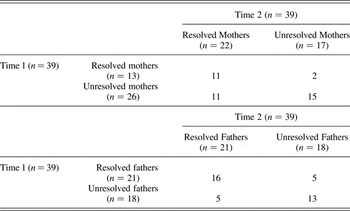
Rates of resolution status (resolved vs. unresolved) of mothers and fathers at Times 1 and 2 are presented in Table 1. At Time 1, 33.33% of the mothers (13/39) were classified as resolved as well as 53.84% of the fathers (21/39). Using the Fisher exact test, no significant association between resolution status and parent sex was found at Time 1 (p > .05). At Time 2, 56.41% of the mothers (22/39) were classified as resolved as well as 53.84% of the fathers (21/39). The Fisher exact test once more revealed no significant association between resolution status and parent sex (p > .05). Thus, no significant differences were found between the number of mothers and fathers who were identified as resolved or as unresolved at each assessment time.
Rates and stability for resolution status at Times 1 and 2

To explore whether parental resolution changed or remained stable between Times 1 and 2, McNemar tests and κ coefficients were calculated. For mothers, a significant change in resolution status emerged between Time 1 and 2 (McNemar test, p = .02). As seen in Table 1, the change in mothers’ resolution status was accounted for by the change from unresolved status at Time 1 to resolved status at Time 2. Almost half of the mothers who were unresolved at Time 1 were classified as resolved at Time 2 (11 of the 26). Although a significant change was detected by the McNemar test, stability was also yielded as indicated by the significant κ coefficient (r = .36; p = .012).
For fathers, there was no change in resolution status as indicated by the McNemar test (p = 1.00) as well as stability as indicated by a significant κ coefficient (r = .48, p = .002). Thus, the numbers of resolved and unresolved fathers remained similar and unchanged between the two time points. As seen in Table 1, 5 fathers changed their status from resolved at Time 1 to unresolved at Time 2, whereas another group of 5 fathers changed in the other direction from unresolved at Time 1 to resolved at Time 2, thereby yielding no overall change in paternal rates of resolution.
Parental attachment styles and stress
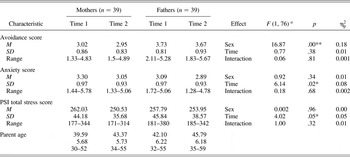
A two-way repeated measures ANOVA with parent's sex (mothers vs. fathers) as a between-subjects factor and time (Time 1 vs. Time 2) as a within-subjects factor was conducted for each parental attachment style (avoidance and anxiety) and stress level (Table 2). For the avoidance score, a significant main effect of parent's sex was found, F (1, 75) = 16.87, p = .00, ηp 2 = 0.18, indicating that the avoidance scores of fathers were significantly higher than the avoidance scores of mothers. Neither the main effect of time nor the interaction with parent's sex was significant, indicating a relative stability in parents’ attachment-related avoidance scores. For the anxiety score, a significant main effect of time was found, F (1, 75) = 6.14, p = .02, ηp 2 = 0.08, indicating a pattern of change (a reduction in anxiety scores from Time 1 to Time 2). Neither the main effect of parent's sex nor the interaction with time was significant. Regarding stress scores, a significant main effect of time was found, F (1, 76) = 4.02, p = .05, ηp 2 = 0.05, indicating a reduction in stress level from Time 1 to Time 2. Neither the main effect of parent's sex nor the interaction with time was significant.
Parental characteristics of mothers and fathers at Times 1 and 2

a Degrees of freedom for the avoidance and anxiety scores were F (1, 75) because of missing data for one of the fathers.
*p < .05. **p < .01.
To evaluate the extent to which individual differences in parental attachment style and stress remained stable over time, intraclass correlation coefficients were also performed. Results indicated stability over time for the three scores of maternal avoidance (r = .76, p = .00), maternal anxiety (r = .71, p = .00), and maternal stress (r = .78, p = .00). Similar results emerged for the fathers, indicating stability over time for the three scores of paternal avoidance (r = .78, p = .00), paternal anxiety (r = .86, p = .00), and paternal stress (r = .80, p = .00).
Sex differences (girls vs. boys) and change in children's characteristics
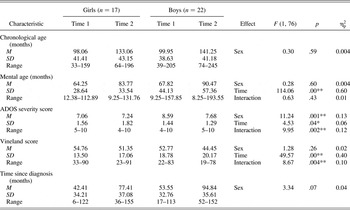
A two-way repeated measures ANOVA with child sex (girls vs. boys) as a between-subjects factor and time (Time 1 vs. Time 2) as a within-subjects factor was conducted for each of the child characteristics. As can be seen in Table 3, no significant differences emerged between boys and girls in our sample for chronological age, mental age, Vineland-II score, and the duration of time since receiving the diagnosis. However, a significant main effect of time was found for child mental age score, F (1, 76) = 114.06, p = .00, ηp 2 = 0.60, which was higher on average at Time 2 compared to Time 1, and a significant main effect of time was also found for child Vineland-II score (total adaptive behavior), F (1, 76) = 49.57, p = .00, ηp 2 = 0.40, which was lower at Time 2 compared to Time 1. Furthermore, an interaction effect was found for the Vineland-II score, F (1, 76) = 8.67, p = .004, ηp 2 = 0.10, indicating a larger decline in the Vineland-II scores of boys compared to girls. Thus, compared to their peers, children diagnosed with ASD revealed lower scores of adaptive behavior over time. Nevertheless, compared to themselves, they gained new abilities over time.
Child's characteristics

*p < .05. **p < .01.
Three main effects were found for the ADOS severity score; a significant child sex effect was found, F (1, 76) = 11.24, p = .001, ηp 2 = 0.13, indicating that overall boys had higher levels of autistic symptoms compared to girls; a significant time effect was found, F (1, 76) = 4.53, p = .04, ηp 2 = 0.06, indicating that overall children's levels of autistic symptoms decreased over time; and a significant interaction effect was found, F (1, 76) = 9.95, p = .002, ηp 2 = 0.12, indicating an opposite pattern of change for boys compared to girls. Boys in our sample revealed a significant decrease in their severity of autistic symptoms whereas girls in our sample revealed an increase in the severity of autistic symptoms.
Predicting resolution status (resolved vs. unresolved) at Time 2
Logistic regression analyses were carried out with resolution status (resolved vs. unresolved) at Time 2 as the dependent measure. In order to investigate which child and/or parental characteristics are associated with resolution status, we created change scores for the following measures: child mental age, child ADOS severity score, parental stress (Parenting Stress Index total score), avoidance, and anxiety scores (Time 2 − Time 1).
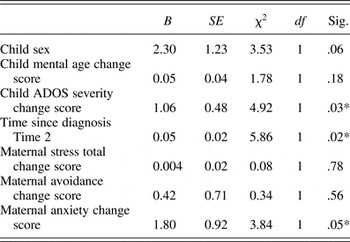
To predict maternal resolution at Time 2 (resolved vs. unresolved), a logistic regression analysis was carried out using the following predictors: child sex, mental age, and ADOS severity change scores, time since receiving the diagnosis (at Time 2), and maternal stress, avoidance, and anxiety change scores (Table 4). Results indicated that an increase in child ADOS severity and in maternal anxiety scores, as well as longer durations of time since receiving the diagnosis significantly predicted maternal resolved status at Time 2.
Mothers: Predicting resolution status at Time 2 (resolved vs. unresolved)

*p < .05.
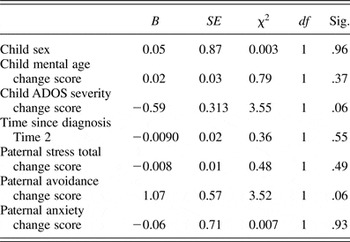
To predict paternal resolution at Time 2 (resolved vs. unresolved), the same logistic regression analysis was carried out using the same predictors. Results indicated that none of the predictors was associated with paternal resolution status at Time 2 (Table 5).
Fathers: Predicting resolution status at Time 2 (resolved vs. unresolved)

Predicting patterns of change in resolution status
Four patterns of change in resolution status were evident among the parents: parents who were resolved at both Time 1 and Time 2 (R-R), parents who were unresolved at both Time 1 and Time 2 (U-U), parents who were classified as unresolved at Time 1 yet resolved at Time 2 (U-R), and parents who were classified as resolved at Time 1 and as unresolved at Time 2 (R-U). In order to investigate which child and/or parental characteristics predicted which pattern of change in resolution status, multinominal regression analyses were conducted separately for mothers (Table 6) and fathers (Table 7).
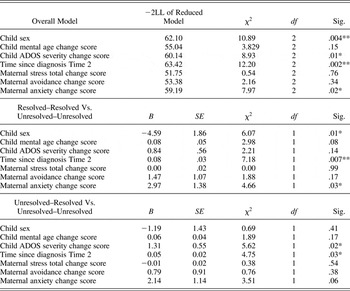
Mothers: Predicting change in resolution status (three groups: resolved–resolved, unresolved–resolved, unresolved–unresolved)

Note: −2LL, −2 Log likelihood.
*p < .05. **p < .01.
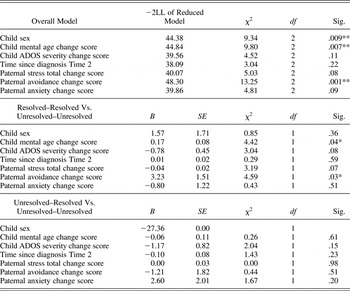
Fathers: Predicting change in resolution status (three groups: resolved–resolved, unresolved–resolved, unresolved–unresolved)

Note: −2LL, −2 Log likelihood.
*p < .05. **p < .01.
For mothers, we only used three patterns of change: R-R (n = 11; 28.20%), U-U (n = 15; 38.46%), and U-R (n = 11; 28.20%) because only 2 mothers (5.13%) were classified as R-U (Table 1). Thus, the multinominal regression analysis was carried out to predict patterns of change in maternal resolution, using the following predictors: child sex, mental age, and ADOS severity change scores, time since receiving the diagnosis, and maternal stress, avoidance, and anxiety change scores using the U-U as the reference group. In the first comparison between R-R mothers and U-U mothers, child sex, time since receiving the diagnosis, and the maternal anxiety change score emerged as significant predictors (Table 6). That is, R-R mothers were more likely to have girls, to have a longer duration of time since receiving the diagnosis, and to reveal an increase in their attachment-related anxiety score compared to U-U mothers. In the second comparison between U-R mothers and U-U mothers, ADOS severity change score and time since receiving the diagnosis emerged as significant predictors. That is, U-R mothers were more likely to have children who experienced an increase in their severity of symptoms as well as a longer duration of time since receiving the diagnosis compared to U-U mothers. Comparing the R-R, U-U, and U-R groups in terms of the number of children whose symptoms improved, remained unchanged, or became more severe in relation to resolution status revealed no differences between the R-R and U-U in the percentages of children whose symptoms improved (55% vs. 60%, respectively) nor in the percentages of children whose symptoms did not change over time (18% and 33%, respectively). Nonetheless, there were many more children whose symptoms became more severe in the R-R (27%) compared to the U-U (7%) groups. The finding that resolution is associated with severity of symptoms was strengthened once the U-R group was examined. Almost half of the children (46%) had more severe symptoms at Time 2 than at Time 1, whereas the rest showed improvement (27%) or no change (27% as well).
For fathers, we also predicted three patterns of change (R-R: n = 16, 41.03%; U-U: n = 13, 33.33%; U-R: n = 5, 12.82%); however, results should be interpreted with caution because the U-R subgroup consisted of only 5 fathers (Table 1) who all had boys. A multinominal regression analysis was carried out to predict patterns of change in paternal resolution (Table 7) using the following predictors: child sex, mental age, and ADOS severity change scores, time since receiving the diagnosis, and paternal stress, avoidance, and anxiety change scores using the U-U as the reference group. In the first comparison between R-R fathers and U-U fathers, the child's mental age change score and the paternal attachment avoidance change score emerged as significant predictors (Table 7). That is, R-R fathers were more likely to have children who showed an increase in their mental age compared to U-U fathers, and R-R fathers were more likely to show an increase in their avoidance score compared to U-U fathers. In the second comparison between U-R fathers and U-U fathers, none of the predictors was associated with patterns of change in paternal resolution.
Discussion
Resolution of diagnosis among mothers and fathers of children with ASD was examined using data from a 3-year longitudinal study. Stability and change over time in parental resolution status were studied as well as the contribution of change in child's characteristics to parents’ resolution, taking into account parental characteristics such as parental styles (avoidance and anxiety) and parental stress. Overall, fathers scored higher on attachment-related avoidance compared to mothers, and both mothers and fathers reported lower rates of attachment-related anxiety and stress over time. Rates of resolution (resolved vs. unresolved) were similar between mothers and fathers at each assessment point. Nevertheless, the relatively high rates of unresolved status in our sample (~50%) are somewhat alarming and highlight the importance of examining parents’ internal resources and considering their states of mind over time.
The resolution status of fathers was relatively stable, whereas a significant change in resolution status emerged for the mothers in our study. At Time 1, two-thirds of the mothers (n = 26) were classified as unresolved, and almost half of these mothers were identified as resolved at Time 2. Researchers who have examined stability and change in the resolution status of parents of children with ASD and of parents of children with other neurological disorders (Barnett et al., Reference Barnett, Clements, Kaplan-Estrin, McCaskill, Hunt and Butler2006; Poslawsky et al., Reference Poslawsky, Naber, Van Daalen and Van Engeland2014; Rentinck et al., Reference Rentinck, Ketelaar, Schuengel, Stolk, Lindeman and Jongmans2010) report that parental resolution is relatively stable (about 70%) with changes in resolution status found mainly in the direction of unresolved to resolved as found for the mothers in our sample. Changes in resolution might be associated with the dynamics and development in parents’ mental states over time, which could be context driven or momentary (Baldwin & Fehr, Reference Baldwin and Fehr1995) or occur in response to emotionally significant life circumstances associated with interpersonal events. In the current sample, several changes emerged over time. The changes over time may reflect the diversity and complexity of both the dynamic processes and development in parents’ mental states and in the manifestations of children's characteristics over time.
Attachment-related avoidance was higher among fathers than among mothers, at both Times 1 and 2. However, no differences were found for the parental attachment style of anxiety between mothers and fathers. These results partially support Bakermans-Kranenburg and van IJzendoorn's (Reference Bakermans-Kranenburg and van IJzendoorn2009) findings on adult attachment representations using the AAI with clinical groups of parents (e.g., those having children with physical/behavioral problems) who reported significantly more insecure patterns of attachment representations among these parents compared to parents of typically, nonclinically diagnosed children. More specifically, 14% of the parents in the clinical groups were classified as secure, 41% were classified as insecure–dismissing, and 45% were classified as insecure–preoccupied using the AAI (van IJzendoorn & Bakermans-Kranenburg, Reference van IJzendoorn and Bakermans-Kranenburg1996). Although parents of children with ASD were not included in their review, our findings regarding resolution support their suggestion that the overrepresentation of the insecure category among parents of children with special needs is associated with parents’ unresolved state of mind regarding their child with special needs. It may be that some parents of children with ASD experience feelings of pain and distress that they handle via various cognitive, affective, and behavioral reactions and regulatory strategies, including distancing themselves from the attachment-related sources of distress (as might be the case for the fathers in our sample) or feeling anxiously preoccupied and having difficulty controlling these overwhelming feelings.
The examination of patterns of change in resolution revealed that, in our sample, few parents were classified as resolved at Time 1 and as unresolved at Time 2 (R-U; 2 mothers, 5 fathers). Most parents were classified as resolved (R-R) or unresolved (U-U), or as unresolved at Time 1 and as resolved at Time 2 (U-R). Our examination revealed that both parent and child characteristics were associated with resolution status at Time 2. For mothers, an increase in their child's severity of symptoms and an increase in anxiety, as well as longer durations of time since receiving the diagnosis significantly, predicted maternal resolved status at Time 2, whether they were resolved or unresolved at Time 1. Although change in the opposite direction might be more intuitively likely, a possible explanation might be that remaining resolved or making a change toward a resolved status is also possible and easier to achieve when the severity of symptoms actually increases. Parents may come to terms with the diagnosis when the symptoms are more evident, rather than when symptoms are more ambiguous. Another explanation for the increase in maternal anxiety as another predictor of maternal resolved status might be that these results reflect the more open, easy to share attitudes of resolved parents who feel more comfortable expressing negative feelings such as anxiety. These parents may also have attachment working models that are not avoidant; that is, they do not distance themselves from the source of distress. Finally, the duration of time since receiving the diagnosis was also a predictor of maternal resolved status. That is, longer duration of time since diagnosis was associated with maternal resolved outcome, suggesting again that resolution status may change over time.
Our findings may suggest that some parents, especially those who are resolved or who become resolved over time, experience what is currently referred to as posttraumatic growth, which is a positive psychological change experienced as a result of the struggle with highly challenging life circumstances (Linley & Joseph, Reference Linley and Joseph2004; Tedeschi & Calhoun, Reference Tedeschi and Calhoun2004). Posttraumatic growth is associated with achieving a sense of meaning and closer relationships and may explain why some parents in our sample remained resolved, or became resolved over time, especially in the face of challenging circumstances, such as an increase in child severity of symptoms or increased levels of anxiety. Nevertheless, the directions and trajectories of these associations are far from clear, thus suggesting that more longitudinal studies as well as intervention studies are needed to explore the possible directionality and causality of these associations with the possibility that all these processes as well as others are in a constant transaction.
For the fathers in our sample, none of patterns of change predicted paternal resolution status at Time 2. That is, none of the changes in child characteristics (mental age and ADOS severity of symptoms) or paternal characteristics (stress, anxiety, and avoidance level), nor time since receiving the diagnosis, predicted paternal resolved status at Time 2. A possible explanation for these results is the differences between mothers and fathers in our sample. The fathers described themselves as more avoidant than the mothers in our sample. Thus, changes in children's characteristics may be less likely to affect fathers who rely on interaction strategies that are more distant and dismissive. However, a close examination revealed that, in the subgroup of fathers who were resolved at both assessment points (R-R), there was a greater increase in child mental age and an increase in the paternal avoidance score compared to fathers who were classified as unresolved at both Times 1 and 2. Our initial findings regarding fathers’ state of mind and their association with patterns of change needs further investigation, using larger samples of fathers and additional measures (e.g., the AAI).
This study has several limitations. Sample size was too small to examine the more specific subcategories of resolution (e.g., feeling oriented or action oriented) or the unresolved state (e.g., emotionally overwhelmed or neutralizing or angrily preoccupied), and their associations with changes in children or parents’ characteristics over time. Future studies should consider larger samples or a different approach for coding resolution. Rather than using dichotomous variables of resolved versus unresolved, Wachtel and Carter (Reference Wachtel and Carter2008) used a more dimensional method in which each of the nine subcategories of resolution was rated on a 5-point scale, yielding two major continuous components of emotional resolution and acceptance resolution. Thus using both a dichotomous rating of resolved versus unresolved as well as two dimensional scales of resolution would enhance the ability to examine shifts in resolution over time and their associations with changes in parents/children's characteristics.
Future directions for translating research on the influential child into preventive interventions
Finally, parents of children with ASD are considered as the best organizers of their children's behaviors, and parenting style has great implications for children's optimal outcome (Siller & Sigman, Reference Siller and Sigman2002, Reference Siller and Sigman2008). Our findings emphasize the need to gain a more in-depth understanding of the factors influencing parents’ states of mind and coping strategies, especially those associated with changes in children's developmental trajectories. Current findings emphasize the importance of change over time for at least some parents as well as for their children regarding coming to terms with their child's diagnosis. These changes may reflect the dynamic of ASD over the years and how it affects parents. Some children in our sample changed to a different developmental stage over the course of 3 years. For example, children who were preschoolers at Time 1 entered middle childhood at Time 2; other children became adolescents. Each stage has its own achievements and unique challenges for parents in general and for parents of children with ASD in particular. One might even suggest that the process of resolution is dynamic and in many ways never ends, as new challenges require additional inner work, readjustment, and resolution. Therefore, intervention and prevention programs for parents should be offered and available as soon as parents are willing to engage in such programs following the diagnostic process. Early enrollment should be encouraged independently of child symptom severity to facilitate the adjustment of parents to the diagnosis and to the child's condition, which changes and evolves across the life span. Furthermore, clinicians who meet with children with ASD and their parents should consider the similarities and differences between mothers and fathers, and how change in children's characteristics differentially affects them. In the current sample, children's symptom severity was associated with maternal but not paternal resolution, suggesting possible different trajectories and mechanisms for mothers and fathers of children with ASD. Furthermore, rates of unresolved status were relatively high among parents of children with ASD compared to other disorders and similar among mothers and fathers. The evidence that more mothers than fathers had changed their resolution status in the direction of being more resolved highlights the need to involve fathers in treatment and intervention programs. Clinicians should be more active and encourage fathers to participate, taking into account patterns of avoidance and anxiety in their states of mind and relationship strategies.