Introduction
There is an extensive body of literature on the ways in which the family home is often a site of conflict and discord rather than security and safety. Much of this work has focussed on the problem of domestic violence perpetrated by adults, and how the state should respond to it (Home Office, 2009). Another form of family violence however, that of the abuse of parents (or those occupying a parental role) by their adolescent children, has not received such public (or academic) recognition (Hunter et al., forthcoming, Reference Hunter, Nixon and Parr2010).
There is no single or simple definition of parent abuse, with the term variously employed to describe a wide range of behaviours. Critically, what distinguishes child-to-parent violence from other troublesome behaviours that could be seen as falling within the range of ‘normal’ adolescent behaviour is an abuse of power which occurs:
when an adolescent attempts physically or psychologically to dominate, coerce and control others in their family. It takes a number of forms. The most commonly acknowledged forms are physical violence, destruction of property and/or possessions, threats and intimidation, psychological, emotional and social abuse, financial abuse and sometimes sexual abuse. (Howard and Rottem, Reference Howard and Rottem2008: 11)
While it is not possible to establish the prevalence of this form of under-reported family violence, evidence from a number of small, mainly qualitative, studies focussing on the experiences of parents whose children are involved in the youth justice system (Squires and Stephen, Reference Squires and Stephen2005; Holt, Reference Holt2009a; Condry, Reference Condry2009) suggest that it is far from uncommon. Holt, for example, found that 12 out of 17 parents she interviewed raised the issue of parent abuse (Holt, Reference Holt2009a: 3).
Further evidence of the widespread, albeit hidden nature, of the problem is reflected in a report by Parentline, which noted that a quarter of calls in the period October 2007–June 2008 concerned reports of children's verbal or physical aggression (Parentline, 2008). A more focused piece of work exploring practices used by specialist family support teams and mainstream social workers to prevent the placement of young people in residential or foster care also found extremely high levels of violence within the home with over half of parents (55 per cent) volunteering that their child had been violent to them in the previous six months (Biehal, Reference Biehal2005: 88).
In exploring parent abuse, we are faced with a confusing reversal of traditionally accepted familial power relations, which rest on the assumption of the ultimate supremacy of parental power. As such, it represents a real challenge to policy makers and practitioners, since, as Downey (Reference Downey1997: 77) points out, ‘adolescents do not fit the typical conception of a perpetrator and parents do not fit the idea of the physically and socially vulnerable victim’. This would suggest that responses to parent abuse, as with domestic violence, need to be founded on an understanding of power relations (Tew, Reference Tew2006).
Further, the ways in which parent abuse remains hidden within UK policy and practice discourses, raises interesting questions at a theoretical level. If parent abuse is constructed as an abuse of power, then we need to have theorisations of family power relations that enable us to recognise, understand and contextualise this phenomenon and devise appropriate strategies of intervention to empower parent-victims to re-establish control over their situations.
In foregrounding parent abuse as a way of exploring power relations within the family, we draw on empirical evidence from two evaluations of Family Intervention Projects (FIPs) (Nixon et al., Reference Nixon, Hunter, Myers, Parr and Sanderson2006, Pawson et al., Reference Pawson, Davidson, Sosenko, Flint, Nixon, Casey and Sanderson2009). The two studies shared a similar methodology, which included scrutiny of FIP records and in-depth interviews with parents, young people, referral agencies and FIP workers. Although not the focus of the work in both studies, the abuse of parents emerged as being a prevalent but unacknowledged problem affecting up to one in ten of families.
Parents reported that, as their child began to display abusive behaviours including stealing money or property, verbal abuse and emotional bullying and/or physical assault, they experienced an acute sense of powerlessness:
At the end of the day, I was like, I think, I was walking about on eggshells because I was terrified. . .(Nixon et al., Reference Nixon, Hunter, Myers, Parr and Sanderson2006, original transcript)
If things don't go his way, he starts smashing things up in me house. (Nixon et al., Reference Nixon, Hunter, Myers, Parr and Sanderson2006, original transcript)
Its hard but sometimes it actually makes me sick. See when he starts arguing, oh, its like my legs are like jelly. (Pawson et al., Reference Pawson, Davidson, Sosenko, Flint, Nixon, Casey and Sanderson2009, original transcript)
A shared theme evident in both studies was the sense of shame, stigma and desperation parents felt in struggling alone to resolve the conflict. Despite seeking support to resolve the violence, parents' voices were not heard, reflecting the failure of current policy frameworks to acknowledge and adequately address this issue.
Through an exploration of the lived realities of child-to-parent violence in this paper, we examine how an understanding of family power relations may be important in developing more effective (and reflective) practice. The first section of the paper explores competing conceptions of power to develop a taxonomy of power relations. This is followed by a discussion of family power relations, highlighting the ways in which limiting forms of power can lock parents into situations in which they become victimised and have, at best, recourse only to individualised strategies for resistance. In the final sections of the paper, we consider strategies parents used to try to regain control and reflect on how practice responses could be used to promote potentially productive ways of mobilising power to support family members.
How do we understand power relations?
While much of the mainstream literature on family policy and practice makes little explicit reference to or acknowledgement of power relationships, such issues are implicit in discussions of child and elder abuse, domestic violence, family rights and responsibilities, anti-social behaviour, disability, social capital and social inclusion, the organisation of care and so on. We would argue that it is only by understanding their underlying contexts in terms of power relations – whether oppressive and limiting or potentially productive – that we can engage constructively with such issues. In practice, however, it is rare for there to be any explicit examination of the relations and deployments of power which provide the contexts in which family issues arise and may be resolved. Within sociological and psychological theory, there is a marked lack of consensus as to how power should be understood. This creates particular problems for those policy makers and practitioners who actively look to empower people suffering from exclusion or victimisation (Masterson and Owen, Reference Masterson and Owen2006). Some theories of power focus on the wider field of social justice and the politics of identity (Dominelli, Reference Dominelli2002); others on individual ‘will’, efficacy and interpersonal influence (Lukes, Reference Lukes2005). Whatever the approach adopted there is often a gap in terms of applying suitable frameworks by which to engage with the particular power relations that shape family life.
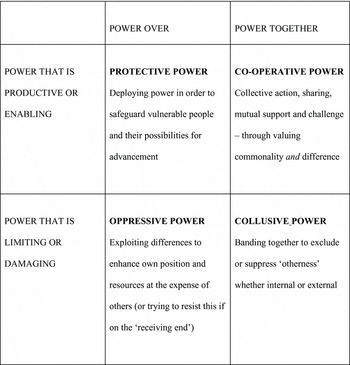
Westwood suggests that a starting point for critical theorisation of power is to see it, not as some finite commodity that individuals or groups can compete to own, but as something that is constructed in and through social relationships (Westwood, Reference Westwood2002). Viewed in this way, the operation of power may be productive of opportunity as well as being constraining or limiting (Foucault, Reference Foucault, Dreyfuss and Rabinow1982). Relationships may situate people in positions of power over one another, or establish lateral connections of power together.
Putting these two dimensions of analysis together, creates a taxonomy of power relations (Tew, Reference Tew2002: 166), which may be helpful in distinguishing the various constructions of power that operate at different scales of social relationships from the societal to the inter-personal. Each cell of the Matrix in Figure 1 describes a particular form of power relation that may play a part in both the internal and external organisation of family life. Power we suggest can be developed between people in ways that are co-operative or protective (Baker Miller, Reference Baker Miller, Jordan, Kaplan, Baker Miller, Stiver and Surrey1991), but also in ways which exclude others. This links to the idea that access to social capital may be limited by collusive ‘conservation strategies’ employed by those who are already advantaged by their membership of social networks (Bourdieu, Reference Bourdieu and Richardson1986).
Matrix of power relations.

Power relations and family life
Two sets of power relations define people's experience of family life. Firstly, there are the power relations that construct the discursive and economic positioning of a family relative to the wider community. For many people, it is their family (extended as well as nuclear) that is their primary route for accessing wider networks of mutual support and resource – co-operative power in the form of social capital (Coleman, Reference Coleman1988; Edwards et al., Reference Edwards, Franklin and Holland2003; Morris et al., Reference Morris, Hughes, Clarke, Tew, Mason, Galvani, Lewis, Loveless, Becker and Burford2008). Equally these extra-familial networks can provide a degree of protective power – both ‘keeping an eye on things’ in a way that safeguards vulnerable individuals within families and also acting as a check on situations where particular family members may be ‘overstepping the mark’ and starting to act abusively towards others. However, some families may face exclusion from such social capital due to the operation of collusive power within their local community. Those who are constructed as ‘different’, perhaps on the basis of culture, ethnicity, lifestyle, or having a family member that is disabled or suffering mental distress, are particularly at risk of exclusion (Young, Reference Young2007). In some instances, this process of cultural essentialism or ‘othering’ can result in an escalating mobilisation of oppressive power within the community in the form of verbal or physical abuse, harassment, victimisation or attacks on property.
Secondly, there are the power relations that define relationships and positioning within the family. Post-Enlightenment notions of citizenship may be seen to have enfranchised some but excluded or subordinated others (Pateman, Reference Pateman1988; Lister, Reference Lister1997) and this is reflected in normative constructions of family life. It is established as somehow a natural and inevitable version of the ‘modern’ family, perhaps most clearly articulated in the sociology of Talcott Parsons (Reference Parsons1960). In this, men presided over small nuclear family units, while responsibility for caring and for organising and managing domestic life fell mainly to women, who were largely excluded from the public sphere – and children readily acceded to their status as minors. Implicit within this conceptualisation of the ‘ideal’ family is a two-way structuring of power over, with men having power over women, and parents having power over children – power relations that could be protective (primarily in relation to children), but could also be oppressive (for both women and children). The wider discourses which invited people to act as if this particular vision of family life was ‘natural’ created a very potent form of collusive power in which any objections or resistances could easily be constructed as deviant.
Feminists have also identified the inherent instability in the iconic form of the ‘bourgeois’ nuclear family, unable to accommodate the contradictory pressures from both within and without, as social and economic circumstances have changed, and awareness of injustices impelled a questioning of certain oppressive or collusive aspects of family structuring (Barrett and McIntosh, Reference Barrett and McIntosh1982). Particularly as women have become active participants in the world of employment, the crisp outlines of this normative form have faded, but it remains nevertheless to haunt, for example, single parent families (and particularly single mothers) as a basis for constructing their inferiorisation.
Internal family relationships typically comprise an uneasy balance of co-operative, collusive, oppressive and protective deployments of power. The negotiation of forms of co-operative power between adults (whether co-resident or otherwise) and between adults and children (as they get older) may open up both positive opportunities for all family members and also serve to mobilise protective power as and when needed – for example, in the collective drawing and redrawing of expectations and boundaries, or in a shared responsiveness to a family member's cry for help. Families, however, can also be sites of victimisation and oppression. This generally involves, not just the direct imposition of oppressive power, but also an arrangement of collusive power that facilitates this and that reinforces or legitimates the superior power of those in positions of domination, and serves to isolate or silence the voices of those who are hurt or diminished by what is going on. Within families, such collusive and excluding relationships may be constructed on the basis of gender, generation or some other commonality (for example, those connected by ‘blood’ relationships within a step-family).
Ending victimisation can best be achieved by shifting the pattern of power relationships – simply removing perpetrators or taking victims to places of safety may do little to change the longer-term dynamics. However, empowerment may be hard to achieve if it is framed in the narrow terms of a competitive ‘zero sum game’ view of power (Barnes and Bowl, Reference Barnes and Bowl2001), where the only way forward is somehow to wrest power away from perpetrators in a head-on struggle. The Matrix offers other more lateral alternatives – such as building up relationships of co-operative and protective power around victims, both inside and outside the family. A productive way of working with perpetrators can be to invite (and challenge) them to give up the inherent isolation that goes with their attempts to dominate others, and to discover instead how different forms of power to may be possible within more co-operative relationships (Cavanagh and Cree, Reference Cavanagh and Cree1996; Tew, Reference Tew2006).
Parent abuse
The instance of parent abuse suggests a particular disruption of conventional power relations in terms of a breaching the traditional parent–child relation of power over, but a disruption that is nevertheless driven by some of the same external deployments of power relations. Although commonly referred to in gender neutral terms, evidence from an international body of literature suggests that this form of violence is in practice highly gendered, with a propensity for women, and particularly lone mothers, to be at risk of becoming the targets of abuse perpetrated by teenage sons (Cottrell and Monk, Reference Cottrell and Monk2004; Stewart et al., Reference Stewart, Burns and Leonard2007; Daly and Nancarrow, Reference Daly, Nancarrow and Ptacek2009).
The still active residue of more traditional forms of patriarchal family relations continues to establish a position of ‘man of the house’ whose right to power over ‘his’ woman could legitimately be reinforced by the use of ‘moderate correction’ (Phillips, Reference Phillips1991). If this position is not filled by an adult male, it potentially stands vacant – a ‘lack’ that is waiting to be filled by another male, and into which a teenage son may seek to insert himself. Evidence to support this interpretation is provided in the narratives of FIP mothers, the majority of whom were lone parents. In this instance, mothers spoke about the ways in which they felt that their relationship with their child represented an inversion of normal family power relations with their teenage child believing they were ‘in charge’ of the home:
Jonathan couldn't understand that he was, he's, he's still a kid and he has to abide by my rules. To him, he's no, you know, that ‘I'm fifte’, fourteen, I can do what I want, I can have a key to the house and I can come in when I want’, you know, it were that what we was always arguing on, and the way he spoke, the way he spoke to me. I mean he'd even hit me once. (Nixon et al., Reference Nixon, Hunter, Myers, Parr and Sanderson2006, original transcript)
Mothers who are victims of such violence are frequently rendered powerless by a number of overlapping power dynamics. While control over material resources and positioning within prevailing discourses tends to allow generation to trump gender as the dominant axis of power over within the construction of family life, this is by no means clear-cut. In two parent families, some degree of a mother's parental authority may be seen to be delegated to her by the presiding authority of the ‘man of the house’ – backed up by some version of a ‘wait until your father gets home’ narrative. By contrast, for single mothers, while constructions of their responsibility for being in control of their children remain undiminished, the authority needed to deliver this may start to evaporate as they find themselves implicitly blamed for the absence of a father figure – both within wider social discourses and also potentially by their children.
The active promotion of parental responsibility by successive neo-liberal governments has been highlighted as a pre-requisite for the creation of a suitable moral climate for the nurturing of the self-governing, responsible citizen. In this dominant discourse, parents are held responsible for the correct socialisation of their children and for any failure of their child to conform to behavioural norms. In practice, however, as Holt argues, such responsibilities ‘are organised around gendered relations of power’ (Holt, Reference Holt2009b). Paradoxically, this can situate mothers in the position of being held responsible for the violence of teenage children, even when it is directed against them (Holt, Reference Holt2009a; Hunter et al., Reference Hunter, Nixon and Parr2010). Within wider social relations, they are invited to feel ashamed and blamed for ‘failing’ to stop the violence – which may serve to intensify their feelings of powerlessness.
Further, the stigma and inferiorisation associated with the status of being a single mother may lead to isolation from potential networks of social capital, and hence reduce mothers’ ability to mobilise effective forms of protective power through extra-familial connections. There is then potentially a vicious circle in which their ‘failure’ to access positions of parental power and be a ‘proper parent’ itself becomes a reason for further stigmatisation and isolation from networks of co-operative or protective power. The lack of public recognition of this hidden form of family violence and the absence of policy guidance may further compound the difficulty parents experience when trying to seek the protective or co-operative power of external agencies to resolve the situation. Indeed FIP mothers who tried to access help from statutory agencies, most frequently from social services, found their pleas for help tended not to meet with a positive response, as one mother explained:
I pleaded with them. You know what I mean? And it's not just once I phoned ‘em, I phoned ‘em a few times. (Nixon et al., Reference Nixon, Hunter, Myers, Parr and Sanderson2006, original transcript)
Alternatively, the service response may construe parent abuse as an individual problem (or failing) on the part of the mother and fail to engage with the inversion of power relations that had rendered her a victim. One mother described how a referral to a social work team for counselling simply left her feeling further demoralised and shamed. Rather than addressing the problem of her son's violence, she felt the intervention had resulted in her son believing he was immune from any further intervention:
And I felt like an idiot basically, because I had to sit there and be like in school . . . anyway, it didn't work. But the sessions had finished, and then that was it. He was just like (whistles). And I thought, ‘Well what do I do?’ You know, I wasn't referred for any other sort of help or whatever . . . (Nixon et al., Reference Nixon, Hunter, Myers, Parr and Sanderson2006, original transcript)
The narratives of women interviewed illustrate how social workers, within the context of prevailing agency discourses, may fail to recognise the oppressive power of violence towards parents, and, in some cases, the failure to take decisive intervention served to reinforce a pattern of collusive power.
The empirical evidence suggests that only in a minority of instances are men victims of parent abuse – a finding which could be explained in terms of their traditional access to positions of discursive or material power, both externally in the public sphere and through the continuing existence of an internal discursive position of ‘man of the house’. However, if a man comes to be viewed as unable to access such positions, perhaps on the basis of unemployment or disability, or because he enters the family from the rather more precarious position of step-parent, he may find that he is more vulnerable – perhaps to violence or abuse from a teenage boy who may be trying out an apparently more effective display of masculine credentials. A theoretical analysis would suggest that what may make a difference is whether or not the man is able to access co-operative power within or outside the family, and whether there may be collusive constructions of masculinity (and an association with a legitimated use of violence) within the localised context of the family's culture (Whitehead, Reference Whitehead2002).
For women, the potential for victimisation may lie within both multi-parent families and where they are single parents. In the former instance, there may be vulnerability where there is a collusive and oppressive organisation of power along gender lines. In patriarchal arrangements, where women lack independent sources of power through work or effective access to social capital, an inversion of prevailing discourses privileging generation may result in gender trumping generation in the organisation of family power relations. This can become manifest in situations where both male partners and sons use violence in a systematic way to enforce their dominance. In the latter instance, single mothers may find that their access to positions of parental power are severely compromised – not only through lack of economic power, stigmatisation or social isolation, but also through more specific circumstances, such as having been seen to victimised by a previous partner. As one mother currently experiencing violence from her son explained:
All my family are back home in Ireland. I mean, I had to come here about 10 years ago, 11 year ago, to get away from domestic violence if I stayed there. (Pawson et al., Reference Pawson, Davidson, Sosenko, Flint, Nixon, Casey and Sanderson2009, original transcript)
In these circumstances, the very status of ‘mother’ may, rather than confer any real power, serve to trap women within abusive relationships – their ongoing responsibility to parent often preventing them either leaving the abusive relationship or even seeking help to stop the violence (Kennair and Mellor, Reference Kennair and Mellor2007). Fulfilling the responsibilities associated with the ‘parent’ element of the confusing ‘parent-victim’ status may require mothers to subordinate their own feelings in order to remain responsive to the feelings of their children:
I used to sit back and I used to cry at nights, I used to think, ‘Well what's he . . . how is he feeling if this is how I'm feeling?’ (Nixon et al., Reference Nixon, Hunter, Myers, Parr and Sanderson2006, original transcript)
Accessing productive forms of power
The above discussion illustrates how child-to-parent violence takes place within the context of a particular intersection of oppressive and collusive power relations that tends to isolate the parent-victim and render them powerless to resist what is going on. The evidence from the research suggests that the majority of parents subject to abuse by their children saw their only strategy for regaining some control in terms of a very lonely and individualised form of struggle, often at considerable cost to themselves. In the absence of any way of accessing co-operative or protective power, one mother described how she had effectively to abandon the role of parent, and even her right to live in her own house, in order to stay safe and survive:
Last year . . . he was unbearable. It was like I was just staying out of the house constantly all the time. And I couldn't . . . and half the time I was storming out of the house because I couldn't stay in the house. (Nixon et al., Reference Nixon, Hunter, Myers, Parr and Sanderson2006, original transcript)
For another, the strategy involved emotional rather than physical separation – and regaining a measure of control was achieved by adopting an attitude of resignation that insulates against further attack:
Basically when he comes in and he starts I just look at him and go ‘you can't get to me no more, say what you want, do what you want, you can't get to me’. I just do that, I just sort of go, ‘I'm not interested.’ (Nixon et al., Reference Nixon, Hunter, Myers, Parr and Sanderson2006, original transcript)
For the mothers in our study, a very significant step in starting to construct co-operative power with others involved lifting the ‘veil of silence’ and talking about the problem. Taking such action, women ran the risk of being put down further within dominant ‘responsible parenting’ discourses of blame and culpability. Even within the relatively safe context of the research interview, speaking about experiences of abuse by children was clearly difficult and, for many, the issue could only be raised tentatively, in an ‘off hand way, as if it was of no real importance’ (Nixon and Hunter, Reference Nixon, Hunter and Millie2009).
While mothers articulated a strong desire for support in controlling their children's behaviour and in setting boundaries, their attempts to access productive or enabling forms of power were often highly restricted and constrained. As with domestic violence 30 years ago, external agencies tended to treat parent abuse as an essentially private matter beyond the control of the state – or at least not as priority in comparison with statutory duties such as child protection. Only a minority of mothers reported they were able to access forms of co-operative or protective power through the intervention of their FIP worker, which began to shift the context of power relationships within the family. This involved recognition that the abuse was an issue that urgently needed to be addressed rather than simply situating the mother as culpable:
I got on the phone right away and she [the project worker] came out and she took Sean out. Had a word with Sean, and yesterday as well she had him out. (Pawson et al., Reference Pawson, Davidson, Sosenko, Flint, Nixon, Casey and Sanderson2009, original transcript)
Equally providing ‘connecting’ rather than punitive responses was welcomed by parents – as in an instance where both children involved were referred for bereavement and anger management counselling. This may open up possibilities for young perpetrators to develop different sorts of relationships based on co-operative power – both inside and outside the family.
Such practices were, however, exceptional and highlight the importance of social care agencies engaging with parents and children as partners in generating forms of co-operative or protective power that channel energies for resisting abuse in more constructive directions, and offer those perpetrating the violence alternative ways of having power to that do not involve the abuse of those who care for them. What may be particularly effective in terms of a whole family approach is to look to resources and connections outside the immediate nuclear family unit, as in the development of ecological approaches operating at the level of the individual, the family, the peer group and the school (Beihal, Reference Biehal2005: 211).
Conclusion
In this paper, we have sought to show how the application of a conceptual framework by which to understand family power relations may be important in highlighting current issues and suggesting strategies for responding to them that go beyond an inadvertent reproduction of oppressive or collusive power relations. Drawing on empirical evidence helps to illustrate the complexity of family power relations and how these may serve to trap parents (most typically mothers) in positions of ongoing abuse and victimisation. While this frame of analysis may be helpful in highlighting certain issues concerning power and social relationships, this only provides one particular lens by which to view what may be going on. Clearly, other lenses may be important, for example those which explore how power relations may be internalised by family members in ways which either construct or detract from their sense of personal efficacy (Bandura, Reference Bandura1986), or how agency discourses and practices may empower or disempower practitioners and shape how they ‘see’ the situations that they encounter.
One explanation as to why mothers found it so hard to locate either protective power or more co-operative forms of power to help them deal with parent abuse lies in the way in which this form of family violence tends to be reconfigured by external agencies as an individual problem arising as a result of poor parenting or delinquency. Despite mothers’ attempts to seek help in resolving the problem, all too often the institutional silence around parent abuse, and the failure of agencies operating within either the youth justice system or family care to recognise this complex form of extreme family conflict, served to reinforce a sense of powerlessness. When the very existence of parent abuse is either ignored and/or constructed as a problem of parenting, the forms of resistance available to parents are acutely curtailed.
We believe that effective interventions must start with the employment of practice models that frame children and families as active players in developing strategies to promote transformative power relationships and empowerment. As a pre-requisite for the development of such practice models, there is an urgent need for academics and practitioners alike to break the collusive power of silence and begin a dialogue to address how best to give voice to parents and children in defining appropriate supportive interventions.