Introduction
The sesquiterpenic lactones (STLs) are one of the largest groups of secondary metabolites of lipophilic character found mainly in the Asteraceae family. STLs are 15-carbon terpenoids consisting of three isoprene (5-C) units with a five-membered lactone ring (cyclic ester) fused to different carbocyclic skeletons. They are classified into different groups according to their carboxylic skeleton: germacranolides, eudesmanolides, guaianolides, melampolides, etc.
A wide range of biological activities has been reported for STLs including anti-tumour (Lee et al., Reference Lee, Hall, Mar, Starnes, ElGebaly, Wadell, Hadgraft, Ruffner and Weidner1977; Zhang, et al., Reference Zhang, Won, Ong and Shen2005; Ghantous et al., Reference Ghantous, Gali-Muhtasib, Vuorela, Najat, Saliba and Darwiche2010), anti-inflammation (Recio et al., Reference Recio, Giner, Uriburu, Máñez, Cerdá, de la Fuente and Ríos2000) and gastric cytoprotective effects (Giordano et al., Reference Giordano, Pestchanker, Guerreiro, Saad, Enriz, Rodriguez, Jauregui, Guzman, Maria and Wendel1992; Penissi et al., Reference Penissi, Fogal, Guzmán and Piezzi1998).
It has been previously shown that dehydroleucodin (DhL), a sesquiterpenic lactone guaianolide type isolated from the aerial parts of Artemisia douglasiana Besser, selectively induces a dose-dependent transient arrest in G2 of both meristematic (López et al., Reference López, Giordano and López2002) and vascular smooth muscle cells (Cruzado et al., Reference Cruzado, Castro, Fernández, Gómez, Roque, Giordano and López2005). Treatment with DhL or its 11,13-dihydro derivative (2H-DhL) of fully grown oocytes of Rhinella arenarum (in the original publication named with the old binomial Bufo arenarum) arrested in G2/M at the beginning of meiosis I produced an inhibition of either spontaneous or progesterone-induced maturation in a dose-dependent manner (Sánchez-Toranzo et al., Reference Sánchez-Toranzo, Giordano, López and Bühler2007). Under hormonal stimulus (progesterone), the meiotic arrest is released and the meiosis progresses to metaphase II, a process termed oocyte maturation (Fortune et al., Reference Fortune, Concannon and Hansel1975; Schuetz, Reference Schuetz1985). Thus, the meiotic maturation represents the transition from G2 to the M phase of the cell cycle (Zelarayán et al., Reference Zelarayán, Oterino and Bühler1996).
In amphibian oocytes meiosis, the transition from G2 to M phase is regulated by the maturation promoting factor (MPF), a complex of cyclin-dependent kinase p34/cdc2 and cyclin B (Lohka et al., Reference Lohka, Kyes and Maller1987). In immature oocytes an inactive complex (pre-MPF) where cdc2 is phosphorylated on both Thr-161 and Thr-14/Tyr-15 residues is present. These inhibitory phosphorylations are probably catalysed by Myt1 protein kinase (Qian et al., Reference Qian, Erikson, Taieb and Maller2001; Inoue & Sagata, Reference Inoue and Sagata2005) present in G2 oocytes and are hyperphosphorylated during oocyte maturation. As inhibition of the endogenous Myt1 can trigger meiotic maturation in the absence of progesterone stimulation, Myt1 could be responsible for maintaining the cdc2–cyclin B complexes in an inactive form in G2-arrested oocytes (Peter et al., Reference Peter, Labbe, Doree and Mandart2002; Furuno et al., Reference Furuno, Kawasaki and Sagata2003; Karaiskou et al., Reference Karaiskou, Lepretre, Pahlavan, Du Pasquier, Ozon and Jessus2004).
Dephosphorylation of Thr-14/Tyr-15 induced by the activation of Cdc25 phosphatase is necessary to start MPF activation (Perdiguero & Nebreda, Reference Perdiguero and Nebreda2004; Dekel, Reference Dekel2005). In G2-arrested Xenopus oocytes, cdc25 is probably maintained inactive by PKA-mediated phosphorylation. When oocyte maturation is initiated by progesterone, cAMP levels are reduced and PKA becomes inactivated. Interestingly, PKA and PP2A are both active in G2-arrested oocytes and become inactive upon progesterone addition (Duckworth et al., Reference Duckworth, Weaver and Ruderman2002; Schmitt & Nebreda, Reference Schmitt and Nebreda2002).
Pretreatment with DhL or 2H-DhL does not affect the percentage of germinal vesicle breakdown (GVBD) induced by H89, a protein kinase A (PKA) inhibitor, which suggests that these lactones would act on another step of the signalling pathway that induces MPF activation (Sánchez-Toranzo et al., Reference Sánchez-Toranzo, López, Zapata-Martínez, Gramajo Bühler and Bühler2010). The fact that both DhL and 2H-DhL inhibit GVBD induced by okadaic acid microinjection suggests that they could act on the activity of the Myt1 kinase. This idea is supported by the experiments of injection of GV contents in which an inhibitory effect of these lactones on GVBD was also observed (Sánchez-Toranzo et al., Reference Sánchez-Toranzo, López, Zapata-Martínez, Gramajo Bühler and Bühler2010).
Previous results suggest that the inhibitory effect of DhL on meiosis progression does not only depend on the activity of the exo-methylene-γ-butyrolactone moiety as its 11,13-hydrogenated derivative, 2H-DhL, where the exo-methylene double bond has been saturated produces a similar effect on the amphibian oocytes. However, 2H-DhL was less active than DhL as roughly a double dose of the saturated lactone was required to obtain an inhibition similar to that of the unsaturated analogue (Sánchez-Toranzo et al., Reference Sánchez-Toranzo, López, Zapata-Martínez, Gramajo Bühler and Bühler2010). Schmidt (Reference Schmidt2006) reported that the α-methylene-γ-butyrolactone ring is not the only active group because other structural characteristics such as α-β-unsaturated carbonyls, epoxides, aldehyde, etc. also participate in the overall reactivity of the molecule.
The aim of this study was to analyze the effect of four closely related guaianolides, i.e., DhL, achillin, desacetoxymatricarin and estafietin as inhibitors of meiosis in oocytes of amphibians in vitro and discuss some structure–activity relationships. These lactones show differences with respect to the presence and position of reactive groups. It should be noted that achillin and desacetoxymatricarin differ only in the configuration at C-11 (epimers).
Materials and methods
Animals
Wild adult females of Rhinella arenarum were collected in the Tucumán province (northwestern Argentina) and kept at 15°C until use. The animals (20) were collected between years 2013 and 2015.
Plant material
Sesquiterpene lactones were isolated from different plants of the Asteraceae family and kindly provided by Dr César A. N. Catalán:
-
• Dehydroleucodin (DhL) was isolated from Artemisia douglasiana Besser, following the procedure described by Giordano et al. (Reference Giordano, Guerreiro, Pestchanker, Guzman, Pastor and Guardia1990).
-
• Achillin and desacetoxymatricarin, also known as leucodin, were isolated from Artemisia copa Phil. (Catalán et al., Reference Catalán, Marcial, Schuff, Perotti and Catalán2007).
-
• Estafietin was isolated from Stevia alpina Griseb. according to De Heluani et al. (Reference De Heluani, de Lampasona, Catalán, Goedken, Gutiérrez and Herz1989).
The purity of all lactones was >95.0% and were characterized by mass spectrometry (MS), proton and carbon-13 nuclear magnetic resonance (1H and 13C-NMR) with 1D and 2D experiments.
The dihydro derivative of DhL (here called 2H-DhL) was obtained by catalytic hydrogenation to yield a 44:66 mixture (mixture of the C-11 epimers achillin and desacetoxymatricarin) and kindly provided by Dr Graciela Sánchez-Toranzo.
STLs were dissolved in ethanol and various doses were added to the culture medium to give a final concentration of 6, 12, 24 or 36 μM.
In vitro culture of denuded oocytes
Experimental manipulation and oocyte culture were performed at room temperature (22–25°C) in amphibian Ringer solution (AR): 6.6 g NaCl/l, 0.15 g CaCl2/l, and 0.15 g KCl/l, containing penicillin G-sodium salt (30 mg/l) and streptomycin sulphate (50 mg/l), and 0.005M Tris–HCl buffer (pH 7.4). Fully grown ovarian oocytes (1.7–1.8 mm in diameter) were obtained from adult female specimens. Oocytes were denuded by manually pulling off the follicle epithelium and theca layer using fine forceps under a stereoscopic microscope (Lin and Schuetz, Reference Lin and Schuetz1985). Follicle cells were removed by shaking in AR for 5 min to 100 oscillations/min (Zelarayán et al, Reference Zelarayán, Oterino and Bühler1995). Denuded oocytes were kept in AR until use. These oocytes are incompetent to mature spontaneously because they require progesterone stimulus to restart the meiosis.
Denuded oocytes (randomized samples of 20 oocytes) of Rhinella arenarum were distributed into separate wells each containing 2 ml of AR with different doses (6, 12, 24 or 36 μM) of DhL, achillin, desacetoxymatricarin and estafietin, and maintained for 60 min before the addition of progesterone. As a control, oocytes were cultured in AR only with the added of hormone.
Oocyte maturation was assessed 24 h after hormone addition and meiotic resumption was scored both by the presence of a transient white spot in the animal pole and by germinal vesicle absence (GVBD). To determine GVBD, oocytes were dissected following fixation for 24 h in Ancel-Vitemberger solution (formol 10%, acetic acid 0.5%, NaCl 0.5% in water).
Progesterone (Sigma Chemicals) was dissolved in ethanol and added directly to the culture medium to reach a final concentration of 2.5 μM.
Compound identification
The NMR spectra were obtained with a Bruker Avance III instrument at 500 MHz (1H) and 125 MHz (13C). All spectra were recorded in CDCl3 with the residual solvent hydrogen used as an internal reference (δH 7.26; δC 77.3, 77.0, 76.7). Multiplicity determinations (DEPT 135) and 2D NMR spectra (1H–1H gCOSY, 1H–13C gHSQC, 1H–13C gHMBC) were acquired using standard Bruker programs.
Statistical analysis
Results are expressed as means ± standard error of the mean (SEM). Comparisons among different treatments were carried out using Student's t-test. A value of P < 0.05 was considered to be statistically significant.
Results
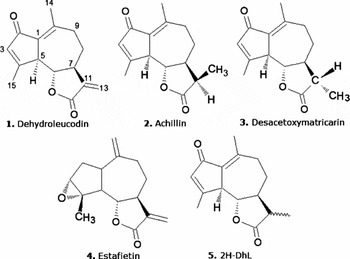
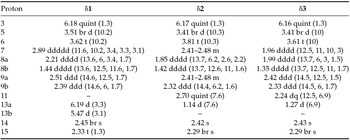
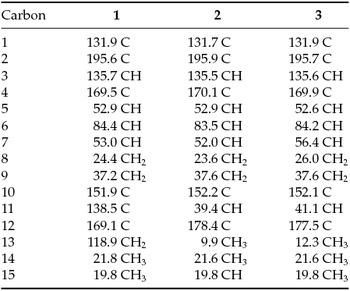
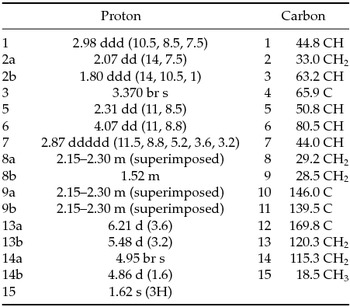
Figure 1 shows the structure of lactones used. Table 1 shows 1H-NMR data of the closely related lactones (DhL, achillin and desacetoxymatricarin), and Table 2 the corresponding 13C-NMR data. Table 3 shows 1H and 13C-NMR data of estafietin.
Structure of sesquiterpene lactones. Numbering according to classic nomenclature.

1H NMR DhL (1), achillin (2) and desacetoxymatricarin (3) (coupling in Hz)

13C-NMR of DhL(1), achillin (2) and desacetoxymatricarin (3)

1H-NMR and 13C-NMR of estafietin (4)

STLs effect on progesterone-induced oocyte maturation
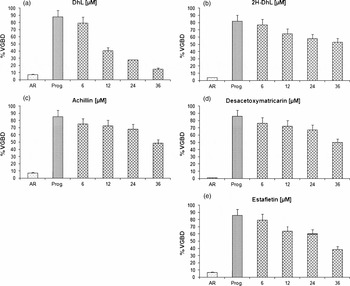
To determine how STLs affect oocyte maturation, oocytes were incubated with different concentrations (6, 12, 24 or 36 μM) of each lactone in AR solution. In accordance with the data indicated by Schmidt (Reference Schmidt2006) on potentially reactive centres (PRCs), DhL contains an exo-methylene-γ-butyrolactone ring and a α,β–α′,β′-diunsaturated ketone. Figure 2 a shows that DhL inhibit meiotic resumption in a dose-dependent manner with an IC50 of 12 μM. It has been shown that the synthetic 11,13-dihydroderivative (2H-DhL) obtained by catalytic hydrogenation of DhL was a 44:66 mixture of the C-11 epimers achillin with desacetoxymatricarin (Sánchez-Toranzo et al., Reference Sánchez-Toranzo, López, Zapata-Martínez, Gramajo Bühler and Bühler2010). This mixture showed roughly half of the inhibitory effect of DhL as shown in Fig. 2 b. At this point the question arises about whether both epimers have a similar inhibitory effect or if the stereochemistry a (desacetoxymatricarin) or b (achillin) of the methyl group attached to C-11 produces some differential effect.
Inhibition effect of sesquiterpene lactones on progesterone-induced maturation (a) DhL, (b) 2H-DhL, (c) achillin, (d) desacetoxymatricarin, and (e) estafietin. Fully grown denuded oocytes unable to mature spontaneously were preincubated (60 min) in amphibian Ringer solution (AR) with specified concentrations of lactone (6–36 μM) before progesterone addition (2.5 μM). The germinal vesicle breakdown (GVBD) was scored after 24 h of incubation. Values are the mean ± standard error of the mean (SEM) (n = 6). Each experiment was performed using a new set of fresh animals.

As can see in Fig. 2 c and 2 d, both lactones achillin and desacetoxymatricarin show similar values, which demonstrate that the inhibitory effect is essentially insensitive to orientation of the methyl group at C-11 and that the saturation of the 11,13-double bond conjugated to the lactone carbonyl plays a significant role in the inhibitory effect.
Conversely, estafietin, where the α,β–α′,β′-diunsaturated cyclopentanone moiety has been substituted by an epoxy ring between C-3 and C-4, exhibited an inhibitory effect significantly lower than DhL and slightly higher than both achillin and desacetoxymatricarin (Fig. 2 e).
Results of GVBD controls (cultures only with AR and with added hormone) are also shown in all graphs. At 36 μM and higher concentrations of lactones, toxic effects were observed evidenced by the percentage of nonviable cells (greater than 80%). Oocytes show alterations in their external appearance, such as interruption of pigment in the cortex, increased volume, cell lysis, etc.).
Discussion
According to Giordano et al (Reference Giordano, Pestchanker, Guerreiro, Saad, Enriz, Rodriguez, Jauregui, Guzman, Maria and Wendel1992) lactones belonging to the guaianolide group need two PRCs, i.e. an exo-methylene-γ-butyrolactone ring and an α,β-unsaturated cyclopentenone moiety, to exert significant cytoprotective activity.
However, regarding meiosis resumption, we have previously determined that the presence of a saturated γ-butyrolactone ring together with the α,β-unsaturated cyclopentenone moiety exerts an inhibitory effect (Sánchez-Toranzo et al., Reference Sánchez-Toranzo, López, Zapata-Martínez, Gramajo Bühler and Bühler2010).
In both cases, a synthetic dihydro derivative of DhL was prepared to show the effect of saturation of the conjugated double bond in the exo-methylene-γ-butyrolactone ring.
The same inhibitory effects were observed in the treatment of 3T3-L1 pre-adipocytes with DhL and 2H-DhL (Galvis et al, Reference Galvis, Marcano, Stefancin, Villaverde, Priestap, Tonn, Lopez and Barbieri2011). In this work, the epimers mixture was separated by HPLC and tested as pure compounds. It was found that the (11R) epimer (lactone 2) exerted a greater inhibitory effect on adipocyte differentiation than the (11S) epimer (lactone 3).
In our study, natural lactones achillin and desacetoxymatricarin isolated from Artemisia copa were used. The results obtained showed no significant differences between both lactones and, as expected, were essentially identical to the inhibitory effect of 2H-DhL (Fig. 2). However, DhL was shown to be much more active that its 11,13-saturated counterparts indicating that the unsaturated γ-lactone moiety increases significantly the inhibitory effect on meiosis reinitiation.
Conversely, estafietin where the α,β–α′,β′-diunsaturated cyclopentanone moiety of DhL has been substituted by an epoxy ring between C-3 and C-4, exhibited an inhibitory effect significantly lower than DhL indicating that the α,β-unsaturated cyclopentenone moiety has the greatest affinity with their biological target.
Based on the structural differences between estafietin and the C-11 epimers (lactones 2 and 3), we can see that their inhibitory effects are similar although slightly higher for estafietin, indicating that the exo-methylene-γ-lactone group is of greater importance compared with the α,β-unsaturated cyclopentenone ring. It should be noted that estafietin has an epoxide function that is as a hard electrophile, which reacts preferably with hard nucleophiles such as –OH and −NH groups. However, perhaps because of its relative position in the molecule, stereochemical requirements or the chemical nature of the unknown biological target, the epoxide ring is not sufficiently effective to exert inhibition.
In conclusion, most STLs exert their biological activity by interfering with the function of cellular macromolecules by forming covalent bonds between structures partially electrophilic centres of STLs and nucleophilic centres of biological targets (Michael type addition). The following PRCs can be recognized in the guaianolides studied here: the exo-methylene-γ-lactone grouping and the α,β–α′,β′-diunsaturated cyclopentanone system, which can react with a nucleophile through 1,4-addition and the epoxy group.
According to results presented herein, a better inhibitory effect occurs when the lactone has two PRCs. If the molecule has only one reactive group its inhibitory effect is lower. Clearly, the exo-methylene-γ-lactone ring alone is not determinative for the inhibitory effect. Our results suggest that SH groups of the target macromolecule (most likely some key protein related to the meiotic arrest maintenance, such as Myt1) are involved in the inhibitory effect as it is known that they are capable of reacting by Michael addition with α,β-unsaturated carbonyl systems.
Acknowledgements
This work was supported by a grant from the Science Council of the National University of Tucumán (CIUNT) and the National Agency for Promotion of Science and Technology (FONCYT).