

Introduction
In modern orchards and vineyards there are numerous row widths, varieties, plant spacing and variations in canopy shape and style. Canopy characteristics (height, width and density) also change as the growing season progresses. Good disease and insect control is dependent upon the correct amount of pesticide being applied at the correct time. Incorrect application may result in pest resistance, poor pest or disease control, increase costs for the grower, and an increased risk of chemical contamination in the environment.
Landers (Reference Landers2010) describes real-time adjustment of the operating parameters (air flow, pressure, active nozzles, etc.) according to the target density as an important goal for canopy spraying systems. Keeping the spray cloud within the canopy is the goal. Maintaining the spray plume within the canopy reduces spray drift and increases deposition. Fruit sprayers comprise two systems. The first system is the liquid spray and the second and, equally important for tree and vine crop applications, is the airflow. The liquid flow is based upon nozzles and pressure, the airflow is based upon a fan to provide air for canopy penetration.
Researchers have recently developed three main methods of changing liquid flow through a nozzle. Llorens et al. (Reference Llorens, Gil, Llop and Escolà2010) utilized an ASCO valve to change on real time the flow rate. Khot et al. (Reference Khot, Ehsani, Abrigo, Larbi, Landers, Campoy and Wellington2012) adapted an axial fan air-assisted sprayer specifically for precision spraying in citrus orchards using Capstan pulse width modulation solenoid valves (Capstan Ag Systems Inc., Topeka, KS USA) to provide variable rate liquid output. The flow rate from these nozzles is determined by electrically adjusting the length of time the nozzle is open resulting in a pulsing spray. Doruchowski et al. (Reference Doruchowski, Swiechowski, Holownicki and Godyn2009) developed a nozzle manifold block, comprising eight individual pneumatically-controlled nozzles per block for the European Union project ISAFRUIT. Llorens et al. (Reference Llorens, Landers and Larzelere2013) and Llorens and Landers (Reference Llorens and Landers2014) developed a method of liquid control, adapting the Lechler Vario-Select (Lechler GmbH,Metzingen,Germany) nozzle system from horizontal boom sprayers and applying it to the vertical boom found on tower fruit sprayers. The Lechler Vario-Select comprises a cluster of nozzles, each nozzle being operated individually or in a combination thereof, allowing a wide range of outputs to be obtained. The Lechler system used compressed air to open and close the nozzles. All the above methods allow variable rate technology (VRT), a basic requirement in the precision farming concept.
Previous research, at Cornell University, lead to the development of an adjustable louvre to control the air leaving the sprayer. The adjustable louvre on the air outlet of an air blast sprayer reduced drift by as much as 63% in orchards during field trials in early to mid-season when canopies are developing (Landers, Reference Landers2012). When drift is reduced by adjusted air volume or speed, deposition within the canopy or on the fruit increases. Currently the sprayer operator manually adjusts the louvre via an adjustable stroke length actuator that moves the louvre, thus matching airflow to canopy size. Unfortunately in tall trees and heavy canopies it is a challenge to see how far the spray cloud is passing through the canopy.
Tumbo et al. (Reference Tumbo, Salyani, Whitney, Wheaton and Miller2002) proposed the use of ultrasound sensors to estimate the volume of citrus trees using the principle of time of flight to determine the distance to the target. Adopting the same system, Zaman and Salyani (Reference Zaman and Salyani2004) proved that forward speed is not as important as tree density. This method assumes a constant distance from the sensor to the tree, and small variations on these distances results in a large error on the final volume estimation (Palleja et al., Reference Palleja, Tresanchez, Teixido, Sanz, Rosell and Palacin2010). Balsari et al. (Reference Balsari, Doruchowski, Marucco, Tamagnone, Van de Zande and Wenneker2008) went one step further analyzing the Crop Identification System (CIS) and concluded that there is a relationship between canopy density and its ultrasonic echo signal. Balsari et al. (Reference Balsari, Marucco and Tamagnone2009) also solved the target distance by using GPS and reported better deposition by adjusting the sprayer parameters (air flow and nozzles) as a function of the CIS data.
Llorens et al. (Reference Llorens, Landers and Larzelere2013) developed a system which measured the distance from the ultrasonic sensor to the edge of the tree or vine canopy. The low cost system calculated canopy volume based upon the distance and time of the ultrasonic system and the centerline (trellis posts) of the canopy. The assumption being made that the rows of vines or trees were in a straight-line and the tractor was being driven in a straight-line, neither being commonly found. Palleja and Landers (Reference Palleja and Landers2015) developed a low cost system using 4 ultrasonic sensors and a microcontroller board to estimate the canopy density as a function of the ultrasonic echoes. It was tested as the growing season progressed and the data obtained was highly correlated with the season but it was not compared to actual canopy density. A modified sensor system to monitor the canopy density and volume was further developed by Palleja and Landers (Reference Palleja and Landers2015 and Reference Palleja and Landers2016) resulting in the ability to adjust the airflow actuator and the liquid flow from the nozzles based upon canopy density.
The main objective of this work is to compare the ultrasonic data with a scientifically accepted method to estimate canopy density, check if the data is correlated, and validate the ultrasonic system. Point Quadrat Analysis (PQA) was selected as an acceptable yet simple field method to measure key parameters of the canopy characteristics. In PQA, a probe is passed through the canopy and any contact with biomass such as leaves or fruit are identified and recorded (Smart, Reference Smart1985; Smart and Robinson, Reference Smart and Robinson1991). The canopy is sampled at specific heights, which is usually at the fruit zone, at consistent intervals along the row. Enhanced Point Quadrat Analysis (EPQA) was a further development of the PQA method by Meyers and Vanden Heuvel, (Reference Meyers and Vanden Heuvel2008) and is a more descriptive system as it adds metrics which allow cluster exposure mapping and leaf exposure mapping to measure sunlight distribution.
Materials and Methods
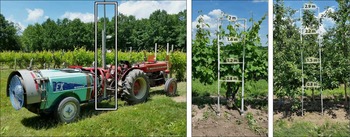
The ultrasonic system detailed in previous work (Palleja and Landers, Reference Palleja and Landers2015) was used in the field trials. The canopy sprayer was a Berthoud S600 axial fan sprayer. It incorporates a set of 4 ultrasonic sensors (XL-MaxSonar MB7092) mounted on a 3 m long mast (Figure 1, left). The sensors are distributed along the mast according to the vineyards or the orchard size. Two plastic frames were built to perform PQA in the two vineyards (0.5×2 m, Figure 1, center) as well as in an apple orchard (0.5×2.9 m, Figure 1, right). The frames have 4 horizontal bars, matching the ultrasonic sensors’ height. Each horizontal bar has 6 marks spaced 10 cm apart, indicating the position where the operator introduces the probe to count the number of leaf layers.
Left, Berthoud sprayer, the white rectangle indicates the mast and the sensor position. Centre and right: vineyard and orchard PQA frame.

The experiments were conducted in fields belonging to Cornell University during the growing season of 2015. Vineyards of V. vinifera cv. Vignoles and cv. Cabernet Franc grapevines were used. A cv. Macoun apple orchard was used. The field trial consists of using the ultrasonic system to scan both sides of a row (Table 1) at 4.6 km/h as well as perform PQA. The PQA frame has 24 different positions and it is moved along the row at 4 random locations, making a total 96 samples per row per week. The average 96 PQA samples, named |PQA|, is compared with the average of the 4 sensors’ wc (the average of the full sum of ultrasonic sound returns, see Pallejà and Landers Reference Palleja and Landers2015) along row, named |wc|. wc values are expressed in volts.
Field rows used in the experiment and its lineal adjustment.

1 lineal regression: y=m·x+n
2 r-squared and root mean squared error.
Results
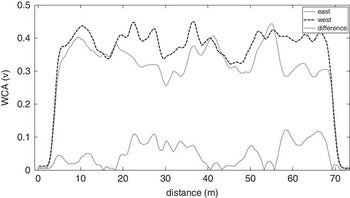
Figure 2 shows the data obtained with the ultrasonic system along a section of the Vignoles row. It shows the variation of crop parameters in one row, demonstrating the density differences both inside and along the row.
Comparison of the echoes received from the east and west side of the row on July 17th.

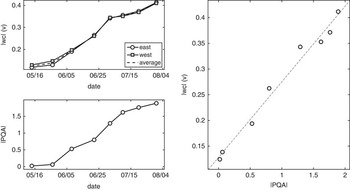
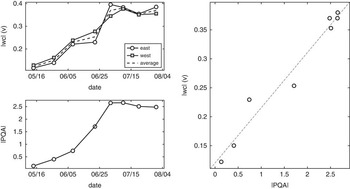
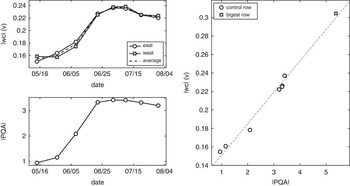
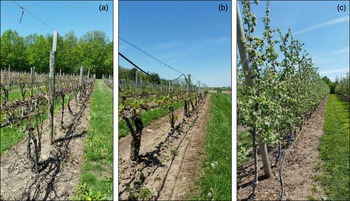
Figures 3, 4 and 5 show the evolution of the |wc|, the |PQA| and its relationship between May 14th and July 31th, 2015. The three varieties present a good correlation (Table 1). Both vineyards have similar |wc| ranges, from 0.025 to 0.4 V while the apple trees’ range grows from 0.15 to 0.24 V, indicating greater density at early growth stages and less density on fully developed canopies. On May 14th, the orchard |wc| was ≈0.12 V bigger than vineyards because the apple trees had branches and some leaves whilst the buds in the vineyards were just emerging (Figure 6).
Average ultrasonic signal (|wc|) compared with the average PQA data (|PQA|) on Vignoles vineyards, between May 14th and July 31th, 2015.

Average ultrasonic signal (|wc|) compared with the average PQA data (|PQA|) on Cabernet Franc vineyards, between May 14th and July 31th, 2015.

Average ultrasonic signal (|wc|) compared with the average PQA data (|PQA|) on Macoun apple orchards, between May 14th and July 31th, 2015.

a) Vignoles, b) Cabernet Franc and c) Macoun on May 14th.

Furthermore, the regressions lines are different for each plant (Table 1), this means that, although there is a good correlation between |wc| and |PQA|, there is an intrinsic plant propriety which cannot be exported to other plants or varieties.
Discussion
This work compares the ultrasonic echo signal from the sensors with the variation of PQA to estimate canopy density and validate the ultrasonic system. One apple orchard and two vineyards were scanned weekly throughout the growing season of 2015 and the results show a good correlation between both methods although it cannot be exported to other plants or varieties without previous calibration. It shows that the echoes are related to intrinsic plant characteristics, such as leaf size, leaf softness, branches, structure, etc.
Visually, when the plants were fully developed (about July 10th), the vines had a greater density than the apple trees, which matches with the results from the ultrasonic signal (vineyard: 0.35 V and 0.38 V, orchard: 0.24 V) although the PQA indicates the opposite (vineyard: 1.62 and 2.65, orchard: 3.45). Orchards have many layers of small, sparse leaves, which generate a high PQA, but, in fact, the trees are not really dense (it is relatively easy to see through to the next row). On the other hand, vines have large leaves condensed into a small area (low PQA), creating a very dense canopy that is relatively more difficult to see through.
Conclusions
The ultrasonic system shows strong correlation to the acceptable, traditional method of Point Quadrat Analysis (PQA). This work shows that the ultrasonic canopy density method needs to be calibrated for each variety and plant type, in order to be used as a reference for adjustment of the sprayer’s parameters in real time, with the aim of improving deposition and reducing drift The ultrasonic system allows the rapid determination of canopy density, providing information to allow the variable application of pesticides in real-time. The ultrasonic system will also provide horticultural researchers with a fast method of comparing canopy density and growth stage for their field trials.
Acknowledgments
Funding for this project was provided by The New York Apple Research and Development Progam (fruit tree trials), The Canandaigua Wine Company Endowment, Kaplan Endowment, Lacroute Endowment, and Saltonstall Endowment (vineyard trials).