I. Introduction
Entry bar or zapret na v'ezd (запрет на въезд) is an immigration law sanction that came to force in Russia gradually in 2012 and 2013. Initially, a three-year entry bar was to be issued to anyone who had not left the territory of Russian Federation (RF) within the thirty-day grace period after the expiry of his or her residence permit. In July 2013, new, stricter amendments followed—the three-year entry bar was to be issued to foreign citizens who committed two or more administrative offenses—a category that included, for example, a speeding or a parking ticket—within a three-year period. In practice, this new law applied to past offenses (Gannushkina Reference Gannushkina2014). If issued from within the country, the entry bar rendered a person effectively deportable.Footnote 1
The issuance of this form of entry bar does not result from a judicial decision, but lies within the discretion of a Federal Migration Service (FMS) staff member.Footnote 2 In the majority of cases, an FMS officer issues zapret na v'ezd after cross-referencing the police databases of petty administrative (e.g., traffic) offensesFootnote 3 with the database that holds information about foreign citizens' residence status in Russia.Footnote 4 If two offenses are registered against a foreign national's name, the entry bar is issued.
Among migration scholars and human rights lawyers in Russia, this is called popast' v bazu (попасть в базу), meaning to “fall into the database,” or to “get caught in the database,” language that captures the lack of agency on the part of the migrants against whom a bar has been issued. This language intuitively points to the haphazard law enforcement and a negative image of law—a reflection of the all too familiar traits of Russian legal culture—revealing legal nihilism and cynicism about the law (Kurkchiyan Reference Kurkchiyan, Banakar and Travers2005, 263–64) that legal scholars inexorably share with the wider society. After all, tripping and falling into does not inspire much confidence in how the law in general is applied among citizens and noncitizens alike, but brings to mind the rather well known and well rehearsed arguments about how the law does not really work in Russia.
But is this the full story? How does one understand the evolution and enforcement of the entry bar legislation in Russia? Should it be explained solely from the perspective of Russia's lack of the rule of law (Kahn Reference Kahn2002,Reference Kahn2008; Hendley Reference Hendley2006; McAulley, Ledeneva, and Barnes Reference McAulley, Ledeneva and Barnes2006), the country's historical and political otherness (Ledeneva Reference Ledeneva, McAulley, Ledeneva and Barnes2006a, Reference Ledeneva2006b, Reference Ledeneva2013), or obscure and notorious bureaucratic caveats (Kononenko and Moshes Reference Kononenko and Moshes2011) giving rise to massive abuses? Although I acknowledge the importance of these explanations, based on empirical fieldwork conducted in Russia between April and October 2014 I argue that clues to understanding the entry bar legislation and enforcement in Russia also lies elsewhere.
This article explains the zapret na v'ezd legislation and enforcement by placing it in a comparative perspective. I trace how the evolution of the entry bar legislation in Russia reflects the more global trends and directions of immigration law in the United States and Europe (Menjívar Reference Menjívar2014a, Reference Menjívar2014b). Russia, with 11.6 million foreign-born people currently residing in its territory, is the third largest destination for migrants worldwide (after the United States and Germany), attracting in particular migrants from Central Asia—Kyrgyzstan, Kazakhstan, Tajikistan, and Uzbekistan (United Nations Population Division 2015). Situating zapret na v'ezd in a more global, comparative perspective clearly demonstrates how the evolution of the Russian immigration law follows the logic, well-established in other major migration-receiving jurisdictions, of an increased reliance on deportation and deportability (de Genova and Peutz Reference de Genova and Peutz2010) as a form of post-entry control of the migrant population rather than a regulatory border control tool (cf. Kanstroom Reference Kanstroom2000).
Another similarity is the retroactive application of the law: entry bar in Russia, and deportation in the United States in particular, are often issued for administrative or criminal offenses (aggravated felonies in the United States, a category that since 1996 has expanded in scope almost exponentially) committed prior to the introduction of the law that has attached immigration consequences to these offenses. In other words, I turn to a comparative perspective to understand certain legal phenomena and sociolegal processes taking place in one specific country, Russia, better by reference to the legal developments in the areas of deportation and removal in the United States and the United Kingdom.
At the same time, I readily acknowledge that to understand the nuances and subtleties of the entry bar legislation in Russia fully, one needs to see how these global practices and tendencies are entwined or combined with the elements of local legal specificity (Shevel Reference Shevel2012, 112), as Russia's case comes of course with its particulars, which affect the translation of these practices into the local context. These differences concern the rather broad (in relation to other migration-receiving jurisdictions) appeal structures. Unlike the United Kingdom, where, with the introduction of the Immigration Act 2014, one could observe the scything of appeal rights in immigration cases, the formal appeal structures in Russia remain rather broad—both administrative review and regular court routes are available for challenging the entry bar.
The final distinction lies in the proportionality of the entry bar relative to the offense (administrative conviction). Russia—in contrast to the United Kingdom or the United States—has not formally criminalized its migration law. The violations of migration law are of an administrative nature and follow administrative process. And yet, with the introduction of the entry bar for minor administrative offenses, such as speeding or parking tickets, the migration law appears disproportionally harsh, leading towards increasingly punitive administrative process aimed at noncitizens. By contrast, deportation in the United States or the United Kingdom, however harsh and inflexible, is nevertheless primarily attached to a criminal conviction (Legomsky Reference Legomsky2007; Chacon Reference Chacon2009,Reference Chacon2012). Whereas much of the discussion on deportation in the United States and the United Kingdom takes place in the context of criminalization of migration (Aliverti Reference Aliverti2012; Kubal Reference Kubal2016), overcriminalization (Chacon Reference Chacon2012) or—blatantly—“crimmigration” law (Stumpf Reference Stumpf2006; Moore Reference Moore2008; Romero Reference Romero2010), the analysis of the entry bar in Russia invites a deeper reflection about the nature and the consequences of the civil and criminal labels in migration law (cf. Steiker Reference Steiker1997; Sarat, Douglas, and Umphrey Reference Sarat, Douglas and Umphrey2011). I contend that although formally within the remit of the administrative law, if analyzed from the perspective of the impact on migrants' lives zapret na v'ezd actually constitutes a quasi-criminal sanction, a form of punishment.
This article proceeds as follows. The next section presents the research methods I used in gathering empirical material and explains in more detail the comparative perspective I adopted to understand the entry bar legislation and immigration practice in Russia. Section III examines the evolution of entry bar legislation, followed by a presentation of an empirical case study, based on the story of Akmal (a composite character), showing how the entry bar operates in Central Asian migrants' everyday lives in Moscow (Section IV). Sections V and VI analyze the similarities between the entry bar and deportation practices in Russia and in the United Kingdom and the United States: the shift from employing these tools to control migration processes to control the post-entry conduct of migrants, and the increased retroactive application of immigration law, respectively. Sections VII and VIII point out the differences with respect to the appeal structures, and the proportionality (severity) of these sanctions, in relation to the alleged transgressions of the law. The article concludes with a broader discussion about the civil and criminal labels in migration law.
II. A Note on Methods and Comparative Perspective
This article is based on empirical material gathered in Moscow during five months' fieldwork in 2014 (between April and October). I collected the primary data in three different settings. First, I observed the work of a number of NGOs (e.g., legal aid clinics) and organizations (e.g., migrant trade unions) that help migrants with their legal problems and represent them in courts, in disputes with employers, or with the FMS. I selected the different organizations to map the types of services (both paid and pro bono) available to migrants. Throughout several months, I observed the interactions between the lawyers, employees of the NGO, and their clients. Normally, I sat in one corner of a consultation room with my notebook upon being introduced to the clients of the organization as a researcher; sometimes I played a more active role as an interpreter or office clerk (e.g., photocopying materials). These daily observations, supplemented by in-depth interviews with a selected number of representatives of NGOs, migrant organizations and lawyers, informed me about (1) how migrants found out and, subsequently, sought specialist help about their entry bar, (2) the role the above-mentioned institutions play in mediating migrants' access to justice in Russia, and (3) the experiences of handling claims and complaints, their outcomes, and their consequences (see Appendix).
Second, I conducted an ethnographic study in a sample of low-level courts in Moscow (district courts, Moscow city court, and Moscow oblast court). This was informative about the nature of cases when migrants or their representatives mobilized the law—in this specific context, by challenging the legality of the entry bar, appealing the grounds for the entry bar, or complaining against unauthorized issuance of the entry bar by the specific territorial FMS unit. The observations of the interactions in the courtroom gave firsthand information on how the entry bar cases were considered by the Russian justice system.
Third, my regular observations at these places were supported by in-depth interviews with migrants themselves, sometimes in a more formal setting (e.g., while accompanying them to the FMS offices in Moscow), sometimes in less structured and less formal settings (e.g., at social gatherings). Drawing on these interviews, my article gives voice to those migrants whose lives are shaped by the law, capturing their experiences of learning about their reentry bar, the intricate strategies of living under its shadow, and the ways in which they challenged it.
The comparative perspective adopted in this study acknowledges the specificity of Russia, while avoiding the intellectual trap of treating Russia as exceptional or deviant. I argue that to capture the distinctive nuances and subtleties of Russian immigration law requires a comparative perspective (Nelken Reference Nelken2004), drawing on similarities and differences with immigration law developments in other migrant-receiving jurisdictions.
This article therefore contributes to comparative sociolegal scholarship analyzing zapret na v'ezd in Russia by drawing inferences with deportation orders as developed and widespread in Western (mainly US and British) immigration law and practice, which, although formally different, in practice share similar logics and modes of operation and have analogous consequences. I use Western as a heuristic (meaning liberal-democratic) to enable comparison with other main immigration receiving countries—the United States and the United Kingdom—and the scholarship developed there.
The title of this article—“Entry Bar as Surreptitious Deportation?”—alludes to the type of comparative analogy I rely on, arguing that the entry bar could best be understood as a form of deportation, exclusion from legality very much resembling the conditions of deportability: the possibility of deportation, the possibility of being removed from the space of the nation-state (de Genova Reference de Genova2002, 439), which constitutes a specific form of contemporary migration governance. I ultimately contend that this practice, despite its name of entry bar, is actually very much akin to deportation, albeit a silent and clandestine one. The predicament under which many migrants in Russia with entry bars find themselves is similar to that of a legal limbo: migrants are prevented from regularizing their stay, and are subject to removal (deportation or expulsion proceedings) in the event of an immigration raid or an ad hoc control.
III. Evolution of Entry Bar Legislation in Russia
Prior to 2012, the zapret na v'ezd was solely tied to extradition, deportation, or expulsion proceedings. Once a court determined a person to be eligible for deportation, that person would be physically removed from the territory of RF and a zapret na v'ezd would be issued for a particular period of time. It was an auxiliary mechanism, similar to how reentry bars are administered currently in the United States or the United Kingdom.
On December 30, 2012, Russian lawmakers decoupled the entry bar from the deportation/expulsion proceedings. The entry bar was made a standalone sanction issued to foreign citizens who have not left the territory of RF within the thirty-day period since the expiry of their residence permits (Law on the Rules of Entry and Exit from the Territory of the RF 2012, Article 26, Paragraph 8, hereafter the Law on the Rules of Entry and Exit). This first stage in the evolution of zapret na v'ezd was an element of Russia's wider migration governance policy and practice. Two broad phenomena inspired these changes: the strategically pursued liberalization of the migration policy and the economic crisis that hit Russia severely in 2009.
Since the dissolution of the Soviet Union, visa-free movement between the former Soviet Union countries has been possible. The already high level of migration acquired a new momentum in 2006 when the Russian government announced the policy of attracting new, and regularizing already present, migrants. Due to unfavorable demographics, with a catastrophic decrease in life expectancy (plunging to 56 years for men during the early 1990s and having recovered now to only 62 years), Russia was in dire need of migrant labor (Malakhov Reference Malakhov2014). One main change to the new policy was the simplification of the procedures by which migrant workers regularized their residence and employment (as evidenced in laws No. 109-FZ, No. 110-FZ of 2006). This change, combined with executive steps to make it easier for citizens of former Soviet republics to acquire Russian citizenship (Presidential Decree N 1545 2004), marked a significant transition in Russia's migration policy from restricting immigration to importing labor and attracting more migrants (Malakhov Reference Malakhov2014; Ivahniuk Reference Ivahniuk2015).
Furthermore, until January 2014, citizens of the Commonwealth of Independent States (CIS)Footnote 5 could come to Russia and stay there for a 90-day grace period without any special documents (except for the residence registration that was obligatory to all, including Russian, citizens). They could use this time to find work, in construction, cleaning or other services, and start sending remittances back to their origin countries. Prior to the expiry of the 90-day grace period, many would apply for a permit in order to continue working in Russia legally. Due to strict quotas, however, many would not be able to obtain work permits. As a result, they would leave the territory of the RF, cross into Ukraine or Kazakhstan, for example, and return within one day with a new 90-day grace period. Their situation could best be described as one of semi-legality (Kubal Reference Kubal2009; Kubal Reference Kubal2013): they were residing in Russia in accordance with the migration law (Law on the Rules of Entry and Exit 1996), but accessing the labor market outside of the legal provisions regulating it. Those who could not afford the trips to the border every three months would overstay their 90 days, continue to work, and continue to send money home.Footnote 6
When the economic crisis hit Russia in 2009, the number of building sites and new construction projects was significantly reduced; the newspapers were full of pictures of sites that were abandoned by developers (Lowe Reference Lowe2009). Migrants were considered likely to respond to this situation by returning to their home countries. However, by that time the movements between Central Asia and Russia had become intrinsically linked to wider processes of social change and transformation in the region (cf. de Haas Reference de Haas2010). Not only individual families, but also whole communities relied on remittances sent by migrants (Buckley and Hofmann Reference Buckley and Hofmann2012). Tajikistan and the Kyrgyz Republic had become two of the top three remittance-dependent countries worldwide—with money transfers constituting 40 and 27 percent of their respective GDPs (World Bank 2011). Unsurprisingly, migrants did not and could not return.
As a consequence, the Russian state-controlled (and sponsored) deportations and expulsions, as traditional sanctions for noncompliance with immigration law, became ineffective and costly to enforce. According to the data published by the FMS, in the first five months of 2009 alone Russia spent more than 2m RUB (66,564 USDFootnote 7 ) on the deportation of just 13 people.Footnote 8 At that time, GDP per capita (based on purchasing power parity) in Russia was 14,830 USD. It was difficult for the government to justify the removal cost of one person, which equaled over one third of GDP per capita, especially in times of economic crisis. A solution that would take the financial burden off the public resources that needed to be found.
Migration policy makers saw decoupling zapret na v'ezd from deportation, and thereby making it a standalone sanction, as a way to solve this problem. The introduction of zapret na v'ezd legislation in December 2012 therefore arguably took place in response to a growing migrant population with expired work permits. A person against whom zapret na v'ezd was administered was obliged to leave the territory of the RF within the shortest possible time, as he or she would be prevented from extending and renewing his or her immigration papers (a residence or a work permit) in Russia.
And yet, understanding the first stage of the evolution of the zapret na v'ezd legislation solely in the context of Russian government's response to the growing number of undocumented migrants from Central Asia tells only part of the story. Migrants with perfectly legitimate immigration documents (both in terms of residence and work permits) face, in Russia, haphazard law enforcement on the side of the different state organs, mainly police officers who are not legally entrusted with enforcing immigration law (Open Society Institute 2006; Reeves Reference Reeves2013; Dave Reference Dave2014). The enforcement of the immigration rules and practices is focused on disciplining and punishing migrants who fail to obey the law, rather than facilitating general compliance. In other words, migrants are often caught in the net of potential immigration fraud that is cast far too wide, with discretion given to law enforcement agents but not enough accountability or safeguards and protections for those “facing the law” (Kubal Reference Kubal2016). This demonstrates that the introduction of the entry bar in Russia “in response to migrant illegality” was in fact a response to a phenomenon constructed by the state law and its oppressive law enforcement.
The second stage in the evolution of the entry bar legislation began on July 23, 2013, when the law was amended so that any foreign citizen who, within a period of three years, had committed two or more administrative offenses received a three-year entry bar (Law on the Rules of Entry and Exit 2013, Article 26, Paragraph 4). This amendment shifted zapret na v'ezd from immigration law convictions (overstaying one's leave to remain) to administrative law offenses. As a result, a single traffic offense that leads to no prison time now falls within the reach of the new entry bar grounds. This significantly increased the possibility and likelihood of zapret na v'ezd: administrative offenses that previously would have had no possible immigration law consequences now mandate surreptitious deportation—a three-year (re)entry bar making it effectively impossible for a migrant to regularize his or her stay in Russia. This new legislation has also created a complicated regulatory structure with regard to past offenses. Entry bars have been enforced ex post facto—for traffic offenses that have already been settled in law (with the fines paid). The retroactive application of this new law makes de facto deportable migrants who were charged with offenses that, at the time of conviction, would not have had any immigration law–related consequences.
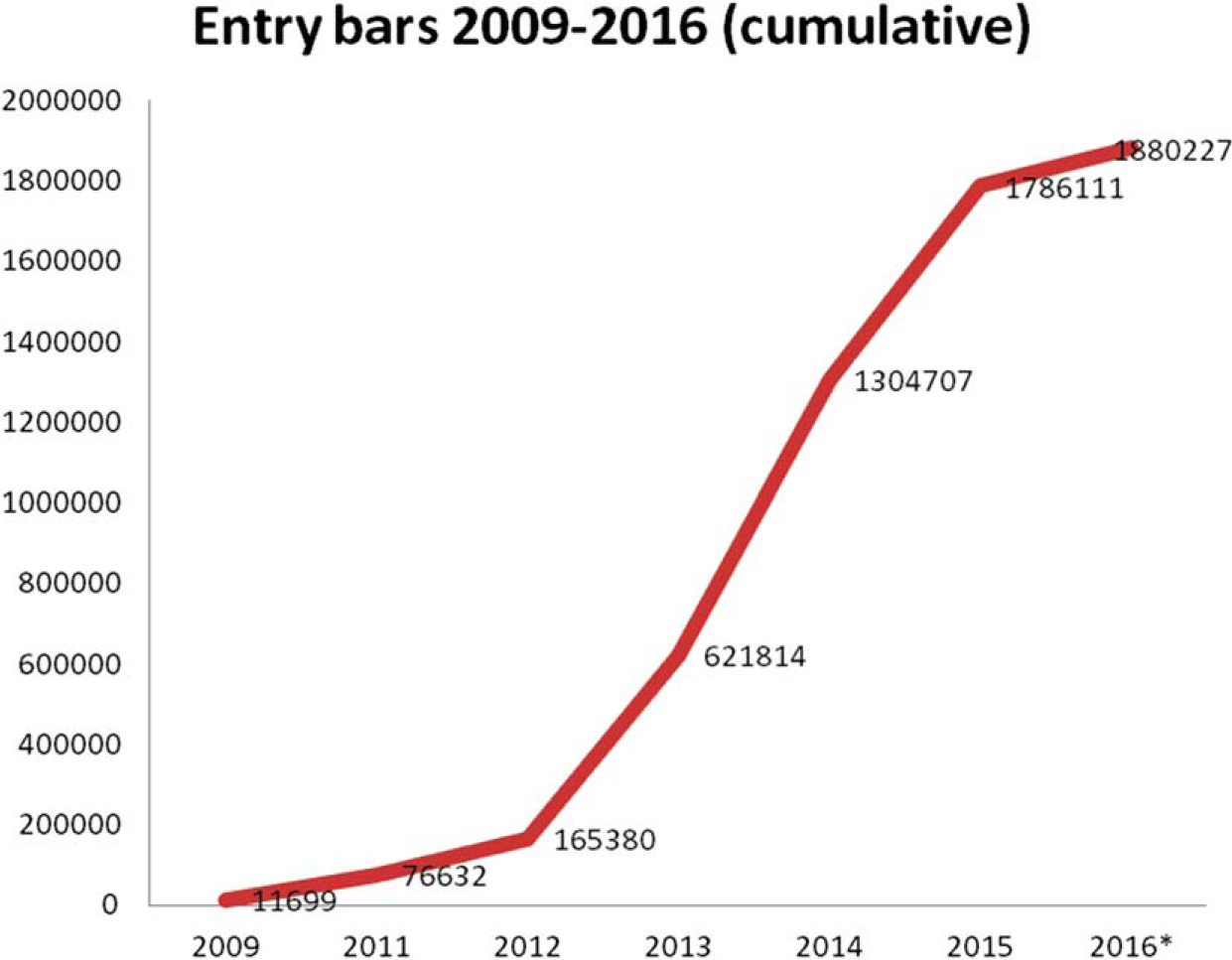
When the law introducing zapret na v'ezd for administrative offenses entered into legal force, the number of people against whom reentry bars were issued increased over twofold between 2013 and 2014, peaking at 1.8 million in February 2016 (see Figure 1).
Entry Bars Issued in Russia to Foreign Nationals between 2009 and 2016.
Sources: Federal Migration Service 2009–2016, as of 2016 (when the FMS has been disbanded) the statistical data can be accessed from the General Administration for Migration Issues of the Interior Ministry of Russia, Statistical Department, https://гувм.мвд.рф/about/activity/stats/Statistics/Statisticheskie_svedenija_po_migracionno (all data accessed on September, 20, 2016); 2016* – cumulative data until March 2016. [Color figure can be viewed at wileyonlinelibrary.com]

IV. Controlling Whom? An Entry Bar Case Study
Russia, due to its geopolitical positioning and post-empire status, was a magnet for migrant workers from the region. Nearly 43 percent of all migrants in Russia are citizens of Uzbekistan, Tajikistan, Kazakhstan, and Kyrgyzstan (United Nations 2009). Due to the free movement, no-visa regime, they would have entered the country legally and, on the basis of a work permit or a patent (an out-of-quota work permit introduced in 2011), would have been accepted by the FMS as legal residents in Russia. Most migrants from Central Asia come to Russia to work; however some, particularly those from Uzbekistan and Tajikistan, seek refuge from religious or political persecution. Almost all of them are legally eligible to become Russian citizens via the three-year temporary residence permit (razresheniye na vremennoe perezhivanie Footnote 9 ) and subsequently indefinite leave to remain (vid na zhytelstvo Footnote 10 ) (Shevel Reference Shevel2012).Footnote 11
Those migrants, as legal residents, work, marry, raise children who then go to school, and lead lives in many aspects similar to those of Russian citizens. When lawful residents face charges in a court of law, the formal qualities of the process largely resemble those encountered by a citizen. Migrants have the same procedural protections and face the same system of trial and sentencing with the same right to appeal. According to the Russian Constitution, they cannot be charged with a crime that was not a crime at the time of its commitment; they cannot receive a sentence that exceeds that authorized at the time the crime was committed. And yet, despite these procedural safeguards in place, these legal residents face one big difference in the legal process—with the changes in the entry bar legislation over 2012 and 2013, two or more simple administrative offenses, such as parking or speeding tickets, now make them effectively deportable, since these offenses lead to a three-year entry bar and the impossibility of further legalization.
To add some empirical flesh to the statistical and legal information and illustrate whom the entry bar de facto affects and with what consequences, this section presents a case study of a composite character, Akmal.Footnote 12 Akmal is thirty-one, Muslim, and comes from Fergana in Uzbekistan. He arrived in Moscow nearly eleven years ago and initially stayed with one of his extended family members: an uncle. He was working for him on one of Moscow's many construction sites. Now, when he drove me in his car around the city, he would be pointing to buildings which he helped to construct or to restore, or where he offered a consultation. With time, Akmal moved to work for himself. He bought a car and in his spare time, mostly at night, he worked as a taxi driver—mainly for people he knew and extended family members who were coming from Uzbekistan to Moscow and needed to be picked up from the airport.
Akmal, now an experienced builder, rose through the career ranks in the construction industry and started working as a team leader for one of the building companies. That company was an example of the complex and intricate pyramid of intermediaries, where, until the crisis of 2009, Akmal controlled who would be hired on the different construction projects, making sure to fill the available vacancies with the network of his kinsmen from Fergana. At one point he was managing a team of fifteen people on a large construction project outside of Moscow. Akmal and his team specialized in window and door fittings. Their clients were mainly other construction companies, or individuals renovating their flats, apartments, and houses, or building new ones.
Akmal was able to cut back on his taxi driving. He nevertheless still very much relied on his car to get to work and to commute between different construction sites. He often was stopped by the traffic police for a regular document check, and was sometimes fined for speeding or not wearing a seatbelt. The tickets were never higher than 500 Roubles (approximately 8 USD). Akmal never had a serious collision; he never drove under the influence of alcohol. He was a careful and experienced driver. He accepted the tickets as part of the business, and paid them on time.
With regard to his immigration papers and work permit, Akmal followed a typical pattern of a migrant worker in Russia. Initially, when he arrived in Moscow, he resided legally, on the basis of the free movement (no-visa) regime between Russia and the former Soviet republics, but he worked without a permit. A work permit was too expensive to obtain for a first-time migrant worker in Moscow. Gradually, however, he legalized his work, obtained a work permit via an intermediary, and renewed the permit more or less regularly. There were times when the money was short due to delays in getting paid, so Akmal would seek different means of regularizing his stay—he would leave Russia for one day, return and enjoy a renewed grace period of three months for arranging a new work permit. As Akmal became more experienced and knowledgeable about the migration papers market, he would omit the intermediaries and apply for a work permit directly at the FMS.
In February 2014, during what he thought would be a routine renewal of the work permit, for the first time his application was rejected. The local FMS officer told Akmal that his name had been placed on a blacklist (chernyi spisok), and that he was forbidden entry to the RF (v'ezd zakryt). He was asked to leave Russia in the shortest possible time. Akmal was not given a reason why this had happened. With various construction projects under way, money still owed to Akmal and his team, a wife and a child living with him in Moscow, leaving Russia seemed impossible.
Akmal wanted to find out why he had been issued the reentry bar. This involved a painstaking process. There were only a few FMS offices in Moscow that offered such service, and they were open only twice a week and understaffed. He had to wake up at 4 a.m. in order to register himself in the queue (the so-called zhyvoi ochered). Akmal arrived at 5 a.m., five hours before the office opened, and was already tenth in the queue. Six hours later, an FMS officer confirmed that the three-year entry bar had been issued for administrative offenses committed within the last three years. He found out the exact date of the issuance of the reentry bar, when the bar information had been forwarded to the border guards of the RF, and which local FMS office had issued it. The information also included the date when the reentry bar would automatically be lifted. When asked about the exact nature of the administrative offenses committed, the FMS officer did not have this information on the database, except for a general reference to the relevant statutory provision. He advised Akmal to contact the Federal Bailiff ServiceFootnote 13 for detailed information. However, a quick look at the open database of the State Inspection of Road SafetyFootnote 14 demonstrated that Akmal had earned himself three tickets (two for speeding and one for not wearing a seatbelt) between 2011 and 2013. He promptly paid the fines for two out of the three tickets. The entry bar would have therefore been administered partially in a retrospective manner because the law introducing the entry bar on the basis of two or more administrative offenses within a time span of three years was only introduced in July 2013.
Akmal asked the FMS officer about the possibility of removing the entry bar. He was told that if any of his close family members were Russian citizens, he could apply for the removal of the bar by writing a letter to the head FMS office in Moscow and submitting notary-certified copies of the marriage certificate and/or passport or birth certificate of the child. Akmal was fortunate that he fit the criteria: he was married to a Kyrgyz woman with Russian citizenship, and his son, born in Moscow, was also a Russian citizen. At the time of writing this article, Akmal was still waiting for the decision of the FMS in response to his letter.
Akmal is a composite character. This case study is designed to be representative of many Central Asian migrants in Russia against whom an entry bar has been issued. Some of them, like Akmal, have family members who are citizens of RF, and therefore can appeal the bar on the basis of Article 8 (the right to private and family life) of the European Convention of Human Rights (ECHR), to which Russia is a party. Many of them, however, do not have this advantage and, upon receiving the entry bar on the basis of administrative offenses, they join a growing group of legally produced (de Genova Reference de Genova2004) illegal or deportable people. This case study illustrates many of the important features of entry bar immigration law in practice. In the remainder of the article, I focus on the four most important features: (1) a shift in the role of the entry bar from controlling the migration process to controlling the social conduct of migrants, (2) the retroactivity in administering the entry bar, (3) the grounds of appeal and structures available for challenging the entry bar, and (4) the proportionality or severity of the sanction, demonstrating that it falls somewhere in the gray area of the civil/criminal divide.
V. Conceptualizing the Entry Bar as a form of Social Control Deportation Model
Daniel Kanstroom, in his seminal essay on Deportation, Social Control and Punishment, introduced an important distinction between two basic models of deportation laws and practices: border control and social control (Kanstroom Reference Kanstroom2000, 1897). The border control model envisions deportation as “the consequence of a violation by a non-citizen of a condition imposed at the time of entry” (1898)—in other words, it sanctions deportation as a consequence of a violation of the contract between the migrant and the host country as inherent to the immigration law. The social control deportation model rests on a different assumption; it is conceived of as a method of continual control of the behavior of noncitizens for their alleged post-entry misconduct; it is normally issued by courts as a result of a noncitizen breaking some sort of laws on the territory of the host state (usually criminal in nature or attracting a relatively long imprisonment). In the United States, for instance, deportation follows from being found guilty of committing crimes classified as aggravated felonies (sanctioned by the Antiterrorism and Effective Death Penalty Act [AEDPA] and the Illegal Immigration Reform and Immigrant Responsibility Act [IIRIRA], both of 1996); in the United Kingdom, the 2007 UK Borders Act made deportation nondiscretionary when the jail sentence was over a year.Footnote 15 These immigration reforms have expanded the class of deportable offenses and limited judges' authority to alleviate deportation's harsh consequences. The drastic measure of deportation or removal is now virtually inevitable for a vast number of noncitizens convicted of crimes.
Kanstroom (Reference Kanstroom2000) argues convincingly that, in the latter sense, the deportation law is more analogous to criminal law and often seems more punitive than regulatory. By distinguishing these two types of deportation models, Kanstroom in fact draws a line between regulatory/punitive and civil/criminal deportations. This typology, systematically denied by courts in the United States, which—until Padilla v. Kentucky (2010)—rather tautologically insisted that deportation, however harsh it may be in practice, is not a criminal sanction but a regulatory and administrative procedure (Schuck Reference Schuck1984; Golash-Boza Reference Golash‐Boza2010), therefore enables inquiry into the real effects of deportation for long-term residents and their families.
With the expansion of the criminal grounds leading to deportation (since 1996) the US Supreme Court in Padilla has recognized deportation as an integral part of the penalty that may be imposed on noncitizen defendants who plead guilty to specified crimes. The deportation for lawful permanent residents “no longer serves the remedial purpose of regulating the immigration process, but seeks to punish the residents for the underlying criminal behavior” (Ortiz Maddali Reference Ortiz Maddali2011, 6). As a result, the court established that because deportation based upon criminal convictions is akin to punishment—“[t]he severity of deportation [is] the equivalent of banishment or exile” (Padilla v. Kentucky 2010, 1486)—it requires special safeguards and protections.
The acknowledgment by the US Supreme Court that deportation may constitute a punishment legally recognizes Kanstroom's typology. In the regulatory or border control model, the role of deportation was supposed to be remedial (Ortiz Maddali Reference Ortiz Maddali2011, 34), to put an end to ongoing immigration violationsFootnote 16 where one's presence on the territory of the state would constitute a continuing violation of immigration law. In contrast, sanctioning deportation for (even minor) criminal offenses committed on the territory of the host state does not serve this purpose—the alleged crime has already been committed and the person would have served the sentence prescribed by law. Here, deportation is, according to the court in Padilla, “an integral part—and sometimes the most important part of the penalty that may be imposed” (Padilla v Kentucky 2010, 1480). It serves a different, punitive function: it aims to control the behavior of those migrants already admitted to the country.
The Kanstroom typology and the discussion around Padilla also cast more light on zapret na v'ezd in Russia. The evolution of entry bar legislation and practice in Russia following the changes to the Federal Law on the Rules of Entry and Exit in December 2012 and July 2013 reveals how the entry bar has been transformed from a remedy for an ongoing immigration law violation to a punishment for the administrative offenses of migrants legally admitted and legally residing in the country. This demonstrates a shift from the regulatory, border control model, where the entry bar sanction was indeed to control the immigration process, toward the social control model, resting firmly on the condition of deportability (de Genova Reference de Genova2002, 439) of a growing number of migrants, mostly already within the country. Thus, Russia has followed the global trend toward migration governance through deportability (de Genova and Peutz Reference de Genova and Peutz2010).
VI. Lex Retro Non Agit? Footnote 17 the Retroactivity of the Entry Bar
Russia has also followed in the footsteps of other immigrant-receiving jurisdictions in the retroactive application of its immigration law. The 2013 amendment states that the entry bar should be administered to foreign citizens who “two or more times within the three years' period were brought to administrative responsibility” (Law on the Rules of Entry and Exit 2013, Article 26, Paragraph 4). This wording leaves open the exact placement of this three-year window. In practice, immigration officials have interpreted this language to mean any three-year period of a migrant's residence rather than a three-year period since the passage of the law.
The retroactive application of the law arguably conflicts with Article 54 of the Russian Constitution, which prohibits ex post facto punishment in criminal and administrative law. However, the permissibility of retroactive laws requiring the de facto deportation of (long-term) lawful residents has so far not made it before the courts.
Russian practice resembles that of the United States. After the passage of the IIRIRA and the AEDPA of 1996, deportation became a virtually automatic consequence of a criminal conviction, even if the alleged crimes were committed prior to the passage of the Act (Kanstroom Reference Kanstroom2000, 1891). AEDPA and IIRIRA placed mandatory detention orders on all noncitizens convicted of crimes to be applied at the time of their release from the custody of the criminal justice system with a view to removal or deportation. The retroactivity of deportation in the United States rested on an assumption that the migrants “were not being punished, they were being regulated” (Kanstroom Reference Kanstroom2000, 1895). For example, noncitizens who committed crimes in the United States would first complete any jail or prison time that was mandated as punishment for their crimes. If those criminal convictions rendered them deportable, they were deported upon completing their sentences.
People convicted of certain crimes classified as aggravated felonies face “mandatory deportation without a discretionary hearing where family and community ties can be considered” (United Nations Human Rights Council 2008, 8), even though these crimes have been already settled in law. Nancy Morawets illustrates the dire consequences of retroactive deportation with an example from her immigration law practice:
Jackie H. immigrated to the United States at the age of 18 and has resided there ever since as lawful permanent resident. A few years later she was arrested for possession of marijuana when police discovered two ounces of that substance in a car that she was driving. Although she did not know about the marijuana, she was in fact the owner and driver of the car. Seeking to avoid disruption of her work and family life, she pled guilty to a simple possession charge and was sentenced to probation.…
Several years later, when she applied for a replacement of her residency card the immigration officer picked up the conviction on a computer check and placed Ms. H in deportation proceedings.… Unless the Attorney General opts to terminate and reinitiate proceedings under IIRIRA, Ms. H will be deported regardless of how long ago she committed the offence. (Morawetz Reference Morawetz1998, 117–18)
The Jackie H. case demonstrates how the immigration legislation that sanctions deportation retroactively undermines the certainty of the law. Migrants could not know at the time of committing a particular crime or administrative offense that it would have immigration law–related consequences. Upon serving the sentence or having paid the fine, they would have regarded the matter as closed. The introduction of IIRIRA and AEDPA in the United States, when applied to past convictions, served to alter the legal consequences of those convictions—either by creating a risk of deportation where none existed, or by making deportation a necessary consequence of a conviction that before only gave rise to a risk of deportation (Morawetz Reference Morawetz1998, 122).
With regard to zapret na v'ezd issued retroactively for administrative offenses like parking or speeding tickets, during my fieldwork in Russia in 2014 I came across numerous cases of people who, like Akmal from the case study, were affected by this harsher, retroactive reentry bar legislation. These migrants worked and lived in Russia in accordance with the migration law—on the basis of either a work permit or a patent. But then during a routine visit to the FMS office to renew their documents, they could be met with a staunch refusal.Footnote 18 Due to the entry bar on the FMS database, their immigration papers could not be renewed and they were asked to leave the RF in the shortest possible time. Many felt confused—some of them had been working and living legally in Russia for many years. Now, on the basis of past speeding or parking tickets (which by and large they would have paid and regarded the matter as closed) they found themselves deportable from a country in which they had established families, lived, worked, and paid taxes, sometimes for many years.
The courts in Russia have not yet taken a stance with regard to the constitutionality or broader legality of zapret na v'ezd issued for past administrative offenses. Some immigration lawyers with whom I spoke in Russia dismiss the potential unconstitutionality of zapret na v'ezd. One said that “theoretically it has not been designed as a supplementary punishment for past offences” (Interview 3, 2014). The entry bar, another said, should rather be perceived as “a limitation of one's right to reenter the territory of RF” (Interview 4, 2014). This argument is based on a normative principle that the state, as a sovereign, should have a full right to decide who should be admitted and who should be prohibited entry, also on the basis of that person's conduct on the Russian territory—resembling the plenary power doctrine in the United States (Legomsky Reference Legomsky1984, Motomura Reference Motomura1990). The entry bar does not void migrants' current immigration papers, it “only prevents them from renewing them, applying for an extension of a residence or a work permit” (Interview 4, 2014).
The Russian immigration lawyers' arguments about the reentry bar for past administrative offenses being not a punishment but a limitation of one's right to reenter Russia echo the circular arguments on the side of state authorities elsewhere in the Western liberal-democratic jurisdictions holding that deportation is not a punishment but an administrative procedure. However, from the migrants' perspective, the entry bar as issued in Russia for past minor administrative violations nevertheless comes across as a double punishment for the same wrongdoing. As one frustrated migrant said, “Look, these tickets. I paid for them. I paid them. Why now the zapret is added as well?” (Interview 37, 2014)
The discussion about the retroactivity of the entry bar in Russia demonstrates once again that this sanction is not necessarily tied to the border or to the admission process, but it follows what might be termed an eternal probation or perhaps an eternal guest logic (Kanstroom Reference Kanstroom2000). This suggests that noncitizens, including lawful residents, may be subject to a shifting, even retroactive regime of deportation and the government's absolute and unqualified right to exclude on the basis of alleged post-entry misconduct. In Russia—in contrast to the United States—the state does not physically expel migrants (thus saving on precious resources), but removes any possibility of regularizing their stay. It uses a subtle mechanism of closing off the internal borders by making the renewal of immigration and employment documents dependent on one's traffic offenses record. The aim of the reentry bar regulation is not necessarily to enforce the general compliance with immigration law—it is to control, police, and ultimately exclude those who happened to transgress those rules when they were not even part of the law yet. The practice of barring reentry on the basis of past administrative offenses literally pushes migrants outside the inner ring of legality, resulting in a “border at the door” phenomenon (Kubal Reference Kubal2016). It makes their stay illegal.
VII. Appeal Structures
The slogan repeated by the FMS officials at almost every public meeting—“the entry bar database does not take bribes”Footnote 19 —illustrates the modern, technocratic style of administering this new sanction. However, it also brings to mind the potential miscarriages of justice that could happen due to conscious or unconscious human and technical errors. A leading human rights activist in Russia expressed this in the following terms:
OK, so the database does not take bribes. Fine. But what if the database gets something wrong? What if an FMS officer clicked the wrong button? As the database is this impersonal machine which does not take bribes, it is also difficult to argue with, to appeal, to correct its potential mistakes. A human life is involved; migrants have families, jobs, and children in Russia; what if they find themselves in the database by mistake, by a technical error? (Interview 1, 2014)
This raises an important question about the checks and balances inscribed in the enforcement of the new legislation and the modes of appealing or challenging the entry bar. These, in Russia, still remain rather broad. Article 46(2) of the Russian Constitution provides that decisions and actions (or inaction) of state authorities, bodies of local self-government, public associations, and officials may be appealed against in a court of law. Courts tend to regard as unconstitutional any statutory restrictions of this right (Burnham, Maggs, and Danilenko Reference Burnham, Maggs and Danilenko2012, 669). The FMS guidelines therefore state that the “decision on the re-entry bar into the territory of the Russian Federation may be reviewed in accordance with the legislation of the Russian Federation” (Federal Migration Service 2014). There are two main ways of challenging the entry bar in Russia—administrative review and judicial review, using district-level (first instance) and regional-level (second instance) courts as arbiters between the FMS and foreign citizens.
As the case study of Akmal illustrated, a person who wishes to challenge the entry bar via administrative review must write a letter to the Head Office of the FMS explaining the reasons why the bar should be lifted, accompanied with documentary evidence (in originals) that would support the plea. The formal basis for the administrative review, as described on the FMS website (and also included in a correspondence between FMS and one of Moscow's legal NGOs), are rather broad.Footnote 20 They include, for example, the presence of close relatives who are citizens of Russia (as spouses, parents, or minor children), valid temporary or permanent leave to remain, a valid work permit or patent, and a need for emergency medical treatment or full-time study at Russian universities. These grounds explicitly result either from the national law or international obligations to which Russia is a party, such as the ECHR. FMS has 30 days to respond to the letter with its decision. My fieldwork demonstrates, however, that the practice of entry bar removals is inconsistent. Despite clear FMS policy, some grounds for entry bar removal are more likely to be granted than others. For example, entry bar challenges on the basis of permanent residence documents or a valid work permit are often refused. In contrast, petitions on the basis of Article 8 of the ECHR have been more successful.
If denied under administrative review, one can appeal the entry bar directly in a regular district court, challenging not only the decision itself, but also the legality of the decision taken by FMS officials (e.g., procedural violations in arriving at the decision) (Solomon Reference Solomon2004, 553). Generally, the citizens do not have to exhaust the remedies within the administrative hierarchy before going to court (Burnham, Maggs, and Danilenko Reference Burnham, Maggs and Danilenko2012, 661). The scope of Russian review of administrative action includes a review of both the law and fact issues, as the courts are not obliged to accept findings of fact or conclusions of law made by officials or other state bodies (Burnham, Maggs, and Danilenko Reference Burnham, Maggs and Danilenko2012, 672).
As courts in Russia follow the territorial jurisdiction principle, the appeal must be submitted either to the court in a district where the applicant is registered or the district court where the FMS office that took the decision about the entry bar is located. Since in Moscow there are difficulties for migrants to prove their residence registration (Reeves Reference Reeves2013), appeals are usually filed in the district courts where the main FMS offices are based. These courts have developed an expertise in migration law–related cases. Filing the case to court usually suspends the implementation of the challenged action or decision while the case is pending (Burnham, Maggs, and Danilenko Reference Burnham, Maggs and Danilenko2012, 672).
There is also a right to appeal from the decision of the first-level district courts. The appeal must be lodged within seven days of the day the court judgment is rendered. The filing of an appeal automatically suspends execution of the court's judgment or ruling. The appellate (regional) court can uphold the judgment, annul the judgment and return the case for further investigation, annul the judgment and terminate the case, or modify the judgment (Smith Reference Smith1996, 146).
The rather broad formal appeal structures in Russia contrast with the more limited appeal rights that have become the main feature of immigration law in Western liberal jurisdictions. In the Immigration Act 2014, for example (which repealed the Immigration Act 1999), the United Kingdom reduced the number of grounds for appeal from seventeen to just three (Sayeed Reference Sayeed2014). There is only a right of appeal against a decision of the Home Office to refuse a protection or human rights claim, or against a decision of the Home Office to revoke a protection status. Every other immigration decision made by the Home Office will not attract a right of appeal, with the remedy in those circumstances being administrative review and/or judicial review (Sayeed Reference Sayeed2014).Footnote 21 Furthermore, the Immigration Act 2014 enables the secretary of state to require any appeal against deportation to be brought only after the very act of physically removing a person from the territory, both in UK law and EU law cases (Yeo Reference Yeo2014).Footnote 22 Analogically, any person with no leave to remain (and who is required to have it) may simply be removed from the United Kingdom with no further notice or legal step being required. The new provision should be seen as a simple power to remove rather than a type or species of immigration decision (Hoshi Reference Hoshi2014).Footnote 23
With regard to the appeal structures for the entry bar, Russia's relatively broad rights of appeal distinguish it (for now) from other immigration-receiving jurisdictions. Although there is a variation in how the formal appeal rights work in practice, the interviews with immigration lawyers in Russia demonstrate that they are definitely relied upon. As one stated:
You do go to court. You do appeal. Whether you succeed or not … mostly you do not … is another matter, but as a principle you do appeal to court. (Interview 13, 2014)
VIII. Proportionality of Punishment
Notwithstanding the broad appeal structures, the introduction of the three-year entry bar in response to alleged migrant illegality in the areas of traffic or other administrative offenses raises rather serious questions concerning the proportionality of these sanctions in relation to the violations for which they are usually administered. I conceptualize proportionality in a sociolegal, empirical manner—by focusing on the disruptive effects this bar has on immigrants' livelihoods. If the entry bar is often administered whilst a person resides in the country (e.g., with a valid residence permit and/or a work permit), works there, and has children and family ties—as illustrated by the composite story of Akmal—the entry bar makes it impossible for that person further to renew his or her immigration documents and forces him or her to leave Russia for a period of three years. It therefore results in a disproportionate sanction in a commonsense meaning of the word. These specificities of the zapret na v'ezd concerning the proportionality of this practice demonstrate how global migration governance practices reflect the strictness and punitiveness that are longstanding elements of Russian legal tradition.
The various legal reforms in Russian criminal and civil law since the 1960s were aimed at dismantling, at least partially, the draconian elements of the Stalinist system (Smith Reference Smith1996, 141). A set of incremental changes in the 1960s and 1970s under the auspices of Soviet legality were designed to guarantee the procedural and substantive rights of citizens and to ensure the professionalism of the courts (Smith Reference Smith1996, 141)). And yet, although the same judicial system was capable of professional and fair handling of routine cases (Smith Reference Smith1996, 142; Hendley Reference Hendley2011), it was also used as a repressive and arbitrary tool to punish individuals in order to protect the state. With the changes of the perestroika period and the greater legal reforms that followed—for example, introducing the new Criminal Code (1997) that formally decriminalized a number of victimless offenses, ameliorated the severity of sanctions, and articulated preference for noncustodial sentences—came, however, the chaos of the 1990s, preserved in collective social memory as the breakdown of public order and a rapid increase in violent crimes.
The early 1990s were characterized by soaring rates of murder (Izvestiya, October 2, 1992, quoted in Smith Reference Smith1996, 154) and rape (New York Times, January 3, 1994, quoted in Smith Reference Smith1996, 154), as well as an explosion of white-collar and property crimes. It is perhaps not surprising, then, in a period characterized by “extremist politics, volatile economics and bewildering legislation” (Kurkchiyan Reference Kurkchiyan, Galligan and Kurkchiyan2003, 26), the Russian legal system retained strong punitive elements. These “stubborn legacies” of the Soviet past—the “punitive mindset” and an inclination to seek solutions to societal problems in repressive measures (Pomorski Reference Pomorski1998, 392)—were thereby preserved well into the twenty-first century.
Russian immigration law, in contrast to the UK (Aliverti Reference Aliverti2012) or the US (Chacon Reference Chacon2009; Romero Reference Romero2010) systems, has not been formally criminalized. The three-year entry bar or surreptitious deportation does seem to follow the logic of the social control deportation model (Kanstroom Reference Kanstroom2000), but it does not constitute a migration-related mechanism of enforcing criminal law (Legomsky Reference Legomsky2007). It remains attached to administrative offenses. Examining Russia's legal tradition helps to explain this phenomenon: there was no need to criminalize Russian immigration law, as its repressive functions could be equally accommodated within the existing framework of historically punitive administrative law. Although formally within the ambit of the administrative law, if analyzed from the perspective of the severe impact on migrants' lives, zapret na v'ezd actually constitutes a quasi-criminal sanction, a form of punishment.
The analysis of the entry bar in Russia invites a deeper reflection about the nature and the consequences of the civil and criminal labels in immigration law more broadly. With the expansion of punitive administrative sanctions, the division of legal sanctions into these two categories is perhaps misleading. As punishment seems no longer to be the distinctive attribute of criminal law (Ortiz Maddali Reference Ortiz Maddali2011, 8), keeping in mind that the civil sanctions might actually be severer and harsher than actual criminal sanction imposed helps to interrogate the actual aims of the ever-expanding criminalization of migration law in the United States and the United Kingdom.
The incorporation of criminal law into the immigration domain in Western liberal jurisdictions can rather be viewed as an instance of symbolic law (Aliverti Reference Aliverti2012). These policies aim to placate public concerns with undocumented immigration, sending a loud and clear political message that action is being taken (Aliverti Reference Aliverti2012; Kubal Reference Kubal2016). I argue elsewhere that even when the criminalization of migration is stripped of the attributes of formal judicial power, courts, and lawyers, it nevertheless exercises a real power over peoples' lives. Indeed, extralegal manifestations of criminalization may be even more “effective” tools of social control (Kubal Reference Kubal2016, 3). Once the message of criminalization of certain aspects of migration law reaches the public discourse, it gains a life of its own, with factors such as penal politics, media coverage, and the extensive discretion exercised by criminal justice and immigration officials effectively blurring the boundaries between undocumented migrant, asylum seeker, and the criminal. In Russia the blurring or destabilization of the criminal–civil distinction is partially explained by its historically punitive law, and partially by the current hybridization of legal institutions and practices and “the slipperiness of the operations of state power as they seek to name the various modalities of its exercise” (Sarat, Douglas, and Umphrey Reference Sarat, Douglas and Umphrey2011, 14). This complex relationship between historical legacy and institutional change lies at the roots of the current instability of the criminal–civil distinction in all of its messy manifestations in immigration law and practice (cf. Steiker Reference Steiker1997).
IX. Conclusions
The aim of this article was to examine the evolution and the sociolegal characteristics of the entry bar legislation in Russia, with comparative reference to the legal developments in the areas of deportation and removal in the United States and the United Kingdom. I adopted a comparative perspective to cast more light on the migration governance processes in Russia and to move away from the intellectually dead-end explanations that exoticize Russia and invoke arguments about how law does not really work there. The comparative perspective demonstrates that the entry bar legislation follows a similar logic to the developments surrounding deportation and removal orders of the United States and the United Kingdom: a shift from remedial to increasingly punitive sanctions, from putting an end to an ongoing immigration law violation to punishing migrants for their post-entry misconduct. Both sanctions are also increasingly retroactively applied. This analysis reveals how the most recent changes in Russian migration law stay very much in tune with more global migration governance developments.
Where Russia diverges from the more general trends is in its still quite broad appeal structures in comparison to the removal of appeal rights for migrants in Western liberal jurisdictions. The disproportionality of the entry bar in relation to the actual offenses for which it is administered demonstrates, however, that the global developments are very much combined in Russia with the local legal specificities and the legacy of its punitive and repressive legal system. This, in turn, helps to question the criminal and civil labels in migration law more broadly—suggesting, in particular, the danger of extending criminal liability to what are essentially regulatory violations. With the increased criminalization of migration law in the United States and the United Kingdom, this comparative analysis suggests that serious deterrent sanctions can effectively be imposed under an administrative system provided that due process safeguards are in place.
Appendix

| Informant details | Date | Place |
|---|---|---|
| 1 – Head of NGO | May 25, 2014 | Moscow |
| 2 – Professional Advocate | June 6, 2014 | Moscow |
| 3 – Professional Advocate | April 13, 2014 | Moscow |
| 4 – Professional Advocate | September 9, 2014 | Moscow |
| 5 – Migration Researcher | April 6, 2014 | Moscow |
| 6 – Legal Consultant | April 26, 2014 | Moscow |
| 7 – Professional Lawyer for Migrants | April 1, 2014 | Moscow |
| 8 – Labor Rights Researcher | May 16, 2014 | Moscow |
| 9 – Migrants' Rights Researcher | June 26, 2015 | Moscow |
| 10 – Legal Consultant | May 15, 2015 | Moscow |
| 11 – Professional Advocate | April 5, 2014 | Moscow |
| 12 – Professional Advocate | April 14, 2014 | Moscow |
| 13 – Professional Advocate | September 7, 2014 | Moscow |
| 14 – HR Lawyer | April 16, 2014 | Moscow |
| 15 – HR Lawyer | April 28, 2014 | Moscow |
| 16 – Professional Advocate | June 18, 2015 | London |
| 17 – Social Worker | April 23, 2014 | Moscow |
| 18 – Social Worker | May 28, 2014 | Moscow |
| 19 – Social Worker | May 27, 2014 | Moscow |
| 20 – Social Worker | June 18, 2014 | Moscow |
| 21 – Social Worker | June 7, 2014 | Moscow |
| 22 – Researcher | September 12, 2014 | Moscow |
| 23 – FMS Representative | September 16, 2014 | Moscow |
| 24 – FMS Representative | September 18, 2014 | Moscow |
| 25 – FMS Representative | May 6, 2014 | Moscow |
| 26 – FMS Representative | June 2, 2014 | Moscow |
| 27 – FMS Representative | September 8, 2014 | Moscow |
| 29 – FMS Representative | September 19, 2014 | Moscow |
| 30 – NGO Employee | May 25, 2014 | Moscow |
| 31 – NGO Employee | September 5, 2014 | Moscow |
| 32 – NGO Employee | June 6, 2014 | Moscow |
| 33 – Migrant Uzbekistan, male | April 6, 2014 | Moscow |
| 34 – Migrant Kyrgyzstan, female | April 12, 2014 | Moscow |
| 35 – Migrant Kyrgyzstan, male | April 13, 2014 | Moscow |
| 35 – Migrant Kyrgyzstan, female | April 15, 2014 | Moscow |
| 36 – Migrant Kyrgyzstan, female | May 15, 2014 | Moscow |
| 37 – Migrant Uzbekistan, male | April 17, 2014 | Moscow |
| 38 – Migrant Uzbekistan, male | April 17, 2014 | Moscow |
| 39 – Migrant Uzbekistan, male | April 17, 2014 | Moscow |
| 40 – Asylum Seeker Uzbekistan, male | June 26, 2014 | Moscow |
| 41 – Asylum Seeker Uzbekistan, male | May 24, 2014 | Moscow |
| 42 – Asylum Seeker Uzbekistan, male | June 19, 2014 | Moscow |
| 43 – Asylum Seeker Uzbekistan, male | September 23, 2014 | Moscow |
| 44 – Asylum Seeker Uzbekistan, female | September 23, 2014 | Moscow |
| 45 – Asylum Seeker Tajikistan, female | September 20, 2014 | Moscow |
| 46 – Asylum Seeker Uzbekistan, female | June 2, 2014 | Moscow |
| 47 – Refugee Uzbekistan, male | September 18, 2014 | Moscow |
| 48 – Refugee Uzbekistan, male | September 20, 2014 | Moscow |
| 49 – Refugee Tajikistan, male | September 23, 2014 | Moscow |
| 50 – Asylum Seeker Syria, male | May 21, 2014 | Moscow |