Thousands of hazardous materials (hazmat) releases occur each year in the United States.1 When not properly managed by on-scene first responders (eg, police, fire, and hazmat response teams), the boundaries of a hazmat event can quickly extend beyond the point of origin. When this occurs, medical personnel (eg, emergency medical technicians [EMTs] and hospital personnel, such as emergency department [ED] physicians and nurses), equipment, and facilities are at risk for secondary contamination from primary victims exposed during hazmat releases. Secondary contamination—the transfer of hazardous materials from contaminated victims to offsite responders and equipment—can cause adverse symptoms and injuries in medical personnel. In addition, secondary contamination can lead to medical assets (eg, ambulances) being taken out of service, temporarily or permanently, and to costly ED closures and evacuations. 2–Reference Burgess4
Secondary contamination of medical personnel, equipment, and facilities typically results when hazmat victims leave the release area without undergoing decontamination or are inadequately decontaminated. The basic purpose of decontamination is to reduce external contamination (eg, on people and equipment), contain the contamination present, and prevent the spread of potentially dangerous substances.5, 6 Medical personnel can be exposed to chemicals from hazmat victims, primarily through inhalation and dermal contact. The risk for secondary injury largely depends on the toxicity of the substance on the primary victim's hair, skin, and clothing or in body fluids (including vomitus) and exhaled air. The risk also depends on the concentration of the substance, ventilation, and the duration of contact that medical personnel have with the victim. Primary victims who undergo proper decontamination at the scene of the event are less likely to pose a secondary contamination risk to medical personnel; however, victims whose hair, skin, or clothing is contaminated with solids, liquids, and vapors (including condensed vapor) may endanger medical personnel by direct contact or from off-gasses.2
Data from the Agency for Toxic Substances and Disease Registry's (ATSDR) Hazardous Substances Emergency Events Surveillance (HSEES) system were used to conduct a retrospective analysis on hazmat events in 17 states that involved secondary contamination of medical personnel, equipment, and facilities during 2003 through 2006. HSEES is the only surveillance system that captures the public health consequences (eg, morbidity, mortality, evacuations) from hazmat releases. The purpose of this article is to raise awareness among responders, particularly medical personnel (ie, EMTs and hospital personnel), about the potential risk of secondary contamination from hazmat releases, and to update previously conducted secondary contamination analyses using HSEES data.Reference Horton, Burgess and Rossiter7, Reference Horton, Berkowitz and Kaye8 It should be noted that this analysis differs from earlier analyses because personnel victims are included here, whereas in the previous analyses only ED personnel were included. The objectives of the analysis were to describe the characteristics and acute public health consequences of hazmat events involving secondary contamination, to present selected case reports of hazmat events involving secondary contamination, and to identify key strategies that may help prevent secondary contamination during future hazmat events.
METHODS
Since 1990, ATSDR has maintained the state-based HSEES system to help reduce the morbidity and mortality associated with hazardous substances releases. Every 5 years, ATSDR has a competitive announcement and funds as many state health department applicants as possible. Fourteen state health departments currently participate in HSEES. Participating HSEES states use multiple data sources to capture complete information about an event. These sources include, but are not limited to, the US National Response Center; the US Department of Transportation; state environmental, emergency response, and transportation agencies; police and fire departments; poison control centers; hospitals; and news media. The information collected (eg, substance[s] released, victims, injuries, and evacuations) is entered into a real-time, Web-based surveillance system.
A HSEES event is defined as the release, or threatened release, of a hazardous substance or substances. The amount of the substance released must meet minimal amount criteria (ie, 10 lbs or 1 gal). Under HSEES, a hazardous substance is defined as any substance (chemical, biological, or radiological) that can reasonably be expected to cause an adverse health effect. Events involving only petroleum are excluded by HSEES. Victims are defined as people experiencing at least 1 injury or symptom (eg, respiratory irritation) or death as a result of the event. First responders include police officers, firefighters (career, volunteer, and unknown type), EMTs, responders of unknown type, and hospital personnel (primarily ED physicians and nurses). Personal protective equipment (PPE) refers to the respiratory equipment, garments, and barrier materials used to protect rescuers and medical personnel from exposure to biological, chemical, and radioactive hazards. Choices for PPE that was being worn at the time of the event are none, level A, level B, level C, level D, firefighter turnout gear with respiratory protection, firefighter turnout gear without respiratory protection, and other types of protection (eg, gloves, eye protection, hard hat, steel-toed shoes). Evacuations are defined as events in which people were ordered to leave the area because of the release. Decontamination is defined as any cleaning procedure that is not considered routine. (Washing hands and/or clothing is considered routine practice.) Data from 17 states that participated during this time period were included. States contributing data for the entire period were Colorado, Iowa, Louisiana, Minnesota, New Jersey, New York, North Carolina, Oregon, Texas, Utah, Washington, and Wisconsin. States contributing partial data included Alabama (2003–2004), Florida (2006), Michigan (2006), Mississippi (2003–2004), and Missouri (2003–2004).
For purposes of this report, the authors queried the HSEES database for all 2003 through 2006 events to identify possible secondary contamination events. All events in which medical personnel (eg, EMTs, ED personnel) were injured were selected. In addition, all events were selected that had either “secondary contamination” or “multiple locations” indicated and had the potential to contaminate medical personnel because of one of the following: “evacuation ordered” was indicated, or “total persons injured” or “total persons decontaminated” was greater than 0. The comments and scenario sections for all selected events were reviewed carefully to rule out events that clearly did not involve secondary contamination of medical personnel, equipment, and facilities. The state health department HSEES program coordinator then was asked to use their investigation documentation to verify whether they qualified. Some events were excluded, for example events in which the hazmat release originated in the hospital and the injuries sustained did not result from secondary contamination. The year 2003 was chosen as a starting point for this analysis because secondary contamination data from 1995 to 2002 have been described in previous publications.Reference Horton, Burgess and Rossiter7, Reference Horton, Berkowitz and Kaye8 Similarly, 2006 data were the most recent data available at the time of this analysis. Analyses of the included events were conducted by use of SAS statistical software (SAS, Cary, NC).9
For time-sequence clarity and to provide background on the actual origins of the hazmat releases, the events are discussed in terms of 3 distinct phases: the hazmat phase, the transport phase, and the hospital phase. The hazmat phase of an event is defined as the original period and location in which the hazmat release occurred. The transport phase of an event is defined as the period in which a primary hazmat victim (eg, a member of the public) was being transported to a medical facility. This phase could have occurred via self-transport or by an official transport mode, such as an ambulance. EMT secondary contamination injuries are assumed to have occurred once primary victims were removed from the hazmat phase and/or contaminated zone. The hospital phase of the event begins when contaminated victims arrive at the hospital.
RESULTS
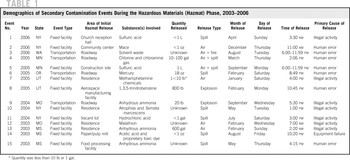
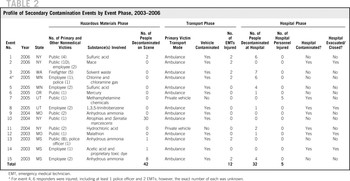
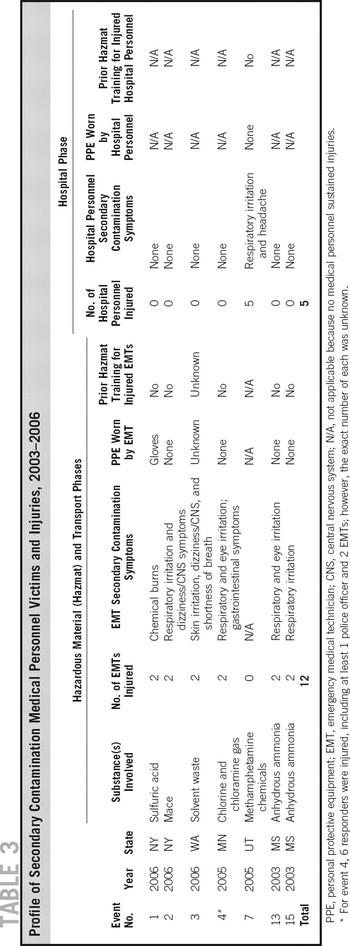
From January 1, 2003, through December 31, 2006, 33,157 events were reported to HSEES. Of these, 15 (0.05%) were identified in which secondary contamination occurred (Table 1). Seventeen medical personnel were injured by exposure to hazardous materials through secondary contamination while treating primary victims (Table 2). Of these 17, 12 were EMTs and 5 were hospital personnel. The most common injury sustained by medical personnel was respiratory irritation (Table 3).
Demographics of Secondary Contamination Events During the Hazardous Materials (Hazmat) Phase, 2003–2006

Profile of Secondary Contamination Events by Event Phase, 2003–2006

Profile of Secondary Contamination Medical Personnel Victims and Injuries, 2003–2006

Hazmat Phase of Events
Of the 15 secondary contamination events, 8 (53.3%) originated in mixed commercial/residential or in distinct commercial or residential areas where the public likely would have been affected. Five of the events (33.3%) occurred in mixed industrial/commercial areas or in industrial areas where workers, as well as the public, likely would have been affected. One event (6.7%) occurred in an agricultural area. The area type was unknown for 1 event. Eleven (73.3%) of the events occurred in fixed facilities and 4 (26.7%) during transportation. Six (40.0%) of the secondary contamination events began during the hours of noon to 5:59 pm, and 5 (33.3%) occurred from 6 to 11:59 pm. Ten (66.6%) occurred on a weekday. Five (33.3%) events occurred during the months of January and February. The primary factors contributing to the hazmat phase included human error (7, 46.7%) and intentional or illegal acts (7, 46.7%).
In the hazmat phase of these 15 events, several extremely hazardous substances were involved, including anhydrous ammonia, chlorine, and acids. During this phase, substances were released primarily via spills (6), air emissions (4), and a combination of air emission and spill (2). Some substances were released through explosions (2) and from a combination of air emission and explosion (1). The quantity of substances released ranged from <1 oz to 600 gal (Table 1). Illicit methamphetamine production was involved in 3 (20.0%) of the 15 secondary contamination events. A total of 47 nonmedical personnel were injured (eg, members of the public, employees, other first responders). The most frequent injuries sustained during this phase involved respiratory irritation. Forty-two people were decontaminated at the scene of the release; 2 (4.8%) were members of the public, 3 (7.1%) were employees, and 37 (88.1%) were first responders. Five (33.3%) of the 15 events during this phase involved ordered evacuations of homes and businesses, during which the total number of evacuees was 397 or more. The number of people evacuated during any single event ranged from 1 to 300 people. The period of evacuation ranged from 1 to 160 hours.
Transport Phase of Events
Of the 15 secondary contamination events, 13 (86.7%) involved official transport modes (eg, ambulance) of hazmat victims to medical facilities, and the remaining 2 events (13.3%) involved self-transport. An ambulance was contaminated in all 13 of the events in which ambulance transport was used, and these events resulted in a total of 15 contaminated ambulances. During this phase, 12 EMTs were known to have been injured through secondary contamination. The most frequent injury sustained during this phase involved respiratory irritation. Of the 12 EMTs injured, 10 (83.3%) were not wearing any designated PPE at the time of injury and 2 (16.7%) were wearing only non–chemical-resistant gloves.
Hospital Phase of Events
Of the 15 secondary contamination events, 30 (69.8%) of the 43 arriving primary victims underwent decontamination before entering the hospital, and 13 (30.2%) did not. The hospital was contaminated in 7 (46.7%) of the events. As a result, 5 hospital personnel sustained secondary contamination injuries. These 5 individuals worked in a psychiatric hospital and were injured when a contaminated person from an illegal methamphetamine laboratory located in a residence was brought in to the ED. The 5 workers experienced respiratory irritation and headache; all 5 were treated at the hospital but were not admitted. None was wearing any form of PPE at the time of injury. Four (26.7%) of the 15 events involved the hospital or ED being temporarily evacuated and/or closed. A total of 32 people underwent decontamination at hospitals during these 15 events.
Case Reports
Select HSEES case reports are presented below to illustrate actual circumstances leading to and resulting from secondary contamination of medical personnel.
New York, December 2006
Hazmat phase: Mace was released at a community center. Between 21 and 50 people were evacuated and the building remained closed for 6 days. Fourteen people—including 10 members of the public, 2 employees, and 2 EMTs—experienced symptoms of respiratory irritation, dizziness, and/or central nervous system problems. Transport phase: To minimize the hypothermia risk, none of the victims were decontaminated before being transported to a hospital. As a result, 2 ambulances were contaminated. Hospital phase: The hospital had to be closed for decontamination.
Washington, August 2006
Hazmat phase: While putting out a garbage truck fire that involved improperly discarded solvent waste, 5 firefighters experienced skin irritation, dizziness/central nervous system symptoms, and shortness of breath. An ambulance crew responded and treated the firefighters. No on-scene decontaminations were conducted. Transport phase: As the firefighters were being transported to the hospital, 2 EMTs also began experiencing the same symptoms. Hospital phase: After being decontaminated at the hospital, all of the responders were admitted. The ambulance and command vehicle had to be decontaminated.
Utah, February 2005
Hazmat phase: Two employees at an aerospace products and parts manufacturing plant were attempting to scrape off 1,3,5-trinitrobenzene that had dried on the parts. The scraping caused a detonation, resulting in a large explosion. One employee died on the scene from thermal burns and respiratory problems. Transport phase: The other employee, who experienced severe thermal burns, was transported to the hospital without undergoing decontamination. Hospital phase: Because of secondary contamination, the hospital was closed for 8 hours until it could be decontaminated. The employee had to be transferred to another hospital, where he was decontaminated before admission. The 2 ambulances also had to be decontaminated. No evacuations or sheltering in place was ordered.
New York, July 2004
Hazmat phase: Two children found small glass containers of hydrochloric acid. While handling the containers, they received skin burns and eye irritation. Transport phase: The parents transported the children and containers to the hospital. Hospital phase: The children were decontaminated at the hospital, treated, and released. The ED was subsequently contaminated with hydrochloric acid vapors. No evacuation was ordered.
DISCUSSION
Recent emphasis by the Occupational Safety and Health Administration (OSHA) on the need to decontaminate certain patients may have increased hospital employee preparation and awareness of this topic;6 however, there is room for improvement. The HSEES data presented here—as well as other accounts of terrorist, military, and suicide-related activitiesReference Nozaki, Hori and Shinozawa10–Reference Stacey, Morfey and Payne15—illustrate that even though secondary contamination events appear to occur infrequently, they can have substantial adverse effects, including injuries to exposed medical personnel, disruption or delays in medical services, temporary loss of work for medical personnel, and time consumed in cleaning ambulances, emergency departments, and hospitals. Furthermore, the costs of taking an ambulance out of service, closing down an emergency department or an entire hospital, or evacuating patients can lead to loss of revenue as well as loss of valuable equipment and resources.
Preplanning
ATSDR and OSHA have created planning guides to help emergency medical services and hospital EDs improve their ability to respond appropriately to hazmat events.2,5,6,16,17 Implementation of procedures from these guides can help medical personnel comply with standards and regulations and could prevent needless injuries that occur because of secondary contamination. The US Environmental Protection Agency is charged with ensuring that Title III of the Superfund Amendments and Reauthorization Act of 1986 (SARA) is followed. According to SARA, local emergency planning committees (LEPC) must develop a community hazardous substance emergency contingency plan to be followed by facility owners, police, hospitals, local emergency responders, and emergency medical personnel. The LEPC must designate a local hospital that has agreed to accept and treat victims of emergency incidents. This hospital should participate in the LEPC and become part of the community emergency response organization. OSHA, as directed by SARA, established the Hazardous Waste Operations and Emergency Response (HAZWOPER) Standard, Title 29, Code of Federal Regulations (CFR) 1910.120, in 1990. HAZWOPER protects employee health and safety during hazardous waste operations, including emergency responses to the release of hazardous substances.16 Further clarification of the HAZWOPER regulation is published in OSHA interpretative letters.18–21
HAZWOPER requires employers, including hospitals, to plan for emergencies if they expect to use their employees to handle an emergency involving hazardous substances. A hospital designated by an LEPC to handle hazardous substances emergency victims must have an emergency response plan (ERP), decontamination equipment, PPE, and trained personnel. The emergency response section of HAZWOPER (29 CFR 1910.120(q)) outlines required ERP elements. The ERP must meet The Joint Commission's guidelines. The plan must address scenarios in which the employers in the community have preplanned, and scenarios in which they have not, as well as hazardous substance incidents that occur in the hospital itself. The hospital's ERP must be prepared in writing and established before an actual emergency. All of the employees and affiliated personnel expected to be involved in an emergency response must be familiar with the plan details. Hospitals involved in a community response to a hazardous substance incident should be familiar with the incident command system to be used during emergencies and should participate in training and practice sessions using the incident command system. The Joint Commission requires accredited hospitals to implement their response plan twice per year, either to reply to an actual emergency or in a planned drill. The ERP also should have an evacuation plan and identify alternative facilities that could provide treatment in the event that patients would need to be rerouted because of contamination of the ED. The ERP should cover plans for critique and follow-up of drills and actual emergencies.16
Communication
As part of preplanning, communication channels must be established. During preplanning the LEPC identifies known chemical hazards in the community, including the material safety data sheets. Hospitals should have access to the database that the LEPC has collected to receive immediate information on the hazards associated with the toxic materials that may be used by local employers. Effective communication from the hazmat scene (eg, by a firefighter or an EMT) to the medical facility before potentially contaminated victims arrive will allow hospital personnel to prepare. For example, foreknowledge of the number of incoming victims and the substance(s) involved will help hospital personnel to have a proper decontamination area available, if necessary; decide whether the local fire department or a hazmat team should help respond; and have appropriate PPE available, if needed.5, 16 In 2 of the 15 HSEES events, contaminated victims arrived unannounced at the hospital by private vehicle; therefore, medical facilities should preplan for this possibility as well.
Training
The medical personnel in this analysis reportedly did not receive hazmat training before sustaining injury. Appropriate preplanning and hazmat training among first responders (medical and nonmedical) is another step that may help to minimize the risk of being exposed to hazardous substances. According to 29 CFR 1910.120(q),6 medical personnel who will decontaminate victims must be trained to the first responder operations level with emphasis on the use of PPE and decontamination procedures. Likewise, individuals who develop the decontamination procedures and select PPE for the workers who help decontaminate patients must receive similar training. Hospitals may develop an in-house training course on decontamination, PPE use, and measures to prevent secondary contamination, or send personnel to a standard first responder operations-level course, and then provide additional training in decontamination and PPE use.16 A training-needs determination should be based on worst-case scenarios. Appendix E of the HAZWOPER standard offers guidelines for site-specific training curriculum to fulfill training requirements.22 In selecting a training course, it is important to ensure that the training topics will be tailored to employees' assigned work duties. Local hospitals and community emergency response organizations often coordinate such classes. Computer-based training programs are available, but it is important that training include hands-on experience and exercises and that trainees have ample opportunity to ask questions.18 The employer must certify that personnel are trained to safely perform their job duties and responsibilities. This includes a minimum of 8 hours of training or demonstrated competencies. The standard also requires annual refresher training or demonstration of competency, as described in 29 CFR 1910.120(q).Reference Horton, Berkowitz and Kaye8, 16
When other hospital personnel need to enter the decontamination area in a life-threatening emergency, they may be considered “skilled support personnel” as described in 29 CFR 1910.120(q)Reference Burgess4 and be given an initial briefing (on hazards, protective measures, PPE, etc) before their participation in any emergency response.16, 20 Ancillary personnel expected to clean up the decontamination area must be trained in accordance with 29 CFR 1910.120(q).Reference Okudera11
The HAZWOPER awareness-level training/competency is intended for workers who are likely to encounter a hazardous substance emergency (or potential hazardous substance emergency). This level of training “enables workers to recognize the presence of hazardous conditions, stay away from the danger area, and call for additional, more highly skilled assistance.”18 Because emergency medical services (EMS) responders are often the first on the scene, they should be given first responder awareness-level training as a minimum, even if they are not expected to handle contaminated victims. There is no specific hourly minimum required, but the training must be sufficient or the employees must have proven experience in specific competencies with an annual refresher. EMS personnel who have received only awareness-level training should not be involved in the transport or treatment of contaminated patients. EMS personnel who may be exposed to hazardous substances because they are expected to transport or treat contaminated patients at the release area should be trained to the first responder operations level.19
Employers of emergency medical responders are required to designate workers to treat contaminated patients outside the danger area at HAZWOPER incidents “if the employer has agreed to be designated to provide this service in a site, facility, or community emergency response plan.”20 If EMS service has not been anticipated, EMS providers can be considered “skilled support personnel to be given on-the-spot instruction on [hazards, protective measures, PPE] prior to treating contaminated victims. If an EMS organization is repeatedly called upon to treat contaminated accident victims but they are not designated in any emergency response plan, the EMS employer must train and designate these workers to the first responder operations level.”20
HAZWOPER allows individual employers flexibility in meeting the requirements of the regulation in the most cost-effective manner. To determine the appropriate level and type of training under HAZWOPER, community response agencies will need to consider the hazards in their community and determine what capabilities will be required to respond effectively to those hazards. This determination is to be based on worst-case scenarios. All individuals must be adequately trained to perform their anticipated job duties without endangering themselves or others. Community fire departments may develop a small group of highly trained hazardous materials technicians and specialists, called a hazmat team. All EMTs do not need to be trained to treat contaminated victims.16, 21
Personal Protective Equipment (PPE)
Only 2 of the 17 medical personnel secondarily injured were known to be wearing any type of PPE when injuries were sustained. Although the secondary injuries among medical personnel in this analysis were not severe, all of the injuries could have been prevented if appropriate PPE had been worn. OSHA's personal protective equipment standard (29 CFR 1910.132) requires that employers evaluate the hazards to which their employees may be exposed and select the PPE that will protect the employee from those hazards. Employers must certify that such an evaluation has been performed.
Proper selection of PPE for medical personnel is complicated because the identity of the contaminating chemical frequently is unknown. In addition, the most protective levels of PPE may be restrictive and cumbersome, making patient care more difficult and posing potential health and safety risks to the user. Appropriate PPE training, fitting, and screening is essential for any responder before it is to be used.Reference Burgess4, 17 Factors to be considered in the selection of PPE include toxicity of substance, routes of exposure, degree of contact, and the specific task assigned to the user. Reference guidebooks, database networks, material safety data sheets, and telephone hotlines may also be useful in determining suitable PPE. To determine which respirator is needed, hospitals can consult OSHA's respiratory protection standard, 29 CFR 1910.134. The standard includes requirements covering training in the use of respiratory protective equipment and development of a written respiratory protection program that addresses fit-testing of respirators and inspection and maintenance procedures. Communication with those at the scene of the incident will be helpful in identifying the type of PPE that will be required to prevent secondary contamination of hospital personnel. The standard includes requirements covering training in the use of respiratory protective equipment and development of a written respiratory protection program that addresses fit-testing of respirators and inspection and maintenance procedures.16
Hospital employees involved in patient decontamination are a special case of EMS personnel, for which OSHA recommends a National Institute for Occupational Safety and Health–approved powered air-purifying respirator that provides a 1000-fold protection factor and combination 99.7% high-efficiency particulate air/organic vapor/acid gas respirator cartridges, as well as a double layer of gloves, chemical resistant suit, head covering and eye/face protection (if not part of the respirator), chemical-protective boots, and suit openings sealed with tape. For employees in the hospital postdecontamination zone, OSHA recommends normal work clothing and PPE as necessary for infection control purposes.6
The level of PPE and respiratory protection needed by EMS personnel varies greatly and depends on their anticipated work activities and their role in the community emergency response structure. The HAZWOPER standard leaves the ultimate decision about the minimum level of PPE used at a hazardous release scene to the incident commander in most cases. However, paragraph (q)3 requires that first responders (including EMS responders) engaged in emergency response and exposed to hazardous substances presenting an inhalation hazard or potential inhalation hazard wear positive-pressure self-contained breathing apparatus until the incident commander determines through the use of air monitoring that a decreased level of respiratory protection will not result in hazardous exposure to employees. The incident commander is to designate a safety officer to identify and evaluate hazards and to provide direction for the emergency at hand.
Decontaminating Patients
One of the most important steps in preventing secondary contamination and injuries is the proper decontamination of primary hazmat victims.16 Of the 13 HSEES secondary contamination events in which EMS was dispatched during the hazmat phase, 8 did not involve any decontamination of primary victims before transport, resulting in 15 ambulances being contaminated. Furthermore, on-scene decontamination was performed in only 1 of 7 events in which a hospital was subsequently contaminated. Although this appears to suggest that decontamination procedures did not occur when needed, or were conducted inadequately, some decontamination procedures may not have been conducted for various reasons, such as lack of communication between EMS and the hospital or lack of proper decontamination training, in general. A specific reason decontamination was not conducted in one particular event was the weather. As a result of cold temperatures, EMS decided not to decontaminate the primary victims, thus leading to secondary contamination. Whereas decontamination at the site of release may not always be feasible, every attempt should be made by the nonmedical first responders (eg, certified hazmat team members, firefighters) to decontaminate the primary victim before transport. However, because proper decontamination does not always occur, the hospital should have designated decontamination areas in parts of the facility that will minimize any exposures to uncontaminated employees, other patients, or equipment. (Morgues may be a good candidate for this role.) Alternatively, a hospital may designate an outside decontamination area that can include wading pools or outdoor showers, along with bags for disposal of contaminated clothes. People near the route to the decontamination room need to be relocated, the area may need to be protected by plastic or paper sheeting, and the setup must direct the flow of contaminated patients to the decontamination area. Ventilation in the decontamination area should be separate from the rest of the hospital (as often is the case in morgues).16
Performing ongoing medical monitoring of those health care personnel participating in the decontamination procedure is mandatory. This evaluation should include all of the participants, focusing particular attention on the risk for experiencing adverse reactions from heat, stress, or hazmat exposure. This is performed for the purpose of prevention or early recognition of such symptoms, and in compliance with federal regulations.6
HSEES Limitations
HSEES is useful for capturing information on the impacts on public health from hazardous substance releases; however, there are limitations to the system.Reference Horton, Berkowitz and Kaye8 HSEES does not count exposed people, only those who are injured. Also, HSEES only captures acute health effects. Therefore, this system does not capture the prevalence of contamination and its outcomes.
Areas for Future Consideration
Some areas that require further consideration are balancing the costs and benefits of preparing EMS to handle contaminated patients versus getting the hazmat team on site in a timely manner. Also of interest is evaluating the differences in response capability between urban and rural areas.
CONCLUSIONS
Although secondary contamination events appear to happen infrequently, HSEES data demonstrate that such events can cause injuries among medical personnel and result in subsequent contamination of medical equipment and facilities. Critical steps that can be taken by first responders to help prevent secondary contamination include the following:
1. Participating in hazardous material emergency preplanning and drills
2. Establishing effective communications from the hazmat scene to the medical facility
3. Establishing and maintaining appropriate hazmat training
4. Identifying and wearing proper PPE when working with potentially contaminated primary victims
5. Ensuring that victims undergo proper decontamination during the hazmat phase of an event, if possible
Authors' Disclosures The findings and conclusions in this report are those of the authors and do not necessarily represent the views of the Agency for Toxic Substances and Disease Registry, the Centers for Disease Control and Prevention, or the Oregon Public Health Division.
Funding was provided by the Agency for Toxic Substances and Disease Registry, US Department of Health and Human Services under Cooperative Agreement Number 5 U61 TS074151-04 to the Oregon Public Health Division. Funds for HSEES come from the Comprehensive Environmental Response, Compensation, and Liability Act (CERCLA) trust fund and the Office of Terrorism Planning and Emergency Response of the Centers for Disease Control and Prevention.
The authors report no conflicts of interest.
Acknowledgments
Our grateful appreciation goes to our partners in the participating state health departments who gathered the data for this publication. We also would like to acknowledge the review and comments from Whitney Fay Long, MPH, CIH, Eastern Research Group.