Phonetic interference is a common characteristic of bilingual speech. Work in language contact and second language acquisition typically makes a distinction between the uncontrolled effects of L1 “interference” and the more controlled and often socially loaded occurrence of “transfer” of L1 features in L2 speech (Sankoff, Reference Sankoff, Chambers, Trudgill and Schilling-Estes2002; Thomason, Reference Thomason, Joseph and Janda2003). In the case of interference, influence from the L1 is seen to reflect the bilingual speaker's process of acquisition of the L2. In situations of language shift, L1 interference is expected to be lost in the speech of subsequent generations (Thomason & Kaufman, Reference Thomason and Kaufman1988; Van Coetsem, Reference Van Coetsem1988). Transfer, or “reallocation” (Britain, Reference Britain2002; Sharma & Sankaran, Reference Sharma and Sankaran2011), involves situations where generations of bilingual speakers retain some of that interference, instead of losing it. Thomason (Reference Thomason, Joseph and Janda2003:688) defined transfer as “innovations based on reinterpretation of source-language features by the speakers who implement the changes as well as the introduction of features actually present in the source language.” The changes that these L1-based features undergo may be structural or social (Britain, Reference Britain2002), and in the latter case, typically involve the construction of an ethnic identity (e.g., Dubois & Horvath, Reference Dubois and Horvath1998).
Despite the apparent prevalence of both interference and transfer, not much is known about which non-native features persist (or get transferred) across generations or why it happens. Thomason and Kaufman (Reference Thomason and Kaufman1988) famously argued for the supremacy of social over linguistic factors in determining the outcomes of language contact. Yet variationist studies of second language acquisition have demonstrated that both linguistic and social factors determine the retention of interference (e.g., Adamson & Regan, Reference Adamson and Regan1991; Bayley & Preston, Reference Bayley and Preston1996; Preston, Reference Preston1989; Sharma, Reference Sharma2005; Wolfram & Hatfield, Reference Wolfram and Hatfield1984) and the acquisition of regional variants in the speech of ethnic groups (e.g., Drummond, Reference Drummond2012; Schleef, Meyerhoff, & Clark, Reference Schleef, Meyerhoff and Clark2011; Wolfram, Carter, & Moriello, Reference Wolfram, Carter and Moriello2004).
Studies of contact phonology in the speech of immigrant populations in the United States have repeatedly pointed to markedness as a linguistic predictor of which features are retained. Markedness is rather loosely defined and reflects both ease of learning and cross-linguistic frequency of occurrence (Thomason, Reference Thomason and Hickey2010). Irrespective of their origin in L1 or L2, marked sounds are believed to be avoided in language contact situations. For example, interdental fricatives, universally difficult to acquire and typologically rare, are frequently stopped in the speech of bilinguals whose native phonologies lack these sounds, as in the case of the French-influenced Cajun English (Dubois & Horvath, Reference Dubois and Horvath1998, Reference Dubois and Horvath2000). However, this understanding of markedness provides only a partial explanation for the transfer effects observed. For instance, although it accounts for the presence of TH-stopping in the Cajun community, it does not explain the maintenance of other French-influenced variables, such as nasal realization of vowels, because oral vowels cannot be considered to be cross-linguistically marked.
This study examines cross-generational differences in the production of an English phonological contrast by bilingual Polish Americans living in New York City. At the segmental level, I analyze stop productions of interdental fricatives (TH-stopping), as in [t]in for thin and [d]en for then. TH-stopping is a regional feature of New York City English (NYCE), robustly present in the speech of Polish Americans (Newlin-Łukowicz, Reference Newlin-Łukowicz2013). At the subsegmental level, I compare the realization of voice onset time (VOT) in stops derived from interdental fricatives and in underlying stops, as in tin and den. VOT, which represents the lag between stop release and the onset of voicing, has been identified as one of the main correlates of obstruent voicing in English and a common source of interference for bilingual speakers.
In an English-only reading task, the Polish-born first generation is found to exhibit a general pattern of VOT interference, with a bias toward interference with voiced stops. The New York City-born second generation transfers Polish-like VOTs to derived stops. I argue that the cross-generational progression from the global effects of interference to the focused presence of transfer is filtered through L1 voicing markedness and reflects speakers' growing sensitivity to L2 phonology and social differences between generations. The distribution of L1 interference and transfer emerges as variable and asymmetrical, and thus, cannot be accounted for by dominant models of L2 acquisition. The findings presented in this paper contribute to our understanding of bilingual phonology and motivate a view of L1/L2 phonetic categories as governed by a variable grammar.
VOT INTERFERENCE IN BILINGUAL SPEECH
Existing phonetic models of second language acquisition, such as the Perceptual Assimilation Model ([PAM] Best, Reference Best and Strange1995; Best & Tyler, Reference Best, Tyler, Munro and Bohn2007) or the Speech Learning Model ([SLM] Flege, Reference Flege and Strange1995), regard the L1 as a type of “filter” that affects L2 acquisition. Both models posit that the development of an L2 phonetic category is contingent upon its perceived distance from existing L1 phones. The presence of interference then results from the initial misperception and the eventual misclassification of an L2 sound as belonging to an L1 category. Neither model provides an explicit metric of determining phonetic similarity or difference, but PAM posits that this process relies on the perception of articulatory features. For SLM, the successful acquisition of an L2 feature, with its concomitant acoustic or articulatory correlates, depends on perceptual (and phonotactic) factors that result from contrasting L1 and L2 feature specifications.
PAM and SLM are powerful models because they account for the most commonly observed outcomes of interference. For example, positing the presence of a single phonetic category for L1 and L2 sounds predicts “merged” VOTs (Chang, Yao, Haynes, & Rhodes, Reference Chang, Yao, Haynes and Rhodes2011), while assuming the formation of two separate sets of categories explains “compromise” and “polarized” VOTs (Flege & Eefting, Reference Flege and Eefting1987). The models' reliance on L1 and L2 phonological contrasts in phonetic category formation also explains divergent outcomes of interference for groups of bilinguals speaking different languages.
However, PAM and SLM do not allow for a variable presence of interference, whether at an individual or group level. Both models posit that, once established, L1 and L2 phonetic categories are used exclusively in their respective languages, unaffected by phonological or social factors. Sociolinguistic work, on the other hand, has uniformly pointed to the variable and systematic presence of interference in L2 speech (e.g., Adamson & Regan, Reference Adamson and Regan1991; Sharma, Reference Sharma2005), demonstrating that interference relies on multiple factors that can be modeled quantitatively. In addition, as models of phonetic interference, PAM and SLM do not account for cases of transfer. Yet, the maintenance of non-native features across generations can typically be traced back to interference in the speech of the first generation (e.g., Dubois & Horvath, Reference Dubois and Horvath1998; Nagy & Kochetov, Reference Nagy, Kochetov, Siemund, Gogolin, Schulz and Davydova2013; Sharma & Sankaran, Reference Sharma and Sankaran2011). Whereas sociolinguistic studies have commonly appealed to the social setting and cross-linguistic markedness as an explanation of transfer patterns, PAM and SLM predict that within-language markedness should matter as well.
VOT: Polish vs. English
Polish-English bilinguals are susceptible to interference from VOT because Polish and English employ different VOT ranges. Like most other Slavic languages, Polish is a “voice” language in that it employs glottal pulsing to contrast prevoiced stops /b d g/ (negative VOT) with their voiceless counterparts /p t k/ (short-lag VOT). These two VOT categories are robust for Polish speakers in production (Keating, Reference Keating1980) and perception (Keating, Mikoś, & Ganong, Reference Keating, Ann, ś and Ganong1981) and show very little category overlap. Keating (Reference Keating1980) found Polish voiced stops to be consistently prevoiced, but the amount of prevoicing was larger in stop-initial isolated words (mean VOT for /d/ = –120 msec) than in stop-initial sentences (mean VOT for /d/ = –30 msec). By contrast, voiceless stops exhibited very little variation in VOT, and the mean VOT for /t/ was around 20 msec regardless of the task.
English, along with many other Germanic languages, can be classified as an “aspiration” language because it relies on the degree of openness of the glottis to distinguish unaspirated stops /b d g/ (short-lag VOT) from aspirated ones /p t k/ (long-lag VOT). English exhibits a very different VOT pattern from Polish, in that it contrasts two positive VOTs: short-lag VOT (small positive values, 0 to 10 msec) for unaspirated stops and long-lag VOT (large positive values, around 75 msec) for aspirated stops (Lisker & Abramson, Reference Lisker and Abramson1964). Unlike in Polish, the two VOT categories show substantial overlap, so that there is no clear break between them. The degree of overlap is even more pronounced in the utterance-initial position, where English voiced stops lose their voicing (Flege & Brown, Reference Flege and Brown1982). This situation again contrasts sharply with Polish, where prevoicing is most pronounced utterance-initially.
A number of studies have reported prevoicing for voiced stops in English, but variation across dialects and speakers is substantial. Jacewicz, Fox, and Lyle (Reference Jacewicz, Fox and Lyle2009) observed prevoicing in the utterance-medial position, when stops were flanked by (voiced) vowels, but only in North Carolina English, as opposed to Wisconsin English. Negative VOT has also been reported in post-pausal position, but here the occurrence of prevoicing differs across studies (e.g., Docherty, Reference Docherty1992; Flege & Brown, Reference Flege and Brown1982; Lisker & Abramson, Reference Lisker and Abramson1964; Simon, Reference Simon2010).
VOICING: PHONOLOGICAL REPRESENTATION AND MARKEDNESS
These two contrastive voicing systems result in divergent within-language markedness relations. The short-lag VOT categories, “voiceless” in Polish and “unaspirated” in English, are believed to represent the unmarked members of the voicing pairs in the respective languages, because their production requires a lack of voicing or aspiration. By contrast, the marked members of the voicing pairs are the ones that require an extra articulation: prevoiced stops in Polish and aspirated stops in English.
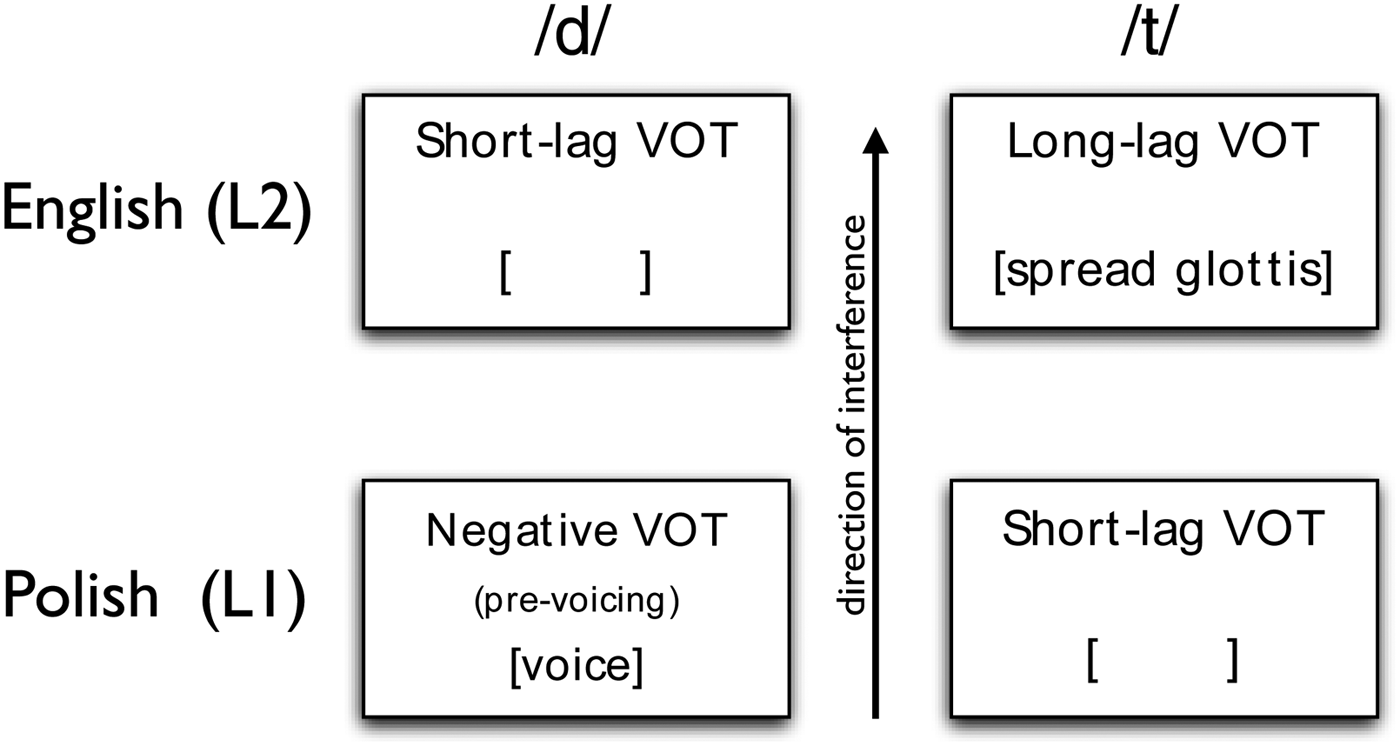
To represent this distinction phonologically, I will follow the assumptions of “laryngeal realism,” also known as “multiple feature theory” (Honeybone, Reference Honeybone, van Oostendorp and van de Weijer2005; Iverson & Salmons, Reference Iverson and Salmons1995, Reference Iverson and Salmons1999; Kager, van der Feest, Fikkert, Kerkhoff, & Zamuner, Reference Kager, van der Feest, Fikkert, Kerkhoff, Zamuner, van de Weijer and van der Torre2007). This model of the phonological representation of laryngeal contrasts is phonetics-based and draws on language-internal markedness distinctions. According to laryngeal realism, contrastive two-way systems, such as Polish and English, are distinguished by the presence of the privative feature [voice] and [spread glottis] on the marked member of each voicing pair. The unmarked members of each pair are left unspecified for either feature, resulting in the configuration in Figure 1.Footnote 1 Languages are commonly believed to manifest at most a three-way VOT contrast, in which case the feature [constricted glottis] is posited.
Contrasting Polish and English VOT systems.

These conflicting featural specifications on the voicing pairs in Polish and English have predictions for the direction of interference. If L1 acts as a “filter” in L2 acquisition, and assuming that L1 and L2 categories coexist in shared phonological space (Flege, Reference Flege and Strange1995), one could expect Polish /d/ to impose phonetic interference on English /d/ in the form of prevoicing because the former is specified for [voice] and the latter is not. Conversely, the Polish /t/ is not associated with any feature that could impose a specific realization on English /t/. Therefore, the realization of English /t/ in a monolingual-like manner (i.e., with long VOT) should depend on factors strictly related to the acquisition of a new L2 feature, [spread glottis].
Few studies have investigated the production of voiced stops in bilingual speech, as the focus has been placed on the voiceless series. However, voiced and voiceless stops typically behave differently in the speech of bilinguals whose L1 is a “voice” language and L2 an “aspiration” language. Specifically, L2 voiced stops always seem to be produced with elevated rates of prevoicing, whereas L2 voiceless stops may remain impervious to interference (and be produced with monolingual-like VOTs). For example, Punjabi-English bilinguals (Heselwood & McChrystal, Reference Heselwood and McChrystal2000), French-English bilinguals (Sundara, Reference Sundara2005), and Italian-English bilinguals (MacKay, Flege, Piske, & Schirru, Reference MacKay, Flege and Piske2001) were all found to employ prevoicing more frequently than English monolinguals did.
In what follows, I investigate whether within-language markedness distinctions can predict the direction of interference in language contact situations. PAM and SLM assume that L1 and L2 phonetic categories draw on the featural composition of phonological contrasts in their respective languages. Hence, I hypothesize that L2 phones will pose fewer acquisition problems (and trigger less interference) if they share the same phonological specification as their L1 counterparts than if their features mismatch. I explain the observed patterns of interference/transfer by assuming a variable grammar and by appealing to social factors beyond the scope of PAM or SLM.
TH-STOPPING
To test whether interference applies at uniform rates within the L2, I analyze VOTs in two contexts: underlying stops, as in tin and den, and stops produced through TH-stopping, as in [t]in for thin and [d]en for then. TH-stopping is typically defined as the “substitution” of stops [t d] for interdental fricatives [θ ð]. Yet, there are linguistic and social reasons to believe that speakers distinguish derived from underlying stops.
At the linguistic level, acoustic evidence suggests that speakers of American English differentiate underlying and derived voiced stops. Zhao (Reference Zhao2010) found word-initial /d/ and stop-like realizations of /ð/ to diverge on several acoustic measures of the burst. The observed differences systematically confirmed that the place of articulation is alveolar for /d/ and dental for stop-like /ð/, corroborating the common impression that stopped /ð/ and /θ/ retain the place of articulation of the original fricatives (e.g., Labov Reference Labov1966). Yet, Zhao's findings are not informative about the realization of /ð/ in dialects where TH-stopping is a regional feature, as speakers of these dialects, including New Yorkers, were purposely excluded, under the assumption that they would not differentiate the two stops. The stopped realizations in her study then reflect sporadic articulatory modifications, rather than systematic sociolinguistic variants.
Different places of articulation for derived and underlying stops should also be reflected in their VOTs, because VOT is expected to increase as the place of articulation becomes more posterior. For example, Lisker and Abramson (Reference Lisker and Abramson1964) report the shortest mean VOTs for bilabial stops (/b/: 1 msec, /p/: 58 msec), intermediate VOTs for alveolar stops (/d/: 5 msec, /t/: 70 msec), and the largest VOTs for velar stops (/g/: 21 msec, /k/: 80 msec). Similarly, Sundara (Reference Sundara2005) compared the acoustics of coronal stops /t d/ in Canadian English and Canadian French, where these stops are described as alveolar and dental, respectively. She found that VOTs for coronal stops are longer in Canadian English (VOT for /t/ = 60 msec, /d/ = 16 msec) than in Canadian French (VOT for /t/ = 20 msec, /d/ = –82 msec), presumably reflecting differences in the place of articulation of these two stops.
At the social level, derived stops could be distinguished from their underlying counterparts because of the social meaning that TH-stopping may carry as a common sociolinguistic variable (Wells, Reference Wells1982). In NYCE, TH-stopping is a stigmatized dialect feature, associated with class-based, stylistic, and ethnic differentiation (Labov, Reference Labov1966). Its origins have been anecdotally attributed to the non-native speech of the first immigrants to the area, such as the Irish, Italians, and Poles (Babbitt, Reference Babbitt1896; Labov, Reference Labov1966). This hypothesis is largely uncontroversial as substitutions of interdental fricatives are common for L2 learners whose native phonologies lack interdental fricatives (Lombardi, Reference Lombardi2003). Labov (Reference Labov1966) estimated TH-stopping to be in stable variation, but it may be receding from contemporary NYCE, just like other stigmatized local features are (Becker, Reference Becker2010). Yet, TH-stopping remains robust in the speech of Polish New Yorkers, patterning in a way that is consistent with L1 interference but also an ethnic marker (Newlin-Łukowicz, Reference Newlin-Łukowicz2013).
THE STUDY
Participants
The present study was conducted as part of a larger research project on language variation among Polish New Yorkers. This larger project integrates variationist, quantitative methodologies with a qualitative approach that draws on ethnographic research with this group (as in neighborhood studies, e.g., Hall-Lew, Reference Hall-Lew2009, and peer group studies, e.g., Mendoza-Denton, Reference Mendoza-Denton, Chambers, Trudgill and Schilling-Estes2002). As the present study crosscuts a number of neighborhoods and communities of practice in New York City, the goal of the ethnography was to obtain relevant social information about Poles and Polish Americans residing in New York City. Ethnography involved participant observation of language use in everyday activities in Greenpoint, Brooklyn, and in cultural activities in greater New York City. Ethnographic observations were conducted over the span of three years (fall 2009 to fall 2012), culminating in data collection in the spring of 2013.
Thirty-five Polish Americans were sampled to participate in the present study. Participants were bilingual children of Polish parents who immigrated to New York City between 1970 and 1990. Participants classified as generation one (n = 15; 8 women, 7 men) immigrated to New York City and started learning English between the ages of 8 and 15.Footnote 2 Those classified as generation two (n = 20; 10 women, 10 men) were born in the city or immigrated and started learning English before age 5. All participants were close in age (19 to 35; one speaker was 46) and had similar social class backgrounds: they were raised in working-class homes and neighborhoods and held college degrees or were enrolled in college at the time of the study.
Participants' bilingual abilities were not formally tested. Instead, the author was able to verify participants' ability to speak Polish through ethnographic observation, as well as in additional tasks, such as sociolinguistic interviews and use-of-Polish surveys. Almost all second-generation speakers underwent some formal education in Polish, having attended various Polish supplementary schools in New York City for up to 13 years, and for an average of 5 years. All second-generation speakers reported having acquired the two languages sequentially, with Polish being spoken from birth and English from about age 5. They described themselves as English-dominant in sociolinguistic interviews, and many stressed having difficulties reading and writing in Polish. In the use-of-Polish survey, all second-generation speakers reported speaking only Polish to their extended families. Half of them also reported speaking exclusively Polish to their parents, whereas the other half spoke both Polish and English. All but one second-generation speaker reported using exclusively English or code-switching between Polish and English in interactions with their siblings and Polish American friends.
All first-generation speakers in this study underwent some formal schooling in Poland (from two to eight years), and some of them attended Polish supplementary school in New York City for another one to five years. These participants typically spoke little English before moving to New York City, and some still retained traces of a non-native accent. Many expressed difficulties communicating in Polish, much like the second-generation speakers did. Their language choices also mirrored those of the other group, with Polish being spoken at home and English or both languages elsewhere. In the home, first-generation speakers reported speaking Polish to parents as well as siblings.
In addition, 10 white non-Polish New Yorkers (7 women, 3 men) were recorded to obtain baseline data on TH-stopping and VOT for the New York City dialect. These speakers were all born in New York City, spoke English at home, and reported various European ancestries (i.e., Irish, Italian, German, Danish, and Eastern European). Because of impressionistic accounts that suggest that TH-stopping is diminishing in New York City, half of the speakers matched the sample of Polish Americans in age (20 to 41 years), and half of them were older (51 to 61 years). All speakers were monolingual in English, but had some exposure to other languages in schools (e.g., Spanish, French) or within the family (e.g., Hebrew).
Materials and procedure
Participants were asked to read three short stories loosely based on stories told by American stand-up comedians for Reader's Digest (see the Appendix). The short stories were heavily modified to accommodate a large number of tokens of word-initial underlying coronal stops /t d/ and interdental fricatives /θ ð/ and were designed with the intention of making participants produce TH-stopping. Newlin-Łukowicz (Reference Newlin-Łukowicz2013) found that, relative to the sociolinguistic interview, Polish Americans' stopping rates dropped drastically in a word list task, but remained high in a short story task. Therefore, to prevent participants from becoming overtly aware of the linguistic nature of the task, the short stories in this study were kept intentionally light-hearted. As such, they were designed to resemble spoken, rather than written, texts and included a number of incomplete sentences, exclamations, and expressions commonly encountered in spoken speech.
Using short stories rather than spontaneous speech allowed for the control of a number of linguistic factors that are crucial in comparing VOT categories. The linguistic context is particularly essential in distinguishing prevoicing from a continuation of voicing from a preceding voiced segment. I thus controlled for the position of interdental fricatives and stops within the utterance (initial, medial, final), the segment that preceded them (pause, vowel, voiceless stop, voiceless fricative), and the words in which they appeared. No preceding voiced sounds were included, except for vowels, which are known to condition prevoicing for American English speakers (Jacewicz et al., Reference Jacewicz, Fox and Lyle2009), and thus provide a point of comparison for stops produced after voiceless segments.
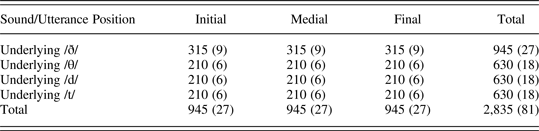
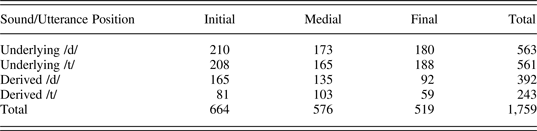
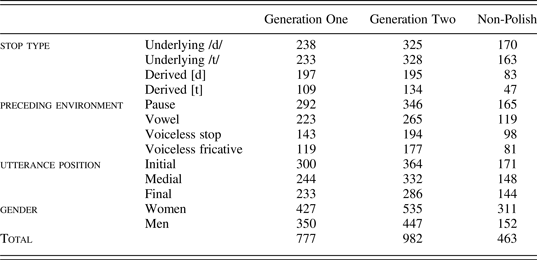
The distribution of word-initial interdental fricatives in the English lexicon is such that the voiced one is largely limited to function words, and the voiceless one to lexical items. Accordingly, this asymmetry is reflected in the short stories. Tokens of /ð/ are represented by the function words that, this, and there. These function words were chosen based on their overall high TH-stopping rates as compared to other function words (Newlin-Łukowicz, Reference Newlin-Łukowicz2013), as well as their ability to appear in various positions within the utterance. For example, this can be utterance-initial (“This is when I knew she was a crazy person”), utterance-medial (“Let's kick this party off with a bang”), or utterance-final (“He looks deep into my eyes, like this”). Tokens in the utterance-medial and utterance-final positions were preceded by vowels, voiceless stops, or voiceless fricatives (three tokens of each per position). To boost the number of /ð/ tokens, each function word appeared three times in each utterance position.Footnote 3 I included a larger number of tokens of the voiced interdental fricative than of the other phonemes as TH-stopping was not expected to apply to all cases of /ð/. Tables 1 and 2 contrast the targeted and actual number of tokens. The actual number of tokens was always lower than the targeted number.Footnote 4 For derived stops, it was due to the variable nature of TH-stopping. For underlying stops, it had to do with the absence of a clear burst for some stop tokens, which excluded them from analysis.
Prevoicing and closure burst in a stopped realization of there by a second-generation speaker.
Targeted number of tokens per stop type and utterance position, for the entire sample of Polish Americans and per speaker (in parentheses)
Actual number of tokens produced by Polish Americans
The distribution of /θ/ in the short stories mirrored that of /t d/, due to similar lexical properties. For /θ/, as well as /t d/, six lexical items appeared in each utterance position, as there are fewer limitations on the distribution of lexical items within sentences than there are for function words. Therefore, in each utterance position, /θ/ was represented by one token of a monosyllabic or disyllabic word: think, thank, thousand, thing, thrilled, and three. Underlying coronal stops were, similarly, represented by tokens of monosyllabic and disyllabic words: deep, Deb, David, days, doors, and dark for /d/, and Tina, tell, take, tables, talk, and Tom for /t/. In the utterance-medial and utterance-final positions, one third of tokens of /θ t d/ were preceded by a vowel, a voiceless stop, and a voiceless fricative. For underlying stops, I additionally controlled for the following vowel and included tokens of high /i/, mid /ε, eɪ/, and low /ɑ, ɔ/.
Recordings were made in a sound attenuated room, using a Zoom H4N digital recorder, set at a sampling rate of 44.1 kHz. Each participant was recorded individually, after having completed a sociolinguistic interview and a use-of-Polish survey. Participants wore an Audio-Technica ATR3350 lavalier microphone and were instructed to read the short stories out loud and at their regular reading pace.
Acoustic analysis
All tokens of interdental fricatives were examined spectrographically in Praat (Boersma & Weenink, Reference Boersma and Weenink2014). Underlying interdental fricatives were coded as fricatives, stops, or affricates, following the criteria laid out in Table 3. These coding criteria are fairly conservative, as I take the presence of a burst (in addition to the presence of closure) to be a requirement for the identification of stops. Stops identified this way were later subjected to the VOT analysis.
Acoustic criteria for coding
VOT was measured in word-initial underlying stops (/t/, e.g., tin, total n = 724; /d/, e.g., den, total n = 733) and stops derived from interdental fricatives ([t], e.g., [t]in for thin, total n = 290; [d], e.g., [d]en for then, total n =475). See Table 5 for the breakdown of tokens per speaker group. Using TextGrids in Praat, I segmented VOT boundaries for each stop token, and their durations were extracted using a script. For prevoiced stops, VOT was measured from the onset of voicing (determined by the presence of the voice bar and periodic waveform preceding the burst) up until the burst (see Figure 2). For stops that did not show prevoicing, VOT was measured from the burst to the start of periodic waveform in the vowel. Measurements for prevoiced stops were recorded with negative values; the rest were positive.
Statistical analysis
VOTs were analyzed through mixed-effects regression modeling in R (R Development Core Team, 2011), using the lmer() function of the lme4 package (Bates & Maechler, Reference Bates and Maechler2009). Separate models were built for generation one, generation two, and non-Polish New Yorkers. The models tested included the following fixed effects: Stop Type ([t], [d], /t/, /d/), Utterance Position (initial, medial, final), Preceding Environment (pause, vowel, voiceless fricative, voiceless stop), and Gender (male, female; not tested for the non-Polish group). Speaker and Token were included as random slopes to account for within-speaker and between-speaker variability in the VOTs produced for the four categories of Stop Type. The models reported in the following section constituted the best fit arrived at through a step-wise evaluation process whereby nonsignificant fixed effects were discarded (Baayen, Reference Baayen2008:182–185). The inclusion of each fixed effect was determined by an analysis of variance model comparison, based on likelihood ratio tests. Linear mixed-effects modeling was followed by post hoc Tukey tests (the glht function in the multcomp package) that determined which levels of a predictor were significantly different from each other. This method is conservative as it employs Bonferroni adjusted p values.
RESULTS
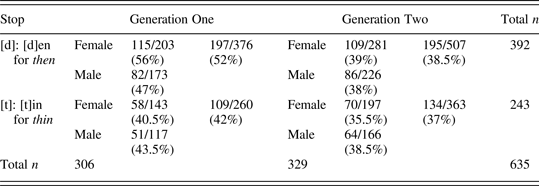
All speakers were found to produce TH-stopping while reading the short stories, but some did so more often than others. Non-Polish New Yorkers produced stopping at an average rate of 29% and showed a slight preference for stopping of the voiced fricative (30%) relative to the voiceless one (26%). Older and younger non-Polish New Yorkers produced TH-stopping at the same average rate, which suggests that TH-stopping remains a stable feature of the dialect. Polish Americans exhibited rates of stopping that were considerably higher than these baseline values (see Table 4). Generation one showed the highest stopping rates: 52% for /ð/ and 42% for /θ/. Generation two produced stopping at a rate that was intermediate between that for generation one and non-Polish New Yorkers (i.e., around 38% for both /ð/ and /θ/).
TH-stopping rates for Polish Americans, divided by generation and gender
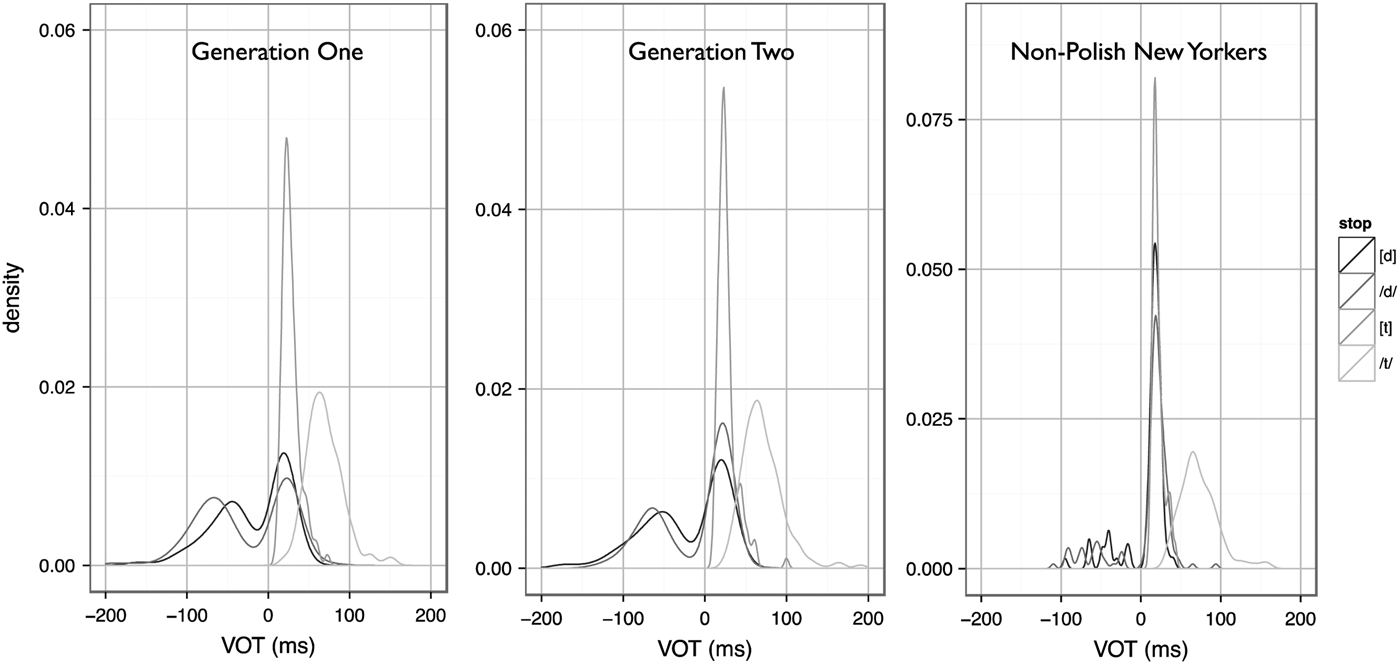
All speakers produced a wide range of VOT values. Figure 3 presents density plots of VOTs per stop type for the two generations of Polish Americans and non-Polish New Yorkers. The two voiceless stops are realized the same by all groups: tokens of underlying /t/ are overwhelmingly long-lag, and tokens of derived [t] are mainly short-lag. Differences between speaker groups only emerge for the two voiced stops. Specifically, density plots for underlying /d/ and derived [d] are bimodal for Polish Americans, as all voiced stops are variably produced with negative and short-lag VOTs. Whereas generation one displays a comparable ratio of prevoiced to short-lag tokens for both stops (55% of prevoicing for /d/ and 50% for [d]), generation two trends toward English-like, short-lag VOTs for underlying /d/, where prevoicing is at 40%, compared to 49% for derived [d]. By contrast, non-Polish New Yorkers equally prevoice derived and underlying stops and do so at the much lower rate of 17%.
Density plots of VOTs produced by the three speaker groups.
Linear mixed-effects modeling
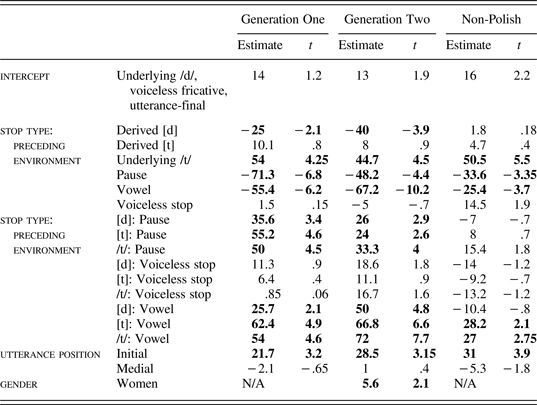
Modeling revealed that VOT values are largely affected by the same factors for all three groups, with significant effects of Stop Type, Preceding Environment, Utterance Position, and a significant interaction of Stop Type and Preceding Environment. Second-generation New Yorkers additionally show an effect of Gender. Table 5 breaks down the number of tokens speakers produced for different factor levels, and Table 6 summarizes regression results. In Table 6, the intercept represents the baseline to which the remaining factor levels are compared. In this case, it stands for the estimated VOT for underlying /d/ in utterance-final position and following a voiceless fricative. The estimates for the remaining factor levels indicate the amount by which the mean is predicted to increase (if the estimate is positive) or decrease (if the estimate is negative), relative to the estimate for the intercept. For ease of interpretation, factor levels are marked in bold if significant (t value exceeds –2 or 2).
Factor levels used in the regression analyses, along with the number of tokens
Fixed-effect coefficients in a mixed-effects model fitted to VOT values
Note: Bold values are statistically significant.
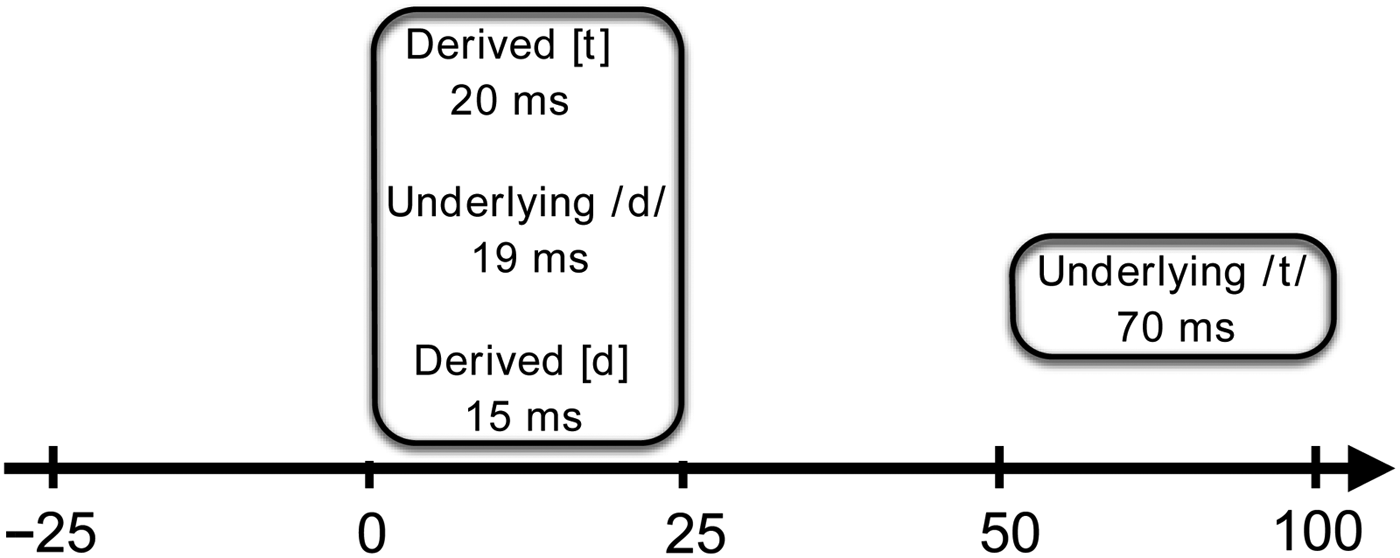
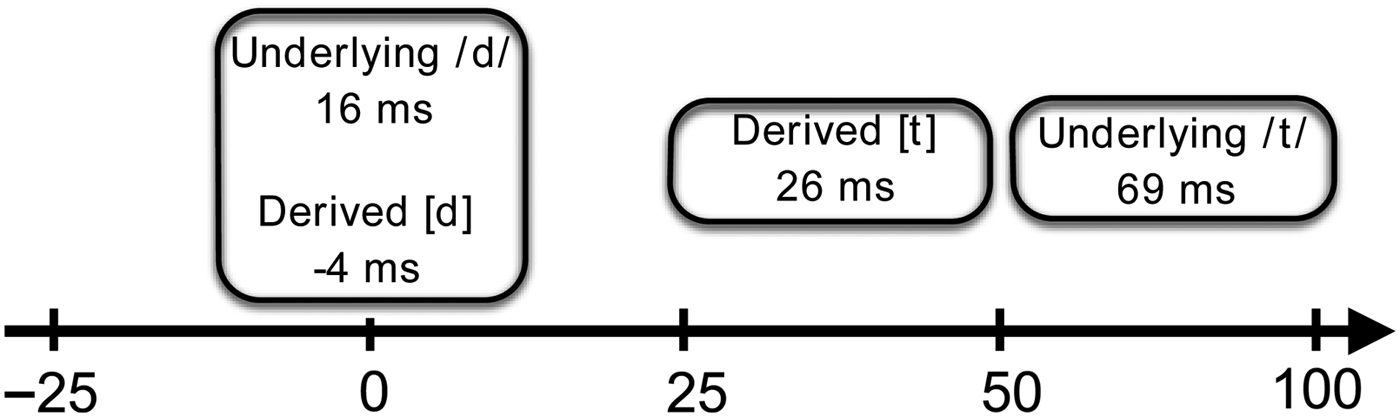
Models for all three groups reveal that VOTs vary according to Stop Type. This result is expected, as English stops are known to fall into two VOT categories: short-lag and long-lag. Table 6 confirms that this distinction is present for all three groups: the mean VOTs for underlying /t/ are about 50 msec longer than the mean VOTs for underlying /d/ (the intercept) are, suggesting that the former stops type is aspirated. For non-Polish New Yorkers, all stops fall into this English-like distinction. These speakers contrast long-lag VOT for /t/, as in tin, with short-lag VOT for everything else (p < .001): the two voiced stops and derived [t]. This means that they do not distinguish [d]en for then from den, producing both with short-lag VOT, but they do distinguish [t]in for thin from tin, deaspirating the former. Figure 4 illustrates this two-way contrast.
VOT means for stop categories produced by non-Polish white New Yorkers.
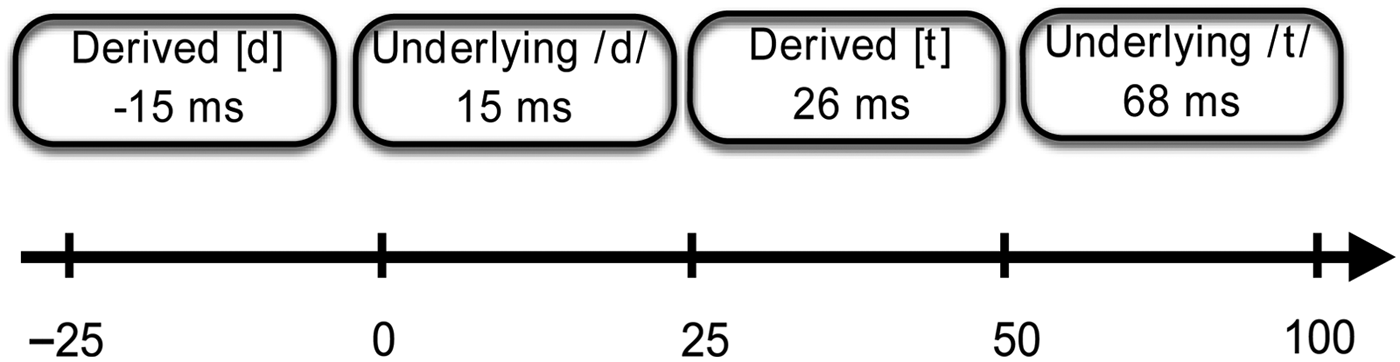
The two generations of Polish Americans depart from this pattern. First, they differentiate derived [t] from the voiced stops and realize it with a VOT that is intermediate between that of underlying /t/ and /d/. Although the t-test comparison between derived [t] and underlying /d/ is not significant (p = .9), these two stop types are distinguished in their VOT distributions (see Figure 3): derived [t] is never realized with a negative VOT. Polish Americans thus produce an extra VOT contrast that is absent from the non-Polish group. Second, Polish Americans employ considerably more prevoicing than the non-Polish group does, which affects their realization of voiced stops. Generation one produces a comparable ratio of prevoiced and short-lag tokens for underlying /d/ and derived [d] (p = .13), but it shows a slight preference for short-lag tokens with underlying /d/, which is reflected in the positive mean for this stop. The first generation then produces a three-way VOT contrast that distinguishes prevoiced [d] and /d/, short-lag [t], and long-lag /t/, as illustrated in Figure 5. The second generation polarizes the contrast between the two voiced stops, restricting prevoicing to the derived context. As such, the second generation adds a fourth dimension to the VOT distinctions in English stops, as it produces negative VOT for [d], short-lag VOT for /d/, (longer) short-lag VOT for [t], and a long-lag VOT for /t/ (see Figure 6). The t-test comparisons of all stop types are highly significant and yield p < .001 (with the exception of the /d/-[t] comparison explained earlier). This four-way VOT distinction is unlike any other VOT contrast that has been reported, as (monolingual) language varieties are believed to distinguish no more than three VOT categories (e.g., Lisker & Abramson, Reference Lisker and Abramson1964).
VOT means for stop categories produced by first-generation Polish Americans.
VOT means for stop categories produced by second-generation Polish Americans.
Preceding Environment also emerged as a predictor of VOT. Table 6 shows that underlying /d/ (the intercept) differentially favors short-lag and negative VOT. For all three groups of speakers, short-lag VOT is more likely to appear if underlying /d/ is preceded by a voiceless fricative (intercept; mean VOT between 13 and 16 msec) or a voiceless stop (mean VOT between 8 and 30 msec), whereas prevoicing is conditioned by a preceding vowel (mean VOT between –54 and –9 msec) or pause (mean VOT between –57 and –17 msec). The postvocalic position is known to produce prevoicing for American English (Jacewicz et al., Reference Jacewicz, Fox and Lyle2009) and likely represents a continuation of voicing from a preceding voiced segment. The preference for negative VOT in the postpausal context is more unusual and possibly points to emphatic pronunciations. The postpausal context included some utterance-initial realizations, as well as cases where the speaker paused before the target word, usually due to disfluency or emphatic speech.
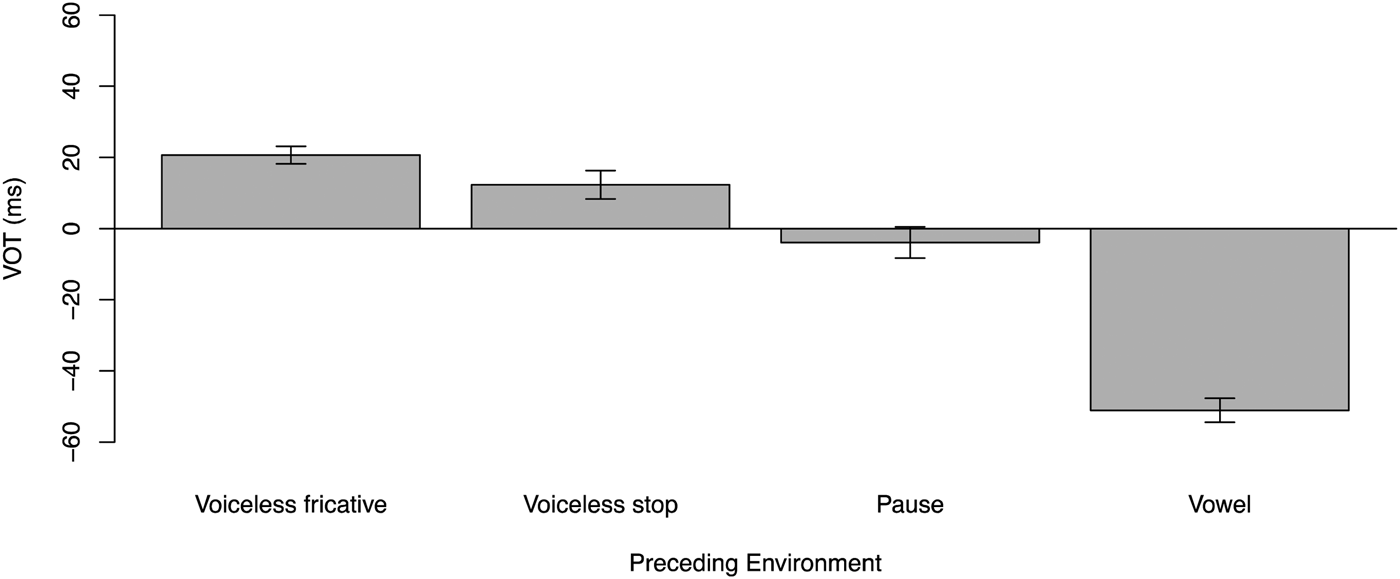
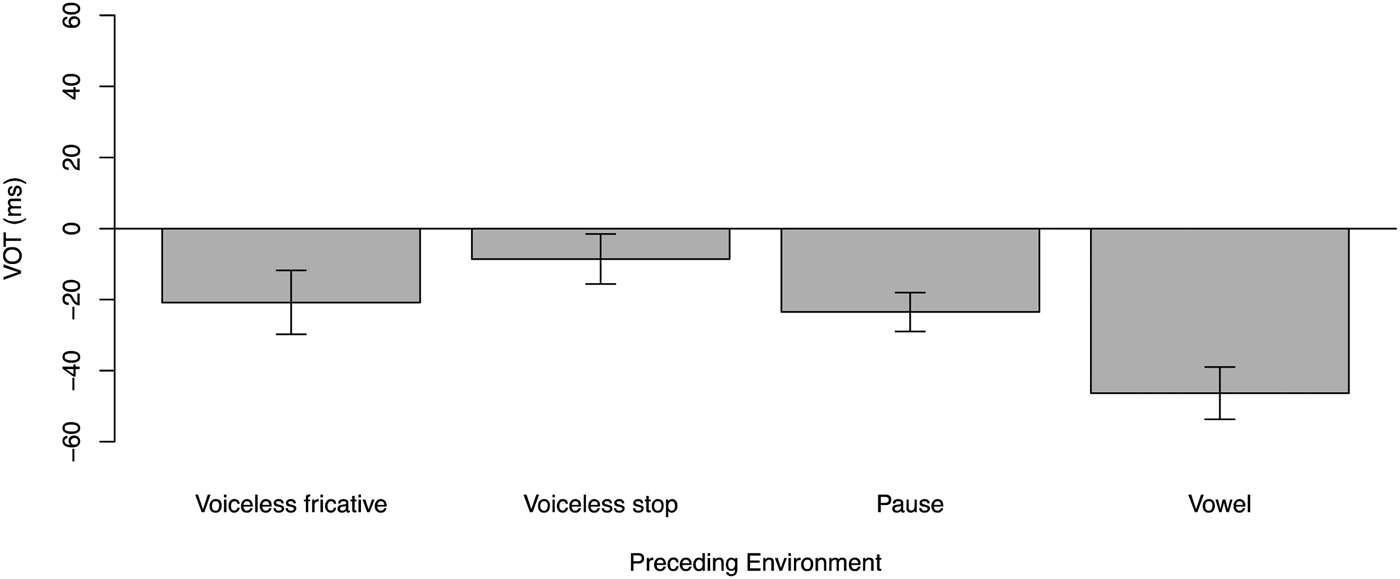
For all three groups, a significant interaction was observed between Preceding Environment and Stop Type. For Polish Americans, this interaction is explained by differences in what conditions prevoicing for the two voiced stops (see Figures 7 and 8). Prevoicing exhibits selective conditioning for underlying /d/, as it is favored by preceding vowels and pauses, but not voiceless segments. By contrast, derived [d] favors prevoicing irrespective of the voicing of the preceding segment, which further confirms that negative VOT is associated with this stop type, rather than resulting from a voicing assimilation process, as in the case of underlying /d/. This different conditioning of prevoicing for underlying /d/ and derived [d] is specific to Polish Americans. Non-Polish New Yorkers also exhibit a significant interaction of Preceding Environment and Stop Type, but this effect is driven by longer VOTs for voiceless stops following vowels.
Mean VOT for underlying /d/ depending on preceding environment for second-generation Polish Americans. Prevoicing is favored by pauses and vowels.
Mean VOT for derived [d] depending on preceding environment for second-generation Polish Americans. Prevoicing is favored regardless of context.
VOT is also predicted by Utterance Position. This effect is driven by significantly more positive VOTs in the utterance-initial position, relative to tokens that appeared utterance-medially or utterance-finally. A longer VOT indicates that underlying /d/ is realized as voiceless utterance-initially, which is consistent with reports for American English (Flege & Brown, Reference Flege and Brown1982).
Lastly, Gender was selected as a predictor of VOTs for second-generation Polish Americans only. Women tended to produce VOTs that were on average 5 msec longer than those produced by men. This gender difference is consistent with previous research, which has shown that English-speaking women produce longer VOTs than men do (Whiteside, Henry, & Dobbin, Reference Whiteside, Henry and Dobbin2004), and Dutch-speaking men produce more frequent and longer prevoicing than women do (Van Alphen, Reference Van Alphen, Van de Weijer and van der Torre2007). This finding can be explained by men having larger vocal tracts, which allow more air to accumulate in prevoicing before transglottal pressure equalization inhibits voicing.
DISCUSSION
The results of this paper suggest that second-generation Polish Americans maintain separate VOT categories for English underlying /t d/ and derived [t d]. As is expected of English, an “aspiration” language, underlying stops contrast in aspiration. Derived stops, however, pattern in a way that is consistent with “voice” languages, such as Polish: derived [d] exhibits a strong preference for prevoicing, whereas derived [t] is unaspirated.
Crucially, the four-way separation of VOT categories is specific to second-generation Polish Americans. Non-Polish white New Yorkers maintain a two-way VOT contrast between long-lag underlying /t/, on the one hand, and short-lag underlying /d/ and derived [t d], on the other. Likewise, first-generation Polish Americans do not fully distinguish all stops, producing both voiced stops with prevoicing, but differentiating them from derived [t] and underlying /t/. This result points to the presence of a voicing bias in interference: underlying /d/ shows interference (in the form of prevoicing), whereas underlying /t/ is acquired successfully.
Remnants of this voicing bias can be observed in the second-generation's high proportion of prevoiced to short-lag VOTs. Prevoicing rates decrease across generations only for underlying /d/ (from 55% to 40%) and remain equally high for derived [d] (around 50%). These prevoicing rates are much higher than those observed for non-Polish white New Yorkers (i.e., 17%) and mirror those reported for other bilinguals whose L1 is a “voice” language. For example, Punjabi-English bilinguals employed prevoicing 50% of the time, compared to 5% to 20% for British English monolinguals (Heselwood & McChrystal, Reference Heselwood and McChrystal2000). Similarly, MacKay et al. (Reference MacKay, Flege and Piske2001) found four groups of Italian-English bilinguals to produce prevoicing for /b/ at rates ranging from 57% for early bilinguals to 79% for late bilinguals, compared to 31% for American English monolinguals.
I argue that the voicing bias reflects differences in markedness relations between the bilinguals' L1 and L2. In Polish, voiced stops /b d g/ are believed to be marked with respect to their voiceless counterparts because of the presence of voicing throughout their articulation. In English, it is the aspirated stops /p t k/, characterized by a long VOT, that are thought to be marked with respect to the unaspirated series /b d g/. According to laryngeal realism (e.g., Honeybone, Reference Honeybone, van Oostendorp and van de Weijer2005; Iverson & Salmons, Reference Iverson and Salmons1995; Kager et al., Reference Kager, van der Feest, Fikkert, Kerkhoff, Zamuner, van de Weijer and van der Torre2007), the marked member of a voicing pair carries a privative laryngeal specification, whereas its unmarked counterpart is thought to remain unspecified for any laryngeal features. These asymmetries in stops' featural specifications could account for the disproportionate pattern of L1 interference and transfer observed in this study: Polish /d/, specified for [voice], imposes a prevoiced realization on English /d/, which lacks this specification. By contrast, the absence of a laryngeal specification on Polish /t/ does not predict interference. The monolingual-like realization of English aspirated stops, therefore, relies on the acquisition of a new contrast, represented by the feature [spread glottis]. Within-language markedness distinctions can, therefore, account not only for the voicing bias toward interference with voiced stops, but also for the successful realization of the English long-lag VOT category by first-generation speakers. Note that the role of within-language markedness in predicting interference does not rest on any one phonological representation as divergent markedness relations could also presumably be deduced from the phonetic representation of L1 and L2 stop categories.
Within-language markedness thus emerges as a key determinant of interference. Previous work in language contact has focused on cross-linguistic markedness that translates into ease of learning (Thomason, Reference Thomason and Hickey2010). TH-stopping represents this kind of cross-linguistic markedness, as seen in its generational decline in the speech of Polish Americans. Yet, a study of stopping rates alone, without any consideration of within-language markedness, would only provide a partial understanding of the interference effects observed here. Within-language markedness relations may also apply to cases of transfer reported elsewhere. For example, although cross-linguistic markedness explains the presence of TH-stopping for Louisiana Cajuns (Dubois & Horvath, Reference Dubois and Horvath1998, Reference Dubois and Horvath2000), it does not account for the maintenance of other French-influenced variables, such as nasalization on vowels, because lack of nasalization is not considered to be cross-linguistically marked. A linguistic motivation may be missing altogether, especially for speakers who are not bilingual, but this case of transfer could possibly be explained by differences in the phonological representation of (nasal) vowels in French and English. Although the exact outcome of interference will be ultimately subject to social considerations, within-language markedness may explain why some acoustic measures, such as VOT, are more prone to interference than others are.
Interference vs. transfer
Contrasting cross-generational profiles in the realization of VOTs suggest fundamental differences in the nature of Polish-like voicing for the two groups of Polish Americans. For the first generation, Polish-like VOTs appear to be a product of L1 interference. These speakers manifest Polish-like voicing in underlying /d/ as well as in derived stops, which themselves result from L1 interference. Therefore, the first generation exhibits an involuntary, across-the-board implementation of Polish-like voicing, except for underlying /t/. Second-generation Polish Americans, on the other hand, relegate Polish-like voicing to derived stops. This selective presence of a non-native contrast suggests a degree of control that no longer resembles L1 interference. Rather, Polish-like VOTs in derived stops represent a case of transfer that is both linguistically and socially motivated.
At the linguistic level, transfer of Polish-like VOTs serves to preserve a contrast between underlying and derived stops. “Incomplete neutralization” is well studied and refers to the maintenance of slight phonetic differences between sounds that underlyingly represent different phonemes, but on the surface undergo a process that positionally obliterates the contrast, as in, for example, final devoicing (Warner, Jongman, Sereno, & Kemps, Reference Warner, Jongman, Sereno and Kemps2004). Similarly, the dichotomy between underlying and derived stops observed in this study may result from speakers' attempt to differentiate the two stop types as not corresponding to the same phoneme in their underlying representations. This interpretation is further motivated by Zhao's (Reference Zhao2010) findings, which suggest that underlying /d/ and stop-like /ð/ differ on a number of characteristics, most likely resulting from differences in place or articulation between alveolar /d/ and dental stop-like /ð/. Thus, TH-stopping in general does not involve a one-to-one “substitution” of a stop for a fricative, as the common definition of the process might suggest. Instead, it produces a category of sounds that sustains some characteristics of the interdental fricative, thus only partially neutralizing the contrast between /θ ð/ and /t d/.
Although the transfer of Polish-like VOTs serves a linguistic role in the partial maintenance of a contrast, the progression from interference to transfer is simultaneously affected by social factors. Previous work has shown that TH-stopping may have gained a new meaning for Polish New Yorkers, as its rates correlate with speakers' ethnic orientation scores (Newlin-Łukowicz, Reference Newlin-Łukowicz2013). Specifically, the most frequent stoppers lead a Polish lifestyle, engage in Polish cultural activities, and have Polish friends in New York City as well as in Poland. The least frequent stoppers, on the other hand, are removed from the Polish community and have predominantly non-Polish friendship circles. If TH-stopping carries some sort of ethnic connotations for Polish New Yorkers, then its phonetic implementation with Polish-like voicing, prevoicing for [d] and lack of aspiration on [t], further reinforces its (acoustic and social) salience. Therefore, even though the overall rates of TH-stopping decline across generations, the salience of derived stops is strengthened by the fact that underlying stops become more English-like. A similar reallocation of t-retroflexion to more salient contexts was observed for young second-generation Punjabi-English bilinguals in London (Sharma & Sankaran, Reference Sharma and Sankaran2011). Although the use of t-retroflexion decreased for the second generation compared to the first, retroflex /t/ gained a more “fortis” qualityFootnote 5 and became restricted to the (more salient) word-initial position. Sharma and Sankaran (Reference Sharma and Sankaran2011) ascribed the focused retention of t-retroflexion to the second generation's orientation toward a local British Asian community, rather than the Indian motherland of their parents.
Similar cross-generational differences are observed for the speakers in this study and could explain the second generation's restriction of Polish-like voicing to derived contexts. The obvious distinction between the two generations is that of nativeness and immigrant status: first-generation speakers were born and raised in Poland and thus speak with an accent that identifies them as foreign-born. In most cases, they were forced to immigrate for economic reasons, leaving family and friends behind. Often not speaking a word of English and having no experience with diverse settings, they had to learn to navigate New York City's complex racial and ethnic relations. At some point or other, they came in contact with second-generation Polish Americans, and though some regarded their common background as basis for immediate friendship, others saw the “Americanized ways” of the second generation as alienating. The following excerpt, taken from a sociolinguistic interview with one of the speakers in this study, illustrates the disjunct between the second generation's “romantic” idea of Poland and their strong Polish identity, and the first generation's disenchantment with Poland, as described by a first-generation woman.
Magda: When you're born here you have this very romantic idea of what Poland should be. You see these, Mazowsze, these people just. Just dancing beautifully, and you see this, these beautiful forests and lakes and you think it's so romantic and so nice and lovely and you see these beautiful, Polish hairstyles and dresses and you think it's all great, but you don't really know the dark side once you live there. So like it's. And it's really funny cause you don't wanna. cause it is true that that's, so there's a lot of beauty to it but it's funny that you just. You don't wanna see the dark side and you don't wanna know about it and you're not gonna even try, so I'm not gonna, talk to you about it and they, and they want, and they feel like they're more Polish than I am. In a way because they love it way more than I do, just simply because I know the, all the, all the sides how it fits together so it's always so funny to me how I meet these Polish people born here. Like “Poland is the best, it's the best country to live in!” So why don't you go there?
Second-generation Polish Americans were born in New York City and spoke English from age 5 onward. Many of them grew up in Polish neighborhoods, led Polish lifestyles, attended Polish supplementary schools and visited Poland every one to two years. Despite a heavily Polish upbringing, second-generation Polish Americans were exposed to racial diversity all their lives and many of them stressed being able to relate to other second-generation New Yorkers better than to first-generation Poles, who are often seen as unassimilated. This view is illustrated in the following interview excerpt, which captures a second-generation woman's idea of first-generation Poles.
Alicja: They like to think they're better. Especially the ones that came here, when they were older, and they feel this connection, this deeper connection with their, with their motherland. I don't. I feel more, actually I have more loyalty, although loyalty's maybe not the best word. Solidarity towards America. Actually. I relate to the greater culture much more, even though I never had an American friend. Much more than to Polish people. I find them to be really narrow, more narrow minded, their view of the world is more limited. In America, it's more open.
These excerpts provide only a small window into the cross-generational differences among Polish Americans and should not be taken to represent the views of every member of the community. Although this evidence is qualitative in nature, these cultural differences across generations could conceivably account for the linguistic differences between interference and transfer observed here. Specifically, the second generation's restriction of Polish-like voicing to derived contexts linguistically differentiates them from the first generation. Although both generations manifest Polish-influenced features in their speech, the accent of the first generation can be considered more global, as it is unrestricted, whereas the accent of the second generation is more focused and disproportionately applies to derived contexts. These social and linguistic differences across generations further suggest that TH-stopping, realized with Polish-like voicing, may act as an ethnic identity marker for the second generation only.
Models of interference
The results from this study suggest that L1 interference and transfer are variable and asymmetrical, with interference favoring voiced over voiceless stops, and transfer preferring derived over underlying stops. The observed voicing bias is consistent with existing theories of L2 acquisition, as it reflects within-language markedness. However, the variable presence of negative and short-lag VOTs for English voiced stops is not predicted by existing theories, which assume that once established, L2 phonetic categories are used across the board. This deterministic view is reflected in the fact that previous work on L2 interference almost exclusively compared bilinguals' cross-linguistic productions, assuming that within-language categories were stable. In addition, the dominant models of interference, such as PAM nor SLM, are not meant to account for cases of transfer as they do not incorporate social information. However, because features that become “transferred” commonly derive from interference patterns, a unified model of interference and transfer would be desirable. In fact, PAM and SLM could be extended to account for variation if they assumed a more nuanced understanding of L1/L2 phonetic categories and the grammar that governs their choice.
This paper motivates a view of bilingual phonology as governed by a variable grammar with access to phonological and social information. The variable realization of VOTs, along with the reported separation of VOT categories for underlying and derived stops, demonstrate that L1 phonetic categories can affect the production of “similar” L2 categories, thus providing ground for transfer. Crucially, this transfer is socially driven: derived stops with Polish-like voicing likely serve as a type of ethnic marker for second-generation Polish Americans (Newlin-Łukowicz, Reference Newlin-Łukowicz2013). If we assume that the distribution of L1/L2 phonetic categories is subject to variable rules or constraints of the sort discussed by Labov (Reference Labov1969), Cedergren and Sankoff (Reference Cedergren and Sankoff1974), Sankoff (Reference Sankoff1978), and Guy (Reference Guy1991), we can achieve a unified account of the transition from the global effects of interference to the focused presence of transfer. In fact, the transfer effect observed for second-generation Polish Americans falls out of the interference pattern reported for the first generation in that it exhibits remnants of the voicing bias. The preference for transfer in derived stops, on the other hand, reflects the second generation's successful acquisition of English-like VOTs in underlying stops, largely freed from interference, as well as the development of a possible social meaning attached to TH-stopping in the Polish community in New York City. Transfer effects, previously understood as decreased rates of interference (Thomason & Kaufman, Reference Thomason and Kaufman1988; Van Coetsem, Reference Van Coetsem1988), would then emerge as a reweighting of the constraints that trigger interference for the first generation, modulated by phonological and social factors.
APPENDIX
Short stories (tokens in bold)
1. Talk about a funny story! When I was still new in the business, a guy offered me a gig at his comedy club in Santa Monica. Thrilled to finally have a chance to prove myself, I agreed to do live stand-up there.
I get to the address and I immediately notice that I'm not in a good part of town. Not sure if I feel safe. Dark, gloomy buildings surround the club. But hey, at least I don't have to worry about parking. There's plenty of space by the Ballona Creek bank.
I spot the illuminated silhouettes of women flashing on the roof of the club. That, coupled with a neon sign above the door makes me a bit suspicious.
“Dance till you drop,” that's what the sign says. I didn't think there would be any dancing at a jazz club, but whatever.
Then I notice a man out front handing out religious pamphlets.
“This is not the house of God!,” he yells. “Think twice before you walk in. Every time you walk through that door a part of your soul dies. Piece by piece. In the end, who do you want the Lord to save?”
Deep inside of me, I start feeling uneasy. Not paying attention to this weirdo, I march to the door. There, I'm stopped in my tracks by the bouncer. I tell him that I'm there to perform.
“Are you here for ladies' night?” he asks. I had no idea this was an all-female event. I think to myself: “This place really supports female comics.”
The bouncer motions into a cellar. I go into a rather small room and meet the other comics there. My first thought: Why are they all so attractive? I wonder if they'll be telling jokes about being single and dating like me. My second thought: Why are they only wearing bras and underwear?
Suddenly, the feeling comes over me that I had once before when I was applying lip liner in a poorly lit bathroom at a TGI Friday's and a man emerged from the stall — I'm in the wrong place!
They all think I'm a stripper! The bouncer, the waitress, and the audience think I'm here to strip! How did I not see that?
Of course, I was flattered. Who wouldn't be? And when I found out the prize was six thousand dollars, I considered entering. Then, I remembered the high-waisted panties I was wearing and decided to stick with comedy. Days like these should either be forgotten, or laughed at.
2. It was my first time on the Late Show with David Letterman, and I was doing my best to control my nerves. I was so excited to be there! I knew the crowd was expecting a cheap thrill: Tom Cruise was scheduled to talk with David.
Thousands of fans were lined up in front of the CBS building.
That night Tom Cruise was pumped. Almost as pumped as he was during the Oprah Winfrey show. He had become the butt of all jokes since this performance, having jumped off a sofa and onto an antique table. And all of this just to proclaim his love for Katie Holmes, his better half.
So here I am, doing my best to stay cool before going on. All of a sudden, someone runs offstage and makes a beeline for me. Of course it's Tom. He's sweating and breathing heavily like he has just won a prizefight. He grabs my hand and looks deep into my eyes, like this. I notice a nervous twitch. Or was that a wink?
“Whoo!” he yells. “Whoo?” I try to mimic but my voice does not sound that deep.
I look down. I see that Tom's arm left a sweat mark on my new dark leather jacket. (Don't even ask about the price). “Dingy is the new cool,” I console myself. “Take it off!” – I hear the stylist's voice hollering behind me. “Drop that!” – she repeats, pointing at the jacket, and vanishes behind a puff of make-up that now surrounds my face. I so do not want to do this. I'm convinced that this chic three thousand dollar jacket is my ticket to stardom.
I can feel Tom grip my hand again. “I promise that you'll do great. Tell me, are you nervous?” he asks. “A little bit. That's the only jacket I got.”
Tom goes, “Do I need to have a serious talk with you? It's not about the jacket. And it's not about anything else you may or may not have . . . You have your own fears to beat! That's all it takes.” I thank Tom for his words of wisdom. He yells an excited “You bet!” before he disappears. I didn't even see him leave.
He says I'll do great but how can he tell? And how can he promise that?
I am now about to perform in front of a crowd of people who apparently filled Tom Cruise with pure rocket fuel, and I'm freaking out even more! I tell myself that I got nothing to prove. David Letterman—who I totally forgot about—is getting ready to introduce me.
I don't remember much of what happened on the show. But I discovered one thing.
The wack thing about being a comedian is you don't really have to be there as long as the jokes show up, which, luckily, happened on this landmark day. And for that realization, I owe Tom Cruise a generous thankyou.
3. Thing is, I got into show business for the parties. When I joined the cast of MADtv in the year two thousand, I was in my party phase.
One historic day I posted signs at all of the show's offices in the production wing: “Party at My House! Bring Anyone!” It would prove to be poorly worded.
At 8:30 on the dot, the doorbell rang.
Doors open and my first guest walks in. She's a demure-looking stranger in her 60 s, I think. Weirdly thrilled to meet me. She introduces herself as Deb.
Deb goes, “I'm Tina's niece.”
“Tina . . . ,” I stutter.
“She works there, at MAD.”
I pretend to know who Tina is. We go into the kitchen, and I make Deb a drink.
“One, two . . .” (gulp) “three!” She takes a sip and immediately spits it out into the sink.
“Bad?” I ask. “I wouldn't know. I've never had alcohol in my life! But hey, let's kick this party off with a bang!”
Three more strangers arrive. They all come in saying: “we're friends with Tina.” I'm starting to get concerned. Who is this mysterious Tina and how many people has she invited? I hate being kept in the dark.
I'm right to be worried because by 10 p.m. the air is heavy with social ineptitude.
There are 25 of my friends, 30 friends of Tina's and no Tina. Time is passing slowly as I'm trying to keep the party alive. I try to get people to sing. But a few have already passed out on the sofa bed.
Others are playing a drinking game with Deb. They're sitting on their knees.
Throwing dice.
I see two guys challenge each other to thread a string of peas. Just like you would a bead. In the meantime, their buddy is placing a bid.
“What's the prize?” I ask. “The winner gets this!,” the guy answers, pointing at my vintage baseball bat!
Eventually, I learned that Tina and her friends were enrolled in an institute called Top Rank, where they were taking classes in confidence building. Their homework was to attend a party and find someone to talk to. Apparently, Tina, who holds an administrative position at MADtv, passed along my invitation—to all 100 students. And here's proof!
Around 11, in walks a big, smiling face. She yells, “Hi, I'm Tina! I'm the one you have to thank for getting your party started!” She then hands me a picnic table. “There! A housewarming gift! I always like to do nice things.”
A . . . table?! This is when I knew she was a crazy person. “Thank you?,” I hesitated.
At the end of the night, I gave Tina and each of her friends a class evaluation: everyone got an F in networking, except Deb, who got credit for being punctual.
As for myself, I decided it was time to turn over a new leaf. No more parties with unexpected guests.