Do international institutions promote political liberalization among member states? In the present era, when institutions occupy a central role in governing interstate relations, this question is of paramount importance, yet the answer is far from resolved. Indeed, while prominent international organizations such as the World Bank and International Monetary Fund have redoubled their efforts to encourage reforms, the literature generally finds little evidence that their attempts have been successful. Have these organizations truly failed to achieve their goals despite their ample money, power and influence?
We argue that the current controversy is due in large part to both theoretical and empirical difficulties. Theoretically, scholars have focused on the effects of these organizations on recipient countries that are in need of loans and support. These countries often exhibit considerable resistance to implementing the programs demanded of them in order to receive these resources, due to both domestic and international constraints. This article instead focuses on the incentives these organizations can create for countries to assume the responsibilities associated with attaining more prestigious positions within these bodies. We argue that offering a more prominent status can successfully push countries to undergo politically liberalizing reforms when they otherwise would not do so.
In addition to looking for the effects of these organizations in new places, we also overcome persistent empirical challenges faced by scholars of international organizations. In particular, current accounts that find a positive association between these organizations and political freedoms have remained largely unable to disentangle whether institutions spark real changes, or whether freer, more democratic states simply seek membership or specific roles within them. In this article, we develop a novel empirical strategy for isolating the impact of international institutions on political liberalization by focusing on a quasi-random procedure that occurs within one of the largest, oldest and most influential international institutions in the world – the World Bank.
Beyond its importance on the world stage, the bank has a unique feature whereby states are transformed from borrower to lender status. When a recipient reaches a specified level of economic development, it becomes eligible to ‘graduate’ from the bank’s International Bank for Reconstruction and Development (IBRD) loans program. While graduation entails the loss of access to World Bank loans, we observe that countries often choose to pursue it. Yet why would countries seek to lose their borrowing privileges from the bank?
We demonstrate that international and domestic populations view graduation from the World Bank loans program as a way to become associated with advanced, wealthy states. When international institutions intensify their scrutiny of states’ domestic institutions during the graduation process, governments respond by taking actions that demonstrate their commitment to political liberalization in order to graduate. States do so due to their belief that a variety of diffuse benefits are associated with the enhanced status that comes with graduation, including greater international influence, increased investment and greater domestic support, which we discuss further below. Thus we argue that all parties view the prospect of graduation positively, despite the fact that it results in the loss of eligibility for World Bank loans.Footnote 1
The World Bank has a strict rule to determine which countries may be considered for graduation: only those exceeding a fixed gross national income (GNI per capita) threshold are eligible. When recipient countries cross the GNI per capita threshold for two consecutive years – an event that cannot be precisely anticipated in advance – they enter into negotiations for graduation in the following year. During this time, the country under review is subject to heightened scrutiny of its domestic institutions by bank officials and countries on the bank’s governing board. Because the bank is run by a group of liberal states, their members generally believe that graduating countries must enact liberalizing reforms in order to join the top echelon of the organization. We show that this process represents an important example of an international institution producing liberalizing change.
In particular, the deterministic nature of the eligibility process allows us to identify the causal effects of the World Bank’s incentive structure. Using a regression discontinuity design, we compare the political liberalization of countries that are barely eligible for graduation to that of those barely ineligible. We find that the World Bank’s graduation process is indeed an effective motivator of political reform. Generally speaking, countries’ democracy scores in our sample tend to naturally progress upwards over time. Crossing the graduation threshold leads to a bump in such scores that is equivalent to ten to fifteen years of such natural progress. As such, the evidence indicates that organizations such as the bank can critically affect liberalization processes. Further, they also raise questions about whether previous findings of a positive relationship between membership in these bodies and political outcomes is causal, or whether they are instead driven by the effects of eligibility for membership in these bodies.
Below we discuss the theoretical underpinnings of our argument that states adopt politically liberalizing reforms in order to join a group of rich, developed countries. We then detail the World Bank’s graduation policies, describing the reputational and material incentives for loan recipients to graduate and providing a variety of real-world examples. Next, we explain our empirical strategy and demonstrate that World Bank graduation eligibility improves democracy and human rights, and conduct extensive robustness checks on our main results. We also investigate potential alternative mechanisms, examining whether governments democratize to compensate for lost funds by, for instance, making concessions to the domestic population in exchange for tax increases, and do not find support for these theories. Finally, we identify areas for future research, describing how our theory can shed light on other puzzling state behaviors within international institutions.
INTERNATIONAL INSTITUTIONS AND POLITICAL LIBERALIZATION
We offer an account explaining how international institutions can enhance political liberalization by offering states opportunities to join a club of wealthy, advanced countries. We argue that, when given the opportunity to become associated with such countries, states willingly undergo political reforms. In detailing a prominent means through which institutions can foster liberal behavior, this article revises and extends the research agenda examining the link between international institutions and liberal reforms.
Elite clubs such as the group of donor countries in the World Bank form when powerful states share more common interests with each other than they do with other states in the international community.Footnote 2 Such states often decide to assure collective action by forming groups that exclude states with divergent preferences. They develop common standards before potentially offering membership to others. Doing so can lead to preference convergence due to socialization effects, coercion, emulation, reciprocity or learning by new members,Footnote 3 but may reduce states’ leverage over new members. These considerations have played a part in accession to many organizations, including the European Union (EU)Footnote 4 and the Organisation for Economic Co-operation and Developemnt.Footnote 5
Once these groups form, strong incentives are created for outsiders to participate. From an international standpoint, joining a club of powerful states can yield increased prestige, which is often desired for its own sake, and because of the social power and influence it confers.Footnote 6 Further, the status and prestige associated with entering these organizations can provide domestic benefits by increasing citizens’ pride in their countryFootnote 7 and contributing to the perceived legitimacy of a ruler,Footnote 8 which can help prolong their political survival. Citizens may credit their leader with enhancing prestige, or may interpret membership in such a club as a sign of the leader’s competence.Footnote 9 Finally, association with wealthy states can garner benefits from investors, such as loans with lower interest rates and increased foreign direct investment (FDI).Footnote 10 Investors’ beliefs about a recipient are often influenced by the recipient’s behavior in many areas other than the country’s repayment history, such as its political and institutional environment, as forward-looking investors also look for current indicators that a country will repay its debts in the future. A country must convince investors that it is a profitable place to invest, as investors find it difficult to determine a country’s creditworthiness in an uncertain environment,Footnote 11 and a stamp of approval from an elite group of states can do just this.
Joining such a group is not easy, however. A state’s reputation is often conferred by powerful players in the international community, which may resist allowing new states to join their group.Footnote 12 International organizations, as clusters of states that collect and disseminate information, frequently have the ability to shape a state’s perceived role in the international system.Footnote 13 These institutions can both reflect the international community’s opinions and inform international and domestic views by providing details about a state’s type in a given issue area.Footnote 14 Indeed, many countries form or enter international institutions with the explicit purpose of demonstrating that they have tied their hands, reassuring outside actors about their future behavior.Footnote 15 As such, institutions often exchange membership for reforms, including economic or political liberalization.Footnote 16
However, these institutions’ effects remain the subject of considerable controversy. Rather than promote liberalization, institutions may represent groups of like-minded states,Footnote 17 such that these bodies simply exclude illiberal states.Footnote 18 A positive association between rights and membership may thus indicate that states join institutions when they would have improved human rights and democracy anyway. Rather than foster rights, institutions would then merely attract states that already respect those rights. Yet scholars have often failed to find evidence of even this positive correlation. Indeed, the bulk of the empirical evidence indicates that these institutions’ attempts to promote reforms have not generally been successful,Footnote 19 or have succeeded in a limited manner.Footnote 20
Unfortunately, this debate remains unresolved due to seemingly intractable measurement and research design issues.Footnote 21 While scholars have used many sophisticated techniques to address these statistical challenges,Footnote 22 endogeneity problems remain. To overcome these obstacles, we focus our analysis on a specific quasi-experiment that occurs within the World Bank, to which we now turn.
A FOCUS ON THE WORLD BANK
We focus on the World Bank for two primary reasons: (1) it is a very influential international organization and (2) its strict classification procedures yield a compelling natural experiment that cannot be found in other institutions (such as the EU).Footnote 23 Due to its in-depth interactions with its members and its considerable influence on the world stage, the bank represents an important setting for studying the effects of international institutions on their members’ domestic institutions.Footnote 24 As a central actor in international affairs, it can provide information to the international community regarding a state’s economic development and institutional quality. Since the bank consistently evaluates its members’ strengths and weaknesses, develops strategies to implement reforms and monitors their progress, its assessment can shape these countries’ reputations.
The bank also provides foreign assistance, typically in the form of loans, to developing countries both by borrowing money from the private market to re-lend to recipients, and by allocating funds that are provided by its wealthiest members. While the bank is owned and financed by its members, which include all countries except for Cuba, North Korea and the micro-states, the members that provide the bank with the most resources tend to exert the greatest control over its operations. As the largest contributor, the United States exercises the most influence, wielding a veto over changes to the articles of agreement.Footnote 25 Other large donors include Germany, the United Kingdom, Japan, Canada and other European countries. These countries – particularly the United States – hold the most voting power, choose the bank’s leadership and management officials, and wield considerable influence behind the scenes by, for example, threatening to cut the organization’s funding.Footnote 26 However, because the bank is backed by these large, credit-worthy governments, it receives the highest credit rating and can borrow at very low interest rates, enabling it to re-lend at below-market rates to assist countries that cannot access affordable private capital.
The bank is comprised of two lending divisions: the IBRD and the International Development Association (IDA). While the IDA supplies interest-free loans and grants to low-income countries, the IBRD provides non-concessional loans primarily to middle-income countries. Eligibility for these programs is based on a country’s level of economic development. Countries at the lowest level of development are eligible for IDA loans. Once these countries grow past a specified threshold, they become eligible for assistance from both the IDA and the IBRD. When they develop further, they lose access to IDA programs, and then eventually lose access to both programs. Countries that are ineligible for either program are considered donor countries, as they exclusively contribute to World Bank funds rather than receive them.Footnote 27
We examine the impact of eligibility for graduation from the IBRD program for two reasons. First, the data on IBRD recipients’ per capita GNI are highly reliable, whereas data on IDA recipients’ per capita GNI are often questionable due to poor reporting practices.Footnote 28 IBRD recipients have achieved high enough levels of development that they tend to have the resources to produce credible data.Footnote 29 Secondly, this focus allows us to isolate the effects of becoming qualified to stop borrowing funds, and instead to exclusively donate them.Footnote 30 We argue that doing so represents a particularly salient opportunity for countries to signal their commitment to political liberalization to the international community due to the required commitment to liberalization. Indeed, while eligibility for graduation is based solely on a state’s per capita GNI, so that all eligible states have achieved comparable levels of economic development, not all of these states are allowed to graduate. Instead, once the threshold is crossed, the bank reviews the country’s ‘overall economic situation and its capacity to sustain a long-term development progress with particular reference to two factors: (1) access to external capital markets on reasonable terms and (2) the extent of progress in establishing key institutions for economic and social development’.Footnote 31 This policy ‘gives the Bank flexibility in making these assessments, [as] the decision on graduating a country rests with the Bank’.Footnote 32
Knack, Rogers and Heckelman show that in practice, ‘establishing key institutions’ is interpreted to include democratization, which the bank likely requires for two primary reasons: First, it is run by states that actively promote political liberalization, and graduation provides the bank with the ability to encourage these reforms.Footnote 33 Thus it may be able to coerce states to undergo reforms, inducing ‘quasi-voluntary compliance’Footnote 34 with the bank’s demands by implicitly threatening to prevent graduation. Leaders of applicant countries therefore have strong incentives to abide by the bank’s requests, which often include improvements in rights and democracy prior to graduation. Indeed, in connection with its strong leadership by politically liberal states, the bank has promoted political liberalization in many countriesFootnote 35 and has embraced the norm of a community of liberal states since its inception.Footnote 36 In fact, the strategy papers reviewed by the bank when determining whether to allow a country to graduate frequently mention elections, political stability, good governance, labor reform, judicial reform and many other aspects of democracy.Footnote 37 Even if the bank does not explicitly pressure a country to liberalize, a country must merely believe that doing so will enhance its prospects for graduation for our mechanism to hold.
But while Knack, Rogers and Heckelman demonstrate that eligible countries have a greater propensity to graduate from the bank’s loans program if they become more politically free, the question remains whether countries respond to these incentives by undergoing political liberalization.Footnote 38 Our theory suggests that they do, as graduation into the club of advanced states often represents an achievement in the eyes of both the graduate’s domestic population and the international community. Since the World Bank is a venerable, respected international organization with considerable information about the potential graduates’ institutional quality, the bank’s designation confers significant and visible status, constituting ‘a focal and dramatic event’.Footnote 39 A bank official explained that countries ‘utilize the fact of graduation as a demonstration of maturity. [...] [Borrowing from the bank] is like being in the wrong club. That’s why graduation tends to be something countries are happy to do’. He added, ‘Countries want the reputation from graduating’.Footnote 40 Moreover, Kuusik emphasizes the significant prestige attached to graduating and, in a similar vein, Horkỳ and Lightfoot explain that by becoming donors through the graduation process, states can change their labels.Footnote 41 They point out that these labels matter greatly, citing the example of new EU members shunning the label ‘Eastern European’ because they do not want to be lumped together with less developed states, as well as the label ‘new member state’ because they ‘want to be in the same club’ as the other EU member states.Footnote 42 Further, while these benefits likely represent lower stakes than many other potential groups that states could join, such as the EU or the World Trade Organization, examining World Bank graduation eligibility provides a unique natural experiment, allowing us to overcome seemingly intractable methodological difficulties in obtaining credible estimates, while EU accession does not, due to the highly endogenous nature of EU accession eligibility. Thus a positive finding in this setting provides especially strong evidence for our theory.
ILLUSTRATIVE EXAMPLES
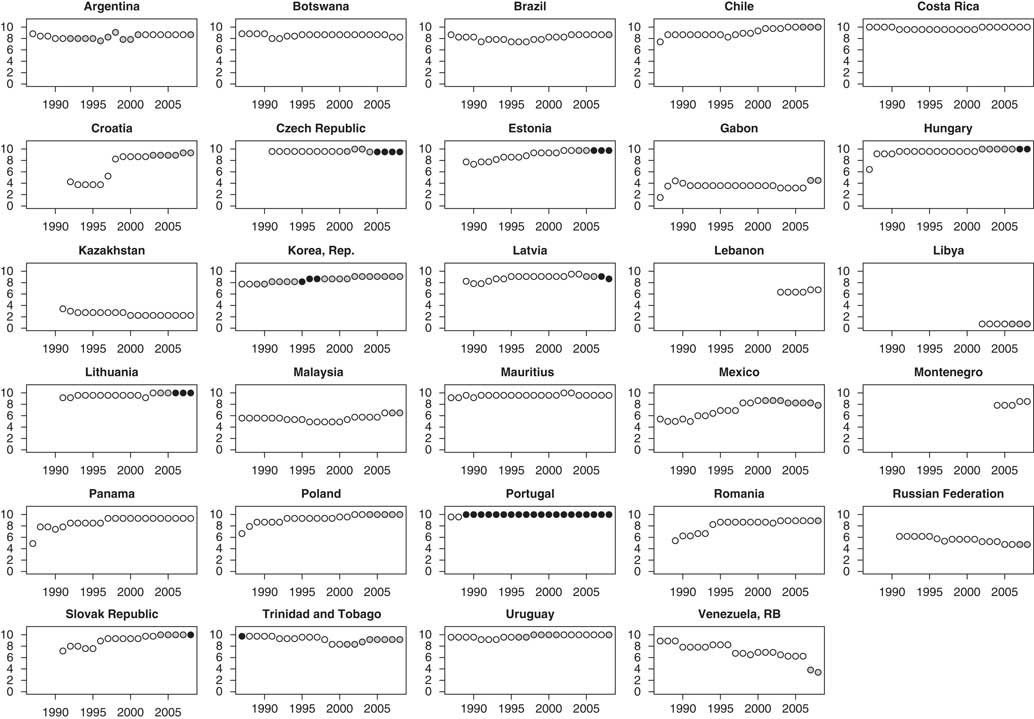
Anecdotally, countries seem to value graduation and therefore implement political reforms in order to achieve it. For example, many reports indicate that its 2005 graduation represented a significant incentive for the Czech Republic to liberalize, as the country expected this acheivement to allow the country to ‘receive a better label on international markets’ so that it would ‘receive more FDI in future years’.Footnote 43 Further, it believed that this event changed how it was perceived internationally; its official international broadcasting station stated that its graduation ‘marks an important shift in how the Czech Republic is viewed. Until now, the country was officially labelled a developing country [...] [but] on February 28th, the Czech Republic officially graduates to “developed”’. Other reports declared that ‘the Czech Republic’s days as a post-communist pauper are over’.Footnote 44 Czech Finance Minister Bohuslav Sobotka announced that the Czech Republic could ‘reestablish its position among the world’s most developed economies’.Footnote 45 Likely due to these incentives, the Czech Republic implemented political reforms upon becoming eligible to graduate, which, according to Freedom House reports,Footnote 46 included cleaning up crime and corruption, improving its election laws, protecting minority rights and liberalizing the media. This uptick in rights after becoming eligible to graduate can also be seen in Figure 2. The Czech Republic even used its graduation as evidence of its reforms, reporting that as a result it had ‘transform[ed] to a market economy and [...] a full-fledged democracy’.Footnote 47
For South Korea, graduation also represented a strong incentive to reform, as the consequences were very positive. Upon its 1995 graduation, it became a prominently cited World Bank success story; the New York Times hailed this acheivement as evidence that the country was ‘poised to rise again’.Footnote 48 Further, the bank’s managing director stated that its graduation showed ‘that it’s possible for a country to transform itself from poor debtor to international donor in less than a generation’. The director stated that graduation had occurred due to South Korea’s ‘investment in people, an outward orientation and long stretches of political stability’.Footnote 49 Indeed, South Korea ‘fulfilled [an] important step in the consolidation of [the] democratization process’Footnote 50 when it became eligibile for graduation. Further, because it had liberalized, it believed it could soon join the Organization for Economic Cooperation and Development – an international organization committed to democracy – and thus applied for membership in 1992.
Beyond these two examples, an examination of particular graduation-eligible countries reveals real and substantial changes in the quality of democracy. Though space constraints prevent a detailed analysis here, substantial reforms occurred in many states such as Eastern European states,Footnote 51 JapanFootnote 52 and MexicoFootnote 53 at the time they became eligible to graduate from the IBRD. But while these anecdotes help to establish the plausibility of our argument, and show that states believe that graduation leads to significant benefits, questions may remain as to whether graduation eligibility has generally encouraged liberalization across states and over time, as well as whether graduation eligibility actually causes these reforms.Footnote 54 We now conduct a systematic empirical test of our hypothesis, utilizing our novel natural experiment.Footnote 55
QUASI-EXPERIMENTAL EVIDENCE
Because graduation represents a highly desirable public demonstration of a country’s inclusion in the group of advanced donor states, and countries believe that it requires the enactment of political reforms, we expect countries that are eligible for graduation to undergo political liberalization. We therefore test whether becoming eligible to graduate from recipient status in the World Bank improves democracy and human rights. However, isolating the impact of international institutions on political liberalization is a difficult task. Generally speaking, membership in international institutions and treatment by such institutions are likely endogenous to factors that also affect liberalization dynamics; for example, states may seek membership in international bodies only after they are prepared to undertake liberalizing reforms. The empirical strategy we employ allows us to overcome these common endogeneity challenges.
Our strategy rests on the fact that the ability to borrow from the World Bank is based in part on a country’s per capita GNI. The World Bank records the per capital GNI of each member and determines a threshold beyond which members automatically begin the graduation process from the IBRD loans program. Once eligible, a country’s graduation from the IBRD typically takes about five years and is determined by many factors, such as its creditworthiness and institutional development.Footnote 56 However, it is important to note that the trigger to begin the graduation process occurs automatically and is based solely on a country’s per capita GNI.Footnote 57 Furthermore, the World Bank’s thresholds are set on the basis of a pre-determined (and therefore exogenous) formula that is insensitive to conditions prevailing in countries that are poised to cross the threshold. Official documentation produced by the World Bank’s OpenData program states:Footnote 58
The process of setting per capita income thresholds started [in 1970] with finding a stable relationship between a summary measure of well-being such as poverty incidence and infant mortality on the one hand and economic variables including per capita GNI estimated based on the bank’s Atlas method on the other [sic]. Based on such a relationship and the annual availability of Bank’s resources, the original per capita income thresholds were established. Thereafter, the original thresholds have been updated based on a predetermined formula every year to incorporate the effect of international inflation, which is now measured by the average inflation of Japan, the United Kingdom, the United States and the Euro Zone. Thus, the thresholds remain constant in real terms over time.
Countries that have just crossed the per capita GNI eligibility threshold should, in principle, be similar to those that are close to crossing the threshold. These two sets of countries are at virtually indistinguishable stages of development; the only major difference between them is that one set has become eligible for graduation. We are therefore able to exploit the quasi-random nature of graduation eligibility by using a regression discontinuity design.
DATA
Our treatment variable is based on income classifications issued by the World Bank from 1987 to 2010. We begin our analysis in 1987 because our data must account for nuances in the way that the World Bank uses per capita GNI data for classification purposes.Footnote 59 World Bank income classifications are set each year on 1 July based on states’ per capita GNI from the previous year. For the most part, these estimates are released by mid-May prior to the 1 July classification. However, if the actual data are not available by 1 July, temporary estimates are made for the purposes of classification. These analytical classifications remain fixed through the World Bank’s ensuing fiscal year, which ends on 30 June of the following year. Thus countries remain in the categories in which they are classified on 1 July even if their temporary estimate is revised later in the year to suggest a different classification. While current World Bank data are correct in terms of the bank’s best estimate of actual per capita GNI levels, they include revisions made subsequent to 1 July of the given year. As such, the data available in current World Bank datasets cannot be used to establish a country’s position relative to the eligibility thresholds. The original, obsolete data that include the temporary per capita GNI estimates that served as the basis of the 1 July classifications must be used. We were provided with such historical data going back to 1987 by the World Bank Development Data Group. (Data from previous years were not accessible in the archives that the Data Group maintains.)
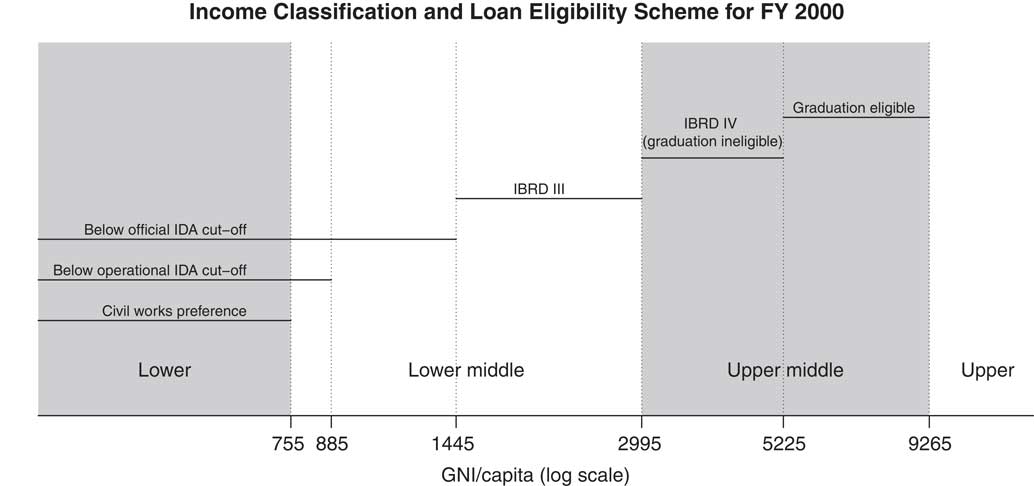
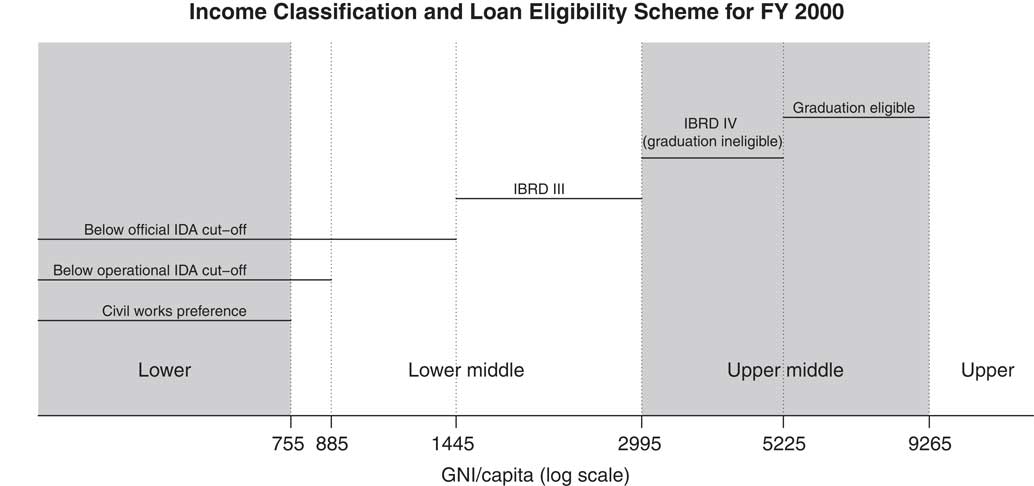
Figure 1 displays the World Bank’s entire income classification schedule for fiscal year 2000. The schedule for other years follows the same structure. As the figure shows, different thresholds distinguish each classification. The full classification schedule is described in Appendix Section A.
Income classification and loan eligibility scheme, FY 2000 Note: figure illustrates how the World Bank classifications are set and loan eligibility determined by GNI per capita, using the classification thresholds for the fiscal year 2000.
We are interested in the effect of World Bank graduation eligibility on political liberalization. We focus on two measures of political liberalization.Footnote 60 The first score, developed by Hadenius and Teorell, aggregates Freedom House’s civil liberties and political rights expert ratings with the Polity IV combined score.Footnote 61 Hadenius and Teorell recommend this score for its apparently high empirical validity and sensitivity.Footnote 62 The second measure is the Unified Democracy Score (UDS) developed by Pemstein, Meserve and Melton.Footnote 63 The UDS is the product of a latent factor analysis of ten regime type ratings.Footnote 64 In addition to showing results for these two scores, we also present disaggregated results for the average of Freedom House’s civil liberties and political rights ratings and for the Polity IV combined score. We do so because they have long represented the ‘industry standard’ measures in analyses of regime types. The Freedom House measure also is useful because Knack, Rogers and Heckelman show that Freedom House scores constitute an explicit criterion for graduation.Footnote 65 In our regression discontinuity analysis, we standardize the scores relative to the pooled mean and standard deviation of country-years to the left of the graduation-eligibility cut-point (our ‘control’ cases). Our regression discontinuity effect estimates are therefore on this scale as well.
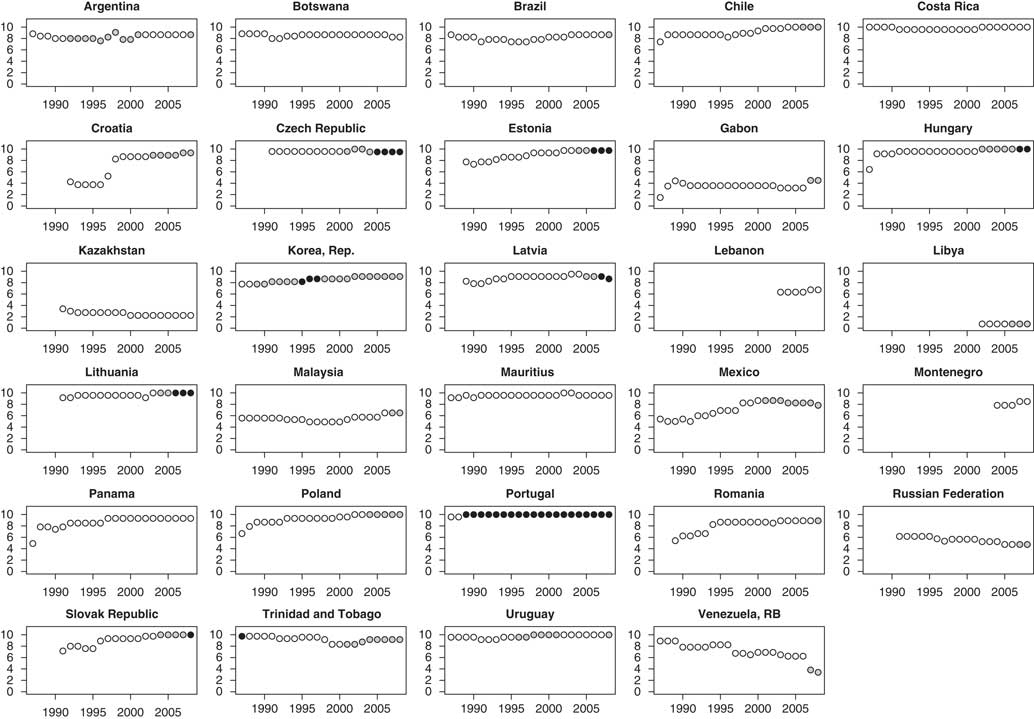
A first look at the data suggests that graduation eligibility has a positive effect on political liberalization. Figure 2 plots the aggregate Freedom House–Polity score two years forward for countries that have come close to the graduation eligibility threshold since 1987.Footnote 66 The points are colored white when the country’s income was below the threshold, gray when income was above the threshold and the country was thus eligible for graduation (but not yet graduated), and black when the country had graduated. For Croatia, the Czech Republic, Hungary, the Republic of Korea, Portugal, the Slovak Republic, Trinidad and Tobago, and Uruguay, there is upward movement in the years that follow the switch from graduation ineligibility to eligibility, although in some cases (for example, the Czech Republic) this trend is fleeting. The opposite pattern holds for Latvia and Mexico, while no clear change is evident for the other countries in the sample. Table 1 shows the results of a series of fixed effects regressions that quantify the relationship. A country fixed effects regression suggests about a half-point increase in the Freedom House–Polity combined score associated with graduation eligibility, although the coefficient is reduced by about half (and is statistically insignificant) once we control for year fixed effects and income level.Footnote 67 While these results are suggestive, they do not make full use of the deterministic nature of the graduation eligibility process to isolate the effects of eligibility. Our regression discontinuity design, to which we now turn, does just that.
Changes in Freedom House–Polity aggregate score after graduation eligibility by country Note: the x-axis is years and the y-axis is aggregate Freedom House–Polity scores two years forward for countries that have approached the IBRD graduation eligibility threshold. Points are colored white for years when a country’s income was below the threshold, gray for when it was above the threshold and the country was eligible for graduation, and black for when the country had graduated.
Changes in Freedom House-Polity Aggregate Score after Graduation Eligibility

Note: ordinary least squares with fixed effects (FE) estimates for countries and years shown in Figure 2. Standard errors account for clustering by country. †Significant at p<0.10; *p<0.05; **p<0.01; ***p<0.001
REGRESSION DISCONTINUITY DESIGN
We use a regression discontinuity design to estimate the effect of crossing the per capita GNI threshold on political liberalization.Footnote 68 Formally, we suppose a random sample of countries indexed by i and observed over periods indexed by t. We define causal effects in terms of ‘potential outcomes’.Footnote 69 Let (Y oi,t , Y 1i,t ) denote potential outcomes for country i in period t under conditions of ‘IBRD graduation ineligible in period t’ and ‘IBRD graduation eligible in period t’, respectively. The causal effect of eligibility for country i in year t is defined in terms of the difference, Y 1i,t −Y oi,t .
We denote as X
it
country i’s log income per capita in period t, while
 $$\tilde{X}_{{it}} {\equals}X_{{it}} {\minus}c_{t} $$
denotes country i’s log income per capita in year t centered at the IBRD graduation eligibility threshold for year t, which we denote with c
t
. The deterministic nature of graduation eligibility allows us to use the centered log income per capita variable
 $(\tilde{X}_{{it}} )$
as the forcing variable for the regression discontinuity design. Let Z
it
be an indicator of being graduation eligible. As discussed above, according to IBRD rules,
 $$Z_{{i,t}} {\equals}1\left( {\tilde{X}_{{i,t{\minus}2}} \,\gt\,0} \right)$$
. That is, eligibility in year t is based on a country’s income two years prior. This two-year lag is due to the following: if in year t a country’s income crosses the threshold, then this becomes known to both the country in question and the World Bank in year t+1, in which case year t+2 is the first year of eligibility for graduation. In the analyses below, we consider ‘instantaneous’ effects for the year that the graduation eligibility change is in effect (t+2, if t is the year that income crossed the threshold) as well as effects one, two and three years out (setting t+3, t+4, t+5). Graduation eligibility changes over time: a country that was ineligible at time t may become eligible in the future or, less commonly, a country that was graduation eligible at time t may fall back below the threshold in some future period. Thus, effects that we estimate for outcomes that are, say, three years out incorporate the consequences of any changes in eligibility during those three years. This will tend to dampen the size of the effects that we estimate. (We discuss this issue below with reference to Appendix Table 10.)
We make the standard regression discontinuity design assumption that potential outcomes are always smooth in the neighborhood of the cut-point. Substantively, this means that other than the switch from graduation eligibility to ineligibility, nothing else that affects the expected value of the outcomes in future periods changes discontinuously as countries cross the cut-point. This assumption is justified if (1) the eligibility threshold is set by a genuinely exogenous process, (2) it does not serve as the basis of any other institutional judgments aside from those tied to World Bank classification and IBRD graduation eligibility, and (3) a country’s income trajectory is not manipulated precisely in the neighborhood of the cut-point. The discussion above suggests that Conditions 1 and 2 can be reasonably assumed to hold, given the rather arbitrary pinning of the eligibility threshold to levels set decades ago. For Condition 3, a formal density test proposed by McCrary does not have us reject the null of no sorting (p=0.47); informally, visual inspection of plots of countries’ income trajectories does not suggest reason for concern either (Appendix Section B).Footnote 70
Given this smoothness assumption, the regression discontinuity design identifies the following conditional treatment effect:Footnote 71
 $${\rm \beta }_{{1,{\rm \tau }}} \,{\equals}\,\mathop{{{\rm lim}}}\limits_{{\tilde{X}_{{it}} \downarrow0}} {\rm E}\left[ {{\rm Y}_{{i,t{\plus}{\rm \tau }}} \left| {\tilde{X}_{{it}} } \right.} \right]{\minus}\mathop{{{\rm lim}}}\limits_{{\tilde{X}_{{it}} \uparrow0}} {\rm E}\left[ {{\rm Y}_{{i,t}} {\plus}{\rm \tau }\left| {\tilde{X}_{{it}} } \right.} \right]{\equals}{\rm E}\left[ {{\rm Y}_{{1i,t{\plus}{\rm \tau }}} {\minus}{\rm Y}_{{0i,t{\plus}{\rm \tau }}} \left| {\tilde{X}_{{it}} \,{\equals}\,0} \right.} \right],$$
where τ indicates the number of years after or before country i crosses the income threshold. By the smoothness assumption and the fact that eligibility reclassifications are lagged by two years, we must have for
 $\underline{t} \,\lt\,t{\plus}2$
,
 $$\mathop{{\lim }}\limits_{{\tilde{X}_{{it}} \downarrow0}} {\rm E}\left[ {{\rm Y}_{{i,\underline{t} }} \left| {\widetilde{X}_{{it}} } \right.} \right]\,{\equals}\,\mathop{{\lim }}\limits_{{\tilde{X}_{{it}} \uparrow0}} {\rm E}\left[ {{\rm Y}_{{i,\underline{t} }} \left| {\widetilde{X}_{{it}} } \right.} \right].$$
This condition is an implication of our broader smoothness assumption, but it is quite reasonable substantively. It holds if pre-treatment outcomes for countries that go from graduation eligible to barely ineligible in year t resemble, on average, lagged outcomes from those that just miss crossing the threshold, and likewise for countries that move toward becoming eligible. This condition allows us to write the RDD conditional treatment effect in terms of changes rather than levels:Footnote 72
 $${\rm \beta }_{{1,{\rm \tau }}} {\equals}\mathop{{\lim }}\limits_{{\tilde{X}_{{it}} \downarrow0}} {\rm E}\left[ {\left. {{\rm Y}_{{i,t{\plus}{\rm \tau }}} {\minus}Y_{{i,\underline{t} }} } \right|\widetilde{X}_{{it}} } \right]{\minus}\mathop{{\lim }}\limits_{{\tilde{X}_{{it}} \uparrow0}} {\rm E}\left[ {\left. {{\rm Y}_{{i,t{\plus}{\rm \tau }}} {\minus}Y_{{i,\underline{t} }} } \right|\widetilde{X}_{{it}} } \right].$$
Using changes instead of levels helps control for country-specific heterogeneity, thereby increasing efficiency. In our analysis, we use
 $\underline{t} \,{\equals}\,t$
, since it is the most proximate value available for which we can be sure that there is no effect of crossing the threshold; therefore, this ought to maximize efficiency.
We estimate β 1,τ using the local linear regression approach described in Imbens and Lemieux and Imbens and Kalyanaraman.Footnote 73 We use a constant bandwidth that corresponds to about ±$500 GNI/per capita or ±0.10 on the log(GNI/capita) scale. This is the tightest bandwidth for which we can perform ‘placebo tests’ with reasonable power.Footnote 74 The placebo tests provide additional evidence of the validity of the design, showing that an implication of our identifying assumptions holds (namely, that lagged outcomes should not differ over treatment values). These tests are shown in the main results tables below as the ‘placebo’. Our placebo is the difference, Y i,t −Y i,t−2 , which is analogous to the ‘instantaneous effect’ but in the reverse temporal direction. Keeping the bandwidth constant also facilitates interpretation of the results, as all effects are estimated from the same subpopulation.Footnote 75 Appendix Section C provides additional details on the methods of estimation.
RESULTS
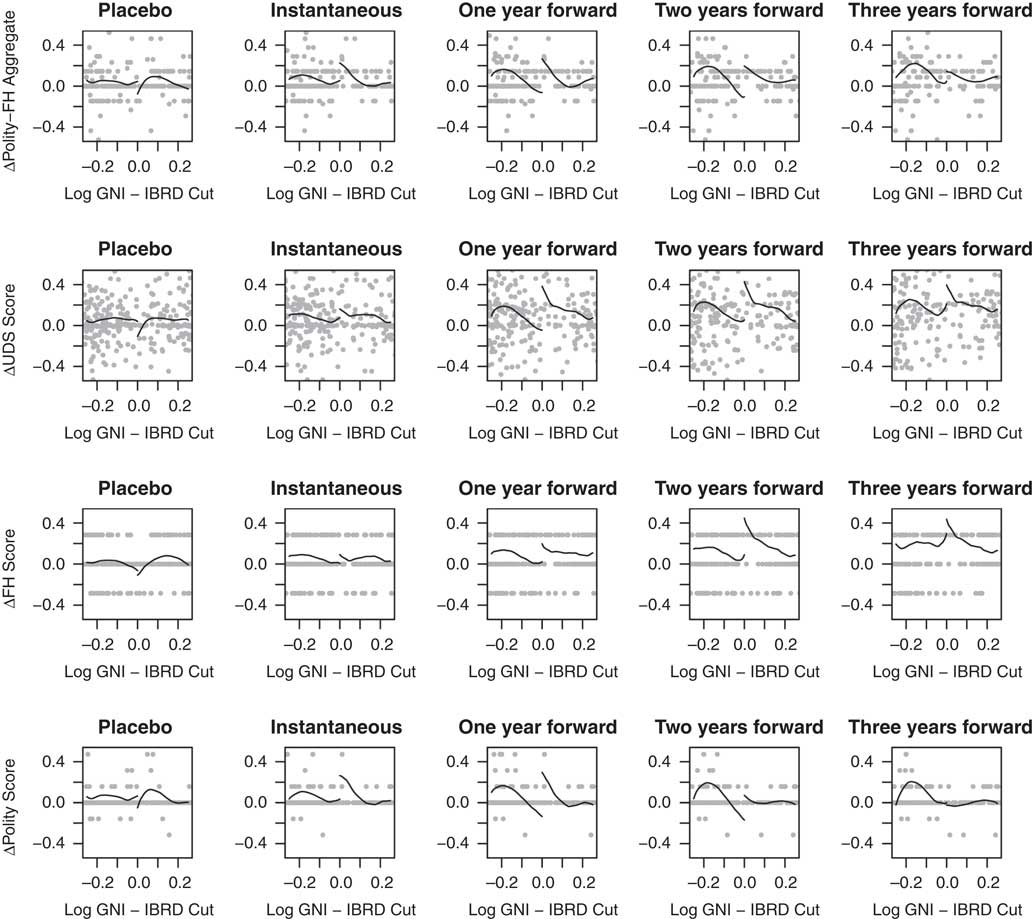
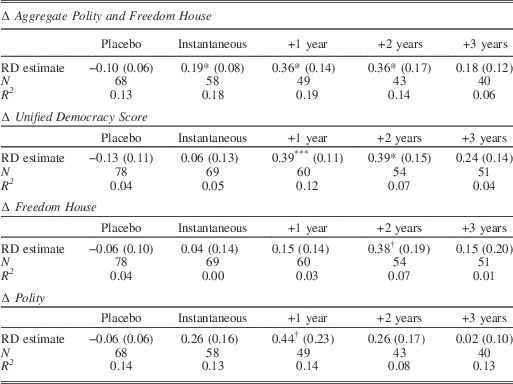
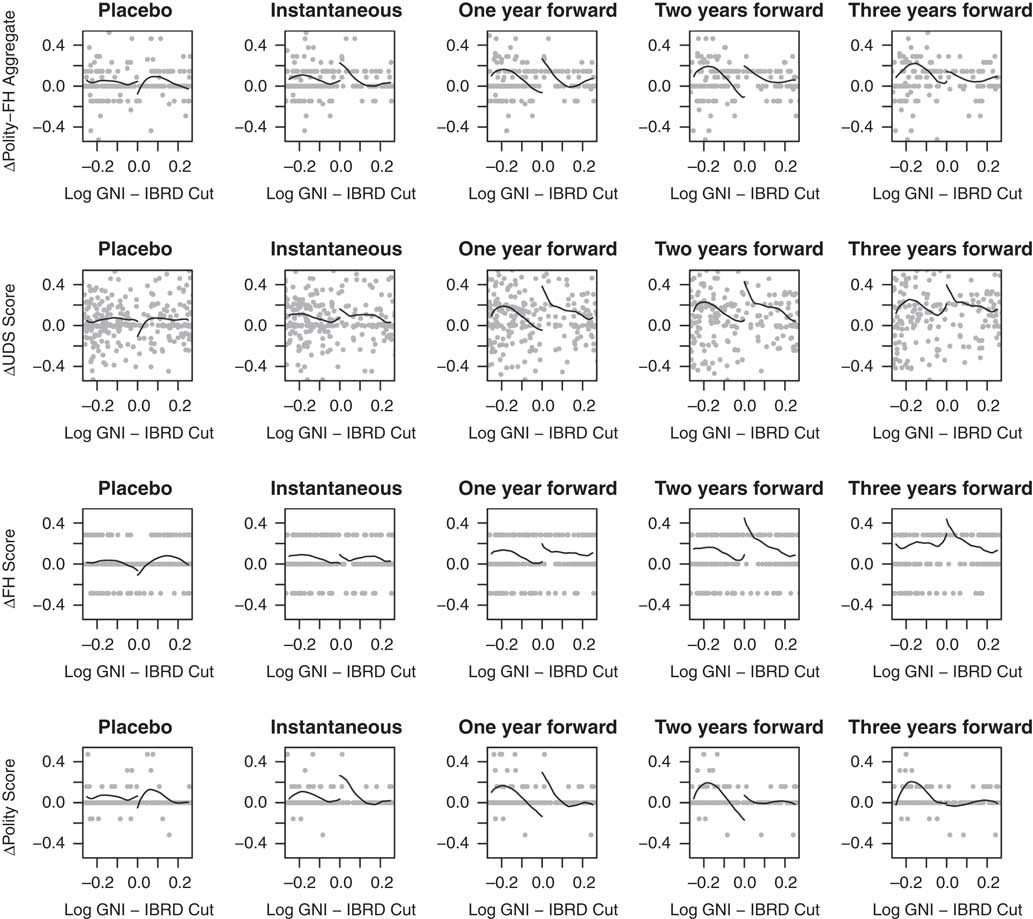
The results of the analysis of the effects of graduation eligibility on political liberalization are displayed in Table 2 and Figure 3. We show the results for the aggregate Polity–Freedom House score, the UDS, and then the component Freedom House and Polity scores. Our preferred specifications use the combined Polity–Freedom House score and the UDS, given that these two sources aggregate multiple sources of information and therefore maximize measurement reliability. However, we also include the effects on the Freedom House and Polity scores for completeness. As discussed above, the analysis uses differences between lead and lag outcomes measured against outcomes in year t (hence the ∆ symbols for the outcome headings).
Changes in mean political liberalization scores Note: scores are measured in terms of aggregate Freedom House–Polity score, Unified Democracy Score (UDS), Freedom House (FH) score and Polity score, as a function of the distance between a country’s log GNI per capita and the IBRD graduation eligibility cut point. Outcomes are standardized relative to the mean and standard deviation of outcomes to the left of the cut point. Plots are given for changes from year t−2 to t (placebo), t to t+2 (instantaneous relative to eligibility change at t+2), t to t+3, t to t+4, and t to t+5 (one, two, and three years forward, respectively, relative to eligibility change at t+2). The gray dots represent country-year observations, and black curves are local linear estimates of the conditional mean.
Effects of Graduation Eligibility on Political Liberalization

Note: least squares regression discontinuity (RD) estimates. 0.10 bandwidth around cut point and rectangular kernel. Standard errors account for clustering by country.
Effects are in pre-treatment standard deviation units. Pre-treatment standard deviations are 2.87 for Aggregate Polity-Freedom House score, 0.69 for Unified Democracy Score, 1.76 for Freedom House, and 6.34 for Polity score. Sample sizes decrease as we move forward in years because of country-year observations that reach beyond the highest year for the dataset (treated up to 2008, and outcomes up to 2010). Appendix Section D contains the full list of country years included in each analysis.
†Significant at p<0.10; *p<0.05; **p<0.01; ***p<0.001
The first column of results presents the ‘placebo’ check using the lagged two-year difference (Y t −Y t−2), and the next columns display the ‘instantaneous’ effect and then effects one, two and three years forward. Recall that by instantaneous effects we mean effects in the first year that the change in eligibility is operative, which is two years after a country’s per capita GNI crosses the threshold (Y t+2 −Y t ). The ‘forward’ effects are also defined in terms of the year that the eligibility change goes into effect, and so the one, two and three years forward effects are three, four and five years after the country’s per capita GNI crosses the threshold, respectively. Figure 3 displays regression discontinuity graphs for these same outcomes. The graphs plot estimates of the conditional mean of the political liberalization outcomes over the centered log(GNI/capita) forcing variable. The estimates are produced from local linear regressions with a 0.10 bandwidth, and are generated separately on either side of the cut-point.Footnote 76 Outcomes are standardized relative to the pooled mean and standard deviation of country-years to the left of the cut-point.Footnote 77 Appendix Section D contains a table showing the list of country-year cases that fall within the bandwidth for which complete data were available. The cases include upper middle income countries from all regions of the world over years spanning 1988 to 2007. A variety of robustness checks are shown in Appendix Figure 4.
The results suggest a boost to political liberalization that becomes apparent almost immediately and carries through one to two years after a country becomes graduation eligible. The size of the effect is between about 0.2 to 0.4 standard deviations. To better understand the substantive significance of the finding, one way to scale the effect is with respect to changes over time within countries. For the sample of countries analyzed here, these scores tend to trend upward, so that the effect is equivalent to 10 to 15 years of progress in the average trend. Further, the coefficients are highly statistically significant for our preferred specifications, though levels of significance fall for the Freedom House and Polity scores on their own. This is unsurprising, given that these component measures incorporate less information, and therefore admit more measurement error, than is the case for the two aggregated measures. Even here, however, the coefficients are positive and approach statistical significance.Footnote 78
We further find that the effects dissipate by year three after the eligibility change, but this is easily explained by the dynamics of our natural experiment, wherein our ‘control’ observations become increasingly tainted over time. Recall that our estimates take countries that are just below the eligibility threshold in year t (our ‘control group’) and compare them to countries that are just above the threshold in year t (our ‘treatment group’). Over time, control group members tend to cross the threshold themselves, thereby erasing any differences with their treatment group counterparts; this dynamic process is evident when we analyze eligibility status over time (see Appendix Table 10). Indeed, the comparison is already ‘watered down’ substantially after one year, suggesting that our estimates understate the impact on political liberalization.
Note that because we identify the effect based on changes in graduation eligibility, rather than actual graduation, we obviate concerns over whether the result represents a halo effect in the ratings that comes from the increased media coverage and publicity that graduation entails. Eligibility does not bring such publicity. Nothing tangible happens when a country becomes eligible to graduate; there is no change in the group in which the country falls, the country remains eligible for loans, and no political or economic reforms are required. As Knack, Rogers and Heckelman state, ‘The income threshold [...] is simply a trigger for beginning discussions on graduation’.Footnote 79 Thus while graduation eligibility simply represents a shift in per capita GNI past a specific threshold, graduation itself indicates that a country has achieved political liberalization and has thus altered its international status. The latter is therefore highly touted, while the former passes without fanfare.Footnote 80
To bolster confidence in our findings, we also conduct a variety of robustness checks, extend our main results, and consider alternative explanations for our findings. The results of these additional tests are presented in the Appendix due to space constraints, but we briefly describe them here: First, we examine the effect of graduation eligibility on graduation and find that, on average, eligibility tends to accelerate graduation (see Appendix Section F). Secondly, we disaggregate the effects on the components of the Freedom House and Polity scores as well as Freedom House’s press freedom measure. While tentative, we find that the political liberalization effects tend to be associated primarily with improvements in press freedom and competitive executive institutions, although these effects are not always statistically significant (see Appendix Section H).
Thirdly, we explore alternative explanations for our findings centered around the possibility that states seek to compensate for the lost funding associated with graduation by liberalizing in order to secure money elsewhere (see Appendix Section G). We explain that this possibility is theoretically unlikely for several reasons: (1) graduates do not tend to lose funds in practice, (2) they may continue to receive other forms of assistance from the bank after graduation and (3) we identify effects based on eligibility, which itself does not represent a loss of access to loans. We nonetheless subject these alternative explanations to empirical examination, but find no evidence to support them (Appendix Table 8).
Fourthly, we consider potential confounding associated with income and income classification dynamics. The first is the possible impact of countries’ anticipation of crossing the per capita GNI threshold on the interpretation of our results (see Appendix Section I). We demonstrate empirically that anticipation is likely muted, since there is considerable uncertainty about whether a country will in fact cross the threshold in a given year. Next, we examine whether countries tend to ‘linger’ below the eligibility threshold, and if so, whether they are particularly resistant to liberalizing (see Appendix Section J). Since lingering effects could bias our results, we conduct robustness checks that account for this behavior and our findings remain unchanged.
Fifthly, we examine whether our effects are driven by particular countries, such as EU candidate countries or US allies (see Appendix Section J). We find that the effects for these sets of countries are actually smaller than those for other countries in the sample, and thus our results are driven primarily by non-candidate countries and non-US allies. Further, since we also show that EU candidate countries and US allies tend to exhibit significantly higher liberalization scores on average, these results may indicate a ceiling effect, whereby these countries have less room to improve after they become eligible for graduation. However, another possible reason for our finding regarding US allies is that these states may be more insulated from US pressure to reform. We are unable to determine which mechanism drives these results, and view this as an interesting avenue for future research.
Sixthly, we investigate whether the effects of World Bank graduation are long lasting. While graduation itself is endogenous and our identification strategy does not allow us to analyze this question rigorously, we explore this question using descriptive evidence and find little evidence that backsliding occurs. While this does happen occasionally in our sample, it is rare; we typically see countries continue to improve following graduation. In particular, we compare the Polity–Freedom House scores of countries in the year they graduated to their scores one year afterward and five years afterward. Out of the twenty-four graduates for which we have data (we are missing data for Cyprus), two countries’ scores improved one year after graduation (Greece and Spain) and one country’s score declined (Czech Republic). Further, ten countries’ scores rose five years after graduation (Bahamas, Greece, Iraq, Israel, South Korea, Oman, Portugal, Spain, Trinidad and Tobago and Venezuela) while only three countries’ scores fell (Czech Republic, Hungary, Latvia).
Finally, we conduct several robustness checks including the use of a triangular kernel, alternative bandwidths and level outcomes (see Appendix Section L). Our results are highly robust, as we find similar effects using each alternative specification.
CONCLUSION
Using the example of the World Bank, we show that international organizations can prompt governments to adopt political reforms by offering them the chance to join a group of developed, advanced countries in exchange. We examine a distinctive aspect of the bank’s loans program, whereby loan recipients become eligible to graduate from the program upon achieving a pre-specified level of economic development. Our research design builds upon Knack, Rogers and Heckelman’s findings that eligible countries are more likely to graduate from the IBRD program if they increase their political freedoms, as we show that countries actually respond to these incentives in practice.Footnote 81 Indeed, we demonstrate that while graduation entails a loss of access to World Bank loans, states are willing to take significant steps to improve democracy and human rights when given the opportunity to become part of the club of developed states.
We test our argument using a regression discontinuity design that compares countries with per capita GNIs just below the cut-off for graduation eligibility to those just above it. Since these states are identical in expectation apart from their eligibility status, we are able to compare outcomes between the two groups to uncover the effect of becoming eligible for graduation. The results corroborate our theoretical expectations, as we find that graduation-eligible states exhibit statistically and substantively large increases in political liberalization. The size of the effects is roughly equivalent to what the countries in our sample otherwise tend to experience after 10 to 15 years of ‘natural’ progress in liberalization. We also examine potential alternative arguments and detect no evidence to support them.
While we focus our analysis on the World Bank, our study has far-reaching implications. In particular, for the large literature seeking to understand how the international community may shape states’ behavior, our findings are encouraging. By demonstrating that international organizations can provoke significant improvements in political liberalization, our article speaks to their power to influence member states. Contrary to many previous findings, we show that these institutions do more than merely attract states that respect human rights; instead, institutions can actually foster these rights. International institutions thus have the ability to encourage change, representing more than epiphenomenal reflections of international interests and power distributions.
Further, our results demonstrate that graduation eligibility has a large effect on political liberalization. This finding raises further concerns about whether the observed relationship between membership and political outcomes in the existing literature is causal. Instead, it is plausible that accession processes that demand specific reforms as a condition of membership are effective, while institutions themselves may not be as impactful as the literature claims. Put differently, previous work may have misattributed effects of membership conditions to the effects of institutions. Our identification strategy allows us to isolate the effect of eligibility for a prize – in this case graduation – to demonstrate that this process has an independent causal effect.
However, though our research design allows us to identify the impact of an important and influential World Bank program, it is reasonable to ask whether these effects hold more generally in other institutions and settings. While we cannot answer that question definitively, the particular mechanism suggested by our qualitative and quantitative evidence suggests that similar results could be obtained by other organizations. Specifically, other institutions could potentially convince states to reform by adopting an analogous approach of offering opportunities to join high-status groups; for instance, perhaps the potential to gain a seat on the United Nations Security Council or to receive representation on the Executive Board of the International Monetary Fund could similarly motivate states to adopt policy changes.
Moreover, in addition to suggesting that international institutions could productively offer chances to attain membership in desirable groupings, our results touch on many policy controversies related to the design and administration of these bodies. Many policy makers and practitioners have suggested that selection into prominent positions in the international system should be merit based, whereby the fulfillment of specific criteria would be necessary to become eligible for these roles. Our findings imply that such a system could motivate reforms because, like the bank, an organization comprised of politically liberal states could perhaps more effectively encourage political liberalization among new entrants. Further, since we have shown that promotion into a more desirable group within an organization can stimulate reforms, perhaps demotion or suspension of a state’s participation for failing to meet certain conditions could be similarly consequential. Both the act of suspension and the threat of suspension could motivate states to sustain certain policies. The degree to which such processes could motivate liberalization likely depends on the size of the reward for doing so relative to the cost of undertaking the reforms. These avenues constitute fruitful avenues to explore for future research.