Introduction
Wetlands worldwide support numerous plant and animal species, acting as breeding and feeding grounds and providing various ecosystem services (Maltby & Acreman Reference Maltby and Acreman2011). Yet wetlands face significant threats from industrial and agricultural pollution, drainage and land conversion (Davidson Reference Davidson2014). Approximately half of the world’s wetlands have been lost (Davidson Reference Davidson2014), reducing biodiversity and disrupting ecological interactions (Harris et al. Reference Harris, Tomas, Mourão, Da Silva, Guimarães, Sonoda and Fachim2005).
The Pantanal, a Neotropical wetland encompassing 179 300 km2 in the Upper Paraguay River Basin of central South America (Marengo et al. Reference Marengo, Cunha, Cuartas, Deusdara, Broedel and Seluchi2021), comprises a mosaic of water bodies, grasslands, savannahs and forests, connected by seasonal floods. However, recent reductions in rainfall and water levels have diminished these connections (Marengo et al. Reference Marengo, Cunha, Cuartas, Deusdara, Broedel and Seluchi2021), impacting aquatic and semi-aquatic species, including giant otters (Pteronura brasiliensis; Soresini et al. Reference Soresini, da Silva, Leuchtenberger and Mourão2021).
Gold-mining has occurred in the northern Pantanal for 200 years (Callil & Junk Reference Callil, Junk, Junk, da Silva, Nunes da Cunha and Wantzen2011). Mercury (Hg), used in gold amalgamation, can have neurotoxic and endocrine-disrupting effects (Wiener et al. Reference Wiener, Krabbenhoft, Heinz, Scheuhammer, Hoffman, Rattner, Burton and Cairns2002), and it is lethal at high concentrations (Gutleb Reference Gutleb, Conroy, Yoxon and Gutleb2000). Despite technological and regulatory improvements (Callil & Junk Reference Callil, Junk, Junk, da Silva, Nunes da Cunha and Wantzen2011, Brasil 2018), Hg contamination persists, and even low concentrations can biomagnify and bioaccumulate along the aquatic food web (Marmontel Reference Marmontel, Spironello, Barnett, Lynch, Bobrowiec and Boyle2023).
Selenium (Se) mitigates Hg toxicity by forming a Se:Hg compound at a 1:1 molar ratio (Nakazawa et al. Reference Nakazawa, Ikemoto, Hokura, Terada, Kunito and Tanabe2011). Predatory aquatic mammals, such as giant otters, detoxify methylmercury via demethylation through Se bioaccumulation (Marmontel Reference Marmontel, Spironello, Barnett, Lynch, Bobrowiec and Boyle2023). However, Se concentrations being lower than Hg concentrations may lead to toxicity (Zhang Reference Zhang2014). Therefore, we report the Se:Hg ratio that can be used as a proxy to evaluate potential physiological protection or increased risk of Hg toxicity in giant otters.
The giant otter, the largest of the Lutrinae subfamily, is categorized as Endangered globally (Groenendijk et al. Reference Groenendijk, Marmontel, Van Damme, Schenck, Schenck and Wallace2021) and as Vulnerable in Brazil (Rodrigues et al. Reference Rodrigues, Leuchtenberger and Da Silva2013). Although extinct in parts of its former range (Groenendijk et al. Reference Groenendijk, Marmontel, Van Damme, Schenck, Schenck and Wallace2021), populations persist in the Pantanal. As apex predators with piscivorous habits, they are key bioindicators of freshwater ecosystems (Utreras & Jorgenson Reference Utreras and Jorgenson2003).
Previous studies have reported Hg concentrations in Pantanal wildlife, including fish (Hylander et al. Reference Hylander, Pinto, Guimarães, Meili, Oliveira and Castro e Silva2000), caimans (Vieira et al. Reference Vieira, Nunes, Amaral, Oliveira, Hauser-Davis and Campos2011), wood storks (Del Lama et al. Reference Del Lama, Rocha, Jardim, Tsai and Frederick2011), jaguars (May-Júnior et al. Reference May-Júnior, Quigley, Hoogesteijn, Tortato, Devlin and Carvalho Júnior2018) and giant otters (Fonseca et al. Reference Fonseca, Malm and Waldemarin2005, Soresini et al. Reference Soresini, da Silva, Leuchtenberger and Mourão2021). However, prior studies on giant otters examined only small areas of the southern Pantanal, far from gold-mining sites. Therefore, the present study is the first to evaluate Hg and Se concentrations in giant otters across a broader scale in the Pantanal.
The concentrations of contaminants in animals depend on exposure duration, environmental concentration, diet, trophic level, metabolism and tissue type (Hyvärinen et al. Reference Hyvärinen, Tyni and Nieminen2003). Keratin-rich structures, such as fur, provide stable long-term records of toxic elements via metabolic deposition (Hyvärinen et al. Reference Hyvärinen, Tyni and Nieminen2003). Non-invasive fur sampling (Pedroso et al. Reference Pedroso, Dias, Diniz-Reis, Santos-Reis and Verdade2018) is practical for threatened and difficult-to-capture species such as giant otters.
We evaluated whether Hg contamination in giant otter fur in the Pantanal is related to their contact with and distance from gold-mining areas. We predicted that Hg levels would be higher in otters near gold-mining areas and would decrease with increasing downstream distance. We also evaluated the Se:Hg molar ratio, given its potential role in reducing Hg toxicity in giant otters.
Methods
Study area
The Pantanal wetland, located primarily in the Midwest of Brazil, receives water mainly from the surrounding uplands. The Paraguay River, flowing north to south, serves as the region’s main water contributor, with most tributaries flowing east to west (Hamilton et al. Reference Hamilton, Sippel and Melack1996). The primary gold-mining sites are concentrated in Poconé, a city in the northern Pantanal.
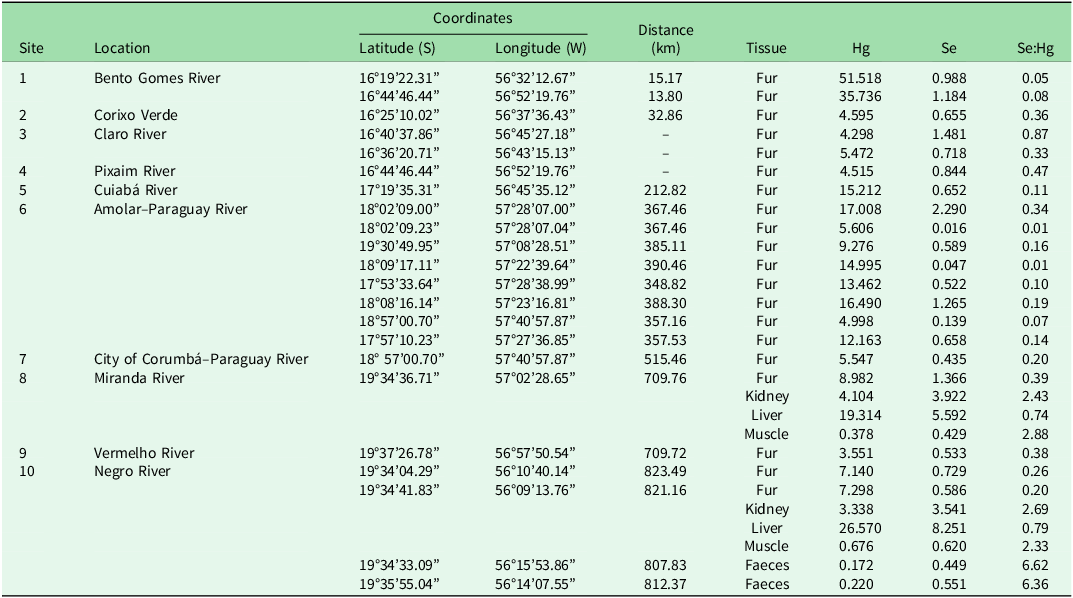
Ten study sites were chosen, located approximately along a north–south gradient (Fig. 1 & Table 1). Both the Bento Gomes River (gold-mining area) and the city of Corumbá (urban area) sites are subject to domestic and industrial waste. The other sites are relatively unimpacted by humans, and the main economic activities there are cattle farming and ecotourism.
Diagrammatic map showing the distribution of sites where biological samples from giant otters (Pteronura brasiliensis) were collected in the Pantanal. Numbered circles represent the sampling sites. Black circles indicate giant otters inhabiting water bodies connected to the main rivers. White circles indicate giant otters from isolated water bodies.

Mercury (Hg) and selenium (Se) concentrations (μg g–1 dry weight) and Se:Hg molar ratios detected in tissues and faeces from giant otter (Pteronura brasiliensis) groups and individuals from 10 sites in the Brazilian Pantanal wetland between September 2020 and October 2021.

Note: ‘Distance’ refers to the length of river courses connecting each sampled site to gold-mining areas in the northern Pantanal.
a Samples collected from individuals.
Sampling and analysis
To reduce animal stress, fur samples were collected between September 2020 and October 2021, adapting the fur trap method of Pedroso et al. (Reference Pedroso, Dias, Diniz-Reis, Santos-Reis and Verdade2018) by placing adhesive tape strips on roots and branches at active dens and latrines. The number of traps varied depending on the number of active sites. Camera traps were positioned to monitor the fur traps and identify the sampled groups. Traps remained set up for at least 2 days. The collected fur was detached from the tape with tweezers, stored in Eppendorf tubes and labelled. The collection method did not allow individual identification of fur samples, preventing age and sex determination, but they still represented otters inhabiting those locations.
Tissue (liver, kidney, muscle) and fur samples were obtained from two giant otter carcasses found at the Negro River (February 2020) and the Miranda River (September 2021). At the Negro River, fur alone was collected from another carcass in an advanced stage of decomposition in September 2020, and two faecal samples were collected shortly after deposition using clean tools and stored in sterile tubes to minimize contamination risk. Sample collection was conducted under SISBIO/ICMBio licences 68974, 78746 and 79173.
Fur samples were washed with acetone PA (pro analysis), rinsed three times with ultra-purified water (Milli-Q system) and washed again with acetone PA to remove external contamination, then oven-dried at 40°C for 4 hours. Tissues (kidney, liver, muscle) and faeces were not washed or dried, but the samples of tissues were collected by the dissection of the carcass using disinfected instruments and placed in sterile containers to prevent external contamination. All samples were placed in Teflon jars and weighed using an analytical scale. The masses of the samples ranged from 0.7 to 200 mg. Next, 3 mL of distilled nitric acid (HNO3) was added to the samples, which were then digested in a closed system of microwave-assisted digestion. The samples were then diluted with ultra-purified water to 50 mL in centrifuge tubes containing 2.5 mL of 10% (v/v) distilled hydrochloric acid (HCl). Elemental concentrations were determined using inductively coupled plasma mass spectrometry (ICP-MS; NexION 2000, Perkin Elmer) at the Exata Brasil Laboratory in Jataí, Brazil. Calibration curves were prepared using certified Hg and Se standards (NSI Lab Solutions), and internal standards (germanium-74, rhodium-103, iridium-193) were added to all samples and standards to correct for instrumental drift and matrix effects.
Quality control included four blanks, recovery tests using spiked samples and an external standard (QC STD 1). Recoveries for Se and Hg ranged from 97.8% to 104.8% and from 103.4% to 117.0%, respectively. Reproducibility was assessed using replicate analyses, with relative standard deviations of <5%. Limits of qualification were 0.0428 μg g–1 for Se and 0.0672 μg g–1 for Hg. All results were presented in μg g–1 dry weight, and to compare them with values expressed in wet weight, we performed a 3:1 conversion of dry to wet weight (Puls Reference Puls1994).
Data analysis
We evaluated the contamination gradient based on: (1) the distance from contaminant sources to the study sites along river channels and other water bodies; and (2) the presence of connecting waters between the sources and study sites. Therefore, only fur samples from sites with at least 4 years of water coalescence were included in this analysis. Moulting aids in the elimination of toxic substances, including Hg, and typically occurs year-round in tropical otters (Kuhn Reference Kuhn2009). The 4-year isolation period ensured that the collected fur reflected the current contamination scenario at each site during the sampling period.
To assess connectivity between sampled sites and gold-mining areas, we selected Sentinel-2 satellite images from 2018 to 2021 from the USGS Earth Explorer (USGS 2022), and we processed them using QGIS v. 3.26.0 software (QGIS.org 2022). We applied the normalized difference water index (NDWI), a radiometric index derived from spectral band combinations that enhances surface differences, allowing the detection of water bodies and flooded vegetation (Gao Reference Gao1996, Pereira et al. Reference Pereira, Amorim, Grigio and Paranhos Filho2018). This enabled us to identify sites that were – at least temporarily – hydrologically connected during the selected years. The NDWI was calculated using Equation 1 (the formula proposed by Gao Reference Gao1996):
 $${\rm{NDWI}} = {{{{\rm{NIR\;}} - {\rm{\;MIR}}}}\over{{{\rm{NIR\;}} + {\rm{\;MIR}}}}}$$
Gao (Reference Gao1996) uses two bands of the infrared channel, where NIR is near-infrared band and MIR is the mid-infrared band.
We measured the distance between sampled sites using the QGIS ‘measuring tool’, following river courses and other connected water bodies. To evaluate whether the total Hg in giant otter fur was related to their distance from gold-mining areas upstream, we constructed a two-factor generalized additive model (GAM) with integrated smoothness estimation. This analysis was performed using the mgcv package (Wood Reference Wood2017) in the R statistical environment v. 4.2.1 (R Core Team 2022). To determine whether the datasets from this study could be merged with those from 2016–2017 of Soresini et al. (Reference Soresini, da Silva, Leuchtenberger and Mourão2021), we included the datasets as a factor. A non-significant result for this term would support the merging. The other modelled explanatory variable was the distance from sampling locations to gold-mining areas along rivers and connected channels. Sites 3 and 4 were excluded due to a lack of connectivity to other sites during the selected period. Site 2 was included as it connected to the Bento Gomes River and subsequently to the Paraguay River during the 2018–2019 floods, despite being isolated during 2020–2021.
To calculate the Se:Hg molar ratio, we converted the dry weight measurements to molar concentrations by dividing the concentrations (μg g–1) by their respective molecular weights: 78.96 g mol−1 for Se and 200.59 g mol−1 for Hg. A summary of the overall workflow, from sample collection to statistical analysis, is provided in Fig. S1.
Results
We detected Hg and Se in all samples (Table 1). The total Hg concentration in the fur samples ranged from 3.55 to 51.51 μg g–1 (mean 12.40 ± 11.85 μg g–1 SD). The highest values were from the Bento Gomes River (51.51 and 35.73 μg g–1), followed by the Amolar region (mean 12.62 ± 4.28 μg g–1 SD) and the Cuiabá River in Porto Jofre (16.49 μg g–1). Despite the proximity to gold-mining areas, samples from the unconnected sites of the Claro and Pixaim rivers revealed lower values (4.29 and 4.51 μg g–1, respectively). The lowest concentration was from the Vermelho River (3.55 μg g–1).
From the carcasses, we obtained the highest Hg concentrations in the liver (26.57 and 19.31 μg g–1), followed by fur (8.98 and 7.29 μg g–1), kidney (4.10 and 3.33 μg g–1) and muscle (0.67 and 0.37 μg g–1). The Hg concentration in faecal samples ranged from 0.157 to 0.23 µg g–1.
The 19 fur samples from the 2016–2017 dataset (Soresini et al. Reference Soresini, da Silva, Leuchtenberger and Mourão2021) and the 17 samples from present study’s dataset (2020–2021) could be merged, as the two-factor GAM indicated a non-significant result for this term (t = –0.123, ppartial = 0.903, n = 36). The combined data resulted in a significant smooth term (estimated degrees of freedom = 2.402, ppartial < 0.001) for the distance along the watercourses. Overall, the model explained c. 51.2% of the deviance, and R2adjusted = 0.467 (Table S1). Hence, for the connected sites, the total Hg measured in the fur of the giant otters was related to the distance along river channels and other water bodies from the gold-mining areas upstream. In contrast, fur from unconnected water bodies had lower Hg concentrations, irrespective of proximity to gold-mining areas (Fig. 2).
Generalized additive model (GAM) plot of the total mercury (Hg) concentration (μg g–1 dry weight) in the fur of giant otters (Pteronura brasiliensis) as a function of the distance from gold-mining areas in the Pantanal wetland. The shaded area indicates the 95% confidence interval. Black circles represent connected sites analysed in the current study, squares indicate data from Soresini et al. (Reference Soresini, da Silva, Leuchtenberger and Mourão2021) and white circles represent unconnected sites not included in the GAM analysis. The dashed horizontal line indicates the 5 μg g–1 threshold for environmental Hg contamination, beyond which adverse effects on wildlife are likely to occur (Eisler Reference Eisler2006).

The Se concentrations in fur were 0.016–2.290 μg g–1 (mean 0.78 ± 0.54 μg g–1 SD). In carcasses, Se concentrations were 3.541–3.922 μg g–1 in kidneys, 5.592–8.251 μg g–1 in the liver and 0.429–0.620 μg g–1 in muscle (Table 1). The Se concentrations in the faecal samples were 0.383–0.719 μg g–1.
The Se:Hg molar ratios ranged from 0.008 to 0.873 in the fur samples. In the fresh carcasses, the Se:Hg molar ratios were lower in the fur (0.203–0.386) compared to the liver (0.737–0.789), muscle (2.329–2.885) and kidneys (2.428–2.695; Table 1). In the faecal samples, the Se:Hg molar ratio ranged from 4.133 to 9.912.
Discussion
The Hg concentration in giant otter fur samples from the Negro River in the southern Pantanal exceeded those reported by Fonseca et al. (Reference Fonseca, Malm and Waldemarin2005; 2.94–3.68 μg g–1) and was comparable to those found by Soresini et al. (Reference Soresini, da Silva, Leuchtenberger and Mourão2021; 2.62–12.06 μg g–1) in the Vermelho and Miranda rivers. Most samples from this region surpassed 5 μg g–1, a threshold indicating environmental Hg contamination (Eisler Reference Eisler2006) and substantial pollution in the area.
Mercury concentrations in giant otter fur decreased with distance downstream from mining areas, yet contamination persisted in remote areas, highlighting the far-reaching effects of local pollution. Although other sources, such as fertilizers, pesticides or microbial-mediated methylmercury, may contribute locally (Soresini et al. Reference Soresini, da Silva, Leuchtenberger and Mourão2021), gold-mining remains the main Hg source in the Pantanal. In Madre de Dios, Peru, Hg contamination was widespread in sediments, fish and areas hundreds of kilometres from gold-mining sites, threatening both wildlife and human communities (Diringer et al. Reference Diringer, Feingold, Ortiz, Gallis, Araújo-Flores and Berky2015). In the same region, Barocas et al. (Reference Barocas, Vega, Pardo, Flores, Fernandez and Groenendijk2023) found no significant correlation between Hg levels in fish and giant otter presence but suggested that habitat destruction from mining may harm otter populations.
The highest Hg concentration recorded in this study (51.51 μg g–1 in the Bento Gomes River) is the highest ever reported for giant otters. A study on jaguars in the Pantanal also found significant Hg differences between the northern and southern regions (May-Júnior et al. Reference May-Júnior, Quigley, Hoogesteijn, Tortato, Devlin and Carvalho Júnior2018), with the highest value ever recorded in a wild animal (2000 μg g–1) near our sampling sites. We found lower Hg levels in otters inhabiting unconnected sites, regardless of proximity to mining areas, consistent with Soresini et al. (Reference Soresini, da Silva, Leuchtenberger and Mourão2021); thus, connectivity rather than proximity alone evidently influences contamination levels.
The Hg concentration and distribution vary among tissues due to differences in absorption and excretion (Eisler Reference Eisler2006). For instance, Eurasian otters (Lutra lutra) can eliminate up to 7.3 mg of Hg during a complete moult (Hyvärinen et al. Reference Hyvärinen, Tyni and Nieminen2003), highlighting fur as an important Hg elimination pathway. Giant otters, however, exhibit 2.0–3.6 times more Hg in their livers than in their fur (Fonseca et al. Reference Fonseca, Malm and Waldemarin2005, this study), unlike temperate otters inhabiting areas where environmental Hg concentrations are similar (Hyvärinen et al. Reference Hyvärinen, Tyni and Nieminen2003). While temperate otters undergo a definite moult (Kuhn Reference Kuhn2009), probably leading to higher Hg deposition in fur within seasons, many tropical semi-aquatic animals, including some otters (Kuhn Reference Kuhn2009) and probably giant otters, moult continuously, facilitating Hg elimination throughout the year. Faeces might also be an important elimination pathway, as seen in Baltic grey seals (Halichoerus grypus; Grajewska et al. Reference Grajewska, Falkowska, Saniewska and Pawliczka2020). The low Hg concentration in faecal samples from this study aligns with previous findings regarding Peruvian giant otters near gold-mining areas (Gutleb et al. Reference Gutleb, Schenck and Staib1997). However, given their rapid digestion and frequent defecation (Carter & Rosas Reference Carter and Rosas1997), defecation might be a key Hg elimination pathway for giant otters.
Even moderate Hg contamination can cause subclinical effects with significant population-level impacts, especially through reproductive impairment (Marmontel Reference Marmontel, Spironello, Barnett, Lynch, Bobrowiec and Boyle2023). Intrauterine Hg accumulation has been observed in North American river otters (Lontra canadensis; Beck, Reference Beck1977), and environmental factors such as droughts can aggravate Hg contamination in fish (Hylander et al. Reference Hylander, Pinto, Guimarães, Meili, Oliveira and Castro e Silva2000), increasing contamination in otters. Our sampling period coincided with a phase of severe drought and reduced hydrological connectivity in the Pantanal, conditions that are expected to become more frequent under climate change (Marengo et al. Reference Marengo, Cunha, Cuartas, Deusdara, Broedel and Seluchi2021), potentially intensifying Hg transfer through food webs. Therefore, our dataset reflects a critical ecological scenario with ongoing relevance for Hg transport and biomagnification in the region.
The liver is one of the main target organs where Hg–Se binding occurs through the formation of inert complexes, which are part of a detoxification mechanism that reduces Hg’s bioavailability and toxicity in mammals (Arroyo-Abad et al. Reference Arroyo-Abad, Pfeifer, Mothes, Stärk, Piechotta, Mattusch and Reemtsma2016, Kalisińska et al. Reference Kalisińska, Lanocha-Arendarczyk, Kosik-Bogacka, Budis, Pilarczyk and Tomza-Marciniak2017). Our results revealed low Se:Hg ratios in the liver samples, indicating potential Hg poisoning in this organ (Kalisińska et al. Reference Kalisińska, Lanocha-Arendarczyk, Kosik-Bogacka, Budis, Pilarczyk and Tomza-Marciniak2017). Moreover, if hepatic Hg concentrations in giant otters are 2.0–3.6 times higher than in their fur, individuals inhabiting the Bento Gomes River near mining sites could exceed 100 μg g–1 in their livers – above the 90 μg g–1 threshold linked to otter mortality (O’Connor & Neilsen Reference O’Connor, Nielsen, Chapman and Pursley1981). Furthermore, although we did not measure methylmercury in this study, it is the most bioavailable form of Hg and is capable of crossing the blood–brain barrier, causing neurotoxicity and death (Wolfe et al. Reference Wolfe, Schwarzbach and Sulaiman1998). The interpretation of tissue-specific Hg distributions should be considered with caution, given the limited number of carcasses. Further studies should expand sample sizes and incorporate methylmercury quantification to provide more comprehensive toxicological analyses and risk assessments for the species.
Giant otters require healthy freshwater habitats and are apex predators in aquatic food webs. We found Hg concentrations above the limit considered normal for uncontaminated otters at sites 400–750 km away from gold-mining areas, which are the most likely sources of Hg in this region. The observed Hg gradient in giant otters related to the distance from and connectivity of water bodies with gold-mining areas supports this. Whether Hg sources are local or hundreds of kilometres away, the high Hg levels in giant otters underscore the widespread exposure of many organisms to Hg in the Pantanal.
Conclusion
We reveal a gradient of Hg contamination across the Pantanal, with impacts extending from the northern regions to distant downstream sites. As apex predators, giant otters are indicators of ecosystem health, and their contamination suggests broader ecological risks. Establishing long-term monitoring programmes to track inorganic contaminant concentration in this species is essential to evaluate their conservation status over time, especially due to the expanding human activities in the region. Additionally, further research on methylmercury levels and endocrine effects is necessary to fully assess the impacts of Hg on giant otter populations and other species in the Pantanal.
Supplementary material
To view supplementary material for this article, please visit https://doi.org/10.1017/S0376892925100155.
Acknowledgements
The authors thank Houston Zoo, Barranco Alto Farm, Piuval Lodge, Ipiranga Farm, Pantanal Mato Grosso Hotel, Jaguar Identification Project and Instituto Homem Pantaneiro for logistical support, and the employees of the Pantanal Study Base and the UFMS Zoological Reference Collection for their support during the necropsies. LA Pellegrin helped us with the satellite images and PP Dutra helped us with the NDWI analysis. We are indebted to Mariana Furtado, who put us in touch with the Grupo Exata Brasil.
Financial support
The study was funded by Fundação de Apoio ao Desenvolvimento do Ensino, Ciência e Tecnologia do Estado de Mato Grosso do Sul (Fundect/CNPq grant PRONEX 006/2015), Houston Zoo, Grupo Exata Brasil and the Giant Otter Project. Coordenação de Aperfeiçoamento de Pessoal de Nível Superior (CAPES) provided a scholarship to NF (88887.311430/2018-00) and Conselho Nacional de Desenvolvimento Científico e Tecnológico (CNPq) awarded a productivity fellowship to GM (308934/2017-2).
Competing interests
The authors declare none.
Ethical standards
The sample collection was authorized under the Brazilian environmental licences SISBIO/ICMBio 68974, 78746 and 79173.