Telemedicine and remote patient monitoring gained an increasing use throughout the last years. Consequently, new technical innovations may help to improve patient care even in remote regions. Besides the innovations in medical products, there are lifestyle tools like the Apple watch that seem to have an increasing spread even in remote areas and underdeveloped regions.Reference Massoomi and Handberg1 The increasing availability of these tools offers the chance to use the already available health care functions of these devices to improve provision of professional medical care.Reference Haynes, Dharmar and Hill2 This might be especially true in the setting of parents living at home with their children, children delivered outside a hospital or even in remote regions, and as a tool used by health care professionals for a quick consultation of a specialist when needed.
The primary focus of these devices to provide collected data in a format that allows an easy transfer via common online pathways may represent a great opportunity for physicians to use these data to improve health care availability. Currently, the Apple Watch provides an Food and Drug Administration-approved iECG function in patients from 22 years of age.3,4 Although there are case reports about adolescent and adult patients who used their Apple Watches as out-of-hospital cardiac event monitors, there are only scarce data on the use of the Apple Watch in children.Reference Siddeek, Fisher, McMakin, Bass and Cortez5,Reference Yerasi, O'Donoghue, Satler and Waksman6 First data on the use of the Apple Watch as a remote monitoring device in children have been reported, showing good acceptability and usability of the Apple Watch for symptom monitoring in children.Reference Vaughn, Gollarahalli and Shaw7 Yet, there are no data on the usability and accuracy of the iECG function of the Apple Watch in very small children or neonates. Data needed for the possible use of the Apple Watch as a device to support decision making of health care professionals on neonates born in remote regions or enable parents to perform a non-continuous basic monitoring of their baby following discharge from hospital.
The aim of this study was therefore to evaluate the accuracy of the Apple Watch iECG in comparison to a standard 12-lead ECG in pre-term babies.
Methods
Patient collection
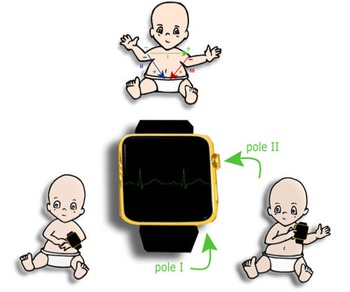
In this prospective, single-arm study, consecutive preterm neonates hospitalised in Leipzig University Hospital neonatal ICU were eligible. Inclusion criteria were prematurity, i.e. gestational week <37 and parental consent to participate. There were no exclusion criteria apart from parental refusal to give informed consent. After obtaining informed consent, the participants’ demographic data and patients’ history were collected and a basic echocardiography was performed. A 12-lead ECG and an iECG using Apple Watch 4 were performed. Two standard positions to place the Apple Watch were used to achieve an Einthoven I – like iECG measurement (Fig 1).
Apple Watch
The Apple Watch records a 30-s one-lead ECG (iECG) that is stored in the watch as a PDF file.
For the first position, the Apple Watch was placed on the patients’ left wrist and a finger from the patients’ right hand was placed on the Apple Watch’s knob, as described inReference Samol, Bischof, Luani, Pascut, Wiemer and Kaese8 (Fig 1a).
Due to the small-sized wrist of a pre-term neonate as well as the expectation of motion artefacts, a second position of the Apple Watch for iECG recording was performed. The Apple Watch was placed on the neonates’ left clavipectoral triangle and the neonates’ fingers were held by the parents or the examiner during iECG recording (Fig 1b).
Standard ECG
12-lead ECGs were recorded using a Nihon Kohden Cardiofax M ECG-2350 device with a writing speed of 50 mm/s speed, low pass filter at 150 Hz, and drift suppression set on “weak”.
Measurements
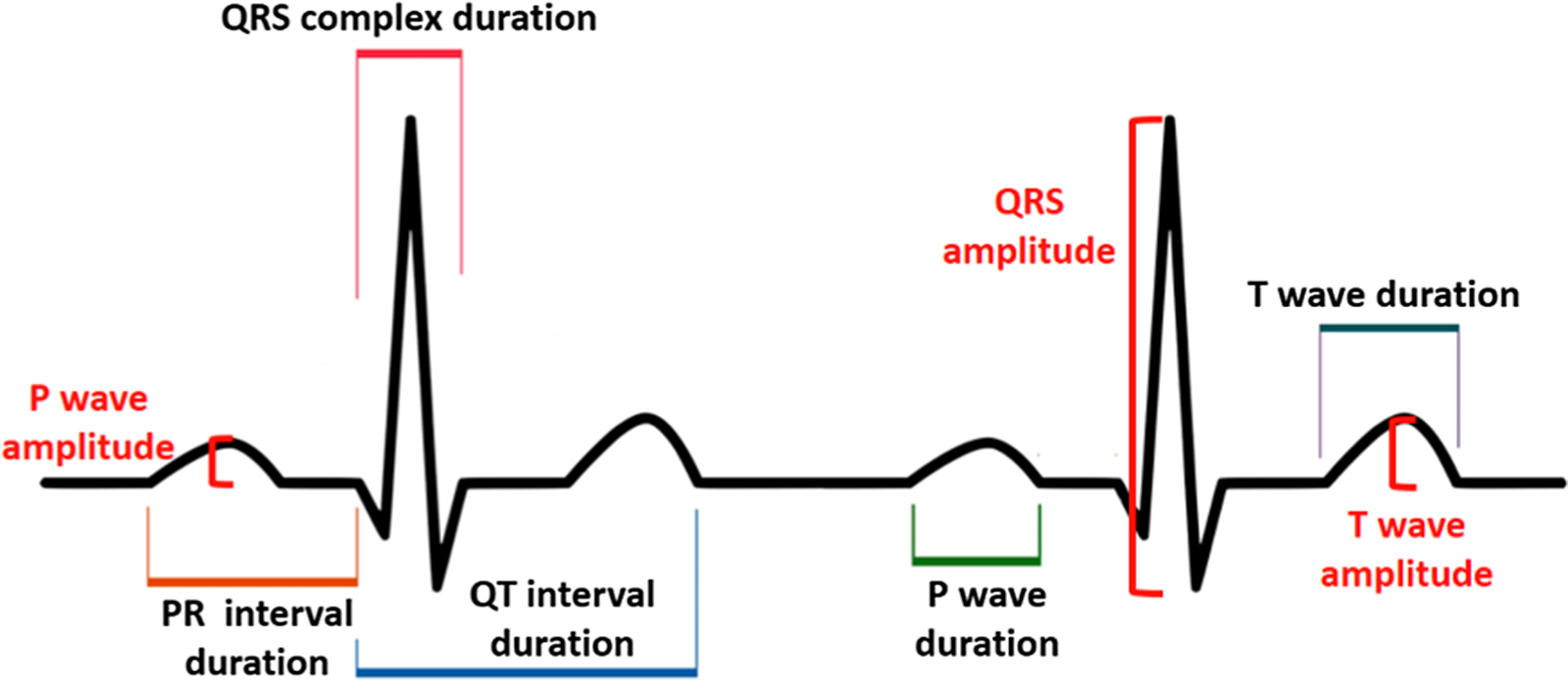
iECG and 12-lead ECG measurements were performed by an experienced paediatric cardiologist blinded to the patients’ history and data. Cardiac rhythm was classified and amplitudes and timing intervals were analysed for comparability (Fig 2).
Statistics
Statistic analysis was performed using SPSS V27 and Microsoft Excel. ECG amplitudes and intervals were computed for 12-lead ECG and iECG each and presented as mean (minimum and maximum). 12-lead ECG and iECG measurements were compared using Bivariate Pearson’s Correlation and Linear Regression Analysis, a p-value of <0.05 was considered statistically significant. Linear regression analysis was performed to analyse the presence of proportional bias.
Results
Fifty pre-term neonates were enrolled.
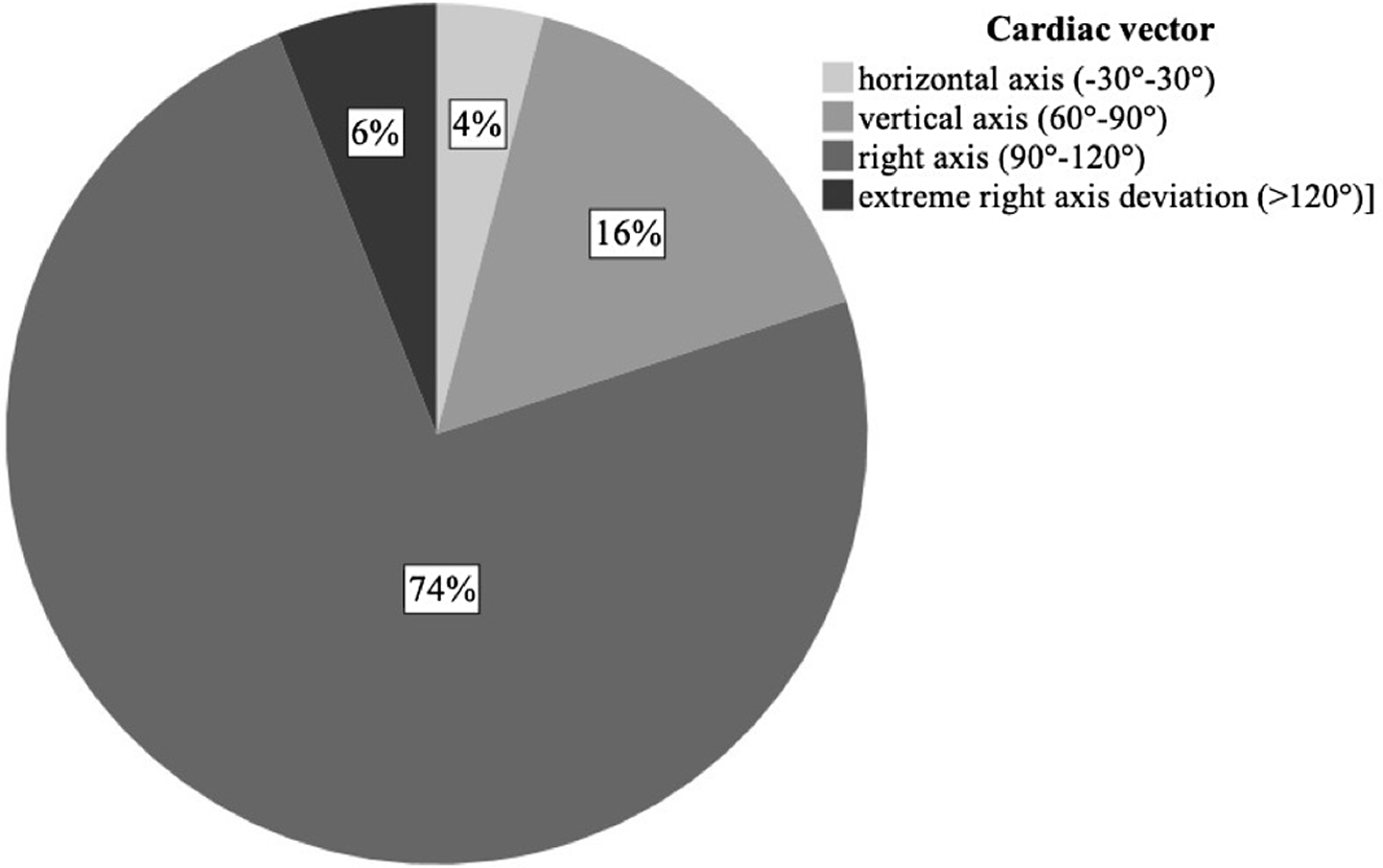
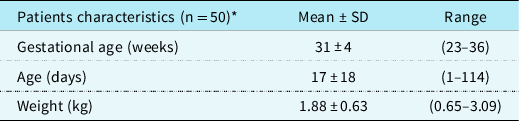
Patient population: Pre-term neonates from 23 to 36 weeks of gestational age were enrolled in this study regardless of their cardiac history. Descriptive parameters such as gestational age, precise age, and weight are shown in Table 1. With 74% the majority of pre-term neonates had a cardiac axis of 90–120° (Fig 3). A basic echocardiography including four chamber view and a short axis view was performed in all patients and did not reveal CHD in any of the enrolled patients.
Apple watch positions.

Definition of ECG interval and amplitude measurements.

Cardiac vectors.

Patients characteristics

* 30 female, 20 male.
Comparison of Apple Watch iECG placements (wrist vs. shoulder)
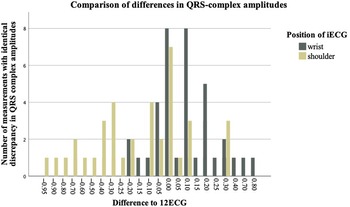
Table 2 compares the correlation between 12-lead ECG (12ECG) and Apple Watch iECG, measured on the wrist (@ECG-wrist) and on the shoulder (@ECG-shoulder). Displayed are Pearson correlation coefficients. The correlation between @ECG-wrist and 12ECG was overall stronger than between iECG-shoulder and 12ECG. This tendency is further visualised, e.g. for QRS-complex amplitudes in Figure 4. These correlations suggest that iECG records, measured on the wrist, showed a stronger correlation to 12ECG than those measured on the shoulder.
Comparison of differences to 12ECG in QRS-complex amplitudes measured on the wrist and shoulder.

Correlation overview

* Means p < 0.05.
** p < 0.01.
Figure 4 visualises the deviation of measurements in iECG-wrist records versus iECG-shoulder records from the standard 12-lead ECG. Measurements are shown exemplarily for QRS-complex amplitudes (mV). Overall lower amplitudes compared to 12- lead ECG can be seen when looking at the shoulder measurements, whereas rather higher amplitudes compared to 12- lead ECG can be seen when looking at the wrist measurements. Notice that there are more identical measurements in the wrist measurement group showing better correspondence between wrist measurement and 12-lead ECG in the displayed feature.
Influencing factors on accuracy of the iECG
Multi-variate regression analysis did not reveal any significant influence of either sex, age or weight on iECG measurement accuracy.
Apple watch automatic algorithm for heart rhythm classification
As there were no patients with a heart rate below 120 bpm, representing a normal heart rate in this group of patients, the Apple Watch algorithm classified all iECGs as inconclusive or inappropriately as tachycardia. In contrast 12-lead ECG revealed a normal sinus rhythm in all pre-term neonates included into the study.
Clinical interpretability of iECGs
Regarding the interpretability of iECGs, when interpreted by a paediatric cardiologist, it has to be mentioned that all iECGs recorded at the wrist could be assessed, i.e. a rhythm classification could be performed, whereas 4% (n = 2) of iECGs recorded at the shoulder could not be analysed due to inferior quality. Both iECGs were not interpretable due to a high level of artefacts.
Discussion
Telemedicine and remote patient monitoring gained increasing recognition throughout the last years, illustrating the efforts of modern medicine to bring specialised care to remote regions and enable early detection of symptoms with the purpose of prevention. While heart rate monitoring has already emerged into daily life with the appearance of fitness trackers and smartwatches, now, the Apple watch represents the first commercially available non-medical product to record a one lead ECG (iECG).
As fetal or neonatal arrhythmias are a common phenomenon, the importance of the ECG as a simple tool for the diagnosis of congenital heart disease including cardiac arrhythmias is accepted. The spread of ECG availability using non-medical products like the Apple Watch may improve the early detection and consequently early treatment of these diseases.Reference van der Linde, Konings and Slager9 This might be especially true in the setting of parents living at home with their children, children delivered outside a hospital or even in remote regions, and as a tool used by health care professionals for a quick consultation of a specialist when needed.
While the Apple Watch ECG function has been evaluated for accuracy in adults, there are still only scarce data on the usability and accuracy in very small patients.Reference Kobel, Kalden and Michaelis10 To the best of our knowledge, the current study is the first to evaluate the application of the Apple Watch to record iECGs in preterm babies.
The main finding of the current study is the overall good quality and excellent correlation of the Apple Watch generated iECG in comparison to the standard 12-lead ECG when used in the first position (wrist placement of the watch). It seems to be possible to record iECGs in even very small preterm neonates. Furthermore, data imply a good quality of the iECG in terms of clinical interpretation, i.e. classification of heart rhythm, of the iECG in preterm infants. These findings are in accordance with the currently published data by Kobel et al.Reference Kobel, Kalden and Michaelis10.
Analysing the data in more detail it can be seen that there is a strong correlation of nearly all intervals and amplitudes between iECG and 12-lead ECG when the first position is used. Recognisably, these correlations are significantly weaker when used in position two (placement of the watch on the shoulder). Even more important, the clinical interpretability of iECGs was excellent when used in the first position. The diagnosis of sinus rhythm could be correctly established in all recorded iECGs. Contrary to our expectations that the left shoulder may yield fewer motion artefacts as well as more space to adequately place the watch in this cohort of small children with very small wrists, we found that the shoulder placement was clearly inferior to the conventional placement on the left wrist. In particular, there were even two recordings in the shoulder position that could not be analysed due to a technically low quality of the recordings.
When looking at influencing factors to the quality of the iECG recording apart from the positioning of the watch, there were no clinically significant detrimental factors identified. The recording of an interpretable iECG seems to be unaffected by gestational age, sex, body weight or body surface area.
However, the automatic algorithm for heart rhythm classification, seems to be insufficient in giving a diagnosis in this subset of patients. A manual inspection of the iECG by a physician seems to be indispensable to establish a correct diagnosis.
Conclusion
The Apple Watch iECG seems to be a valuable tool to record an ECG comparable to lead I of the standard 12-lead ECG even in preterm neonates. The watch should be positioned at the patients’ left wrist to achieve good quality compared to the standard ECG. With a widespread availability and excellent connectivity, the Apple Watch iECG function may provide practitioners with a tool to send an iECG for interpretation to a paediatric cardiac specialist.
Limitations
A major limitation of this study is the single-centre design and the relatively small number of patients included. This may limit the ability to detect a statistical significance. Comparison of ECG amplitudes may be erroneous because it is currently unknown which frequency filters are employed in the Apple Watch iECG app. Different running speeds of the iECG (25 mm/s) and 12-lead ECG (50 mm/s) may influence the measurements. As all 50 patients were in sinus rhythm, it remains beyond the scope of this study to evaluate if a correct diagnosis of cardiac rhythms, other than sinus rhythm, will be correctly identified.
Acknowledgements
The authors like to thank study team of the outpatient clinic, Department for Pediatric Cardiology, Heart Center Leipzig.
Financial support
This project has received funding from the Leipzig Heart Institute GmbH.
Conflicts of interest
None.
Ethical standards
The study has been approved by the University of Leipzig Ethics Committee.