

Introduction
As in many scientific disciplines, nuclear physics research now looks little like it did sixty years ago during the heyday of the Atomic Energy Commission and “Atoms for Peace” (Hewitt and Holl Reference Hewlett and Holl1989). Even in the mid-1980s, nuclear physicists were beginning to recognize that “the horizons of nuclear science [have been] expanding in substantial ways” embracing new topics, funding sources, and interdisciplinary collaborations. Today, nuclear physicists investigate questions that routinely push at the boundaries of the field's original mission to study atomic nuclei and often collaborate with colleagues in many disciplines across the world (DOE/NSF 1989, 1).
Decades worth of scholarship in science studies and in the history of science have explored how scientific disciplines change over time (e.g. Kuhn Reference Kuhn2012; Crombie Reference Crombie1994). Somewhat less research, however, has considered how the institutional homes for research, including national laboratories, universities, or companies, respond to these changes in scientific disciplines (e.g. Westfall 2012; Bodnarczuk and Hoddeson Reference Bodnarczuk and Hoddeson2008). This is especially the case for nuclear physics; little has been written about the changes in the day-to-day life and practice of non-weapons research after the cold war.
Beginning in the mid-1960s, the Atomic Energy Commission (AEC) founded a small group of nuclear research centers based at universities across the country, including the University of Washington, Princeton, and Florida State University. Later renamed Department of Energy (DOE) Centers of Excellence, these institutes have consistently produced important nuclear research and trained generations of nuclear physicists.
This article investigates how one university-based nuclear physics laboratory, referred to here as the Southeast Nuclear Science Exchange (SENSE)Footnote 1, has been confronting ongoing changes in nuclear physics. Thanks to four decades of work in science studies, there are many ethnographic accounts of physics research practice (Latour and Woolgar Reference Latour and Woolgar1986; Galison Reference Galison1997; Traweek Reference Traweek1988). However, the vast majority of this work has investigated large, elite, or distributed institutions; far less scholarship has considered research life at smaller, less famous, university-based scientific organizations.Footnote 2 There is good reason, however, to suspect that research practice at SENSE is notably distinct from that at an organization like CERN, which employs thousands of researchers, houses dozens of advanced instruments, and consolidates billions of dollars of funding from countries across the world (Krige Reference Krige2001). Most importantly, while CERN facilitates international collaboration by physically consolidating diverse scientists from around the world, SENSE houses researchers who work on experiments that are usually located elsewhere. That is, where CERN accepts researchers from across the world, SENSE sends researchers all over the world.
This article reveals how the day-to-day practice of nuclear physics at one organization has been shifting amid a broader transformation of nuclear physics itself. To answer these questions, this paper combines traditional ethnographic methods with recent theoretical work in media studies around the term mediatization. Broadly recognizing that contemporary life is fundamentally infused with and by media – from computers, to phones, to documents – media scholars have recently suggested that by studying those media, one can learn a great deal about social and cultural changes that are otherwise difficult to observe (Couldry and Hepp Reference Couldry and Hepp2013, 191). Building on the recognition that science itself is thoroughly and fundamentally entwined with media (Siegert Reference Siegert2013, 107–8; Packer Reference Packer2013, 11), this article adopts mediatization as a method for studying social change in scientific practice.
Through an interpretative analysis of four common-place media objects in the lab: collaboration wikis, telephones, computer simulations, and government reports, this article looks at specific social, cultural, and organization changes in the research life at SENSE. Specifically it highlights how, as SENSE researchers have eschewed in-house research for large international collaborations, there have been significant changes in social dynamics, power relations, and forms of social capital at SENSE. In the broadest sense, this paper tells the story of a single research organization's efforts to adapt to a rapidly changing discipline and world.
Setting Up the Project
Lab Ethnographies and the Structure of Research Collaborations
There is a long history of ethnographies of scientific laboratories in science and technology studies. Yet while ethnographers have given much attention to disciplines such as high-energy particle physics (Traweek Reference Traweek1988; Knorr-Cetina Reference Knorr-Cetina1999; Galison Reference Galison1997) and biology (Latour and Woolgar Reference Latour and Woolgar1986; Kleinman Reference Kleinman2003), nuclear physics has received far less attention. Similarly, while there are some exceptions, far more work has investigated large and/or elite organizations, than smaller, less renowned labs or groups. Also, starting with Derek J. DeSolla Price's influential work, Little Science, Big Science. . .and Beyond (1965), “big science,” and now “megascience” (Jacob and Hallonsten Reference Jacob and Hallonsten2012; Hoddeson, Kolb, and Westfall Reference Hoddeson, Kolb and Westfall2009; Bodnarczuk and Hoddeson. Reference Bodnarczuk and Hoddeson2008) have received consistent attention from historians (Galison and Hevly Reference Galison and Hevly1992; Westfall Reference Westfall2003) and, increasingly, sociologists of science (e.g. Mazur and Boyko Reference Mazur and Boyko1981; Hallonsten and Heinze Reference Hallonsten and Heinze2013).
As sociologists have begun to take more of an interest in “big” or “mega” science, there has been a growing interest in exploring the structure of those scientific collaborations (e.g. Shrum, Genuth, and Chompalov Reference Shrum, Genuth and Chompalov2007). Within this work, there has been a persistent interest in modes of communication within collaborations, including through digital media (Vertesi Reference Vertesi2014; Magerko Reference Magerko2010; Walsh and Maloney Reference Walsh and Maloney2007). While scholars now understand a great deal about the structures and practices of distributed research collaborations, we know very little about how individual laboratories or organizations are adapting to the increasing prevalence of collaborations.Footnote 3
Studying SENSE
This article is based on ethnographic research at SENSE that began in early May 2014. Upon entering the organization, the researcher was given a desk in a work suite at SENSE. For four months over the summer, the author sat in on meetings both at SENSE and with external collaborators, observed research activities, helped set up experiments, and attended talks, presentations, and assorted social events. The findings in this paper also draw from a set of 15 semi-structured interviews with personnel at SENSE. Interviews ranged from 45 minutes to two hours, and were held with SENSE faculty from each of the affiliated universities, staff research scientists, SENSE's technical staff, and both graduate and undergraduate students. Questions ranged widely depending on the informant's position, research activities, background, and interests, but generally concerned research activities, media use, and interactions with colleagues and collaborators. Finally, data for this article also derives from a corpus of archival documents from SENSE, the Nuclear Science Advisory Committee (NSAC), and assorted government agencies such as the Atomic Energy Commission (AEC), Department of Energy (DOE), and the National Science Foundation (NSF).
Mediatization as Method
As far as theoretical terms go, “mediatization” has recently enjoyed a moment of celebrity in communication theory, having “emerged as the most likely ‘winner’ in a race between” a number of “cumbersome” terms including mediatization, medialization, mediation, and mediazation (Couldry and Hepp Reference Couldry and Hepp2013, 191). Although scholars use “mediatization” in a number of distinct ways, there is general agreement that the term refers to the relations between changes in culture and social institutions and practices, and changes in media technologies and practices (Hepp Reference Hepp2013, 31). This paper draws on a long history of media theory to read mediatization through an expansive definition of media as “our infrastructures of being, the habitats and materials through which we act and are” (Peters Reference Peters2015). This broad account of media, which goes far beyond mass media, enables this article to recognize mediatization as a methodological approach that makes it possible to study often hard-to-see changes in social relations or cultural forms by looking at practices involving diverse media objects. Put another way, if media infuse our lives – as has been recognized for decades by media studies scholars (McLuhan Reference McLuhan1964; Couldry 2003), then, by studying the ways that a range of media objects, from communication technologies, to digital tools, to texts are integrated and made meaningful in practice, we can learn a great deal about social dynamics and cultural forms. Simultaneously, many scholars have begun to recognize that scientific practice fundamentally depends on media objects like books, journals (Latour and Woolgar Reference Latour and Woolgar1986), instruments (Packer Reference Packer2013), and computers (Winsberg Reference Winsberg2010) to anchor scientific research. As a result, there is reason to expect that as in other realms of social life, by studying media objects we can gain significant insight into social and cultural changes in science.
Identifying and Explaining the Changes at SENSE
SENSE: The Early Days
Southeastern Nuclear Science Exchange (SENSE) is located at a prominent university in the southeastern United States. Founded in the mid-1960s as a collaboration among several nearby universities through a renewable Atomic Energy Commission (AEC) grant, SENSE has consistently produced both influential experimental nuclear physics research and highly regarded nuclear physicists, many of whom have gone on to lead their own prestigious research groups, run national laboratories, or hold top positions in science policy (SENSE 2012). SENSE's founder had a long career in nuclear physics that included working on the Manhattan project. He later acknowledged that his experience during the war helped inform his vision of SENSE as a collaborative organization bringing together three nearby universities (M-R. R 2013).Footnote 4
SENSE began as a home for a promising new instrument, a unique hybrid of a cyclotron particle accelerator and a tandem Van de Graaff accelerator often referred to as a Cryclo-Graaff (Newson, Bilpuch, Purser, Boyce, and Clegg Reference Newson, Bilpuch, Purser, Boyce and Clegg1974). SENSE's instrumentation helped engender a successful and long-running research program that aligned well with more traditional areas of nuclear physics. According to SENSE's 1980 annual report
At [SENSE] particular emphasis has evolved for programs studying interactions induced by polarized protons, deuterons, and neutrons. We also continue our historic major commitment to the study of the statistical properties of nuclear structure revealed by elastic and inelastic scattering experiments using ultra high resolution beams. A third major laboratory commitment involves measurements of fast neutron cross sections required by the Department of Energy's program to produce controlled thermonuclear fusion (ii).
Phase Shift: In Research Topics
Over the past several decades, SENSE has been undergoing a fundamental “phase shifta.”Footnote 5 Broadly speaking, there have been two intertwined changes. First, while SENSE has pursued “our historic major commitment” to studies of nuclear structure, SENSE's most recent annual report observes, “The primary mission of [SENSE] is to advance the frontiers of nuclear physics” (SENSE 2012–2013, vii). That same progress report highlights a mix of research initiatives that would be familiar to any 1960s nuclear physicist or 1960s nuclear textbook (e.g. Meyerhoff Reference Meyerhoff1967), such as “Nuclear Structure and Reactions,” or “Fundamental Symmetries in the Nucleus,” along with those that would not, including “Neutrino physics” and “Nuclear astrophysics” (SENSE 2012).
This shift at SENSE corresponds to a larger broadening of the field of nuclear physics begun decades ago. Since 1979, every seven years, the Nuclear Science Advisory Committee (NSAC) has produced a document laying out consensus recommendations on the priorities of the field. The 1983 report describes the field in this way: “Our perspective is to observe, characterize, and attempt to understand the properties of the atomic nuclei which are the overwhelmingly dominant component of the universe in which we live” (NSAC 1989, 1).Footnote 6 By 1996, NSAC declared:
The goal of nuclear physics research is the understanding of matter at a fundamental level. Nuclear physicists answer questions about how this matter has formed, how it is held together, how it is structured, how it interacts in collision, and how it is transformed in stellar interiors. (NSAC 1996, vi)
In thirteen years, the field went from studying “atomic nuclei,” to the much broader, “matter at a fundamental level.”
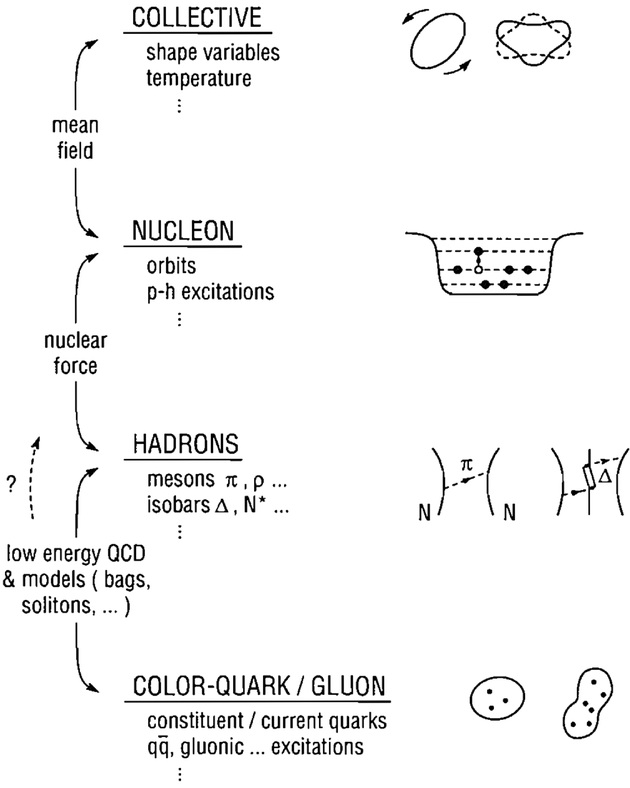
The 1989 NSAC report includes a brief chart of the “historic evolution of nuclear physics,” in which “Nuclear history evolves from the top to the bottom of the figure. Not accidentally, this sequence also describes the nucleus on an increasingly finer length scale” (NSAC 2012, 2).
The above chart demonstrates how as nuclear physicists gained new understanding of what comprises the nucleus, the purview of nuclear physics expanded. Most notably the development of quantum chromodynamics (QCD) and the recognition of its application to nuclear scales and structures helped shift nuclear physicists from simply studying the nucleus to studying its components and forces.
Nuclear physics now spans the realm stretching from the macroscopic structure of the nucleus as a whole, through the behavior of individual nucleons inside the nucleus, through the meson cloud that pervades the nuclear medium, and ultimately to the underlying quark structure of the nucleons and mesons themselves. (NSAC 1989, 8)
Interestingly, these developments “have expanded the horizons of nuclear physics into an energy domain that was, until very recently, considered the exclusive realm of elementary particle physics (NSAC 1989, 2). Elementary particle physics, or high-energy particle physics (HEP), was described by the 1983 NSAC report as nuclear physics’ “younger and precocious sister field” (NSAC 1983, 2) but is perhaps better recognized as emerging from nuclear physics in the years following the Second World War. Yet as nuclear physicists began to study topics that originally animated the separation of HEP from nuclear physics, the two fields have (re)grown closer.
Diagram from 1989 NSAC Long Range Plan.
In addition to scientific explanations, there is some evidence that wider political or economic forces have also played a role in pushing the boundaries of nuclear physics outward. One researcher, who has been a faculty member at SENSE since the late 1960s, observed:
the Cold War is what drove nuclear physics, I mean, the funding for nuclear physics was going up every year as long as the Cold War was going on; Berlin Wall fell down, then nuclear physics flat-topped in terms of funding. . .. And at that point, the field became very competitive with people thinking bigger and bigger about new things, putting big systems together in national laboratories, these big collaborations with experiments that are expensive.j
While this description doesn't quite capture the complexity of the funding dynamics across the four decades of the Cold War, it is true that research and development funding at the Department of Energy dropped noticeably in the early 1990s. Adjusting for inflation, by 1997, R&D funding at the DOE had dropped almost 31 percent from 1992, and more than 41 percent from the DOE's 1978 high (AAAS 2017).
Similarly, it hardly seems a coincidence that the 1989 NSAC report stressed the recent “great expansion in the scope of nuclear physics” (NSAC 1989, 8). Seen together, this suggests a sort of existential quandary for nuclear physics at the end of the Cold War. Not only were new understandings of the world challenging nuclear physics' traditional areas of study, but geo-political changes were also helping to further shift funding and research priorities. Given this, it is no wonder that nuclear physicists began to push the boundaries and frontiers of the field.
Phase Shift: The Rise of International Collaborations
The second major “phase shift” occurring at SENSE in the past several decades has been that faculty members increasingly pursue their research initiatives as part of large, networked collaborations with colleagues all over the world. Much of the research completed at SENSE in its first several decades involved small groups of faculty designing, building, running, and analyzing experiments on in-house instruments (see SENSE 1972 1974 1975; Newsom et al. Reference Newson, Bilpuch, Purser, Boyce and Clegg1974). By 2012, the annual report observed that research at SENSE consisted of “a mixture of experiments conducted at our local research facilities and large-scale collaborative projects that are carried out at national user laboratories and facilities” (SENSE 2012, vii) A look through the section on “Research Highlights,” reveals that many of the “Highlights” involve SENSE researchers participating in large national or international collaborations, such as nEDM, UCNA, DANCE, Mahiraba, and KATRIN. Importantly, within these large collaborations, “everybody plays this small part, these are huge eighty [to one-] hundred people collaborations. It's all these people doing their own small part, working together, putting it together.”b This means that a researcher, or a small group of researchers at SENSE, might contribute only a small piece to a much larger project. For example, the same “Research Highlight” section in the 2012 report notes that during the commissioning period for the KATRIN experiment, SENSE “researchers provided nine percent of the relative total on-site shifts” (SENSE 2012, xii).
Similar to the way that shifts in research topics at SENSE mirror those in the larger field, large collaborations are more generally becoming common within nuclear physics. In interviews, several researchers explained this by noting that it is simply no longer possible to do cutting edge nuclear physics on small-scale facilities, like those at SENSE. “We can't think of other good experiments to do. That particular field has been plowed. . . . I mean, the physics is just more complicated.”j Instead, they argued that groundbreaking work requires large and expensive instruments that entail a great deal of money and coordination to build and run. Again, this can be seen in the 1989 NSAC report, which placed as its first three priorities the creation of large instruments: the Continuous Electron Beam Accelerator Facility (CEBAF) at Thomas Jefferson National Accelerator Facility, the Relativistic Heavy Ion Collider (RHIC) at Brookhaven National Laboratory, and the KAON Factory at TRIUMF (NSAC 1989, vi). In contrast to maintaining a large number of smaller instruments distributed around the country – like at DOE Centers of Excellence – supporting a handful of very expensive, very large instruments at major national laboratories encourages the consolidation of researchers into larger groups or collaborations. Large facilities not only mean more competition for access, but also often require larger teams to operate.
At the same time, there is a direct relation between the expansion of research topics described above and the consolidation into larger research collaborations. Many of the big collaborative experiments pursued by SENSE faculty involve researchers from different disciplines. For example, Majorana, an experiment attempting to observe neutrino-less double beta decay,Footnote 7 involves not only nuclear physicists, but also high-energy particle, and condensed matter physicists (Abgrall et al. Reference Abgrall2014). As some of the strong disciplinary boundaries break down between nuclear physics and other sub-disciplines, there is increased opportunity for interdisciplinary collaboration.
Similarly, declines in available research funding are also linked to the consolidation of experiments and research activities into larger collaborations (Bodnarczuk and Hoddeson Reference Bodnarczuk and Hoddeson2008). One faculty memberc explained the mechanism underwriting this connection in this way: when funding agencies face flat or reduced budgets, they must decide whether to support more projects with fewer resources or to support fewer projects with more. Often, funders will choose to defund smaller, poorly performing projects, freeing up funds to help support other projects at full capacity. This is also often accompanied by changes in funding review mechanisms. Several informants noted that recently, the DOE has begun employing “comparative review,” in which funders compare grant proposals against each other, selecting only the bestc,g – thereby reducing the number of projects funded. As it is essential for academic physicists to be involved in research projects: a constant supply of scientists, a lower number of potential projects, and – as noted below – somewhat open collaboration boundaries, all push toward larger collaborations. At the same time, many informants suggested that there was “power in numbers,”i and that simply having more people involved serves as a strong argument to funding agencies that a given collaboration should be funded.
Finally, several informants suggested that specific forces within the organization were deeply influential in propelling the structural shifts occurring at SENSE. A number of informants identified the role that SENSE administrators – past and present – have played in pushing the organization toward a more networked, collaboration-based structure. Informants explained that SENSE administrators have been increasingly interested in having faculty members associated with potentially prize-winning collaborations. One compared having an associated faculty be part of a Noble Prize-winning collaboration like “winning the basketball title”g – it would mean a great deal of positive publicity for SENSE. As SENSE faculty and administrators increasingly recognize that in-house experiments are unlikely to result in broad notoriety, administrators, according to several informants, have been facilitating the involvement of faculty in large external collaborations. One of the key ways administrators do so is through faculty hiring. Over the past several decades, SENSE has increasingly hired faculty members who are already involved in large collaborations and are likely to continue doing so. Interestingly, several faculty members suggested a different logic underwriting recent decisions to hire faculty with active collaboration membership. SENSE has a number of older faculty members who have spent most of their careers at SENSE. One faculty member, who has himself been at SENSE for more than fifteen years, suggested that other faculty feel that they have been doing work at SENSE for so long, and they have “done this as well as its ever going to be done; we shouldn't really hire anyone to carry on [their] tasks, we should go hire somebody to go do bigger and better things, . . . and move into a different area – which is outside.”g
What These Changes Mean for Research Practice at SENSE
Having described and explained the two major changes that have been occurring both at SENSE and in the larger field of nuclear physics, this section asks what these changes have meant for the day-to-day life and research practice at SENSE. As described above, in order to answer this question, this section turns to recent scholarship in media theory that suggests studying media objects in practice can help reveal social and cultural changes that are otherwise difficult to observe. This section considers four media objects that repeatedly appeared across both ethnographic fieldwork and interviews. Each object is analyzed to better understand what the increasing prominence of distributed collaborations and broadened research areas mean for professional life at SENSE.
WIKIs and Other Collaboration Software
Large collaborations must devise ways of overcoming space and time. Collaboration physicists not only need to work together and share data and information across space, but also they must devise means of maintaining institutional memory and continuity across time. One way that collaborations do so is by employing specialized software platforms (see Ahmed Reference Ahmed2007; Walsh and Maloney Reference Walsh and Maloney2007). In addition to more complex digital logbooks, almost all of the collaborations referenced by informants have a dedicated wiki, a simple collaborative document that everyone can read and edit and that keeps track of each modification. These wikis often are built through open-sourced platforms such as MoinMoin and MediaWiki.
Interestingly, SENSE dedicates substantial resources to supporting collaboration wikis – computer support staff described in interviews spending a significant amount of time helping faculty setup and maintain wikis for the collaborations to which they belong. That being said, despite the prevalence of wikis, many physicists expressed how little they like using wikis, finding them onerous, poorly organized, or simply unnecessary. One faculty member noted, “you have to physically edit that wiki through that complicated scripting and they don't provide any easy tools for the users.”c He also observed that wikis often grow quite large, with “multiple sub groups” making it difficult to wade through large amounts of poorly organized information, or to “exchange simple pieces of information.”c
Some of the dissatisfaction with wikis appeared to stem from the fact that wikis were somewhat unfamiliar to nuclear physicists. One observed, “I had never worked with wikis before, until I started working with high-energy physicists, like you have a collaboration with five people you need a wiki.”d Large research collaborations have long been associated with high-energy particle physics, as have wikis (Galison Reference Galison1997; Knorr-Cetina Reference Knorr-Cetina1999). As nuclear physicists are increasingly joining researchers from other fields, they are likewise forced to employ new media objects and technologies. Yet, as informants reveal, this adoption of new media, as in the adoption of new organizations structures, is rarely seamless.
One member of the technical staff at SENSE who frequently works on wikis for external collaborations noted that in collaborations “Everything must be preserved forever.”e This dedication to archiving serves a functional necessity for collaborations, helping to maintain some continuity over years or even decades. But more, this sentiment points to a more persistent logic of archiving expressed in and revealed by wikis. One faculty member noted “I can go back you know, six years ago, and say, oh, I went to that workshop and I gave a talk, and my talk is there, linked properly, organized with everyone's talk I can go and, so there's a historical lineage maintained in that process.”c Indeed, this same faculty member noted the extremes to which this logic can be taken, leaving wikis, filled with ancient minutia, unwieldy and cluttered.
Even still, several informants stressed the utility of keeping such detailed records, especially when it comes to efficiently and collaboratively producing software.c,a,d Collaborations frequently require highly specialized software to analyze data, calibrate equipment, and run instruments. Often this software is written, updated, and debugged collaboratively. Doing so, however, requires specific rules and procedures not only to track the changes researchers make, but also to ensure that the software works when others need to use it. In a sense, the same is true of experimental protocols, data analysis, and designs: information that is collaboratively produced requires mechanisms to ensure that the information is credible and trustworthy. Wikis and other platforms include ways of tracking who makes what changes to collaborative documents, protocols, or software. “You can go back to any page and see every change that was made historically. Who made it? When they made it . . . in case you want to know what particular pieces something came from.”f
In that wikis allow full access to all collaboration members, it is also possible to see underlying values of participation and transparency structuring wikis and other collaboration software. In the most basic sense wikis are imagined as open and collaborative media through which all members of collaborations can access, share, and edit information and resources – even about collaboration aspects they are not involved in. In this sense, wikis are indicative of the formal democratic structures and processes that pervade many collaborations. While there is much variation in collaboration structure (Shrum et al. Reference Shrum, Genuth and Chompalov2007), leadership positions – often including the head administrator or spokesperson – are usually elected positions. That being said, it is important to stress that collaborations are structured, hierarchical organizations; many have formal organizational charts, with clear positions and roles. Indeed, many of the larger collaborations to which SENSE faculty belong, such as nEDM or Majorana have layers of management organization – far more than exists at SENSE.
Within collaborations, these leadership roles usually depend on experience and scientific expertise. Spokespersons are almost always senior researchers who have been with the collaboration from the beginning. Interestingly, in notable opposition to the more general trend toward specialization described in detail below, one informant, who holds a senior administrative position in a major collaboration, confided that for many years, the collaboration leaders made a point of cycling him through a variety of different administrative positions, so that he could gain a broad familiarity and expertise with the entire experiment.
The connection between collaboration leadership and expertise also appeared at a more informal level as well. One faculty member observed that the person who has the most relevant expertise in a given situation often assumes an informal leadership role, irrespective of formal position in the collaboration, academic credentials, or seniority. He observed, “Once they have proven themselves that they understand what they are doing and they are making solid decisions, they become the authority on this part of the experiment, and it could be a grad student, or a senior faculty.”a He also suggested that “it's the sensible way to do it, nobody in the experiments knows all the technical details, so you have to trust the experts on site.”a
Telephones
Not all of the influential media objects at SENSE are new or digital technologies. Several faculty members suggested that one of the most important technologies within collaborations is the telephone. One faculty member observed that in one collaboration
we have phone calls every day. We just sit on the phone, because right now we're in the construction phase and there's a lot going on. A lot of people need to stay in the loop, so we have daily phone calls at this point. It used to be weekly, then a few a week, and now its daily, some days even more than once a day.a
While some collaborations employ videoconferencing software like GoToMeeting or BlueJeans, more use “old fashioned” telephone conference systems and/or they email PDFs of slides. One faculty member observed, “that's actually amazingly effective, you don't have the twenty minutes trying to get the video conference set up.”a
The concern expressed in this quotation with the “need to stay in the loop,” appears to compel the very frequent phone calls. Individual researchers want to make sure that they are “present” in some form where the actual decisions are being made. At the same time, however, this same concern with being in the loop also appeared to underlie the consistent frustration that informants expressed with the limitations of phone meetings. Some simply lamented the inefficiency of phones. Others noted that at in-person meetings or conferences, “the real discussions happen overnight over beers and during the coffee breaks.”a Communicating through phone or video conferences therefore prevents collaborators from being involved in the “real discussion.” Indeed several emphasized the importance of getting together with collaborators in-person. Informants compared this to the more informal possibilities for communication afforded at an institution like SENSE, where it was always possible to drop in to a colleague's office, strike up a conversation at a party, or grab a beer after work. Indeed, this concern with the limitations of phone calls animated, what one faculty member, who does not belong to any large external collaborations, suggested dismissively as the normal of collaborations: “you don't spend your money buying detectors. You spend all your money on airplane tickets to go to some stupid hole in the ground in the middle of nowhere – that's your tax dollars at work.”g
Computer Simulations
As many have observed, computer simulations have become increasingly important across scientific disciplines (Winsberg Reference Winsberg2010). The same is true not only of nuclear physics, but also of the research at SENSE, where simulations have become key aspects of many experiments. One faculty member suggested that when building and organizing a new collaboration, “computer simulation work . . . is the first thing you do. You build a computer simulation of the experiment to see if it's gonna work.”a In fact, computer simulations have become one of the most prevalent and important media objects in collaborations. Throughout the span of most collaboration, physicists build and run computer simulations and models of different facets of the experiment. Indeed, within some collaborators, running computer simulations has become the main form of research activity for many researchers. Combined with the rise of collaborations, computer simulations have had a radical effect on both the risk mitigation strategies and educational mission at SENSE.
In addition to helping define the feasibility of an experiment, simulations also play a key role in cost management and legitimation. Simulations can identify key instruments or processes that need special attention or care, anticipate problems and issues, and help collaborators create software for data analysis. Performing exhaustive simulations also offers for funders evidence that experiments can, at the minimum, work. Indeed, often for big projects, funders prefer to see a series of smaller-scale models – both simulated and real – of the experimental set up. For example Majorana, which is currently funded by a $40 million grant, is using that money to build a “demonstrator,” a smaller version of what will eventually be a more than $100 million detector. Computer simulations legitimate and support projects according to a similar logic.
In effect, simulations serve as an effective tool for managing risk. Big science is risky science; as collaborations grow, they involve and risk more money, time, work, and careers. “One thing which collaborations hate, and the people within collaborations hate, are surprises. Nobody wants to be surprised with any piece of news, scientific or otherwise.”c Collaborations often have to purchase time on very expensive facilities. If instruments and protocols do not work when and as expected, there can be serious and costly ramifications. Exhaustive simulations can provide ways of anticipating and mitigating some of these risks.
Notably, several informants expressed concern that the growing ubiquity of simulations has begun to get in the way of the specific educational mission of SENSE – as it has at peer institutions. In a broader sense, with the notable exception of their senior administrators, large collaborations encourage and are defined by specialization, such that physicists are increasingly becoming experts in narrow topics, methods, or instruments. If faculty members are increasingly specialized, it means the graduate students who work under them are similarly exposed to somewhat narrow topic areas. While specialization might help to make collaborations more efficient, several informants expressed worry that it might prevent graduate students from being exposed to a broad range of research activities. At heart SENSE is an educational institution – one that prides itself on producing future nuclear physicists. However, several informants expressed worry that the increasing commonality of collaborations might not benefit graduate student education. Speaking about a peer institution, one faculty member noted, “You go into [physics building], just walk around down there and ask them if they've ever read a detector signal in a computer and they'll say nope – but I model it.”g
NSAC Reports
Every five to seven years since 1979, the Nuclear Science Advisory Committee (NSAC), an advisory committee to the DOE and NSF, has produced a formal report laying out future goals and priorities for nuclear physics. These Long Range Plans wield significant influence in directing DOE and NSF funding. One faculty member at SENSE, talking about a new collaboration, stated very simply “We can't get in the budget unless we're in the Long Range Plan.”h
Part of NSAC's influence on DOE and NSF funding hinges on its claims to present a consensus view of the whole field of nuclear physics. The committee is currently made up of nineteen elected physicists from various institutions across the country. Writing the plan is actually tasked to a larger, elected “working group,” usually made up of around 60 members. NSAC also includes a number of elected topic-area sub-committees. In the long process of producing recommendations for the long-range plan, these sub-committees hold a number of “town hall meetings,” open to any physicist or layperson, where recommendations are suggested, debated, and finally pushed up the chain. Through these various participatory procedures, NSAC claims to be offering “a bottom-up review and forward look by the nuclear science community” that is enacted through a “community wide-process” (NSAC 2007). Such claims offer a strategic performative resource for influencing funding decisions at the DOE and NSF (see Hilgartner Reference Hilgartner2000). One faculty member noted, “it's weird we have these impartial groups of very partial people who advise the Department of Energy what they think is important.”g Yet, NSAC is very successful at disciplining the community of nuclear physicists into a single consensus view – or at least in making it appear that way. Presenting a unified set of suggestions helps support funding requests for large and expensive instruments and projects. At the same time, NSAC proposals offer realistic funding suggestions that are attuned to how much money the DOE and NSF can actually grant. One faculty member suggested that “the nuclear physics community pretty much stands together and says, "these are the next big facilities we want, we all agree this is what we want—that looks good to congress and so they more willing to entertain those.”a
To illustrate this point, the same faculty member compared NSAC to the Particle Physics Project Prioritization Panel (P5). The P5 is a subgroup of the High Energy Physics Advisory Panel (HEPAP), a long-running federal advisory council that eventually served as a model for NSAC. He suggested that P5 has done a far worse job at presenting either, what appears as a consensus view for the community, or a reasonable set of funding requests,
the proposed portfolio [P5] had was like five times a reasonable budget and nobody wants to stand down on their projects, and when they do the long range planning and people aren't happy with the decisions they go complain to congress or other very high up people . . . and congress just says, we're not going to give you $200 million, or half a billion dollars to build this facility, if you guys can't agree that this is what you want to do, because we aren't going to build it and not have anyone use it.a
NSAC reports indicate the strength of the community of nuclear physics, while also serving as a key technology or mechanism through which that community is built. In fact, the boundaries between collaborations are somewhat fluid. One faculty member suggested (who, admittedly, is a senior faculty member), “I can walk up to pretty much any collaboration and say ‘you guys need help?’ and pretty much most would say yes.”a
Several informants suggested that NSAC meetings themselves are key sites for building collaborations, “in these town hall meetings, there are always physics opportunities or new problems to tackle, and then interested people just start talking to each other.”a Others stressed the effort that goes into building collaborations at these meetings, a process that seems to occur, in part, through publicity. One faculty member suggested, “what we need to do is have a presence at these meetings and have someone yell [the collaboration's] name.”h Another informant stressed the importance of convincing potential collaborators that your project is “interesting,”i a process he struggled to explain. Yet, what is interesting seems to be a complex mix of cutting-edge science, award potential, technical complexity, potential media coverage, and, of course, a far more ambiguous “cool” factor.
Making Sense of SENSE
Pulling together the findings above, this final section considers what a detailed examination of these four media objects: wikis, telephones, computer simulations, and government reports, reveals about research practice at SENSE.
Changes in Power
Broadly speaking, this investigation suggests changes in the modes and mechanisms of power at SENSE. First, as discussed above, wikis introduce a different form of governance enacted in nuclear physics research. Rather than exerting control through more familiar academic mechanisms (hiring, tenure, committees, administration policy, etc.), archiving members’ work so that it is visible to the entire collaboration enacts a diffuse sort of discipline through surveillance. Wikis encourage collaborators to police themselves while working independently at institutions all over the world, by making work materials public to the rest of the collaboration.
Second, even though physics collaborations are often run democratically (Knorr-Cetina Reference Knorr-Cetina1999), when a faculty member at SENSE joins a collaboration, she must seed some amount of authority to the rest of the collaboration. Placed in comparison to the small in-house research projects, collaborations require participants to give up a great deal of control over how the experiment runs, deferring to the opinions of committees, senior researchers, and spokespersons. This is demonstrated simply through the amount of time that members spend on the telephone, listening to collaboration meetings.
Third, as noted above, since the late 1970s, NSAC has gained a great deal of influence in setting government funding priorities for the field. As experiments and instruments have grown larger and more expensive, they require far more coordination and support to secure funding – NSAC has played a huge role in demonstrating the community consensus around certain topics, projects, and priorities. In producing each Long Range Plan, the committee holds a series of public meetings with nuclear physicists around the country. While these meetings help the committee understand community priorities, they also serve a potent rhetorical function in allowing NSAC to claim to speak for the whole community of physicists. At the same time, NSAC has become a hugely powerful player in nuclear physics – influencing what projects are funded, what instruments are built, and how the field evolves. Just as collaborations introduce new decision makers and authorities into the lives of SENSE faculty, so does NSAC. Rather than research projects being decided only by individual physicists, grant agencies, and perhaps colleagues and administrators, many projects now must first be approved both by the larger community of physicists as well as several NSAC committees.
Changes in Status and Legitimation
The findings here also indicate broad changes in the forms and sources of status and legitimation within nuclear physics. First, in that NSAC Long Range Plans provide direction for the next seven years of physics research, having one's research topic or specific experiment discussed can directly translate to new members, funders, and opportunities. This is the reason that one informant stressed the importance of simply going to NSAC public meetings to make sure the committee has heard the name of his new collaboration.a
Of course, NSAC alone cannot make or break a collaboration. Positive results, publications, and reputation are still deeply important. Simultaneously, throughout field observations and interviews, physicists kept asserting the importance of prizes. Some referred to topics or potential results as prize worthy, others noted the high status of past winners, or marked the significant social capital gained by winning a large prize. For example, there was a good deal of gossip about the efforts of one of SENSE's contributing universities to hire a Noble prize-winning physicist and the department's subsequent reaction to his appointment. While several decades ago physicists might have achieved high status simply by being employed by an elite institution, publishing in top journals, or having successful graduate students, increasingly it is membership in successful, well known, and (potentially) prize-winning collaborations that serve as important sources of legitimacy and status within nuclear physics research.
Changes in Social Relations
Over the past decade, a number of scholars in many fields have argued that media technologies are facilitating radical and positive changes across social life. Specifically, some have claimed that new media technologies are encouraging many organizations outside of science to shift from more hierarchical to more egalitarian or flat structures (Castells Reference Castells2010). At first glance, it is tempting to draw comparison between these shifts and those occurring at SENSE over the past decade. However, like most academic organizations, SENSE does not have – nor ever really had – a well-defined hierarchy or extensive bureaucracy (SENSE 1974, 1980, 2012). In contrast, however, collaborations, especially the larger ones, are deeply hierarchical. While most collaborations have unique structures (Shrum et al. 2012) most have complicated and formal organizational charts and plans. Rather than reading the growing trend of SENSE faculty belonging to large research collaborations as a new-media-facilitated egalitarian de-bureaucratization, this case shows physicists opting to make their research lives more bureaucratic. Yet, collaborations are not traditional hierarchies, they are also distributed in space, and comprised of members from institutions all over the world. Ultimately, this means that the shift at SENSE is one from a (somewhat) flat non-networked organization, to a more hierarchical networked one. This transition is one that is somewhat unique in a literature that has been far more interested in exploring and celebrating the flattening of organizations thanks to new media technologies. Not only is the rise in collaborations at SENSE not associated with organizational flattening, but also, as described above, there is little reason to suspect that new technologies play any causal role in compelling these organizational shifts.
Nuclear Physics Today
Nuclear physics is not the field it was in the 1960s. Not only do nuclear physicists now study a range of topics, but also the field no longer holds the same privileged place in either public attention or government funding priorities. At the same time, between the expansion in scope and the growing predominance of interdisciplinary collaborations, the boundaries of the field are changing (NSAC 1989, 2). Yet at the same time, this article has shown that as these large-scale shifts occur, day-to-day research practice at SENSE is changing as well. Looking at four media objects, this article has shown how changes across nuclear physics have meant that there are new forms of power, new determinates of status, and new social relationships within SENSE. Collaborations have brought new possibilities to nuclear physics, but also new dynamics, new bureaucracies, and new problems: opening but also complicating the day-to-day life of research physics.



