

INTRODUCTION
The turn of the century saw a new and welcome optimism about the prospects for economic growth and poverty-reduction in sub-Saharan Africa (henceforth Africa). The recent slowdown in the global economy and the collapse of commodity prices has dented progress, particularly in countries that are heavily dependent on extractive industries. IMF (2016) expects GDP for the region as a whole to rise by about 3% in 2015 and in 2016, only slightly above the projected average annual population growth rate of 2.6% for the period 2015–20. Nevertheless, medium-term prospects are viewed positively. Governance has improved, as witnessed, for instance, by the peaceful transfer of political power in Nigeria in 2015 and the 2016 conviction in an African court of a past president of Chad. Expectations have also been raised that the region could benefit from a “demographic dividend”, arising from falls in fertility and associated favorable changes in age structure.
The potential of the demographic dividend, though ignored in most mainstream academic literature on economic development, has been eagerly endorsed by the World Bank and the IMF [World Bank Group (2016); IMF (2015)].The key positive evidence stems from econometric analyses, by US-based economists including Bloom, Canning and Kelley, of the rapid economic growth in East Asia, where rapid fertility declines led to steep falls in child dependency ratios. Such a shift in age structure brings an automatic but modest increase in income per head, provided that employment and productivity do not fall [Eastwood and Lipton (Reference Eastwood and Lipton2011)]. In the case of East Asia, the purely demographic stimulus was greatly amplified by improvements in human capital, savings, and investment. These factors led to the indispensable condition for seizing the opportunity of falling fertility and dependency ratios to make rapid economic progress, namely the creation of employment and livelihoods (i.e. the diverse ways in which people secure the necessities of life for instance by a combination of subsistence farming, petty trading and reliance on kin support) for a growing working age population together with raised productivity. Unless this condition is met, cohorts of increasingly well-educated young people, swollen in size by the legacy of past high fertility and high child survival, are unable to find suitable employment and their aspirations are dashed, leading to social unrest, as occurred in the Arab Spring.
Africa is the single remaining region where fertility, though declining, remains high at about five births per woman, and rapid population growth, barring a resurgence of death rates, is inevitable for many decades. Any demographic dividend thus lies largely in the future and prospects are discussed by Bloom, Kuhn, and Prettner in this issue. This paper has a narrower focus than that by Bloom and colleagues. It starts with an outline of likely population trends for the region up until mid-century. The implications of these demographic projections for employment, livelihoods, and productivity are then outlined. It is acknowledged from the outset that sweeping generalizations for a very diverse range of countries are dangerous. Yet, with the exception of the Republic of South Africa and smaller adjacent countries with low fertility, the central forces of demographic change and the challenges they pose are similar. No doubt some countries will flourish and others will fail, but this paper is emphatically not about economic predictions. Rather the purpose is to identify problems that have to be overcome or circumvented if African countries are to harness population changes to their advantage.
2. DEMOGRAPHIC CHANGE
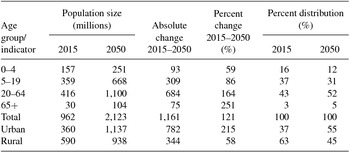
Table 1 shows projections from 2015 to 2050 of Africa's population size, age structure, and rural–urban distribution based on the medium variant of the UN Population Division's 2015 Population Prospects and the 2014 report on World Urbanization Prospects. The assumptions underlying the projections are that fertility will fall from five to three births per woman over the next three and a half decades, life expectancy will improve from 58 to 69 years and that net out-migration will be steady at about 0.3 per thousand, equivalent to about 450,000 persons per year. Under these assumptions, total population will more than double (an increase of 118%), with an average annual increment of 32 million. Those in the prime working ages of 20 to 64 years will increase at a faster proportionate pace of 156%, with an average absolute annual rise of 18.6 million. Because of fertility decline the number of pre-school children and school-aged children will grow at a slower pace. In 2015, 42% of Africa's population was aged 20 to 64 years. By mid-century, this proportion will have risen to 52%.
Sub-Saharan Africa: Demographic changes (2015–2050)

These projected changes can be put into perspective by comparing them with population change in China and the Republic of Korea between 1965 and 2000. In 1965, the proportion of total population in the prime working ages in these two countries was similar to that in Africa in 2015, at about 45%, but in the next 35 years, it rose to 60% in China and 64% in Korea, a steeper change than foreseen for Africa by mid-century. The reason for the difference is that fertility decline was much more pronounced in the two Asian countries than forecast for Africa. Fertility is also responsible for differences in total population growth, projected to be 118% in Africa compared with 80% in China and 63% in Korea between 1965 and 2000. However, like Africa, the two countries had to accommodate a very large increase of 135% in the number of adults aged 20 to 64 years, smaller than Africa's projected increase of 156% but nevertheless of the same order of magnitude.
The UN also projects rapid urbanization in Africa, with a trebling in size in the urban population over the 35 year projection horizon, compared to a 58% increase in the rural population. Though not included in UN projections, the adult population will become more educated. According to one projection, the proportion of adults with at least some secondary schooling will rise in Western and Middle Africa from about 35% in 2015 to about 65% by 2050 and from 25% to 45% in East Africa (www.wittgensteincentre.org/dataexplorer).
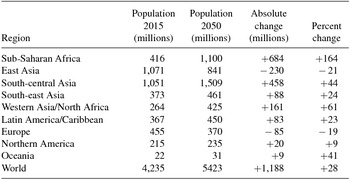
The contrast between Africa's burgeoning labor force and expected declines in some other regions over the next 35 years is seen by some as an exciting opportunity [Leke et al. (Reference Leke, Lund, Roxburgh and van Wamelen2010)]. The relevant 2015 UN projections are shown in Table 2, using the age band of 20 to 64 years as an approximation of the prime working ages. Declines in the size of the labor force are projected for East Asia, dominated by China and Japan, and in Europe, despite an allowance for net in-migration. All other regions, however, are projected to experience increases in their working age populations, notably in South-Central Asia (dominated numerically by India, Pakistan, and Bangladesh) with an expected increase over the next 35 years of about 500 million. No region comes close to the huge proportionate increase expected in Africa and this region's share of the global labor force will double from 10% in 2015 to 20% in 2050. Over half (57%) of the projected global rise in the working age population will be contributed by Africa. Whether or not this represents an advantage is considered below.
Projected change in population aged 20–64 years in major regions 2015–2050

3. EMPLOYMENT AND LIVELIHOODS: THE CURRENT SITUATION
Reliable information on employment and livelihoods is scarce because few African countries have conducted labor force surveys and because of inherent measurement difficulties in settings where subsistence farming and informal activities dominate. Yet, World Bank and ILO sources provide a reasonably consistent picture. About 65% rely on farming for their main occupation, about 20% are in the non-agricultural informal sector, mainly self-employed and working in small family enterprises, while close to 15% are wage earners. Most wage earners work in the sales and service sector; only 2–3% are employed in the industrial sector (manufacturing, mining, construction, and public utilities). The share of wage earners in the public sector has been falling and is now estimated to be about 40%, though higher in resource rich countries.
Poverty levels among farmers are higher than in other sectors. Farm sizes are small (1.8 hectares on average) and have been becoming smaller because of past population increase. Land scarcity varies greatly between countries. Some, for instance, DR Congo and Angola, still retain much virgin land that can be brought into production. Conversely, in others, a large minority of smallholders control less than half a hectare and are close to landlessness [Jayne et al. (Reference Jayne, Mason, Myers, Mason, Myers, Ferris, Mather, Beaver, Lenski, Chapoto and Boughton2010)]. Many are unable to meet their own food needs, let alone sell a surplus. In Ethiopia, for instance, about seven million chronically food insecure, rural people have to be supported by a cash or food for work scheme [World Bank (2015)]. Many of Africa's problems stem from lack of agricultural progress. Yields per hectare have improved little. About one-quarter of land is severely degraded and only 5% is irrigated. Use of fertilizers is low. Infrastructure and access to markets is weak. Only 10% of farmers have secure, registered ownership of land, which acts as a disincentive to invest for the longer term, for instance in soil improvement, water capture and storage, or tree planting [Byamugisha (Reference Byamugisha2013)].
The next largest share of employment and livelihoods is represented by the informal sector comprising the self-employed and family workers, though about 10% of micro-enterprises employ others. Petty trading accounts for some 50–70% of activity, with additional contributions from services, such as hairdressing, and manufacturing. A few will evolve into larger enterprises but most will remain small and precarious [World Bank (2012)]. Nevertheless, their consumption is higher than that of farmers [Filmer and Fox (Reference Filmer and Fox2014)].
Among wage earners, the disappointing feature is the very small proportion employed in the industrial sector and particularly in manufacturing. Indeed, Africa's share of global manufacturing exports fell from 2% to 1% between 1992 and 2012 whereas East Asia's rose from 30% to 58% [UNIDO (2013)]. Along with low agricultural productivity, the weakness of industrial sector employment distinguishes Africa most sharply from low and low-middle income countries in other regions. Whereas about 11% of the labor force in low income Bangladesh and Cambodia have an industrial wage the equivalent in low income African countries is 2.3%. For low-middle income countries in Africa, the proportion is 2% compared with a range from 5.4% in Laos to over 14% in Vietnam [Fox et al. (Reference Fox, Haines, Munoz and Thomas2013)].
There are, however, positive features. As noted earlier, GDP growth has been impressive and by no means confined to resource-rich countries. The poverty headcount has fallen from 57% in 2000 to 43% in 2012. Despite the region's declining share of global manufacturing, the value of manufacturing rose from $73 to $98 billion between 2005 and 2014, at constant prices. The absolute number of jobs in manufacturing also increased though this is not reflected in share of employment because the labor force grew by 10 million a year between 2000 and 2015 [Balchin et al. (Reference Balchin, Gelb, Kennan, Martin, William te Velde and Williams2016)]. It is also likely that conventional employment statistics do not provide a valid impression of positive changes in Africa because they do not take into account multiple income sources. A detailed analysis of Uganda is revealing[Fox and Pimhidzai (Reference Fox and Pimhidzai2011)]. Despite impressive and sustained annual GDP growth of 8%, an exclusive focus on primary employment shows little change. But a more comprehensive examination of livelihoods reveals a clear trend toward income diversification and a shift away from subsistence agriculture. Between 1992 and 2009, the percent of rural households having a non-farm enterprise increased from 24% to 40%. Over the same period, farmers widened the range of crops grown and became more commercial. In the view of the authors, these subtle changes, undetected by conventional surveys, account for the large drop in the poverty head count.
4. FUTURE PROSPECTS
To achieve welfare improvements, African countries need to make simultaneous progress on three fronts: improvement of agricultural productivity; creation of manufacturing jobs on a far larger scale than in the past; and encouragement of entrepreneurship in the informal sector. Unless this three-fold progress is made, the doubling of population in the next 35 years will entrench poverty and hunger.
4.1. Agricultural Productivity
Over the next 35 years, farming will steadily decline in terms of share of GDP and employment, as countries urbanize. Yet, the rural population will continue to grow and small family farms will continue to comprise a large share of employment. The growth in total population and the massive expansion of people living in towns and cities will fuel demand for food. This demand could be met in part by promotion of large commercial farms, a favored past policy in many countries, but the employment implications are dire; a large cereal farm requires only about one worker per hundred hectares. A near-consensus has emerged that one of the keys to economic progress and poverty-reduction in Africa is improved productivity of smallholders. This view is consistent with historical evidence that agricultural productivity has led the escape from poverty [Lipton (Reference Lipton2005)]. It is also essential for a re-vitalization of entire rural economy; off-farm jobs are most likely to flourish when farmers are doing well.
Much has been written on the steps necessary to improve agricultural productivity and the long list includes: greater investment to improve seed varieties, increased use of fertilizers, more astute crop rotation and diversification, enhanced water capture and storage, better infrastructure, and access to credit and markets. Particular optimism has been expressed about the potential of digital technology to better link small farmers to the wider world by providing them, for instance, with information about market prices.
Yields per hectare in Africa are so low by international standards that there is huge potential for progress. Improving educational levels will help as this factor is a major determinant of agricultural efficiency [Ogundari (Reference Ogundari2014)]. Farms with good access to towns and cities are well placed to supply the urban market with high value produce, such as fruit and vegetables. But threats to progress also need to be recognized. The preponderance of very small farm plots may further increase due to population growth. Understandably, small-scale farmers tend to be risk-averse and less likely to innovate than larger-scale farmers who have a cushion against adversity [Collier and Dercon (Reference Collier and Dercon2014)]. But the biggest single threat is climate change. Most farmers in Africa will remain vulnerable to erratic rainfall for many decades and extreme weather is one of the firmest predictions of climate scientists. The 2016 food crisis in much of East and Southern Africa may be a portend of problems ahead. Further, temperature increases will be particularly damaging to agriculture in the tropics.
4.2. Creation of Manufacturing Jobs
Historically, the pathway out of national poverty has involved a massive expansion of manufacturing, together with improvements in agricultural productivity. Manufacturing has been the main engine of economic growth and technological progress in poor countries. It makes a larger contribution to GDP per worker than the service sector, with the exception of tradable services (mainly finance and the professions). Moreover, manufacturing has a multiplier effect in terms of employment; each job in manufacturing generates two to three jobs in other sectors [UNIDO (2013)].
As noted above, Africa's economic progress in the past 15 years has not been driven by manufacturing, a feature that raises doubts about sustainability. The crucial question is whether African countries can exploit their growing and increasingly urban labor force to develop a thriving manufacturing base. Past and future trends in the number of global jobs in manufacturing is uncertain. According to the World Bank (2012), the number has risen only slightly since 1990 and is currently about 200 million; increased production has been largely the result of productivity gains. If valid, this implies that Africa will have to wrest jobs away from Asia. UNIDO (2013), however, takes into account jobs in the informal sector and related services (often outsourced by manufacturers) and estimates that manufacturing and related jobs rose from about 400 to about 500 million between 1995 and 2009. The 2009 estimate comprises 200 million in the formal sector, an equal number in the informal sector and 100 million in related services. UNIDO's more comprehensive assessment may be correct but it is unlikely that informal sector jobs have the same advantages as formal jobs in terms of productivity, earnings, and wider advantages for the economy.
Many factors will determine the future of manufacturing in Africa, including infrastructure, size of the domestic market, a coastline for exports by sea, and conducive policies. Here, three key factors are considered: relative wages, skills of the labor force, and capital for investment.
It may seem predictable that manufacturing will migrate to Africa, as wages rise in China and other parts of Asia, just as it earlier migrated from Europe and North America to Asia. That prospect is reasonable in the more distant future but, currently, the thesis that Africa has a wage advantage over Asia is doubtful. A comparison of wages for skilled and unskilled workers engaged in light manufacturing in China, Vietnam, Ethiopia, Tanzania, and Zambia confirmed that China's wages were higher but that Vietnam and Tanzania had similar wage levels and Zambia's were higher than Vietnam's. Only Ethiopia had a wage advantage over both Asian countries [Dinh et al. (Reference Dinh, Palmade, Chandra and Cossar2012)]. When relative unit labor costs are considered, that is wages relative to production, Africa's advantage over China disappears. A comparison of relative costs in seven African countries with those in China and four other Asian countries showed that they were higher in five of the African states than in China and in all but one of the four other Asian countries [Ceglowski et al. (Reference Ceglowski, Golub, Mbaye and Prasad2015)].
Clearly, wage levels have to be assessed together with labor skills and capital. Skills comprise both generic abilities in literacy and numeracy, usually acquired in school, and more applied technical and vocational skills that may be gained in formal education, apprenticeships, or on the job training. Much progress in primary schooling enrolments has been made in Africa and the deficit relative to other regions has narrowed. However, Africa still lags behind in secondary school enrolments. According to survey estimates reported by UNICEF for the period 2009–14, the net enrolment in Africa is 36 compared to 52 in South Asia and 70 or more in other developing regions. Furthermore, mere school attendance does not necessarily imply literacy and numeracy if quality of teaching is poor. In 2007, among 14 East and Southern African countries, an average of 18% of grade 6 students were rated to be illiterate and the figure for innumeracy was 31% [Hungi et al. (2010)]. African educational systems have also been criticized for failure to prepare students for the job market. Instead the emphasis is too often on academic preparation for tertiary education that few will reach [ILO (2012)]. Population trends will exacerbate the difficulty of rapid progress. As shown in Table 1, the school age population will increase on average by 8.8 million each year between 2015 and 2050 and this rise in numbers, together with rising demand, will put huge pressure on educational budgets.
Capital accumulation and investment can come from two main sources: domestic savings, foreign direct investment (FDI). Remittances are a third potential source but are not thought to be a major factor for most African countries and will not be considered here [Gupta, Pattillo and Wagh (Reference Gupta, Pattillo and Wagh2009)]. World Bank indicators show that gross savings as a percent of gross national income were 18.8% in Africa compared with 30.7% in South Asia. When adjusted downwards for mineral extraction and environmental degradation and upwards for educational expenditure the respective figures for Africa and South Asia are 5.5% and 18.9%. Net FDI into Africa has been rising sharply and exceeds that into South Asia both in absolute amount and as a percent of gross national income. However, among developing regions, FDI flows into Africa are dwarfed by those going to East Asia and Latin America: 46 billion US dollars per year versus 612 and 215 billion, respectively. Further, only a minority of FDI into Africa is directed at manufacturing [Chen, Geiger and Fu (Reference Chen, Geiger and Fu2015)]. Despite positive trends, Africa is not investing the 25% of GDP thought to be necessary to sustain an economic growth rate of 7%. Specifically, investment (gross fixed capital formation) in Africa (including North Africa) was 17.7% of GDP in the period 1990–1999 rising slightly to 18.7% in 2000–2011 [UNCTAD (2014)]. The average for all developing countries for the more recent period was 26%.
4.3. Entrepreneurship in the Informal Sector
Even with an optimistic view about the creation of private-sector wage-earning jobs, it is clear that that a very large fraction of the working age population will remain in the non-agricultural informal sector. An IMF working paper concludes that “even with non-agricultural growth as rapid and labor intensive as occurred in the last 20 years in East Asia, a similar employment transition will not occur. The enterprises would not be able to absorb the same share of the labor force because the labor force would just be too big” [Fox et al. (Reference Fox, Haines, Munoz and Thomas2013): p.7]. The same paper shows that, even under extremely optimistic assumptions about industrial growth, employment in the short term will continue to be dominated by agriculture and the informal sector. In Uganda, an impressive 100,000 non-agricultural jobs were created each year between 2002 and 2005, but there were 400,000 new entrants to the labor force, leading to a generalized conclusion that at best only one-quarter of young people leaving school in Africa will find a wage job [Fox and Pimhidzai (Reference Fox and Pimhidzai2011); Filmer and Fox (Reference Filmer and Fox2014)].
These considerations underscore the key role of small family enterprises and self-employment to Africa's economic future. Conducive policies can help, for instance, by enhancing access to credit, but much will depend on the ingenuity, hard work, and entrepreneurial abilities of individuals.
5. CONCLUSIONS
This paper has provided a brief sketch of the opportunities and challenges that African countries face in converting very large increases in the labor force and slowly unfolding but favorable changes in population age structure into accelerated economic growth and poverty reduction. Faster fertility declines than anticipated by the UN Population Division would certainly enhance prospects, not least because it would assist in human capital formation by reducing the growth of the school age population and pressure on educational budgets. Accelerated fertility declines are certainly possible, as shown by the success of vigorous family planning promotion in Ethiopia and Rwanda. Political will is important and one of the great virtues of the demographic dividend narrative is that has traction with ministries of finance and planning, who are far more influential than ministries of health in setting national priorities.
To cope with further rapid population growth and harness a demographic dividend, African countries have to make progress simultaneously on three fronts: agricultural productivity, creation of jobs in manufacturing, and fostering entrepreneurship in the informal sector. Of the three, agricultural modernization may be the easiest to achieve, because it is not heavily dependent on outside international forces and because the pathway to improvement is clearly signposted. The historic neglect of this sector is being remedied. The future of manufacturing in Africa is deeply uncertain, partly because it is dependent on actors outside the region, including foreign investors and competition from low-wage countries in Asia. Contrary to some views, the mere huge increase in Africa's labor force is not an advantage; it will simply retard structural changes in employment. Whether or not productivity in the informal sector will improve is also uncertain. No blueprint for success is available. Rising educational levels will help and perhaps a greater emphasis on training in vocational and technical skills will also. But it remains doubtful that entrepreneurship can be taught and much will depend on the energy and ingenuity of the individuals themselves.
Neither Collier and Dercon (2014) nor Ogundari (2014) have an issue number. The issue number for Eastwood and Lipton (2011) and for Gupta et al (2009) is 1.