Introduction
Candida auris, now reclassified as Candidozyma auris, Reference Liu, Hu and Zhao1 has emerged as a significant cause of intractable outbreaks in healthcare settings. Reference Cortegiani, Misseri, Fasciana, Giammanco, Giarratano and Chowdhary2 This fungus can lead to prolonged colonization 3 in patients and can persist on environmental surfaces. Reference Piedrahita, Cadnum, Jencson, Shaikh, Ghannoum and Donskey4,Reference Welsh, Bentz and Shams5 Such persistence complicates outbreak control and environment decontamination in healthcare environments. Although detection of C. auris from air samples has been described, Reference Schelenz, Hagen and Rhodes6 our group was the first to report the phenomenon of long-range air dispersal of C. auris in 2023. Reference Didik, Yau and Cheung7
Clustering of C. auris was first documented in a public hospital in Hong Kong in 2019. 8 All previously isolated strains belong to clade I/South Asia. Reference Tse, Tsang, Chu and Tsang9 Subsequently, nosocomial outbreaks have emerged in other public hospitals within the region. 10 Following the COVID-19 pandemic, the Hospital Authority (HA) of Hong Kong conducted a territory-wide point prevalence survey of C. auris among patients with risk factors in March 2023. This survey, along with subsequent contact tracing, revealed C. auris outbreaks in the Kowloon Central Cluster (KCC), suggesting significant silent transmissions during the COVID-19 pandemic.
In this study, we present clusters of outbreaks and sporadic C. auris cases in two public hospitals in the KCC and analyze factors affecting environmental contamination, particularly concerning air grilles. These findings have significant implications for mitigating C. auris transmission and informing effective infection control measures.
Methods
Setting
This retrospective study examined C. auris cases identified between March 2023 and October 2023 in Queen Elizabeth Hospital (QEH) and Kowloon Hospital (KH). QEH is an acute hospital with over 1,800 beds. KH is a convalescent hospital with over 1,300 beds and provides step-down and rehabilitation care for patients from various hospitals, including QEH.
C. auris screening and contact tracing
Admission screening was conducted since March 2023 for patients recently admitted to local hospitals with ongoing C. auris outbreaks, or history of hospitalization outside Hong Kong in the past year, or from residential care homes with known C. auris cases. Culture methods were adopted for admission screening.
During hospitalization, patients had contact history with a known C. auris case (index) were screened. ‘Close contact’ was defined as patient sharing the same cubicle with the index patient, while ‘other contact’ was defined as patient sharing the same ward but in different cubicles. 11 The screening targeted patients with close or other contact with the index patient up to 10 weeks before identification of C. auris carriage. All contact cases were screened for C. auris using polymerase chain reaction (PCR) and culture on Day 1, followed by culture on Day 3 and 7. Close contacts underwent weekly screenings until discharge, and biweekly screenings were conducted for all hospitalized patients staying over 14 days.
Culture screening utilized paired Transystem™ 108C swabs (Copan, Italy) from nasal area, along with the axillary and groin regions. PCR screening employed paired Transystem™ 139C swabs (Copan, Italy) from these same areas.
Confirmed C. auris carriage was defined as detection of C. auris by culture or PCR from any patient specimen type.
Infection control measures
All confirmed and contact C. auris cases were isolated in single rooms or cohorting units with ensuite facility according to the HA guideline. 11 Universal and contact precautions, 12–14 aligned with international guidelines, were implemented at the earliest opportunity upon case identification (see Supplementary Text Appendix 1 for detailed protocols). In light of our previous findings suggesting potential long-range air dispersal transmission of C. auris, Reference Didik, Yau and Cheung7 augmented measures have been implemented since September 2022, including installation of movable partition to convert open ward cubicle to segregated area and disinfection of ventilation grilles using 1,000 ppm sodium hypochlorite.
Collection of environmental and air grille samples for C. auris
Environmental sampling was performed within 48 hours of identifying C. auris carriage in patients residing in open ward settings for over 48 hours, and prior to ward decontamination. Cases with hospital stays under 48 hours were excluded, as they might represent community-acquired infections. Reference Biswal, Rudramurthy and Jain15 Using pre-moistened sterile Polywipe™ sponge swabs (Medical Wire and Equipment, UK), we sampled high-touch surfaces, including clinical equipment (blood pressure monitors, bladder scanners, ECG machines), furniture (bed rails, mattresses, commode chairs, cabinets, and lockers), workstations (computers, patient notes), and infrastructure (handwashing basins, door handles, sliding doors, stretchers, and trolleys), as well as supply and return air grilles, swabbing all blade surfaces end-to-end. Related samples were pooled for analysis.
Laboratory investigation
C. auris detection employed culture (CHROMagar™ Candida Plus with MALDI-TOF MS confirmation) and PCR (AurisID kit) methods (see Supplementary Text Appendix 2)
Whole genome sequencing
Whole-genome sequencing (WGS) for C. auris isolates obtained from patients and environmental samples was performed as previously described. Reference Didik, Yau and Cheung7
Data analysis
Two distinct groups of patients were observed in this study: outbreak and sporadic. An outbreak was defined as two or more new cases of C. auris that were epidemiologically linked. A sporadic case was defined as a carrier without epidemiological links to other cases and with no secondary cases identified following contact tracing. Reference Schelenz, Hagen and Rhodes6 Prolonged stay was defined as hospitalization for two weeks or longer. Contamination rates between groups were analyzed using a χ2 test for categorical variables and the Mann–Whitney U test for interval data, with statistical significance set at P < 0.05.
Ethics
Approval for the study was obtained from the Institutional Review Board of the Hospital Authority Kowloon Central Cluster. (Reference number: CIRB-2024-454-2)
Results
During the study period, 170 new C. auris carriers were identified, including 65 from nine outbreaks, and 105 sporadic cases. Comprehensive environmental screening was conducted for all outbreaks and 46 sporadic cases (Figure 1). One outbreak and five sporadic cases were excluded from further analysis due to delayed sampling after decontamination.
Study flow chart. C. auris carriers were identified by culture or PCR methods. Environmental sampling was conducted once a new carrier in the ward was identified. After collecting the samples, decontamination was done using a 1,000 ppm sodium hypochlorite solution.

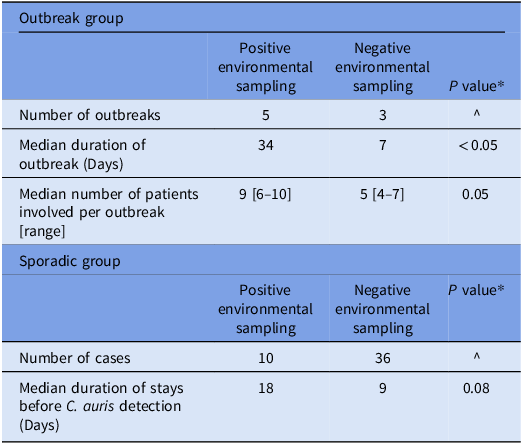
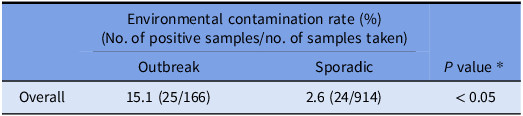
Of the eight outbreaks investigated, environmental contamination was detected in five, while the remaining three screened negative. Outbreaks with positive environmental contamination were significantly longer in duration (34 [27–45] vs 7 [7–12] days, P < 0.05) and involved a greater median number of affected patients per outbreak (9 [6–10] vs 5 [4–7], P = 0.05). A similar trend was observed in the sporadic group, where positive environmental contamination was associated with longer median hospital stays, although the difference was not statistically significant. Findings are summarized in Table 1. Overall, the environmental contamination rate was significantly higher in the outbreak group at 15.1% compared to the sporadic group at 2.6% (P < 0.05) (Table 2).
Analysis of outbreak and sporadic group characteristics and environmental sampling results

* P value obtained by Mann-Whitney U test
^ Descriptive counts, not suitable for comparative statistical analysis
Comparison of overall environmental contamination rate of outbreak and sporadic groups

* P value obtained by χ² test
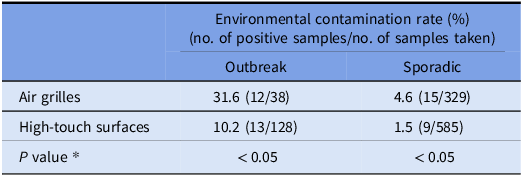
Notably, air grille samples showed a significantly higher contamination rate than high-touch surfaces in both the outbreak group (31.6% vs. 10.2%, P < 0.05) and the sporadic group (4.6% vs. 1.5%, P < 0.05) (Table 3). Further analysis revealed different contamination patterns between air grille types, with return air grilles exhibiting higher positivity rates than supply grilles (11.4% [14/123] vs 5.3% [13/244], P < 0.05).
Comparison of air grilles and high-touch surfaces contamination rate

* P value obtained by χ² test
Whole-genome sequencing
Eighty-two viable patient isolates (46 from outbreak cases and 36 from sporadic cases), alongside 24 viable environmental isolates, were subject to WGS and phylogenetic analysis (Accession number SRR33822667 - SRR33822772). All isolates belonged to clade I/South Asia, forming a closely related cluster with the C. auris strains from the first local outbreak in 2019 (Cau 1915 and Cau 1919), Reference Tse, Tsang, Chu and Tsang9 consistent with our previous report (Figure 2). Reference Didik, Yau and Cheung7
Phylogenetic tree of C. auris isolates from patient and environmental samples. A total of 106 isolates were subjected to whole-genome sequencing. All isolates were identified as strains belonging to clade I/South Asia.

Discussion
Current international recommendations emphasize contact precautions as the primary measure for preventing the spread of C. auris in healthcare facilities, while the potential role of air dispersal in transmission has not been addressed (Supplementary Text Appendix 3). 3,11,16–21 To our best knowledge, decontamination of air grilles during terminal disinfection has not been discussed in existing literature.
We observed that prolonged and sizeable C. auris clustering was associated with more extensive environmental contamination, particularly in air grilles. Although return air grilles exhibited higher relative contamination rates per unit sampled, both supply and return grilles demonstrated evidence of environmental bioburden in clinical wards. The detection of C. auris contaminants in supply grilles, where outward airflow should theoretically prevent particulate accumulation, cannot be explained by passive deposition alone. Reference Kumari, Haji, Keer, Hawkey, Duncanson and Flower22 We hypothesize that airflow dynamics (e.g., turbulence or local pressure gradients) may redirect particles toward supply vents, counteracting intended directional airflow. Reference Timmer and Zeller23 Additionally, human thermal plumes Reference Sun, Li and Han24 , the phenomenon of rising air flows caused by the body-air temperature gradient, could mobilize particles into upward convective flows, allowing them to deposit directly onto the supply air grilles, thus bypassing ventilation filtration system. Together, these mechanisms may explain the unexpected findings of C. auris in supply air grilles.
Air grilles could serve as deposition sites for C. auris and potentially other multidrug-resistant organisms (MDROs), including methicillin-resistant Staphylococcus aureus (MRSA), carbapenem-resistant Acinetobacter baumannii (CRAB), and carbapenemase-producing Enterobacterales (CPE). Reference Wong, Chen and Kwok25 This reservoir carries significant clinical implications that extend beyond surface contamination. The continuous circulation of contaminated air through supply air vents may persistently redistribute pathogens across patient care areas, creating an ongoing transmission risk. This air dispersal dissemination pathway helps explain why conventional surface disinfection protocols often prove insufficient for outbreak control. Furthermore, the open-ward designs common in many hospitals may unintentionally amplify this effect by enabling widespread air recirculation. Collectively, our findings support the importance of physical segregation to mitigate long-range air dispersal. Strategies such as single-room isolation or cohorting carriers in designated cubicles with closed doors, preferably with negative pressure, are crucial in limiting air dispersal. Reference Wong, Chen and Kwok25
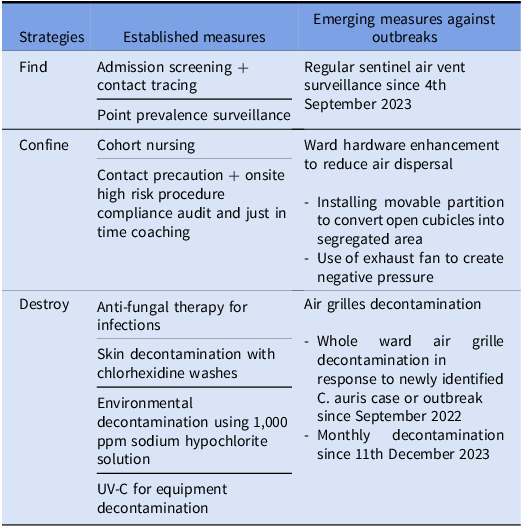
Although guidelines from the CDC 26 and the National Health Service 27 recommend cleaning ventilation grilles as part of general hospital cleaning protocols, they do not specifically target the control of C. auris. Based on our findings, we adopted regular decontamination of air grilles to eliminate C. auris reservoirs since December 2023, with regular monthly dusting and cleaning of supply and return air grilles in clinical areas. This was followed by decontamination using 1,000 ppm sodium hypochlorite solution. 18 Additionally, ad hoc disinfection of air grilles in the entire ward would be performed if new C. auris cases were identified. Post-decontamination screening implemented since June 2023 during outbreak conditions confirmed no detectable contamination on all sampled high-touch surfaces and air grilles, demonstrating protocol efficacy. The C. auris control strategies adopted by HA are summarized in Table 4. The number of new C. auris cases identified from admission screening has remained stable following the adoption of these measures, with a significant reduction in outbreaks (Figure 3), where the number of admission and number of patient day remain static during the study period. This temporal correlation suggests that the interventions may play role in reducing transmission in the healthcare setting. Further investigation into the impact of these measures is warranted to confirm their role in controlling C. auris outbreaks.
Established and emerging measures against C. auris outbreak

Monthly number of new C. auris cases identified in QEH and KH. QEH_H7 was the first nosocomial outbreak in 2022. KH 03.23 was excluded due to delayed environmental sample post decontamination, and QEH 12.23 fell outside the study period. Cases include all patients who tested positive for C. auris during hospitalization, irrespective of timing of identification.

Our study had several limitations. As a retrospective analysis, variability in environmental sampling may have led to incomplete contamination data. Air grille sampling delays in one outbreak and five sporadic cases resulted in their exclusion. Operational constraints, such as working at heights and bed repositioning in occupied wards, affected sampling consistency, though extension poles were introduced in late 2024 to address this (Supplementary Text Appendix 5). Sampling limitations may confound transmission interpretation. While long-range air dispersal transmission of other MDROs was reported, Reference Wong, Lam and Chen28,Reference Wong, Chen and Yuen29 current evidence for C. auris remains limited to our prior report. Our present findings support this hypothesis, though independent validation remains essential.
Future research should investigate the feasibility of proactive sentinel air grille surveillance as a proxy for detecting the silent spread of C. auris, leveraging lessons from wastewater surveillance during the COVID-19 pandemic 14 and our present findings. The approach may offer a more cost-effective alternative for detecting nosocomial silent carriers compared to traditional point prevalence surveillance.
In conclusion, significant and prolonged C. auris clustering has been associated with extensive environmental contamination, particularly of air grilles. There is a gap in current recommendations for air grilles decontamination. We recommend decontamination of air grille in addition to physical segregation to tackle the overlooked reservoir of C. auris in hospital environments.
Supplementary material
The supplementary material for this article can be found at https://doi.org/10.1017/ice.2025.10347
Acknowledgements
None.
Financial support
None reported.
Competing interests
All authors report no conflicts of interest relevant to this article.