Introduction
For the past ten years or so, stand-up comedy has achieved great success among young comics of non-European descent and their audience in Hexagonal France.Footnote 1 Video-sharing websites such as YouTube and its French counterpart Dailymotion have fostered the burgeoning of stand-up comic acts with varying degrees of professionalism. ‘Stand-up clubs’ have flourished throughout France, giving rise to competition among amateurish and semi-professional aspiring comics. First broadcast on TV in 2006, stand-up comedies have since spread to mainstream French entertainment TV programs.
Although minority comics had been sporadically present on the Hexagonal French comic scene since the 1980s (Quemener Reference Quemener2013), the mid 2000s saw the emergence of new figures collectively claiming their share of French public- and media-scape. Stand-up comedy then became a rallying category around which they organized, for example, into performing teams. Unlike their predecessors (including the few minority performers) who used the long established category one-man/woman show, the younger generation of comics of North and sub-Saharan African origins discursively constructed their solo performances as stand-up, which they claimed as their new way of doing comedy.
This article examines the ways in which stand-up comedy has been taken up by comedians of non-European descent in France as a new space of visibility and hearability. In agreement with Bakhtin (Reference Bakhtin, Emerson and Holquist1986:65), who argues that speech genres reflect ‘all the changes taking place in social life’, I show how and why the indexically and iconically copied genre of stand-up comedy genre in France is socially meaningful. My approach to genre is in line with that of Hanks (Reference Hanks1987:668), itself largely inspired by Bakhtin's theory of genre and Pierre Bourdieu's theory of practice. According to Hanks, a genre consists of ‘historically specific elements of social practice’ shaped by sociohistorical acts, groups, and ideologies, which also shape the social environment in which the genre itself gets inserted.
A genre is intrinsically relational, as it creates indexical connections that extend beyond the setting of the production and reception of performances (Briggs & Bauman Reference Briggs and Bauman1992). In the data presented here, I demonstrate how stand-up comedy as performed by French comics of North and sub-Saharan African origins primarily indexes an African-American genre that helps them project themselves within a history of social emancipation.
The intertextual links (Hanks Reference Hanks1987) that a given genre establishes are made conspicuous here through the comics’ heteroglossic performances, as described below. For example, their use of English frames the origin of the stand-up comedy genre as ‘American’, establishing congruence between ‘named language’ and textual genre. By contrast, the comics’ stylization of the latter (through a marked French-sounding accent) unsettles this relationship, as it inscribes the genre in the locale where it is performed and evaluated. The stand-uppers’ heteroglossic repertoire (viz. Maghrebi Arabic (or Darija), different varieties of vernacular French, standard French and English, mesolectal African French, and stylized African French and English) orient their audience to multiple chronotopes (Bakhtin Reference Bakhtin1981) linked to different social personae with which the comics align or from which they distance themselves.
Heteroglossia, as defined by Bakhtin (Reference Bakhtin1981), does not simply refer to the simultaneous use of different chunks of ‘named languages’ or registers. More importantly, it addresses ‘the tensions and conflicts among those signs, based on the historical associations they carry with them’ (Bailey Reference Bailey and Heller2007:257). Heteroglossia inscribes the speaker and his/her addressee(s) within a history of language use, of social stratification and ideological relationships.
Besides bearing historical and social connections with ‘other times, other places and persons’ (Briggs & Bauman Reference Briggs and Bauman1992:147–48), the evocation of a genre also pertains to issues of identity and power, as it asserts the performer's authority to decontextualize discourse and recontextualize it in another setting and to another audience. In the sociopolitical context of France, I argue that performers of North and sub-Saharan descent use stand-up comedy as a forum to make their way of being French heard (both literally and figuratively) and, more importantly, to take an active part in creating a new narrative of the here-and-now France. (On genre as social action, see Miller Reference Miller1984.) The comics’ heteroglossic speech practices are creative resources deployed to achieve this goal. For instance, their use of languages other than French symbolically destabilize the one-language-one-people ideology at the foundation of France as a nation-state since the eighteenth century. As discursive devices, heteroglossic resources help portray non-European French citizens, which the comics embody, through the gaze of the (white French) Other, thanks to the use of typifying linguistic features such as marked nonnative Hexagonal French accent. The strategy indexes France's multilingual practices and multicultural populations, the outcome of the country's long history of transnational migrations coming from, among other places, its former settlement and exploitation colonies in North and sub-Saharan Africa, respectively. (For Portuguese migrations to France, see Koven & Simões Marques, this issue.)
I treat the stand-up comedy genre as a communicative framework that enables comics of non-European descent to claim new (social) positions and construct new identities. Through the comics’ combined use of the linguistic resources mentioned above emerges a new ‘subject’ defined as urban, which both encompasses and transcends racial or ethnic categories in France's sociopolitical context, where ethnicity and race have been left out of the grand national narrative (see below).
Stand-uppers’ public display of heteroglossic resources beyond its intended immediate audience, via social media such as YouTube and TV, risks reinforcing social stratifications. As a matter of fact, their performing acts have been received ambivalently.Footnote 2 On the one hand, the broadcast of comedians of North and sub-Saharan African origins embodying and styling their Frenchness has been celebrated by journalists as a tiny salutary breach of the monochromatic character of France's mediascape, to which I return below. On the other hand, some professionals (e.g. Pascal Girbig, the artistic director of the international humor festival Drôles de Zèbres)Footnote 3 have construed stand-up comedies as indexing recursively (Gal & Irvine 1995) the rise of communautarisme, that is, the fragmentation of France's sociocultural space into ethnic and sociopolitical subspaces marked by their peculiarities. Thus, this communicative genre has become predominantly associated with la banlieue, the city's periphery and residential zone of culturally diverse working-class (immigrant) populations (Wacquant Reference Wacquant2008), and its type of humor as sectarian and sociopolitically divisive (Tetreault Reference Tetreault2013). Yet again, some commentators have understood this genre as indexing foreign origin and as one among many illustrations of Yankee imperialism, which is a threat to French culture (see Kuisel Reference Kuisel1997; Gueldry Reference Gueldry2009 regarding France's putative Americanization). These contrastive and somehow competitive framings of stand-up comedy and its performers highlight the embedded ideologies in light of which this genre should be analyzed and its sociopolitical relevance assessed:
(i) France's public policy is informed by a strong republican secularist ideology, which rejects any claim of communal particularisms, be they religious, linguistic, racial, cultural, or sexual. Any attempt by particular groups to claim rights and organize politically, or, as in the present case, artistically, is considered a threat to the nation's cohesiveness. French color-blind universalism views multiculturalist policies (see below) as essentializing (viz. reducing people to their inescapable origins or ethnic groups) where individuals are not treated as equal and free but representatives of distinctive communities. Because it putatively leads to ‘cultural isolationism’ (repli identitaire) or ‘tribalization’ (Jennings Reference Jennings2000:587), multicultural ideology is interpreted as highly divisive and therefore a potential source of social disruption. As aptly summarized by Jennings (Reference Jennings2000:589), ‘Multiculturalism is thus un-French. It sanctions unequal rights. It countenances communities closed in upon themselves. It places culture before politics, groups before individuals’.
(ii) France's republicanism translates into a highly regimented and centralized linguistic ideology with several processes of ‘erasure’ (Gal & Irvine Reference Gal and Irvine1995) at play. For instance, despite the fact that the country's linguistic diversity (with its regional languages, dialectal Arabic, Western Armenian, Berber, Judeo-Spanish, Romani, Yiddish, and French Creoles) has been officially acknowledged (see http://www.culture.gouv.fr/culture/dglf/), the ‘monoglot ideology’ (Silverstein Reference Silverstein, Brenneis and Macaulay1996) is still pervasive. In addition, the erasure of regional and non-Hexagonal varieties in national media has contributed to an economy of talking and listening in which comics’ performances in and of non-Hexagonal French are inserted and against which they are evaluated.
(iii) Since the sixteenth century, French has been construed as a language under siege both within and outside France (Vigouroux Reference Vigouroux2013). In the last century the main threat to France's culture has been identified as North American.
(iv) Finally, any attempts to claim rights in the name of ethnic communities have been interpreted as an illustration of French society's Americanization, and multiculturalism has been mainly associated with the United States and, to a lesser extent, Great Britain. Indeed, the French universalist model has been rearticulated as the antithesis of American multiculturalism with the French society presented as more egalitarian and inclusive than its putatively highly divided American counterpart (Dhume Reference Dhume2010).
The data analyzed here are excerpts of stand-up shows broadcast on YouTube by three French comics of North and sub-Saharan African origins. Jamel Debbouze was born in France, of Moroccan parents. He is one of the most successful solo performers in France today. In 2008 he purchased a small Parisian theatre, the Theatre Comedy Club, in order to promote stand-up comedy. Many of the solo stand-uppers in the French circuit nowadays have launched their career by joining Debbouze's performing team, The Jamel Comedy Club (JCC).Footnote 4 Thomas Ngijol is one of the JCC's early recruits, although he had been performing in small venues before joining the team. He was born of Cameroonian parents in a southeastern suburb of Paris. Patson, also a former JCC member, grew up in Côte d'Ivoire; he was later sent to France where he was adopted by a white French family.
The rest of the article is organized as follows. The next section opens the discussion, with the history of stand-up comedy in France and the sociocultural and political context to which it orients and in which it is inserted. This first part lays the groundwork for the analysis of the sociopolitical relevance of Jamel Debbouze's ‘identification work’ (Hall Reference Hall, Hall and du Gay1996) in example (4). I illustrate how his use of verbal resources such as Maghrebi Arabic and several registers of vernacular French and stylized English helps him align with a modern image of France as socioculturally diverse. In the last section, I analyze how the comics’ selection of heteroglossic verbal resources, for example, accented African French to typify an African character, inserts their performance in a history of stereotypical Other-representations. I particularly focus on stand-uppers of sub-Saharan origin whose performance of Africanness bears on representations of Black Africans since the eighteenth century. I conclude that the break in the politics of representation may not be as radical as both the performers and their receptive audience call or hope for.
Indexing a ‘new’ genre to make oneself visible and heard
In the mid 2000s France's marginal cultural sites (confined to small venues or in the geographic periphery of the intellectual and cultural capital, Paris) saw the mushrooming of performing teams and shows categorized as stand-ups. For instance, in 2005, the Comic Street Show (CSS) claimed to be ‘100% stand-up’ and advertised itself as le 1 ershow d'humour urbain ‘the 1st show of urban humor’, which mixed humor and music from urban cultures. The comedians were described as vrai ‘entertainers’ ‘true entertainers’, inspired by sitcoms US, musiques urbaines ‘American sitcoms, urban music styles’, and métissages culturels ‘cultural hybridizations’. The category urban refers here to modern French society that the Comic Street Show iconizes as citizens and orients to as performers (mainly French of North and sub-Saharan African origins). The ‘cultural hybridizations’ mentioned at the website signal both France's highly diverse sociocultural fabric and its transnational cultural influences epitomized by the category ‘urban music styles’ (hip hop and rap, among others). (On the translocality of hip hop, see Condry Reference Condry, Gmelch and Zenner2001; Alim Reference Alim2009.) In many stand-up shows à la française, hip hop music is played as opening and closing sequences, establishing interdiscursive links with other semiotic spaces; we return to this later in the article (on the emergence and social significance of hip hop culture in France, see Boucher Reference Boucher and Vulbeau2001; Prévos Reference Prévos and Mitchell2001). This musical routine also differentiates stand-up comedy shows from the long-established one-person show format.
While CSS claims to be inspired by sitcoms US, ‘Jokes session’ (created by Délo), which saw light a few months after CSS, asserts a more direct filiation from the African American tradition of stand-up comedy:
Nous souhaitons lancer ce concept, qui aux Etats-Unis fait fureur depuis déjà plus de dix ans (« Dej Comedy Jam», « Platinium Comedy », «La Ffapooloza»…. [Laffapalooza]). (http://www.grioo.com/info5842.html)
‘We wish to launch this concept that has been very popular in the United States for over ten years already (« Dej Comedy Jam », « Platinium Comedy », « La Ffapooloza »…. [Laffapalooza])’Footnote 5
The particular reference to African American shows highlights here not only Délo's source of inspiration as an entertainer and show-promoter but also his agenda in developing stand-up in France. To a journalist's question about his ‘Jokes Session’ project, he explains that as a “young Black” he had never seen Black actors or comedians who had left an impression on him like those “across the Atlantic”, where “there is no problem” seeing black entertainers (http://www.grioo.com/info8304.html). Délo's professional identification with African American comedians involves a process of erasure in which stand-up comedy is constructed as a predominantly African American comic genre. Because American stand-up comedy shows had up to then not been broadcast on French TV, one can surmise that Délo accessed them through the internet and therefore was potentially exposed to a variety of stand-up comics. This makes his association of stand-up comedy genre with the African American population far from fortuitous. The selective process he operates here suggests the indexicalities he attaches to stand-up comedy as a genre performed by sociocultural minorities, epitomized here by the Black figure, and as a way of taking the floor in an environment that has prevented people like him (African Americans and French citizens of African descent alike) from doing so.
One of the most salient features of stand-up comedy à la française lies less in its actual American origin than in the comics’ recurring meta-framing and performance of it. As noted above, the category American stands for ‘African American’ (and by extension any sociocultural minority) with which French comedians of North and Sub-Saharan African descent tend to identify as minorized/racialized French citizens yet as valorized artists (at least for some segments of the population), as they do not find any sociocultural model to emulate within the French society. I analyze the comics’ ‘saying doing’ stand-up comedy as indexing the ways in which they assume simultaneously opposite positions in two concurrent fields (Bourdieu Reference Bourdieu1993): on the one hand, a subordinate position in France's socioeconomic field, where social roles and positions have been shaped by longue durée (Braudel Reference Braudel1969) historical processes such as colonial and postcolonial relationships, and, on the other hand, the courte durée artistic field, in which positions are structured according to the economic and symbolic capital accumulated within the field. As Bourdieu argues, a position in a field is determined by the type(s) of capital (economic, cultural, social, and symbolic) one possesses. Yet, because fields are never totally independent from each other, one's position in a given field may be reshaped by the position one occupies in another field. In the case discussed here, among the ‘strategic possibilities’ (Bourdieu Reference Bourdieu1993:314, Hanks Reference Hanks2005:73) the artistic field offered to comics is that of unsettling the sociocultural representations associated with postcolonial French citizens. We need not ignore the possible reaction that might dismiss stand-up comedy as a superficial arena of (cultural) practice (see below), especially in a country like France, where cultural consumption still strongly indexes social class (see Bourdieu Reference Bourdieu1979, but cf. Fabiani Reference Fabiani, Donnat and Tolila2003).
As illustrated by Délo's comment, stand-up comedy shows were initially launched to provide a platform of expression for comics who felt socioculturally marginalized in French socio- and media-scapes. Thanks to the popularity of its main proponent, Jamel Debbouze, The Jamel Comedy Club helped make the genre available to a broader audience, as it was broadcast on the private and trendy TV channel Canal Plus in 2006.
Concurrently, the year 2005 was marked by three-week riots that spread like wildfire. What started as localized violent confrontations between an outraged group of youngsters from the banlieue and the police, following the death of two young boys trying to escape the police, escalated into several pockets of contestation throughout France. Through violent confrontations with representatives of the State apparatus (viz. police) and the destruction of institutional buildings such as schools or sport facilities, disenfranchised youngsters sought to challenge the government on its tendency to treat them and their parents as legitimate French citizens and social actors of the Republic. As stressed by scholars (Murray Reference Murray2006; Gondola Reference Gondola, Tshimanga, Gondola and Bloom2009; Mbembe Reference Mbembe, Tshimanga, Gondola and Bloom2009), such uprisings uncovered the failure of the French republican model to make room for the postcolonial segments of its population, viz., those born from parents from former French colonies.
The misrecognition of France's highly diverse sociocultural fabric is manifested by the underrepresentation of so-called ‘visible minorities’ in the media as documented by the French broadcasting high commission in 2000 (Conseil Supérieur de l'Audiovisuel). As stated in the report and subsequent studies (e.g. Macé Reference Macé2008), nonwhite fictional characters or mainstream talk-show presenters are not only rare; when ‘visible’, they tend to be confined to second-tier positions. Fictional characters are shown in stereotypical roles such as rap musicians, drug dealers, and more generally, social outcasts. Comedian Thomas Ngijol comments on this in (1) below by both assigning stereotypical social roles to his characters (e.g. ‘soothsayer’) and distinguishing cultural features indexing physical cruelty and backwardness according to Western societies’ belief system (e.g. ‘the excised’) (for a discussion on the ideological construction of the categories modern/unmodern, see Koven & Simões Marques, this issue). By using West African names (e.g. Bintou, Amadou) Ngijol aligns the black body with clichéd ‘black-sounding names’ that contrast with his own unmarked (Christian) name.Footnote 6
(1)

In the news, nonwhites tend to be epitomized as the threatening banlieusards (i.e. ‘people from the banlieue’), who are discursively constructed as socially deviant if not outright dangerous (Sedel Reference Sedel2009). At the same time, the demographic imbalance in the media is iconic of broader social dynamics in which nonwhites are strikingly absent from high-ranked positions and civil service including academia. On the political level, national representatives are still overwhelmingly male, Christian, and of European descent (Keslassy Reference Keslassy2012).
As can be inferred from the short history above, the broadcast of JCC in 2005 had both social and symbolic significance. Stand-up comedy has enabled French comics of non-European descent to design their own space of visibility in France's media and claim agency (i.e. the capacity to act and speak, rather than being spoken about) over the sociocultural figure they wish to project. There is indeed an iconic relationship between the claimed newness of the genre in France and the emergence of French comics of North and sub-Saharan descent as public social figures. The newness of the latter lies in the way in which they destabilize the undifferentiated and (often) disembodied Other-discourse on youth from the banlieues in France, partly by embodying stereotypical personae to which they tend to be reduced or, on the contrary, by transcending ascribed social categories. (On how comics play out derisive ethnic stereotypes, see Boskin & Dorinson Reference Boskin and Dorinson1985, Chun Reference Chun2004, and Brayton Reference Brayton2009, among many others.)
Comics rationalize their choice of stand-up comedy (as opposed to a one-person show with staged characters, props, and a story line) by invoking the sense of ‘freedom to be oneself’ that the genre provides, although it is not always clear which dimension of self is at issue (for example, performer, immigrant or offspring thereof, or racialized French citizen). To a journalist's question about his choice of stand-up comedy, Thomas Ngijol responds that he got attracted to stand-up after watching American and British stand-up comics being funny through ‘being themselves’ (“en fait les mecs ils sont eux-mêmes et c'est drôle quoi”; http://www.buzzmoica.fr/video/interview-de-thomas-ngijol-12969). Whereas Ngijol emphasizes the expression of the individual self, others, like Jamel Debbouze, approach stand-up comedy as a genre in which social personae can be voiced:
on a demandé à nos arrière-grands-parents de défendre la France, à nos grands-parents de la reconstruire, à nos parents de la nettoyer, et nous on va essayer de la... raconter. (http://jamelbedouze.over-blog.com/categorie-1171828.html)
‘they asked our great grandparents to defend France, our grandparents to reconstruct it, our parents to clean it and we will try to narrate it.’
Debbouze orients here to two intertwined chronotopic frames (Bakhtin Reference Bakhtin1981): a genealogic or autobiographic frame (history) with reference to his forefathers (e.g. great-grandparents) embedded in a broader historical frame (colonial history) where the family story is inscribed. Baktin's conception of the chronotope maps personhood in time and place, which is achieved through the participation framework (Agha Reference Agha2005). In Debbouze's speech, above, each clause denotes a different chronotope associated with a particular state of subjection and the immigrant's social figure in France: the verb ‘defend’ indexes colonial infantrymen (tirailleurs) sent to the frontline as canon fodder to fight against Germany, France's enemy during WWI and WWII; ‘reconstruct’ evokes post-war North African factory workers employed in the automobile industry; finally ‘clean’ indexes the figure of immigrant street cleaners found in major French cities whose upward social mobility has been impeded by France's (often covert) exclusionary policies toward immigrants, especially those coming from the former North African and sub-Saharan colonies. By embedding the genealogical within the historical chronotopic frame, Debbouze highlights the fact that the histories of the former colonies are constitutive of France's history and not outside it. Because silence and erasure in France's official history are constructed within the discourse, these ‘other’ histories can only be brought back within the discourse through ‘narrativization’ (White Reference White1980), that is, the transformation of historical materials into the shape of a story. As illustrated by the shift from the pronoun on ‘indefinite they’ (i.e. French people of European descent) to nous ‘we’ (i.e. French from immigrant backgrounds), Debbouze presents stand-up comedy as a platform for French comics ‘like him’ to shift away from the positions that had been prepared for their parents, as immigrants, to a position they claim for themselves.
Stand-up comedy provides to French comics of non-European descent ‘powerful strategies for building … imagined communities’ (Briggs & Bauman Reference Briggs and Bauman1992:150) in a regimented French sociopolitical space in which the republican ideology does not recognize ethnic subgroupings. Multiculturalism is performed and staged in the shows, as illustrated by the way in which TV cameras frame the attending audience, broadcasting regular snapshots of nonwhite faces and laughter.Footnote 7 Acknowledgement of the audience's diversity (to which the latter responds positively, as shown below) is often thematized in shows by using either a racial taxonomy (‘Whites’), a panethnic group category (‘Arab’), or a synecdoche (e.g. ‘Chinese’ for Asian), or even by identifying specific populations metonymically (e.g. ‘les Antilles’ for the West Indies), as in Patson's opening and closing sequences below in (2) and (3).
(2) Opening sequence

(3) Closing sequence
Racial and/or ethnic Other-ascription is a very common interactional routine used as part of ‘peer-bonding’ (Doran Reference Doran, Pavlenko and Blackledge2004:108) among French urban youths living in heterogeneous sociocultural environments. Therefore, Patson's address to his audience could also be analyzed as an in-group identity framing. Such an interpretation is corroborated by my observations of the demographics of stand-up comedy's audience (more specifically that performed by comics of non-European descent), which is culturally far more diverse and younger than that of other verbal arts.
Although Patson's explicit ethnic or racial Other-categorizations symbolically breach France's republican pact, through his here-and-now heteroglossic performance the performer declares that he and his audience are members of modern French society, which he simultaneously acknowledges to be socioculturally heterogeneous.
Heteroglossia as a narrative resource to project a new historical (French) subject
In the sequence analysed in this section, Debbouze performs a highly heteroglossic repertoire whose linguistic boundaries (although problematic to define; see Bailey Reference Bailey and Heller2007) can be summed up as follows: various registers of Hexagonal French (viz. standard, vernacular, and VerlanizedFootnote 8, Darija (or Moroccan Arabic), stylized nonnative American English, and African American Vernacular English (AAVE).
I say performed rather than displayed heteroglossic speech practices in order to stress Debbouze's metapragmatic awareness (Silverstein Reference Silverstein and Lucy1993), which is central to his work as a verbal performer. By pointing out that comics perform for rather than to their audience, Bell & Gibson (Reference Bell and Gibson2011) suggest that their use of linguistic resources should not be analyzed as a mere reflection of their language repertoire (although the on- and off-stage repertoires may overlap), but as creative work around and with language second-order indexical relationships (Silverstein Reference Silverstein2003) as illustrated below. The functions and efficacy of linguistic resources used in comic acts are subject to the audience's evaluation, whether positive in the form of laughter and/or clapping or negative as in displayed discontent with boos (Bauman Reference Bauman1975). Laughter signals that a linguistic form, a stylized accent, a register, and/or a language switch are recognized as meaningful signs and that the indexical relationships they establish are understood, shared, reinforced, or reinterpreted (Bell & Gibson Reference Bell and Gibson2011).
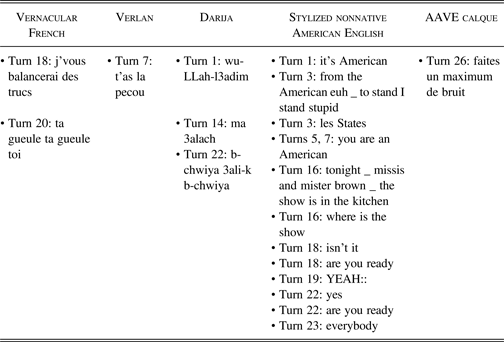
The pragmatic and social meanings of Debbouze's performed repertoire below are not always easy to assess. The function and indexical meaning of each linguistic resource (be it the register, the style, or chunks of named languages, etc.) should be analyzed in relation to the speaker's whole repertoire as each resource finds its meaning against the backdrop of the others. In other words, although for analytical reasons they are investigated separately, what matters in the sequence below is the combined usage of Darija with several registers and varieties of Hexagonal French and English. The linguistic resources used are summarized in Table 1, above.
Some linguistic resources in play in Debbouze's sequence.

The different aspects of the heteroglossic repertoire are shown as follows in the transcript below: boldface marks English, small capitals mark Darija, italics mark vernacular French, superscript indicates Verlanized forms, subscript marks an AAVE calque; the unmarked remaining text signals standard Hexagonal French.
(4)
The communicative functions performed in Debbouze's extract include: (i) a warm up sequence, to prepare the audience to welcome the performers he will later call on stage. Debbouze officiates here as the master of ceremony by engaging in playful acts with the audience; and (ii) his ‘metalinguistic specification’ (Hanks Reference Hanks1987:672) of the stand-up comedy genre of his act (turn 1, ‘so tonight I am going to talk to you about stand-up’) is an ‘orienting framework for the … reception of the discourse’ (Bauman Reference Bauman2000:84), in which identities are assigned (turn 5, ‘you are an American’) and interactional roles established (turn 22, ‘sometimes sometimes I will say <ARE YOU READY > /you _ you'll say _ EVERYBODY’). Transgression of these ascribed roles may occur, as in turn 19 where a member of the audience uses the ‘wrong’ (i.e. not expected) linguistic resource (English yeah instead of his French equivalent ouais or oui) and is sanctioned by the master of ceremony (turn 20, ‘you shut the fuck up’). The interactional routine between the performer and his audience is framed as an informal one, with the use of the term of address tu as in tu te rappelles en 6 ème (turn 9). In public settings, the use of tu is marked in Hexagonal French and, depending on the context, it can be perceived as infringing the rules of civility and social distance toward an addressee (Coveney Reference Coveney2010). In stand-up comedy, the tu form can have multiple functions and meanings: it helps to frame the performed act as a casual conversation (i.e. nonrehearsed) and establish intimacy between the comic and his or her audience, based on attributes such as common origin or shared experience (see Brodie Reference Brodie2008 for stand-up comedy as a genre of intimacy). Because (reciprocal) tu is the expected form among peers to mark shared affiliation and coolness, in stand-up shows it may also be used to signal that both the members of the audience and the performer are laid back. In France, the use of tu distinguishes stand-up comedy from the one-person genre where the pronoun of address vous tends to be the norm (in French vous can be a singular formal term of address or an unmarked plural one). As noted above, the demographics of stand-up shows’ audiences tend to be younger than that in one-person shows, which may explain the preference for the tu form in the former.
The definition of ‘stand-up’ introduced by Debbouze's rhetorical question (turn 1, ‘what is stand-up’) orients the audience to the origin of the genre as North American, iconized here by the switch, marked by a short pause, from French to English (‘c'est _ it's American’). By contrast, Debbouze's styling of a French speaker allegedly speaking with an American accent reframes the speech event into a comic performance and prefaces his playful act around the local appropriation of the genre acknowledged by the audience's laughter. Debbouze's ‘saying-doing’ stand-up is iconized by the learning of ‘its’ named language (viz. English), which establishes a strong relationship between textuality (viz. the speech genre) and the (linguistic) code. The activity of learning is parodied here, first, by Debbouze's entextualization of short English textbook-type extracts used in French schools, such as ‘tonight misses and mister Brown’ (Brown is a common name for a character in English textbooks for French middle-schoolers); second, by his referring to EFL classroom learning practices such as the mechanistic repetition of irregular verbs (turn 3, ‘to stand I stand stupid verbe irrégulier’); and, third, by recalling the ascription of English names to French pupils (turn 9) (see Perrino, this volume, for a similar process of name giving). In the same vein, Debbouze also parodies a famous routine found in English-class textbooks (‘Where is Brian — Brian is in the kitchen’). As is evidenced by JCC's next broadcast shows, the call response (turns 16–17, ‘where is the show/in the kitchen’) serves as a rallying routine between Debbouze and his audience; it contributes to the inscription of JCC in a temporal and thematic continuity and to the ratification of the audience's insiderness.
Debbouze establishes an intertextual relation with African American stand-up shows (and, more broadly, entertainment) in the way that he prompts the audience to applaud. He uses an expression literally translated from African American Vernacular English (turn 26, faites un maximum de bruit pour… ‘make some noise for…’) instead of its French vernacular equivalent veuillez applaudir/accueillir ‘please give a round of applause’. Now commonly used by French emcees in urban culture-type shows such as hip-hop concerts, dance performances, and stand-up comedies, this expression has acquired the second-order indexicality of hipness for those who use it and, by extension, for the show they host. Debbouze's introduction of Thomas Ngijol as coming ‘straight from Long Beach’ is a ratification of the ‘tonight-we-all-are-Americans’ framing of the participants of the show, comics and audience alike. By contrast, he unsettles the established Americanness when he situates the stand-up comedy's source as de l'autre côté de de _ de la méditerranée ‘from the other side of of _ of the Mediterranean sea’. Laughter (turn 4) is triggered by the unexpected frame shift: having introduced America, the audience is set up to anticipate ‘the other side of the Atlantic’ but Debbouze names ‘another side’, North Africa. The reframing here seems to have multiple possible claims and meanings, including perhaps the possibility that Debbouze identifies himself with both ‘Other’ and American but not really, because the ‘other side’ he is referring to is closer.
I contend that performances such as Debbouze's enable stand-uppers to both ratify and transcend sociocultural categories of race and ethnicity according to which they are essentialized by the French doxa and political discourse; they do so by constructing an identity simultaneously oriented to both the locale (viz. the sociocultural diversity in which they grew up and that they embody as speakers) and the global (viz. urban culture epitomized by hip hop and world music), the ‘experienced’ (viz. sociocultural stigmatization), and the ‘fantasized’ (viz. the ‘African American culture’ with which they align as racialized citizens). For instance, although Debbouze's pronunciation of Darija words (turns 1, 14, and 22) indexes him as a speaker of Arabic, the expressions he selects help him align with a non-Arabic audience. For young French urbanites Darija has become a useful and desirable resource to acquire in highly multicultural urban settings. (Regarding the influence of popular culture in the spread of Darija among young urbanites of non-Arabic heritage, see Caubet Reference Caubet2004.)Footnote 10 As noted by Caubet (Reference Caubet2002), French youngsters who used to practice crossing (Rampton Reference Rampton1995) in singing English tunes, now also sing Arabic songs they do not understand any better. Debbouze's swearing in Darija (wu-LLah-l3adim, turn 1) constructs stand-up comedy as a local genre by establishing an intertextual relation between the latter and French popular culture, as the expression was popularized by the music band Zebda in a song with the same name.
Similar remarks apply to stand-uppers’ use of Verlan, a vernacular variety of French devalued by the mainstream and typically associated (often indiscriminately) with young people from the banlieue living in subsidized housing (Doran, Reference Doran2007). Like any named form of language, Verlan has several varieties roughly divided between local in-group and translocal out-group ones. The latter are made up of a limited set of lexical items, whose formation (often by syllable inversion) is transparent, thus keeping the meanings still intelligible to speakers who have had only limited exposure to it. Speakers’ active or passive knowledge of this variety often develops in urban settings and depends on the relevant speakers’ networks of socialization. Use of Verlanized forms often signals the informality of the interaction and projects the speaker's social identity as urbanite and cool. This variety has been called by the media français branché ‘trendy French’, and by linguists verlan ludique ‘playful Verlan’ or style faux-jeune ‘fake youth style’ (see Boyer Reference Boyer1997 for references). Some of the words commonly used in this way of speaking have been recorded in French dictionaries and have been standardized to some extent (viz. their orthography has been fixed), starting with the name of the variety itself, verlan, from envers ‘backwards’. Unlike their out-group counterparts, in-group varieties are less intelligible to outsiders, because they tend to be used as codes signaling group-affiliation and territorial belongingness (e.g. a cluster of apartments within a specific residential zone). In Verlan, word formation extends beyond syllable inversions, as it includes common lexical borrowings or calques from the local linguistic resources, viz., Romani, Arabic, and sub-Saharan African languages. Depending on its context of use, it can be considered as an anti-language (Halliday Reference Halliday1976). Verlanized forms in stand-up shows are intended for a broader audience as they are highly intelligible by non-Verlan speakers; they generally belong to the ‘translocal’ variety, although speakers like Debbouze have had a long exposure to in-group varieties while growing up in a western banlieue of Paris. Translocal Verlan used in the shows is therefore inclusive toward a generally young and socioculturally diverse audience; it inserts the performer and their addressees in the here-and-now of modern Hexagonal France that this variety epitomizes. The second-order indexicality (Silverstein Reference Silverstein2003) associated with the comics’ performance of heteroglossic repertoires as described above is nicely encapsulated by Debbouze's new identity category icicien, ‘herean’: on est nés ici, on est des iciciens ‘we were born here, we are hereans’.Footnote 11
The deictic ici ‘here’ is both ambiguous (where does the ‘here’ start and end?) and all-encompassing, as it discursively dismisses the geographic and sociocultural divisions between a (white homogenous French-national) center and a (predominantly nonwhite immigrant-origin) banlieue. Debbouze's quotation prompts scholars of Hexagonal French culture to rethink the ‘bipolar center-periphery model [which positions French citizens of immigrant background] between the cultural heritage of formerly colonized spaces on the one hand and between national language and dominant culture of the former colonial power on the other’ (Hargreaves Reference Hargreaves and Mudimbe-Boyi2009:38). By creating a new word (iciciens ‘hereans’) Debbouze draws attention to the fact that bounded identity categories based on ethnicity, race (although not official in France, see the introduction), or nation-state membership (i.e. French) are no longer valid (if they ever were in the first place) to account for the diversity that characterizes modern France.
Competing framings of stand-up comedy arise from its performers’ public display of Verlanized forms, Darija, and vernacular French, with detractors of the genre denigrating it as a subaltern cultural production performed by social outcasts. It is derided as having a very low symbolic, cultural, and linguistic capital; and its type of humor is categorized as sectarian or ‘ethnic-based’ (see Mongin Reference Mongin2006). The decentralizing or centrifugal forces of heteroglossia (Bakhtin Reference Bakhtin1981) reinforce here the hegemonic centralizing or centripetal effect of the ‘unitary language’ (Bakhtin Reference Bakhtin1981:270), especially in the sociocultural context of France (see earlier). Although stand-uppers’ uses of chunks of languages other than French may be analyzed as symbolically unsettling France's monoglot ideology, the mainstream's compartmentalization of stand-up humor as ‘ethnic’ still resists this symbolic disturbance. Some analysts have considered stand-up comedy as a space of contestation and resistance to established sociopolitical (Weaver Reference Weaver2010) or sociolinguistic order (Chun Reference Chun2004), though the question remains of how to assess types of challenges or resistance to dominant ideologies. What if, instead of counter-hegemonic acts of resistance to linguistic and social centralizing power, stand-uppers’ heteroglossic practices are interpreted as linguistic strategies for the performers to signal in-group solidarity with their young French audience (Brown Reference Brown1996)? Evidently, this explanation is not mutually exclusive with the previous one. One may also wonder, however, about the nature of this solidarity: a common history as French citizens who grew up in France (turn 9, ‘you remember in grade 6 we all had English names?’); or common linguistic references as urbanites evolving in highly multicultural environments. These questions remain open.
In the next section, I illustrate how stand-uppers’ stylization of ‘African French accent’ to portray African characters inserts their performance into a long history of Other-representations of Blackness/Africanness in France.Footnote 12 Our description of the sociopolitical history of representations of Africans in France helps to understand the process by which linguistic stereotypes about Africans emerged, circulated, and were further entextualized in white entertainers’ comic acts and, as described below, in stand-up shows performed by French comics of sub-Saharan Africa descent. The analysis of two excerpts illustrates how the latter's performance is constructed through multiple chronotopic frames: a White Hexagonal France (from which a stand-upper like Patson distances himself), a colonial period, during which the centrality of the former metropole is symbolically asserted; a socioculturally diverse urban France, to which Thomas Ngijol claims belongingness; and a remote African space, from which Ngijol distances himself. The comics’ alignment with and disalignment from the personhoods associated with each chronotope are achieved through heteroglossia.
The politics of representation of Africans
France's long literary and pictorial tradition of representations of Blacks has, up until the mid-twentieth century, mediated French people's relationships with Africa and Africans.Footnote 13 Although white French actors were asked to wear wigs and appear in blackface to embody black characters, there is never been a strong French tradition of minstrels as in the United States (L'Hamon, Jr. Reference L'Hamon1998). White actors were not inclined to paint their faces black, as the French audience and critics were generally reluctant to see Black personas (let alone Black performers) on stage (Chalaye Reference Chalaye2002:147).
Before ‘seeing race’, the French audience ‘heard’ race in the media (Brayton Reference Brayton2009). Africanness was animated by ‘white voices’ performing an ostensibly derided ‘African accent’ (if such a uniform continent-wide phenomenon exists) rendered, among other things, by shifting the stress from the last to the first syllable of the word (making it even more tonal) and by exaggerating the apical trill, contrary to the Hexagonal French norm. (See also Perrino, this issue, for instances of mock African accent.) White French imitator Michel Leeb became famous in the late 1980s and 1990s for his caricatures of alleged ‘ethnic accents’ (e.g. Chinese, Swiss, Belgian). He has been highly praised (but lately decried) for his animation of Africans in two of his one-man shows, l'Africain ‘The African’ (1983) and L’épicerie africaine ‘The African grocery store’ (1994). These are still highly popular twenty years later, as is evident from hundreds of thousands of views and positive comments on Youtube. In Leebs’ impersonations, a clear dichotomy is made between, on the one hand, savagery, with African characters portrayed as intellectually challenged and displaying a cannibalistic appetite and, on the other hand, civilization embodied by the performing comedian and his laughing audience. Visual fiction of Africanness is activated here by ‘embodied racism’ (Weaver Reference Weaver2010:36) reminiscent of nineteenth-century biological racism where bodily characteristics are mocked (see Mbembe Reference Mbembe, Bancel, Blanchard and Lemaire2005). One such joke is about the allegedly protuberant nostrils mistaken for sunglasses by the immigration officer checking the passport of Leeb's performed African character. Racial body is aligned here with racial sound (Brayton Reference Brayton2009).
In the French media, the fantasized representations of the Black body extend beyond the performance of ‘African-sounding French’. Blackness is embodied and essentialized in an alleged ‘Black voice’, such as in the dubbing industry where voices of Black French artists are almost exclusively confined to the animation of Black characters (mostly African American), whereas their white counterparts, whose voices are considered ‘neutral’ and universal, indiscriminately dub any character (Noudelmann Reference Noudelmann2008). Voice functions here as an index of the body (Smith Reference Smith2008, cited by Brayton Reference Brayton2009), with speakers’ grain de la voix ‘singularity of the voice’ (Barthes Reference Barthes1981:11) reduced to a fantasized ‘genotypic accent’ (Noudelmann Reference Noudelmann2008).
Stereotypes associated with the ‘African way of speaking French’ (assessed as ‘bad’) are embedded within a long history of race-based linguistic stereotypes inherited from some nineteenth-century constructs from evolutionary biology and linguistics. According to these, European languages and European populations were claimed to be more evolved than their African counterparts, which were supposed to be primitive (Mufwene Reference Mufwene2008; see Errington (Reference Errington2001) for references on colonial linguistics). Moreover, because of their allegedly mental inability to learn ‘refined’ European languages such as French and because of the allegedly child-like structures of their substrate languages (e.g. Adam Reference Adam1883), Africans were thought to have developed a bad French variety called petit nègre ‘small/broken negro’, which in fact had been artificially fabricated and institutionalized in the nineteenth century through popular literature and advertising materials (van den Avenne Reference van den Avenne and Perrot-Corpet2007).Footnote 14 Such imaginative materials and the representations that they include are still pervasive in Hexagonal France, where they have been so naturalized in sociocultural practices that the vast majority of French of European descent do not question the ideologically loaded nature of these representations and are insensitive to their offensive character (Vigouroux Reference Vigouroux, Stroud and Prinsloo2015).
In the following excerpt, Paston, a native-born Ivoirien, offers his reading of these long-standing social and linguistic representations of Africans. His Cameroonian character performs here a putatively Hexagonal French accent in order to display his Frenchness in contrast to that of Patson's. However, the comedian's hyper-stylization of the latter's accent (viz. switch to a higher pitch, segmentation of words in distinctive syllables, and exaggerated pronunciation of the uvular trill [R]) ridicules such an attempt.
(5)
In this sequence, Patson unsettles the ‘ideological contract’ (Brayton Reference Brayton2009:109) between ‘racial body’ and ‘ethnic voice’—which he himself embodies through his ‘accent’—by mocking the putative Hexagonal French-sounding accent of his Cameroonian character. By contrasting ‘accent’ with skin complexion (lines 4–5, ‘a Cameroonian _ blackER than me’) Patson establishes a congruence between racial/ethnic and linguistic identities. The character's unexpected ‘non-Cameroonian-sounding-French’, his gesture (i.e. raising his hand to ask for the floor), and use of lexical items such as bro (line 8), are characterized as signs of integration to France, constructed here as deculturation from one's background (‘when you came from Douala from Cameroon back then how did you speak’). ‘Cameroonian accent’, by contrast, is construed as an ‘authentification device’ (Coupland Reference Coupland2001:416) of Cameroonian identity. The character's failure to conform to Patson's essentializing frame of reference is perceived as an act of passing that transgresses moral values. That is, not sounding Cameroonian is betraying one's own people. Patson reinforces here long lasting sociopolitical ideologies by offering a racial reading of French people as exclusively White (lines 1–2, ‘if there are any white French brothers’) and thereby any black people as other than French citizens. His character's act of ‘passing for French’ could also be analyzed as a case of ‘heterochrony’ defined as ‘a long-time scale process [producing] an effect in a much shorter timespace scale activity’ (Lemke Reference Lemke2000:280). The here-and-now timespace scale of the performance is intertwined with the longer timespace scale of colonial ideology where the centrality of the former metropole, France, is reasserted in linguistic terms.
Accent shifting to index a character's ethnic group or social background (Hirji Reference Hirji2009) or as first generation migrant (see Chun Reference Chun2004, Reference Chun2009; Jaspers Reference Jaspers2011; Koven & Simões Marques and da Silva, this issue) has become a canonical form in stand-up comedy, although its meanings and functions vary across contexts. Accent contrast is a narrative device (Bakhtin Reference Bakhtin1981) extensively used in shows performed by French comics of sub-Saharan descent, often to typify first generation African migrants in France (embodied by the figure of the comics’ parents) or Africans living in Africa, such as in the following segment from Thomas Ngijol.
In (6) below, italics mark vernacular French and boldface translocal African French, while the unmarked remaining text signals standard Hexagonal French.
(6)
This extract is a critique of African family members’ unrealistic economic expectations toward their relatives living abroad (e.g. ‘send me a scooter’, turn 7). Remittances are a crucial source of income for many families in Africa and shape family relationships transnationally. Members of the audience who share such family dynamics can identify with Ngijol's story and laugh along with the uninitiated members of the audience about the exaggerated dramatic tone of the letter (e.g. ‘me I am not dead but I am _ screwed’, turn 7). The stylization of Cameroonian French can be analyzed as a ‘breakthrough into performance’ (Hymes Reference Hymes, Ben-Amos and Goldstein1975) within the performing act itself. It ‘keys’ (Goffman Reference Goffman1974) the reading event as a mockery, while softening the comic's critical stance and therefore the potentially offensive nature of the critique by the carnavalesque tone of the act. The comic's preface to the accent shift frames his speaking role as the animator (Goffman Reference Goffman1981) of his cousin's written words. His stylization of the Cameroonian accent lends an air of authenticity to the letter (turn 3, ‘I am reading it to you the local way…’). His conniving gazes toward his audience, his metapragmatic comments on the letter (turn 5, ‘the smooth operator already reminds me’), and his use of marked vernacular Hexagonal French (turn 3, la tête de ma mère ‘I swear’) help him assert his local identity, as a French national. By contrast, his use of a translocal African French variety indexes him as a knowledgeable speaker and therefore a credible performer of African character: for example, the interjection pardon in African French(es) usually accompanies a request and means ‘please, I beg you’ or the term of address grand-frère (turn 3, ‘elder brother’) signals the addressee's elderly position, independent of family ties.
Ngijol's performance of his African cousin is built up through ‘voicing contrast’ (Agha Reference Agha2005) with his own staged persona. For instance, the comic's stylization of his character's putative Cameroonian-sounding French accent constructs his own as unmarked; the characters’ naming establishes a distinction between people from there (Africa) and the comic from here (France): the cousin's African-sounding name Diakité (see the example in the earlier extract from Ngijol) or the old-fashioned French names Honoré, Rigobert—reminiscent of the colonial practice of endowing Africans with Christian names as a mark of subjection—contrasts with the performer's own unmarked (Christian) name, Thomas. Ngijol's typification partly taps into a long history of stereotypes that portray Africans as uncouth, if not uncivilized (see above); the latter's putative uncouthness is iconically indexed by their loudness in public settings, which Ngijol renders with his high-pitched reading of his cousin's letter.Footnote 15
Ngijol's black body may neutralize, at least for some, potential racialized interpretation of his stereotypical depiction of Africans living ‘out there’ (see Chun Reference Chun2004 for a similar point). His essentializing representations, however, are not ideologically far from those of Whites’ bias against Blacks dubbing nonblack characters (as remarked above). Ngijol uses accent contrast to index a stereotypic fantasized African persona bounded to a remote geographic and social space from whom he disaligns as a socially mobile citizen. The cultural distance that his voicing enables him to achieve helps the comic assert a locally rooted identity encapsulated by the category ‘Black from France’:
je vous jure ce petit voyage [au Cameroun] mon cousin tout ça m'a fait
réfléchir _ moi je sais que ma place elle est ici _ moi je suis un Noir de France
‘I swear to you this short trip [to Cameroon] my cousin everything made me think _ I know that my place is here _ I am a Black from France’
Ngijol constructs the category Black through the erasure of that of African. Origin is no longer defined as a retrospective move toward a genealogic past (i.e. the cousin from Cameroon) but as a forward process of becoming in France's here-and now. Ngijol's embodied experience as Black is spatially constructed (‘my place’). Whereas Africanness lies outside of France, Blackness is constitutive of its modern social fabric.
Conclusion
The questions I addressed in this article can be summarized as follows: why stand-up comedy in France, why now, by whom, for whom, and for what? The issue of genre prompted us to investigate the indexical relations stand-up comedy creates beyond the setting of the performance. I have shown that comics’ heteroglossic semiotic resources are used creatively to perform identification work and thereby challenge ‘old identities’ (Hall Reference Hall and King1991) that are based on racial or ethnic categories (although these are excluded from France's official republican discourse). They are also used as discursive devices to create a new narrative that can account for modern France's socioculturally diverse fabric, which comics instantiate as citizens of North and sub-Saharan African origins and as speakers of various (non) Hexagonal French varieties, Darija, and English. Stand-up comedy is therefore constructed as a space where the comics as citizens of non-European descent make themselves visible and hearable.
I have argued that the comics’ appropriation of stand-up comedy has been a way for nontraditional social figures to access the media and by extension the public space from which they have been marginalized because they are French citizens of non-European background and native speakers of ‘urban’ French (Verlan, and nonstandard vernacular French), non-Hexagonal varieties, and other languages such as Darija, in France's highly regimented and stratified linguistic scape.
While stand-up comedy can be seen as a form of symbolic disruption of France's dominant social structures and models, the risk for performers to consolidate social stigma and linguistic hierarchies is all too real. In a mediascape where nonstereotypical African or Arab counter-models are still rare and in a social sphere where nonwhites are absent from dominant positions, stand-up comics are likely to reinforce stereotypes of ‘Black jesters entertaining Whites’ (Ndiaye Reference Ndiaye2008:259). Indeed, stand-up comedy as a genre and social practice cannot be disconnected from other social practices in the ecology in which it is performed and evaluated. However, changes must start somewhere.
APPENDIX: TRANSCRIPTION CONVENTIONS
- xyz::
prolongation of the immediately preceding sound
- _
short pause
- _ _
long pause
- /
rising intonation
- \
falling intonation
- [inaud.]
inaudible syllable
- CAPS
loud word
- c-
self interruption
- (…)
omitted section
- <xyz>
delimitation of extralinguistic notation
- ((xyz))
extralinguistic notation