Introduction
The UK welfare state has been subject to significant reform since the 1980s with a tightening up of eligibility criteria, a decrease in benefit levels and the duration of support, alongside an increased focus on compulsory participation in welfare-to-work schemes. Welfare recipients who are out of work and receiving benefits as a result of ill health or a disability were the final benefit group to be the target of such changes. In 2008, Incapacity Benefit (IB) was replaced for new but not existing claimants, by the Employment Support Allowance (ESA). ESA has a two-tier system of benefits in which those judged (via a Work Capability Assessment [WCA] carried out by private health company Atos) as unable to work or with limited work capacity due to the severity of their physical or mental condition receive a higher level of benefit and are placed in the Support Group – essentially IB – with no conditionality. Those who are deemed ‘sick but able to work’ will only receive the Employment Support component if they participate in work-related activities such as the Work Programme. Since 2011, the ESA system has been extended to all existing IB recipients and by early 2014 all IB recipients will therefore be subject to the WCA with three possible outcomes: fit for work; ESA – work-related activity group; or ESA – support group. If someone is found fit for work, they will be moved onto Jobseekers Allowance (JSA) (paid at a lower rate than IB or ESA and which is means-tested after six months) and will have to actively search for work.
These changes are accompanied by the popularised media, public and policy assumption that many recipients are not sufficiently sick or disabled to ‘deserve’ welfare benefits, drawing on notions of the ‘deserving’ and ‘undeserving’ poor (Bambra and Smith, Reference Bambra and Smith2010). The separation of people receiving ESA into either a ‘support’ or an ‘employment’ group reinforces such distinctions, with certain types of illness or disability perceived as less deserving of unconditional public support than others (Bambra, Reference Bambra2008; Bambra and Smith, Reference Bambra and Smith2010; Bambra, Reference Bambra2011; Grover and Piggott, Reference Grover and Piggott2010). Furthermore, the changes have reconceptualised the idea of capacity to work, introducing greater conditionality and challenging the principle that ill health constitutes an absolute barrier to engaging in any kind of work or work-related activity. Here, the idea of a ‘life first’ approach as introduced by Dean (Reference Dean2003) can be applied. A ‘life-first’ approach recognises that peoples’ lives are inherently complex and this complexity should be taken into account when implementing policies to move benefits recipients towards the labour market. The approach also recognises that work – though not necessarily paid work – is a key component of human identity and as such should be supported (p. 456). The concept of a ‘life-first’ approach will be considered alongside a ‘health-first’ approach in relation to sick and disabled benefit recipients in the discussion section of the paper
Quantitative longitudinal studies investigating the health and wellbeing of long-term IB and ESA recipients are largely absent from the current social policy literature and so there has been no empirical basis upon which the claims made by politicians and the media or public perceptions of the relationship between benefit receipt and ill health can be tested. Previous UK studies of IB receipt have largely focused on evaluating the effects of welfare-to-work interventions amongst this group and have tended to employ experimental or evaluation methodologies with employment (rather than health) as the main study outcome. For example, Burns et al. (Reference Burns, Catty, Becker, Drake, Fioritti, Knapp, Lauber, Rössler, Tomov, van Busschbach, White and Wiersma2007) investigated the effectiveness of supported employment for people with severe mental illness, and Kellett et al. (Reference Kellett, Bickerstaffe, Purdie, Dyke, Filer, Lomax and Tomlinson2011) examined the clinical and occupational effectiveness of condition management and Skivington et al. (Reference Skivington, McCartney, Thomson and Bond2010) evaluated the Pathways Advisory Service. Kemp and Davidson (Reference Kemp and Davidson2010) surveyed a national cohort of IB claimants six months after their initial claim and followed them up at twelve months but they were not using validated health questionnaires. There has also been some cross-sectional geographical work on the health of IB recipients (Norman and Bambra, Reference Norman and Bambra2007) which found a strong area-level correlation between IB receipt and morbidity and mortality. Equally, the health and illness narratives of IB benefits recipients have remained largely hidden in qualitative research. Previous studies have focused upon employability, work motivations and the employment trajectories of recipients (for example, see Beatty et al., Reference Beatty, Fothergill and Macmillan2000; Kemp and Davidson, Reference Kemp and Davidson2010; Sainsbury and Davidson, Reference Sainsbury and Davidson2006), with less attention paid to the health status or lived experiences of this vulnerable, marginalised and under-researched group.
This paper presents the first longitudinal, mixed-methods examination of the health of long-term (three years or more) IB recipients. The study examines the health status of IB recipients both quantitatively and qualitatively and explores whether their health improved, remained constant or deteriorated over a period in which there were significant changes to the UK benefits system, and a growing culture of suspicion over the legitimacy of their health conditions and associated benefit receipt. The paper then discusses whether the support for recipients is adequate, and whether the balance of mandatory versus voluntary activity and the limits of conditionality are appropriate.
Methods
Mixed-methods approaches can bridge the traditions of quantitative and qualitative research (Haverkamp et al., Reference Haverkamp, Morrow and Ponterotto2005). The strengths of quantitative approaches include accurate operationalisation and measurement of a specific construct, alongside the capacity to conduct group comparisons, alongside monitoring change over time. One major limitation of the quantitative approach is that measurement typically detaches information from its original ‘real-world’ context. In contrast, the qualitative approach examines the whole person holistically within that person's social, political and lived environment. The strengths of the qualitative approach include the capacity for generating rich detailed accounts of experiences such as emotions, beliefs and behaviours (Guba and Lincoln, Reference Guba, Lincoln, Denzin and Lincoln1994). Moreover, the qualitative approach affords an in-depth analysis of complex experiences in a manner that cannot be fully captured with measurement scales and multivariate models (Plano Clark et al., Reference Plano-Clark, Huddleston-Casas, Churchill, O’Neil Green and Garrett2008). A multi-method approach such as that presented here can provide both. By using different types of data collection techniques, Bendelow (Reference Bendelow, Renzetti and Lee1993) has shown that a more accurate representation of sensitive issues, such as painful and traumatic experiences, or indeed the sensitive issue of health and illness experiences, is elicited from informants when multiple methods are used.
Quantitative data collection
In 2009, as part of a wider project commissioned by County Durham and Darlington Primary Care Trust, a longitudinal survey of the health of a representative sample of long-term IB recipients was undertaken in the North East of England (Warren et al., Reference Warren, Bambra, Kasim, Garthwaite, Mason and Booth2013). In May 2011, 8.4 per cent of the working age population of the North East were in receipt of IB or ESA compared to 6.5 per cent nationally. In keeping with the national IB population, the majority of recipients in the North East are in receipt of benefits as a result of mental ill health (38.2 per cent) or musculoskeletal conditions (20.7 per cent). Study participants were recruited to the health survey on a face-to-face basis through Jobcentre Plus (JCP) ‘Choices’ outreach events held in County Durham, Sunderland and South Tyneside. The events were designed to inform long-term IB recipients of employability courses, schemes and services available to them in the local area. Between September 2009 and June 2010, JCP invited all eligible long-term IB recipients (those in IB receipt of over three years) in the region to twenty-eight of these events. As such, the events offered a consistent and representative sampling frame for the survey as all of those eligible within a given postcode area were invited to the event. Of the 8,858 individuals invited to the events, 1,429 attended (16.1 per cent). Of these 1,429, 229 (16.0 per cent) participated in the health survey, representing a 2.6 per cent sample of all long-term IB recipients in the study areas.
Detailed description of health measures used in survey of IB recipients
EuroQol (ED-5D)
Two parts: a questionnaire and a ‘health thermometer’. The EQ-5D questionnaire asks participants about their mobility, ability to self-care, their ability to carry out their usual activities, pain and discomfort and anxiety and depression on the day when they are interviewed. The responses are converted to a value between 0 and 1. The higher the value is the better the health state. The second element is the Visual Analogue Scale (VAS), often known as a ‘Health Thermometer’ due to the show card which is used. Participants are asked to rate their health on the day they are interviewed on a scale of 0–100. 0 represents the worst health state the participant can imagine, 100 represents the best health state they can imagine with 50 representing the midpoint.
Hospital Anxiety and Depression Scale (HADS)
There are two parts: HADS-A (anxiety) and HADS-D (depression). Both ask participants to choose options that best describe how they are feeling. Both generate a score between 0–21. A higher score indicates a higher degree of depression.
Quality Metric Short Form 8(SF-8)
SF-8 is a measure of health that produces a physical health score (PCS) and a mental health score (MCS). Participants are asked eight questions about their health during the past four weeks. These generate two scores, both between 0 and 100; the higher the score the better the health state.
Nordic Musculoskeletal Questionnaire
There are three elements: Nordic 1 is a measure of musculoskeletal problems over the preceding twelve months and Nordic 2 over the preceding seven days. In both, participants are asked whether they have had problems with different areas of the body. The measures produce a scores of between 0 (no problem) areas and 9 (nine problem areas). Nordic 3 asks whether the musculoskeletal problems have prevented the individual carrying out what they regard as normal activities over the preceding twelve months. Participants are asked whether different areas of the body have prevented them functioning. The measure produces a score between 0 (no problem) areas and 9 (nine problem areas).
Participants provided demographic and socio-economic data about themselves and their household, as well as their social capital and work history, mirroring questions used in large-scale national surveys such as the General Household Survey (GHS) and the British Household Panel Survey (BHPS). Participants were asked to outline their health conditions, health care use and their health-related behaviours (alcohol and tobacco use). They were also asked to answer four short validated health questionnaires: EuroQol's EQ-5D, Quality Metric's Short Form 8 (SF-8), Hospital Anxiety and Depression Scale (HADS) and the Nordic Musculoskeletal Questionnaire (see Box 1 for details). EQ-5D is a two-part general measure of health and wellbeing. SF-8 is also a general measure of health and wellbeing (a shortened version of the SF-36) with a physical (PCS) and a mental (MCS) health scale. The Hospital Anxiety and Depression Scale (HADS) is a well-validated measure of anxiety (HADS-A) and depression (HADS-D), whilst the Nordic Musculoskeletal Questionnaire is a validated measure of musculoskeletal (MSK) pain. The latter two condition-specific measures were included as they reflect the two largest clinical reasons for IB receipt in the UK. Participants completed surveys every three months over eighteen months (from September 2009 to March 2011). At baseline there were 229 participants, after three months there were 187 (82 per cent), after six months there were 165 (72 per cent), after nine months there were 154 (67 per cent), after twelve months there were 96 (42 per cent), at fifteen months there were 83 (36 per cent) and at the final eighteen-month follow up there were 78 (34 per cent).
A linear mixed effects model was used to statistically investigate the constancy of participants' health profiles over time at two levels: average group profile and individual profiles. The average profile was modelled by the fixed effects in the model, accounting for other factors such as gender, age and whether the participants experienced a particular health problem or not. The individual profiles were modelled as random effects with a random intercept and slope. This part of the study received NHS National Research Ethics Service ethical approval from the County Durham and Tees Valley 2 Research Ethics Committee (REC reference 09/H0908/84).
Qualitative data collection
The project also involved qualitative research with long-term IB recipients in the North East of England. Health survey participants were asked whether they would be interested in taking part in qualitative research and 90 per cent of the 229 agreed to participate. Purposive sampling was then used to recruit twenty-five chronically ill and disabled people who were then interviewed between March 2011 and August 2011, with the majority of interviews taking place in participants’ own homes. The aim of this sampling strategy was to achieve difference and variation rather than generalisability given the focus upon narrative case studies. As a result, interviewees were drawn from a variety of instances and backgrounds. Interviews typically lasted between forty-five and 120 minutes and were transcribed verbatim and fully anonymised before thematic analysis was undertaken. The age range of the sample varied from thirty-two to sixty-three. Only two participants reported growing up with health problems which were musculoskeletal in nature. Diagnoses most frequently reported included arthritis, rheumatism, fibromyalgia, cardiovascular disease, multiple sclerosis and mental health problems, including depression and bipolar disorder. Of the twenty-five people interviewed, fifteen were women and ten were men. A substantial range existed between the lengths of time people had spent on IB – some had been receiving it for three years, whilst others had been receiving the benefit for over twenty years.
A thematic framework for analysis was derived partly from the study objectives and partly by identifying themes from ongoing analysis of transcripts. Additionally, NVivo 8 software was employed to assist with coding and ensure transcripts had been analysed thoroughly. Coded interview transcripts were explored and presented in a case-by-case format as opposed to issue-by-issue. Presenting the findings via a narrative for each individual was more accessible and easier to navigate than would be the case for discussions of individual issues. Participants were ensured that all information given would be treated with confidentiality; hence, all participants’ names have been anonymised and it has been ensured that individual participants cannot be identified. Ethical considerations were respected throughout the research, and this part of the project was approved in advance by Durham University Department of Geography Ethics Committee.
Results
Quantitative results
Baseline measures
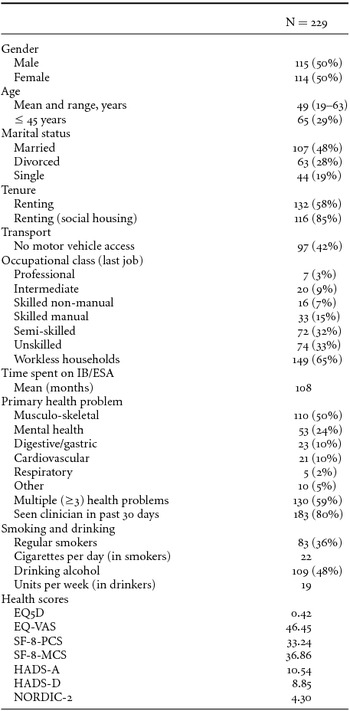
Table 1 shows the baseline and follow up data for the cohort. Demographically, the cohort was 50 per cent men and 50 per cent women, with a mean age of forty-nine years (range nineteen to sixty-three). Of the survey population, 48 per cent were married, 28 per cent divorced and 19 per cent single. In terms of socio-economic variables, renting was the most common form of housing tenure (58 per cent) with the majority of these (85 per cent) living in social housing. Forty-two per cent had no access to a vehicle compared to the regional average of 34 per cent and the national average of 25 per cent (ONS, 2010). The majority of participants previously worked in semi- (32 per cent) or un-skilled (33 per cent) jobs with only 3 per cent having a professional occupational background. Nearly two-thirds of participants lived in households in which no-one worked (65 per cent). The average time spent on IB for the 229 participants was 108 months – approximately nine years.
Baseline characteristics of survey participants

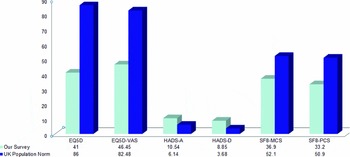
Musculoskeletal problems were the largest category of self-reported health problems with 50 per cent of participants identifying this as their primary health problem. Mental illness was the primary health issue for around a quarter (24 per cent). Other primary problems reported included: digestive/gastric issues (10 per cent), cardiovascular problems (10 per cent) and respiratory problems (2 per cent). Fifty-nine per cent of participants identified themselves as having multiple health problems (three or more). In terms of the validated health measures, the IB participants surveyed had a consistently lower state of health than the general population at baseline (see Figure 2). For EQ-5D, the survey group had a mean score of 0.42 compared to the UK population norm score of 0.86 (Kind et al., Reference Kind, Hardman and Macran1999). For EQ-5D-VAS, the group had a mean score of 46.45 compared to the UK population norm score of 82.48 (Kind et al., Reference Kind, Hardman and Macran1999). The mean HADS-A scores of the participants were 10.54 compared to a UK population norm of 6.14, and the mean HADS-D score was 8.85 compared to a UK population norm of 3.68 (Crawford et al., Reference Crawford, Henry, Crombie and Taylor2001). Those surveyed had a mean SF-8-MCS score of 36.86 compared to a UK population norm score of 52.1 (Gandek et al., Reference Gandek, Ware, Aaronson, Apolone, Bjorner, Brazier, Bullinger, Kaasa, Leplege, Prieto and Sullivan1998). In terms of the Nordic Musculoskeletal Questionnaires, participants had a mean Nordic 1 score of 5.2, a Nordic 2 score of 4.3 and a Nordic 3 score of 4.0.
Follow-up
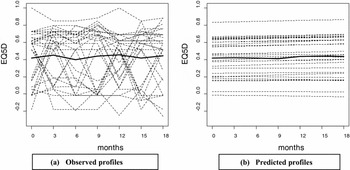
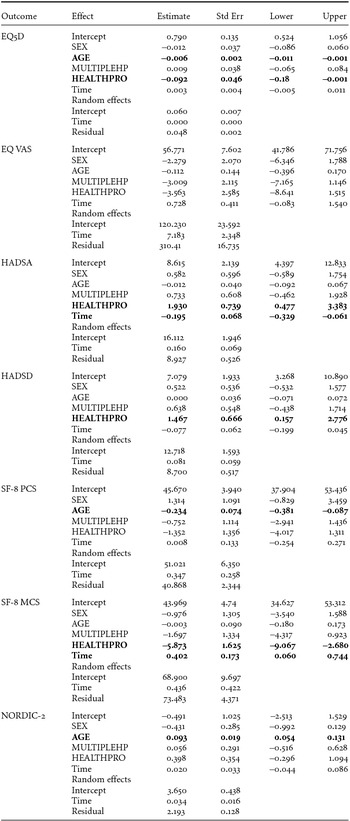
There were no changes in the distribution of primary health problems except for a notable rise in the reporting of multiple health problems (from 59 per cent at baseline to 67 per cent at follow up). The validated health measures (EQ-5D, EQ-VAS, HADS-D, NORDIC2 and SF-8-PCS) indicate that the health status of participants has also remained very static over the study period. Results from the analyses for the validated health outcomes are summarised in Table 2. Based on these health outcomes, there is no statistical evidence to suggest that the participants experienced changes in their health status over the period of the study. The average profile for HADS-A appeared to decrease over time from 10.54 at baseline to 8.94 at follow up (suggesting that anxiety levels dropped slightly between the time points) whilst the average profile for SF-8-MCS increased over time (also suggesting a slight improvement in mental health). At the individual level, the differences in health outcomes between the participants were mostly influenced by their baseline values with less than 2 per cent of the total variability at the individual level attributable to changes over time. Figure 1 shows the observed and the predicted profile for an example outcome, EQ-5D. The observed individual profiles (for thirty participants) show non-systematic change over time, with average profile over time almost constant. The predicted profiles from the model reflect the patterns in the data, with smoothed individual profiles of the participants indicating that most variability between the participants is at the baseline. The EQ-5D score for the participants remained more or less the same over the entire period of the study.
Validated health measures at baseline: survey participants compared to uk population norms

Individual (broken lines) and average (solid line) observed profiles for EQ5D*
Note: *Individual profiles for thirty participants are shown in the plots.

Parameter estimates, standard errors, asymptotic confidence intervals for the health outcomes (p ≤ 5% in bold).

The study is subject to some limitations. The study participants were volunteers and represent only a small proportion of the IB population. The study was undertaken in the North East of England and so it cannot be assumed that the findings can be generalised to the whole UK IB population. The health outcomes, although based on validated scales, were all self-reported and are so limited in the same ways as all self-reported health data; however, self-reported health does have a strong relationship with subsequent mortality at both the individual and population level (Norman and Bambra, Reference Norman and Bambra2007). The final response rate of the survey after eighteen months was 36 per cent, and whilst this is not ideal, it is still above average for a telephone survey with a vulnerable and hard to reach group. It should also be noted that participants were originally asked to sign up for a batch of three follow ups (baseline, three, six and nine months after baseline) and then re-sign for a further batch of three. It was at the re-sign-up stage (twelve months post baseline) that the highest dropout occurred. The statistical analysis though looks at trends across the whole time point, not just baseline and follows up.
Qualitative results
The quantitative data found little or no change in health status over an eighteen-month period as measured using validated health outcomes. Health at baseline was worse than the national average and continued to be poor throughout the study period. However, the quantitative data are unable to capture how this ill health developed, or what it means to experience life as a long-term IB recipient. The following section presents the results from the qualitative analysis of twenty-five in-depth semi-structured interviews with long-term IB recipients. The findings are categorised into two sections centred on the illness experience: first, life before IB and the onset of ill health and, secondly, the lived reality of being out of work due to ill health and a long-term IB recipient in a climate of ongoing change and uncertainty. In contributing to a better understanding of the experiences and circumstances of the ESA population, this might help to challenge the stigma and misconceptualisation that surrounds this group.
Life before Incapacity
This section will focus upon participants’ health trajectories, showing that the onset of health conditions could occur at different stages in the life course: before entering the labour market; gradually, usually whilst working; or suddenly, usually whilst in work. What is evident is that participants experienced the trajectory in different ways – for some, leaving the labour market to begin claiming IB was a welcome relief, whilst for others it evoked feelings of shame, guilt and isolation. The most commonly reported scenario was that health problems ‘crept’ into people's lives gradually. Whilst some attributed this to the effects of their particular form of work, for others conditions such as arthritis, musculoskeletal problems and mental health issues began to build up, which finally resulted in them having to exit the labour market and begin receiving IB. Leaving the labour market due to health problems that set in gradually was a common theme for many interviewees. Terry had been a salesman, a crane driver and a factory worker before he began receiving IB. His condition is exacerbated by stress, and for him ‘jobs equal stress’, so he views working as having a negative impact upon his health. He was diagnosed with bipolar disorder ten years ago, but has suffered with the symptoms since his teens though the condition remained undiagnosed:
Oh it was horrible I got no treatment, the only thing I got was people didn't want to see much of me (laughs). I went to see the doctor and this time my wife had kept a diary of what was going on and the doctor had a look at it and prescribed bipolar disorder and gave me Lithium and anti-psychotic medication. I also take an anti-depressant as well and I’ve never looked back, that cured me – well I’d say so, y’know? See when I had a diagnosis my life changed for the better, when I wasn't diagnosed it was terrible y’know. It just shows you how you can slip through the system.
A number of people interviewed had experienced accidents at work which led to a sudden health problem or a worsening of an existing problem that had previously been manageable. Kirsty, thirty-three, was a prison officer for ten years until a chance accident at work – a heavy door fell on her neck in her workplace of a young offender's institution. Kirsty said of the accident:
(Laughs) Of all the things that can happen in a prison, a door fell off and hit me on the head. I pushed it open and the top hinge failed. It swivelled on the bottom hinge and fell onto me and I took the full weight on my head and it snapped my neck back and that's what caused the damage to my spine. It's a bit ironic of all the brave things that could happen to me in a prison – a door fell on my head.
Linda, fifty-four, who had worked in factories all of her life until she had to leave due to health problems which were exacerbated by an accident at work, said:
I trapped me hand in a machine and rove me shoulder so that place has a lot to do with what's wrong with me I reckon. I can't blame me hip on that apart from the fact I was on me feet all day but me hands certainly, it was all that stapling.
Clearly, working in often physically demanding jobs could lead to a worsening of existing health problems or the onset of new ones, whether that derives from an accident or the nature of the job itself, as was the case for Linda.
Lived reality of IB receipt
An overarching theme that emerged from the narrative interviews was one of a life ‘before illness’ and a life ‘after illness’. Many described a daily routine filled with feeling guilt, boredom, restlessness and frustration at not being able to do the things they used to be able to do. Angie, fifty, was involved in a car accident just after New Year's Day which left her with physical and mental health issues. Describing the period of time following the accident, Angie says:
Before the accident I had a really good life, I had the two lasses, me mam was there, y’know just I loved to work. I worked in the doctors. We were all friends; I had meals out, things like that. You lose everything – you lose your friends, you lose your job which I loved me job, I love people, working with people, and I just loved it all, I really did.
Certain ‘critical incidents’ can occur that can cause a person to question who they are or ‘force a person to recognise that “I’m not the same as I was, or I used to be”’ (Strauss, Reference Strauss1969: 93). As Charmaz (Reference Charmaz1991: 49) found, people who live with chronic illness experience fluctuation in their health problems – they have good days and bad days, and good days and bad days ‘reveal images of self’. On a bad day, when symptoms are more intrusive, people are more aware of changes in themselves and begin to feel that they have less control, which can negatively affect their personal competence and overall sense of self. On a good day, when they have more control, they are apt to feel more like their usual selves. Kirsty describes how she would negotiate her daily tasks on a ‘bad day’:
I used to have neighbour's coming in checking on me, making me a cup of tea and it's mortifying, it's really hard to deal with. I used to get really angry and frustrated about it and not want any help at all so I used to just stay upstairs with a bottle of water and ready-made kind of . . . like a few packets of crisps and a sandwich and that would just tide me over during the day until he (her ex-partner) was home. I just used to live upstairs when I was having bad days.
Additionally, others narrated stories of extreme suffering and pain. When asked to describe living on IB, Shaun, fifty-four, who, at the age of thirty-one, had an accident at the building site he was working on that left him with broken vertebrae in his back, says:
I had another partner she was lovely but I had to break that up cos I was holding her back. I’ve been on me own for three years, yeah I’m bored and I’m lonely but I’m scared. I’m scared of falling out the shower, I’ve got scars all over where I’ve done that. Because of this I’ve lost me home, me family, me business, I lost the ability to be a bricklayer . . . and here's me now, years later on me own, too scared to have a shower.
For some people who were already dealing with juggling work and chronic illness, leaving work was viewed as a positive step. For Jacqui, fifty, initially the departure from work as a result of back problems to begin receiving IB was somewhat of a relief:
In the beginning for me health I was quite grateful [that she had left work] but now it's just monotonous isn't it, every day is the same. I get up and take me tablets and that's my life and that's not my way, I am very independent so I’ve never really took to it. Like some people might be like ‘I’m on it and that's it’ but I can't settle.
In direct contrast to much media and political opinion, for the majority of people in this study, being on IB was certainly not a lifestyle choice. Poverty and insecurity was a harsh and unavoidable reality for some, particularly in the case of people who were living alone and managing on IB as their sole income. Ray, fifty-three, lives alone and suffers from mental and physical health problems together with alcohol addiction, says:
Being on Incapacity, you can't afford little luxuries anymore. I used to like having steak for me tea, I can't afford that now so it might be beans on toast or something like that. When you’re working you can treat yourself to things like that, but now it's just getting by, day to day.
Kevin and Jennifer, both fifty-six, were a married couple who together depend on IB for their joint income. Jennifer, Kevin's wife, says:
That's why they’ve got us that (mobility scooter) cos it's not doing his health any good but I mean me son and his wife have been really good, but I don't want to be a burden to them. But I need to have something to do otherwise I’d go crazy, so I do a bit of light dusting. I mean it kills us cos I’m in this house 24/7 and it's because I suffer with panic attacks as well. Terrible. If I go somewhere and it gets packed, he has to get me out, so if we go down the town, it's early on a morning. But yeah I deal with a lot, but we just get on with it don't we. Some days I go upstairs and have a good cry cos I’m that frustrated at not being able to do what I used to do.
These extracts together illustrate the context in which current ‘reforms’ are shifting the goalposts for sick and disabled people by compounding the life-limiting consequences of incapacity with a regime that can potentially aggravate their stigmatisation, shame and isolation.
Discussion
Overall, the results indicate that the level of ill health remains fairly static across the eighteen-month time period studied: the health of IB participants was significantly lower and remained significantly lower than the national average over the entire study period. There were two exceptions – a small decrease in anxiety scores (as measured using HADS-A) and a small improvement in mental health (as measured using the SF-8-MCS). These improvements may be a result of participation in the survey itself (the so-called ‘placebo’ effect) or because participants felt increasingly comfortable about discussing their health issues with the research team. It should be noted that even with these slight improvements, the health of the IB recipients remained well below the national population norms: they remained significantly sicker than the general population. The qualitative research findings reinforce the stability and constancy of ill health for IB recipients, with life in receipt of IB meaning that ‘every day is the same’. Many interviewees described a daily routine filled with feeling guilt, boredom and frustration at not being able to do the things they used to be able to do as a result of their limiting conditions. The onset of illness and IB receipt was experienced in different ways – for some leaving the labour market to begin claiming IB was a welcome relief, whilst for others it evoked feelings of shame, guilt and isolation. The qualitative research has also demonstrated the poverty and isolation experienced by IB recipients, in addition to their ill health.
The study findings have a number of important implications for social policy. First, there is a clear need, as has been argued elsewhere, for a ‘health-first’ approach to the re-integration of the IB population. Previous welfare-to-work policies in the UK for those in receipt of IB have focused almost exclusively on improved employability (Bambra, Reference Bambra2008, Reference Bambra2011). There has been little attention paid to the (ill) health needs of this group, who, as the study data presented here clearly shows, are workless in the first place, and continue to be so, as a result of ill health. Such approaches were recommended by the National Institute for Health and Clinical Excellence (NICE, 2009) whose guidance on ‘managing long-term sickness absence and incapacity for work’ recommended that integrated programmes which combine traditional vocational training approaches, financial support and health management on an ongoing case management basis should be commissioned to help IB recipients enter or return to work. One example of a national service with more of an emphasis on addressing health prior to employment was the Condition Management Programme provided by Primary Health Care Trusts and Jobcentre Plus as part of the Pathways to Work programme before its withdrawal in 2010. An example of a ‘health-first’ case management intervention is analysed elsewhere (Warren et al., Reference Warren, Bambra, Kasim, Garthwaite, Mason and Booth2013). Such an approach would complement existing strategies to address labour demand; something that is particularly important in localities such as the North East of England.
Secondly, the results of this study show that the health of long-term IB recipients is well below the national average and that it is long-term and unchanging in nature. This conflicts with the widespread media accusations of fraud on the part of IB recipients. It is also in keeping with official figures from the Department for Work and Pensions (DWP) which suggests that fraud levels are, in fact, very low. The figures from the DWP show that the fraud rate for IB is just 0.5 per cent, with the figures for official error higher than the level of fraud at 1.7 per cent (DWP, 2011). Clearly, that people have long-standing, unchanging ill health should not be in question. The reframing of what constitutes capacity or incapacity for work calls into question whether claimants are therefore incapable of any work or work-related activity. Although being assessed as having partial capacity for work does not necessarily equate to being told that your illness is ‘fake’, government rhetoric and ensuing media coverage has led sickness benefits recipients placed in this position to perceive the latter message – a message which is having important impacts on the daily lives of long-term sickness benefits recipients by generating feelings of shame, stigma and isolation. What is going on can be best understood as a ‘shifting of the goalposts’; a process that is nothing new and can be seen as the latest reconfiguration of who the state deems capable of work and who it deems worthy of welfare. As Warren (Reference Warren, Roulstone and Barnes2005) argues, the British story of citizenship is one ‘within which being in employment and being a legitimate citizen are densely intertwined’ (Warren, Reference Warren, Roulstone and Barnes2005: 301). This tradition is typified by the proposition that ‘work is better than welfare’ and has been in existence from the early nineteenth century with the 1834 Poor Law until the present day. This narrative equates work with wage labour, and it periodically recasts those who it deems to be employable (Warren, Reference Warren, Roulstone and Barnes2005: 301).
Thirdly, it can also be argued that the recent changes place greater emphasis upon the shifting interpretations of work readiness for sick and disabled people, placing paid employment at the forefront of discussions rather than considering the multiple barriers sick and disabled people can face. Instead, perhaps what is then needed is an approach that considers the often disrupted and chaotic lives of sick and disabled benefits recipients – an idea which Dean (Reference Dean2003) terms the ‘life-first’ approach. Following an empirical investigation in the UK into the labour market experiences of people with multiple problems and needs, Dean (Reference Dean2003) suggested that policy makers – certainly in the UK – needed to re-think what is meant by the concept of ‘work-readiness’. Dean (Reference Dean2003: 456) argues that a ‘life first approach would prioritise the life needs of the individual above any obligation to work’. Dean (forthcoming) further argues that the ‘life-first’ approach should ‘be about work-to-welfare, not welfare-to-work’ and calls for a re-thinking of the meaning of both, thus redefining the responsibilities of both employers and the state. The findings of this study advocate that a combination of a ‘health-first’ approach together with a ‘life-first’ approach could allow for a greater understanding of the implications of the goalpost shifting that is currently impacting upon sick and disabled peoples’ lives.
Fourthly, the study results undermine media and politicians’ representations of IB recipients as ‘feckless benefit cheats’. The research in this paper was undertaken against a backdrop of increased suspicion, uncertainty and ongoing change for sickness benefits recipients in the UK (Garthwaite, Reference Garthwaite2011) and the findings presented here lend credence to findings from previous research relating to media portrayals of benefits recipients. McKendrick et al. (Reference McKendrick, Sinclair, Irwin, O’Donnell, Scott and Dobbie2008) note how within the media, recent decades have seen characteristic moral distinctions of the relative ‘deservingness’ of welfare users (Norris, Reference Norris1978). Alongside this, exaggerated concerns about fraud and ‘scrounging’ (Taylor-Gooby, Reference Taylor-Gooby1983, Reference Taylor-Gooby1985) and a belief that entitlement should be conditional on a work ethic (Deacon, Reference Deacon1978) have become increasingly popular. This has resulted in changes to out of work benefit receipt, including the introduction of ESA – as discussed earlier in this paper. Commentators such as Dean and Taylor-Gooby (Reference Dean and Taylor-Gooby1992) have attacked the ‘myth’ of a dependency culture. Their research in 1990, based on in-depth interviews with social security claimants, found that the vast majority of claimants wanted to work and there was no evidence of a dependency culture amongst claimants. Similar findings were found some twenty years later by Shildrick et al. (Reference Shildrick, MacDonald, Webster and Garthwaite2012) who demonstrated the resilience and lasting work commitment shown by their interviewees in a deprived area of Teesside, UK, despite the frustrations and setbacks associated with their repeated periods of unemployment and low-paid jobs.
Finally, the results of this study are an example of how the changing nature of administrative definitions and redefinitions of illness and capacity to work can impact upon the lives of sick and disabled people. As this study has demonstrated, such categories may bear little resemblance to actual health or ill health states (Stone, Reference Stone1986). For Finkelstein (Reference Finkelstein1980), this collusion of the state and medical professionals constituted what he termed an ‘administrative model’ of disability whereby disabled people were more closely administered to and controlled by the agencies of the state. The boundaries and definitions of able-bodiedness, sickness, fitness for work and the expectation of work have been renegotiated at various times and on differing terms set by the need of the state and those of capital. The introduction of ESA and ongoing welfare reform means that there is a risk of IB recipients’ administrative health status changing overnight, despite no actual change in their health state. For example, following a WCA, someone can be found ‘fit for work’ even though their health status has not altered, thus creating further obstacles for IB recipients to face, with all of the implications of a ‘deserving’ and ‘undeserving’ rhetoric that accompanies such a change. Equally, sickness benefits recipients may reject the label of ‘disabled’ and thus distance themselves from this term, posing further challenges when considering definitions of capacity and categories of sickness and disability. The results of the study presented in this paper show that the IB recipients have multiple health conditions, that their levels of ill health are stable over time, and that their health status is well below the general population level.
Conclusion
This paper has examined the health of long-term IB recipients in the North East of England, an area where levels of deprivation, ill health and health inequalities exceed that of any other English region. Adopting a longitudinal, mixed-methods approach has allowed for a statistical representation of the health of long-term IB recipients over an eighteen-month period to be combined with qualitative analysis of their lived experiences and illness narratives. Taken together, the two data sources show that those in long-term receipt of IB experience significant – and constant – ill health and other barriers to labour market participation, and that their lives are difficult and limited by both illness and the stigmatisation of benefit receipt. This is coupled with shifting interpretations of ‘work readiness’ that are being attached to benefits recipients; what constitutes ill health for benefit recipients – or at least ill health of a sufficient level to receive state support – is a constantly changing and politically determined state, which may bear no relation to the real health or lived experiences of recipients. Adopting a ‘health-first’, together with a ‘life-first’, approach could allow for a consideration of the intricacies of the experiences of sick and disabled benefits recipients.
Acknowledgements
We would like to thank all those who supported the project including Rebecca Maier for her help with ethical approval procedures, Jennifer Reynolds, Jacquelyn Briggs, Ladan Cockshut, Katie Ridley and Kerry Joyce for their help administering the project and carrying out telephone interviews. Most of all, thanks go to those who gave up their time to take part in the research and discuss personal and often distressing aspects of their lives.
This work was supported by County Durham and Darlington Primary Care Trust. All views are those of the authors and not necessarily those of the Trust.