While economic policy issues feature prominently in nearly all German election campaigns, the study of economic voting is not as developed in Germany as it is in other major democracies, such as the United States, Britain and France (Lewis-Beck and Stegmaier Reference Lewis-Beck and Stegmaier2000). A few early empirical studies of German elections point to the importance of the economy for electoral outcomes and government popularity (Fröchling Reference Fröchling1998; Feld and Kirchgässner Reference Feld and Kirchgässner2000; Rattinger and Faas Reference Rattinger and Faas2001), but scholars have recently begun devoting more attention to these relationships (Faas Reference Faas2010; Rattinger and Steinbrecher Reference Rattinger and Steinbrecher2011; Steinbrecher and Steiner Reference Steinbrecher and Steiner2011; Zohlnhöfer Reference Zohlnhöfer2011; Anderson and Hecht Reference Anderson and Hecht2012). One possible reason for the paucity of research in the past is that economic voting may be difficult to detect in Germany due to its parliamentary system and coalition governments. The typical way to study reward-punishment economic voting is to test whether voters support the government when times are good and punish it when times are bad. This approach works well with single-party governments, but what happens in coalition governments? Do voters reward or punish the entire coalition government, or do they target the party they deem most responsible for leading the economy?
In this article, we address this question by combining theories of voting behavior with theoretical approaches to coalition governance and cabinet decision making, while also taking policy-specific considerations into account. We advance two key arguments. First, economic voting should be conceptualized in a distinctive fashion when dealing with multiparty cabinets. Secondly, once we use this modified conceptualization, we should observe economic voting even in polities governed by multiparty coalitions. Our assumption is that voters are able to cognitively cope with the fact that several parties are responsible for adopting and implementing policies. In this regard, we expect voters to hold accountable the party that is leading the government or is in charge of the key cabinet offices responsible for economic and financial policy issues. We assess whether voters target parties based on their cabinet responsibilities or whether they reward the coalition government as a whole for positive economic performance.
We expect that the effects of economic voting remain significant for either the “ministerial discretion model” (Laver and Shepsle Reference Laver and Shepsle1996), the model that reflects “prime ministerial government” or the one that argues that voters hold all government parties accountable for the state of the economy (“collective cabinet decision making”)Footnote 1 after controlling for a battery of additional factors. Comparing these different voting models reveals to which party voters assign economic responsibility: the party of the cabinet member(s) in charge of economic policy, the party of the chancellor or all parties supporting the cabinet. The empirical results, which are based on data from German national election studies from 1987–2009, show that economic voting occurs in German parliamentary elections, and that it is targeted specifically toward the chancellor's party.
The article is structured as follows. First, we review the literature on economic voting and political decision making in coalition governments. We focus on theoretical approaches that emphasize the importance of portfolio allocation and ministerial discretion. On that basis, we develop hypotheses regarding the factors that might influence voting behavior in a political system characterized by governing in multiparty cabinets. Before presenting the results, we provide an overview of the data and methods used in our analysis. The final section concludes and discusses the implications of the findings for theories of voting behavior and coalition governance.
Economic Voting and Political Decision Making in German Governments
Economic policy represents a key area of policy making in modern democracies. Research has shown that economic policy making is determined by the political parties’ programmatic positions.Footnote 2 The relationship between economic policy outputs (that is, legislative decisions) and outcomes (effects) has been shown to depend on the respective institutional arrangements.Footnote 3 Comparative research has demonstrated a persistent link between retrospective economic evaluations and voting behavior (Lewis-Beck Reference Lewis-Beck1988; Anderson Reference Anderson1995, Reference Anderson2000; Armingeon and Giger Reference Armingeon and Giger2008; Giger and Nelson Reference Giger and Nelson2011).Footnote 4 Thus voters who hold positive evaluations of the national economy are more likely to vote for the incumbent than those who perceive national economic decline. However, the strength of this relationship varies according to political and institutional contexts. When it is clear which party is responsible for economic decisions, voters can easily reward or punish that party for the current economic conditions. However, when assigning responsibility is less clear, the impact of the economy on voting for or against the government is muted (Powell and Whitten Reference Powell and Whitten1993; Whitten and Palmer Reference Whitten and Palmer1999; Anderson Reference Anderson2000; Duch Reference Duch2007).
One key factor that affects the clarity of responsibility in parliamentary systems is the composition of the government. Lewis-Beck (Reference Lewis-Beck1986, Reference Lewis-Beck1988) found that economic voting was most evident in the United Kingdom,Footnote 5 where one party controlled parliament, and least evident in Italy, which had five parties in its 1983 governing coalition. Germany was located in between, with a coalition government of two parties: Christian Democrats and Liberals.
Since 1961, Germany has been governed by coalitions.Footnote 6 The combination of the parties in government changes, but in no election since then has a single party held a majority in parliament. As part of the government formation process, German parties draft long and detailed policy agreements.Footnote 7 Furthermore, Article 65 of the German Basic Law stresses the competence not only of the chancellor and the individual ministers in terms of political decision making, but also the cabinet as a whole, which can decide on political issues as a collective actor.Footnote 8 Therefore, voters might identify all government parties that agreed on a common policy program as the political actors responsible for the performance of the economy during a given legislative period. If this is the case, and based on the general reward-punishment economic voting theory in which the government is held accountable, we expect that German voters are more likely to vote for parties represented in the federal government if they have a positive perception of the country's overall economic performance. This leads to our first hypothesis:
HYPOTHESIS 1: Voters who hold positive assessments of national economic performance will be more likely to vote for parties represented in the federal government.
Since we also want to test whether a government party that controls a key position within the cabinet is held accountable by the voters for the performance of the economy, we differentiate between whether the prime minister, as the head of the cabinet, is held accountable or whether voters hold the party leading the key economics-related ministries responsible.
Prime Ministerial Government
Focusing on the coalition parties collectively as the focus of the economic vote might obscure more targeted economic voting. Building on Lewis-Beck's (Reference Lewis-Beck1986, Reference Lewis-Beck1988) results, which show different magnitudes in the economic vote across democracies, researchers have questioned whether the entire coalition should be the target of credit or blame—or if, in fact, voters are more savvy in identifying the most responsible party. Evidence suggests that voters often identify the largest party (or the prime minister's party) as the leading party within the coalition, and thus most in charge of decision making.Footnote 9
There are strong theoretical grounds for voters holding the prime minister's party accountable. The principal agent model—which plays a prominent role in analyzing the “chain of delegation” between voters, parties, parliaments and governments in modern democraciesFootnote 10—identifies the head of the cabinet (the prime minister or chancellor) and his or her party as the key “agent” held accountable for a country's economic record. While the constitutionally provided powers of the head of the cabinet vary across modern democracies, quantitative indices developed by Strøm, Müller and Bergman (Reference Strøm, Müller and Bergman2008) and O'Malley (Reference O'Malley2007) show that prime ministers in the United Kingdom and Germany have strong agenda-setting and cabinet decision-making powers, in contrast to weaker prime ministers in Austria, Belgium and the Netherlands.
These findings are consistent with qualitative analyses of cabinet decision making, which not only take institutional, constitutionally provided features into account, but also focus on contextual approaches and the historical development of decision-making patterns in the executive of a political system.Footnote 11 Furthermore, in the German case, Norpoth and Gschwend (Reference Norpoth and Gschwend2010) emphasize the strong position of the chancellor in the cabinet decision-making process and in formulating future policies.
Since the chancellor is the most visible member of the German government and has a strong institutional position in terms of deciding on future policies, we expect to find stronger evidence of economic voting targeted at the chancellor's party than other parties represented in the coalition government. We are also interested in how strongly the economic vote manifests itself for the chancellor's party relative to the other parties in the coalition. If voters target the chancellor's party, then we would expect to find the economic vote stronger for his/her party compared to other coalition members. These considerations culminate in the second hypothesis.
HYPOTHESIS 2a: Voters who hold positive assessments of national economic performance will be more likely to vote for the chancellor's party.
HYPOTHESIS 2b: Economic voting should be stronger for the chancellor's party compared to other coalition parties.
Ministerial Government and Ministerial Discretion
Within coalition governments, control over the various ministries is divided up through the coalition negotiation process. If voters understand specific party responsibilities within the coalition, then when it comes to the economic vote, perhaps they will hone in on the party in control of the economic ministries. In their well-known portfolio allocation model, Laver and Shepsle (Reference Laver and Shepsle1996) presume that coalition cabinets are based on ministerial discretion. Taking the assumptions of this model seriously, which can also be identified in several European constitutions, we expect voters to reward or punish not the party of the head of the cabinet, but rather the party in charge of the ministries that deal with economic issues for the state of the economy. On the basis of a qualitative analysis of election manifestos, Tosun (Reference Tosun2011) shows, for instance, that the economically liberal Free Democratic Party (FDP) had the most comprehensive marine policy agenda of all German parliamentary parties in the 1980s and 1990s, despite the fact that environmental policy is not a salient issue for the FDP (Benoit and Laver Reference Benoit and Laver2006; Bäck, Debus and Dumont Reference Bäck, Debus and Dumont2011). One reason was that the Liberals controlled the foreign ministry in German coalition governments, so the FDP may have paid more attention to marine pollution as they perceived it to be a crucial dimension of foreign policy (Tosun Reference Tosun2011, 540).
There are typically several cabinet portfolios that deal with economic issues, such as the ministry of finance, the ministry of economics, or the department of labor and social affairs. Multiple parties often control the portfolios in coalition cabinets that belong to a single broader policy area. In countries such as Austria, which has often been governed by so-called grand coalitions between both large parties, one party (such as the Social Democrats) has won control over the ministry of finance, while their coalition partner—the conservative People's Party—led the ministry of economics (see Müller Reference Müller2000). This way of distributing ministries between coalition parties not only implies that both coalition parties can influence the country's economic direction, but also that they can mutually control each other in what the different departments are doing in this policy area. On the basis of several cabinet position rankingsFootnote 12 and institutional provisions, such as the privilege of the German minister of finance to veto the budget, we can argue that the party that is in charge of the ministry of finance, as well as the chancellor's party, is held accountable for the government's economic record. We thus expect that the party that controls the ministry of finance (or the ministry of economics, which is the second-most important cabinet office in Germany in terms of economic policy) will benefit from a positive evaluation of the economy by the voters, so voters should be more likely to vote for the party of the minister of finance if they perceive the economy to be doing well. Likewise, according to our considerations on “prime ministerial government”, we expect that if voters target the party of the minister who is mostly in charge of economic policy and performance, the economic vote is stronger for the party that controls the ministry of finance or economics compared to parties that control other cabinet posts in the coalition.
HYPOTHESIS 3a: Voters who positively assess national economic performance will be more likely to vote for the party that controls the ministry of finance or the ministry of economics.
HYPOTHESIS 3b: Economic voting should be stronger for the party that controls the ministry of finance or economics compared to other coalition parties.
The prime minister's party, as the strongest party in the coalition, will win control over the ministries deemed most important. However, under specific constellations of party competition, the other parties may make ministry demands during coalition negotiations that the dominant party must accept in order to finalize the agreement. In Germany, the chancellor's party—that is, either the Christian Democrats or the Social Democrats—has controlled the key economic ministries during most (but not all) the elections in our study. In 2005, when Christian Democrats (CDU/CSU) and Social Democrats (SPD) formed a “grand coalition” government, the Social Democrats controlled the ministry of finance, while the Christian Democrats received the position of the chancellor and the ministry of economics.Footnote 13 In the coalition governments between CDU/CSU and the Liberals, by contrast, the Christian Democrats, as the strongest party, won control over the position of the chancellor and the ministry of finance, while an FDP politician headed the ministry of economics. The grand coalition between the CDU/CSU and SPD offers an interesting scenario that allows us, in the 2009 election, to test whether it is the party that controls the ministry of finance (the SPD) or the party of the chancellor (the Christian Democrats) that benefits from a positive evaluation of the economy by the voters.Footnote 14
Data and Methods
To test whether voters hold the whole cabinet—and, thus, all parties that support a government—accountable for the country's economic performance, or whether only the governing parties that control the office of the chancellor or specific ministries benefit from perceived economic improvements, we use election studies for six Bundestag elections: 1987, 1990, 1994, 1998, 2002 and 2009.Footnote 15 To identify the factors that influence voting behavior and to measure the effect of the perception of the economic performance on the likelihood that voters will vote for (one of) the parties in government, we apply conditional logistic regression models (McFadden Reference McFadden1974) that have been widely used to analyze government formation (Martin and Stevenson Reference Martin and Stevenson2001; Bäck Reference Bäck2003), portfolio allocation (Bäck, Debus and Dumont Reference Bäck, Debus and Dumont2011) and voting behavior (Alvarez and Nagler Reference Alvarez and Nagler1998; Thurner Reference Thurner2000; Dow and Endersby Reference Dow and Endersby2004; Adams, Merrill and Grodman Reference Adams, Merrill and Grofman2005). This approach models the decision-making process of (political) actors as an unordered discrete choice problem where (in our case) each party represents one case in which the set of discrete alternatives is the set of all parties from which a voter could choose. The set of discrete alternatives consists of up to five parties that were regarded as being most likely to win parliamentary representation, according to the framework of the election surveys.Footnote 16
The dependent variable in our analysis provides information on the voters’ choice.Footnote 17 A voter can choose one alternative only—a political party in our case. The party that the respondent intends to vote for is coded 1 in the dependent variable, whereas all others are coded 0. Each alternative is described with specific characteristics that reflect different theories of voting behavior. Our main explanatory variable—the economic situation as perceived by the voters—is coded 1 if a voter considers the economy to be in good shape and 0 otherwise. Since we argue that only the parties that form the current government or parties that control specific cabinet posts should benefit from a positive evaluation of the economy, parties from the parliamentary opposition are always coded 0. To test whether only the chancellor's party increases its chances of a vote by respondents if they evaluate the economy positively, we assign a score of 1 on the economic voting variable only to the party of the chancellor, while the opposition parties and the other coalition party receive a value of 0. If we apply the ministerial government model, by contrast, we argue that only the party that controls the ministry of finance or the ministry of economics benefits from a perceived better condition of the economy, so we assign a 1 only to the minister's party, while all other parties are coded 0.
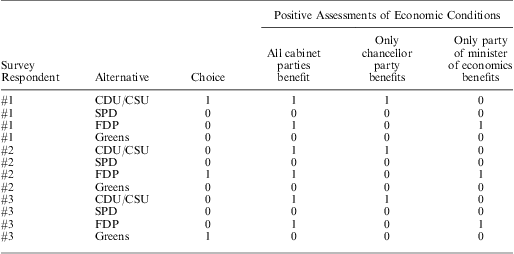
Table 1 clarifies the coding of the economic assessment variable and the structure of the dataset using an example from the 1987 election, when the federal government was formed between the CDU/CSU and the FDP. While the chancellor and the minister of finance belonged to the Christian Democrats, the Liberals (FDP) controlled the ministry of economics. Voter #1 intends to vote for the Christian Democrats, while Voter #2 indicates a vote for the Liberals. Voter #3 plans, however, to vote for the Green Party. All three voters have a positive perception of Germany's recent economic performance. According to our theoretical considerations, the parties in government should benefit from positive economic evaluations. The voting behavior of voter #3 is thus not in line with our theoretical considerations, since this voter intends to vote for an opposition party. The behavior of Voter #1 is, however, consistent with the argument that voters hold the chancellor's party accountable for the country's economic performance. In the case of Germany in 1987, choosing the Christian Democrats would support the ideal type of “prime ministerial government”, since CDU/CSU controlled the chancellor post, but would also give support to the “ministerial discretion” approach, because the Christian Democrats also placed one of their politicians at the top of the ministry of finance. The small Liberal partner, which controlled the ministry of economics in the coalition cabinet that was in office from 1983 until 1987, would, however, not benefit from the first voter's positive perception of the economy. Meanwhile, Voter #2 has a positive assessment of economic conditions and wants to vote for the Liberals.
Structure of the Dataset and Coding of the Economic Voting Variable for the 1987 Bundestag Election
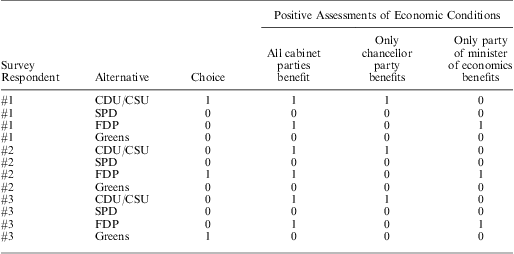
Note: the incumbent government consisted of CDU/CSU and FDP. The Christian Democrats controlled the office of the chancellor and the ministry of finance, while the ministry of economics was occupied by a member of the FDP.
On the basis of the estimated coefficients, we can test whether economic voting exists in Germany, as well as which institutional actor—all coalition parties, only the chancellor's party or only the one that controls ministries related to economic policy—are held accountable. If we assume that all government parties will be held accountable for a perceived positive economic situation, then—in the example from the 1987 election in Table 1—the chances should increase that a voter chooses either CDU/CSU or FDP since they are the incumbent cabinet parties. We should therefore see a positive and statistically significant coefficient for the economic assessment variable if we model it so that collective cabinet decision making exists. If, by contrast, voters held the chancellor and his/her party accountable, then the effect of the economic assessment variable should be positive and significant only if we assign a value of 1 to the Christian Democrats; if voters consider the FDP (and, thus, the small coalition partner of CDU/CSU that controlled the ministry of economics) as the government party accountable for the country's perceived positive economic development, then the estimated coefficient for the economic variable should be statistically significant with a positive sign if we assign a score of 1 to the Liberal Party only.
Voting behavior is, of course, not only determined by assessments of the national economy. The well-established “Michigan school” model, summarized by the “funnel of causality” (Campbell et al. Reference Campbell, Converse, Miller and Stokes1960; Lewis-Beck et al. Reference Lewis-Beck, Jacoby, Norpoth and Weisberg2008), in addition to valence issues and candidate preferences of voters, also includes the interests of voters that result from their position in a country's social structure.Footnote 18 Furthermore, Campbell et al. (Reference Campbell, Converse, Miller and Stokes1960) developed the concept of “party identification”, which argues that voters develop a close attachment to a political party that should not change significantly over time.Footnote 19 Additionally, spatial models of voting behavior that are based on Downs’ (Reference Downs1957; Adams, Merrill and Grofman Reference Adams, Merrill and Grofman2005) seminal study highlight the role of ideological distances between parties, their candidates and voters.
Based on this vast body of literature, we include four explanatory variables in our models: the preference for a chancellor candidate, a party's perceived problem-solving capacity (as a proxy for the valence issue concept developed by Stokes (Reference Stokes1963)), the ideological distance between a voter and the parties, and the attachment of a voter to a social group that has a special relationship to a political party.Footnote 20 In doing so, we generated a dummy variable that takes a value of 1 if a party represents the interests of the social group to which the voter belongs on the basis of the Lipset and Rokkan (Reference Lipset and Rokkan1967) cleavage approach. We take into account the following relationships between social groups and parties: (1) voters who regularly attend church, which should have a close attachment to the Christian Democrats and (2) trade union members, who are traditional supporters of the Social Democrats.Footnote 21 If, for instance, voters belong to a labor union, then they should be more likely to vote for the Social Democrats since they are traditionally the “ally” of labor unions and represent the interests of their members. Furthermore, we include a variable that provides information on the voters’ preference for chancellor. Voters who prefer the CDU/CSU candidate as the next chancellor should be more likely to vote for the Christian Democrats and their coalition partner, if the respective parties formed a pre-electoral pact during the election campaign.Footnote 22 We also incorporate a variable that informs us which party a voter thinks is more able to solve the problem (s)he perceives as the most important one. This problem may or may not be related to economic issues. If voters name a party that is, in their view, able to solve the most salient problem, then they should be more likely to vote for this party. Finally, we include the ideological distance between voters and parties in the regression models by referring to the squared distance between the left-right self-placement of a voter and the parties’ positions as perceived by the voters.Footnote 23 The next section presents the findings of our analysis and evaluates our main hypotheses.
Results
In order to test our expectations, we present several conditional logistic regression analyses separately for each of the covered election studies. For each election, we differentiate between three models for which the coding of the economic voting variable changes. While in Model 1 the economic assessment variable is coded so that all government parties should benefit from positive economic evaluations, in the remaining models we coded the economic variable so that only the government party that controls specific cabinet offices—the chancellor, the minister of finance or the minister of economics—should be more likely to be chosen by the voters if the respective respondents indicate that the economy has improved.
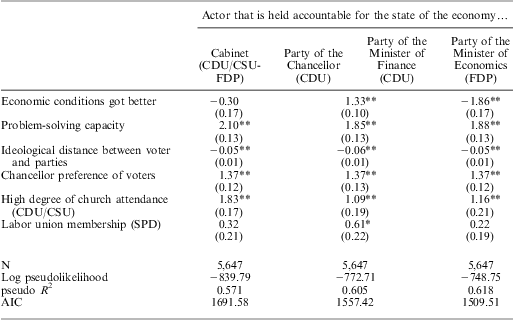
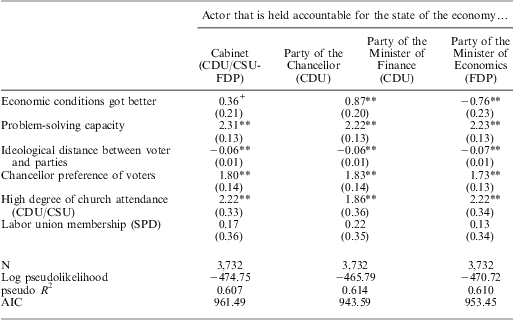
Table 2 presents the results of our analysis for the 1987 Bundestag election. We see that voting behavior was mainly influenced by the voters’ perception of the parties’ problem-solving capacity—that is, voters are more likely to choose a political party if they think it can best solve the most important problem facing the country. Furthermore, the ideological distance between voters and parties, and the preference of voters for the chancellor candidates, influenced the vote. In addition, we find that a high degree of church attendance positively affects the chances that voters select the CDU and CSU, while there is—at least in the 1987 election—no empirical evidence that labor union membership positively affects the chances of voting for the Social Democrats. If we code the economic assessment variable so that all government parties (CDU/CSU and FDP) should benefit from a positive economic perception, we do not find evidence of economic voting. If, by contrast, we code the economic assessment variable so that only CDU/CSU—as the party that controls the ministry of finance and the position of the chancellor—should benefit, then it reaches standard levels of statistical significance and has the expected positive effect, meaning that voters are more likely to vote for the Christian Democrats if they think the economy is in good shape. The FDP (the smaller coalition partner, which was in charge of the ministry of economics) does not benefit from a positive view of the economy: the chances that voters choose the Liberals significantly decrease if they have a positive evaluation of the German economic situation. In the 1987 election, then, we find support that only the larger coalition partner (CDU/CSU) benefited from a positive evaluation of the economy, while the FDP (as the smaller government party) did not.
Determinants of Voting Behavior in the 1987 Bundestag Election

Note: robust standard errors in parentheses. *p < 0.01, **p < 0.001. Estimates are based on a conditional logit model in which each case is a party that a voter can choose.
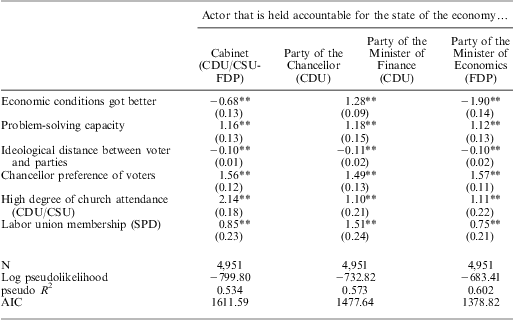
The results from 1990 confirm our findings from the 1987 analyses (see Table 3). While we can identify similar effects for the explanatory variables covering information on the ideological distance between parties and voters, the parties’ problem-solving capacities as perceived by the voters, chancellor preference and social group membership, we find that in 1990 the cabinet as a whole did not benefit at all from a positive evaluation of the economy by the voters. When differentiating between the two coalition parties, it becomes clear that voters were more likely to vote for the Christian Democrats if they had a positive view of the economy, and thus gave the party that held the chancellorship and the ministry of finance credit for the perceived economic improvement. Similar to 1987, it seems that the smaller party in the coalition government, the FDP, did not reap any rewards from a positive evaluation of the economy, despite controlling the ministry of economics.
Determinants of Voting Behavior in the 1990 Bundestag Election
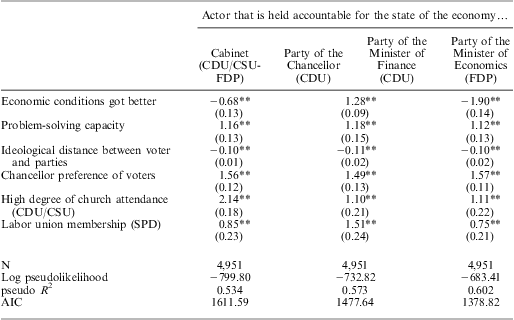
Note: robust standard errors in parentheses. *p < 0.01, **p < 0.001. Estimates are based on a conditional logit model in which each case is a party that a voter can choose. The analysis includes respondents from West Germany only.
The 1994 and 1998 election analyses provide similar resultsFootnote 24 (see Tables 4 and 5). We find that voters are significantly more likely to vote for the larger incumbent party—the Christian Democrats—if they hold favorable views of the current economic situation, while the chances decrease that voters prefer the smaller coalition party if they perceive positive economic conditions. Further, for our other variables that should also theoretically influence voting behavior, we find significant effects in the expected directions (positive effects for chancellor preference, problem-solving capacity and social group membership, and negative effects for the ideological distance between voters and parties). To sum up, only the larger coalition party, which controlled the office of the chancellor and the ministry of finance, appears to benefit from positive economic assessments, at least from 1987–98, when the incumbent cabinets were formed between the Christian Democrats and the smaller FDP. The FDP did not benefit from a positive evaluation of the economy, so controlling the cabinet portfolio of economics does not lead voters to choose that party if it is the smaller coalition partner.
Determinants of Voting Behavior in the 1994 Bundestag Election
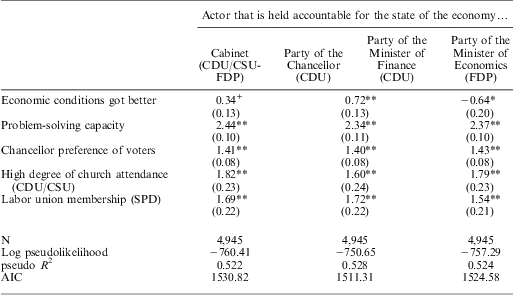
Note: robust standard errors in parentheses. +p < 0.05, *p < 0.01, **p < 0.001. Estimates are based on a conditional logit model in which each case is a party that a voter can choose. The analysis includes respondents from West Germany only.
Determinants of Voting Behavior in the 1998 Bundestag Election
Note: robust standard errors in parentheses. +p < 0.05, **p < 0.001. Estimates are based on a conditional logit model in which each case is a party that a voter can choose. The analysis includes respondents from West Germany only.
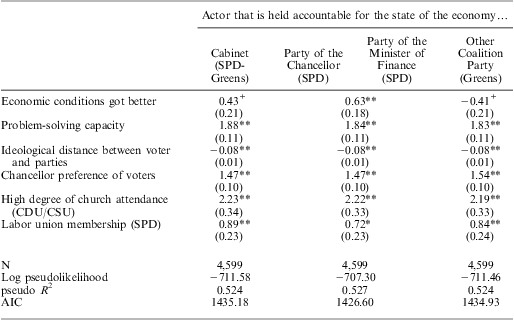
Do these patterns change in elections in which parties other than CDU/CSU and FDP formed the coalition government? The results presented in Table 6 of the 2002 election show patterns similar to the results presented in Tables 2 to 5. While voters with a positive assessment of the economy are more likely to vote for the coalition of the SPD and Greens rather than the opposition, the remaining models clarify that it is once more the strongest party in the coalition—that is, the Social Democrats of the then-acting Chancellor Gerhard Schröder—that benefits from a positive assessment of economic conditions.Footnote 25
Determinants of Voting Behavior in the 2002 Bundestag Election
Note: robust standard errors in parentheses. +p < 0.05, *p < 0.01, **p < 0.001. Estimates are based on a conditional logit model in which each case is a party that a voter can choose. The analysis includes respondents from West Germany only.
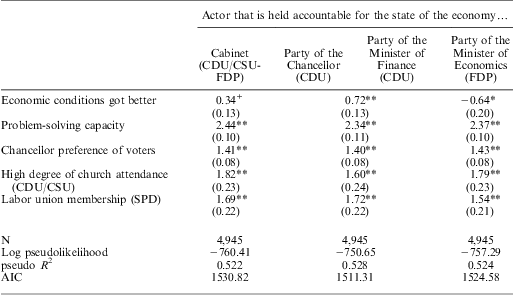
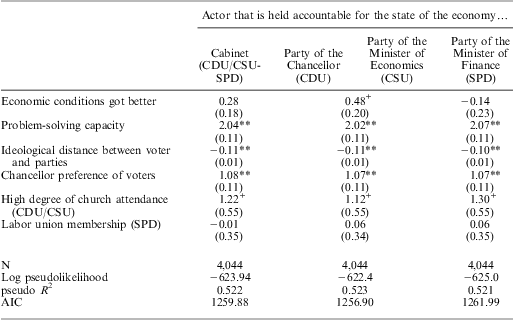
The 2009 election and the behavior of voters in the context of the incumbent grand coalition between both large parties (CDU/CSU and SPD) represent an excellent test of our hypotheses.Footnote 26 Not only were both parties almost equally strong, according to the 2005 election result, but two key cabinet posts were captured by the two coalition parties. While Chancellor Angela Merkel is a member of the Christian Democrats, the Social Democrats controlled the very important ministry of finance from 2005 until 2009. The minister of economics does, however, belong to the CSU. We thus can identify whether the partisan affiliation of the chancellor or the minister of finance makes a difference in terms of economic voting. As the results presented in Table 7 show, voters are more likely to choose the Christian Democrats (and, thus, the chancellor's party) if they evaluate the economic situation positively, whereas the Social Democrats, the nearly equally strong coalition partner of CDU/CSU that controlled the ministry of finance, did not benefit from a positive perception of the economy. This finding, which was derived from the 2009 German national election study,Footnote 27 demonstrates that the chancellor's party is more likely than the minister of finance's party to be chosen by the voters if they perceive the economy to be performing well.
Determinants of Voting Behavior in the 2009 Bundestag Election
Note: robust standard errors in parentheses. +p < 0.05, **p < 0.001. Estimates are based on a conditional logit model in which each case is a party that a voter can choose. The analysis includes respondents from West Germany only.
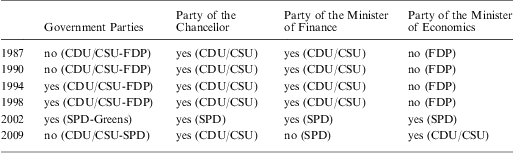
What do these findings imply for our expectations that were derived from theories on cabinet decision making? Table 8 summarizes our findings across the six elections covered in our study. In all six elections, under different coalition configurations and economic ministry assignments, the chancellor's party is rewarded by voters who perceive improvement in the national economy. This provides clear and consistent support for our “prime ministerial hypothesis”.
Overview of the Findings and Evaluation of the Hypotheses
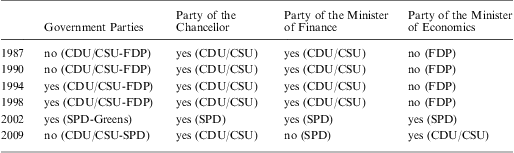
Note: “yes” implies that the effect of the variable that reflects economic voting (that is, economic conditions got better) has a statistically significant and positive effect on the likelihood that a voter will choose the respective party/parties. “No” means that there is no positive and statistically significant effect.
The other hypotheses—which argue that the coalition parties should collectively benefit from positive economic perceptions (Hypothesis 1) or that the party controlling the finance and/or economic ministries should benefit (Hypothesis 3)—hold in some elections, but not in all. In the party controlling the ministry models, the expected effect occurs when the party holding the ministry is the same as the chancellor's party. The FDP never benefits from positive economic evaluations (as it has not held the chancellorship), and under the grand coalition, only the CDU/CSU was rewarded, while the SPD, which controlled the ministry of finance, was not credited by voters for economic improvement.
Conclusion
In testing how voters assign credit or blame to coalition governments for economic conditions, we have affirmed previous findings that the chancellor's party (that is, the strongest party within a coalition government) is the primary target of reward when voters perceive national economic improvement. In the 1987, 1990 and 2009 elections, had we looked only at the impact of the economic evaluations on the coalition as a whole, we would have concluded that perceptions of economic improvement either have no effect or a negative effect on votes for the government. These null findings for the coalition as a whole mask important differences in the assignment of economic credit. We observed in these elections that the chancellor's party is rewarded by those who believe the economy has improved, at the expense of the junior coalition members. Further, based on the 2009 election survey, there is no evidence that the party that controls the ministry of finance benefits from positive economic evaluations. Additionally, we do not find support for the idea that the party controlling the ministry of economics benefits. This is surprising, given that economic issues are the core policy area for the FDP, which controlled the ministry of economics in four of the six cases under consideration.
Overall, the results demonstrate the importance of assessing the impact of the economy on support for specific parties rather than for the governing coalition as a whole. Voters recognize that parties play different roles within a governing coalition, but the dominant chancellor's party is the clear target of credit among voters who perceive improved economic conditions. This finding relates to other empirical research showing that in multiparty systems, the largest party in the governing coalition is the primary target of economic voting.Footnote 28 That being said, since in the German case the chancellor invariably comes from the largest party in the coalition, the chancellor effect found by this study can be seen as a special case of the dominant-party effect.
These findings provide motivation for further studies. For one, it appears seminal to explore the German case in an even more detailed fashion by linking this analysis to studies of chancellor or government popularity (Goergen and Norpoth Reference Goergen and Norpoth1991; Geys and Vermeir Reference Geys and Vermeir2008). Another avenue for future research that concentrates on the German case is to differentiate between the individual components of economic policy outcomes such as unemployment, inflation or economic growth. Goergen and Norpoth (Reference Goergen and Norpoth1991), for example, showed that government popularity reacts more sharply to unemployment than to inflation. Consequently, it could be insightful to disaggregate the compound variable “economic performance” to see which dimensions are important for explaining electoral outcomes.
Further nuances in economic voting under coalition governments might be illuminated by creating a comparative research design by selecting countries where the institutional structure of cabinet decision making (and thus, the important role of the prime minister or chancellor in election campaigns) varies.Footnote 29 Because the chancellor plays an important role for cabinet decision making in Germany, it is understandable that voters reward the chancellor's party if the economy is in good shape. However, in countries like Austria, the Netherlands or Iceland, where the head of the cabinet has lesser institutional competencies, the effect of rewarding the prime minister's party, relative to other coalition partners, might disappear.