Introduction
Tobacco is the world's leading cause of preventable morbidity and mortality (2012) and promoting cessation is one of the most effective measures to improve population's health. In Argentina, a middle income Latin American country, the prevalence of tobacco use has decreased by about 50% in the past 10 years from 37% in 2004 (Secretarıa de Programacion para la Prevencion de la Drogadiccion y la Lucha contra el Narcotrafico, 2004) to 22.1% in 2012 (Ministerio de Salud de la Nacion, 2012) presumably as a consequence of the tobacco control policies implemented. Nevertheless, smoking prevalence and per capita consumption are high, tobacco use results in 40,000 annual deaths, and treatment of tobacco-related diseases accounts for 12% of the total health economic burden (Pichon-Riviere et al., (Mayo Reference Pichon-Riviere, Alcaraz, Bardach, Augustovski, Caporale and Francisco2013)). Physicians have an important potential role in the implementation of smoking cessation interventions even though the prevalence of tobacco use among physicians and medical students in Argentina has been similar to that of the general population in previous surveys (Gigliotti et al., Reference Gigliotti, Ferrero, Castanos, Blengini, Duran and Moreno2013; Mejia, Martinez, Gregorich, & Perez-Stable, Reference Mejia, Martinez, Gregorich and Perez-Stable2010; Tambussi, Schoj, Perel, Zabert, & Ortiz, Reference Tambussi, Schoj, Perel, Zabert and Ortiz2003; G. Zabert, Chatkin, & Ponciano-Rodriguez, Reference Zabert, Chatkin and Ponciano-Rodriguez2010; G Zabert & Verra, Reference Zabert and Verra2004; G Zabert, Videla, & Verra, Reference Zabert, Videla and Verra2005; Zylbersztejn et al., Reference Zylbersztejn, Cardone, Vainstein, Mulassi, Calderón and Blanco2007).
There is substantial evidence supporting the efficacy of different types of clinician implemented pharmacological and behavioural interventions (Cahill, Lancaster, & Green, Reference Cahill, Lancaster and Green2010; Cahill, Stead, & Lancaster, Reference Cahill, Stead and Lancaster2012; Hughes, Stead, & Lancaster, Reference Hughes, Stead, Hartmann-Boyce, Cahill and Lancaster2007; Lai, Cahill, Qin, & Tang, Reference Lai, Cahill, Qin and Tang2010; Lancaster & Stead, Reference Lancaster and Stead2004; Lemmens, Oenema, Knut, & Brug, Reference Lemmens, Oenema, Knut and Brug2008; Stead & Lancaster, Reference Stead and Lancaster2005; Stead, Perera, & Lancaster, Reference Stead, Perera and Lancaster2006; Stead et al., Reference Stead, Buitrago, Preciado, Sanchez, Hartmann-Boyce and Lancaster2013). Moreover, brief physician-implemented counselling interventions can increase the absolute rate of cessation by 1% to 3% (Alba, Murillo, & Castillo, Reference Alba, Murillo and Castillo2013; Stead et al., Reference Stead, Buitrago, Preciado, Sanchez, Hartmann-Boyce and Lancaster2013). However, despite the efforts to promote physician-led interventions for smoking cessation, few clinicians consistently implement them (Huang et al., Reference Huang, Guo, Yu, Feng, Song and Eriksen2013; Kruger et al., Reference Kruger, Shaw, Kahende and Frank2012; Lee et al., Reference Lee, Fleming, McCollister, Caban, Arheart and LeBlanc2007; Pipe, Sorensen, & Reid, Reference Pipe, Sorensen and Reid2009) particularly in Latin American countries (Gigliotti et al., Reference Gigliotti, Ferrero, Castanos, Blengini, Duran and Moreno2013; Juliao et al., Reference Juliao, Camargo, Citero Vde, Maranhao, Maluf Neto and Paes2013; Mejia et al., Reference Mejia, Martinez, Gregorich and Perez-Stable2010). Physicians have also reported lack of training to help their patients quit and limited time for counselling during clinic visits (Perez-Stable et al., Reference Perez-Stable, Juarez-Reyes, Kaplan, Fuentes-Afflick, Gildengorin and Millstein2001; Soto Mas et al., Reference Soto Mas, Papenfuss, Jacobson, Hsu, Urrutia-Rojas and Kane2005; Vogt, Hall, & Marteau, Reference Vogt, Hall and Marteau2005; Warren, Jones, & Chauvin, Reference Warren, Jones and Chauvin2008).
The main predictors of physician-implemented smoking cessation interventions were specific training (Huang et al., Reference Huang, Guo, Yu, Feng, Song and Eriksen2013; Sadowski, Ruffieux, & Cornuz, Reference Sadowski, Ruffieux and Cornuz2009; Soto Mas et al., Reference Soto Mas, Balcazar, Valderrama Alberola and Hsu2008) (Schnoll, Rukstalis, Wileyto, & Shields, Reference Schnoll, Rukstalis, Wileyto and Shields2006; Twardella & Brenner, Reference Twardella and Brenner2005; Zhou et al., Reference Zhou, Abdullah, Pun, Huang, Lu and Luo2010), clinician self-efficacy (Sadowski et al., Reference Sadowski, Ruffieux and Cornuz2009; Soto Mas et al., Reference Soto Mas, Balcazar, Valderrama Alberola and Hsu2008) (Schnoll et al., Reference Schnoll, Rukstalis, Wileyto and Shields2006), and younger physician age (Schnoll et al., Reference Schnoll, Rukstalis, Wileyto and Shields2006). Physician smoking status was a negative predictor of cessation success in several studies (Huang et al., Reference Huang, Guo, Yu, Feng, Song and Eriksen2013; Juliao et al., Reference Juliao, Camargo, Citero Vde, Maranhao, Maluf Neto and Paes2013; Ng et al., Reference Ng, Prabandari, Padmawati, Okah, Haddock and Nichter2007; Noble, Perez Stable, & Casal, Reference Noble, Perez Stable and Casal1996; Pipe et al., Reference Pipe, Sorensen and Reid2009; Ulbricht et al., Reference Ulbricht, Baumeister, Meyer, Schmidt, Schumann and Rumpf2009), but it showed no effect on others (Gigliotti et al., Reference Gigliotti, Ferrero, Castanos, Blengini, Duran and Moreno2013; Sadowski et al., Reference Sadowski, Ruffieux and Cornuz2009). Physician gender has also shown conflicting results (Frank & Harvey, Reference Frank and Harvey1996; Soto Mas et al., Reference Sadowski, Ruffieux and Cornuz2005; Soto Mas et al., Reference Soto Mas, Balcazar, Valderrama Alberola and Hsu2008; Zhou et al., Reference Zhou, Abdullah, Pun, Huang, Lu and Luo2010). Studies indicated that primary care physicians were more likely to implement cessation interventions with their patients compared to specialists (Kaplan et al., Reference Kaplan, Perez-Stable, Fuentes-Afflick, Gildengorin, Millstein and Juarez-Reyes2004; Perez-Stable et al., Reference Perez-Stable, Juarez-Reyes, Kaplan, Fuentes-Afflick, Gildengorin and Millstein2001).
Studies from Argentina have shown low rates of smoking cessation counselling by physicians and that smoking cessation training is insufficient (Noble et al., Reference Noble, Perez Stable and Casal1996; Tambussi et al., Reference Tambussi, Schoj, Perel, Zabert and Ortiz2003; Zabert & Verra, Reference Zabert and Verra2004; Zabert et al., Reference Zabert, Videla and Verra2005; Zylbersztejn et al., Reference Zylbersztejn, Cardone, Vainstein, Mulassi, Calderón and Blanco2007). Several Argentinean studies have identified previous tobacco training as a positive predictor of smoking cessation interventions among physicians from different specialties (Gigliotti et al., Reference Gigliotti, Ferrero, Castanos, Blengini, Duran and Moreno2013; Mejia et al., Reference Mejia, Martinez, Gregorich and Perez-Stable2010; Zylbersztejn et al., Reference Zylbersztejn, Cardone, Vainstein, Mulassi, Calderón and Blanco2007), and two of them found an association between tobacco use in physicians and lower rates of implementing tobacco cessation interventions (Mejia et al., Reference Mejia, Martinez, Gregorich and Perez-Stable2010; Zylbersztejn et al., Reference Zylbersztejn, Cardone, Vainstein, Mulassi, Calderón and Blanco2007). However, most of these studies were conducted several years ago, before the implementation of the National Tobacco Control Law in 2013 which among other public health components includes the dissemination of educational interventions targeting physicians and medical students in the clinical practice guidelines launched by the Ministry of Health in 2005 (Ministerio de Salud de la Nacion, 2005). This study aimed to evaluate knowledge, attitudes, beliefs, and smoking cessation practice patterns in a sample of primary care physicians and gynaecologist/obstetricians from six different clinical systems in Argentina.
Methods
Study Design and Settings
As part of a smoking cessation randomized control trial which was designed to evaluate the impact of a physician educational intervention on increased smoking cessation among their patients, we conducted a cross-sectional baseline survey of general internists, family physicians, and gynaecologist/obstetricians based in six different clinical systems in the cities of Buenos Aires, La Plata and Olavarria, Argentina including private practices, health maintenance organizations, and clinics in the public health care system. The survey measured physicians’ baseline knowledge, attitudes and practices prior to the start of the trial. Only baseline data are reported upon here.
The six selected medical centres varied by patient characteristics and type of health care system. Within Buenos Aires, Medicus is a private health care plan using a fee-for-service model and covers a patient population of middle and high socioeconomic status. Hospital Italiano is a staff model health maintenance organization (HMO) serving mostly an employed lower middle class population with nine sites located in Buenos Aires. Centro de Educación Médica e Investigación Clínica (CEMIC) is an HMO using a fee-for-service model that cares for employed lower middle class patients and is located in Buenos Aires. Olavarria is a municipality located 4 hours from Buenos Aires; the public health system has 31 clinics located in rural areas and cares for working class and poor underserved populations. The public health system from the city of La Plata has 26 urban clinics serving mostly poor patients. Hospital Aleman is a community hospital in Buenos Aires with a health plan using a fee-for-service model and most patients are from upper middle class background. Each of the participant institutions’ institutional review board (IRB) and an NIH-certified IRB based in CEMIC approved the protocol.
Participants
All practicing primary care physicians and gynaecologist/obstetricians from the six clinical systems who saw more than 100 patients a month were invited to participate in this study. Exclusion criteria included explicit refusal to participate or refusal to sign the informed consent forms. In addition, tobacco cessation experts from smoking cessation clinics in each institution were excluded from the study.
Measures
The questionnaire included items from the CDC Global Health Professional Student Survey (World Health Organization, 2013), a physician survey implemented in Argentina (Zabert et al., Reference Zabert, Videla and Verra2005) and items developed by the authors. English items were translated into Spanish, back translated to English and reviewed by three bilingual Argentinean investigators. Pre-test of the instrument was conducted with physicians of the major teaching hospital (Hospital de Clinicas, University of Buenos Aires). The survey was administered face-to-face prior to randomization and consisted of 110 items and took about 30 minutes to complete.
Survey questions included physicians’ demographic background, medical training, type of medical practice (public or private hospital), personal history of tobacco use, attempts to quit if current smoker, and their personal knowledge, beliefs and attitudes about tobacco use. Questions regarding smoking cessation counselling provided to patients were framed to cover a clinician's usual practice with patients. These included the self-reported use of smoking cessation interventions considered to be effective and categorized into the six outcomes defined below. The categories of items follow the recommended pattern of asking, assessing and motivating, advising, assisting, and following-up included in behavioural interventions and pharmacological therapies for tobacco use. Physicians were asked to rate the perceived quality of training in smoking cessation interventions received either in medical school or after graduation.
Outcomes
We created six binary outcome variables based on components of evidence-based clinician smoking cessation interventions (Fiore et al., May Reference Fiore, Jaén, Baker, Bailey, Benowitz and Curry2008). These were: (1) asking about smoking and recording this in the chart (2 items required); (2) advising to quit or reduce cigarettes or to set a quit date (3 items, one required); (3) motivating to quit (4 items, all required); (4) assisting the patient in quitting by providing written materials, referring to a website, referring to a quit line, discussing management of abstinence symptoms, providing individual cognitive therapy or providing behavioural therapy (6 items, 2 required); (5) prescribing medications from one of three categories of medications (4 items, 2 required); and (6) scheduling a follow-up appointment or telephone call (2 items, one required).
Statistical Analysis
We describe the distributions of demographic variables (age, gender), years since graduation from medical school, and smoking behaviour, in the total sample and separately by physician specialty of internal medicine, family medicine and gynaecology. Responses from general internists and family physicians were combined as both were primary care physicians, and compared to gynaecologist/obstetricians for the analysis.
Bivariate analyses were also performed to explore the relationship between main potential predictors and the six defined outcome variables: asking about and recording smoking status in the chart, advising to quit, motivating to quit, assisting to quit, prescribing medications, and follow-up contact. Bivariate analyses were conducted for all physicians and also stratified by specialty (primary care and obstetrics/gynaecology).
Multivariate logistic regression models of each outcome estimated effects of physician age (<40, 40–54, 55+), gender (male/female), self-reported quality of tobacco training (very good/good, fair, bad/very bad/no training), and current smoking behaviour of physician (current smoker, never/past smoker). All models were fit via generalized estimating equations to accommodate clustering of physicians within institutions.
Results
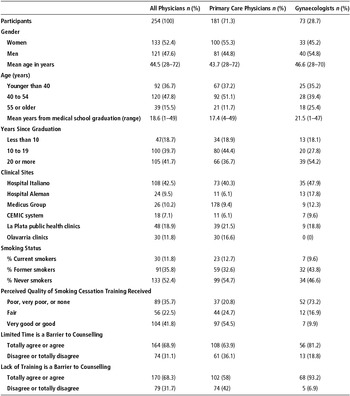
A total of 620 physicians were invited to participate, 173 gynaecologists and 447 general internists and family physicians; 254 (41%) who agreed to participate were randomized and completed the survey (Table 1). Of the 254 respondents, 133 (52.3%) were women and there were 57 (22.4%) family physicians, 124 (48.8%) general internists, and 73 (28.7%) gynaecologist/obstetricians. Physicians’ mean age was 44.5 years with an average 18.6 years (range 1–49) of experience in medical practice. The sample included 108 physicians from the Hospital Italiano, 18 from CEMIC, 26 from Centro Medicus, 24 from the Hospital Alemán, 30 from the Olavarría clinics and 48 from La Plata. There were 133 (52.4%) never-smokers, 91 (35.8%) were former smokers, and only 30 (11.8%) were current smokers at the time of the survey.
Demographic and clinical profiles of 254 physicians participating in smoking cessation intervention, Argentina, 2010

The perceived quality of general training in smoking cessation was evaluated as very good or good by 104 (41.8%) physicians, 56 (22.5%) rated their training as fair and 89 (35.74%) as poor, very poor or no training at all. Of the 104 physicians reporting very good or good training, 97 (93.3%) were general internists or family physicians. Most medical school training focused on health damage caused by tobacco (84%), and only 8.4% and 17.9% reported having received training in psychosocial or behavioural smoking cessation and in nicotine replacement therapies (NRT), respectively. In residency training there was a higher level of reported training in psychosocial or behavioural therapies (45.9%) and NRT (64.6%). Stated barriers to implementing smoking cessation interventions included lack of time during the visit (68.3%) and the lack of knowledge (68%).
Physician-Reported Smoking Cessation Practices
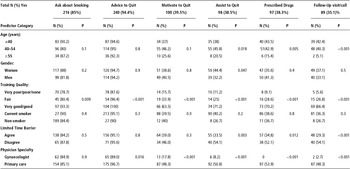
The vast majority of the physicians (96.8%) reported knowing that tobacco smoking was addictive, 31.1% reported that they knew the meaning of a ‘brief smoking intervention’ defined by advising every patient who smokes to quit and discuss tobacco use for at least 3 minutes (Fiore et al., May Reference Fiore, Jaén, Baker, Bailey, Benowitz and Curry2008), and 96.8% indicated a need for further training in smoking cessation. Most physicians reported asking their patients about smoking (89.8%) and recorded the information in their medical history (86.6%). The self-reported rate of physician cessation counselling of smokers was 89.4%. Setting a quit date was implemented by 37.7% of the physicians and providing strategies to manage withdrawal symptoms and avoid weight gain was reported by 36.3% and 41.4%, respectively. Patient motivation to quit was evaluated by 57.5% of the respondents, but only 26.6% used behavioural therapy to help patients quit smoking. With respect to pharmacological treatments 39% recommended NRT, 44.7% bupropion and 18.6% varenicline. Follow-up visits for relapse prevention were performed by 34.9% of physicians. The bivariate analyses showed that physician age, gender, perceived quality of tobacco cessation training, perception of time as a barrier, and physician specialty were each related with at least some of the outcome variables (Table 2).
Number and percent of physician reported smoking cessation practices by predictor categories among 254 physicians, Argentina, 2010

For each predictor category the number (N) and percent responding yes to each of the outcomes by defined category are listed. Numbers may not correspond exactly because of missing responses.
Smoking cessation practices are defined: (1) ask about smoking and record in the chart; (2) advise to quit, to reduce number of cigarettes or to set a quit date; (3) motivate to quit smoking responding yes to 4 items; (4) assist the patient in quitting by providing at least two components (printed materials, website address, telephone quit line, advice on managing withdrawal symptoms, advice on weight gain, individual cognitive therapy, or behavioural therapy; (5) prescribe medications and specify one of the medications as nicotine replacement therapy, bupropion, or varenicline; and (6) follow-up visit or telephone call.
Predictors of Smoking Cessation Intervention Components
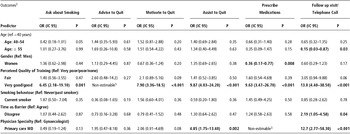
We fit six logistic regression models of cessation intervention components that could be implemented by physicians (Table 3). Those physicians with highest perceived quality of smoking cessation training were significantly more likely to report asking about and recording patient smoking, compared those with those with the lowest perceived quality (OR = 6.5; 95% CI = 2.2–19.1). All physicians who reported very good/good perceived quality of tobacco cessation training responded that they ‘advise to quit, to reduce, and to set a quit date’ among their patients. Similar results were obtained for ‘motivate to quit’, with quality of training as the only significant effect: OR = 7.9 (3.4–18.5).
Predictors of using six components of smoking cessation intervention by 254 physicians, Argentina, 20101

1All models were adjusted for physician age, gender (men/women), self-perception of tobacco training (very good/good, fair, poor/very poor/no training), smoking behaviour of physician (current smoker, never/past smoker), perception of time as a barrier to counselling, and physician specialty.
2Smoking cessation practices are defined: (1) ask about smoking and record in the chart; (2) advise to quit, to reduce number of cigarettes or to set a quit date; (3) motivate to quit smoking responding yes to 4 items; (4) assist the patient in quitting by providing at least two components (printed materials, website address, telephone quit line, advice on managing withdrawal symptoms, advice on weight gain, individual cognitive therapy, or behavioural therapy; (5) prescribe medications and specify one of the medications as nicotine replacement therapy, bupropion, or varenicline; and (6) follow-up visit or telephone call.
3Among physicians reporting good/very good training there was zero variation on the advise outcome as all responded that they provided advise to quit. Similarly, among obstetrician/gynaecologists there was zero variation on the ‘prescribe medication’ outcome as no one prescribed medications for cessation. Therefore, the two corresponding parameters are inestimable and the X variable was thus excluded from the model of that particular outcome because one X-variable category had zero response variation on the corresponding outcome.
Clinicians with higher perceived quality of training in smoking cessation were significantly more likely to report assisting their patients to quit (OR = 9.9, CI = 4.0–24.2), prescribing cessation medications (OR = 9.6, CI = 3.5–26.7), and arranging follow-up appointments (OR = 13.0, CI = 4.4–38.5). For the outcome of prescribed medications, significant effects were found for gender with women physicians less likely to prescribe medications (OR = 0.4; 95% CI = 0.2–0.8). Physicians aged 55 years and older were less likely to schedule follow-up visits or telephone appointments to assist their patients in cessation (OR = 0.2; 95% CI = 0.03–0.9). Disagreement with the statement that time is a barrier to cessation counselling was only significant in predicting follow-up appointments (OR = 2.2; 95% CI = 1.1–4.6). Finally, primary care physicians were significantly more likely to assist their patients in quitting (OR = 4.9; 95% CI = 1.8–13.4), prescribe medications (not one gynaecologist/obstetrician reported prescribing) and to arrange for a follow-up visit or telephone call (OR = 12.7; 95% CI = 2.77–58.3) (Table 3).
Discussion
The main result of our study was that self-reported perceived quality of tobacco-cessation training was the only significant predictor of use of all assessed tobacco cessation process outcomes (ask, advice, motivate, assist, prescribe, and follow up) assessed in the survey. This finding is consistent with other studies conducted in Argentina (Gigliotti et al., Reference Gigliotti, Ferrero, Castanos, Blengini, Duran and Moreno2013; Mejia et al., Reference Mejia, Martinez, Gregorich and Perez-Stable2010), as well as in the US (Huang et al., Reference Huang, Guo, Yu, Feng, Song and Eriksen2013; Sadowski et al., Reference Sadowski, Ruffieux and Cornuz2009; Soto Mas et al., Reference Soto Mas, Balcazar, Valderrama Alberola and Hsu2008). Given the evidence that supports use of physician-implemented smoking cessation interventions, this reinforces the need to standardize and strengthen training in the medical school curricula as well in the residency programs. The Argentinean Congress passed a new National Tobacco Control Law in 2011 and the Executive Branch then implemented the law in 2013. One provision of the law establishes the requirement to include the topic of treatment of tobacco addiction in all health care professional training curricula (Ley 26.687, Regulación de la publicidad, promoción y consumo de los productos elaborados con tabaco, 2011). While there is significant progress in the implementation of smoking cessation training in different professions, the overall implementation process is uneven. Furthermore, cognitive-behavioural and pharmacological treatments of tobacco use are not included in the national ‘Programa Médico Obligatorio’ (PMO), which defines the minimum standard of chronic health care benefits that must be provided by the state-supported health insurance (seguro social) or private prepaid health insurance without exclusion of pre-existing conditions. The National Tobacco Control Law does not include treatment of tobacco addiction in the PMO. Thus, many disadvantaged smokers dependent on the public health care system face challenging financial barriers to access smoking cessation services.
Among these physician participants we found a prevalence of approximately 12% tobacco consumption, which is about half of the overall population prevalence according to the Global Adults Tobacco Survey in 2013 (Ministerio de Salud de la Nacion, 2012). The smoking rate reported in this study is lower than that reported in previous studies of 20% to 35% prevalence among physicians in Argentina (Gigliotti et al., Reference Gigliotti, Ferrero, Castanos, Blengini, Duran and Moreno2013; Minervini et al., Reference Minervini, Zabert, Rondelli, Gómez, Castaños and Buist2006; Tambussi et al., Reference Tambussi, Schoj, Perel, Zabert and Ortiz2003; Zabert et al., Reference Zabert, Videla and Verra2005; Zylbersztejn et al., Reference Zylbersztejn, Cardone, Vainstein, Mulassi, Calderón and Blanco2007). Our finding of a lower prevalence may be explained by selection bias of the sample studied because physicians had to sign an informed consent to participate in research that included randomization to a follow-up educational intervention. Thus selecting a higher proportion of non-smokers than smokers in the study sample might be expected. Furthermore, the medical institutions that agreed to participate are centres of excellence in health care and affiliated with academic institutions with residency training programs which may also lead to less smoking. Regardless, the prevalence of tobacco consumption has decreased in the entire population of Argentina, and in recent years laws creating smoke-free indoor environments have been implemented in all work sites including health centres, and this may have impacted and lowered the consumption of tobacco among physicians.
Our study also suggests that higher perceived quality of training leads to greater implementation of smoking cessation interventions by physicians. Compared to an earlier study of physicians at Buenos Aires Hospitals where 11% reported prescribing NRT, 40% of physicians in this study reported prescribing NRT (Zabert et al., Reference Zabert, Videla and Verra2005). In our study, 95% of physicians recognized smoking as an addiction and 41% reported good or very good training in smoking cessation, compared to only 44% and 33%, respectively, in an earlier study (Minervini et al., Reference Minervini, Zabert, Rondelli, Gómez, Castaños and Buist2006). A survey of clinicians conducted in 1994 in the same medical centres in Buenos Aires showed that only 6% of physicians used effective smoking cessation interventions as defined at that time (Noble et al., Reference Noble, Perez Stable and Casal1996) compared to 30% of clinicians reported using behavioural therapy and 50% prescribing NRT in our current study. Higher perceived quality smoking cessation training was also far more common among primary care clinicians compared to gynaecologist/obstetricians in this study. This is particularly important considering that, in Argentina, women during their reproductive years are almost exclusively cared for by gynaecologist/obstetricians. Thus there is a potential missed opportunity to educate and intervene to decrease tobacco consumption in women and reduce exposure to tobacco smoke at home.
This study found only two self-reported differences by gender and age. Men prescribed more medications to help patients quit and physicians aged over 55 years were less likely to arrange follow-up for smoking patients motivated to quit. Interestingly, unlike other studies, physicians who were current smokers were not less likely to use cessation components and are similar to findings from a US study. (Soto Mas et al., Reference Soto Mas, Papenfuss, Jacobson, Hsu, Urrutia-Rojas and Kane2005; Reference Soto Mas, Balcazar, Valderrama Alberola and Hsu2008) The most frequently identified barriers to implementing cessation interventions were lack of time and lack of training that is similar to those reported by others (Blumenthal, Reference Blumenthal2007; Kaplan et al., Reference Kaplan, Perez-Stable, Fuentes-Afflick, Gildengorin, Millstein and Juarez-Reyes2004) and this was associated with decrease likelihood of arranging follow-up.
Our study has several important limitations. First, the selection of physicians in the six clinical systems whose leadership was willing to participate in the research project may limit the representativeness of the study sample and limits its external validity. We also relied on self-report and were not able to verify any of the evaluated behaviours from direct observation. Finally, we used a cross-sectional design and cannot rule out the possibility that the self-reported outcomes may have causal impact on perceived quality of training.
In summary, our study indicates that self-reported quality of smoking cessation training is the most important predictor for using evidence-based smoking cessation interventions. This suggests an opportunity to strengthen the training of the health care team in general and of physicians in particular to help their patients quit smoking. While over time there may be relatively higher medical training in the subject when compared with the past, the rates of knowledge and use of effective cessation resources remain low, especially among gynaecologist/obstetricians, when compared with primary care physicians. Wider implementation of physician training in Latin America to include smoking cessation counselling techniques and use of pharmacological treatments may be an important component of a national tobacco control program.
Acknowledgements
We thank the medical and administrative directors of the respective clinical institutions that facilitated access to the participating physicians; we also thank Cecilia Populus-Eudave for administrative and research support and Juliette Hong, MS and Jennifer Livaudais-Toman, PhD for statistical analyses at UCSF.
Financial Support
This research was funded by grant no. TW05935 from the Tobacco Research Network Program, Fogarty International Center, National Cancer Institute, National Institute of Drug Abuse, and National Institutes of Health and by grant no. 001726-037 from Research on International Tobacco Control, International Development Research Center, Canada.
Conflict of Interest
None.
Ethical Standards
The authors assert that all procedures contributing to this work comply with the ethical standards of the relevant national and institutional committees on human experimentation and with the Helsinki Declaration of 1975, as revised in 2008.