The politics of financial reform represent a genuine test case for American politics and its institutions. Financial reform is both an Obama administration priority and a square attack on the very crisis issues that brought the President and congressional majorities to their broad electoral victory in 2008. Yet the organizations that mark the target of financial reform count as the richest and most powerful organizations on the planet, not simply the private banks and hedge funds that contribute millions of dollars to political campaigns, but the national and international financial agencies that enjoy privileged institutional positions in law and culture. Furthermore, the diversity and opaqueness of these organizations and their products renders the task of reform much more difficult. The targets are ever moving and adaptive, new species of capital emerging constantly and defying simple definition and application of laws and regulations.
At the same time, the politics of finance affects people at every level of the income and class spectrum—perhaps more so now than ever before. The crisis of 2008 and the “Great Recession” that followed it damaged the fortunes of the wealthy and ripped away the jobs and health insurance of the working poor, working class, and middle class. The national housing crisis was historic in its own right—homeowners lost their shelter and their equity at record levels—and the housing tumult engendered a crisis in banking, with bank failures and plummeting asset values for major investments (including institutional pension accounts, retirement funds, and foundation and university endowments). A structural implosion in housing generated an implosion in major financial institutions and their assets, which in turn decimated employment and incomes, worsening the housing crisis. The local world destabilized the global one, and the global returned the insult.
In the battles over financial reform in the first fourteen months of the Obama presidency, the forces of crisis and anger have run up headlong against the institutional strangulation for which American political institutions have become known. The Obama administration advanced proposals for far-reaching transformation of American finance, both in systematic regulation and in consumer finance. To date, these efforts have been heavily watered down, delayed and compromised, though with a few notable but incremental victories. Although legislative reform has (as of early August 2010) passed Congress and has been signed into law by President Obama, many of the most popular and transformative proposals have been abandoned. These proposals were diverse. They ranged from the requirement for simple, baseline mortgages and credit instruments, to broad regulation of over-the-counter derivatives, to the creation of an independent consumer financial agency. To a tee, however, they were defeated not in public moments of political turmoil, but in quieter moments of negation. These moments amount to a process of “institutional strangulation,” where the victim perishes silently.
The dynamic of institutional strangulation is not, however, the separated powers vision of Montesquieu, of John Adams and the Massachusetts Constitution of 1780, and of the Founders and the American Constitution of 1787. It is instead the historically atomized character of voting, allegiance, and administration that came to mark late twentieth-century American politics. The strangulation of financial reform has come from a combination of veto points (the non-constitutional explosion of players who can say “no” to reform), gridlock (intransigence and obstruction among those operating American political machinery), and perhaps most important, bureaucratic politics (the jockeying among existing financial agencies and their associated coalitions for turf and authority).
Financial Reform: The Basics
The world of finance and its regulation is a vast one, but for purposes of analysis a simple binary—that between systemic and consumer risk—helps to simplify discussions. Consumer risk comprises the set of investments and assets in which individuals and households invest—retirement plans and pensions, life insurance, home ownership and mortgages, consumer and auto loans, equities and annuities, small bonds and the like. These are financial products historically provided by smaller and more localized credit institutions (credit unions, unions and employers, savings and loans, community banks, even the postal savings banks of the early twentieth century). Systemic risk comprises the institutional transactions and financial products—bank-to-bank transactions, collateralized debt obligations, hedge funds, securitized assets and mortgages, derivatives of various kinds, asset bundles with various tranches of quality—that constitute the world of Wall Street, large insurance companies, and mass mortgage lenders. Bluntly and simply but somewhat inaccurately put, consumer risk is citizen-to-citizen; systemic is bank-to-bank.Footnote 1
The economic crisis of the past two years, as I mentioned, has hit both consumer and systemic realms, and hard. Past stock market crashes were not as deeply embedded in the consumer finance market—witness the crash of 1987, the popping of the tech and NASDAQ bubble in 2000, and the problems of Long-Term Capital Management and its international investments in 1998. In contrast to the current crisis, in none of those events was the American housing market deeply implicated, and only in one was a set of overvalued household-level investments (many of them institutional, in the IT bubble of the 1990s) partially involved. At the same time, the crisis in home ownership and consumer finance is certainly lucid now, but it has been growing for the better part of two decades. For a number of reasons, median income per capita has stagnated over the past decade even as the costs of health care, education, and housing have continued to rise.Footnote 2 And even as the costs of these goods have risen, Americans are becoming more enamored with them, sacrificing long-term savings and other expenditures in order to gain access to education, health care, and owned housing.
In combination with these structural developments, companies have begun to offer new and much more complicated financial products to consumers. Each of these financial products can be reduced to a contract that contains its fundamental components; a promise of the lender to provide money now in return for a series of payments by the citizen later. The explosion of credit cards over the past two decades—the average individual American carries 10 or more of these in her purse or his wallet—is perhaps the most familiar evidence that financial products have revolutionized our lives. Yet it is not just credit cards but their contractual terms that have been transformed. The diversity and complexity of credit card contracts is bewildering. Most cards require no monthly fee for card use but some still do (and many more did just a decade or more ago). Cards differ in the fees that kick in—and the transparency with which they kick in—when payments for accumulated balances come in late or not at all. One can use credit cards to accumulate money for airline flights, purchases at favored merchandisers, and even to make implicit contributions to one's alma mater or favored charity.
The array of other consumer financial products has also exploded in diversity and complexity. For much of the twentieth century the dominant form of home loan was a thirty-year fixed-rate mortgage with a certain percentage of the housing value down (20 to 30 percent, usually). In recent years, however, homeowners have been able to purchase homes using an array of mortgages that allow purchases with very little money down and, in addition, little or no documentation (the monikers for these products being “no-doc” or “low-doc” home loans). And in combination with credit cards, these products have been marketed with increasing psychological and sociological sophistication to the working class, the working poor, recent immigrants, and those in particular religious and social communities where homeownership was prized both culturally and even spiritually.Footnote 3
In tandem with these new consumer products have arisen a wide range of systemic financial products—collateralized debt obligations, securitized asset bundles such as residential mortgage-backed securities (RMBS), derivatives sold institutionally as well as in individual transactions. Of these products, most of the policy attention has focused upon two sorts, first the class of financial products known as over-the-counter derivatives.Footnote 4 Derivatives are simply financial products derived from other financial products, and these can be traded on an exchange like that in South Korea or the Eurex institution of Europe, or “over-the-counter” between a party and a counterparty. The lack of a major exchange for derivatives trading in the United States is a peculiar feature of the American market, and one that renders the American derivatives market largely unregulated, both institutionally (through the exchanges) and governmentally.Footnote 5 The second set of products that have come in for criticism are bundles of consumer products or bundles of those bundles—residential mortgage-backed securities and credit default swaps (CDSs). The RMBS is a bundle of mortgages, each of varying quality where quality levels correspond to slices or tranches, and in which the aggregation of individual mortgages is theoretically supposed to reduce the risk. The CDS is a hedge that a party makes on another party's default on a bond or loan; it could be (often was), for instance, a hedge that a bank makes on the probability that another bank's RMBS-backed purchase of a bond, will default. Again, these hedges can be used to reduce risk, and it was not uncommon for banks (or their associates) to take out credit default swaps on some of the very loan products that they were providing to other borrowers. Again, the construction and sale of these products has been largely unregulated in the United States over the past two decades.
The Obama Administration Response: Policy Proposals of the Spring of 2009
In the almost two years since President Obama took office, a debate has raged between Wall Street and Washington about how to respond to the global financial crisis, both at the systemic and the consumer levels. The most controversial proposal has come in the form of the resurrection of an older idea about consumer financial protection. In 2007, Harvard law scholar Elizabeth Warren published a highly influential essay in the journal Democracy entitled “Unsafe at Any Rate.” Her idea was to create a separate agency for financial safety, one that echoed institutions established by the Canadian government almost a decade ago. Even during the midst of the financial crisis of the fall of 2008, little legislative or media attention was given to this idea. The idea became legislatively tangible in March 2009, when it was formally introduced to Congress as a proposal for a “Financial Products Safety Commission” by representatives William Delahunt of Massachusetts and Brad Miller of North Carolina. Key players in the Obama administration had been attracted to the idea—some (Assistant Treasury Secretary Michael Barr and the president himself) more than others (Treasury Secretary Timothy Geithner and National Economic Council head Larry Summers) —and the Treasury Department issued a large blueprint for financial reform in June 2009.Footnote 6
In the year following the introduction of this proposal, it is the independent agency idea that attracted most of the attention and vitriol. Warren's brainchild has been supported and attacked, surpassed only by health care and perhaps Afghanistan as front-page news and a front-burner priority for politicians. Yet other changes that are further off the radar screen have come in for strong opposition from banks, lending companies, and existing federal agencies with turf and fee-based revenues to protect. For an examination of the possibilities, it is worth examining (on the more progressive side of the agenda) the package of financial reforms passed by the US House of Representatives in December 2009. This bill, which was reported by the House Financial Services Committee (chaired by Massachusetts Democrat Barney Frank) contains a dizzying array of elements, but five of them are of interest here.
1. Systemic regulatory reforms including minimal capital requirements for systemic risk (“skin-in-the-game” reforms), enhanced and uniform fiduciary duties, and credit rating transparency
2. Regulation of OTC derivatives and/or a requirement that they be traded on institutional exchanges
3. Unification of systemic financial regulation in a new agency (a “national banking supervisor”), with the result that it is taken out of the Fed
4. A consumer financial protection agency (CFPA)
5. Fees for regulation of large banks, and restrictions on the practices and business models of large banks (these are more recent proposals by the President in the last few months).
As of August 2010, just a few of these reforms had come to full fruition. Some reforms took on the identity of a “litmus test” for progressives, such as the idea of an independent consumer finance regulator. Others have been debated under the public radar—namely the idea of taking prudential regulation of systemic risk out of the Federal Reserve and according this power to a new agency—but are significant nonetheless. What is perhaps most notable is that proposals for financial regulation have been significantly watered down—some of the most broadly popular ideas will never see the light of an agenda. There are many reasons for institutional strangulation in the United States, and for financial reform proposals specifically, but it is the three-fold combination of veto points, polarization and policy intransigence and bureaucratic dynamics that I examine here.
Veto Points
Legislative Veto Points
One of the principal reasons that financial reforms of a wide variety have failed is that various opponents have skillfully slowed and stopped the progress of the Obama reform legislation at the multiple veto points offered by the American policy process. It is critical to understand that not all of these veto points are legislative, and I will devote a separate section to understanding how bureaucratic politics among existing financial agencies has been one of the primary sources of constraint for Obama reforms.
Yet perhaps the best evidence that veto points are critical to understanding the strangulation of financial reform comes, as in health care politics, with a glance at what has been produced by the House of Representative and what has (not yet) been produced by the Senate. In December 2009, the House passed landmark financial regulatory reform legislation. The bill included new rules for derivatives trading, increased transparency and regulation of credit rating agencies and their processes, a consumer financial protection agency, and even a legislatively-mandated audit of the Federal Reserve. The vote was in fact a more commanding majority (223–202) than existed in the health care legislation passed a few weeks later (220–215).
Before addressing the inaction that has occurred in the Senate, it is worth reflecting on several points in which the House bill, too, was compromised by various veto players. For one, even when the House bill was passed, critical elements of the legislation were watered down and in some cases abjectly voted down, especially when it came to the regulation of OTC derivatives. These included Michigan Representative Bart Stupak's amendment to mandate increased transparency of derivatives trading (voted down by the substantial margin of 330–98), Barney Frank's amendment to strengthen the powers of existing regulators over OTC derivatives, and bans on secondary and tertiary derivatives trading (where banks are investing in derivatives of derivatives, the kind of asset favored by the American International Group (AIG) before its downfall).Footnote 7
Beyond this, many aspects of the House legislation had been watered down in committee and in negotiations between major industries and members of Congress. One of the notable cases was the demise of the “plain vanilla” concept. In the spring of 2009, building on insights from real estate and contracts law, psychology, and behavioral economics, key players in the network of financial reform began to seize upon the concept of plain vanilla financial products as a favored concept for a wide variety of markets. In the creation of a new consumer financial protection agency, the thinking went, new regulators could place a premium on products that were simple in their contractual nature and proven safer by dint of consumer experience with them. So in the mortgage lending market, for instance, a plain vanilla product would be a 30-year, fixed-rate mortgage with 20 percent down payment; this financial product would qualify as plain vanilla because of its simplicity (same rate paid over the time interval of the mortgage repayment schedule) and its proven safety (this sort of contract has been around for decades). By contrast, a subprime mortgage with a two-year “teaser” rate would not qualify as plain vanilla and would presumably be subject to greater regulation. The idea, then, was to use plain vanilla as a designation for products that would be safer and simpler and thus subject to less expected regulation; firms would then compete to make their products plainer and more vanilla. Thus regulation and market incentives would work together, in theory, to produce simpler products with less risk of mis-matching between product and consumer. Yet in the summer and fall of 2009, the House financial services committee and Senators received intense lobbying pressure to water down this requirement. When Assistant Treasury Secretary Michael Barr appeared before the Senate, he was compelled to reassure senators that no FDA-style pre-approval of financial products would occur under the envisioned commission; it would have post-market, not pre-market authority. By the fall, House financial services committee chair Barney Frank made a hasty retreat from the plain vanilla provision in his draft legislation and deleted it from the bill in favor of language that directed the new agency to consider the simplicity and ease-of-use of financial products.Footnote 8
One reason for this watering down was the effort of committee staffers to secure unanimous agreement among Democrats on the House financial services committee. This sort of partisan unity signal was deemed important (by Frank and his subcommittee chairs) as a message both to the House floor and to the Senate that informed Democrats were unified behind the measure. This norm of universality among House committee Democrats actually gave moderate members veto power, and it only increased the pivotality of these members and the extent to which they attracted lobbying pressure.Footnote 9
Nonetheless, given the parameters of financial reform outlined by the Obama administration in June 2009, and given the structurally haphazard regulation of finance (systemic and consumer) as of 2008, the House bill advanced a far-reaching set of institutions and a vision to complement them. Particular consumer groups wanted more, but they got something tangible in the Obama proposal and the House bill.Footnote 10
Of course, the politics of the House legislation was played out in the shadow of the Senate, where it was understood all along that Democrats would need sixty votes or more to overcome an expected filibuster. In this respect, one of the early financial reform successes of the spring of 2009—the passage and presidential signing of the Credit Card Accountability, Responsibility, and Disclosure (CARD) Act of 2009—contained some ominous news for Democrats and defenders of financial reform. Senator Tim Johnson of South Dakota voted against this otherwise popular act on the Senate floor. This no vote came against a very popular bill (many Republican Senators and House members voted for it) and at a time when President Obama himself enjoyed wide popularity. It was a signal that Senator Johnson, who represents a state with many credit-card companies and employees, would not be a reliable vote for consumer financial protection. In order for broad consumer protections to pass, Democrats understood early on that either they would have to be adapted to attract Johnson's support or that a Republican would have to be brought on board the coalition.Footnote 11
In the months of fall 2009 and in the early weeks of 2010, the consumer financial protection agency became a sticking point in negotiations in the Senate. Once financial reform was passed by the House, the critical site of negotiation became the Senate Banking Committee, chaired by Christopher Dodd of Connecticut. Dodd had long attempted to run something of a bipartisan operation in this committee, in part because he had been historically cooperative with ranking Republican Richard Shelby of Alabama, and in part because he had been supposedly enamored with the pattern of cooperation between Charles Grassley and Max Baucus on the Senate Finance Committee. Scott Brown's surprise victory in the special election for Massachusetts' Senate seat in January 2010 officially broke up the filibuster-proof coalition that the Democrats had enjoyed. However, because of Senator Johnson's lukewarm commitment to consumer protection in the area of credit cards, the Democrats never had 60 to begin with in the area of consumer-oriented financial reform.Footnote 12
Yet the Massachusetts special election may actually have proved a boon for financial reform, for several reasons. First, the reading of tea leaves by national politicians resulted in the inference of an “angry electorate,” one frustrated with the fact that large financial sectors had received “bailouts.” Indeed, public opinion polls had shown a souring on health care reform but no less vitriol directed at Wall Street and the Federal Reserve. In the weeks after Brown's victory President Obama strategically stepped up his rhetoric against Wall Street and for financial reform; along with a commitment to passing jobs-related legislation, financial reform was still considered a popular issue. Second, Dodd announced his decision not to run for re-election in the weeks after Brown's victory, meaning that he would be able to behave somewhat more independently in his last round of financial negotiations over the bill, not needing to worry about fundraising or the Connecticut electorate as much.
In March 2009 and for weeks thereafter, Dodd and Shelby tried to hammer out a compromise within the Senate Banking Committee. The primary sticking point became the independent consumer regulatory agency and where in the federal government to place it. At this writing, the idea of complete independence for the consumer agency has been abandoned. Dodd has, however, offered a compromise proposal to place a “consumer bureau” within the Federal Reserve, though the initial reaction to this idea was one of general lament from consumer protection advocates and early dismissal by Barney Frank. As of July 2010, the placement of such a bureau in the Federal Reserve seems the most likely outcome of the larger reform process.
At some level, the role of veto points in stopping aggregate reform is nothing new to political scientists who have studied matters ranging from health care reform to taxation legislation in the American context.Footnote 13 For rational choice theorists, this focus upon “pivotal” politicians' preferences is now a staple of analysis, as in Keith Krehbiel's Pivotal Politics.Footnote 14 Yet I want to press the case that the proliferation of veto points in the American system defies analysis by rational choice models that rely upon static or stationary equilibria.Footnote 15 In pointing us to a world of veto players, Krehbiel and other rational choice theorists are not modeling a game or an institution whose parameters have been chosen out of scratch according to equilibrium dynamics of institutional design. For instance, the contemporary filibuster was never envisioned by statesmen of the Founding or early American Republic. So too, other forms of the legislative process, such as seniority rules for committees and committee rights to report legislation before it can be considered on the floor, are also modern accretions that were hardly designed to block major shifts, even though these veto points were subsequently used by opponents of major policy reforms such as the Civil Rights Act and Voting Rights Act. So, too, each and every major expenditure or revenue bill must now be scored by the Congressional Budget Office, but as Stephen Skowronek long ago noted, the emergence of legislative budget institutions was not a development designed to affect legislation in particular but was a part of the executive-legislative struggle of the Progressive Era (a struggle that was accentuated and continued in the Nixon administration).Footnote 16 In short, the veto points that most matter in financial reform—and perhaps also in other areas of reform—are not those that were theorized by Montesquieu, Adams, Madison and others as intentionally posited ways of separating popular impulses from final policy enactments. Instead, the relevant institutions arose for reasons that had little to do with blocking policy reform at the time they were created but were later discovered to be use of use, a process akin to what Skowronek, Karen Orren and congressional scholar Eric Schickler have called “layering.”Footnote 17
Cultural Veto Points in Regulatory Politics
I pause here to note one other feature of the veto points hypothesis, namely that ideas can get shot down not simply because they don't satisfy the preferences of pivotally positioned elites, but because their proponents do not come from the privileged circles and networks of influence in a policy realm. The world of finance is increasingly dominated by finance economists, and this world is an overwhelmingly male one. In this light, it is significant that the two regulatory innovators most threatening to the status quo over the past two decades were women: Brooksley Born and Elizabeth Warren. Born was chair of the Commodity Futures Trading Commission when she proposed stronger regulations for the over-the-counter derivatives market; according to participants in the debate at the time, her ideas met with severe and personalized resistance from Fed chairman Alan Greenspan, Treasury Secretary Robert Rubin, and others in the Clinton administration. So too, it is detectable that much of the opposition to the independent regulator idea in consumer financial protection is coming from people who are averse to seeing Elizabeth Warren have power. Warren comes from outside the financial circles that bestow credibility and privilege upon policymakers and that become network gatekeepers for appointments to powerful posts.Footnote 18 One might surmise that these circles reflect simply the best talent available, but as Johns Hopkins economist Jon Faust has noted with respect to the Federal Reserve, the pattern of appointing academic economists to top positions is a recent one in Fed history. “The Federal Reserve Act envisioned that the board would represent a broad range of interests,” said Faust in a New York Times interview. “The emphasis on academic economists is a trend that's only been happening in central banks around the world over the last 15 to 20 years.”Footnote 19 Hence it is significant that Warren's background is in law, not in economics. And much of the opposition to an independent consumer agency has focused upon her in particular, ranging from the lament of a George Mason law and economics scholar that “she hates banks” to the attempt by a Republican lawmaker to add an amendment to the financial reform legislation that would require the head of the new agency to have significant experience in the financial sector (this would exclude Warren, as she has served primarily as a legal scholar during her career).Footnote 20
As a hypothesis, it may be ventured that where the policy realm (and especially its constitutive networks) is composed of a professional discipline and those of a particular gender, then ideas that originate from outside these networks are likely to be resisted. The veto points are not necessarily those of Congress, but those of administrative and advisory politics. In this networked world, ideas are more likely to disappear from the agenda not with research, but because they are deemed outside the set of “legitimate” ideas. In a world of self-styled alpha males, women's ideas are more likely met with disdain and furrowed brows. By these and other cultural mechanisms, the ideas and proposals of female regulators and of experts with careers outside of finance and financial economics are more likely to get shot down. This is a hypothesis and bears more investigation than I can give it here, but it is at root an institutional hypothesis, because institutions are composed not simply of rules but also of scripts.Footnote 21
The other script-based nature of veto points here is the nature of economic thinking that has come to dominate regulation in Washington. This thinking emphasizes free-market fundamentals (assumptions and criteria). Regulation and government policy are justified if and only if there is a market failure.Footnote 22 In the Office of Management and Budget, in the Treasury Department, in the panels of economic advice for the president and the White House, and in the Congressional Budget Office, many regulatory proposals are never entertained because the analysts that populate these organizations will not consider a policy until a market failure has been identified. If and only if a failure has been identified does the current wisdom instruct analysts to consider or search for solutions or alternative policies.Footnote 23 This mode of analysis is accentuated in financial regulation because of the status hierarchies that govern analysts. Within major financial institutions and policy organizations, analysis of monetary policy and prudential regulation is privileged over analysis of consumer finance, in part because the former modes employ higher-level mathematical modeling and stochastic analysis. Consumer protection analysts simply do not use much of this technology, and indeed the work of consumer protection is considerably “low-tech” in comparison to the work of monetary policy and prudential regulation.
Gridlock and Intransigence
The second force undergirding institutional strangulation is the culture of partisanship and vituperation that has come to dominate elite politics in the United States. Put simply, it's not just the machinery that exists, but the people willing to use that machinery, which determines whether there will be gridlock. Veto points are necessary but not sufficient for strangulation; one needs a determined minority willing and able to use these veto points, a minority that wishes to block even incremental progress. As an example, even in the House of Representatives in the summer of 2009, concerted attempts were made by congressional Republicans to slow down the Obama administration's agenda using a range of dilatory motions. These attempts were mildly entertained and largely unsuccessful—it is well known in the congressional literature that the power of the Speaker and of the party majority is very strong, especially as compared to the Senate—but the fact that these blockages were continually attempted suggests something about the motives of those (Republican legislators, and House Republicans in particular) who did not have strong institutional levers of obstruction and yet still tried to use them.Footnote 24
Undergirding this resistance is a fundamentalist free-market ideology that resists each and every “left turn.” This approach has been especially popular under Republican leadership in the House and Senate since the 1994 midterm elections, when the Republicans succeeded in dramatically reshaping the contours of American politics by running against then President Bill Clinton on an anti-government, economically libertarian but socially conservative platform. Democrats, for worse or better, did not begin to acquire this kind of intransigence on domestic policy issues until the second term of the Bush administration.
The literature on polarization in American politics is substantial and rapidly growing.Footnote 25 The broader consensus in the American politics literature seems to be that polarization is much more an elite-level phenomenon than a public-level phenomenon. Using over-time measures of difference between the parties' voting tendencies, there is little doubt that the last two decades have witnessed levels of inter-party strife not witnessed since the late nineteenth century. This disparity in polarization at different levels of the American political system means that the kind of “middle-of-the-road” political solutions that many voters find palatable are increasingly unlikely to emerge from polarized Washington. In the case of financial reform and for that matter many other Obama administration policy initiatives, opponents have pointed to the filibuster as the essential roadblock, and even mild opponents of social policy and regulatory legislation have begun to threaten not to vote for cloture of Senate debate unless their concerns are addressed or altogether satisfied. This has been the case with the independent financial agency that Elizabeth Warren originally proposed and that the Obama administration has attempted to write in to the financial reform law. Republicans many times threatened a filibuster of the legislation and, in the spring of 2010, some Democratic Senators refused to commit to allow an up-or-down vote on the legislation if a new consumer financial agency was part of the bill.
As much as progressives would like to lament these developments, Republicans are not the only actors responsible for this sorry state of affairs. The myopia of American politics, combined with growing structural laments among those in the American electorate, gives both parties incentives to stop the others' reform efforts in their tracks, to allow independent voters and partisan supporters of the party in office to infer that nothing is being done, and to punish the incumbents accordingly. This behavioral-strategic logic—do not let the opposition score any tangible victories—is one reason why Republicans have voted in lock step against Obama administration reforms even though some more moderate or cross-pressured members of the party might favor some of the planks individually.
Intransigence is, then, an institutional development, not merely an expression of pure underlying preferences for obstruction. In order to make a case for Republican votes in the upcoming midterm elections—where simply by regression to the mean and long-standing patterns of midterm “corrections,” the Republicans will very likely pick up seats in both legislative chambers—party leaders in the minority want their legislators to present a united front against all Obama legislation. The simple signal that minority party leaders intend to send to voters is that “we voted against those with majority power, so if you are dissatisfied with the status quo,” vote for the binary alternative, namely “us.” The success of this strategy, in turn, depends upon two other facts. First, instrumentally, party leaders in the minority must be able to enforce this kind of policy as against moderates or others who might, on occasion, wish to side with the administration. The ability to enforce party discipline is dependent upon criticism, the cultivation of primary challengers to those who do side with the majority,Footnote 26 and perhaps most important, control of access to the party's organizational and financial resources. In the age of incumbency advantage, these resources have been weak, but there is reason to think they have been getting stronger.
The second fact that must hold if this strategy is to work is that independent voters must consistently not blame the minority for obstruction but rather use simple rules of retrospective voting, such as “if dissatisfied, vote against the majority or incumbents.” Recent evidence suggests indeed that independent voters have been using this strategy, especially against the party that controls the White House.Footnote 27
Administrative and Regulatory Politics: Struggles over Bureaucratic Turf and Identities
A third factor strangling the Obama administration's reform agenda in finance is observed in bureaucratic politics. Much as Stephen Skowronek argued in his landmark book Building a New American State, state building in the American context is deeply dependent upon the parameters, contours, and obstacles of existing institutions.Footnote 28 The mediating effect of existing institutions is not always that of blockage—indeed, the multidimensional nature of administrative politics in modern financial regulation echoes some of the unforeseen twists and turns that marked state formation in the Progressive Era.
In this section I contend that much of the action in financial politics has occurred neither in the legislature, nor in the press, but in the existing regulatory arena. Status quo government agencies with turf to protect—mainly the Federal Reserve—have been shifting their rhetoric and their action. In nearly lock step as the possibility of an independent financial regulator has surfaced, existing regulators have changed the themes of their rhetoric and the apparent frequency and substance of their action. For political scientists and students of the federal bureaucracy, this is not surprising; government agencies compete for turf and show their best faces to their audiences all the time.Footnote 29
The shift is most pronounced at the Federal Reserve. It would appear from public opinion surveys that the Federal Reserve is increasingly unpopular, and the historically narrow margin of re-confirmation for Fed chairman Ben Bernanke in February 2010 provides supportive evidence for that hypothesis. Much of the proposed and actual new regulation of consumer finance markets came from the spring of 2009 to the spring of 2010, and much of it came from this agency. Yet judging from its own statistics and speeches, the Fed has come only recently to the issue of consumer protection, and the shift became especially dramatic when Congress took up the idea of an independent agency, Elizabeth-Warren style.
Reputation, Turf and Regulatory Behavior
There are many ways to understand regulation. Two of the most common understandings in regulation are public interest theory, which emphasizes regulation's status as a democratic response to instabilities or abuses in the market, or capture theory, which points to regulation as a form of redistribution (from consumers and smaller producers, to larger and more established firms in the market, or to politicians). In recent years, scholars in the social sciences have been increasingly concerned with how the concerns of regulators themselves affect the policies and enforcement behavior that we see. Some of this research is classic, such as the skilled argument by economist Paul Joskow that utility regulators worried more about nominal gas and electricity prices (the numbers that consumers and voters see) than about real prices (the observed numbers adjusted for inflation).Footnote 30 Brown University political scientist Susan Moffitt has adduced evidence that public image considerations are important for the FDA in determining whether and when it will call an advisory committee meeting, while Israeli political scientist Moshe Maor has shown that similar audience-based considerations influence the FDA's issuance of warning letters. Other research has demonstrated that reputation and audience considerations shape government budget forecasts.Footnote 31
The lesson of this scholarship is that, when trying to account for a regulator's behavior, look at the audience, and look at the threats. Agencies are often concerned less about losing money than they are about their turf and their discretion. When it would appear that the regulators have performed poorly in a given area, the criticism they receive and the threats to their turf and resources may rise. Structural problems in the regulator's environment may not be amenable to change; it is also possible that the regulators in question may not wish to effect structural transformation of the sphere they govern. Yet more cosmetic changes are available for regulators who either cannot or do not wish to create fargoing structural transformations. In the case of financial regulators—especially those with some form of authority over the amorphous but vital area of consumer protection—the main criticisms came in the wake of the financial crisis, and the principal audience was the American public and in particular Congress, which was the institution best positioned to threaten status quo regulators with a loss of their turf, resources or both.
From a longer-term perspective, something more than a simple “turf war” has been unfolding. For purposes of simplicity and constrained space, I focus on the starker turf war here. Yet we are clearly in the midst of a much more sustained and challenging re-evaluation of what banking is, especially what “central banking” is. The professional and methodological lenses that have dominated government finance policy are now under severe duress, and the expertise of entire professions and subdisciplines has been cast into severe doubt. So too, the relative authority and status of actors at different positions in central banks—top governors vis-à-vis bank examiners, finance economists vis-à-vis regulatory attorneys—are undergoing profound change. The proper methods for studying these changes are plural, but ethnographic evidence would seem to be crucial for future research in this area. The turf politics on which I focus here must eventually be seen in a larger, more anthropological light—the rethinking and reimaging of banking and finance itself.Footnote 32
The Emergence of a Threat
The idea for a new independent consumer agency surfaced when Harvard law professor Elizabeth Warren presented the idea in an essay in the journal Democracy (Summer 2007). But the idea did not become tangible or threatening to existing regulators with turf to protect until March 2009, when a bill creating a financial-product safety commission (FPSC) was introduced in the House of Representatives. The announcement for this bill came on March 5, 2009.Footnote 33 The formal bill introduction to the Senate occurred on March 10th.Footnote 34 A number of web-based news sources also began to discuss the legislative proposal for a new commission around this time,Footnote 35 and President Obama mentioned the idea in an appearance that month on the Tonight Show with Jay Leno.Footnote 36
In the bills introduced to Congress, and in the Obama administration's proposal as released in June 2009, there were clear threats to the turf of what may be called the “status quo regulators” of US consumer finance. What was undoubtedly concerning to officials at the Fed, the Federal Deposit Insurance Corporation (FDIC), the Federal Trade Commission (FTC) and other agencies is that significant parts of their governing authority (that one might call their policy “turf”), and in some cases their budgets and personnel, would stand to be transferred to the new consumer agency. The FTC was one of the agencies to circle wagons most forcefully. Commissioner William E. Kovacic read the administration's bill as transferring “all consumer financial protection functions of the Federal Trade Commission” to the new agency. Kovacic also saw the legislation as defining “consumer financial protection functions so broadly as to include ‘research, rulemaking, issuance of orders or guidance….’ This expansive definition would include the Bureau of Economics' research as well as the FTC's enormously valuable public workshops and consumer education programs.”Footnote 37 Kovacic saw in the bill an affront not merely to the agency as a whole, but to its Bureau of Economics and its Bureau of Competition in particular. Indeed, Kovacic's defense of the Commission was so strong that he saw the financial crisis as a rationale for expanding the powers and responsibilities of the FTC: “Rather than divest the FTC of all of its consumer financial protection functions and give it hollow ‘backstop authority,’ a more promising approach could be to remove jurisdictional limits that currently constrain the FTC's regulatory and enforcement authority in the financial services sector.”Footnote 38
Yet given the size and expanse of the Federal Reserve—and its privileged funding structure among government agencies—it is not surprising that the Federal Reserve's mobilization against the CFPA has been larger and more forceful. Some observers saw in the CFPA proposal the largest threat to the Fed in four decades.Footnote 39 The bill approved by the House in December 2009 creates and authorizes the transfer of authorities, funds and personnel from a number of national agencies, most notably the Federal Reserve.Footnote 40 Beyond this, the proposals have some of the CFPA's funding coming directly from the Fed. This change is significant, given that the Federal Reserve's funding model differs from that of most federal agencies is that it is fee-based and less visible to the taxpayer. The Federal Reserve funding model weakens the link between its fee-based revenues and aggregate taxpayer limitations. Of course, American consumers pay for the Federal Reserve's operations nonetheless, because banks undoubtedly pass along the direct costs of the fees (and the “indirect” administrative or compliance costs of paying them) to their customers. Banks and other lender organizations lobby against increases in these fees, and hence the size of aggregate fee revenue can only be so large before it is constrained by political resistance from banks and other fee-payors. Given such a constraint, each agency funded by fees has an incentive to capture the largest portion of the transaction and institution fee base that it can, hence the transfer of Fed funds to the CFPA profoundly affects the Fed even though it does not affect the balance of spending and taxation.Footnote 41
Changes in Federal Reserve Speeches, Testimony, and Rulemaking
An understanding of regulatory behavior—one that incorporates the turf concerns of regulators and their incentives to mute criticism in light of turf threats—would point to a series of threats beginning in March 2009 as a stimulus to regulatory change. My evidence base is simply what the Federal Reserve lists on its website, its speeches, its proposed and finalized rule changes and its announced enforcement actions. My hypothesis is that critical features of these three changed once the threat of an independent consumer agency became tangible in March 2009.
There are obvious limitations to using an agency's publications (paper or electronic) to track its rhetoric and behavior. For one, much of what regulatory agencies do—in particular one as large as the Federal Reserve—comes in informal activities, negotiations with member banks and regulated entities. These informal communications are a critical part of regulation, and mere examination of pronouncements is deeply insufficient to address them.Footnote 42 Agency officials may speak to one set of concerns in a public audience, and with another set of concerns to less visible audiences. Published enforcement actions may undercount (or correlate poorly with) the aggregate pattern of regulatory activity undertaken by a government agency.
Despite these limitations, published speeches and activities are especially useful when it is plausibly the case that reputation-based and audience-based considerations are shaping the organization's behavior. To put the matter more simply, what matters in the analysis here is not actual regulatory behavior but demonstrative regulatory behavior. If the two coincide, this suggests that actual pattern of Fed activity is changing in response to turf threats. If the two do not coincide, the analysis is not weakened for the fact, because then the probable explanation is that of “decoupling,” whereby the formal and publicly visible actions of an organization differ from its less visible behavior.Footnote 43 Decoupling can occur for reasons both conscious and unconscious, both planned and adaptive. The key is that, whether or not decoupling prevails, examination of announced rhetoric and regulatory activity provides an important window into the turf- and audience-based pressures facing the agency.
In terms of consumer protection, it is important to acknowledge first that major problems began to appear on the regulatory horizon some years ago, well before the financial crisis struck in the fall of 2008. There would appear to be widespread recognition that the Federal Reserve was rather inactive in either advancing consumer protection regulation or regulating the market for mortgages and other home loans in the years before the crisis. As former Fed chairman Paul Volcker said recently, “I don't think there's any question the Federal Reserve and other regulators were not on top of the housing picture.”Footnote 44 Members of Congress have pointed to the infamous remarks of Board officials in July 2000, when Governor Ed Gramlich praised the explosion of subprime lending and appeared to dismiss the abuses as evidenced only by “anecdotal” reports and “TV” news stories; so-called responsible lending advocates had actually produced statistical evidence linking subprime loans to abuses in states like North Carolina.Footnote 45 The Federal Reserve failed to act in terms of new rules or new enforcement when foreclosures began to soar in the latter half of 2006,Footnote 46 and a similar silence greeted the wave of foreclosures that was observed in the spring and summer of 2007.Footnote 47
Only when the agency was confronted with the genuine legislative threat from the House—the jeopardy that Congress would transfer its authority to another agency—did the Fed respond significantly. Judging from its own statistics and speeches, the Fed's leadership has come only recently to the issue of consumer protection, and the shift became especially dramatic when Congress took up the idea of an independent agency, Elizabeth Warren style. As the financial crisis unfolded in the fall of 2008, Fed officials made a number of remarks about regulation and meeting the needs of the crisis. Yet using what the Fed itself puts on its website, agency leaders (including Bernanke himself) did not begin talking about “consumer protection” issues until March and April of 2009, when an independent consumer financial protection agency was proposed in Congress. In testimony before Congress in September, Bernanke never discussed regulation or consumer protection.Footnote 48 Finalization of Regulation C rules was announced—these compel mortgage lenders to disclose their aggregate patterns of lending—but this merely culminated rulemaking that began in 2004.Footnote 49 This followed rulemaking that occurred in 2002.Footnote 50 Even in discussing the Fed's response to rising foreclosure rates and problems in the mortgage market, on December 4, 2008,Footnote 51 Bernanke never mentioned regulation or consumer protection among the possible policy solutions. Governor Randall Kroszner's speech on the same day emphasized new policies to combat problems with mortgage-backed securities, including a new “infrastructure” for regulating them; but no mention was made of consumer finance.Footnote 52 Bernanke's discussions of regulation—in January 2009—invariably focused on systemic regulation, arguing that “we should revisit capital regulations, accounting rules, and other aspects of the regulatory regime to ensure that they do not induce excessive procyclicality in the financial system and the economy.”Footnote 53 His main policy speech of the following month focused on “programs to strengthen credit markets and the economy.”Footnote 54
The first comprehensive public statement on consumer protection regulation by top Fed officials in the entire aftermath of the financial crisis did not come until March 19, 2009, when Governor Daniel Tarullo spoke about it at a hearing.Footnote 55 Bernanke's speech before the Council on Foreign Relations on March 10, 2009, mentioned only systemic regulation, not consumer-based regulation.Footnote 56 Bernanke did not mention regulation of consumer products in any speech following the crisis until April 2, right after (and well after) legislative energy for the proposal for consumer protection had begun. His major address on the issue came in mid-April 2009, when (again, based on the Fed's own archive of his speeches) he addressed the issue of “consumer protection” for the first time in his response to the financial crisis. The first hint of opposition to the independent agency came in Bernanke's insistence that it would be his agency that would offer the appropriate response to government failures in financial consumer protection in testimony on July 21, 2009.Footnote 57 This was followed by Governor Tarullo's warnings in testimony to the Senate on July 23, 2009.Footnote 58
Policymaking and Enforcement by the Federal Reserve: Regulation as Rhetoric?
Two other areas where the Fed appeared to alter its behavior included rulemaking and enforcement. For a number of reasons, the Board of Governors had been altering rules related to mortgages since 2008. That year, using its authority under the Truth in Lending Act (TILA), the Fed announced revisions to “Regulation Z” in July. Regulation Z implements the federal government's Truth in Lending initiative and its rules spell out “uniform methods for computing the cost of credit, for disclosing credit terms, and for resolving errors on certain types of credit accounts.”Footnote 59 The new rules imposed significant constraints on sub-prime mortgage lending and similar activities, though many observers wondered why they did not come years earlier, and other critics wondered why the mortgage lending industry was given more than 14 months to comply with the rules, especially given that the national housing crisis was spiraling out of control at the time.Footnote 60 In March 2009, the Fed also announced revisions to its rules for educational loans.Footnote 61
Two days after Bernanke defended his institution before Congress on July 21, and the very day that Governor Tarullo warned Congress about the costs of transferring these important responsibilities to another agency (or any agency not under the Fed's penumbra), the Fed announced the first in a set of critical proposed rules changes, to Regulation Z for mortgage disclosures.Footnote 62 Two months later, as the House began to take up the independent agency proposal in committee, the Fed proposed that credit cards should be subject to similar regulatory reforms,Footnote 63 and Bernanke followed on October 1 with a proposal that Congress create a council of risk regulators. This proposal, which would have the effect of retaining the status quo regulators for systemic and possibly consumer finance, echoed a plan for a council of consumer protection regulators that was then under consideration in the House, proposed by Idaho Democrat Walt Minnick. The House later defeated the Minnick plan and passed a financial regulatory reform bill that established the CFPA.
In July 2009, when the second (and more significant and noteworthy) set of revisions to Regulation Z were proposed, observers of financial markets and financial regulation noted two things. First, there was widespread understanding that the July 2009 proposals were significant and would, if enacted, impose appreciable costs upon banks and consumer lenders.Footnote 64 The Wall Street Journal called them “sweeping new consumer protections for mortgages and home-equity loans.” The new rules compelled simplified disclosures for mortgage costs and amortization terms; they effectively banned yield spread premiums; they directed lenders to create one-page documents demonstrating the risks of loans to consumers; they forced lenders to show consumers how their rate compares with rates of borrowers with better credit.Footnote 65 Second, observers have noted the clear correspondence of these rules to the turf threat posed by a CFPA. As contributors for the financial website “fxstreet.com” stated in an interpretation of the July 2009 proposed rules,
Bottom line: The proposed changes are in line with suggested reforms within the legislative process regarding the Consumer Financial Protection Agency (CFPA). The Federal Reserve may no longer regulate consumer financial products under certain iterations of the legislation backing the CFPA. Today's announcement is part of the feedback loop regarding this pending legislation and implications for the Federal Reserve's structure.Footnote 66
Changes in Federal Reserve Announced Enforcement Actions
In its speeches and in its new rules, then, there is plausible reason to believe that shifts in regulatory emphasis and substance at the Federal Reserve were associated with the emergence of a genuine threat to the organization's statutory authority and fiscal and human resources. The timing of the FRB's response in regulation and rhetoric seems to gesture to March 2009 as a shifting juncture. Just as important, the substance of the changes to FRB speeches was on the subject of precisely the topic for which the agency was getting severely criticized, and on which the proposed agency would exercise the core of its mission. The new rules, too, aimed to achieve in FRB rulemaking a significant part of what would be expected to come from the independent agency if it were created in law.Footnote 67
In this section, I adduce evidence from a time series of announced enforcement actions by the Fed over the past thirteen years. For each month from January 1998 to the present, I aggregate the total number of enforcement actions announced by the Federal Reserve on the enforcement section of its website. The time series so aggregated becomes the dependent variable for analysis.Footnote 68 A plot of the enforcement aggregates over time appears in Figure 1.
Announced Federal Reserve enforcement actions: January 2006 to January 2010

The raw aggregates of the time series of Federal Reserve announced enforcement actions appear in Figure 1. The month of March 2009 is coded darker, and it is observed that the enforcement series reaches unprecedented heights after the CFPA bill's introduction, and these aggregate levels never return below the level of February 2009, or the month before the CFPA bill's introduction to the House.
It is possible, of course, that some of the FRB announcements were planned before the months in which they occur (though in general, federal agencies have considerable discretion and leeway in announcing and timing their enforcement activity). Yet if so, it is just as likely that the Fed saw the CFPA threat coming ahead of time, and that some of the increased enforcement activity in the fall of 2008 may be viewed as an attempt by the FRB to shore up its bank-policing reputation in an effort to fend off or dilute reform.
The associative effect of the CFPA bill introduction can be assessed by using statistical controls to try to account for the effects of other intervening variables. In the Appendix I show evidence from two multivariate regressions, each of which represents the time series in a different way. From these regressions it is observed that the introduction of the CFBA bill in March 2009 coincides with a 40 to 110 percent increase in announced Federal Reserve enforcement actions.
One revealing statistical glimpse of the effect of the CFPA bill comes in looking at six-month averages of enforcement actions that follow events. The six-month boosts are shown as averages in Figure 2. From this evidence, it would appear that March 2009 shifts in the Fed's rhetoric were accompanied by an appreciable change in announced enforcement by the Federal Reserve. Again, using data listed on the Board's website, announced enforcement actions against banks and lenders came at a snail's pace (just over three per month) during the very time that active foreclosures were hitting one million in statistical reports. Only when the crisis passed “from Main Street to Wall Street,” in September 2008, did Fed enforcement activity (again, its own announcements) surge, to about eight and a half per month. But the Fed's announcements on its enforcement activity reached new (and unprecedented) heights when Congress took up the idea of an independent regulator in March 2009. From a post-crisis average of eight announced enforcement actions per month, the Fed nearly doubled its announcements to sixteen actions per month. Every other day, or three out of four business days per week, the Fed was publicly announcing a new enforcement action.
Monthly average of Fed announced enforcement actions

Regulation Comes Full Circle: The Fed Gets a Consumer Bureau
Financial politics is rich with ironies. Consider the fact that, at this writing, the most politically well-connected Wall Street bank, Goldman Sachs, is under civil and criminal investigation for its marketing of mortgage-backed securities to investors. Yet there are few ironies more compelling, or perhaps more predictable in light of the previous analysis, than the fact that as of May 2010, financial reform will most likely leave a consumer protection agency within the boundaries of the Federal Reserve. In a proposal released on March 15, 2010, Dodd proposed placement of a “consumer bureau” inside the FRB, and in a sign that Dodd and other legislators had done their political homework, independent agency advocate Elizabeth Warren endorsed the proposal. Although it is difficult to prove, the Federal Reserve's consumer protection push from March 2009 forward probably made the agency a more hospitable location for a consumer protection bureau. I have argued elsewhere that the Fed may be a poor place for the positioning of a consumer protection bureau, given the agency's undistinguished consumer protection record, and its habit of shifting attention from consumer protection to monetary policy first, then prudential regulation second, when the chance permits. The issue has less to do with organziational capacity—there are skilled cadres of bank regulators and inspectors in the regional banks and offices of the Federal Reserve System—but with the lack of status that consumer protection activity has.Footnote 69
In theory, Dodd's proposal leaves the consumer agency within the Federal Reserve but “autonomous” in the sense that its head is appointed directly by the President and that its rules and its budget plans are not reviewed by the Board of Governors. There is, however, the possibility of an oversight council composed of financial regulators from across the government, which would be empowered to review the consumer bureau's rules. In this case there would be oversight for rulemaking, but it would come from outside the Fed, and the consumer bureau would be able to draw upon the Fed's organizational, technological and analytic capacities. But on this point, it is questionable whether the Fed can really commit to keeping its hands off the consumer bureau. Consider again the reputational incentives. If the Fed's leadership would rather claim credit for consumer protection, or if it fears that an aggressive consumer rule will get in the way of its prudential regulation or the profitability of financial institutions, it may well try to tamp down on the agency by pressuring its oversight council or the OMB, throwing procedural roadblocks in the way of consumer protection rules, or try some other obstructionist measure. Rather uniquely among regulatory agencies, the consumer bureau will have its rules reviewed by other financial regulators.Footnote 70
The issues raised by this institutional move are manifold. Yet one wonders about the long-term signal sent to regulators in the future. By most accounts, the Federal Reserve erred significantly in the lead-up to America's financial crisis. Yet under Dodd's bill, that very institution now stands to gain a new bureau and new authority. What will happen to the new consumer bureau if it commits a regulatory snafu? Will it, too, see a further windfall in the aftermath of failure?
Conclusion: Institutional Strangulation and Its Legacies
As I write, the House and Senate have passed a common bill and President Obama has signed the Restoring Financial Stability Act of 2010 into law. One possible inference from this turn of events is that whatever force has been exercised by obstructive and inertial forces in American politics may seem less significant.
Yet the paths not taken in this saga remain as informative as the those that were followed. At this point, at least four major ideas have been cast aside: an independent consumer protection agency, requirements for plain vanilla baselines for consumer financial products, a tax on larger banks to pay for the possible costs of future bailouts and substantial capital requirements (or limitations on leverage) for large financial institutions. The more stringent regulation of derivatives in the original House bill is also a casualty of the process, though more recent amendments to the Senate legislation may resurrect these restrictions.Footnote 71
As I have intimated, the strangulation metaphor may be apt here because these various proposals died a relatively quiet death. There were pivotal politics and the usual expression of multiple veto points, but those veto points were as much the result of culturally and institutionally privileged elites as they were of the calculus of supermajorities. Given that moments of major institution reform in finance come only once a generation or two, and given that general interest reforms are often quietly weakened in the years after their enactment,Footnote 72 obstruction by strangulation may leave a distinct policy legacy. The result depends heavily upon perspective. For some observers—namely some skeptical progressives and many modern libertarians—the changes afoot in 2010 are significant indeed. From the standpoint of a more radical democratic politics, the most significant changes possible in the first years of the Obama administration were sidelined, representing an opportunity relinquished.
Appendix: Statistical Estimates of FRB Enforcement Aggregates
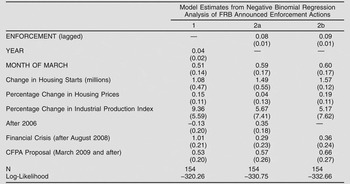
For the time-series of enforcement counts, I estimate the following two linear models, using the negative binomial distribution to map predictions from the linear battery of covariates (each parameterized by a scalar β, with the main variables of interest parameterized by γ) to the enforcement variable. The first model is:

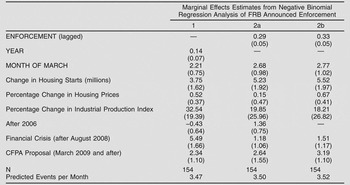
In this model, YEAR is a trend control, and MARCH denotes a binary variable scored 1 in March (to capture seasonal trends that may confound inference from the March 2009 CFPA proposal).Footnote 73 The variables Δ(HOUSINGSTARTS)t, %Δ(HOUSINGPRICES)t and %Δ(INDUSTRIALPRODUCTIONINDEX)t are monthly measurements of changes in national housing starts, median nationwide housing price (percentagized change), and the industrial production index (percentagized change), to measure month-to-month changes in economic and housing fundamentals that may shift enforcement actions.Footnote 74 From the model estimates, marginal effects (expected change for the enforcement counts for each one-unit shift in the relevant independent variable, holding all other variables at their means) are calculated and will be reported separately.
The logic of the first model is that the central variables (FINANCIALCRISIS)t and (CFPAPROPOSAL)t are ‘permanent’ shifts to the enforcement aggregates, such that the financial crisis of September 2008 and the CFPA proposal of March 2009 are coded as 1 in the months they occur and for every month thereafter until the end of the time series. The model is therefore not autoregressive. A second model introduces an autoregressive term and then shifts the major intervention to a six-month “boost,” after which the variable reverts to zero. This model is:

Results of model estimation appear in Table 1, with marginal effects estimates in Table 2.
Negative binomial regression estimates for monthly FRB enforcement, 1997–2010

Marginal effects from negative binomial estimates: FRB enforcement, 1997–2010

The estimates in Table 1 suggest that recent events have been associated with durable shifts in the Federal Reserve's announced enforcement activities. Each coefficient estimate represents the shift in the negative binomial regression function for a one-unit change in the independent variable. There would appear to be a statistically significant trend over time and an increase in the month of March. When the financial crisis and the introduction of the CFPA bill are represented as permanent shifts (model 1 in the leftmost column of estimates), each is associated with a statistically significant increase in the rate of announced enforcement actions. There is not, however, a statistically detectable increase beginning in 2007 when the rate of foreclosures began to skyrocket; indeed, the model estimate on (AFTER2006)t is negative, though statistically non-differentiable from zero.
When the autoregressive model is estimated (models 2a and 2b), and when the financial crisis onset and the CFPA bill are represented as six-month boosts, the explanatory power of the financial crisis (or related event beginning in September 2008) wanes considerably. The coefficient estimate is cut by 80 percent, and the estimate is no longer differentiable from zero. The estimate on the CFPA bill introduction rises slightly, however, and if the unstable variable after 2006 is dropped, the size of the CFPA bill variable increases appreciably.
The marginal effects estimates from the model estimated in Table 1 appear in Table 2. The over time trend from 1997 to the present suggests that for each year, 0.14 additional enforcement actions were taken. These actions would appear to be higher in the month of March by two to two-and-a-half announcements. An increase in housing start of one million would appear to be associated with five additional monthly announced enforcement actions; this is, however, difficult to interpret causally. When the financial crisis onset and the CFPA bill are represented as permanent shifts, then the crisis onset is associated with a 5.5-unit increase in the number of announced enforcement actions, while the CFPA bill introduction, net of the financial crisis, is associated with 2.3 additional enforcement actions per month. When these interventions are represented as six-month boosts, however, the picture changes considerably. The crisis onset in September 2008 is associated with a statistically meaningless 1.2 to 1.5 increase in monthly announced enforcement actions, while the CFPA bill's introduction in March 2009 is associated with a 2.6- to 3.2-unit increase in announcements. By reference, the associated increase for the CFPA bill's introduction ranges from 70 percent to 90 percent of the mean value of the predicted series, which is consistent with (albeit slightly below) the near-doubling observed in the graphical time-series above (Figure 2).
Supplementary Materials
Explanatory File http://journals.cambridge.org/pps2010022
Regression Data and Supplementary Material http://journals.cambridge.org/pps2010023