The increasing public health burden of multi-drug resistant organisms and antibiotic-associated adverse events such as Clostridium difficile colitis has underscored the importance of curbing the misuse of antibiotics. 1 Although stewardship efforts have largely focused on antibiotic use in the hospital,Reference Davey, Brown and Charani 2 for a patient hospitalized with a common infection, the majority of the antibiotic course is completed after hospital discharge.Reference Jenkins, Knepper and Sabel 3 , Reference Jenkins, Stella and Cevantes 4 Therefore, optimization of prescribing at the time of discharge may be important to overall antibiotic stewardship efforts. However, data on the appropriate use of antibiotics at hospital discharge is mostly limited to parenteral antibiotics.Reference Shrestha, Bhaskaran and Scalera 5 The objectives of this study were to perform a comprehensive evaluation of oral antibiotic prescribing practices at the transition from inpatient to outpatient care, to evaluate the appropriateness of antibiotic prescriptions at this transition, and to identify factors associated with inappropriate prescriptions. We hypothesized that a substantial proportion of antibiotics prescribed at the time of hospital discharge are inappropriate, thus representing an important opportunity for antimicrobial stewardship.
METHODS
Study Setting and Population
Denver Health is a vertically integrated, urban, public safety net healthcare system with a 475-bed teaching hospital, with an emergency department and federally qualified community health centers. Most patients are admitted to an inpatient teaching service; a minority was managed by a nonteaching hospitalist service.
Study Design
This study was a retrospective cohort study of adult inpatients prescribed an oral antibiotic at the time of hospital discharge between July 1, 2012, and June 30, 2013. Using our data archive, we identified patients 18 years or older who filled an oral antibiotic prescription at a Denver Health pharmacy within 7 days of hospital discharge. By manual chart review, cases were excluded that involved antibiotic prescriptions unrelated to the hospital stay, intravenous antibiotics at discharge, long-term prophylactic or suppressive antibiotics, absence of documentation of the indication for antibiotics, transfer to or from an outside institution, leaving against medical advice, failure to fill prescribed antibiotics, infection with non-bacterial pathogens, and re-hospitalization for an ongoing infection. For patients with multiple hospitalizations, only the initial hospitalization resulting in an oral antibiotic prescription was included. Using a combination of electronic data extraction and manual chart review, we collected data on demographic and clinical characteristics, microbiology, inpatient antibiotic therapy, discharge antibiotics (indication, agent, dose, and treatment duration), and clinical encounters within the Denver Health system during the 30 days following hospital discharge. Treatment failure within the 30-day follow-up period was defined as a change in antibiotic regimen or extension of planned treatment duration due to inadequate clinical response.
Appropriateness Review
A random sample of the study cohort was selected for evaluation of the appropriateness of discharge antibiotic prescription(s) by 2 infectious disease subspecialists. Each independently reviewed the extracted data and hospital discharge summary and compared the prescription(s) with institutional or national prescribing guidelines, when applicable. Using a standardized reporting form, the reviewers assessed the appropriateness of the indication for antibiotics, antibiotic selection, dose, and duration of therapy. The duration of therapy was considered inappropriate if it was >2 days longer or shorter than guideline recommendations.Reference Filice, Drekonja and Thurn 6 When classifications of appropriateness by the infectious disease physicians were discordant, the institutional Antimicrobial Stewardship Committee adjudicated the case.
Data Analysis
We selected a target sample size of 300 cases to obtain subgroups of 30–50 cases of the most common infections including community-acquired pneumonia (CAP), skin and soft tissue infection (SSTI), and urinary tract infection (UTI). Based on pilot data (unpublished), we estimated that 30%–50% of discharge prescriptions would be classified as inappropriate. To develop a multivariate logistic regression model of factors associated with inappropriate prescriptions with 5–7 variables, we performed appropriateness reviews on a random sample of 150 cases. Variables with a univariate association of P<.20 were considered for inclusion in a multivariate logistic regression model. Multicollinearity and potential confounding were investigated. All analyses were performed using SAS version 9.3 (SAS Institute, Cary, NC).
RESULTS
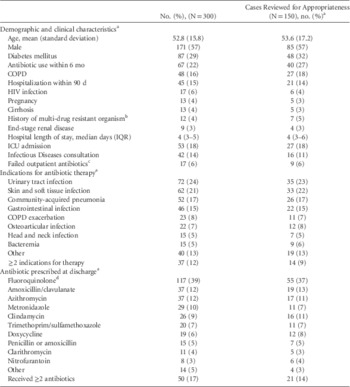
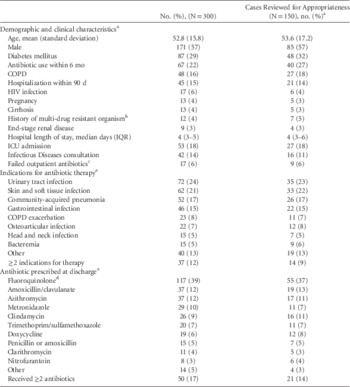
The initial electronic search identified 1,825 adults who filled an antibiotic prescription within 7 days of hospital discharge. To achieve the target sample size of 300 included cases, 376 randomly selected cases were reviewed (76 were excluded). Of the cases meeting study entry criteria, 295 of the antibiotic prescriptions (98%) were filled within 24 hours after hospital discharge; all antibiotics were filled within 48 hours after discharge. Demographic and clinical characteristics were similar between the total cohort and the random sample of 150 cases reviewed for appropriateness (Table 1). Most antibiotics prescribed were for patients discharged from the general medical service (222 cases, 74%).
Patient Characteristics, Treatment Indications, and Antibiotics Prescribed at Discharge
NOTE. COPD, chronic obstructive pulmonary disease; IQR, interquartile range; ICU, intensive care unit; HIV, human immunodeficiency virus.
a No significant differences were detected between the total cohort and the subset of cases reviewed for appropriateness (P>.05 for all subgroups).
b Defined as prior infection with methicillin-resistant Staphylococcus aureus, vancomycin-resistant Enterococci, or extended-spectrum β-lactamase–producing Enterobacteriaceae.
c Defined as lack of clinical response to outpatient therapy requiring hospital admission.
d Includes levofloxacin in 115 cases and ciprofloxacin in 2 cases from the total cohort.
At discharge, 263 patients (88%) had a single indication for the antibiotic(s) prescribed. UTIs (n=72; 24%), SSTIs (n=62; 21%), and CAP (n=52; 17%) accounted for 181 of all cases (60%) (Table 1).
A total of 221 patients (74%) had at least 1 microbiologic specimen collected. A specific pathogen was identified in 94 cases (31%), leaving 206 cases (69%) without microbiologic data to guide the discharge prescriptions. When a pathogen was identified, the most common organisms were Staphylococcus aureus (n=26; 14%), Escherichia coli (n=31; 10%), and Streptococcus spp. (n=24; 8%).
The median total antibiotic duration was 10 days (interquartile range [IQR], 7–13 days), with a median inpatient duration of 3 days (IQR, 3–5 days) and outpatient duration of 6 days (IQR, 4–10 days). The most commonly prescribed antibiotics were levofloxacin (n=115; 38%), amoxicillin/clavulanate (n=37; 12%), and azithromycin (n=37; 12%) (Table 1). In total, antibiotics with broad Gram-negative activity (ie, a fluoroquinolone or amoxicillin/clavulanate) were prescribed in 154 cases (51%).
A follow-up encounter within 30 days of hospital discharge was documented in 209 cases (70%). In total, treatment failure occurred in 32 cases (11%); readmission for the same condition occurred in 17 cases (6%); and an antibiotic-related adverse event occurred in 16 cases (5%). Of the antibiotic-related adverse events, gastrointestinal side effects were the most common (11 cases; 4%); Clostridium difficile colitis occurred in 4 cases (1%).
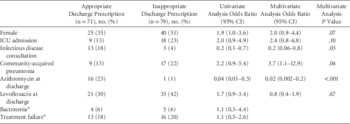
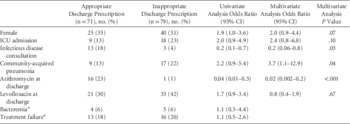
Of the 150 cases for which the discharge prescription(s) were reviewed for appropriateness, independent agreement occurred between the two infection disease specialists in 115 (77%; κ=0.53, P =.028). After adjudication of the 35 cases with discordant classifications, a total of 79 cases (53%) were classified as having inappropriate discharge prescriptions. UTI, CAP, and SSTI accounted for 53 (67%) of the conditions associated with inappropriate prescriptions. The most common reasons prescriptions were classified as inappropriate were excessive treatment duration (49 cases; 33%), suboptimal antibiotic selection (27 cases; 17%), incorrect dose (14 cases; 9%), and conditions not warranting antibiotic therapy (7 cases; 5%).
In the univariate analysis, gender was associated with inappropriate prescribing, while use of azithromycin at discharge and infectious disease consultation were significantly associated with appropriate prescribing (Table 2). In the final multivariate logistic regression model, CAP was independently associated with inappropriate prescriptions, while azithromycin and ID consultation were independently associated with appropriate prescriptions.
Logistic Regression Model of Factors Associated with Inappropriate Antibiotic Prescriptions
NOTE. CI, confidence interval; ICU, intensive care unit.
a Excluded from multivariate model due to non-significance in best-fit model.
DISCUSSION
To our knowledge, this is the first comprehensive description of oral antibiotics prescribed at hospital discharge for all treatment indications. Notably, 3 common infections (UTI, CAP, and SSTI) accounted for 60% of antibiotic prescriptions at the time of discharge. This finding mirrors a recent review of inpatient prescribing for antimicrobials in which genitourinary infections, lower respiratory tract infections, and SSTIs accounted for 61% of all infection-related indications for therapy.Reference Filice, Drekonja and Thurn 6 Of particular interest was the finding that UTI, CAP, and SSTI accounted for 67% of the inappropriate prescriptions, despite the presence of well-established institutional treatment guidelines for oral step-down therapy and duration of therapy for these conditions. Our findings suggest that these 3 conditions may be particularly high yield for future interventions. Of note, we previously implemented institutional treatment algorithms for the management of inpatient SSTIsReference Jenkins, Knepper and Sabel 3 and CAP (unpublished data); these interventions reduced the use of broad-spectrum antibiotics and shortened treatment durations. Therefore, we were surprised to find that CAP remained an independent predictor of inappropriate discharge prescriptions. This suggests that although institutional treatment guidelines can impact prescribing practices at the time of hospital discharge, novel interventions to improve prescribing at this transition in care are clearly needed.
Notably, ~50% of patients were discharged with antibiotics with broad Gram-negative activity, most commonly a fluoroquinolone, which comprised nearly 40% of prescriptions. This finding was also somewhat unexpected because neither fluoroquinolones nor amoxicillin/clavulanate are promoted as oral step-down therapy for common infections in our local treatment guidelines. In fact, use of levofloxacin for UTI and CAP has specifically been discouraged due to the problem of progressive fluoroquinolone resistance among E. coli in our institutionReference Johnson, Sabel and Burman 7 and its association with Clostridium difficile infection.Reference Vardakas, Konstantelias and Loizidis 8 Although the use of levofloxacin was not an independent predictor of inappropriate prescriptions in our logistic regression model, the volume of prescriptions of this antibiotic indicates that it may be an important target for stewardship efforts. Because microbiological data are available to guide discharge antibiotic selection in only a minority of cases, specific recommendations for fluoroquinolone-sparing regimens in the absence of microbiological data are likely needed to reduce use of this broad-spectrum antibiotic.
Similar to prior studies of SSTIReference Jenkins, Knepper and Sabel 3 and CAP,Reference Jenkins, Stella and Cevantes 4 ~65% of total treatment duration was completed after hospital discharge. This finding highlights that antimicrobial stewardship interventions focusing solely on inpatient antibiotic use may only impact a minority of the total antibiotic exposure for common infections and that interventions to shorten the total duration of therapy are necessary.
Our study has several important limitations. First, it involved a single academic safety-net hospital. Because local antimicrobial susceptibilities and treatment guidelines may impact prescribing, our findings may not be generalizable. Second, the retrospective study design and reliance on the discharge summary to document the indication for the antibiotics prescribed may have led to the misclassification of the appropriateness of therapy in some cases. Third, the retrospective design did not allow us to evaluate the underlying causes of inappropriate prescriptions. Finally, only patients filling their prescriptions within the Denver Health system were identified. We did not determine whether prescribing patterns were different for patients who filled their prescriptions at a pharmacy outside this system.
In summary, interventions to improve antibiotic prescribing at the time of hospital discharge for common infections such as UTI, CAP, and SSTI are needed. We found that half of discharge prescriptions were for agents with broad Gram-negative activity and that more than half of all discharge prescriptions were inappropriate. Our findings, along with the paucity of previous studies addressing this topic, suggest that oral antibiotic prescribing at the transition from inpatient to outpatient care is an important and underrecognized opportunity to improve antimicrobial use.
Acknowledgments
We are grateful to Katherine Shihadeh for her role in the Denver Health Antimicrobial Stewardship Committee.
Financial support: This work was funded in part by the Department of Patient Safety and Quality, Denver Health. Dr. Jenkins was supported by the National Institute of Allergy and Infectious Diseases, National Institute of Health (TCJ: K23 AI099082).
Potential conflicts of interest: All authors report no conflicts of interest relevant to this article.