Introduction
The lichen family Porinaceae is relatively well catalogued (McCarthy Reference McCarthy2000, Reference McCarthy2013; Lücking Reference Lücking2008). McCarthy (Reference McCarthy2013) listed 427 species, most of which are tropical and subtropical, and either corticolous or foliicolous. Forty-five species were listed under Trichothelium, and the remainder under Porina. Six genera were accepted by Lücking et al. (Reference Lücking, Hodkinson and Leavitt2016), and Flabelloporina has since been proposed (Sobreira et al. Reference Sobreira, Cáceres, Maia and Lücking2018). However, molecular data are still available only for a very limited number of taxa and gene regions. Sobreira et al. (Reference Sobreira, Cáceres, Maia and Lücking2018) recovered 14 clades within the family that may be interpreted as possible genera, although the analysis was based on small subunit mitochondrial ribosomal sequences representing only 41 species.
Since 2013, at least 20 species have been newly described in Porina, of which P. pseudohibernica (Tretiach Reference Tretiach2014) and P. rivalis (Orange Reference Orange2015) are from Europe. Ertz et al. (Reference Ertz, Sanderson, Coppins, Klepsland and Frisch2019) showed that the sterile lichen Opegrapha multipuncta belonged in Porina.
Materials and Methods
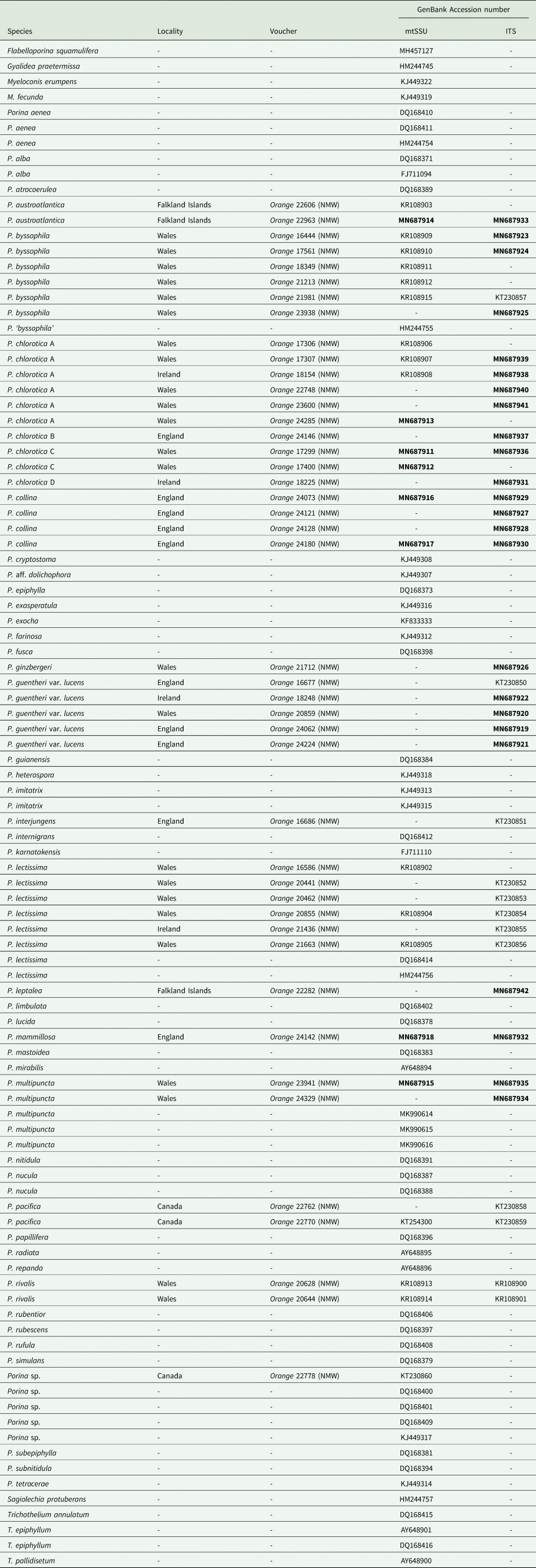
DNA was extracted from recently collected or frozen specimens using the Qiagen DNeasy Plant Mini Kit; the manufacturer's instructions were followed except that warm water was used for the final elution. PCR amplification was carried out using Bioneer AccuPower PCR Premix 50 μl reaction tubes. The two internal transcribed spacer regions and the 5.8S region (ITS1-5.8S-ITS2) of the nuclear ribosomal genes, and part of the small subunit of the mitochondrial ribosomal DNA (mtSSU) were amplified using the primers ITS1F, ITS4 and ITSPoR (see below), and mrSSU1 and mrSSU3R. The PCR thermal cycling parameters were: initial denaturation for 5 min at 94 °C, followed by 5 cycles of 30 s at 94 °C, 30 s at 55 °C, and 1 min at 72 °C, then 30 cycles of 30 s at 94 °C, 30 s at 52 °C and 1 min at 72 °C. PCR products were visualized on agarose gels stained with ethidium bromide and purified using the Sigma GenElute PCR Clean-Up Kit. Sequencing was performed by The Sequencing Service (College of Life Sciences, University of Dundee, www.dnaseq.co.uk) using Applied Biosystems BigDye v3.1 chemistry on an Applied Biosystems 3730 automated capillary DNA sequencer. Alignment of assembled sequences was carried out using BioEdit (http://www.mbio.ncsu.edu/BioEdit/ bioedit.html); ClustalW was used to create an initial alignment, which was edited manually. Ambiguously aligned regions were excluded from the analysis.
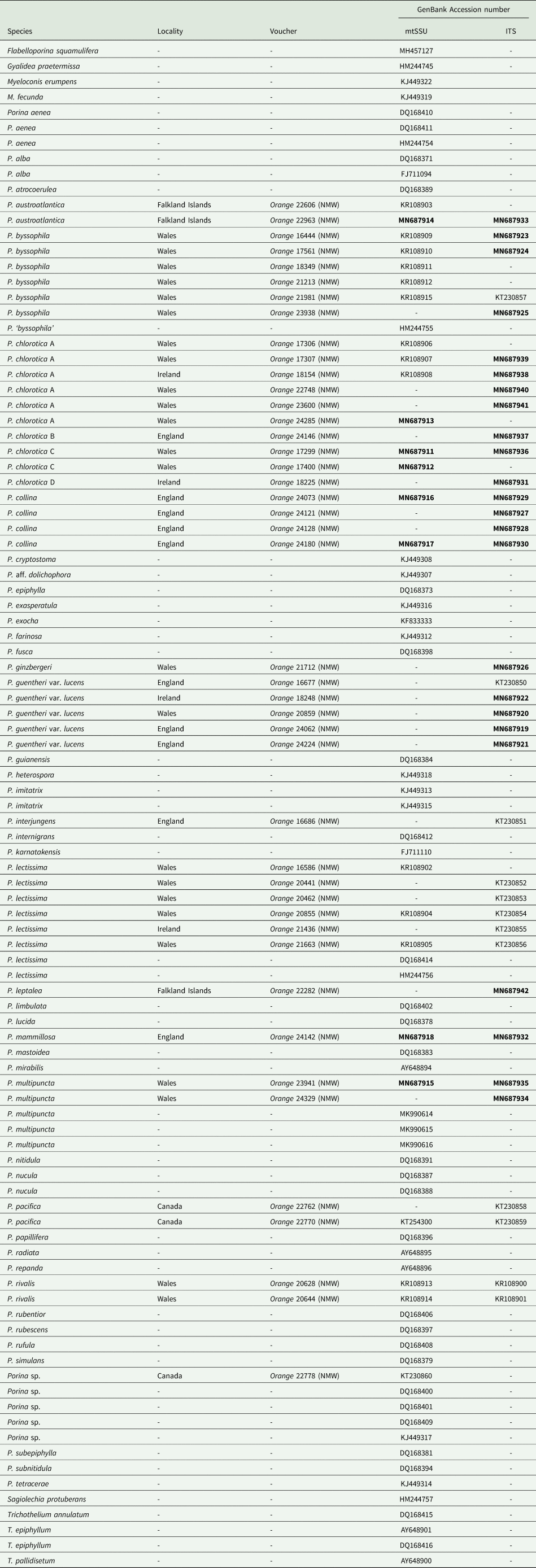
Phylogenetic relationships and support values were investigated using Maximum Likelihood (ML) bootstrapping, as implemented in RaxML (Stamatakis Reference Stamatakis2006; Stamatakis et al. Reference Stamatakis, Hoover and Rougemont2008), hosted on the CIPRES Science Gateway (Miller et al. Reference Miller, Pfeiffer and Schwartz2010). PartitionFinder v2.1.1 (Guindon et al. Reference Guindon, Dufayard, Lefort, Anisimova, Hordijk and Gascuel2010; Lanfear et al. Reference Lanfear, Calcott, Ho and Guindon2012, Reference Lanfear, Frandsen, Wright and Senfeld2017) was used to optimize partitions and substitution models. Three regions of the ITS (ITS1, 5.8S, ITS2) were used as input. No partitions were suggested for mtSSU. Parameters included linked branch lengths and greedy search, and the ‘--raxml’ command was used to limit the number of models to those used in RAxML. PartitionFinder returned GTR + G for ITS1 and ITS2, and GTR + I + G for the 5.8S region and the mtSSU. Analyses of ITS with RAxML used rapid bootstrapping with 1000 iterations and the GTRGAMMA substitution model; a search for the best-scoring ML tree was carried out with the bootstrap analysis in a single run. The resulting tree was visualized using MEGA v4 (Tamura et al. Reference Tamura, Dudley, Nei and Kumar2007). Support values of ≥ 70% ML bootstrapping were regarded as significant. Sequences used in the analyses are shown in Table 1.
Specimens used in the phylogenetic analyses with voucher information and GenBank Accession numbers. Letters A–D indicate unnamed taxa within Porina chlorotica s. lat. New sequences are in bold.
In the descriptions, the number of spores measured and the number of specimens from which spores were measured are given in square brackets. Localities of British and Irish specimens mostly use the relevant national grid, and specimens from other countries use latitude and longitude.
Results
Alignment and primer design
The ITS region in the available sequences of Porina is very variable and large parts cannot be aligned with confidence, suggesting that the sequences may not be closely related. However, the sequences share distinctive motifs in the 5.8S unit and at the 5′ end of the LSU. In the available sequences, the 3′ end of the 5.8S subunit ends in GAACGTYGTT; this motif was not present in any of the 433 ITS sequences of Ostropales downloaded from GenBank on 9 November 2019. In the available Porina sequences, the 5′ end of the LSU subunit has the sequence GGTTTCACTTCGGAT, whereas other Ostropales were NNNDYGACCTCSSAT.
PCR using the primer-pair ITS1F/ITS4 frequently failed, or amplified non-target fungi. A new reverse primer for the ITS region was designed with increased specificity for Porina, and named ITSPoR (5′ - CCT TGC CTG ATC CGA AGT GAA ACC G - 3′ ). This primer binds at the 5′ end of the LSU. Use of this primer instead of ITS4 resulted in much improved amplification, although the 3′ end of ITS2 is not recovered.
ITS analysis
ITS sequences were newly prepared for 25 specimens and 12 additional sequences were available from GenBank. The ITS alignment was 628 bp in length. A total of 333 bp were excluded from the analysis as they could not be unambiguously aligned (ITS1: 8 regions with a total of 175 bp, 5.8S: 2 regions with a total of 6 bp, ITS2: 4 regions with a total of 152 bp). After deletion of ambiguous regions, the alignment was 295 characters in length.
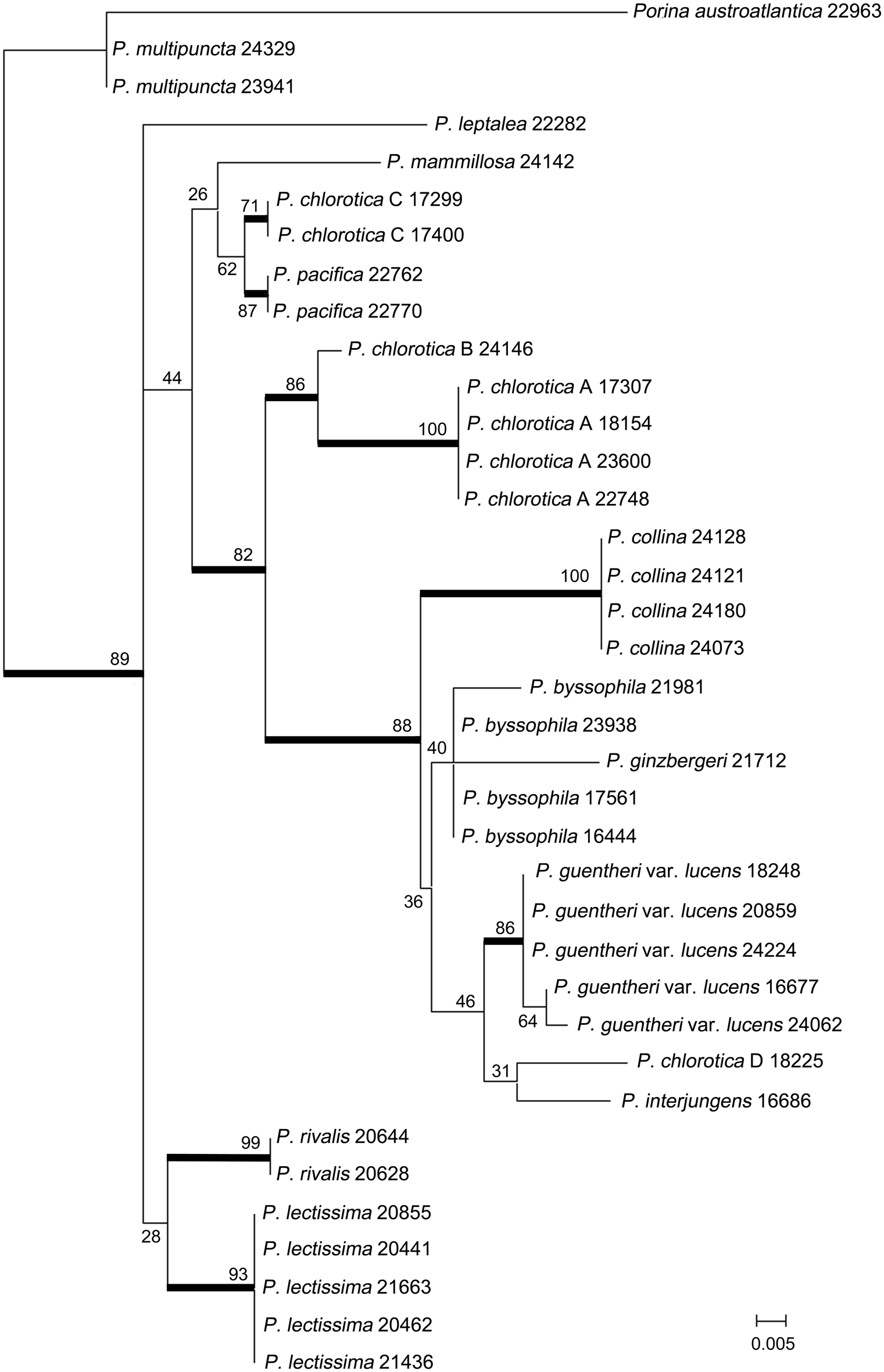
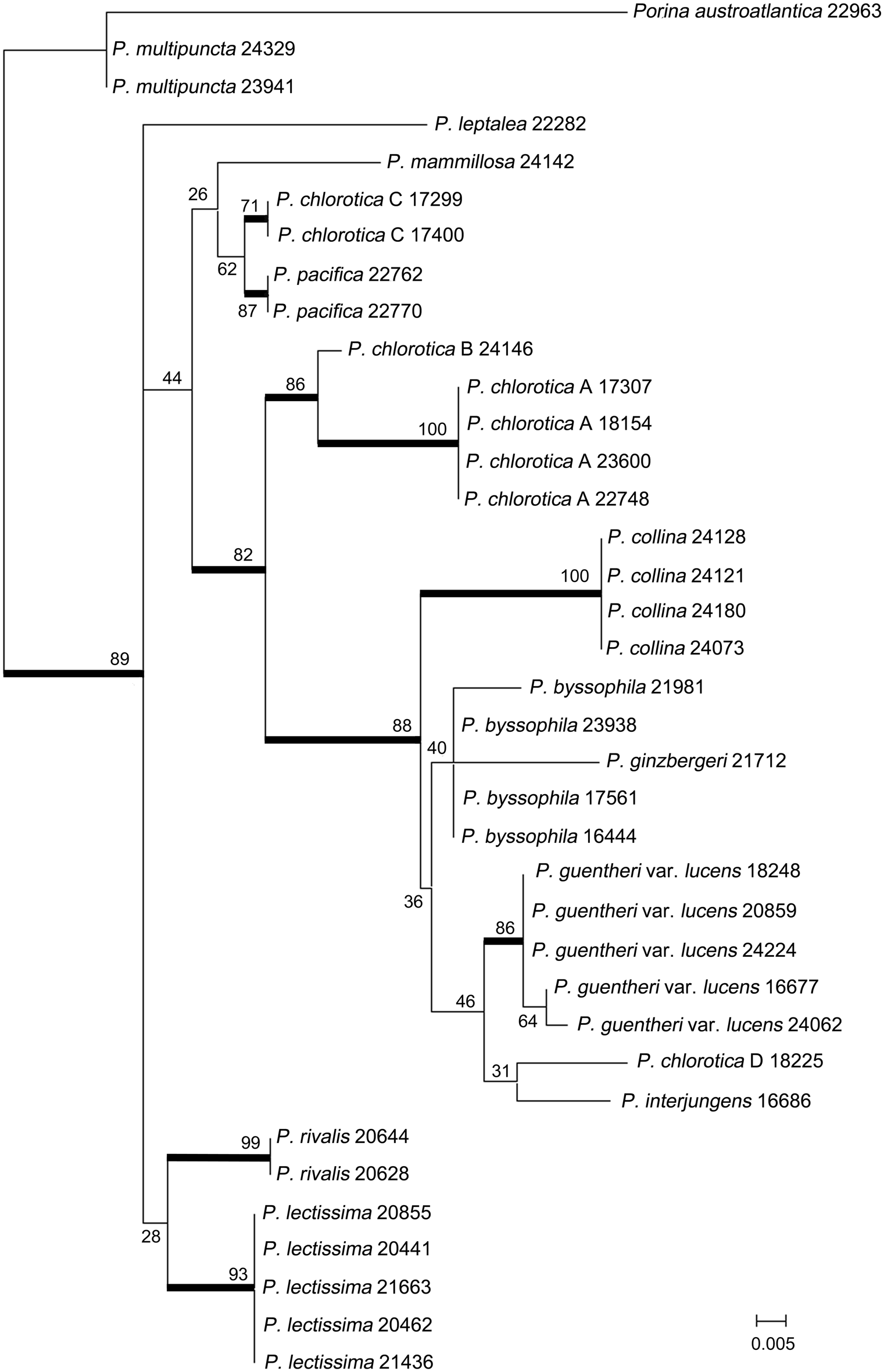
The tree resulting from analysis of the ITS1-5.8S-ITS2 region is shown in Fig. 1. Most nodes below the level of species are poorly supported and are consequently uninformative about the phylogenetic structure of the genus. Porina collina appears well separated from other species, in a well-supported group with Porina byssophila, P. chlorotica pro parte, P. guentheri var. lucens and P. interjungens. However, sequences were not available for all European species, some of which have vegetative propagules. The only other species in the tree which produces vegetative propagules, P. multipuncta, is not closely related. Specimens which conform to the traditional morphological concept of P. chlorotica form four clusters which probably represent separate species, provisionally named ‘P. chlorotica A–D’ pending further study. Porina ginzbergeri is nested within P. byssophila but this is an artefact resulting from the exclusion of unalignable regions from the analysis. The two species in the analysis that contain only a yellow to orange (Porina-yellow) pigment in the perithecium, P. lectissima and P. leptalea, are not recovered as closely related.
Phylogenetic relationships of Porina, based on a Maximum Likelihood (ML) analysis of the ITS region. The tree is mid-point rooted. Codes after each name represent voucher specimen numbers (Table 1) and letters A–D indicate unnamed taxa within Porina chlorotica s. lat.
mtSSU analysis
Partial mtSSU sequences were newly prepared for eight Porina specimens and 69 sequences of Porinaceae were selected from GenBank. After discarding ends of the alignment with few sequences, the alignment was 735 bp in length. A further 169 bp were excluded from the analysis as they could not be unambiguously aligned. After deletion of ambiguous regions, the alignment was 533 bp in length. Sequences of Gyalidea praetermissa and Sagiolechia protuberans were used as outgroup, suggested by a BLAST search for similar sequences.
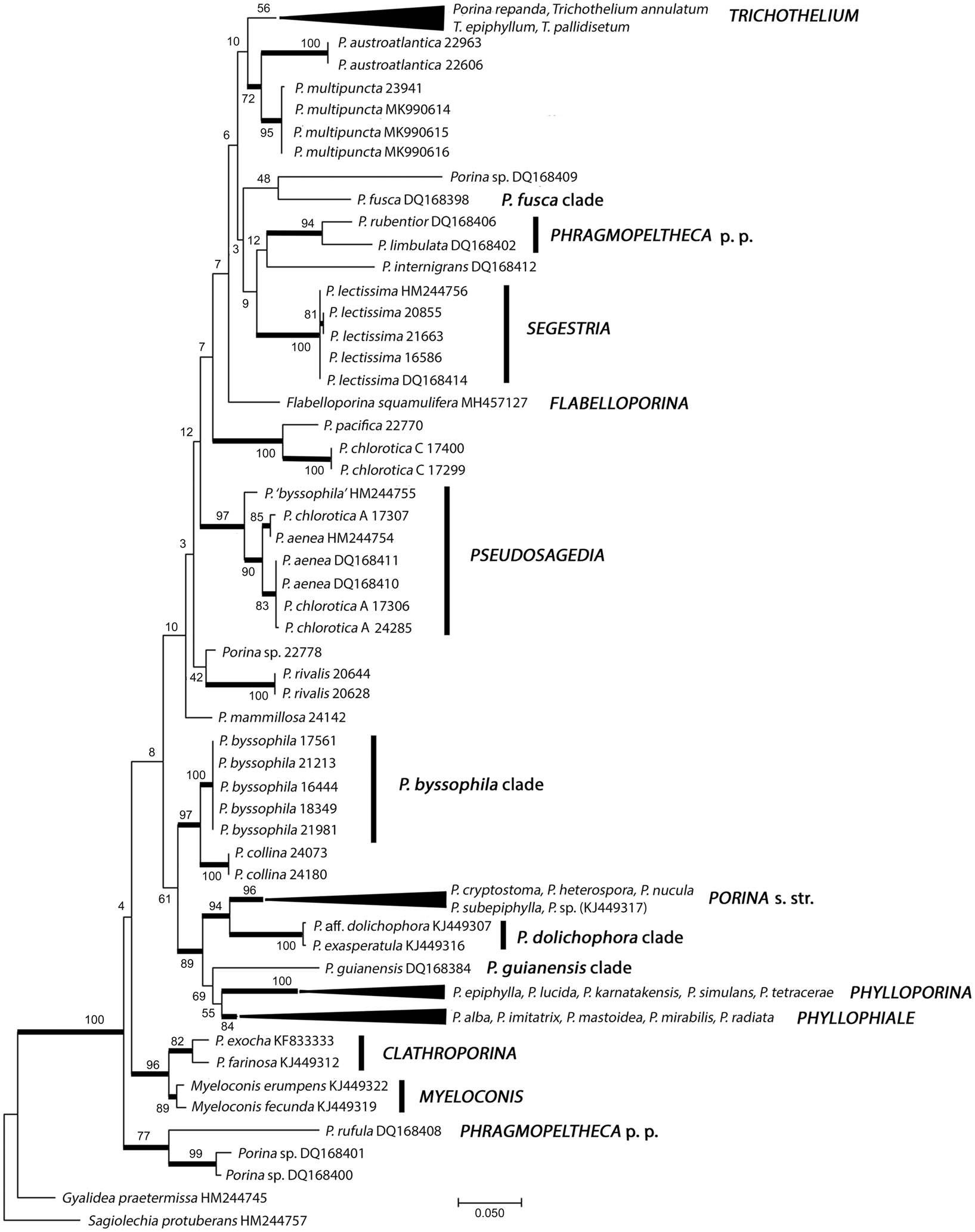
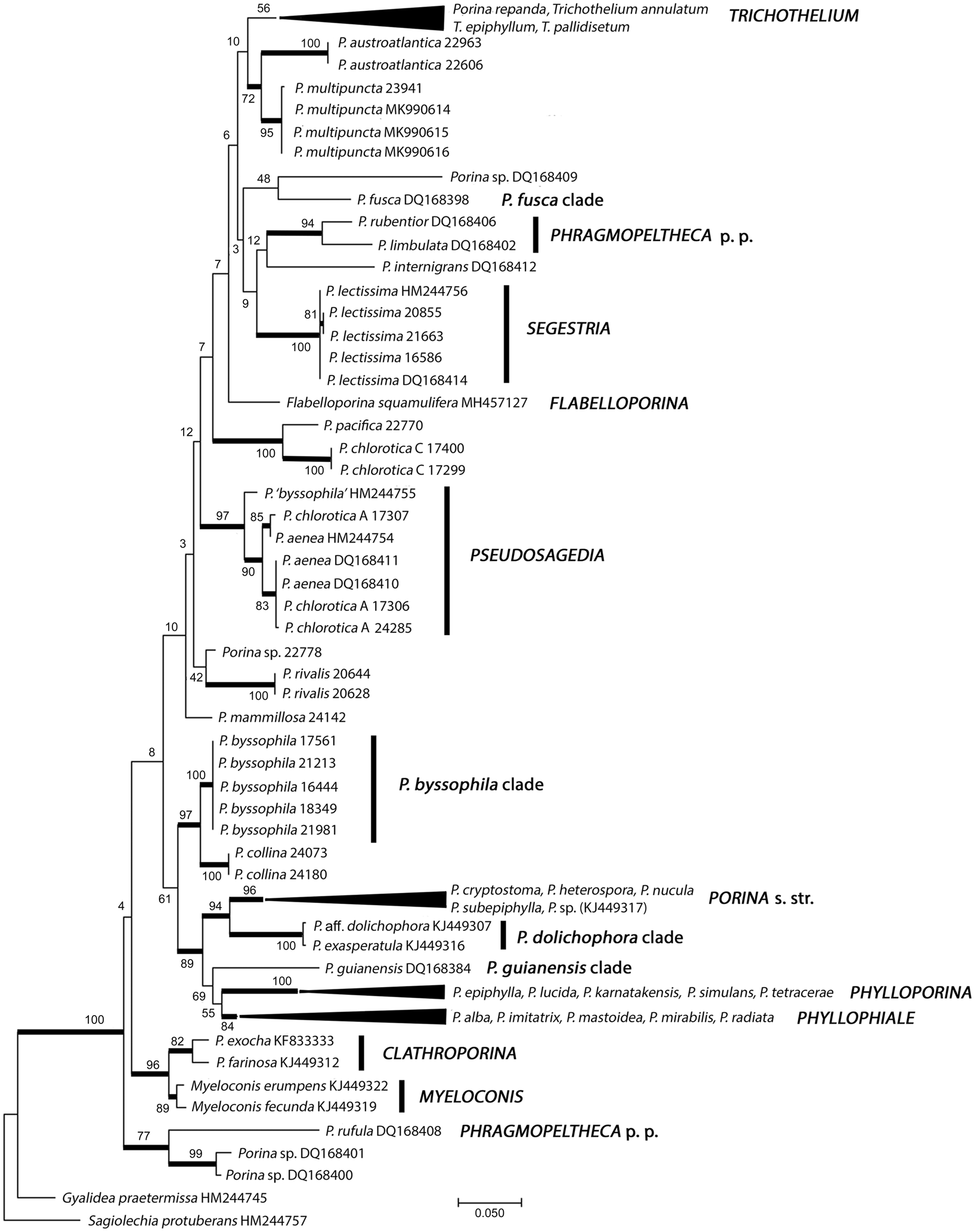
The tree resulting from analysis of the mtSSU is shown in Fig. 2. The basal nodes are poorly supported and are consequently uninformative about the phylogenetic structure of the genus. Porina collina is recovered in a well-supported clade with P. byssophila. Porina chlorotica ‘A’ is recovered as a well-supported clade with sequences named as P. aenea and one presumably misidentified as P. byssophila; two sequences of Porina chlorotica ‘C’ form a well-supported clade with one sequence of P. pacifica.
Phylogenetic relationships of Porina, based on a Maximum Likelihood (ML) analysis of the mitochondrial SSU. The tree was rooted using Gyalidea praetermissa and Sagiolechia protuberans. The ML bootstrap value is shown adjacent to each branch. Branches in bold indicate a support of ML bootstrap ≥ 70%. The provisionally named clades recovered by Sobreira et al. (Reference Sobreira, Cáceres, Maia and Lücking2018) are shown to the right. Information for strains used is given in Table 1 and letters A–D indicate unnamed taxa within Porina chlorotica s. lat.
The Species
Porina collina Orange, Palice & Klepsland sp. nov.
MycoBank No.: MB 834374
Differing from other species of Porina in the combination of fragile, isidioid propagules forming finely granular mounds, the dark purplish brown exciple, 3-septate ascospores, and habitat on siliceous rock.
Type: Great Britain, England, Westmorland (V.C. 69), Helvellyn, Brown Cove, Water Crag, national grid NY3390.1544, latitude and longitude 54.52999°N, 03.02283°W, alt. 810 m, on slightly flushed steep face of low rocks, with Andreaea rothii, Racomitrium sudeticum, Kiaeria blytii and Rhizocarpon lavatum, 9 July 2018, Alan Orange 24073 (NMW—holotype).
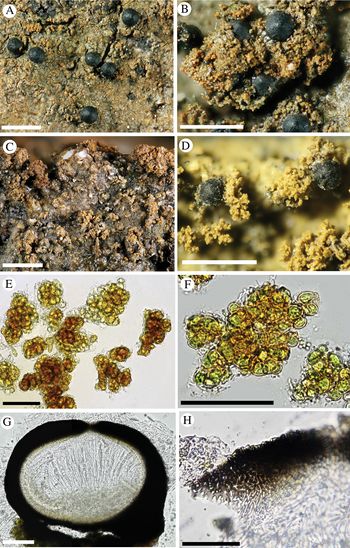
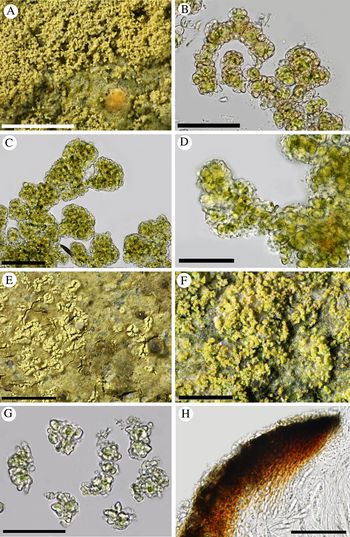
Porina collina. A & B, holotype, with isidia and perithecia. C, Orange 24121, sterile thallus with isidia. D, Klepsland JK14-L214. E, Orange 24121, isidial fragments. F, Orange 24180, isidial fragments. G, holotype, section of perithecium. H, Orange 24180, thin section near apex of exciple, in water. Scales: A–D = 1 mm; E, F & H = 50 μm; G = 100 μm.
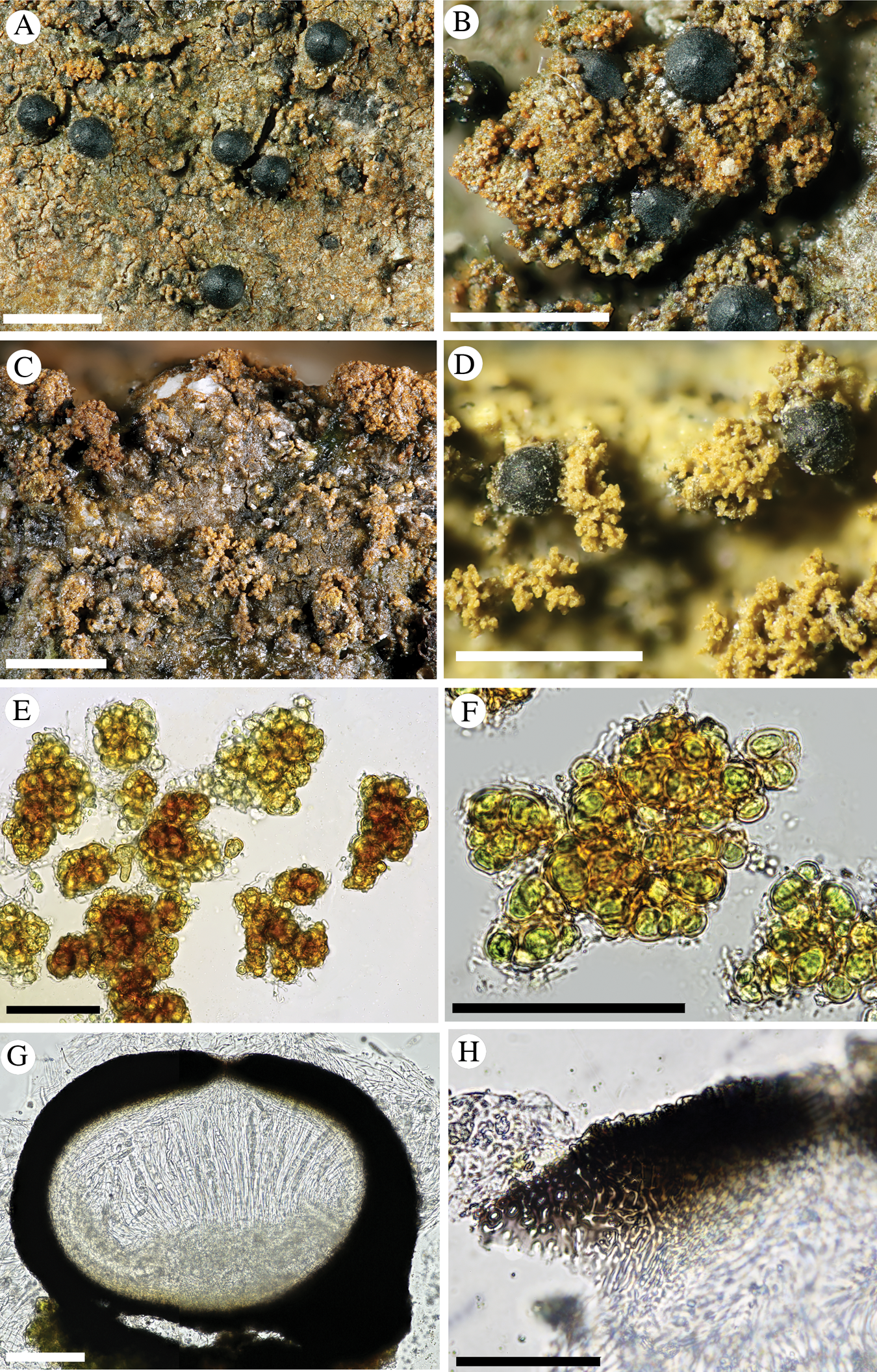
Prothallus not seen. Thallus superficial, thin, 20–125 μm thick, light to dull greenish orange-brown, uneven, continuous or with a very few small cracks. Cortex absent. Photobiont trentepohlioid, cells distributed throughout the thallus, mostly single, 11–18 × 10–13 μm, with thick walls 0.5–3 μm thick. Isidia arising singly on the thallus surface, later forming patches which are irregular in shape, convex, concolorous with the unbroken thallus, soon confluent and sometimes covering much of the thallus, pale dull orange when fresh, fading in the herbarium; isidial patches finely granular, granules poorly-defined and appearing 10–40 μm under the stereomicroscope, individual isidia not distinguishable; sometimes the patches densely coralloid, evidently comprising congested and densely branched units. Isidia disintegrating in water even without pressure, forming granules 30–150(–250) × 30–125(–150) μm as measured under the compound microscope, irregular in shape and poorly delimited from each other. Granules with the photobiont cells not completely enclosed by hyphae, frequently exposed at the surface; hyphae sparse within the granules. Photobiont in isidia trentepohlioid, cells single or paired (rarely a chain of three), 7–20 × 6–17 μm, with thickened walls 1–3 μm thick.
Ascomata perithecioid, globose, 220–420 μm diam., immersed in thallus at base, with inconspicuous ostiolar region. Involucrellum absent. Exciple more or less continuous around centrum, dark purplish brown, K+ grey to dark grey-brown to dark greenish grey, inner part yellowish, K+ intensifying. Ascus apex rounded, without thickening or refractive ring. Ascospores 3-septate, 24–43 × 5.5–6 μm, hyaline [few mature spores seen].
Conidiomata not detected.
Etymology
From the Latin word ‘collina’ (pertaining to hills), referring to the known habitat in Great Britain.
Ecology and distribution
On steep or slightly overhanging siliceous rock faces in forest or upland grassland. At the British locality on Helvellyn it grows on rocks in grassland and heath at an altitude of 745–810 m, on faces which are moist or seasonally slightly flushed; associated species include Enterographa zonata, Lecidea phaeops, Porpidia contraponenda, P. macrocarpa, Rhizocarpon lavatum and Trapelia placodioides, and the bryophytes Andreaea rothii, A. rupestris, Diplophyllum albicans, Kiaeria blyttii, Marsupella emarginata, Racomitrium aquaticum, R. fasciculare and R. sudeticum. Central European localities are in humid forested valleys of a stream and a small river; in one specimen from a damp sheltered rock (Palice 27177), the accompanying lichens included ombrophobic species such as Lepraria spp. and Cystocoleus ebeneus. Isidioid tufts of Porina collina may spread over tufts of adjacent bryophytes (Andreaea rupestris in Palice 27769). The species is currently known from a small number of localities in the Czech Republic, Great Britain and Norway.
Notes
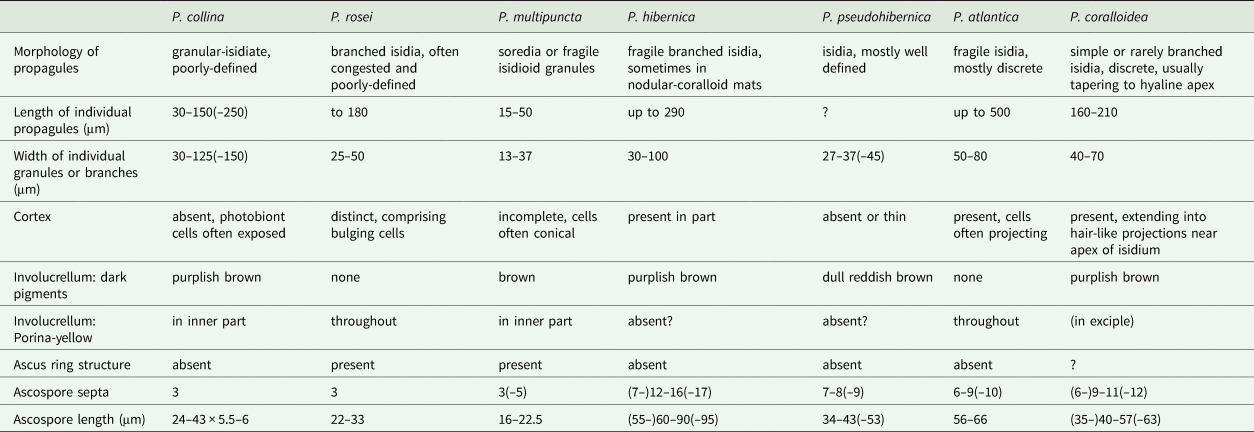
The vegetative propagules of Porina collina do not fit easily into the standard categories of propagule, such as isidia, soredia and blastidia. The propagules arise as minute protuberances but soon form masses which superficially resemble soralia. However, the appearance of the surface of the masses suggests that they increase by branching or budding of the individual units within the mass, although the masses are so fragile that no trace of branching can be seen in microscopic preparations, as the mass disintegrates into very small, irregularly-shaped granules. However, the propagules resemble those found in Porina rosei, and to a lesser extent those in P. hibernica and P. pseudohibernica, which have been regarded as isidia (Sérusiaux Reference Sérusiaux1991; Tretiach Reference Tretiach2014). The isidia of P. collina are more fragile and less discrete than in any of these three species.
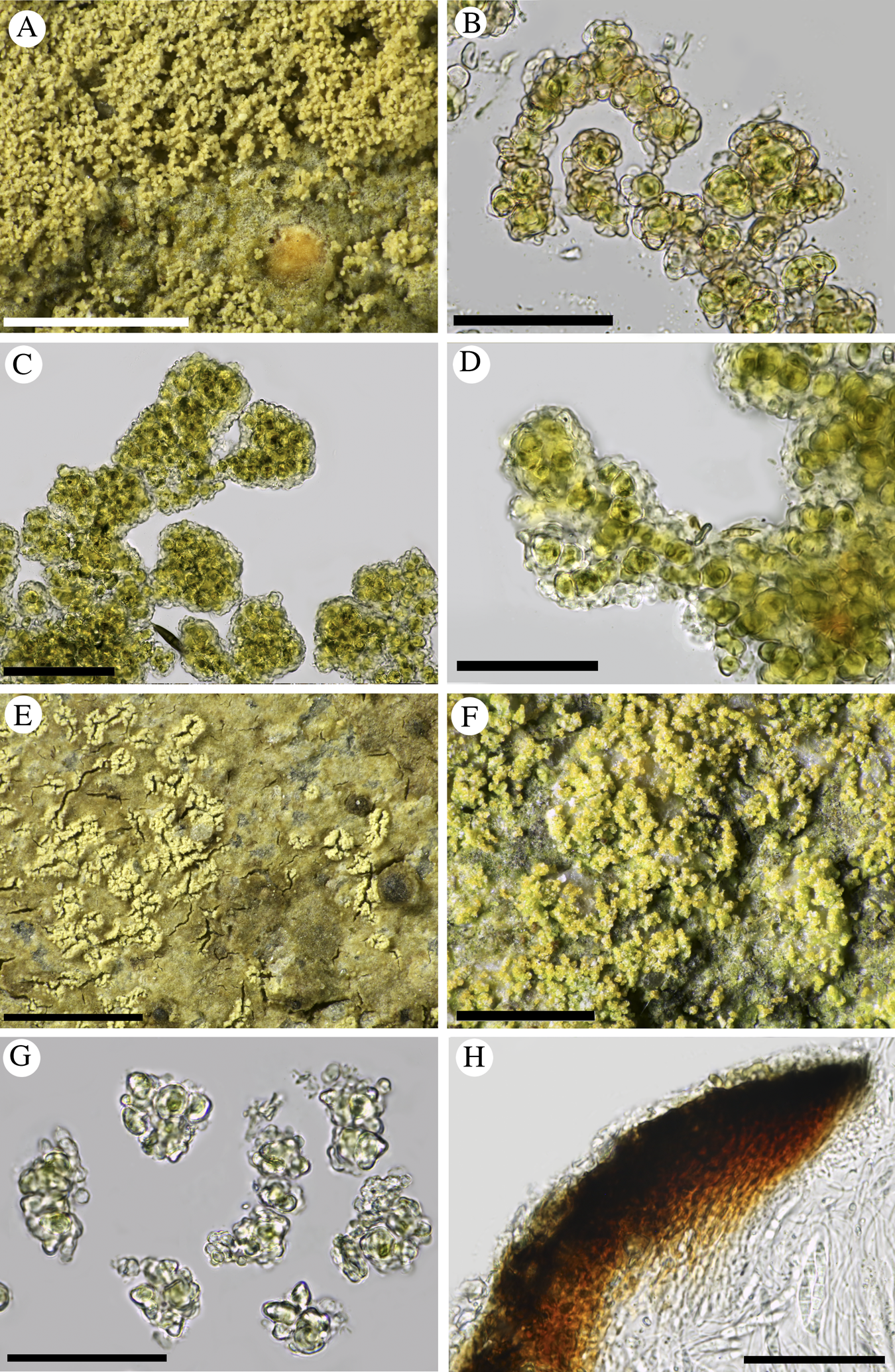
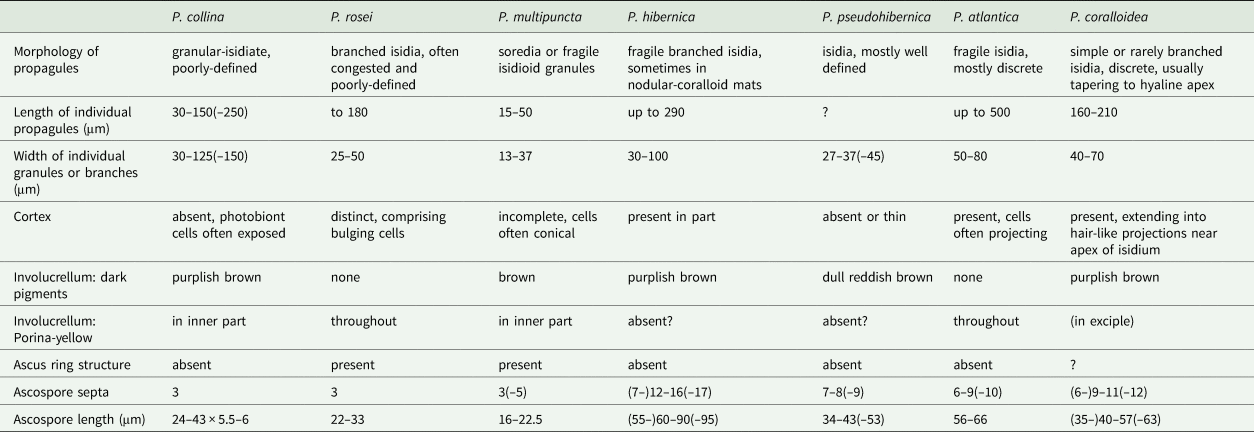
Porina rosei differs from P. collina in the isidia which have a distinct cortex, appearing as bulging hyaline cells in microscopic preparations (Fig. 4A & B); P. hibernica differs in the more robust isidia, 30–100 μm wide, which retain traces of branching in microscopic preparations and also have at least a partial cortex (Fig. 4C & D). Porina pseudohibernica has rather discrete isidia which are less fragile and have a thin cortex (Tretiach Reference Tretiach2014). These species also differ in characters of the exciple and ascospores: exciple with only Porina-yellow pigment in P. rosei, ascospores (7–)12–16(–17)-septate in P. hibernica, and ascospores 7–8(–9)-septate in P. pseudohibernica. The European species of Porina which have vegetative propagules are compared in Table 2.
Porina rosei, P. hibernica and P. multipuncta. A & B, P. rosei, Orange 16445, isidia. C & D, P. hibernica, Orange 14033, isidia. E, P. multipuncta, Orange 10999. F, P. multipuncta, Orange 24329. G, P. multipuncta, soredia, Orange 13839. H, P. multipuncta, apex of exciple in K, Orange 10999. Scales: A & E = 1 mm; B, D, G & H = 50 μm; C = 100 μm; F = 500 μm.
Comparison of European Porina species with vegetative propagules.
Porina multipuncta has propagules which are usually clearly identifiable as soredia (for instance in Orange 10999, 13839 and 23941). The soralia arise at the margins of small cracks in the thallus, and the thin thallus is eroded as they expand, sometimes exposing the rock beneath (Fig. 4E). The soredia are very fine, appearing c. 20 μm under the dissecting microscope and not showing any tendency to form branching clusters or isidioid structures. Under a compound microscope, the soredia are very small, isodiametric to irregularly elongated, 15–45 × 13–25 μm; with gentle pressure from a coverslip the soredia further disintegrate into units as small as c. 18 μm. The photobiont cells are partly enclosed by hyphae; hyphae appressed to cells are up to 5 μm thick and sometimes appear conical in side view, giving a slightly angular appearance to some soredia (Fig. 4G). In some specimens (Orange 24329) the propagules are less obviously soredia; propagules arise on the thallus surface and develop into very fragile aggregations of minute granules measuring 25–50 × 25–37 μm under high power, scattered across the surface at varying density but not forming discrete patches; the thallus cortex is not obviously broken and the thallus does not become obviously eroded (Fig. 4F). Propagules of this sort are more or less intermediate in appearance between true soredia and the propagules of P. collina.
Ascomata in P. multipuncta are reported here for the first time (in Orange 10999, Fig. 4E), and they also differ from those in P. collina: the involucrellum is brown at the surface in water, K−; orange within, K+ orange-red; the subhymenium is orange, K+ dark orange (Fig. 4H). Beside the ostiole there is a small area of pigment which is grey in K, but no purplish tints were seen. The ascus narrows to a slightly truncate apex containing a chitinoid ring structure; the ascospores are 16–22.5 × 3–5.5 μm, 3(–5)-septate [17/1]. In this specimen (Orange 10999), the thalli of P. multipuncta are sorediate with locally numerous perithecia. Porina chlorotica is also present but the thalli are darker. Porina chlorotica has only a small amount of orange pigment in the perithecium, sometimes visible in K near the top of the centrum, whereas in the perithecia associated with the sorediate thalli, orange pigment is abundant. However, the association of thallus and perithecia should be confirmed by sequencing when fresh material becomes available.
When sterile, Porina collina may be confused in the field with Gyrographa gyrocarpa, which can also grow on moist, exposed rock faces in addition to its more usual habitat of rain-sheltered faces. In G. gyrocarpa, the unbroken thallus is dull dark brown and the soralia tend to be a more vivid orange colour, C+ red (gyrophoric acid).
Additional specimens examined
Great Britain: England: V.C. 69, Westmorland, Helvellyn, Red Tarn, NY3462.1500, alt. 800 m, 2018, Orange 24121 (NMW); Helvellyn, Red Tarn, NY3430.1520, 2018, Orange 24128; Helvellyn, Brown Cove below Catstye Cam, NY3444.1560, alt. 745 m, 2018, Orange 24143 (NMW); Helvellyn, Red Tarn, NY3465.1506, alt. 750 m, 2018, Orange 24180 (NMW).—Norway: Nordland: Gildeskål, Vigdel, moist Betula forest, 67°00′03″N, 13°52′46″E, on gneissic rock under overhang, alt. 35 m, 2015, Klepsland JK14-L214 (hb. J. Klepsland, dupl. NMW).—Czech Republic: North Bohemia: W. Sudetes, Krkonoše Mts, Kořenov, valley of Jizera, managed beech forest on a bouldery slope with some Picea and Betula on N-facing slope, 50°45′28.5″N, 15°23′57.5″E, on shaded vertical siliceous rock, alt. 655 m, 2015, Palice 20895 & Uhlík (PRA). West Bohemia: Šumava Mts, Hamry, Bílá Strž Nature Reserve, mica-schist outcrops in forest on W-facing slope above the right bank of the brook Bílý potok, 49°11′45.7″N, 13°09′23.5″E, on humid and shaded overhanging mica-schist rock, alt. 805 m, 2019, Palice 27177 & Uhlík (PRA); Šumava Mts, Hamry, Bílá Strž Nature Reserve, humid forest below the highest waterfall, just below the view of it on the left bank of the brook Bílý potok, 49°11′26.2″N, 13°09′25.1″E, on damp mica-schist rock, alt. 910 m, 2019, Palice 27769 & Uhlík (PRA).
Specimens of other species figured, cited, or newly sequenced
Porina austroatlantica. Falkland Islands: West Falkland: Saunders Island, 51.31114°S, 60.10552°W, 2015, Orange 22963 (NMW).
Porina byssophila. Great Britain: Wales: V.C. 35, Monmouthshire, Chepstow, Pierce Wood, 31/537.961, 2006, Orange 16444 (NMW); V.C. 41, Glamorgan, Southerndown, Dunraven Park, 21/8937.7319, 2008, Orange 17561 (NMW); V.C. 42, Breconshire, Elan Valley, west of Rhiwnant, Nant y Car North Mine, 52.24419°N, 03.62591°W, 2018, Orange 23938 (NMW).
Porina chlorotica s. lat. Great Britain: Wales: V.C. 43, Radnorshire, Nannerth, 22/950.715, 2007, Orange 17307 (NMW); V.C. 45, Pembrokeshire, Rosebush, 22/0790.3048, 2008, Orange 17400 (NMW); V.C. 46, Cardiganshire, Coedmor NNR, 52.06567°N, 04.64043°W, 2017, Orange 23600 (NMW); V.C. 47, Montgomeryshire, Hafren Forest, 22/868.866, 2007, Orange 17299 (NMW); V.C. 48, Merioneth, near Corris, Nant Cildydd, 23/7392.1135, 2015, Orange 22748 (NMW). England: V.C. 70, Cumberland, Keswick, Strutta Wood, 35/269.196, 2018, Orange 24146 (NMW).—Ireland: V.C. H1, South Kerry, Cooncrome Harbour, 00/4439.8192, 2009, Orange 18225 (NMW). V.C. H6, Limerick, near Abbeyfeale, 01/2720.2408, 2009, Orange 18154 (NMW).
Porina ginzbergeri. Great Britain: Wales: V.C. 44, Carmarthenshire, Carmel NNR, 22/5999.1642, 2014, Orange 21712 (NMW).
Porina guentheri var. lucens. Great Britain: Wales: V.C. 44, Carmarthenshire, near Rhandirmwyn, Dinas, 22/7798.4676, 2012, Orange 20859 (NMW). England: V.C. 69, Westmorland, Windermere, 54.41898°N, 02.96950°W, 2018, Orange 24062 (NMW); V.C. 70, Cumberland, Combe Gill, 54.50771°N, 03.15657°W, 2018, Orange 24224 (NMW).—Ireland: V.C. H1, South Kerry, Cloonaghlin Lough, 00/6073.7057, 2009, Orange 18248 (NMW).
Porina hibernica. Great Britain: Wales: V.C. 48, Merioneth, Plas Tan-y-Bwlch, 23/6576.4094, 2002, Orange 14033 (NMW).
Porina leptalea. Falkland Islands: East Falkland: Mount Kent, 51.67551°S, 58.11231°W, 2015, Orange 22282 (NMW).
Porina multipuncta. Great Britain: Wales: V.C. 42, Breconshire, Rhiwnant, Nant y Car North Mine, 52.24378°N, 03.62527°W, 2018, Orange 23941 (NMW); V.C. 46, Cardiganshire, Coedmor NNR, 22/195.432, 1996, Orange 10999 (NMW); V.C. 48, Merioneth, Bryn Bwbach, 23/6295.3642, 2002, Orange 13839 (NMW); E of Llyn Gwernan, SH7085.1586, 2019, Orange 24329 (NMW);
Porina rosei. Great Britain: Wales: V.C. 35, Monmouthshire, Chepstow, Pierce Wood, 31/537.961, 2006, Orange 16445 (NMW).
Discussion
Porina collina is currently known from few localities, though it is possible that it has been overlooked when sterile. The limited molecular data suggest that the species is related to P. byssophila, P. guentheri, P. interjungens and a taxon which has been included in P. chlorotica. Porina byssophila was recovered in the ‘Porina byssophila clade’ by Sobreira et al. (Reference Sobreira, Cáceres, Maia and Lücking2018), but the other species mentioned above were not included in their analysis. These saxicolous or corticolous temperate species have dark pigments in the perithecial wall and ascospores which range from 3- to 7-septate or submuriform. However, several other saxicolous species with dark pigments and 3(–5)-septate ascospores were recovered in different clades, including P. chlorotica s. lat. (two clades, one of them named Pseudosagedia by Sobreira et al. (Reference Sobreira, Cáceres, Maia and Lücking2018)), P. multipuncta and P. rivularis. The morphological distinctions between these clades are likely to be subtle, and it is convenient to retain all of them within Porina until more molecular data are available.
Acknowledgements
We would like to thank the two reviewers and the editor for their helpful comments. ZP acknowledges the long-term development research project RVO 67985939.
Author ORCIDs
Alan Orange, 0000-0002-3181-5435.