Implications
Early weaning of rabbits offers nutritional and animal health benefits, enabling the provision of a diet adapted to the young rabbits’ requirements from a very early age and limiting the transmission of pathogenic agents between the mother and young. These factors also have an impact on food safety and animal welfare. According to our results, the weaning age (21, 28 or 35 days) did not cause considerable changes in the digestive physiological parameters measured; however, weaning on day 21 resulted in poor growth in rabbits.
Introduction
In rabbit production, the time around weaning is the most crucial period, when rabbits are highly sensitive to multifactorial digestive disorders. High mortality and morbidity have serious economic impact on rabbit meat production. The digestive tract of young animals is exposed to many changes around weaning, for example, anatomical development, introduction of microbial fermentation and caecotrophy, maturation of the digestive enzymes and the immune system. Many of these changes are determined by ontogenesis, but can be significantly influenced by other factors such as weaning age and diet (Kelly and Coutts, Reference Kelly and Coutts2000).
Weaning is usually carried out between 28 and 35 days of age. Early weaning of rabbits offers nutritional and animal health benefits, enabling the provision of a diet adapted to the young rabbits’ requirements from a very early age and limiting the transmission of pathogenic agents between the mother and young. In contrast, it has been hypothesised that an inappropriate feeding strategy around early weaning can be responsible for an increased sensitivity to enteropathies, and thus digestive maturation and the way it is influenced by the diet should be studied more thoroughly (Gidenne and Fortun-Lamothe, Reference Gidenne and Fortun-Lamothe2002). The effects of different diets at early weaning (at <26 days of age) have been studied by many authors. For instance, Gutierrez et al. (Reference Gutierrez, Espinosa, Garcia, Carabano and DeBlas2002) showed the effect of starch, fibre and lactose levels on digestion and growth, whereas Cesari et al. (Reference Cesari, Toschi, Ferrazzi, Cesari, Grilli and Lavazza2007) studied the relationship between nutritive value of the diet and weaning age. The data of Feugier et al. (Reference Feugier, Smit, Fortun-Lamothe and Gidenne2006), who investigated the fibre and protein requirement of early weaned rabbits, suggested that the detrimental effect of early weaning was not compensated for by a diet better meeting the young rabbits’ nutrient requirements. Few experiments have been conducted in which only the impact of age at weaning was studied (Gallois et al., Reference Gallois, Gidenne, Fortun-Lamothe, Le Huerou-Luron and Lalles2005 and Reference Gallois, Le Huërou-Luron, Fortun-Lamothe, Lalles and Gidenne2008).
The aim of this study was to examine the effect of age and weaning on growth and certain parameters of the digestive tract in rabbits to assess the risk of early weaning for higher morbidity attributable to the presumably less-developed digestive system.
Material and methods
Experimental animals
Pannon White does and their kits were housed in flat-deck cages (85 × 55 cm), whereas after weaning the growing rabbits were housed in two-level wire mesh cages (two kits per cage, 84 cages per treatment) in a closed building. Average temperature ranged from 21°C to 29°C, the light was on between 0500 and 2100 h, and the farm had overpressure ventilation.
The 1-day-old kits of average birth weight were distributed into litters of eight, and these litters were randomly divided into three groups of 21 l (i.e. 168 animals per group) according to weaning age – rabbits weaned at the age of 21 (G21), 28 (G28) or 35 (G35) days. A total of 504 rabbits were used in the experiment.
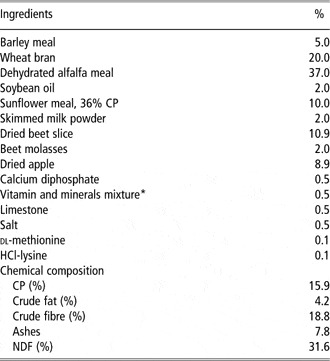
From 3 days before kindling up to weaning, the does were fed a non-medicated basal diet (Table 1). Young rabbits were allowed to consume the same diets besides their mother's milk before weaning and then after weaning, up to the end of the experiment at 42 days of age, ad libitum. The diet contained 9.7 MJ/kg DE, 15.9% CP, 4.2% crude fat and 31.6% NDF, according to the recommendations made by De Blas and Mateos (Reference De Blas and Mateos2010) for growing rabbits.
Ingredients and chemical composition of the diet

*Premix provided per kg of diet: 11 000 IU vitamin A, 2000 IU vitamin D3, 2.5 mg vitamin B1, 4 mg vitamin B2, 1.25 mg vitamin B6, 0.01 mg vitamin B12, 25 mg vitamin E, 0.06 mg biotin, 2.5 mg vitamin K, 15 mg niacin, 0.3 mg folic acid, 600 mg choline, 3 mg Cu, 50 mg Fe, 15 mg Zn, 60 mg Mn, 0.5 mg I, 0.5 mg Co, 0.5 mg lysine and 0.5 mg methionine.
Milk intake of the litter was determined weekly by weighing does before and after nursing. Pellet consumption of the litter was measured by caging young rabbits separately from the mothers from 10 days of age. BW was measured weekly. Weight gain and feed conversion (g intake/g gain) were calculated.
Samplings
At 14, 21, 28, 35 and 42 days of age, six healthy animals from each group (one animal per cage) were randomly selected and killed/slaughtered at 1400 h. The digestive tract was removed immediately and the stomach, the small intestine and the caecum were separated. The quantity of the fresh gastric, small intestinal and caecal contents was measured and their pH values were determined using a pH meter (OP-110, Radelkis, Hungary). One gram of caecal digesta was used immediately after sampling for microbiological culture, and anaerobic conditions were ensured by the use of carbon dioxide. The rest of the caecal content was weighed, frozen and stored at −80°C until analysed for volatile fatty acid (VFA) content.
The weight of the liver, heart, kidneys and lungs, as well as of the empty stomach, small intestine and caecum was measured. Relative weights were calculated; the weight of the liver, heart, kidneys and lungs was expressed in % of BW, and the relative weight of the empty stomach, small intestine and caecum was expressed as a percentage of the weight of the gastrointestinal (GI) organs (stomach, small intestine, caecum and colon).
Laboratory analyses
Chemical composition of the diet was analysed according to the recommendations of the Association of Official Analytical Chemists (AOAC, 2000): dry matter (930.15), CP (Kjeldahl method, 976.05), crude fat (920.39), ash (942.05) and crude fibre (978.10) contents were determined. NDF content was determined according to the ISO 16472:2006 standard (International Standardisation Organisation, 2006).
From 1 g of caecal chyme, serial dilutions with 0.9% NaCl were made immediately after sampling and used for microbiological determination. The strictly anaerobic organisms were cultured on Schaedler's agar (Sharlan Chemie, Barcelona, Spain), the selectivity of which was increased by the addition of esculin (Merck, Darmstadt, Germany), neomycin (Merck, Darmstadt, Germany) and iron ammonium citrate (Sharlan Chemie, Barcelona, Spain). Gamma sterile Petri dishes (Biolab, Budapest, Hungary) were placed into Anaerocult culture dishes (Merck, Darmstadt, Germany), in which the anaerobic conditions were ensured with the help of an ‘Anaerocult A’ (Merck, Darmstadt, Germany) gas-producing bag. Subsequently, the samples were incubated in an LP 104-type thermostat (LMIM, Esztergom, Hungary) at 37°C for 96 h. Coliform bacteria were cultured on a Chromocult differentiation medium (Merck, Darmstadt, Germany), whereas total aerobe germ count was determined on blood agar. The samples were incubated in thermostat at 37°C under aerobic conditions for 24 h. The amount of lactobacilli was measured on MRS agar (Sharlan Chemie, Barcelona, Spain) after anaerobic incubation at 37°C for 24 h. After the incubation time had elapsed, the colonies were counted with an Acolyte colony counter (Aqua-Terra Lab, Veszprém, Hungary). The colony counts were expressed in log10 colony-forming units (CFU) related to 1 g of sample.
Approximately 3 g of caecal digesta was homogenised with 4.5 ml metaphosphoric acid (4.16%), and further centrifuged at 10 000 × g for 10 min and filtered. The concentration of VFA was measured using gas chromatography (Shimadzu GC 2010, Japan: Nukol 30 m × 0.25 mm × 0.25 μm capillary column, Supelco, Bellefonte, PA, USA; FID detector, 1 : 50 split ratio, 1 μl injected volume, helium 0.84 ml/min. Detector conditions: air 400 ml/min, hydrogen 47 ml/min, temperature: injector 250°C, detector 250°C, column 150°C). 2-ethyl-butyrate (FLUKA Chemie GmbH, Buchs, Switzerland) was used as internal standard.
Statistical analysis
Statistical analysis of the data obtained was carried out by the Statistical Package for the Social Sciences (SPSS, 2002), version 10. Effect of treatment, age and their interaction was analysed by the following GLM:

where μ = mean, Ti = effect of treatment (weaning age), Aj = effect of age, TAij = interaction of treatment and age and eijk = random error.
The significance of between-group differences was tested by the least significant differences post hoc test.
The experimental unit was the litter in the case of milk consumption, the cage for feed intake and feed conversion and the animal for growth rate and other measurements. When a significant (P < 0.05) age × treatment interaction occurred, data were further subjected to two types of statistical analyses: within the same age (among the three treatments) and within the same treatment (among ages).
The research protocol was reviewed by the Animal Use and Care Administrative Advisory Committee and approved by the Agricultural Administrative Authority (Protocol No. 00618/007/SOM/2003).
Results
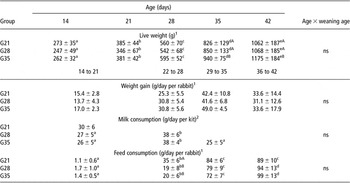
By the age of 35 days, the BW of animals weaned at 35 days of age had increased by 14 and 10% (P < 0.05) as compared to those weaned at 21 and 28 days of age, respectively, whereas by the age of 42 days it increased by 10% (Table 2). The milk consumption of rabbits weaned at 28 and 35 days of age increased by 40% in the 4th week, and thereafter it decreased by 66% between 28 and 35 days of age in the G35 animals (P < 0.05). Early weaned animals had 75% higher feed intake in the 4th week compared with G28 and G35 rabbits (P < 0.05). Solid feed conversion increased from 1.4 g/g (between days 22 and 28) to 1.9–2.1 g/g and 2.6–3.0 g/g (between days 29 to 35 and 36 to 42), respectively, without any significant difference being detectable between the groups.
Effect of weaning and age on growth traits of rabbits

G21 = weaning at 21 days; G28 = weaning at 28 days; G35 = weaning at 35 days.
Different superscripts indicate significant (P < 0.05) differences between a,b,c,d,eages and A,Btreatments.
ns = P > 0.05.
1n = 168 rabbits per treatment.
2n = 21 litters per treatment.
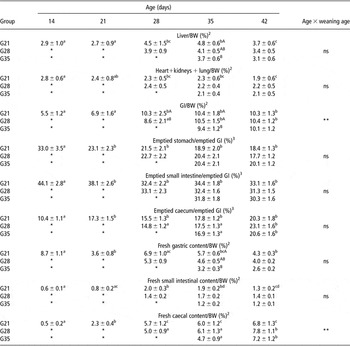
The relative weight of the liver increased by 62% between 21 and 28 days of age (Table 3); thereafter, there was a decrease (by 76%) between days 35 and 42 (P < 0.05). On day 35, G21 rabbits had higher relative liver weight (by 29%) as compared with G35 animals (P < 0.05). The sum of the relative weight of heart, kidneys and lungs decreased with age (by 70% between days 14 and 42). The relative weight of the GI tract increased by 49% between 21 and 28 days of age in G21 (P < 0.05) and by 22% between days 28 and 35 in G28 rabbits (P < 0.05), respectively. On day 28, the relative weight of the GI tract was 19% higher in G21 rabbits than in G28 animals, whereas on day 35, G21 and G28 animals had a heavier GI tract, with a 12% increase as compared with G35 animals (P < 0.05) and an interaction (P < 0.05) being demonstrable between age and treatment (weaning). Age influenced the relative weights of the stomach, small intestine and caecum within the GI tract, regardless of the weaning age.
Effect of weaning and age on weight of the liver, heart, lung, kidneys, GI organs and GI contentFootnote 1

GI = gastrointestinal; G21 = weaning at 21 days; G28 = weaning at 28 days; G35 = weaning at 35 days.
Different superscripts indicate significant (P < 0.05) differences between a,b,c,dages and A,Btreatments.
ns = P > 0.05; ** P < 0.05.
* Before weaning the groups could be considered identical.
1 n = 6 rabbits per treatment.
2 Expressed as % of BW.
3 Expressed as % of the whole GI tract (stomach, small intestine, caecum and colon).
In the same way as it exerted an effect on the relative weight of the individual GI organs, age influenced the relative weight of the GI content (expressed as % of BW), for example, between 14 and 42 days of age, the weight of the gastric content decreased (by 50%), whereas that of the small intestinal and caecal content increased (2.2 and 15 times, respectively), with the latter showing an age × treatment interaction (P < 0.05). More gastric content was found in G21 animals than in G35 rabbits at 35 days of age (78% increase, P < 0.05).
The pH value of the stomach content decreased from 5.7 to 3.3 (P < 0.05) by day 21 in G21 rabbits, and there was a further decrease to 1.6 between 21 and 42 days in all groups (P < 0.05). The pH of the small intestinal content increased from 6.8 to 7.6 and 8.4 (P < 0.05) by days 21 and 28, respectively, in G21 rabbits. Similar to the gastric pH, there was a decrease in caecal pH in G21 rabbits between days 14 and 21 (from 7.1 to 6.4), and then the pH decreased to 6.3 by 42 days of age. No significant difference was observed between the groups (data not shown).
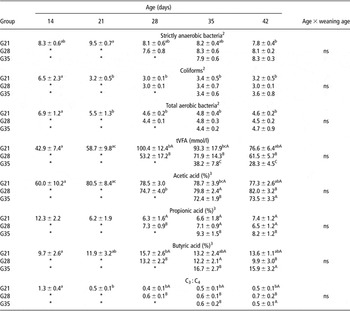
Strictly anaerobic bacteria (mainly Bacteroides) were present in high amounts (108) in the caecum, already at the age of 14 days (Table 4). Their number decreased between 21 and 42 days of age in G21 rabbits (P < 0.05). The number of coliforms and aerobic bacteria decreased from 21 days of age (P < 0.05). The number of lactobacilli (expressed in CFU log10/g digesta) was 2.5 at 14 days of age, and thereafter it decreased below 2.0 (data not shown). No significant difference within groups because of weaning age occurred.
Effect of weaning and age on the caecal digesta traitsFootnote 1

G21 = weaning at 21 days; G28 = weaning at 28 days; G35 = weaning at 35 days; tVFA =total volatile fatty acids; C3 : C4 = propionic to butyric acid ratio.
Different superscripts indicate significant (P < 0.05) differences between a,b,cages and A,Btreatments.
ns = P > 0.05.
* Before weaning the groups could be considered identical.
1 n = 6 rabbits per treatment.
2 Expressed in CFU log10/g digesta.
3 Expressed as % of the tVFA content.
The concentration of the total volatile fatty acids (tVFA) increased with age until 28 (G21) and 35 days of age (G28 and G35), respectively. It was higher in G21 than in G28 and G35 during the whole experimental period (P < 0.05). The proportion of acetic and butyric acid within tVFA increased, whereas that of propionic acid decreased, resulting in a decrease of the C3 : C4 ratio with age. Early weaning (G21) resulted in higher butyric and lower propionic acid proportion on day 28 (P < 0.05). Acetic acid ratio remained significantly higher in G21 and G28 animals as compared with G35 rabbits on day 35.
Discussion
Early weaning can be favourable by enabling lactating does and their kits to cover their different nutritional requirements. In contrast, the still immature digestive system and immune response, including the not-yet-balanced ecosystem of young animals, increases the risk of higher mortality and morbidity. In commercial rabbit farms, early weaning without the administration of preventive antibiotics in the diet carries a high risk. Therefore, it is important to know whether there are differences in the size and function of the digestive organs between early and traditionally weaned rabbits. Although some data on the effects of weaning age (21 to 25 days) are available (Gidenne and Fortun-Lamothe, Reference Gidenne and Fortun-Lamothe2002; Cesari et al., Reference Cesari, Toschi, Ferrazzi, Cesari, Grilli and Lavazza2007; Gallois et al., Reference Gallois, Le Huërou-Luron, Fortun-Lamothe, Lalles and Gidenne2008), this study provides comprehensive information on the most important parameters including the culturable caecal microbiota.
Age and weaning influenced solid feed intake, whereas milk and feed consumption were in accordance with the milk production of the does, which reached the maximum between 19 and 21 days and then began to decline after the 26th day of lactation (Maertens et al., Reference Maertens, Lebas and Szendrő2006). Young rabbits usually begin to eat small amounts of solid food in addition to their mother's milk; however, their feed intake becomes significant only approximately 20 days of age (Gidenne and Fortun-Lamothe, Reference Gidenne and Fortun-Lamothe2002). G21 rabbits consumed more pellet than those weaned at 28 or 35 days of age; however, this higher intake of solid feed was not sufficient to ensure a growth similar to that of G35 animals. Thus, early weaning resulted in a significant reduction in growth compared with weaning at the age of 35 days. This finding is very similar to that of Cesari et al. (Reference Cesari, Toschi, Ferrazzi, Cesari, Grilli and Lavazza2007), who compared the growth performance of rabbits weaned at 25 v. 34 days of age, and also with that of Gallois et al. (Reference Gallois, Le Huërou-Luron, Fortun-Lamothe, Lalles and Gidenne2008), who reported lower growth in early (on day 21) than in classically (on day 35) weaned rabbits until 42 days of age. Xiccato et al. (Reference Xiccato, Trocino, Sartori and Queaque2003) also showed that BW at 32 days of age was in a positive correlation with the weaning age (at 21, 25 and 28 days), but it became similar in rabbits weaned at different times by 56 days of age.
The weight of the GI organs was found to be consistent with most of the relevant data in the literature (Lebas and Laplace, Reference Lebas and Laplace1972; Alus and Edwards, Reference Alus and Edwards1977; Piattoni et al., Reference Piattoni, Maertens and Demeyer1995). When the young begin to eat significant quantities of solid feed, the weight of the GI tract starts to increase (Alus and Edwards, Reference Alus and Edwards1977). Early weaning and a switch to solid feed manifested themselves in earlier growth of the GI tract: on day 28, the relative weight of the GI tract was 19% higher in G21 animals than in the G28 group. Although the level of solid feed consumption, as a mechanical stimulation, should have influenced the development (thickening and elongation) of the caecum (Piattoni et al., Reference Piattoni, Maertens and Demeyer1995; Gallois et al., Reference Gallois, Le Huërou-Luron, Fortun-Lamothe, Lalles and Gidenne2008), we did not detect significant differences between groups. Similarly, no difference in the weight of caecum and caecal content was found by Cesari et al. (Reference Cesari, Toschi, Ferrazzi, Cesari, Grilli and Lavazza2007), when early weaning (at day 25) was compared with weaning on day 34. There was a reversed proportion between the weight of the stomach and the caecum, that is, before weaning (day 14) the stomach accounted for 38% of the GI tract, whereas its proportion decreased to between 29% and 32% by the time around weaning; however, the relative weight of the caecum increased from 12% (before weaning) to between 29% and 32% at 42 days of age. This is also in agreement with previous findings of Lebas and Laplace (Reference Lebas and Laplace1972) and Gallois et al. (Reference Gallois, Gidenne, Fortun-Lamothe, Le Huerou-Luron and Lalles2005), who discussed the role of the different digestive organs in rabbits, assigning increasing importance to the large intestine with age and with increasing solid feed intake.
Changes in the amount of the gastric content occurred with weaning. The decrease in the gastric content observed at day 42 in all groups was because of a temporary lack of food intake on day 41, attributable to a sudden rise in temperature. The increase in the weight of caecal content was related to weaning, although the differences between groups were not significant.
The pH values in the different parts of the GI tract were within the physiological limits, in accordance with age (Gidenne and Fortun-Lamothe, Reference Gidenne and Fortun-Lamothe2002). Significant differences between groups were not found in the pH value of either the gastric or the caecal content.
Most of the caecal changes occur between 21 and 28 days of age, when solid feed intake becomes significant, irrespective of nutrition, weaning or suckling (Gallois et al., Reference Gallois, Le Huërou-Luron, Fortun-Lamothe, Lalles and Gidenne2008). Caecal microbial activity developed mainly after weaning, as shown by the increase in VFA, resulting in a lower pH with age. We expected a lower pH in the caecum because of early weaning, but the differences between groups were not significant.
The count of strictly anaerobic bacteria (mainly Bacteroides) within the caecal ecosystem was consistent with data reported in the literature (Gouet and Fonty, Reference Gouet and Fonty1979; Fekete, Reference Fekete1988; Kovács et al., Reference Kovács, Gyarmati, Szendrő, Bencsné, Donkó, Tornyos, Lukács and Bóta2002; Combes et al., Reference Combes, Michelland, Monteils, Cauquil, Soulié, Tran, Gidenne and Fortun-Lamothe2011). The decrease in their germ count observed on day 28 is attributable to caecotrophy starting at approximately 21 days of age (Smith, Reference Smith1965). The counts of coliforms and total aerobic bacteria decreased, in agreement with observations according to which their presence is usually suppressed by solid feed consumption (Bornside and Cohn, Reference Bornside and Cohn1965; Gouet and Fonty, Reference Gouet and Fonty1979). Lactobacilli are not a part of the normal ecosystem of the caecum in adult rabbits (Gidenne and Fortun-Lamothe, Reference Gidenne and Fortun-Lamothe2002). Bacteria count did not correlate to pH or the VFA production, similar to the observations of Michelland et al. (Reference Michelland, Combes, Monteils, Cauquil, Gidenne and Fortun-Lamothe2010), according to whom only the redox potential was negatively correlated to the bacterial diversity index, whereas pH and VFA were not correlated to the bacterial structure.
tVFA content in the caecum was related to age and weaning. It rose with age because of the increase of solid feed consumption. Early weaning resulted in significantly higher tVFA production throughout the experimental period. This is in agreement with the results of the study of Xiccato et al. (Reference Xiccato, Trocino, Sartori and Queaque2003) in which stimulated solid feed intake (early weaning) resulted in higher tVFA production. The low tVFA content (and also the decreased acetic acid proportion) found on day 42 was the result of the above-mentioned temporary feed refusal on day 41.
In conformity with the data of the literature (Bellier et al., Reference Bellier, Gidenne, Vernay and Colin1995; Padilha et al., Reference Padilha, Licois, Gidenne, Carré and Fonty1995; Gidenne et al., Reference Gidenne, Jehl, Segura and Michalet-Doreau2002), the proportion of propionic acid (C3) was higher than that of butyric acid (C4) before weaning, but thereafter this became reversed, so that the ratio of the two fatty acids (C3 : C4) decreased from >1.0 to <1.0. The increase of the butyrate concentration might be explained by an increase in some butyrate-producing bacteria. This hypothesis was supported by the results of Combes et al. (Reference Combes, Michelland, Monteils, Cauquil, Soulié, Tran, Gidenne and Fortun-Lamothe2011) who described the development of the rabbit caecum microbiota and its metabolic activities from the neonatal (day 2) until the subadult period (day 70) using 16S rRNA gene approaches coupled with capillary electrophoresis single-stranded conformation polymorphism (CE-SSCP). They found that at 70 days of age, the Firmicutes populations remained at high levels, whereas Bacteroides–Prevotella decreased, resulting in higher butyrate production.
Because of the early solid feed consumption of G21 rabbits, the concentration of C3 was significantly lower, whereas that of C4 was significantly higher on day 29 than in the G28 rabbits. The highest C4 content was measured in G21 rabbits throughout the experimental period.
Conclusions
Age at weaning significantly influenced the growth of rabbits. In G35 rabbits, milk consumption and the additional solid feed intake resulted in better growth. The weaning age did not cause significant changes in the counts of some cultured bacteria, whereas it influenced VFA production. Early weaning did not produce considerable changes in the digestive physiological parameters measured, but it resulted in poor growth in rabbits.
Acknowledgement
This study was supported by the OTKA foundation (Project no. T046999) and the Hungarian Academy of Sciences.