


INTRODUCTION
In 2013, public sector employees accounted on average for 21% of total employment in the OECD countries (OECD 2015). While heterogeneous, they are a large group that share an interest in sustaining public employment and that can influence politics in various ways. In addition to a direct voting channel (Garand Reference Garand1988; Blais, Blake, and Dion Reference Blais, Blake and Dion1990; Bhatti and Hansen Reference Bhatti and Hansen2012), recent research has emphasized the role of public sector unions and their effects on the cost of government, either directly through collective bargaining or indirectly through politics (Sieg and Wang Reference Sieg and Wang2013; Anzia and Moe Reference Anzia and Moe2015).
Quite often public sector employees are also politicians themselves.Footnote 1 This dual role of public sector employees has raised the concern that, when elected, they may be in a better position to extract rents from holding the office than otherwise similar politicians. A concrete example would be a teacher in a municipal council that decides whether the teacher's school should be closed or not, or a public sector nurse participating in deciding on budget cuts in the local public health care sector. In both cases, the public sector employees can possibly exert disproportionate influence in the council due to their information advantage over the other councilors on the true costs and benefits of providing public services in their sector of employment (Niskanen Reference Niskanen1971; Romer and Rosenthal Reference Romer and Rosenthal1979). This disproportionate influence may compromise the political neutrality of public service and also undermine the separation powers more generally (Braendle and Stutzer Reference Braendle and Stutzer2016).
Consistent with such concerns, countries often impose incompatibility and to a lesser extent ineligibility rules on the political involvement of public sector employees.Footnote 2 The former force public employees to give up public service if elected and the latter require giving up public service if they run (Braendle and Stutzer Reference Braendle and Stutzer2016). Imposing such restrictions involves a trade-off by limiting the political participation of a group with possibly ample opportunities for rent-seeking at the cost of discriminating against a large citizen group and excluding informed candidates.Footnote 3 There is surprisingly little evidence on whether public-sector employees would act differently from the other politicians when elected. We start to fill this important gap in the literature by providing causal evidence on how municipal employee representation in a municipal council affects local public spending and on the mechanisms at work.Footnote 4
We use data from Finland. Finland provides a particularly interesting context for our analysis for two reasons. First, almost 30% of employment in Finland is in the public sector and more than 20% of employment is in the local public sector.Footnote 5 An important feature of Finnish local politics, and common in other countries as well (e.g., the UK), is that being a municipal councilor is not a full-time job. About one quarter of the Finnish local politicians work for a municipality.Footnote 6 The distribution of power between private- and public-sector employees in the municipal councils may therefore have a large impact on the size and efficiency of the local public sector. Reflecting this tension and its topicality, the Finnish media has expressed concerns that, when elected, municipal employees can make decisions on their own jobs in municipal councils.Footnote 7
The second reason why Finland provides a suitable context for our study is that the Finnish open-list local elections provide us with plausibly exogenous variation in municipal employee representation. The source of this variation is candidate-level close contests within party lists. We use these contests to construct a municipality-level instrument variable for municipal employee representation. Our instrument captures the extent to which the seat share of municipal employees exceeds or falls short of their expected share due to randomness in the outcomes of the close elections. The identifying assumption is that when measured at the candidate level and sufficiently close to the within party election thresholds, the seat allocation between municipal employees and other candidates can be considered to be as-good-as random. This assumption can be tested indirectly by covariate balance tests. We define candidate-level closeness within the party lists to make sure that differences in party representation (party effects) are not driving the results.
Our main result is that electing one additional municipal employee to a council as opposed to a candidate from the same party, but not employed by the public sector, increases local public spending. Our estimates suggest that in a municipality with a median-sized council (27 seats), the spending increases on average by about 1% over the 4-year council term. The effect is surprisingly large considering two features: First, we are probably looking at a relatively unimportant margin, i.e., the last elected candidate within a party to a council that typically consists of tens of councilors. Second, as we explain later, there are explicit restrictions on the types of political positions that Finnish municipal employees can take in their home municipality. Our result is nevertheless in line with previous findings which show that smaller parties and even individual councilors have an effect on policy in proportional representation systems (Folke Reference Folke2014; Freier and Odendahl Reference Freier and Odendahl2015; Fiva and Halse Reference Fiva and Halse2016).Footnote 8
We also provide evidence on the mechanisms at work. First, we show that the effect varies by the type of municipal employee and the type of spending: electing one more employee who works in health care leads to a significant increase in health expenditures, but not in the other (non-health) municipal expenditures. Similarly, when a non–health care employee gets elected, expenditures unrelated to health care increase.Footnote 9 This evidence is consistent with Niskanen's (Reference Niskanen1971) classic bureaucracy model which predicts that bureaucrats can convince politicians to increase public spending due to their information advantage over politicians. The analogy we draw is that municipal employee politicians have both different incentives than and information advantage over the other politicians. Moreover, we find that the positive effect on local public spending arises in particular in close elections that involve the largest party in the municipality and in smaller councils. This evidence suggests that municipal employee councilors influence outcomes through intraparty decision making (Laver and Shepsle Reference Laver and Shepsle1990).
The increased sector-specific spending cannot be automatically attributed to rent-seeking. A reason for this is that municipal employees are experts in their area of employment and can therefore provide useful information to other councilors and improve decision making.Footnote 10 Even though we cannot conclusively differentiate between the competing hypotheses about the efficiency of the increased spending, it is definitely noteworthy − and somewhat puzzling—that the Finnish municipal councilors employed by the public sector want to increase public expenditures in a country that in 2014 had, at 59% (OECD 2015), the highest public sector ratio to GDP among all OECD countries (between 1996–2012 Finland's position varied between 2nd and 8th). The uniform increase in spending is puzzling because our as-good-as-random design guarantees that the citizens’ needs are identical on average in the treated and other municipalities. Viewed from this angle, Niskanen's (Reference Niskanen1971) concerns about bureaucrats’ information advantage leading to excessive spending seem warranted.
The rest of the article is organized as follows: In the following section, we discuss relevant theory and outline testable hypotheses. Then, we describe the institutional setting and data. We present our econometric identification strategy in the fourth section and the results in the fifth section. The final section concludes the study. Auxiliary results are available in the Online Appendices.
THEORY AND HYPOTHESES
We are interested in (i) whether, (ii) through which mechanisms, and (iii) why public employee representation in municipal councils has an effect on municipal spending. We discuss each of these in turn.
Effect on total expenditures: At least two distinct theoretical debates bear directly on whether public employee representation has an effect on local government expenditures. The first view is that public employees have both the economic incentives and the means to maximize the municipal budget to their own benefit (Niskanen Reference Niskanen1971; Courant, Gramlich, and Rubinfield Reference Courant, Gramlich and Rubinfield1979; Dahlberg and Mörk Reference Dahlberg and Mörk2006). This is likely to obfuscate the separation of powers between the executive and the democratically chosen political branches of the local government (Braendle and Stutzer Reference Braendle and Stutzer2016). A public sector employee politician may also have a variety of ways to target public spending to certain voters, such as her own political constituency or interest group (Alesina, Baqir, and Easterly Reference Alesina, Baqir and Easterly2000). The second view posits that the preferences of public sector employees differ systematically from the individuals employed by the private sector. One reason for the difference is that professional background determines socioeconomic conditions and may thus shape identity (Braendle and Stutzer Reference Braendle and Stutzer2016). Consistent with this, public sector employees seem to be politically more active (Bhatti and Hansen Reference Bhatti and Hansen2012) and lean more to the left ideologically (Knutsen Reference Knutsen2005; Jensen, Sum, and Flynn Reference Jensen, Sum and Flynn2009; Rattsø and Sørensen Reference Rattsø and Sørensen2016). They may also be relatively unwilling to support market-oriented solutions, and thus, a smaller public sector.
Taken together, these views suggest that public sector employees have a tendency to favor a larger public sector. We therefore formulate the following hypothesis:
Hypothesis 1: The council seat share of municipal employees increases municipal spending.
We acknowledge the possibility that municipal employees may be more pro-social and better motivated for public service than other candidates from the same party (Francois Reference Francois2000; Besley and Ghatak Reference Besley and Ghatak2003, Reference Besley and Ghatak2006). If that was the case, spending could also decrease (remain unchanged) if the status quo level of per capita spending is too high (optimal) from the social point of view. Municipal employees may also be relatively immune to specific business interests and lobbying (Braendle and Stutzer Reference Braendle and Stutzer2016), which may reduce inefficient spending to public procurement.
Mechanisms at work: How and through which mechanisms could the spending effect come about? This question is of interest, because there are institutional restrictions on the political representation of the municipal employees (see the next section) and because our empirical close-elections approach identifies by design the effect of allocating the last marginal seats to the council. Two key mechanisms suggest themselves: First, holding other things constant, an individual councilor is likely to exert a greater impact in smaller councils because the likelihood of him (or his party) being pivotal is higher. In a smaller council, a single councilor can also pivot informal within-council discussions to his own advantage and influence which issues the council tackles. Second, the literature on coalitional bargaining (Laver and Shepsle Reference Laver and Shepsle1990) suggests that councilors can influence decision making either between-parties or within-parties. In the former case, the municipal employees would vote in the council as if they had a coalition of their own, independent of the formal parties and the municipal employees’ party affiliation. If, on the other hand, the channel of influence is within-parties, the party lines hold, but municipal employee councilors affect the policy position of their own party. This is a plausible channel of influence in our context because public employees may be a relatively loose and heterogeneous interest group. Moreover, the within-party channel matters for policy outcomes only if the public employees’ party is large and powerful enough in the council. In sum, we have the following two hypotheses about the mechanisms of influence:
Hypothesis 2a: Municipal employees of smaller councils have a greater effect on spending than those of larger councils.
Hypothesis 2b: Municipal employees of larger parties have a greater effect on spending than those of smaller parties.
Rent-seeking vs. efficient provision of public services: Finally, we study whether the effect of public employee representation on public spending mirrors rent-seeking, or is more consistent with efficient provision of public services.
Applied to our context, Niskanen's (Reference Niskanen1971) classic model of bureaucracy predicts that municipal employee councilors have an information advantage over the other municipal councilors about the provision of public services in their own employment sector and that the municipal employees are less likely to have such an advantage over the other public services. We therefore formulate:
Hypothesis 3a: Municipal employees never decrease spending and they increase spending especially in their own sector of employment.
This hypothesis would not get support from the data, if municipal employees lean more to the left and generally favor a larger public sector. In this case, municipal employees ought to increase spending also in sectors other than their own sector of employment. Moreover, while the expertise of municipal employees can also be useful for the efficient provision of public services (Braendle and Stutzer Reference Braendle and Stutzer2016), it is unlikely that, holding citizens’ needs constant, such efficient provision systematically calls for greater spending, especially only in their own sector.
Finally, we also look for more direct signs of rent-seeking (Svaleryd and Vlachos Reference Svaleryd and Vlachos2009). Inefficiencies may arise also through clientelistic behavior (i.e., explicit or implicit quid-pro-quo for political support; see Alesina, Baqir, and Easterly Reference Alesina, Baqir and Easterly2000), which are at least partly captured through better re-election prospects. We therefore formulate:
Hypothesis 3b: Municipal employees enjoy higher returns to office in terms of larger salary and smaller unemployment risk, and/or enjoy from a larger incumbency advantage in subsequent elections than the other candidates.
INSTITUTIONAL SETTING AND DATA
Finnish Local Governments
Tasks and revenue sources of municipalities: Finland has a two-tier system of government consisting of the central government and municipalities as the local level (see Saarimaa and Tukiainen Reference Saarimaa and Tukiainen2015). Finnish municipalities have extensive tasks. In addition to the usual local public goods and services, municipalities are responsible for providing most of social and health care services and primary and secondary education. The GDP share of municipality spending is large (roughly 18%) and the municipalities employ around 20% of the total workforce.
Municipalities have extensive fiscal autonomy. The most important revenue source is the flat local income tax, determined by the municipalities. There are, however, large regional tax base and cost disparities. They are offset by a central government grant system, which the municipalities cannot effectively manipulate to their advantage.
Decision making and elections in municipalities: Municipalities are governed by a municipality council which is the most important political actor.Footnote 11 For example, mayors or city managers are public officials chosen by the councils and have only executive power and no political power. Moreover, municipal boards (i.e., cabinets) have only a preparatory role and the representation in the boards follows the political distribution of the council.
Municipal elections are held simultaneously in all municipalities and each municipality has one electoral district. The elections in our data were held on the fourth Sunday of October in 1996, 2000, 2004, and 2008. The council term starts in January of the year following the election year. The term lasts 4 years.
Within each municipality, the allocation of seats is based on proportional representation, as determined by the open-list D'Hondt election rule. In an election, each candidate has an affiliation with a party list and each voter gives a single vote to a single candidate. The voters cannot vote for a party without specifying a candidate. The total number of votes for the candidates in a given party list determines the votes for each party. The party votes determine how many seats each party gets according to the D'Hondt rule. Given these party seats, the competition for the seats within parties is simply an n-past-the-post rule. The rank of a candidate within the party list is determined by his votes, implying that voters—as opposed to parties—decide which candidates are elected from a given party list.
There are nationwide restrictions on the political roles of municipal employees.Footnote 12 First, a municipal employee who is in an executive position of a branch of public service cannot be a council member. For example, the director of a municipality's school authority cannot be a member of the municipal council. Second, a municipal employee cannot be a member of the subcommittee of his own specific sector. For example, a teacher cannot be a member of the subcommittee for education. Third, a municipal employee working in administrative duties directly under the municipal board cannot be a member of the board. Fourth, a municipal employee who is the presenting official for matters dealt by the municipal board cannot be a member of the board. Fifth, the majority of the municipal board cannot consist of municipal employees. Finally, a municipal employee councilor can participate in the decision making in the council meeting even if the matter relates to her own employment, unless she has been directly involved in preparing or presenting the matter as a bureaucrat for the council.
The broader institutional context may also limit the opportunities of the municipal employees to influence outcomes and extract rents while in office. For example, Finland is one of the least corrupted countries in the world. Moreover, wages are largely set at the national-level wage bargaining between the municipal employer organization and various labor unions. However, a municipality can pay more than agreed upon nationally.
Data
Our data come from a number of sources:
Candidate and elections data: We have obtained data on municipal elections held between 1996 and 2008 from the Ministry of Justice. These data consist of candidate-level election results, in particular party affiliation, number of votes, and elected status. The election data also include the age and gender of the candidates. Information on municipal employment status comes from KEVA, which manages local government pensions, and we have linked the candidate data also to Statistics Finland data on education, occupation and socioeconomic status and to income data from the Finnish Tax Authority.
Overall we have roughly 160,000 candidate-election observations (see Online Appendix A for descriptive statistics and descriptions of sample restrictions). For our purposes, a candidate is a municipal employee, if she was employed by a municipality at the end of the election year. Compared to other candidates, municipal employees are more often female (nurse is the most common profession among them), classified as high professionals in terms of socioeconomic status, and running for the Social Democratic Party. We return to these observable differences in candidate characteristics when we present our econometric analysis and results.
Municipal data: We use Statistics Finland's data on municipal expenditures and demographics for the years 1996–2012. We have 1,544 municipality-council term observations (see Online Appendix A for the summary statistics): On average, municipalities’ total expenditures are 5,500 euros per capita. The single most important expenditure category is health care (1,700 euros per capita). Municipal employees’ seat share is on average 26.4%.
ECONOMETRIC APPROACH
Identification Strategy
To estimate the effect of political representation of municipal employees on municipal policy, we use the following regression specification:
 $$\begin{equation}
{Y_{mt}} = {\rm{\delta }}{M_{mt}} + {X'_{mt}}{\rm{\beta }} + {u_{mt}},
\end{equation}$$
where Ymt is the outcome of interest, Mmt is the seat share of municipal employees in the council, X ' mt is a vector of control variables (possibly lagged), and umt is the error term in municipality m at time t. The parameter of interest is δ which measures the effect of a change in the seat share of municipal employees on the outcome.
Our main outcome variable is municipal expenditures. A simple OLS estimation of equation (1) may suffer from both reverse causality and omitted variable bias. This could be the case if, e.g., voters in a municipality demand a high level of municipal services. Such a municipality would have a high number of municipal employees. This calls for greater municipal expenditures and would show up as a greater council seat share of public sector employees as well.
We make use of close elections to estimate the treatment effect of interest (δ). Unlike in much of the recent literature using close elections for identification, the Finnish municipal election system of proportional representation with open party lists does not render itself to a simple regression discontinuity design (RDD) analysis (Lee, Moretti, and Butler Reference Lee, Moretti and Butler2004). The reason is simple: Despite there being an RDD flavor to our close elections approach, we cannot construct a well-defined forcing variable at the municipality level. We therefore build on Clots-Figueras (Reference Clots-Figueras2011, Reference Clots-Figueras2012) who uses the fraction of women winning close elections as an instrument for the share of women in the legislature (see also Folke Reference Folke2014 and Freier and Odendahl Reference Freier and Odendahl2015, who use IV and close elections data). Our IV procedure uses as-good-as-random variation at candidate-level in the close elections and aggregates this variation to get a municipality-level instrumental variable. To properly capture the treatment effect of political representation of municipal employees, we focus on closeness within party lists. This choice means that between-party differences do not confound our results. For example, if municipal employees are more often left- than right-wing, between party comparisons would give us the joint effect of municipal employees and party status.Footnote 13
We construct our instrument in the following steps:
Step 1: For each party list p, we define the pivotal number of votes as the average of the maximum number of votes among the nonelected candidates and the minimum number of votes among the elected candidates. The distance to getting elected for each candidate is the number of votes of the candidate minus the pivotal number of votes of her party list. We normalize this distance by dividing it by the total number of votes of the party list and then multiplying it by 100. We denote the variable thus obtained vipmt .Footnote 14 Closeness of each candidate i in party list p in municipality m in election t, Cipmt , is then defined as
 $$\begin{equation}
{C_{ipmt}}{\rm{\ }}\;{\rm{ = }}\;{\rm{\ }}\left\{ {\begin{array}{@{}*{1}{l}@{}} {{\rm{1\ if\ |}}{v_{ipmt}}{\rm{|\ }} \le \varepsilon }\\[8pt] {{\rm{0\ if\ |}}{v_{ipmt}}|{\rm{\ > \ }}\varepsilon } \end{array}} \right.,
\end{equation}$$
where ε is some small bandwidth, expressed in percentages (e.g., ε = 0.4 means “0.4%”; that is, 4 votes out of 1,000). Due to randomness in the outcomes of elections, candidates just above and below the pivotal number do not differ systematically from each other. Indeed, when ε = 0 in our data, there was a tie within a party list between two (or more) candidates at the threshold of getting into the council. In such a case, a lottery decides which of the candidates are elected (see Hyytinen et al. Reference Hyytinen, Meriläinen, Saarimaa, Toivanen and Tukiainen2017 for details). There are 1,351 candidates who end up in these lotteries and 335 of them are municipal employees.
Step 2: Quasi-randomization taking place within each party list influences how many municipal employees get elected from each list. To capture this list-level variation, we calculate the difference between the realized outcome and the expected outcome of the close races within each party. Formally, this can expressed as
 $$\begin{eqnarray}
T_{pmt} &=& \left( \sum \limits_i^{N_p} C_{ipmt}D_{ipmt}M_{ipmt} \right)\nonumber\\
&& -\, \left[ \frac{\sum_{i}^{N_p} C_{ipmt}M_{ipmt}}
{\sum_i^{N_p} C_{ipmt}}\sum \limits_i^{N_p}C_{ipmt}D_{ipmt}\right],
\end{eqnarray}$$
where Mipmt is equal to one if candidate i is a municipal employee and zero otherwise, Dipmt equals one if candidate i in municipality m was elected in election t and zero otherwise and p refers to a party list and Np to the number of candidates in the list p. The first term is the number of municipal employees that are elected in the close elections. The second term is the expected number of municipal employees who get elected in the close elections. The expected number comes from a hypergeometric distribution, because close elections can be seen as a basic urn problem.Footnote 15 The reason for using Equation (3) is that there may be more than two candidates that are close and thus subject to randomization and any number of the close candidates can be municipal employees.Footnote 16 Moreover, the set of candidates defined as close may compete for more than one seat within the party list. These features are the main difference between our and Clots-Figueras’ (Reference Clots-Figueras2011, Reference Clots-Figueras2012) approach, because she considers only situations where one male and one female candidate compete for one seat.
Step 3: We aggregate the random variation at the party list level to construct a municipal-level instrumental variable, Tmt . This is done by adding up Tpmt over all the party lists within a municipality and by dividing the sum by council size (CS):
 $$\begin{equation}
T_{mt} = 100^*\left( \sum\limits_p T_{pmt}\right)/CS_{mt}
\end{equation}$$
Our instrument, Tmt , captures the extent to which the seat share of municipal employees exceeds (Tmt > 0) or falls short of (Tmt < 0) their expected share due to randomness in the outcomes of the close elections. In other words, the instrument obtains higher values for those municipalities in which the municipal employee candidates were lucky and smaller values for those municipalities in which they were unlucky. If, in a given municipality, municipal employees were lucky within one party list and equally unlucky in another, the instrument at the municipal level would be zero. One can think of Tmt as the part of the variation in Mmt that is as-good-as random. Our IV approach thus assumes that Tmt is a determinant of Mmt , i.e., the (actual) seat share of municipal employees in the council and uncorrelated with umt in (1). This assumption can to an extent be tested using municipality-level covariate balance tests. Moreover, the candidate-level bandwidth can be used to check the robustness of the results to the bandwidth choice.
Empirically, Tmt appears to work as expected (see Online Appendix B for details): First, it is symmetrically distributed around zero. Second, when the seat share of municipal employees increases due to randomness in the outcomes of the close elections (i.e., when Tmt increases by one unit), so does their actual share (i.e., Mmt ). This implies that the coefficient of Tmt in the first stage of the IV should be close to one in a finite sample and equals unity asymptotically. This is indeed empirically the case in our data (Online Appendix B). This feature means that in the reduced form of our IV of equation (1), which means regressing the outcome directly on the instrument (and controls; Wooldridge Reference Wooldridge2002, Ch. 5), the coefficient of the instrument ought to be very close to the IV estimate of δ. This observation is useful and in the subsequent section, we will report both the 2SLS and the reduced form of IV results.
Finally, even with the smallest possible bandwidth (ε = 0), we have variation in Tmt , as explained above. As we increase the bandwidth, almost all municipalities in our data have a close contest within at least one party list. For example, for bandwidth ε = 0.4, we observe either a positive or a negative instrument in 1,145 municipalities out of 1,544. This does not imply that we would use for identification all the variation in the municipal employee council seat share in the data for these 1,145 municipalities: To estimate δ, we only use the part of exogenous variation in Mmt that the instrument, Tmt , isolates.
Validity Tests
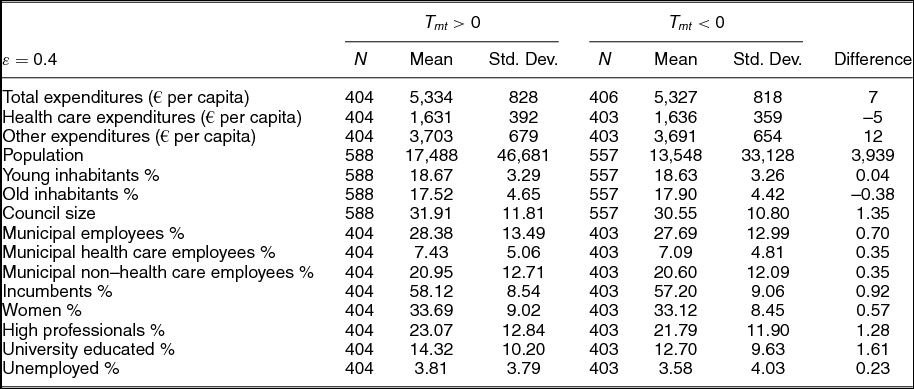
In Table 1, we report balance tests for pretreatment covariates using the largest bandwidth that is employed in the regressions (ε = 0.4).Footnote 17 We divide the data into two groups, based on the seat share of municipal employees exceeding (Tmt > 0) or falling short of (Tmt < 0) its expectation. Table 1 shows that the pretreatment variables are well balanced, including the lagged total expenditures, the lagged municipal employee share in the council, and its lagged instrument.Footnote 18 This means that the municipalities where the municipal employees won, by chance, more seats are very similar to the municipalities where municipal employees lost, by chance, seats to other occupation groups.
Pretreatment Covariate Balance at Municipality Level

Notes: The statistical significance of the differences is tested using a t-test adjusted for clustering at the municipality level. ***, **, and * denote statistical significance at 1%, 5%, and 10% level, respectively.
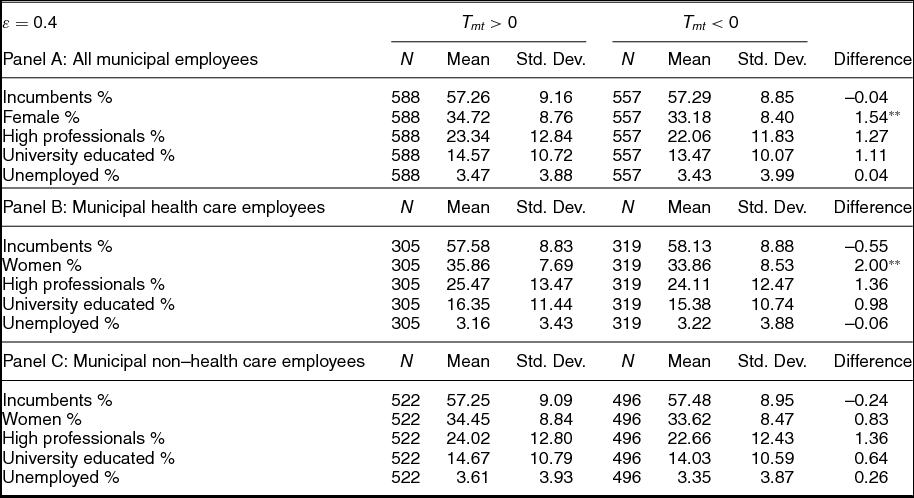
Table 2 reports balance tests on council characteristics for the current election term.Footnote 19 As Panel A shows, the posttreatment council characteristics are well balanced. For example, the municipal employees that by chance won a seat from a candidate from another occupation are of no better or worse quality (see Ferreira and Gyourko Reference Ferreira and Gyourko2014 who argue that, e.g., gender discrimination would imply that candidates with the same number of votes would be of different quality), as measured by their incumbency and education. The only exception to the good balance is the councils’ gender composition. This finding mirrors the strong positive correlation in the data between gender and occupation status at the candidate level.Footnote 20 The imbalance is not a result of failed randomization, but rather an intrinsic feature of municipal employees: When a municipal employee is randomly allocated into a council, a female is more likely to get a seat in the council.
Posttreatment Council Covariate Balance

Notes: In Panel A, the treatment groups are based on all municipal employees. In Panel B, the groups are based on health care sector employees. In Panel C, the groups are based on those municipal employees who do not work in the health care sector. The statistical significance of the differences is tested using a t-test adjusted for clustering at the municipality level. ***, **, and * denote statistical significance at 1%, 5%, and 10% level, respectively.
In Panels B and C of Table 2, we divide municipal employees into two categories: those who work in the health care sector and those who work in the remaining (non–health care) sectors.Footnote 21 The division allows us to analyze whether the positive correlation between municipal employment status and gender is driven by the health care sector and, in particular, by nursing being a female-dominated occupation. Panel B and C of Table 2 suggest that, indeed, the gender imbalance is related to the health care sector. We return to the importance of gender for our findings below.
RESULTS
Treatment Effect on Total Expenditures
We start by analyzing the effect of the share of municipal employees in the council on the (log) per capita total expenditures of the local government, measured as the average over the 4-year council term.
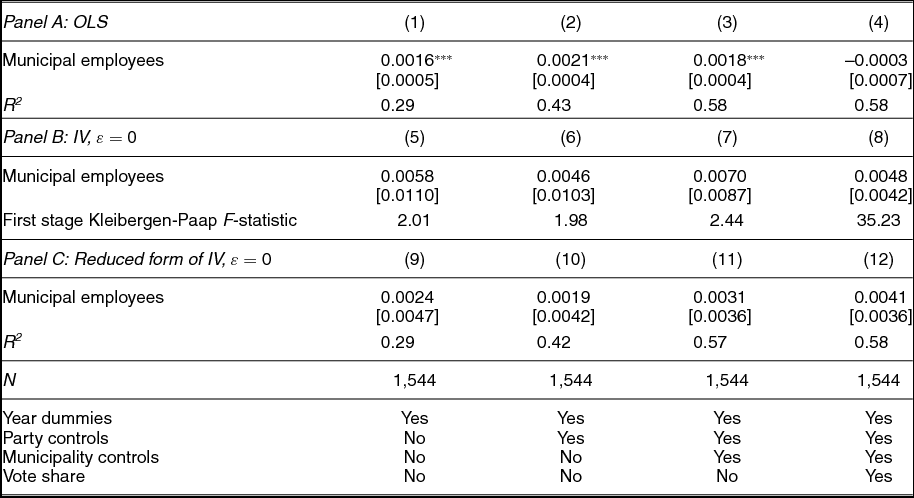
Preliminary regression results: To have a point of comparison, we report naïve OLS results with different sets of controls (Panel A of Table 3) along with the IV results (Panel B of Table 3) and the reduced form of IV (Panel C of Table 3), using the narrowest possible bandwidth of ε = 0. The OLS estimations obviously do not correct for the potential endogeneity of the seat share of the municipal employees, while the latter two ought to do that. The difference between the four columns of each panel is that they include successively more controls. We use lags (means over the t–1 election term) of the control variables to avoid the possible problem of introducing bad controls (i.e., alternative outcomes) in the models.
Results for Total Expenditures: OLS and IV Analysis with ε = 0

Notes: The unit of observation is a municipality m in election period t. The dependent variable is the logarithm of the mean of per capita total expenditures over the council term. Standard errors are clustered at the municipality level and reported in brackets. Party controls include parties’ lagged seat shares. Municipality controls include lagged population, squared population and shares of young and old citizens. Vote share includes a second order polynomial of the municipal employees’ vote share. ***, **, and * denote 1%, 5%, and 10% statistical significance levels, respectively.
As the first three columns of Panel A of Table 3 show, the OLS estimations suggest a positive and statistically significant association between the political representation of public employees and total expenditures. This association vanishes completely once we include a second-order polynomial of the vote share of municipal employees (see column 4). This is not unexpected, because the municipal employees’ vote and seat shares are highly correlated. While insignificant, the point estimates from the IV (Panel B) and the reduced form of IV (Panel C) estimations provide us with three important empirical insights: First, the IV point estimates are positive and larger in magnitude than the OLS estimates. Second, if our instrument is as-good-as random, the only implication of having more control variables in the model ought to be that they reduce residual variance. The results reported in Panel B and C bear this out: The magnitudes of the IV estimates do not change (much) when the municipal employee vote share is controlled for. This finding indicates that unlike OLS, the IV estimates are not confounded by voter preferences. Moreover, the standard errors of the estimates tend to get smaller when more controls are added. Third, the results reported in Panel B and C suggest that the limited amount of variation in the instrument is a potential problem with using the narrowest possible bandwidth (ε = 0). If so, the first-stage regressions may suffer from low power, especially when fewer controls are included. This is indeed what we observe: The first stage F-tests become larger when we control for the municipal employee vote share (see column (8)).
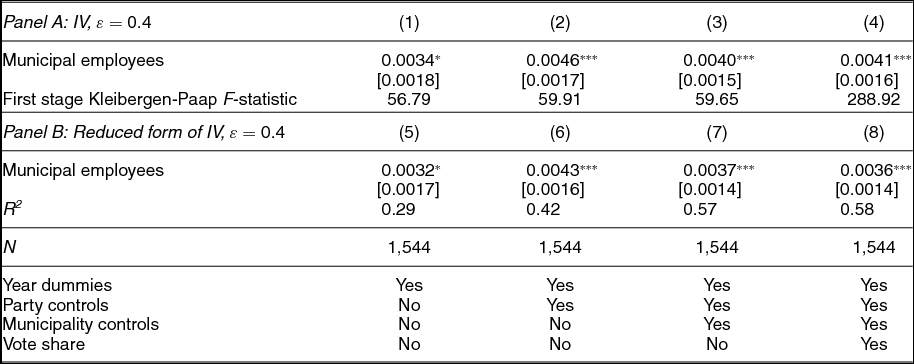
Main regression results: To explore whether we can estimate the effect of political representation of municipal employees on municipal expenditures more precisely, we use the wider bandwidth of ε = 0.4. The wider bandwidth allows us to bring in more variation from the close elections. These results are reported in Table 4, where Panel A reports our IV estimates and Panel B our reduced form estimates. The estimations that rely on the wider bandwidths can be taken to be more reliable if they produce a point estimate that is similar in magnitude to that produced by the narrowest bandwidth and if the effect can be estimated with greater precision (smaller standard error).
Results for Total Expenditures: IV Analysis with ε = 0.4

Notes: The unit of observation is a municipality m in election period t. The dependent variable is the logarithm of the mean of per capita total expenditures over the council term. Standard errors are clustered at the municipality level and reported in brackets. Party controls include parties’ lagged seat shares. Municipality controls include lagged population, squared population and shares of young and old citizens. Vote share includes a second order polynomial of the municipal employees’ vote share. ***, **, and * denote 1%, 5%, and 10% statistical significance levels, respectively.
Starting from the IV estimates in Panel A of Table 4, we find across all specifications a statistically significant treatment effect of 0.0034–0.0046 on municipal spending from having a larger share of municipal employees in the council. The reduced form results in Panel B echo the IV findings: They yield treatment effect estimates that are statistically significant and very similar to those obtained with IV, but somewhat smaller in magnitude. It is especially noteworthy that both estimators deliver point estimates that are very close to those we obtained using the narrowest possible bandwidth (ε = 0.0; see Panel B in Table 3). The fact that the reduced form estimates are a little smaller in absolute value than the IV estimates suggests that the first stage coefficient of the instrument is close to, but somewhat smaller than, one (as it often is; see Online Appendix B). It is comforting to report that we cannot reject the null hypothesis that the 1st stage coefficient of the instrument is unity.
The point estimates of Table 4 show that, consistent with our Hypothesis 1, the council seat share of municipal employees causally increases municipal spending. Increasing municipal employees’ seat share by 1 percentage point increases per capita total expenditures annually by circa 0.4% over one election term. As one seat is on average 3 percentage points of the total number of seats, the overall average effect of an increase of one seat is roughly (at least) 1%. Because the average annual municipal spending is around 5,600 Euros per capita, this effect translates into around 60 euros per capita. The effect is surprisingly large taking three features into account: First, we are identifying the effect at a potentially unimportant of margin of allocating the last seats to the council. Second, the nonelected marginal candidates, to which the elected ones are compared, are often vice-councilors. Our estimate is conservative, because vice-councilors get to attend council meetings if the councilor is absent, may get a council seat if elected councilors step down during the term, and are sometimes given positions in the municipal subcommittees. Third, there are nonnegligible institutional restrictions on the political representation of the municipal employees. The effect could have been larger, had there not been no such rules in place. While a detailed comparison is not straightforward, the magnitude of the effect is nevertheless quite comparable to those reported in the prior papers using data from similar countries and identification based on marginal seats (Freier and Odendahl Reference Freier and Odendahl2015; Fiva and Halse Reference Fiva and Halse2016; Fiva, Folke, and Sørensen Reference Fiva, Folke and Sørensen2017).
Robustness checks: We have explored the robustness of our main findings and their internal and external validity in a number of ways (see Online Appendix B).
First, electing public employees has the documented spending effect irrespectively of their attributes (e.g., gender, age, education). However, a consequence of electing a public employee is greater female participation in the council. This increase may in itself increase public spending (Chattopadhyay and Duflo Reference Chattopadhyay and Duflo2004; Clots-Figueras Reference Clots-Figueras2011; Svaleryd Reference Svaleryd2009; Braendle and Colombier Reference Braendle and Colombier2016). We therefore explore whether the council seat share of municipal employees increases municipal spending also when the gender composition of the marginal seats, i.e., the seat share of females, is accounted for. We instrument this potentially endogenous share by the share of females who were randomly elected in the close contests. This instrument is calculated using the same procedure that produced the instrument for the share of municipal employees. When female seat share is included in the model, we get at the effect of electing a municipal employee while keeping the gender composition of the council constant. Adding the seat share of females to the estimations of Table 4 has only a minor impact on our results, suggesting that there is a municipal employee effect on spending independent of gender; for example, the IV estimates are still statistically significant and vary from 0.0032 to 0.0035.
Second, the choice of bandwidth ε = 0.4 for our main analysis is somewhat ad hoc. The point estimates of the municipal employee effect are quite stable across a wide range of bandwidths and statistically significant for the bandwidths from ε = 0.24 upwards.
Third, we have analyzed the expenditure effects separately for each year instead of the mean over the whole council term. These by-year estimates are all significant, similar in magnitude to what we reported earlier and stable over the council term (no within-term trend). We have also run by-year placebo regressions (4 years prior to the council term of interest), and the estimates are insignificant as they should. However, the expenditure effect is somewhat persistent, as it is different from zero and significant for two years after the council term ends. The effect becomes insignificant by the third postterm year.
Fourth, we have also constructed the instrument using placebo thresholds of getting elected within the party lists. Reassuringly, neither the first nor the second stage IV estimates are significantly different from zero when we use the placebo thresholds.
Finally, our main results are based on the entire sample of 1,544 municipality-election period observations, even though the instrument can be different from zero only within the chosen bandwidth. This choice may lead to a selection bias if the municipalities implicitly selected by the bandwidth are different from the rest of the municipalities. For example, in the close sample defined by the choice of bandwidth of ε = 0, the covariates balance perfectly. On the other hand, for ε = 0.4, the close sample is different from the other municipalities, because larger municipalities are selected into the close sample.Footnote 22 However, it is unlikely that this selection compromises the validity of our findings, because our point estimates are robust to changing the bandwidth. We have also replicated the results of Table 4 using only those observations in which close elections take place: The point estimates remain unchanged, standard errors are slightly larger, but the estimates are mostly statistically significant nonetheless.
Mechanisms at Work
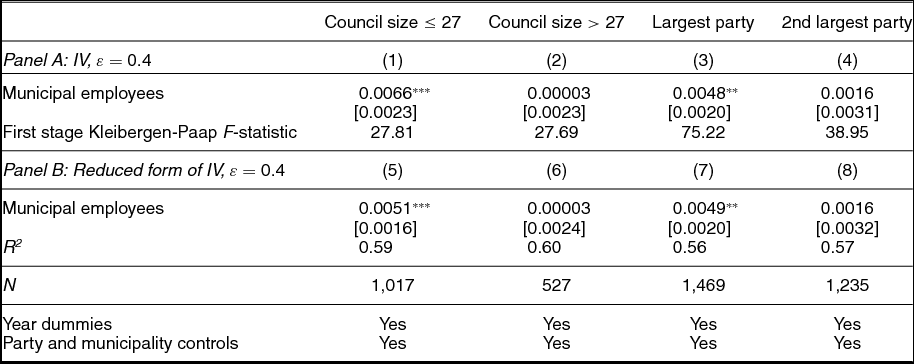
Our results show that when elected, municipal employees influence per capita local public spending (Hypothesis 1). We now turn to our Hypothesis 2a and test whether the influence of an additional municipal employee depends on council size. In the two leftmost columns of Table 5, we present the results for which we have divided the sample into two based on the median council size (27 councilors). Consistent with Hypothesis 2a, we find that the effect is larger and significant in the municipalities with a smaller council size. The difference between the smaller and larger councils is also statistically significant.Footnote 23
Heterogeneity in the Total Expenditures Effect by Council and Party Size

Notes: The unit of observation is a municipality m in election period t. The dependent variable is the logarithm of the mean of per capita total expenditures over the council term. Standard errors are clustered at the municipality level and reported in brackets. Party controls include parties’ lagged seat shares. Municipality controls include lagged population, squared population and shares of young and old citizens. ***, **, and * denote 1%, 5%, and 10% statistical significance levels, respectively.
We then test Hypothesis 2b and specifically the possibility that the municipal employees have a disproportionate effect within and via their party. Table 5 reports results for the largest and second largest parties. Unlike in our earlier regressions, here the endogenous explanatory variable and the instrument refer to the shares of municipal employees within the respective party, not in the entire council. We find a significant effect for the largest party, whereas the estimates are smaller and insignificant for the second largest party (see also Online Appendix C). However, the effects are not statistically significantly different from each other. Thus, while not conclusive, the evidence is consistent with Hypothesis 2b.Footnote 24 This result suggests that municipal employees may be a nonpartisan interest group that is able to influence decision making especially within the party. If the party is large, they have a disproportionate effect on policy.Footnote 25
Evidence on Rent-Seeking
To shed light on whether the effect of public employee representation on public spending reflects rent-seeking, or whether it is more consistent with efficient provision of public services, we test Hypothesis 3a and Hypothesis 3b.
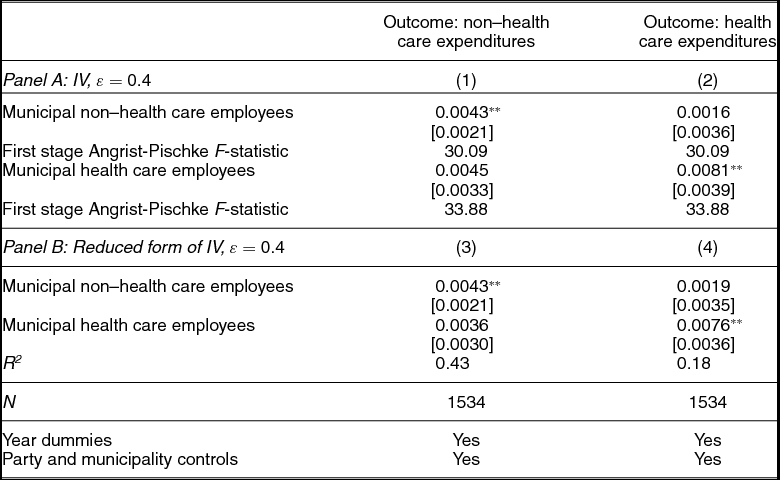
To start with, we explore whether the link between municipal employees in the council and municipal spending is occupation specific. It is plausible that municipal employees have more information on their own employment sector. However, there is no reason why, for example, a teacher would have better information about the appropriate level of health care spending than an otherwise similar councilor from the private sector. In columns (1) and (3) of Table 6, the outcome variable is municipal expenditures that are not related to health care, whereas in columns (2) and (4) of the panels the outcome variable is health care expenditures.Footnote 26 In these models, the interpretation for the coefficient for municipal health care employees is that it mirrors the effect of increasing their seat share relative to any nonmunicipal employee occupation.Footnote 27
Results According to Occupation and Spending Category

Notes: The unit of observation is a municipality m in election period t. The dependent variables are the logarithms of the means of per capita expenditures over the council term. Standard errors are clustered at the municipality level and reported in brackets. Party controls include parties’ lagged seat shares. Municipality controls include lagged population, squared population and shares of young and old citizens. ***, **, and * denote 1%, 5%, and 10% statistical significance levels, respectively.
The results suggest that health care municipal employees increase health care expenditures, but non–health care municipal employees have no effect on them. Similarly, health care employees do not affect non–health care expenditures, but municipal employees in the sectors other than health increase the other (nonhealth) municipal expenditures. Thus, consistent with Hypothesis 3a, spending increases seem to be confined to the sectors that have, by chance, more representation through municipal employees in the municipal council.Footnote 28
While not entirely conclusive, the evidence is consistent with the information advantage of municipal employees (Niskanen Reference Niskanen1971; Romer and Rosenthal Reference Romer and Rosenthal1979). Of course, one has to bear in mind that the context of those models is somewhat different from ours as these models focus on how bureaucrats can convince politicians to overspend. Moreover, the evidence speaks—at least mildly—for inefficient spending, because our as-good-as-random instrument ensures that variation in the needs of citizens is not driving the results. This raises the obvious question of why municipal employees’ information advantage leads to increased—and not to decreased—spending and only in their own sector of employment. These results also speak against the interpretation that municipal employees increase spending because they generally prefer a larger public sector (Knutsen Reference Knutsen2005; Jensen, Sum, and Flynn Reference Jensen, Sum and Flynn2009; Rattsø and Sørensen Reference Rattsø and Sørensen2016). Finally, we would like to point out that intraparty bargaining—for which we already provided support earlier—is an example of an indirect mechanism that could generate the observed sector specific effects: Given that councilors with municipal employment cannot be members of the subcommittee of their own sector, they have to influence sector-specific spending indirectly.
The results reported so far are consistent with our Hypothesis 3a, i.e., with municipal employees having an information advantage over politicians and being able to convince politicians to spend more on public services. To test Hypothesis 3b, which postulates that the extra spending is excessive and related to rent-seeking, we analyze whether municipal employees enjoy larger returns to office in terms of receiving larger salary increases and/or facing smaller unemployment risk, and whether they enjoy from a larger incumbency advantage than the other candidates. When we use candidate-level data (either lottery outcomes that make the election status truly random or RDD), we find no systematic evidence that that the municipal employees would get higher salaries, be more likely to be employed subsequently, or that they would be more likely to get re-elected or get more votes (in the next election at t + 1) than the other candidates due to getting elected at time t (see the Online Appendix E for details of these results).Footnote 29
These null results do not support Hypothesis 3b. Using auxiliary survey data from the Finnish Broadcasting Company (YLE), we have, however, confirmed that municipal employees who run for a council differ from the other candidates in two intriguing ways: First, they oppose more strongly firing of municipal employees in connection with municipal mergers. Second, they oppose more strongly restrictions on nomination of municipal employees in municipal boards (see Online Appendix E for details and further media references). One could argue that these stated views, as well as the concerns expressed in the Finnish media, are harder to reconcile with pro-social behavior than with rent-seeking.
CONCLUSIONS
We have produced three novel findings in this paper. First, the political representation of municipal employees has a positive causal effect on overall local public spending. Second, the effect is sector specific: Having more health care sector employees in the council increases health care spending and having more non–health sector employees increases non–health care spending, but there are no significant cross-sector effects. Third, the effect appears to be related to the interest group influencing the policy from within the parties.
Our findings hold two lessons for contemporary research in political economics and political science. The first is that politicians’ identities matter in local political decision making characterized by proportional representation and open-list D'Hondt election rule. The citizen-candidate model (Osborne and Slivinski Reference Osborne1996; Besley and Coate Reference Besley and Coate1997) is therefore more in line with our evidence than the median voter model or Tiebout (Reference Tiebout1956) competition. The second lesson is that the marginally elected candidates are able to influence local policy. This influence may explain why in the very same Finnish elections that we have studied in this article, a greater likelihood of being the pivotal voter increases turnout (Lyytikäinen and Tukiainen Reference Lyytikäinen and Tukiainen2016).
It is important to interpret our results in the context to which they apply. Our findings refer to a country that has a large public sector and that has traditionally given the local municipalities a major role in the allocation of public resources and production of public services. While we do not find systematic evidence of rent-seeking, our results show that the Finnish municipal councilors employed by the public sector want—by revealed preference—to increase public expenditures in a country that in 2014 had the highest public sector ratio to GDP and whose local governments were among the most indebted among all OECD countries. This is puzzling because our as-good-as-random design guarantees that the citizens’ needs are identical on average in the analyzed municipalities across all sectors. One can therefore raise the question why, in this context, would informed and benevolent municipal employee councilors increase rather than decrease their own sector's public spending? Moreover, can it be desirable—in this context and more generally—that municipal spending is strongly affected by one particular interest group?
Making precise statements about the external validity of a close elections analysis is challenging. On one hand, there are about 40 countries in the world using an open-list PR, similar in spirit to what we have studied. Moreover, the Finnish rules governing the political representation of municipal employees have the same broad goal as many other countries’ corresponding rules: They have been written in order to prevent public employees from having undue influence on political decision making. It thus seems possible that our results generalize at least to countries with a similar political system at the local level. On the other hand, details of political processes tend to matter: We should not extrapolate too much, as there is quite a bit cross-country variation in both the precise functioning of the open-list PR systems as well as in the design of ineligibility and incompatibility rules (Braendle and Stutzer Reference Braendle and Stutzer2016).
Rather than offering detailed policy recommendations, we conclude with a call for more research. There are three reasons to this call. First, while our findings support the argument that some regulation of public employees’ political involvement is warranted, they do not provide guidance on the optimal design of ineligibility and incompatibility rules. We can only conjecture how large the estimated effect would have been, had there not been any restrictions on political participation of public sector employees in Finland. Moreover, we would need to understand better what the interests of other groups are to optimally design policy. Second, when, how, and why ineligibility and incompatibility rules prevent public employees from having undue influence on political decision making in general and spending in particular is likely to be context dependent. This calls for replicating our analysis in other institutional contexts. Finally, the empirical procedure presented here can be applied to a wider range of electoral systems than just the open-list PR. For example, one can use similar aggregation of close races to look at effects of council composition in plurality systems, where the council is composed of politicians elected from many (single or multimember) districts. Subsequent work can thus make use of our procedure to provide more analyses of the desirability to restrict public employees’ political participation in different environments.
SUPPLEMENTARY MATERIAL
To view supplementary material for this article, please visit https://doi.org/10.1017/S0003055417000284.
Replication Files can be found on Dataverse at http://doi.org/10.7910/DVN/V7SQRW.




Comments
No Comments have been published for this article.