1. Introduction
Many studies of the Permian strata of Anatolia and its vicinities indicate that there are various tectonic units having distinct stratigraphic and lithological properties. Different authors (Blumenthal, Reference Blumenthal1944, Reference Blumenthal1951; Lefevre, Reference Lefevre1967; Marcoux, Reference Marcoux1976; T. Güvenç, unpub. Ph.D. thesis, Univ. Paris, 1965, Güvenç, Reference Güvenç1980; Özgül, Reference Özgül1976, Reference Özgül, Göncüoğlu and Tekeli1984) used the terms ‘nappe’ or ‘unit’ for these tectonic units.
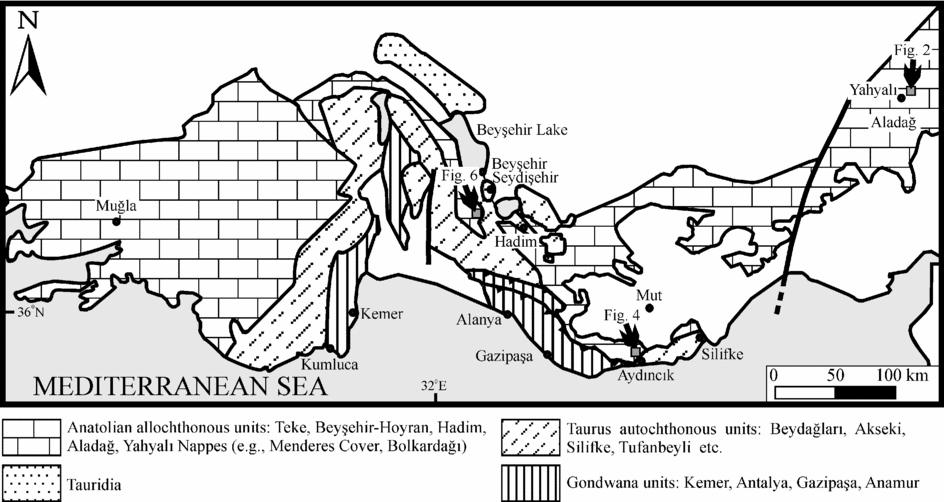
In several studies (Güvenç, Reference Güvenç, Izdar and Nakoman1977b, Reference Güvenç1991; Güvenç et al. Reference Güvenç, Demirel, Meshur, Gül and Tekin1991; Demirel & Tekin, Reference Demirel and Tekin1993), different palaeogeographic units of Palaeozoic and Triassic ages located from north to south with distinct stratigraphic and palaeontological characteristics have been identified in the Taurides. These palaeogeographic units are called Euranatolia, the Aegean–Anatolian Zone, the Anatolian Platform, the Tauridia, the Taurus Trough and autochthonous units of the Taurus and Gondwanan Platform (Fig. 1).
Geological map of the tectonic units of Western and (partly) Eastern Taurus (after Demirel & Tekin, Reference Demirel and Tekin1993). Locations of Figures 2, 4 and 6 are indicated.

The Anatolian Platform (Güvenç, Reference Güvenç, Izdar and Nakoman1977b), which was a part of the Gondwanan Platform, is mainly characterized by carbonate-dominated deposits ranging in age from Devonian to Permian. The Upper Carboniferous/Lower Permian of the Anatolian Platform is mainly represented by quartz sandstone with iron oxide concretions and shallow marine limestones (Girvanella Limestones facies, Calcaires à Girvanella, sensu T. Güvenç, unpub. Ph.D. thesis, Univ. Paris, 1965). The main component of this special facies is a micro-organism traditionally denoted as Girvanella, but it may correspond to a peculiar, small, attached nub-eculariid foraminifer, Ellesmerella, according to some authors (e.g. Vachard & Krainer, 200; Sanders & Krainer, Reference Sanders and Krainer2005). The Early Permian strata of the Anatolian Platform are composed of an alternation of grey and black clayey limestone and clastic sediments.
The aim of this study is to describe the Early Permian (mainly Asselian–Sakmarian) fusulinid fauna of the Anatolian Platform and to correlate it with coeval faunas in other regions. For this purpose, three Early Permian sections from the Anatolian Platform were selected for detailed biostratigraphic studies and the systematic description of the fusulinids. These sections are: (1) the Özbek Tepe section (Tepe = hill, in Turkish) from Siyah Aladağ Nappe in the Eastern Taurides, (2) the Eskibey section from the Aladağ Unit in the Central Taurides and (3) the Bademli section from the Bademli–Cevizli Unit in the Central Taurides.
2. Geological outline of the Taurides
The Taurides, one of the major units of the Alpine–Himalayan Orogenic Belt, extend parallel to the Mediterranean Sea coast in South Anatolia. According to Özgül (Reference Özgül1976, Reference Özgül, Göncüoğlu and Tekeli1984), the Taurides can be subdivided into three geological and morphological regions: (1) the Western Taurides from the Aegean coast to the Kirkkavak fault; (2) the Central Taurides between the Kırkkavak fault and the Ecemiş fault; (3) the Eastern Taurides to the east of the Ecemiş fault. Consequently, the Özbek Tepe section belongs to the Eastern Taurides, whereas the Eskibey and the Bademli sections are situated in the Central Taurides (Fig. 1).
The Tauride Belt consists of a number of allochthonous and autochthonous sequences possessing distinct stratigraphic, structural and metamorphic features (Blumenthal, Reference Blumenthal1944, Reference Blumenthal1951; Özgül, Reference Özgül1976, Reference Özgül, Göncüoğlu and Tekeli1984; Brunn et al. Reference Brunn, Dumont, Graciansky, Gutnic, Juteau, Marcoux, Monod, Poisson and Campbell1971, Reference Brunn, Argyriadis, Marcoux, Monod, Poisson and Ricou1973; O. Monod, unpub. Ph.D. thesis, Univ. Paris, 1977; Gutnic et al. Reference Gutnic, Monod, Poisson and Dumont1979). According to Özgül (Reference Özgül1976), the Tauride Belt is composed of six main tectonostratigraphic units, namely, the ‘Bolkardağı’, ‘Aladağ’, ‘Geyikdagi’, ‘Alanya’, ‘Bozkır’ and ‘Antalya’. The Aladağ Unit is equivalent to the Hadim Nappe of Blumenthal (Reference Blumenthal1951). The Antalya and Alanya units correspond to the Antalya Nappe and Alanya Massif, whereas the Bozkır and Bolkar units are synonyms of the Beyşehir–Hoyran Nappes of Brunn et al. (Reference Brunn, Dumont, Graciansky, Gutnic, Juteau, Marcoux, Monod, Poisson and Campbell1971, Reference Brunn, Argyriadis, Marcoux, Monod, Poisson and Ricou1973).
3. Stratigraphy
3.a. Lithostratigraphic units
Numerous formation names have been used in studies carried out by various researchers in different areas of the Anatolian Platform (e.g. O. Monod, unpub. Ph.D. thesis, Univ. Paris, 1977; Güvenç, Reference Güvenç1980; Tekeli, Reference Tekeli1980; Tekeli et al. Reference Tekeli, Aksay, Urgun, Işik, Göncüoğlu and Tekeli1984; Ulakoğlu, Reference Ulakoğlu1983/Reference Ulakoğlu1984; Y. Lengeranlı et al. unpub. MTA report, Ankara, 1986; Gürçay, Reference Gürçay2000). Güvenç (Reference Güvenç, Izdar and Nakoman1977a) studied the Carboniferous–Permian deposits and introduced some formation names (e.g. Cit Yayla, Bademli–Cevizli, Dikenlidere), which were completed by Güvenç (Reference Güvenç1980) as follows: the Visean–upper Moscovian Dikenli Group including the Dikenlidere, Dikenlitepe and Demirkazik formations, the Upper Carboniferous–Lower Permian Dikmen Group composed of the Gavuralanı and Dikmentepe formations, the Lower Permian Karapertarlar Formation and the Upper Permian Hortubeleni Formation. These formation names are adopted throughout this study.
3.b. Özbek Tepe section
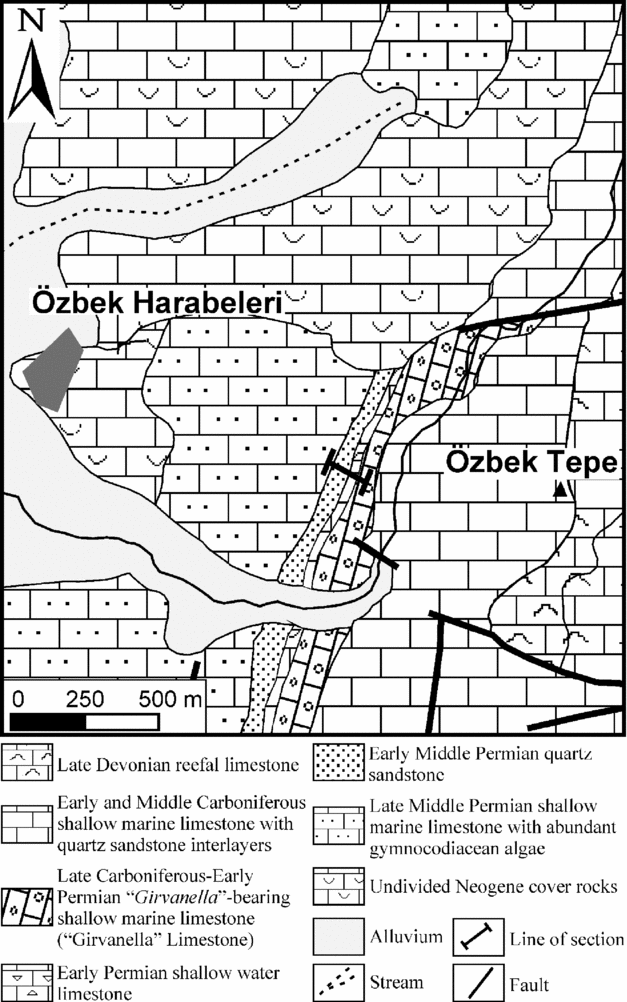
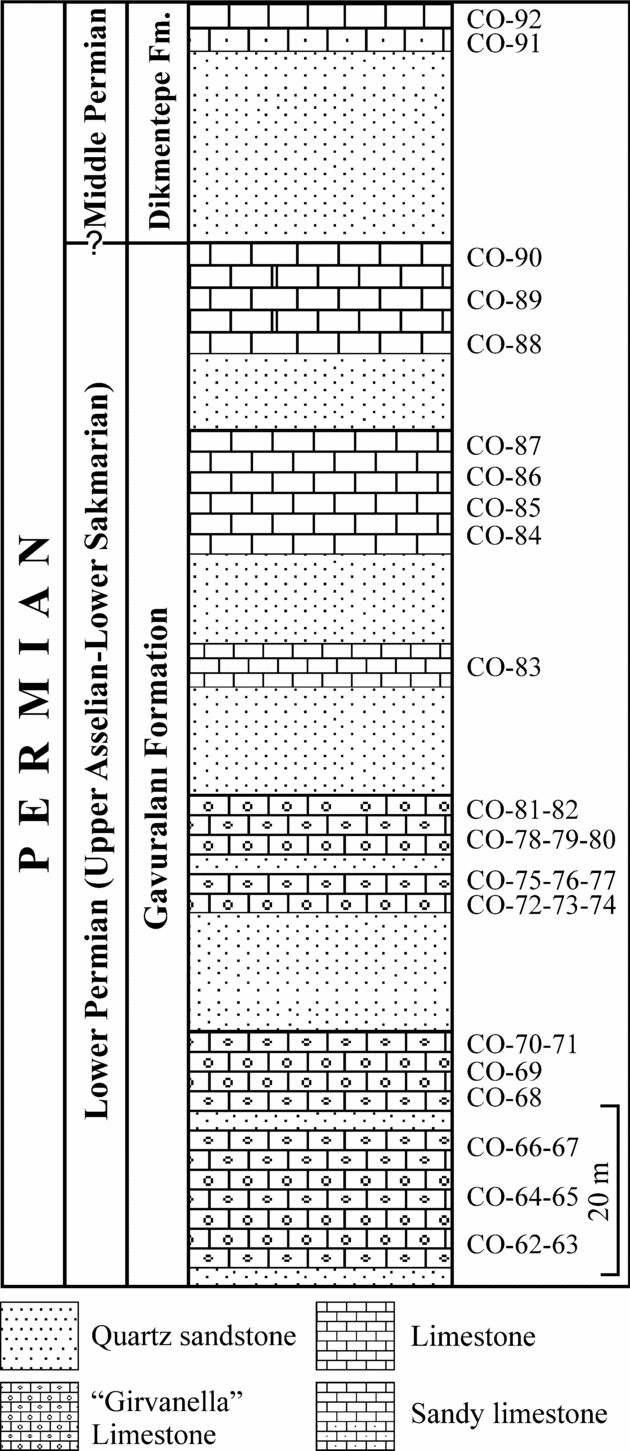
The Özbek Tepe section in the Siyah Aladağ Nappe is located northeast of the town of Yahyalı and is named after Özbek Tepe (Kayseri L34-c3 Quadrangle sheet, between 22.400N/17.075E and 22.550N/16.000E UTM coordinates) (Fig. 2). It is 151 m thick, and 31 samples were collected from this section that includes the sequences of the Gavuralanı and Dikmentepe formations (Fig. 3).
Geological map of the Özbek Tepe section (after Y. Lengeranlı et al. unpub. MTA report, Ankara, 1986) and its vicinities. For location see Figure 1.

Lithological properties and the sampling levels of the Özbek Tepe section.

The base and middle parts of the section are characterized by various thin- to medium-bedded, grey–brown–pink–light green (especially the ‘Girvanella Limestone’ levels) limestone rich in iron oxide, macrofossils and ‘Girvanella’/Ellesmerella corresponding to the Gavuralanı Formation. The upper part of the section (upper part of the Gavuralanı Formation) is mainly characterized by thin- to medium-bedded, fusulinid- and ‘Girvanella’-bearing, grey–brown–yellow coloured clayey limestone with thick-bedded light yellow–grey coloured quartz sandstone intercalations (5–50 m). The uppermost part of the Özbek Tepe section is represented by a quartz sandstone interval (thickness is about 30 m) and overlying thin- to medium-bedded, abundant porcelaneous foraminifers (mainly Pseudovermiporella), small foraminifers and rare fusulinid-bearing grey sandy limestone corresponding to the Dikmentepe Formation (Fig. 3).
3.c. Eskibey section
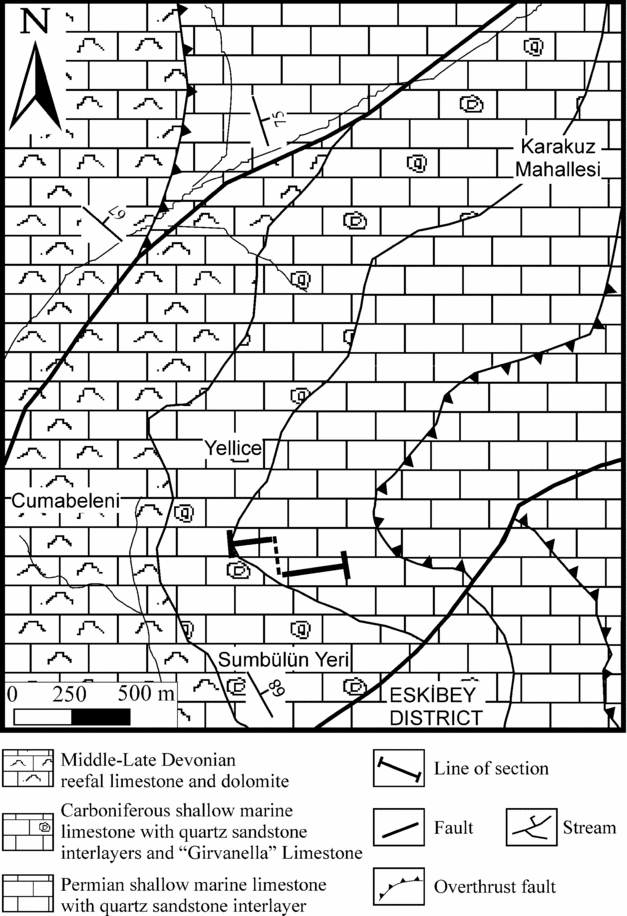
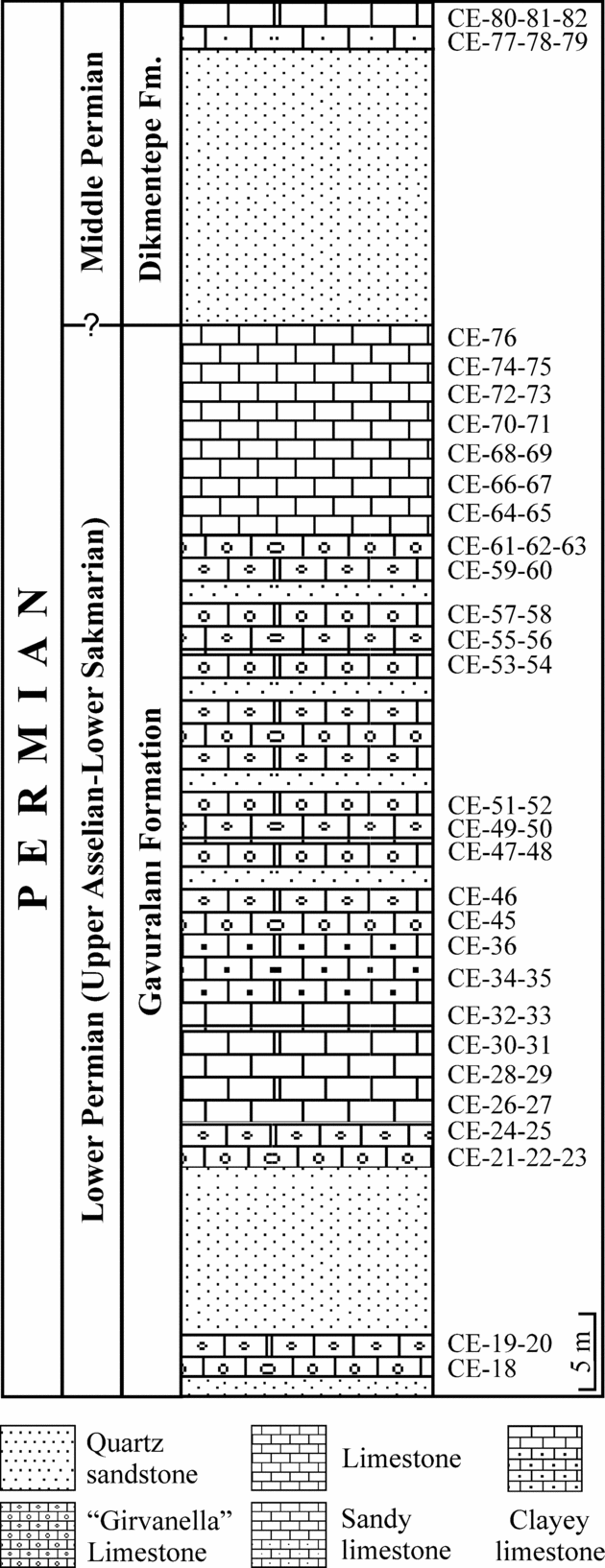
The Eskibey section in the Aladağ Unit is located northwest of the town of Aydıncık and named after the Eskibey district (Silifke P30-d2 Quadrangle sheet, between 08.325N/20.000E and 08.025N/20.900E UTM coordinates) (Fig. 4). Its thickness is 92 m, and 57 samples were taken from this section. The section contains strata with the typical lithology of the Gavuralanı and Dikmentepe formations (Fig. 5).
Geological map of the western part of the Aydıncık (Eskibey district) and its vicinities (simplified after Gürçay, Reference Gürçay2000). For location see Figure 1.

Lithological properties and the sampling levels of the Eskibey section.

The basal part of the Eskibey Section is mainly characterized by medium- to thick-bedded, macrofossil-, fusulinid-, sometimes ‘Girvanella’- and oolite-bearing, grey–brown–pink–yellow–light green coloured (especially ‘Girvanella Limestone’ levels) limestone, and sandy limestone rich in iron oxide and quartz sandstone interbeds corresponding to the lower and middle part of the Gavuralanı Formation. The overlying beds, corresponding to the upper part of the Gavuralanı Formation, are mainly represented by thin- to medium-bedded, ‘Girvanella’- and fusulinid-bearing, yellow coloured, sometimes clayey limestone and thin quartz sandstone (about 5 m thick) interbeds. A quartz sandstone level (about 20 m thick) and overlying thin-bedded, abundant porcelaneous foraminifers (mainly Pseudovermiporella), macrofossil- and rare fusulinid-bearing grey sandy limestone with shale interbeds are the characteristic lithologies of the upper part of the Eskibey section and correspond to the Dikmentepe Formation (Fig. 5).
3.d. Bademli section
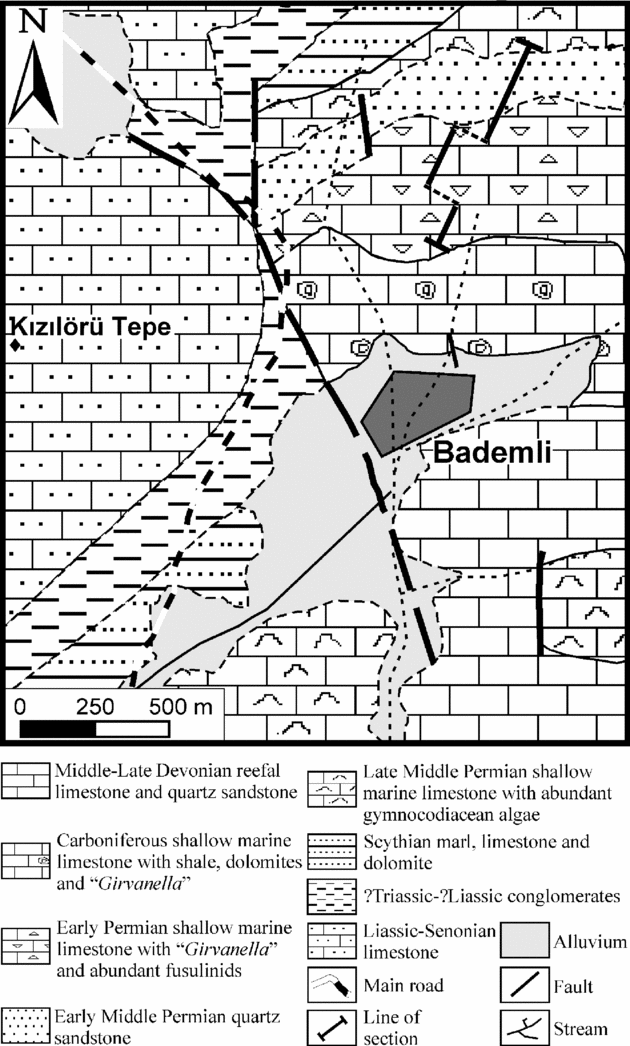
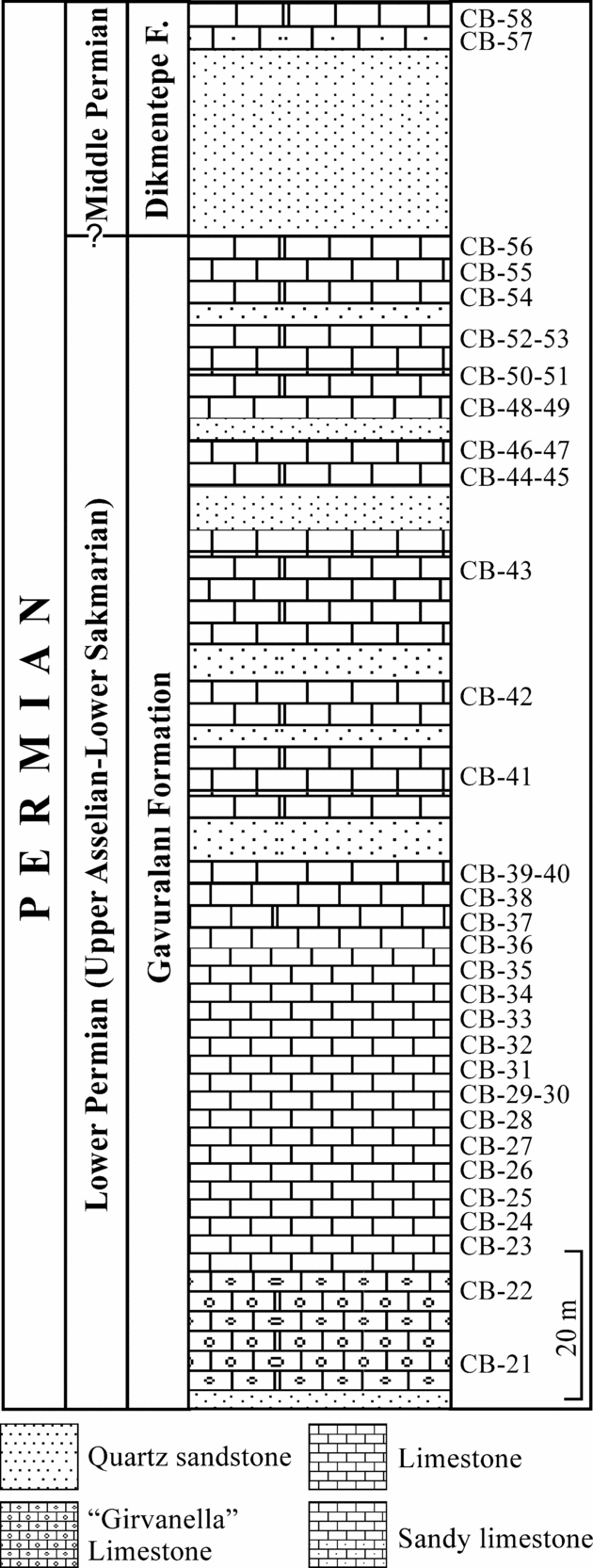
The Bademli section in the Bademli–Cevizli Unit is located southwest of the city of Seydişehir (near the town of Bademli) (Konya N27-a3 Quadrangle sheet, between 30.800N/88.750E and 31.000N/89.000E UTM coordinates) (Fig. 6). Its thickness is 190 m and 38 samples were collected from this section. This section corresponds to the typical strata of the Gavuralanı and Dikmentepe formations (Fig. 7). The base of the section is mainly characterized by thin- to medium-bedded, abundant macrofossil-, fusulinid-, ‘Girvanella’- and iron oxide-bearing grey–brown coloured limestone corresponding to the lower and middle part of the Gavuralanı Formation. The succession of overlying beds consists of yellow coloured thin-bedded, abundant fusulinid- and ‘Girvanella’-bearing and sometimes clayey limestone and thin quartz sandstone alternations of the upper parts of the Gavuralanı Formation. A pink quartz sandstone interval (about 30 m thick) and the overlying beds of grey coloured thin- to medium-bedded, abundant porcelaneous foraminifers (mainly Pseudovermiporella) and macrofossil- and rare fusulinid-bearing sandy limestone become dominant in the upper part of the Bademli section corresponding to the Dikmentepe Formation (Fig. 7).
Geological map of Bademli town and its vicinity (after O. Monod, unpub. Ph.D. thesis, Univ. Paris, 1977). For location see Figure 1.

Lithological properties and the sampling levels of the Bademli section.

4. Systematic palaeontology
In this study, the reference book on the systematics of Palaeozoic Foraminifers (Endothyroida, Fusulinoida) of Rauser-Chernousova et al. (Reference Rauser-Chernousova, Bensh, Vdovenko, Gibshman, Leven, Lipina, Reitlinger, Solovieva and Chediya1996) was used. All holotypes and paratypes are reposited in the collection of the Natural History Museum of MTA (General Directorate of Mineral Research and Exploration of Turkey) under numbers MTA2002/CO2.1–MTA2002/CO10.5. The following abbreviations are used in this paper for the location of samples: ÖTS (Özbek Tepe Section), ES (Eskibey Section) and BS (Bademli Section).
Class FORAMINIFERA d'Orbigny, Reference d'Orbigny1826
Superorder FUSULINOIDA Fursenko, Reference Fursenko1958
Order SCHUBERTELLIDA Skinner, Reference Skinner1931
Family schubertellidae Skinner, Reference Skinner1931
Genus Schubertella Staff & Wedekind, Reference Staff and Wedekind1910
Type species. Schubertella transitoria Staff & Wedekind, Reference Staff and Wedekind1910.
Schubertella sphaerica staffelloides Suleimanov, Reference Suleimanov1949 Figure 8a–c
1949 Schubertella sphaerica var. staffelloides Suleimanov, p. 28, pl. 1, figs 2, 2a.
2001 Eoschubertella sphaerica staffelloides Suleimanov; Leven & Davydov, p. 15, pl. 1, fig. 7.
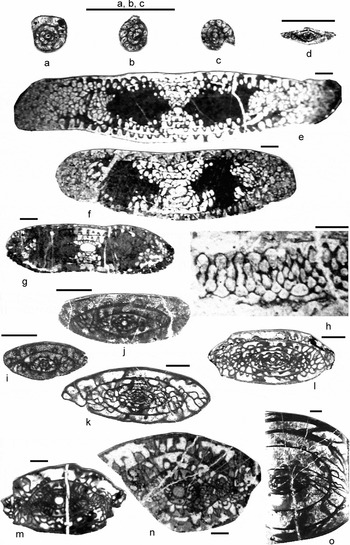
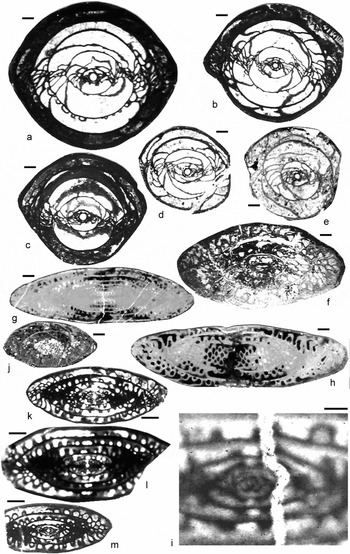
Photomicrographs of the late Asselian–early Sakmarian fusulinid fauna from the Anatolian Platform. Scale bars are 0.5 mm. (a–c) Schubertella sphaerica staffelloides Suleimanov; (a) equatorial section; ES; sample no. CE-59-1-2, ×75; (b) subequatorial section; ES; sample no. CE-59-1-3, ×75; (c) nearly axial section; ES; sample no. CE-59-1-1, ×75. (d) Boultonia willsi Lee, axial section; ES; sample no. CE-69-6-2, ×45. (e) Quasifusulina eleganta Shlykova, axial section; ES; sample no. CE-50-5, ×15. (f–h) Quasifusulina longissima (Moeller); (f) axial section; ÖTS; sample no. CO-73-1, ×15; (g) axial section; ES; sample no. CE-20-5, ×15; (h) appearance of the cuniculi in tangential section; ES; sample no. CE-18-1-3, ×28. (i, j) Biwaella (?) sp., (i) axial section; ÖTS; sample no. CO-72-1, ×30; (j) axial section; ÖTS; sample no. CO-72-2, ×30. (k, l) Darvasites ellipsoidalis (Toriyama); (k) axial section; BS; sample no. CB-23-19, ×20; (l) axial section; ES; sample no. CE-53-11, ×20. (m, n) Dutkevitchia splendida (Bensh); (m) axial section; ÖTS; sample no. CO-68-5, ×15; (n) axial section; ÖTS; sample no. CO-68-4, ×15. (o) Sphaeroschwagerina sp., axial section; ÖTS; sample no. CO-73-2, ×10.

Remarks. The described specimen from Eskibey Section is very similar to the typical Schubertella sphaerica staffelloides Suleimanov in the shape and size of the test, Staffella-like inner volutions and weak chomata.
Occurrence. ES, Gavuralanı Formation (see Figs 4, 5); Early Permian, late Asselian–early Sakmarian.
Family boultoniidae Skinner & Wilde, Reference Skinner and Wilde1954
Genus Boultonia Lee, Reference Lee1927
Type species. Boultonia willsi Lee, Reference Lee1927.
Boultonia willsi Lee, Reference Lee1927 Figure 8d
1927 Boultonia willsi Lee, pp. 10–11, pl. 2, figs 1–4.
Remarks. Boultonia cheni Ho closely resembles Boultonia willsi Lee, but differs in having a larger L/D ratio, more sharply pointed poles and stronger and more regular septal fluting.
Occurrence. ES, Gavuralanı Formation (Figs 4, 5); Early Permian, late Asselian–early Sakmarian.
Order FUSULINIDA Fursenko, Reference Fursenko1958
Family fusulinidae Moeller, Reference Moeller1878
Subfamily quasifusulininae Putrya, Reference Putrya1956
Genus Quasifusulina Chen, Reference Chen1934
Type species. Fusulina longissima Moeller, Reference Moeller1878.
Quasifusulina eleganta Shlykova, Reference Shlykova1948 Figure 8e
1948 Quasifusulina longissima eleganta Shlykova, pp. 131–2, pl. 6, figs 3–6.
1984 Quasifusulina eleganta Shlykova; Zhao, Han & Wang, p. 85, pl. 10, figs 7, 8.
Discussion. The elongated subcylindrical test, diameter of the proloculus, two-layered wall, regular septal folding, shape of axial fillings and uniform coiling of the present specimen clearly show similarities with the holotype of Quasifusulina eleganta Shlykova.
Remarks. Quasifusulina longissima. (Moeller) is the most similar species to Quasifusulina eleganta Shlykova, but differs from the latter in the smaller size of the test, deeply folded septa and more developed axial fillings.
Occurrence. ES, Gavuralanı Formation (Figs 4, 5); Early Permian, late Asselian–early Sakmarian.
Quasifusulina longissima (Moeller, Reference Moeller1878) Figure 8f–h
1878 Fusulina longissima Moeller, pp. 59–61, pl. 1, fig. 4, pl. 2, fig. 1a–e, pl. 8, fig. 1a–c.
1908 Fusulina longissima Moeller; Schellwien, pp. 163–5, pl. 13, figs 14–20.
1927 Schellwienia longissima (Moeller); Lee, pp. 111–16, pl. 19, figs 11–14, pl. 20, figs 1–14.
1934 Quasifusulina longissima (Moeller); Chen, pp. 92–3, pl. 5, figs 6–9.
1990 Quasifusulina ex gr. longissima (Moeller); Vachard, p. 197, pl. 1, fig. 6.
Discussion. The subcylindrical shape of the test, diameter of the proloculus, two-layered wall structure, regular septal folding and uniform coiling clearly show similarity with typical Quasifusulina longissima (Moeller).
Remarks. The present species is similar to Quasifusulina paracompacta Chang in the shape and size of the test. However, the latter differs from Quasifusulina longissima (Moeller) in having bluntly rounded poles, more volutions, tightly coiled inner volutions and smaller proloculus.
Occurrence. ÖTS, ES, Gavuralanı Formation (Figs 2, 3 and Figs 4, 5); Early Permian, late Asselian–early Sakmarian.
Order SCHWAGERINIDA Solovieva in Epshteyn et al. Reference Epshteyn, Terekhova and Solovieva1985
Family triticitidae Davydov, Reference Davydov1986
Genus Biwaella Morikawa & Isomi, Reference Morikawa and Isomi1960
Type species. Biwaella omiensis Morikawa & Isomi, Reference Morikawa and Isomi1960.
Biwaella (?) sp. Figure 8i, j
Description. Test small, fusiform with straight or concave lateral slopes and slightly pointed poles. Shell expands gradually throughout growth. Specimens with three and a half volutions 1.17 to 1.90 mm in length and 0.51 to 0.70 mm in width, form ratios of 2.29 to 2.60. Proloculus spherical and small with an outside diameter of 0.07–0.117 mm. Spirotheca thin with a tectum and lower structureless layer in the inner volutions, but with a tectum and a fine alveolar keriotheca in outer ones. Thin septa weakly fluted in the extreme polar regions. Chomata small and developed in all volutions except the last two. Tunnel narrow in the inner volutions and wide in the outer ones.
Remarks. Biwaella (?) sp. resembles some species of Biwaella, however, a definite species could not be assigned because of insufficient material.
Occurrence. ÖTS, Gavuralanı Formation (Figs 2, 3); Early Permian, late Asselian–early Sakmarian.
Genus Darvasites Miklukho-Maklay, Reference Miklukho-Maklay1959
Type species. Triticites ordinatus var. daroni Miklukho-Maklay, Reference Miklukho-Maklay1949.
Darvasites ellipsoidalis (Toriyama, Reference Toriyama1958) Figure 8k, l
1958 Triticites ellipsoidalis Toriyama, pp. 115–18, pl. 12, figs 13–34.
1987 Eoparafusulina ellipsoidalis (Toriyama); Zhou, Sheng & Wang, pl. 3, fig. 3.
1995 Eoparafusulina? ellipsoidalis (Toriyama); Forke, p. 224, pl. 10, fig. 10.
Description. Test medium in size, ellipsoidal to fusiform in shape with rounded polar ends, convex lateral slopes and regular axis of coiling. The first volution ellipsoidal in shape and the test expands slowly and uniformly except for the last two or three volutions. The specimens of four to seven and a half volutions 1.03–3.18 mm in length and 0.50–1.78 mm in width, form ratios of 1.78 to 2.60. Proloculus spherical and small with an outside diameter of 0.070–110 mm. The spirotheca are composed of a tectum and a finely alveolar keriotheca, and are very thin in the inner one or two volutions (0.007–0.010 mm) and considerably thicker in the outer volutions (0.040–0.065 mm). Septa are thin, almost straight in the central part of the test, but moderately folded in the extreme polar areas. Chomata small and distinct in the inner volutions and well developed in the outer two or three volutions. Tunnel narrow and high with an almost regular path.
Remarks. Darvasites ellipsoidalis (Toriyama) is closely related to forms of Darvasites contractus (Schellwien and Dyhrenfurth) from the Early Permian of Darvas, but differs from it in having fewer volutions, weaker septal folding and smaller size of the test.
Occurrence. ÖTS, ES, BS, Gavuralanı Formation (Figs 2, 3, Figs 4, 5 and Figs 6, 7); Early Permian, late Asselian–early Sakmarian.
Family rugosofusulinidae Davydov, Reference Davydov1980
Genus Dutkevitchia Leven & Shcherbovich, Reference Leven and Shcherbovich1978
Type species. Rugosofusulina devexa Rauser-Chernousova, Reference Rauser-Chernousova1937.
Dutkevitchia splendida (Bensh, Reference Bensh1962) Figure 8m, n
1962 Rugosofusulina splendida Bensh, pp. 202–4, pl. 7, figs 1–2.
1969 Rugosofusulina aff. splendida (Bensh); Shcherbovich, p. 32, pl. 10, fig. 3.
1971 Rugosofusulina splendida Bensh; Leven, p. 14, pl. 1, figs 13–14.
1972 Rugosofusulina splendida Bensh; Bensh, pp. 84–5, pl. 17, fig. 4.
1990 Dutkevitchia splendida (Bensh); Ozawa et al., pl. 7, figs 9, 10.
2002 Dutkevitchia splendida (Bensh); Forke, pp. 232–4, pl. 36, figs 11, 12.
Remarks. The present species is very similar to Dutkevitchia devexa (Rauser-Chernousova) concerning the shape of the test and large proloculus, but differs in having low L/D ratio, less volutions, thick spirotheca and weak and more regular septal folding.
Occurrence. ÖTS, Gavuralanı Formation (Figs 2, 3); Early Permian, late Asselian–early Sakmarian.
Family schwagerinidae Dunbar & Henbest, Reference Dunbar and Henbest1930
Subfamily schwagerininae Dunbar & Henbest, Reference Dunbar and Henbest1930
Genus Sphaeroschwagerina Miklukho-Maklay, Reference Miklukho-Maklay1959
Type species. Schwagerina princeps Schellwien, Reference Schellwien1898.
Sphaeroschwagerina sp. Figure 8o
Description. Test large and spherical in shape with convex lateral slopes and rounded polar ends. Shell exhibits three distinct stages in growth and overall shape, tightly coiled juvenarium, loosely coiled and highly expanded succeeding whorls and the final volution with lower height than the penultimate volution. Juvenarium composed of inner two and a half tightly coiled and subspherical volutions. From third to fourth volution, shell expands very rapidly and becomes globose to subglobose in shape. Specimen with four and a half volutions 6.25 mm in length and 4.50 mm in width, form ratio of 1.38. Proloculus spherical and large with an outside diameter of 0.218–0.296 mm. Wall is composed of a tectum and finely alveolar keriotheca, and is very thin in juvenile volutions and thicker at last two volutions. Septa thin and nearly planar in the inner volutions, but slightly fluted along the axis of outer volutions. Chomata low, asymmetrical and distinct in juvenile volutions and the first one or two loosely coiled whorls. Tunnel low and wide.
Discussion. The unidentified species closely resembles some species of Sphaeroschwagerina, but an exact identification based on this poorly preserved specimen cannot be made.
Occurrence. ÖTS, Gavuralanı Formation (Figs 2, 3); Early Permian, late Asselian–early Sakmarian.
Subfamily pseudoschwagerininae Chang, Reference Chang1963
Genus Zellia Kahler & Kahler, Reference Kahler and Kahler1937
Type species. Zellia heritschi Kahler & Kahler, Reference Kahler and Kahler1937 = Pseudoschwagerina (Zellia) heritschi Kahler & Kahler, Reference Kahler and Kahler1937.
Zellia nunosei Hanzawa, Reference Hanzawa1939Figure 9a–e
Photomicrographs of the late Asselian–early Sakmarian fusulinid fauna from the Anatolian Platform. Scale bars are 0.5 mm. (a–e) Zellia nunosei Hanzawa; (a) axial section; ÖTS; sample no. CO-76-2, (b) axial section; ÖTS; sample no. CO-76-3; (c) axial section; ÖTS; sample no. CO-76-5; (d) axial section; BS; sample no. CB-24-1-1; (e) axial section; ES; sample no. CE-24-11. (f) Paraschwagerina ex gr. pseudomira Miklukho-Maklay, subaxial section; ÖTS; sample no. CO-66-2. (g–i) Pseudochusenella anatoliana n. sp.; (g) holotype, MTA2002/CO2.1; axial section; ÖTS; sample no. CO-68-3; (h) paratype, MTA2002/CO2.2; tangential section; ÖTS; sample no. CO-68-2; (i) enlargement of the inner volutions of the Fig. 9g, ×20; appearance of the small proloculus and symmetrical chomata. (j) Pseudofusulina sp., axial section; ÖTS; sample no. CO-62-1-2. (k–m) Pseudofusulinoides altineri n. sp.; (k) holotype, MTA2002/CO2.3; axial section; ÖTS; sample no. CO-74-8, ×15; (l) paratype, MTA2002/CO2.4.1; axial section; ÖTS; sample no. CO-74-10, ×15; (m) paratype, MTA2002/CO2.4.2; axial section; ÖTS; sample no. CO-74-2, ×15.

1938 Schwagerina aff. amedaei Deprat; Yabe, p. 1621.
1939 Pseudoschwagerina (Zellia) nunosei Hanzawa, pp. 72–3, pl. 4, figs 4–6.
1959 Zellia nunosei Hanzawa; Miklukho-Maklay, p. 158.
1961 Pseudoschwagerina (Zellia) nunosei Hanzawa; Hanzawa, pl. 32, fig. 2, pl. 33, figs 1–2.
1961 Pseudoschwagerina (Zellia) nunosei Hanzawa; Morikawa & Isomi, pp. 9–10, pl. 3, figs 1, 2.
1965 Zellia nunosei Hanzawa; Kanmera & Mikami, pp. 283–4, pl. 45, figs 1–5.
1993 Zellia nunosei Hanzawa; Leven, pp. 177–8, pl. 10, figs 1, 2.
Remarks. Zellia nunosei Hanzawa differs from most species of the genus in the spherical shape of the test, rapidly expanding volutions, larger proloculus and thick spirotheca of the outer volutions. Zellia amedaei (Deprat) is similar to Zellia nunosei Hanzawa in the shape of the test, but differs from the latter by having two and a half closely coiled juvenarium stages and smaller height of the last volutions. Zellia nunosei Hanzawa resembles to Zellia? nucleolata (Ciry) in shell shape, mode of coiling and size of proloculus but differs in the larger size of the test.
Occurrence. ÖTS, ES, BS, Gavuralanı Formation (Figs 2–3, Figs 4–5, Figs 6–7); Early Permian, late Asselian–early Sakmarian.
Subfamily paraschwagerininae Bensh in Rauser-Chernousova et al. Reference Rauser-Chernousova, Bensh, Vdovenko, Gibshman, Leven, Lipina, Reitlinger, Solovieva and Chediya1996
Genus Paraschwagerina Dunbar & Skinner, Reference Dunbar and Skinner1936
Type species. Schwagerina gigantea White, Reference White1932.
Paraschwagerina ex gr. pseudomira Miklukho-Maklay, Reference Miklukho-Maklay1949 Figure 9f
1949 Paraschwagerina pseudomira Miklukho-Maklay, pp. 81–3, pl. 7, figs 1–3.
1972 Paraschwagerina pseudomira Miklukho-Maklay; Bensh, pp. 116–17, pl. 26, figs 3, 4.
2002 Paraschwagerina pseudomira Miklukho-Maklay; Forke, p. 248, pl. 38, fig. 2.
Description. Test large and inflated, fusiform in shape with rounded polar ends and regular lateral slopes. Coiling loose and regular throughout the test. Specimens with four volutions 7.20 mm in long and 3.60 mm in diameter, form ratio of 2.00. Proloculus not visible, but perhaps smaller in size (less than 0.100 mm). The thick spirotheca (0.093 mm at fourth volution) composed of tectum and fine keriothecal structure. Septa highly and regularly fluted throughout the test. Chomata not visible.
Discussion. The shape of the test, the loosely coiled volutions, the thick wall, and the characters of septa (regular and highly fluted) point to the genus Paraschwagerina.
Remarks. The species is rather rare in the material and there is only one subaxial section. The described species is most similar to Paraschwagerina koksarecensis Bensh, but differs from it in having an elongate shape of the test, more rounded polar areas, lower L/D ratio and fewer volutions.
Occurrence. ÖTS, Gavuralanı Formation (Figs 2, 3); Early Permian, late Asselian–early Sakmarian.
Family pseudofusulinidae Dutkevich, 1934 emend. Miklukho-Maklay, Reference Miklukho-Maklay1959
Subfamily pseudofusulininae Dutkevich, 1934 emend. Miklukho-Maklay, Reference Miklukho-Maklay1959
Genus Pseudofusulina Dunbar & Skinner, Reference Dunbar and Skinner1931
Type species. Pseudofusulina huecoensis Dunbar & Skinner, Reference Dunbar and Skinner1931.
Pseudofusulina sp. Figure 9j
Description. Test moderate in size, inflated fusiform with slightly pointed polar ends. All volutions coiled uniformly and higher particularly in the last two. Species with four volutions 4.25 mm in length and 2.05 mm in width, form ratio of 2.07. Proloculus spherical and relatively large with outside diameter of 0.250 mm. The spirotheca thick and composed of a tectum and a finely keriothecal structure. The thick septa irregularly and slightly folded in the inner volutions and strongly fluted in the extreme polar areas. Chomata absent.
Discussion. Only one axial section was obtained from the Özbek Tepe Section. The exact species assignment is not possible due to the paucity of material.
Occurrence. ÖTS, Gavuralanı Formation (Figs 2, 3); Early Permian, late Asselian–early Sakmarian.
Subfamily chusenellinae Kahler & Kahler, Reference Kahler and Kahler1966
Genus Pseudochusenella Bensh, Reference Bensh1987
Type species. Pseudofusulina pseudopointeli Rauser-Chernousova in Shcherbovich, Reference Shcherbovich1969.
Pseudochusenella anatoliana n. sp. Figure 9g–i
Etymology. Geographic, from Anatolia (Turkey).
Material. 1 axial, 2 subaxial and 1 tangential sections.
Deposition of types. Holotype, MTA2002/CO 2.1. Paratype, MTA2002/CO 2.2.
Type locality. Özbek Tepe Section, northeast of Yahyalı Town, Eastern Taurus, Turkey (Figs 2, 3).
Diagnosis. Pseudochusenella with tightly coiled inner whorls, heavy axial fillings, sharply pointed polar ends and a small proloculus.
Description. Test large and subcylindrical with straight axis of coiling, sharply pointed polar ends and slightly convex lateral surfaces. Inner three or four whorls are tightly coiled and outer volutions gradually expanded. Mature test with seven to ten volutions, 6.06–9.00 mm in length and 2.00–2.64 mm in width, form ratios of 3.03 to 3.40. Proloculus spherical and very small with an outside diameter of 0.030 mm. Spirotheca thick and composed of a tectum and finely keriothecal structure. Thick septa regularly and highly fluted throughout the length of the test. Chomata small, symmetrical and distinct in the inner volutions, but generally very weak or absent in the outer ones. Axial fillings well developed on both sides, spreading along the axis of coiling starting at the second or third volution and ending at the penultimate whorl.
Remarks. Pseudochusenella anatoliana n. sp. differs from most species of Pseudochusenella in having a small proloculus, tightly coiled inner whorls and heavy axial fillings. From the most similar species Pseudochusenella pseudopointeli (Rauser-Chernousova), it differs in the shape of the test, smaller chomata, straight or slightly convex lateral slopes, sharply pointed polar ends and more volutions.
Age. Early Permian, late Asselian–early Sakmarian.
Subfamily monodiexodininae Kanmera, Ishii & Toriyama, Reference Kanmera, Ishii and Toriyama1976
Genus Pseudofusulinoides Bensh, Reference Bensh1972
Fusulina – Schellwien, Reference Schellwien1898, p. 250.
Schellwienia – Lee, Reference Lee1927, pp. 104–7.
Triticites – Chen, Reference Chen1934, p. 21.
Pseudofusulina – Bensh, Reference Bensh1962, p. 225.
Pseudofusulinoides – Bensh, Reference Bensh1972, pp. 118–19.
Darvasites – Leven, Reference Leven1997, pp. 65–7.
Type species. Pseudofusulinoides subobscurus Bensh, Reference Bensh1972.
Discussion. In this study, the validity of the genus Pseudofusulinoides is accepted as Bensh's (1972) conception. It is difficult to distinguish Pseudofusulinoides from several species of Darvasites, Nagatoella, Monodiexodina, Eoparafusulina, Maccloudia, Ruzhenzevites and Parafusulina. All these taxa are fusiform to subcylindrical with strong septal folding, diversely developed chomata or axial filling and rare cuniculi. Pseudofusulinoides differs from Eoparafusulina, Maccloudia and Ruzhenzevites in the axial fillings, the shape of the test and weaker cuniculi, from Nagatoella and Darvasites in the shape of the test and chomata, from Monodiexodina in the shape of the test and the axial filling and from Parafusulina (s.l.) in the weaker cuniculi.
Pseudofusulinoides altineri n. sp. Figure 9k–m
Etymology. This species is named after Prof. Dr Demir Altiner, Middle East Technical University, Ankara, Turkey, in honour of his contributions to the knowledge of Palaeozoic and Mesozoic foraminiferal biostratigraphy.
Material. 5 axial sections, 1 oblique section and 1 tangential section.
Deposition of types. Holotype, MTA2002/CO 2.3. Paratypes, MTA2002/CO 2.4.1 and MTA2002/CO 2.4.2.
Type locality. Özbek Tepe Section, Northeast of Yahyalı Town, Eastern Taurus, Turkey (Figs 2, 3).
Diagnosis. Pseudofusulinoides with smaller size, low L/D ratio, fewer volutions and relatively rhombic shape of the last volutions.
Description. Test moderate in size, fusiform-subcylindrical in shape, straight or slightly convex lateral slopes with slightly pointed polar ends. All volutions coiled uniformly and tightly. Species with five to six volutions 3.37 to 5.00 mm in length and 1.27 to 2.05 mm in width, form ratios of 2.41 to 2.65. Proloculus spherical and medium-sized with outside diameter of 0.109–0.171 mm. Spirotheca thick (0.078–0.093 mm in the last volutions) and composed of a tectum and a fine keriothecal structure. Thick septa regularly and slightly folded across the centre of the test and strongly fluted in the extreme polar areas. Cuniculi occur in tangential sections. The small chomata are distinct in all volutions except for the last one and symmetrical throughout most of the test. Tunnel narrow in the inner volutions and wide in the outer ones. Axial fillings weakly developed in the extreme polar areas of inner volutions.
Remarks. Pseudofusulinoides altineri n. sp. is most similar to Pseudofusulinoides instabilis Bensh concerning the shape of the test, the uniform coiling of the volutions and the characters of septal folding. However, the new species differs in its smaller size, fewer volutions, low L/D ratio, larger proloculus and the shape of the last volutions (relatively rhombic, Fig. 9l). Pseudofusulinoides pusillus (Schellwien) resembles Pseudofusulinoides altineri n. sp. but differs from the latter in having a larger size of the test, high L/D ratio, more pointed polar ends and relatively smaller proloculus.
Age. Early Permian, late Asselian–early Sakmarian.
Pseudofusulinoides (?) changi (Rozovskaya, Reference Rozovskaya1975) emend. Figure 10a
1963 Hemifusulina ovata Chang, p. 51 (in Chinese), pp. 60–1 (in Russian), pl. 3, figs 14, 15.
1974 Hemifusulina ovata Chang; Wang, p. 262, pl. 132, fig. 5.
1971 Pseudofusulina ex gr. ovata (Chang); Leven, p. 32, pl. 6, figs 11, 13, 14.
1975 Hemifusulina changi Rozovskaya, p. 152.
1975 Pseudofusulina ovata (Chang); Leven, p. 811.
1983 Eoparafusulina ovata (Chang); Chen & Wang, p. 81, pl. 14, fig. 6.
1991 Mccloudia ovata (Chang); Zhou, pl. 1, figs 1, 2.
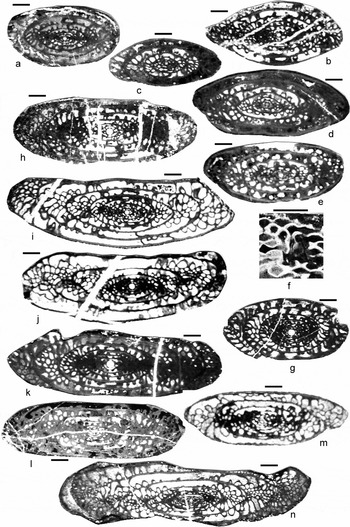
Photomicrographs of the late Asselian–early Sakmarian fusulinid fauna from the Anatolian Platform. Scale bars are 0.5 mm. (a) Pseudofusulinoides (?) changi (Rozovskaya), axial section; BS; sample no. CB-21-2. (b–f) Pseudofusulinoides convexus n. sp.;(b) holotype, MTA2002/CO2.5; axial section; ÖTS; sample no. CO-62-1-1; (c) paratype, MTA2002/CO2.6.1; axial section; ÖTS;sample no. CO-62-4; (d) paratype, MTA2002/CO2.6.2; axial section; ÖTS; sample no. CO-62-4; (e) paratype, MTA2002/CO2.6.3; axial section; ÖTS; sample no. CO-63-2; (f) paratype, MTA2002/CO2.6.4; appearance of a cuniculus in the tangential section; ÖTS; sample no. CO-67-2, ×30. (g) Pseudofusulinoides densimedius (Chen), axial section; ES; sample no. CE-22-5. (h, i) Pseudofusulinoides instabilis Bensh; (h) axial section; ES; sample no. CE21-2; (i) axial section; ES; sample no. CE-54-5. (j, k) Pseudofusulinoides postpusillus (Bensh); (j) axial section; BS; sample no. CB-23-9; (k) axial section; ES; sample no. CE-22-3. (l) Pseudofusulinoides pseudosimplex (Chen), axial section; ES; sample no. CE-502. (m) Pseudofusulinoides pusillus (Schellwien), axial section; BS; sample no. CB-21-1. (n) Pseudofusulinoides subashiensis (Chang), axial section; ES; sample no. CE-25-2.

Description. Test rather small, ellipsoidal in shape with rounded polar ends. The coiling tight and regular with slow expansion of the outer whorls. Test of six volutions 3.25 mm in length and 1.75 mm in width giving a ratio of 1.85. Proloculus spherical and relatively small with an outside diameter of 0.125 mm. The spirotheca composed of a tectum and a finely alveolar keriotheca and its thickness in the last volution 0.062 mm. Septa regularly and slightly folded throughout the length of the test. Chomata small and distinct except for the last ones and nearly symmetrical along almost all the test. Tunnel narrow and low. Axial fillings weakly developed along the axis of inner volutions.
Discussion. Only one axial section was found in the material. This species is closely similar to the genus Pseudofusulinoides due to the mode of septal folding, type of coiling, size of proloculus and weakly developed axial filling. The present species differs slightly from the concept of Pseudofusulinoides in having a different shape of the test and more developed chomata (stronger than many Pseudofusulinoides species) except for the last ones. The herein described species is very close to the genus Darvasites. but differs in the absence of typical chomata of this genus. Pseudofusulinoides (?) changi (Rozovskaya) can be considered as intermediate in its morphological features between the Darvasites and Pseudofusulinoides genera.
Remarks. Hemifusulina changi Rozovskaya was a nomen novum for Hemifusulina ovata Chang preoccupied by Hemifusulina ovata Kireeva.
Occurrence. BS, Gavuralanı Formation (Figs 6, 7); Early Permian, late Asselian–early Sakmarian.
Pseudofusulinoides convexus n. sp. Figure 10b–f
Etymology. Named for its convex lateral surfaces.
Deposition of types. Holotype, MTA2002/CO2.5. Paratypes, MTA2002/CO2.6.1, MTA2002/CO2.6.2, MTA2002/CO2.6.3 and MTA2002/CO2.6.4.
Material. 4 axial sections, 1 subaxial section and 1 tangential section.
Type locality. Özbek Tepe Section, Northeast of Yahyalı Town, Eastern Taurus, Turkey (Figs 2, 3).
Diagnosis. Pseudofusulinoides with smaller size, pointed polar ends, low L/D ratio and convex lateral surfaces.
Description. Test small, fusiform–inflated fusiform with generally sharply pointed polar ends. All volutions coiled uniformly and tightly. Species with four and a half to six and a half volutions 3.37 to 4.62 mm in length and 1.50 to 1.95 mm in width, form ratios of 2.11 to 2.36. Proloculus spherical and medium in size with outside diameter of 0.125–0.156 mm. The spirotheca relatively thick and composed of a tectum and finely alveolar keriotheca. Thick septa regularly and slightly folded across the centre of the test and strongly fluted in the extreme polar areas. Cuniculi occur in tangential sections (Fig. 10f). Small chomata distinct and symmetrical throughout most of the test. Tunnel narrow in the inner volutions and wide in outer ones. Axial fillings weakly developed in the extreme polar areas of the inner volutions.
Remarks. The described new species from the Özbek Tepe section is similar to Pseudofusulinoides pusillus (Schellwien) and Pseudofusulinoides parasecalicus (Chang) in the shape of the test and characters of septal fluting, but the described species differs from them in the smaller size of the test, fewer volutions, low L/D ratio and relatively more pointed polar ends.
Age. Early Permian, late Asselian–early Sakmarian.
Pseudofusulinoides densimedius (Chen, Reference Chen1934) Figure 10g
1934 Triticites densimedius Chen, pp. 45–6, pl. 3, fig. 24.
1972 Pseudofusulinoides densimedius (Chen); Bensh, p. 119.
1980 Triticites cf. densimedius (Chen); Kahler & Kahler, p. 196, pl. 9, fig. 2.
1982 Eoparafusulina pusilla (Schellwien); Zhou, p. 242, pl. 1, fig. 15.
1993 Schellwienia densimedius (Chen); Davydov et al., p. 135.
Remarks. Pseudofusulinoides densimedius (Chen) is similar to Pseudofusulinoides pusillus (Schellwien), but differs in the smaller size of the test, low L/D ratio, smaller proloculus, more rounded poles and more volutions.
Occurrence. ES, Gavuralanı Formation (Figs 4, 5); Early Permian, late Asselian–early Sakmarian.
Pseudofusulinoides instabilis Bensh, Reference Bensh1972 Figure 10h
1972 Pseudofusulinoides instabilis Bensh, pp. 121–2, pl. 27, figs 3, 4.
1984 Eoparafusulina instabilis (Bensh); Zhao, Han & Wang, pp. 88–9, pl. 11, figs 25–9.
1995 Pseudofusulinoides instabilis Bensh; Forke, p. 223, pl. 10, figs 7–9.
1996 Pseudofusulinoides instabilis Bensh; Leven & Okay, pl. 3, fig. 11.
Remarks. The described species is very similar to the holotype from the Early Permian of Northern Fergana designated by Bensh (Reference Bensh1972). Pseudofusulinoides instabilis Bensh is similar to Pseudofusulinoides subobscurus Bensh in the shape of the test, chomata and septal folding, but differs in having low L/D ratio, larger proloculus and thicker wall.
Occurrence. ES, Gavuralanı Formation (Figs 4, 5); Early Permian, late Asselian–early Sakmarian.
Pseudofusulinoides postpusillus (Bensh, Reference Bensh1962) Figure 10j
1962 Pseudofusulina postpusilla Bensh, pp. 226–7, pl. 15, figs 6–8.
1976 Pseudofusulina postpusilla Bensh; Kahler, pp. 451–2, pl. 62, fig. 5.
1987 Pseudofusulinoides postpusillus (Bensh); Bensh, p. 47.
Discussion. Pseudofusulinoides postpusillus (Bensh) was originally described as Pseudofusulina postpusilla by Bensh (Reference Bensh1962). Later, the spelling of this name was modified into Pseudofusulinoides postpusillus (Bensh, Reference Bensh1987). The described specimen in this study is similar to the holotype described by Bensh (Reference Bensh1962) from the Early Permian of Northern Fergana.
Remarks. Pseudofusulinoides postpusillus (Bensh) is very similar to the holotype described by Bensh (Reference Bensh1962) from the early Permian of Northern Fergana. Pseudofusulinoides postpusillus (Bensh) is also similar to Pseudofusulinoides regularis (Schellwien) and Pseudofusulinoides pusillus (Schellwien) in the shape of the test, chomata and septal folding, but differs from them in having more rounded poles, larger proloculus, more elongated test and more fluted septa.
Occurrence. ES, BS, Gavuralanı Formation (Figs 4, 5 and Figs 6, 7); Early Permian, late Asselian–early Sakmarian.
Pseudofusulinoides pseudosimplex (Chen, Reference Chen1934) Figure 10l
1934 Triticites pseudosimplex Chen, pp. 25–6, pl. 1, figs 19–20.
1967 Triticites (Darvasites) pseudosimplex (Chen); Kalmykova, pp. 165–6, pl. 2, fig. 8.
1972 Pseudofusulinoides pseudosimplex (Chen); Bensh, p. 119.
1973 Pseudofusulina aff. ‘Triticites’ pseudosimplex (Chen); Choi, p. 51, pl. 6, figs 6–7.
1986 Eoparafusulina pseudosimplex (Chen); Wu, Lin & Wu, p. 19, pl. 1, fig. 14.
1996 Darvasites aff. pseudosimplex (Chen); Leven & Okay, pl. 3, fig. 14.
1997 Darvasites pseudosimplex (Chen); Leven, p. 66, pl. 9, fig. 11.
Discussion. The present species from Eskibey Section is similar to the holotype described by Chen (Reference Chen1934) from the Swine Limestone of South China. Chen (Reference Chen1934) originally assigned the species pseudosimplex to the genus Triticites. In this study, pseudosimplex is attributed to the genus Pseudofusulinoides, considering the shape of test, septal folding, axial fillings, type of coiling and thick spirotheca.
Remarks. Pseudofusulinoides pseudosimplex (Chen) is similar to Pseudofusulinoides pusillus (Schellwien) in the shape of test, character of septal fluting and size, but differs in having larger proloculus, more rounded poles, relatively smaller size and weaker chomata.
Occurrence. ES, Gavuralanı Formation (Figs 4, 5); Early Permian, late Asselian–early Sakmarian.
Pseudofusulinoides pusillus (Schellwien, Reference Schellwien1898) Figure 10m
1898 Fusulina pusilla Schellwien, pp. 253–5, pl. 20, figs 8–14, 15?
1927 Schellwienia pusilla (Schellwien); Lee, pp. 104–7, pl. 16, figs 4–11.
1934 Triticites pusillus (Schellwien); Chen, pp. 46–47, pl. 3, fig. 23, text-fig. 16, p. 116.
1962 Pseudofusulina pusilla (Schellwien); Bensh, p. 225, pl. 15, figs 4–5.
1972 Pseudofusulinoides pusillus (Schellwien); Bensh, p. 119.
1977 Eoparafusulina pusilla (Schellwien); Lin et al., p. 46, pl. 9, fig. 18.
1980 Pseudofusulinoides cf. pusillus (Schellwien); Kahler & Kahler, p. 205, pl. 14, fig. 1.
1980 Darvasites (?) ex gr. pusillus (Schellwien); Leven & Shcherbovich, p. 11, figs 5–6.
2002 Pseudofusulinoides? sp. cf. P.? pusillus (Schellwien); Forke, pp. 242–3, pl. 37, figs 10, 11.
Discussion. The described species from Bademli and Eskibey sections is similar to the holotype, but differs in having a smaller size and low L/D ratio and relatively larger proloculus.
Remarks. Pseudofusulinoides pusillus (Schellwien) differs from Pseudofusulinoides parasecalicus (Chang) in the shape and size and relatively more rounded polar ends.
Occurrence. ES, BS, Gavuralanı Formation (Figs 4, 5, Figs 6, 7); Early Permian, late Asselian–early Sakmarian.
Pseudofusulinoides subashiensis (Chang, Reference Chang1963) Figure 10n
1963 Triticites subashiensis Chang, p. 53 (in Chinese), p. 63, 70 (in Russian), pl. 3, fig. 8.
1972 Pseudofusulinoides subashiensis (Chang); Bensh, p. 119.
1977 Triticites subashiensis Chang; Lin et al., p. 51, pl. 10, fig. 10.
2002 Pseudofusulinoides subashiensis (Chang); Forke, p. 242, pl. 37, figs 19, 20.
Discussion. The present species is very similar to the holotype described by Chang (Reference Chang1963), in the shape and size of the test, tightly coiled volutions, thick wall and the character of septa (regular and highly fluted).
Remarks. Pseudofusulinoides subashiensis (Chang) is similar to Pseudofusulinoides pusillus (Schellwien), but differs in low L/D ratio, more rounded polar areas, more volutions and smaller proloculus.
Occurrence. ES, Gavuralanı Formation (Figs 4, 5); Early Permian, late Asselian–early Sakmarian.
Pseudofusulinoides subglobosus n. sp. Figure 11a–f
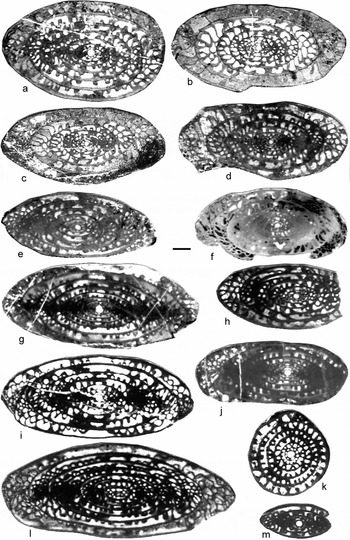
Photomicrographs of the late Asselian–early Sakmarian fusulinid fauna from the Anatolian Platform. Scale bar is 0.5 mm for all figures. (a–f) Pseudofusulinoides subglobosus n. sp.; (a) holotype, MTA2002/CO2.7; axial section; ES; sample no. CE-24-4; (b) paratype, MTA2002/CO2.8.1; axial section; ES; sample no. CE-24-8; (c) paratype, MTA2002/CO2.8.2; axial section; ES; sample no. CE-25-1-2; (d) paratype, MTA2002/CO2.8.3; axial section; ES; sample no. CE-24-9; (e) paratype, MTA2002/CO2.8.4; axial section; ES; sample no. CE-24-10; (f) paratype, MTA2002/CO2.8.5; axial section; ÖTS; sample no. CO-68-10. (g–l) Pseudofusulinoides vachardi n. sp.; (g) holotype, MTA2002/CO2.9; axial section; ES; sample no. CE-23-6; (h) paratype, MTA2002/CO2.10.1; axial section; ES; sample no. CE-23-9; (i) paratype, MTA2002/CO2.10.2; axial section; ES; sample no. CE-23-3; (j) paratype, MTA2002/CO2.10.3; axial section; ES; sample no. CE-23-8; (k) paratype, MTA2002/CO2.10.4; equatorial section; ES; sample no. CE-23-4; (l) paratype, MTA2002/CO2.10.5; subaxial section; ES; sample no. CE-23-10. (m) Pseudofusulinoides sp., axial section; ÖTS; sample no. CO-69-6-1.

Etymology. Named for its subglobular shape.
Deposition of types. Holotype, MTA2002/CO2.7. Paratypes, MTA2002/CO2.8.1, MTA2002/CO2.8.2, MTA2002/CO2.8.3, MTA2002/CO2.8.4 and MTA2002/CO2.8.5.
Material. 7 axial and 1 oblique sections.
Type locality. Eskibey Section, northwest of Aydıncık town, Central Taurus and Özbek Tepe Section, northeast of Yahyalı town, Eastern Taurus, Turkey (Figs 2, 3, Figs 4, 5).
Diagnosis. Pseudofusulinoides with subglobular shape, low L/D ratio, smaller size, larger diameter of the test and well-developed chomata.
Description. Test subglobular–inflated fusiform in shape with convex lateral slopes and rounded polar ends. All volutions coiled uniformly and inner two or three volutions nearly spherical in shape. Species with six and a half to seven volutions 4.45 to 5.30 mm in length and 1.96 to 2.78 mm in width, form ratios of 1.60 to 2.48. Proloculus spherical and large with an outside diameter of 0.145 to 0.230 mm. Thick wall composed of a tectum and fine keriothecal structure. Septa thin, regularly and strongly fluted in the extreme polar areas, but slightly folded in the centre of the test. Chomata distinct and well developed throughout most of the test, and symmetrical. Tunnel relatively narrow in the inner volutions and wide in the outer ones with straight path. Axial fillings very weak and only developed in the inner volutions extreme polar areas.
Remarks. Pseudofusulinoides subglobosus n. sp. differs from other Pseudofusulinoides species in having a subglobular shape of the test, low L/D ratio, smaller size, larger diameter of the test and well-defined chomata.
Age. Early Permian, late Asselian–early Sakmarian.
Pseudofusulinoides vachardi n. sp. Figure 11g–l
Etymology. This species is named after Dr Daniel Vachard, Université des Science et Technologies de Lille (Lille, France), in honour of his contributions to the knowledge of Palaeozoic algae and foraminiferal biostratigraphy.
Deposition of types. Holotype, MTA2002/CO2.9. Paratypes, MTA2002/CO2.10.1, MTA2002/CO2.10.2, MTA2002/CO2.10.3, MTA2002/CO2.10.4 and MTA2002/CO2.10.5.
Material. 5 axial, 1 subaxial, 1 tangential, 1 oblique and 1 equatorial sections.
Type locality. Eskibey Section, northwest of Aydıncık town, Central Taurus, Turkey (see Figs 4, 5).
Diagnosis. Pseudofusulinoides with smaller size, low L/D ratio, weak axial filling in the inner volutions and pseudochomata in the outer volutions.
Description. Test medium in size and inflated fusiform–subcylindrical in shape with slightly convex lateral slopes and rounded polar ends. Inner three volutions ellipsoidal in shape and tightly coiled. From the fourth volution, shell expands uniformly and becomes inflated fusiform to subcylindrical in shape. Specimens with six to eight volutions 4.24 to 5.66 mm in length and 1.84 to 2.42 mm in width, form ratios of 2.23 to 2.33. Proloculus spherical and moderate in size with an outside diameter of 0.121–0.195 mm. Spirotheca composed of tectum and fine alveolar keriotheca. Septa thin and nearly straight in the central part of the test, but regularly and intensely fluted along the axis of outer volutions. Chomata low, symmetrical and distinct in all volutions except for the last one and replaced by pseudochomata in the last volutions. Tunnel high and wide with straight path. Axial fillings weakly developed in the polar areas of inner volutions.
Remarks. The described new species from Eskibey Section can be distinguished from other Pseudofusulinoides species by smaller size of the test, low L/D ratio, inflated median region and having pseudochomata in the outer volutions.
Age. Early Permian, late Asselian–early Sakmarian.
Pseudofusulinoides sp. Figure 11m
Description. Test small, fusiform in shape with slightly pointed polar ends. All volutions coiled uniformly. Species with three and a half volutions 2.00 mm in length and 1.00 mm in width, form ratio of 2.0. Proloculus spherical and medium in size with outside diameter of 0.218 mm. Spirotheca thick and composed of a tectum and a keriothecal structure. Thick septa regularly and slightly folded across the centre of the test and strongly fluted in the extreme polar areas. Small chomata distinct and symmetrical throughout most of the test. Tunnel narrow in the inner volutions and wider in the outer ones. Axial fillings weakly developed in the extreme polar areas of the inner volutions.
Discussion. Only one axial section was obtained during the preparation of the material from the Özbek Tepe Section. The shape of test, size and the character of septal fluting point to the genus Pseudofusulinoides.
Occurrence. ÖTS, Gavuralanı Formation (Figs 2, 3); Early Permian, late Asselian–early Sakmarian.
5. Biostratigraphy
In this study, very rich fusulinid faunas from three different sections are discussed. One fusulinid zone was determined for the late Asselian–early Sakmarian time interval of the Anatolian Platform.
5.a Özbek Tepe section
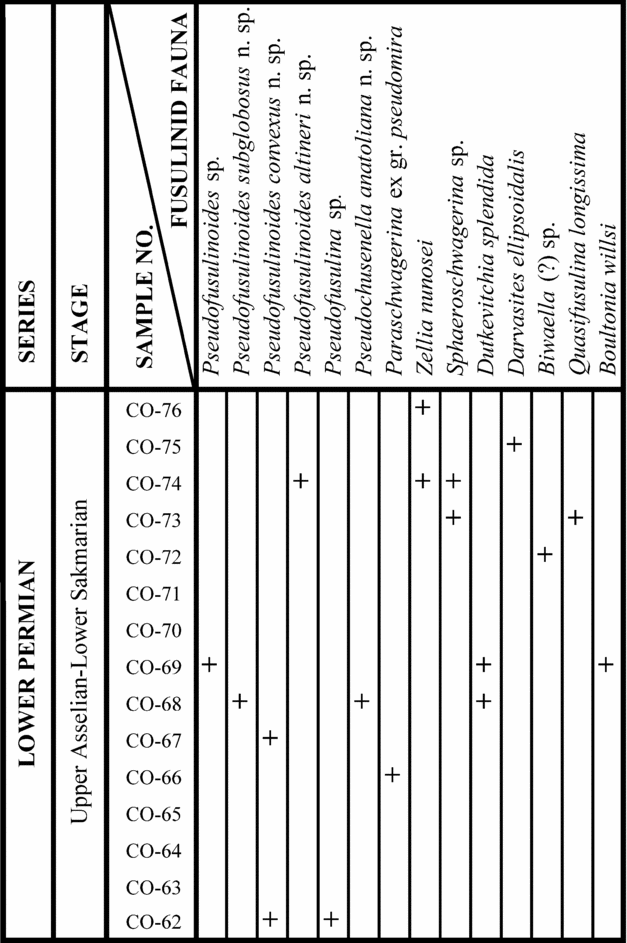
Thirty-one samples (CO-62–CO-92) were collected from Özbek Tepe section and yielded very rich fusulinid faunas (Fig. 12). The basal part of the Özbek Tepe section (CO-62–CO-76) is characterized by the presence of Biwaella(?) sp., Darvasites ellips-oidalis (Toriyama), Dutkevitchia splendida (Bensh), Sphaeroschwagerina sp., Zellia nunosei Hanzawa, Paraschwagerina ex gr. pseudomira Miklukho-Maklay, Pseudochusenella anatoliana n. sp., Pseudofusulina sp., Pseudofusulinoides altineri n. sp., Pseudofusulinoides convexus n. sp., Pseudofusulinoides subglobosus n. sp. and Pseudofusulinoides sp. This part of the section is characterized by three new species of Pseudofusulinoides, and the stratigraphic range of this genus (Pseudofusulinoides) changes from the Asselian to Artinskian. Darvasites ellipsoidalis (Toriyama) and Dutkevitchia splendida (Bensh) are well-known species in the late Asselian–Sakmarian interval of the Tethyan province (Leven, Reference Leven1971, Reference Leven1993, Reference Leven1995; Watanabe, Reference Watanabe1991; Shcherbovich, Reference Shcherbovich1969; Bensh, Reference Bensh1962, Reference Bensh1972; Krainer & Davydov, Reference Krainer and Davydov1998; Ozawa, Kobayashi & Watanabe, Reference Ozawa, Kobayashi and Watanabe1991; Ota, Reference Ota1997). An important taxon of this interval is Paraschwagerina ex gr. pseudomira Miklukho-Maklay, which was described from the upper Asselian–lower Sakmarian of South Fergana (Bensh, Reference Bensh1972). Therefore, this assemblage clearly indicates a late Asselian–early Sakmarian age for this interval (Fig. 12). Samples between CO-77 and CO-90 are very rich in small foraminifers and do not contain fusulinids. However, stratigraphic distributions of small foraminifers in this interval (Nodosinelloides ex gr. longa (Lipina), Geinitzina ex gr. postcarbonica Spandel, Hemigordius ovatus Grozdilova, Globivalvulina ex gr. bulloides (Brady), Neohemigordius sp., Ellesmerella subparallela (Flügel & Flügel-Kahler) and calcivertellid foraminifers) indicate a late Asselian–early Sakmarian age (Groves, Reference Groves2000; Groves & Boardman, Reference Groves and Boardman1999; Vachard & Krainer, Reference Vachard and Krainer2001; D. Vachard, pers. comm.). The uppermost part of the Özbek Tepe section is represented by a quartz sandstone level, and the overlying beds (CO-91 and CO-92) contain Langella sp., Pseudovermiporella ex gr. nipponica (Endo) and Permocalculus sp. According to the first appearance of this fossil assemblage, the age of these levels corresponds to the Middle Permian (at least Kubergandian–Murgabian) (Vachard & Krainer, Reference Vachard and Krainer2001; D. Vachard pers. comm.).
Distribution of the fusulinid fauna in the Özbek Tepe section.

5.b. Eskibey section
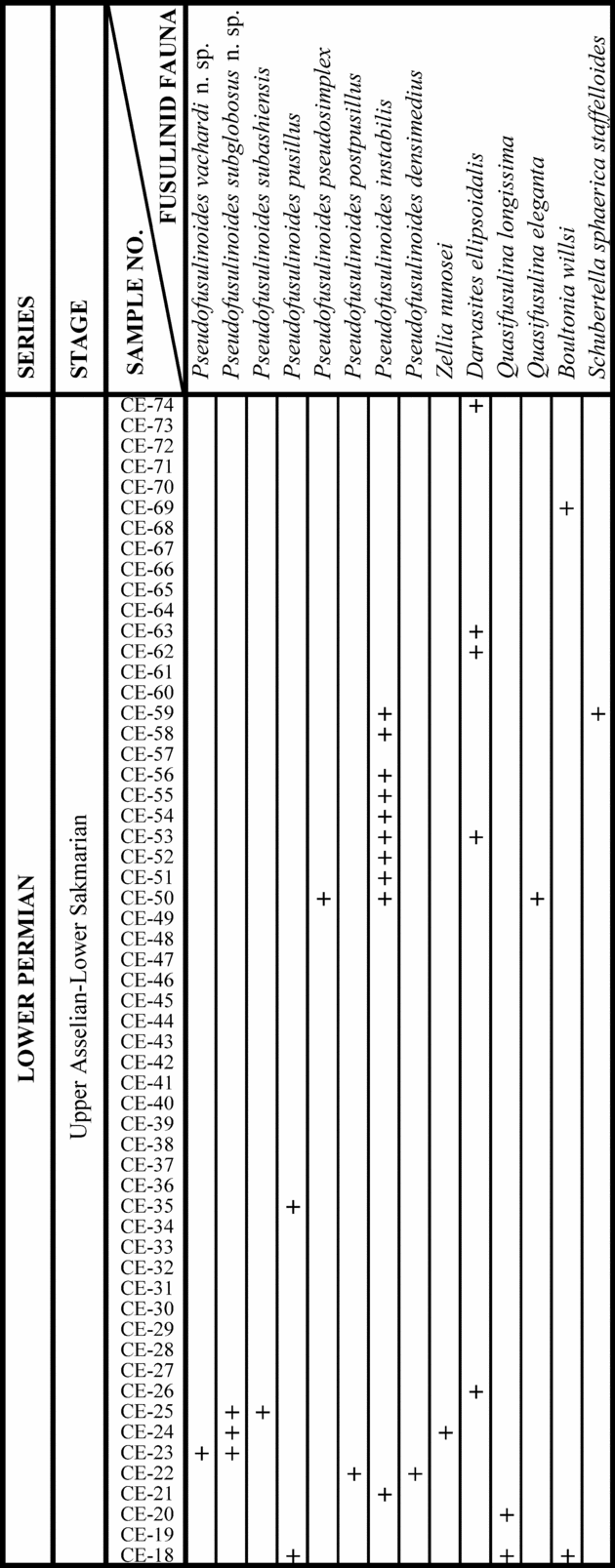
Fifty-seven samples (CE-18–CE-82) were obtained from the Eskibey section with abundant fusulinid faunas (Fig. 13). Boultonia willsi Lee, Quasifusulina longissima (Moeller), Darvasites ellipsoidalis (Toriyama), Zellia nunosei (Hanzawa), Schubertella sphaerica staffelloides Suleimanov, Pseudofusulinoides densimedius (Chen), Pseudofusulinoides instabilis Bensh, Pseudofusulinoides postpusillus (Bensh), Pseudofusulinoides pseudosimplex (Chen), Pseudofusulinoides pusillus (Schellwien), Pseudofusulinoides subashiensis (Chang), Pseudofusulinoides subglobosus n. sp. and Pseudofusulinoides vachardi n. sp. have been obtained from the samples between CE-18 and CE-74. Pseudofusulinoides instabilis Bensh was originally described by Bensh (Reference Bensh1972) from the ‘Schwagerina’ moelleri–Pseudofusulina fecunda zone (middle Asselian) of the South Fergana and has also been recorded from the Sakmarian of the Carnic Alps and the early Yahtashian of the Karakaya Complex (Northwest Turkey) (Forke, Reference Forke1995; Leven & Okay, Reference Leven and Okay1996). Another Pseudofusulinoides species of this interval, Pseudofusulinoides pseudosimplex (Chen), was recorded from the Sakmarian–Yahtashian interval of Afghanistan, Darvas, the Karakaya Complex (Northwest Turkey), Japan and China, and generally from the Sakmarian of the Carnic Alps (Forke, Reference Forke1995; Leven & Okay, Reference Leven and Okay1996; Leven, Reference Leven1997; Ota, Reference Ota1998). Pseudofusulinoides densimedius (Chen) was originally described by Chen (Reference Chen1934) from the late Asselian–Sakmarian of the lower levels (‘Pseudofusulina’ tschernyschewi zone) of the Swine Limestone. Zellia nunosei Hanzawa was originally described from the Early Permian (Sakmarian) of the Kitakami Mountains in northeastern Japan. This species is very common in the Early Permian (Sakmarian) of the Pamirs, Japan and Turkey (Watanabe, Reference Watanabe1991; Leven, Reference Leven1993, Reference Leven1995). This part of section is very rich in many Pseudofusulinoides species, ranging from Asselian to Sakmarian. The fossil assemblage of this interval clearly indicates a late Asselian–early Sakmarian age (Fig. 13). Samples between CE-75 and CE-76 are rich in small foraminifers and do not contain any fusulinids. The upper part of the Eskibey section is represented by a quartz sandstone level. The taxa Hemigordius sp., Agathammina sp., Permocalculus sp., Langella sp. and Pseudovermiporella ex gr. nipponica (Endo) have been obtained from the overlying beds as CE-77 and CE-82. The fossil fauna and flora of these levels correspond to the Middle Permian (at least Kubergandian–Murgabian) (Vachard & Krainer, Reference Vachard and Krainer2001; D. Vachard pers. comm.).
Distribution of the fusulinid fauna in the Eskibey section.

5.c. Bademli section
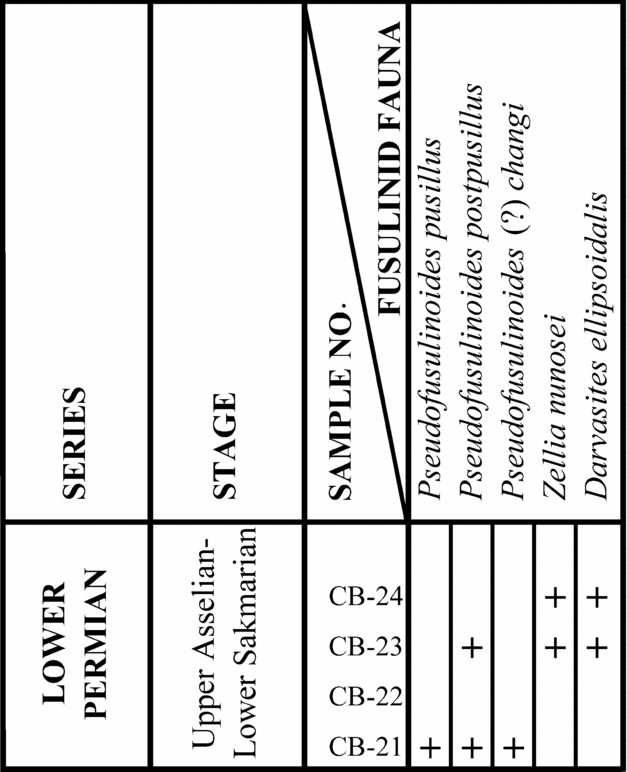
Thirty-eight samples (CB-21–CB-58) were collected from the Bademli section with a rare fusulinid fauna (Fig. 14). The base of the Bademli section (CE-21–CE-24) is dominated by Darvasites ellipsoidalis (Toriyama), Zellia nunosei Hanzawa, Pseudofusulinoides (?) changi (Rozovskaya), Pseudofusulinoides postpusillus (Bensh) and Pseudofusulinoides pusillus (Schellwien). One of the important species of this interval is Pseudofusulinoides (?) changi (Rozovskaya), which occurs from the late Asselian to early Sakmarian in Afghanistan and the Tarim Basin (Leven, Reference Leven1971; Chen & Wang, Reference Chen and Wang1983). Similarly, the fusulinid fauna of this interval (CB-21–CB-24) indicates a late Asselian–early Sakmarian age (Fig. 14). Samples between CB-25 and CB-56 are very rich in small foraminifers and do not contain fusulinids. However, stratigraphic distributions of the small foraminifers in this interval (Nodosinelloides ex gr. postcarbonica (Spandel), Geinitzina postcarbonica Spandel, Globivalvulina ex gr. bulloides (Brady) and calcivertellid foraminifers) correspond to a late Asselian–early Sakmarian age (Groves, Reference Groves2000; Groves & Boardman, Reference Groves and Boardman1999; Vachard & Krainer, Reference Vachard and Krainer2001; D. Vachard, pers. comm.). The uppermost part of the Bademli section is represented by a quartz sandstone level; and Langella sp., Agathammina sp. and Pseudovermiporella ex gr. nipponica (Endo) were obtained from the overlying beds (CB-57 and CB-58). The foraminifers and algae of these levels indicate a Middle Permian age (at least Kubergandian–Murgabian) (Vachard & Krainer, Reference Vachard and Krainer2001; D. Vachard pers. comm.).
Distribution of the fusulinid fauna in the Bademli section.

5.d. Biostratigraphic correlation and palaeobiogeography
The main faunal elements of the studied sections consist of Quasifusulina, Darvasites, Dutkevitchia, Sphaeroschwagerina, Zellia, Paraschwagerina, Pseudochusenella and Pseudofusulinoides species. Pseudofusulinoides, Zellia and Darvasites are the permanent species for all sections.
Darvasites is very typical for all sections and characterized by distinct chomata and the short-ellipsoidal shape of the test. It has been recognized in the Early Sakmarian sections in the Urals as well as Central Asia. The described species, Darvasites ellipsoidalis (Toriyama), is a well-known species in the late Asselian–Sakmarian interval of the Tethyan province and it is the consistent species for all sections. Dutkevitchia splendida is the only specimen of this genus which is known only in the Özbek Tepe section of the Anatolian Platform. In the Carnic Alps, this species is the last representative of the genus and occurs in the uppermost part (early–middle Sakmarian) of the Grenzland Formation (Forke, Reference Forke2002). The specimens in the Carnic Alps are very close to the forms which were described in this study.
The new species, Pseudochusenella anatoliana, is the first recorded species of this genus in the Anatolian Platform sections, and it is characterized by subcylindrical shells, tightly coiled whorls, sharply pointed polar ends, heavy axial fillings and minute proloculus. Pseudochusenella is very common in the Sakmarian–Artinskian interval of Carnic Alps, and common in middle–late Asselian deposits in the Karawanken Mountains (Forke, Reference Forke2002). Pseudofusulinoides is confined to the high-energy, clastic-influenced nearshore deposits (Forke Reference Forke2002). The facies, which is mainly composed of Pseudofusulinoides, is very typical and for the most part, it does not contain any other fusulinid fauna in the studied sections. This fact also indicates that the diversity of the Pseudofusulinoides taxa is facies-controlled in the studied sections. The described Pseudofusulinoides taxa are very similar to the fauna of the Carnic Alps, Karawanken Mountains and South Fergana, and the diversity of Pseudofusulinoides taxa is higher than in the Carnic Alps. The stratigraphic range of the described rich Pseudofusulinoides taxa in this study shows a higher coincidence with the Palaeotethyan province. Paraschwagerina is represented by only one species in the studied sections, Paraschwagerina ex gr. pseudomira. The described species is very similar to the specimens which were described from the upper Asselian deposits of the Born Formation (Southern Alps) and the upper Asselian–lower Sakmarian of South Fergana (Bensh, Reference Bensh1972; Forke, Reference Forke2002). Zellia nunosei is one of the conspicuous faunal elements of the Anatolian Platform sections. It is characterized by the spherical shape of the test, rapidly expanding volutions, larger proloculus and thick spirotheca of the outer volutions. According to Forke (Reference Forke2002), some species of the genus Zellia are very close to Robustoschwagerina, like Zellia nunosei, but the characteristics of the described specimens indicate they are closer to Zellia than to Robustoschwagerina.
The fusulinid fauna of the studied sections in the Anatolian Platform shows close similarities with the Palaeotethyan province from the southern Alps to southern Fergana in Central Asia.
6. Conclusions
The investigations concern three different sections (Özbek Tepe, Eskibey and Bademli) of the Anatolian Platform from the eastern and central Taurides. The late Asselian–early Sakmarian time interval was investigated in the studied sections for fusulinid fauna. One fusulinid zone is described from the late Asselian–early Sakmarian Gavuralanı Formation. The depositional environment of the Gavuralanı Formation is shallow shelf, sometimes with clastic influence where the Pseudofusulinoides taxa are mainly recorded. Four new species of Pseudofusulinoides and one new species of Pseudochusenella are described from the Anatolian Platform sections of southern Turkey: Pseudochusenella anatoliana, Pseudofusulinoides altineri, Pseudofusulinoides convexus, Pseudofusulinoides subglobosus and Pseudofusulinoides vachardi.
The studied part of the Gavuralanı Formation consists of several characteristic fusulinid fauna which are used for palaeobiogeography and biostratigraphic correlations. The late Asselian–early Sakmarian fusulinid fauna of the Anatolian Platform can be correlated very well with the fauna of other Palaeotethyan realm sections.
Acknowledgements
This study was supported by the General Directorate of Mineral Research and Exploration (MTA) and Directorate of Human Resources Development (BAYG) of TUBITAK. I would like to thank to Prof. Dr Tuncer Güvenç and Dr Daniel Vachard (Université des Science et Technologies de Lille, France) for their support and suggestions on this study. I wish to express my sincere thanks to Associate Professor Dr. U. Kağan Tekin (Hacettepe University) and Dr Semih Gürsu (MTA) for their valuable comments and help on this study and also to Dr Halil Yusufoğlu (MTA) for his revision of the English text.