Introduction
Agriculture provides food, fibers and energy for a growing population worldwide. Due to an increasing search for agricultural supplies, civilization faces pressures on forest depredation, greenhouse gases, biodiversity loss, agrochemical pollution and soil degradation (Reganold and Wachter, Reference Reganold and Wachter2016). To conciliate these two demands, the development and practice of sustainable agriculture principles are important.
Organic agriculture comprises some farming practices that discard synthetic pesticides, fertilizers and genetically modified organisms (GMOs). As a consequence of practicing organic agriculture in the long term, maintenance and regeneration of soil may be necessary (Mäder et al., Reference Mäder, Fliessbach, Dubois, Gunst, Fried and Niggli2002; Seidel et al., Reference Seidel, Moyer, Nichols and Bhosekar2017). Organic farming—as a collective—comprises some lines or schools with some specific traits; among them, biodynamic farming proposes to create a balanced farm whose activities are strongly integrated and that uses some specific preparations made from fermented manure, minerals and herbs. In general, practicing biodynamic or traditional organic management provides similar beneficial effects on soil fertility and biology, yields and economic performance (Mäder et al., Reference Mäder, Fliessbach, Dubois, Gunst, Fried and Niggli2002; Birkhofer et al., Reference Birkhofer, Bezemer, Bloem, Bonkowski, Christensen, Dubois and Mäder2008; Forster et al., Reference Forster, Andres, Verma, Zundel, Messmer and Mäder2013). Biodynamic farming preparations are not used to add nutrients, but to stimulate and regulate processes of nutrient and energy cycling, and to improve soil and crop quality. Recent studies have showed that preparations from biodynamic farming may even enhance yields, chemical composition and phytosanitary status (Jariene et al., Reference Jariene, Vaitkeviciene, Danilcenko, Gajewski, Chupakhina, Fedurajev and Ingold2015; Picone et al., Reference Picone, Trimigno, Tessarin, Donnini, Rombolà and Capozzi2016; Maneva et al., Reference Maneva, Atanasova and Nedelcheva2017; Nabi et al., Reference Nabi, Narayan, Afroza, Mushtaq, Mufti, Ummyiah and Magray2017; Jariene et al., Reference Jariene, Levickienė, Danilcenko, Vaitkevičienė, Kulaitienė, Jakštas, Ivanauskas and Gajewski2018).
The input costs of conventional farmers are generally higher than those of alternative low-input systems, such as organic/biodynamic farming. In recent growing seasons, technological rates or royalties have been included in GMO seed costs by biotechnology companies to price herbicide or insect resistance (Bt-engineered plants), which raises costs even more. Due to these costs and the development of resistance of weeds to herbicides and insects to Bt-proteins (failures in control), farmers’ interest in non-GMO seeds is growing. Synthetic fertilizers and pesticides also overtax conventional management costs, which increases variable or effective operational costs (EOCs). However, conventional agriculture is referred to as able to produce more with less labor.
In general, organic foods, such as tomatoes, have higher prices but lower variations. Production costs are also lower (17.2%), which affords higher profitability (59.9% in the summer and 113.6% in the winter growing seasons) (Luz et al., Reference Luz, Shinzato and Diniz da Silva2007).
Almost 34 million ha of soybean are presently cultivated in Brazil. In addition, 22.5 million more ha are cultivated in the countries bordering southern Brazil (Argentina, Paraguay and Uruguay). These agriculturally extensive areas represent great environmental hazards that may be minimized by replacing chemical-based agriculture—in general, designated conventional—by more sustainable systems such as organic/biodynamic farming. However, in general, there is a lack of studies dealing with long-term comparisons between organic and conventional farming systems in Latin America. Long-term studies are more trustworthy due to the diminishing effects of climatic and economic short-term variations (Nemes, Reference Nemes2009).
Profitability is a guiding factor when farmers make their decisions, including choosing crop systems. A series of interviews conducted in Australia showed broad consensus on the risks facing organic farming (McCarthy and Schurmann, Reference McCarthy and Schurmann2018). Since soybean production occupies the largest cultivated land in Brazil, one first step to guide toward changing to more sustainable farming is to obtain a favorable scenario in organic/biodynamic farming related to crop operation accounting. Here, we present results from a 7-yr case study comparison between biodynamic and conventional farming profitability by using analysis of production costs and financial indicators.
Material and methods
This study was performed using data provided from a Farm in São Pedro do Ivaí County, Parana State, Brazil (Latitude 23°49′33.90″S and Longitude 51°52′43,33″W). The farm is a family operation containing 217.8 ha, of which 188.54 is used to produce grains, including soybean [biodynamic (48.4 ha) and conventional (96.8 ha)]. The same conventional management was used previously the onset of the comparisons.
Farm system profitability was compared during seven crop growing seasons (from 2004/5 to 2010/11). The conventional system, in which ordinary regional practices oriented by official extension service were used, was compared to biodynamic certified [Instituto Biodinâmico de Desenvolvimento (IBD)] operation. A no-till approach using herbicides was used in the conventional system, while in the biodynamic system, soil was plowed before sowing and manual weeding during soybean development. Soil fertilization was performed using soluble fertilizers for conventional and organic compost plus specific preparations [compost preparation; BD 500 (cow manure placed in a horn maintained buried in the soil during autumn and winter) sprayed on the soils and BD 501 (powered quartz placed in a horn maintained buried in the soil during spring and summer)] sprayed on the plants.
The fields were settled side by side and were similar in relation to soil type (red eutrophic nitosol), fertility and relief and both were previously managed conventionally, which may be considered representative of the standard management of soybean crops in Brazil. In conventional system, disease and weed were controlled using synthetic chemical pesticides. In biodynamic system, nuclear polyhedrosis virus; home-made traps (2L PET bottles) using cow urine as attractive; and Bordeaux mixture were used to control Anticarsia gemmatalis (Lepidoptera: Noctuidae); brown stink bug Euschistus heros (Hemiptera: Pentatomidae); and soybean rust, Phakopsora pachyrhizi, respectively. In general, same equipments were used in both fields except plow and hoes which were used just for biodynamic. Sprayers and seeders were carefully washed before moving between fields.
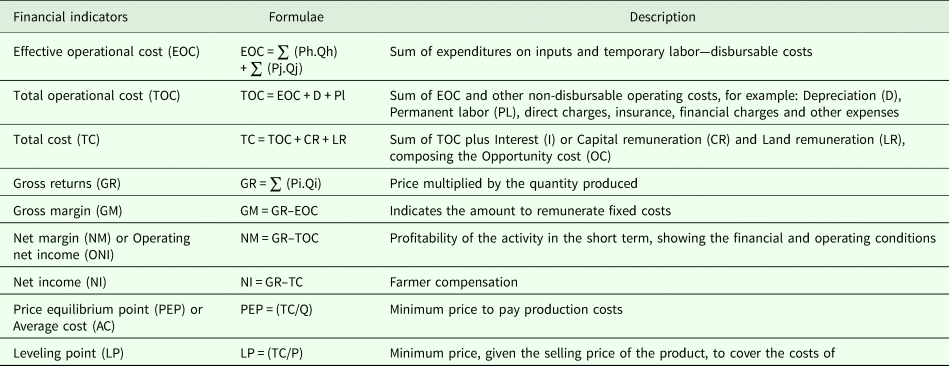
Data were recorded weekly by the farmer and agronomist consultant and included machinery and equipment operations, occasional labor, seeds, pesticides or biodynamic inputs and transport, which made up the EOC. Permanent labor, depreciation, opportunity and insurance costs were added to EOC to generate total cost (TC).
For depreciation, insurance and opportunity costs, the percent participation in TCs from the Department of Rural Economy of the Secretary of Agriculture and Supply of Paraná (SEAB/DERAL, February, 2017) was adopted using the same values independent of management because the costs of organic and conventional management were quite similar to those previously sown (Di Domenico et al., Reference Di Domenico, Magro, Zanin and Boschetti2015).
Financial indicators were calculated in dollars/ha and according to Matsunaga et al. (Reference Matsunaga, Bemelmans and Toledo1976), Ronque et al. (Reference Ronque, Ventura, Soares Júnior, Macedo and Campos2013) and Martins et al. (Reference Martins, Campos, Campos and Almeida2016) (Table 1). Data were stored in electronic spreadsheets in which calculations were performed. The values were adjusted for the base date of August 2017, in accordance with the general price index—domestic availability stipulated by Fundação Getúlio Vargas (IGP-DI/FGV), for the purpose of converting nominal values into real values to compare exempt from effects related to inflation during the study period.
Financial indicators, formulae and description

Source: authors.
Results and discussion
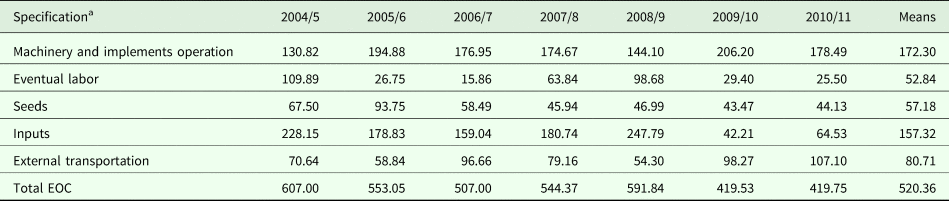
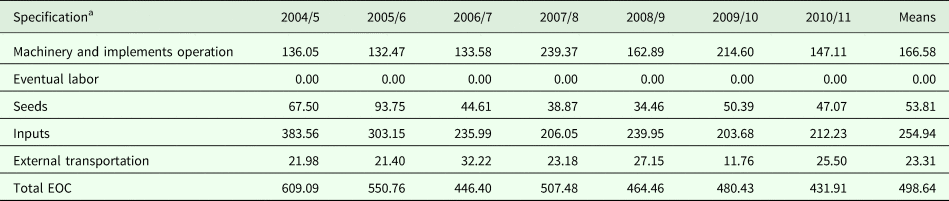
The EOC, which refers to machinery and implements, eventual labor, seeds and other inputs to biodynamic or conventional farming systems, is presented in Tables 2 and 3, respectively.
Effective operational cost (EOC) for soybean biodynamic farming systems (growing seasons from 2004/5 to 2010/11)

Source: authors.
Values corrected to August/2017 (IGP-DI/FGV).
(US$ ha−1).
a (US$ ha−1).
Effective operational cost (EOC) for soybean conventional farming systems (growing seasons from 2004/5 to 2010/11)

Source: authors.
Values corrected to August/2017 (IGP-DI/FGV).
(US$ ha−1).
a (US$.ha−1).
Temporary labor and external transportation were higher in biodynamic than conventional farming in all growing seasons. Temporary labor was used for manual weeding during cropping. Labor costs in organic crops are currently 7–13% higher than conventional costs (Crowder and Reganold, Reference Crowder and Reganold2015). As there is no receiving structure or organic product in the vicinity of the property, grains were transported to Ponta Grossa or Campo Largo Counties, where the biodynamic soybean was received for trading.
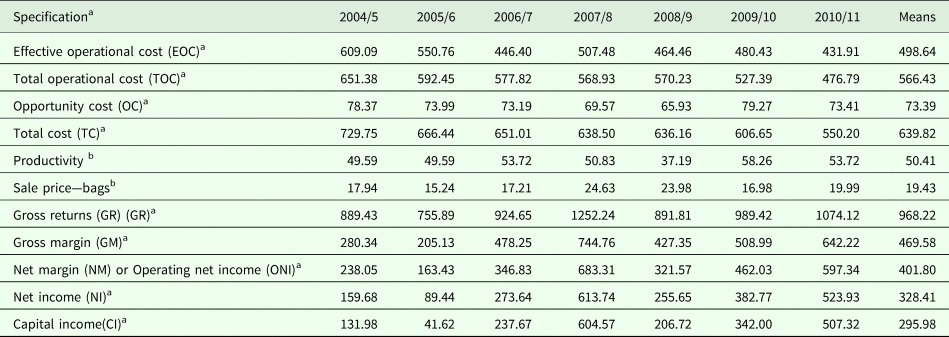
In general, biodynamic farming inputs, including fertilizers, were lower than those of conventional farming systems mostly due to the inclusion of synthetic herbicides, insecticides and fungicides to conventional farming (Tables 4 and 5). Variations in the costs of the production factors resulted in higher EOC in the biodynamic farming in the growing seasons from 2005/6 to 2008/9. In contrast, lower EOCs were obtained for biodynamic than for conventional farming in the 2004/5, 2009/10 and 2010/11 seasons. The EOC was 4.4% higher in biodynamic than conventional farming considering the means of the seven growing seasons.
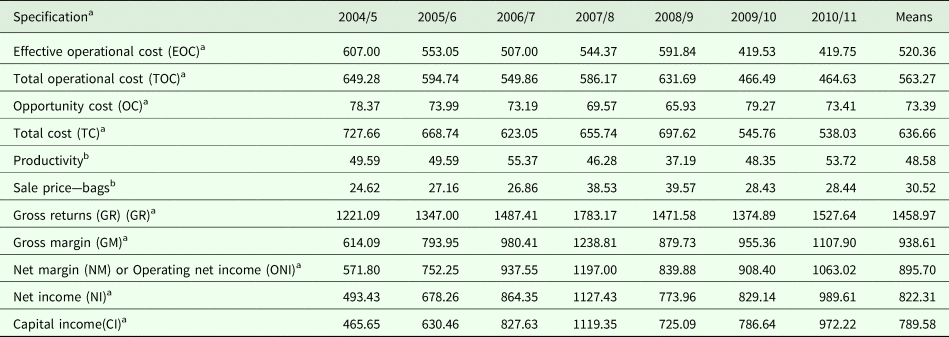
Indicators for biodynamic soybean farming system in the growing seasons from 2004/5 to 2010/11

Source: authors.
Values corrected to August/2017 (IGP-DI/FGV).
a (US$ ha−1).
b (Bags—60 kg ha−1).
Indicators for conventional soybean farming system in the growing seasons from 2004/5 to 2010/11

Source: authors.
Values corrected to August/2017 (IGP-DI/FGV).
a (US$ ha−1).
b (Bags—60 kg ha−1).
Fixed expenses, including depreciation, direct charges, insurance, financial charges and other expenses, were considered similar in the two farming systems as previously established in the methodology. The relative similarity of the costs between biodynamic and conventional farming agrees with the general pattern in which fixed, variable and TCs have been seen as not significantly different between organic and conventional farming (Crowder and Reganold, Reference Crowder and Reganold2015). However, our results disagree with previous revisions, which attributed a reduction in variable costs (50–60%) for grain production compared between organic and conventional farming (Nemes, Reference Nemes2009).
Financial indicators for biodynamic and conventional farming are presented in Tables 4 and 5, respectively. The TCs are presented in Table 6. When lower values for EOC, TOC and TC in biodynamic agriculture were found, better results in the period were obtained. The TC (EOC+TOC+OC) obtained in biodynamic farming was lower in the 2004/5, 2006/7, 2009/10 and 2010/11 growing seasons and higher in the 2005/6, 2007/8 and 2008/9 growing seasons than in conventional farming (Tables 4 and 5).
Total production cost (TC) (ha) for soybean biodynamic and conventional farming systems, growing seasons from 2004/5 to 2010/11, Paraná (US$ ha−1)

Values corrected to August/2017 (IGP-DI/FGV).
a (US$ ha−1).
The biodynamic farming system net income (NI) was 150.4% higher than that in the conventional farming system, despite the oscillations of productivity. Similar yields were obtained in the 2004/5, 2005/6, 2008/9 and 2010/11 growing seasons. A higher yield was obtained in biodynamic than conventional farming in the 2006/2007 growing season.
In general, global yield averages are 8–25% lower in organic than conventional farming, but under certain conditions (crops, growing conditions and management practices), organic systems come closer to matching conventional systems in terms of yield (Reganold and Wachter, Reference Reganold and Wachter2016), and this was the case in the present study, in which productivity was just 3.4% lower in organic farming. Soybean is one of the crops in which higher values of relative yield between organic and conventional farming have been reported (de Ponti et al., Reference De Ponti, Rijk and Van Ittersum2012). In general, organic production of leguminous crops tends to be closer to conventional production than other types of plants (Crowder and Reganold, Reference Crowder and Reganold2015).
Yields from biodynamic farming being higher than those from conventional farming probably reflects previously reported higher resilience in organic systems during drought years due to higher soil moisture availability (Nemes, Reference Nemes2009; Seidel et al., Reference Seidel, Moyer, Nichols and Bhosekar2017). The results reported here contradict previous studies in Brazil, in which a reduction of 35% yields in organic soybean compared with conventional farming systems was found—this comparison was achieved using data from just one season (Di Domenico et al., Reference Di Domenico, Magro, Zanin and Boschetti2015).
The productivity of the biodynamic fields in the three first growing seasons was not lower than that of conventional fields (Tables 2 and 3). These data reinforce previous findings in which leguminous plants were suggested to be included in the conversion to organic growing seasons (McBride and Greene, Reference McBride and Greene2009; Forster et al., Reference Forster, Andres, Verma, Zundel, Messmer and Mäder2013; Crowder and Reganold, Reference Crowder and Reganold2015; Seidel et al., Reference Seidel, Moyer, Nichols and Bhosekar2017).
Biodynamic soybean prices were higher than under conventional farming in all growing seasons [means premium US$11.09 per bag (57.08%)]. Worldwide premium prices of organic products [in general, 29–32% (Crowder and Reganold, Reference Crowder and Reganold2015)] are influenced by costs, quality, selection, amount of sales, placement and consumer market, which affect supply and demand (Nemes, Reference Nemes2009; Post and Schahczenski, Reference Post and Schahczenski2012). Productivity and price are directly related to values of gross return and, as consequence, net margin and NI. Gross margin (GM) in biodynamic farming (medium of the seven growing seasons) was double (99.9%) than in convention farming. GM has been reported to be 21% higher on average in organic farming than in conventional farming (Crowder and Reganold, Reference Crowder and Reganold2015).
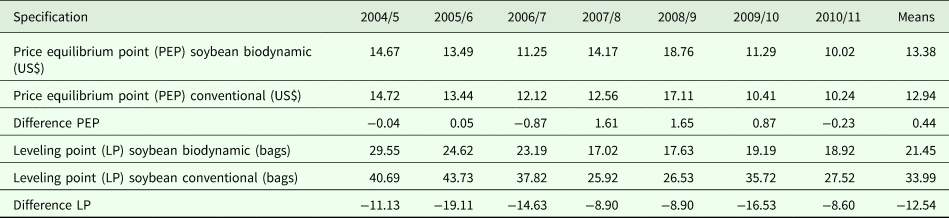
The price equilibrium point (PEP) is the minimum price at which farmers should sell the production to cover the TCs of the operation. PEP was US$0.44 higher in biodynamic than in conventional systems (Table 7), which indicates the need for premium prices in biodynamic systems to make the operation profitable, as has been frequently reported (Crowder and Reganold, Reference Crowder and Reganold2015).
Price equilibrium point (PEP) and leveling point (LP) for soybean production in biodynamic and conventional farming. São Pedro do Ivai/PR, growing seasons from 2004/5 to 2010/11 (US$ ha−1 for 60 kg ha−1 bags)

Source: authors.
The leveling point (LP) from soybean produced in conventional farming was higher than that found for biodynamic farming (an average of 12.5\more bags per season) (Table 7), which indicates that minimum yields for coverage of the costs, considering the received prices, were lower in biodynamic farming than in conventional farming.
Previously, organic production has been referred to as generally more economically profitable than conventional farming due to the reduction of costs and premium prices despite frequent yield decreases (Nemes, Reference Nemes2009). However, a nationwide survey administered in the USA demonstrated that soybean produced from organic farming had higher production costs but was more profitable with premium prices (McBride and Greene, Reference McBride and Greene2009). Our case study showed a similar pattern. Profitability was previously reported to be higher in organic than conventional farming in southern Brazil (just one growing season comparison), and better financial performance of organic farming was due to premium prices and higher input expenditures in conventional farming (Ortega, Reference Ortega2006).
Manual weeding and plowing were the agronomic factors responsible for increasing costs in biodynamic compared with conventional farming. Weeds are the principal limitation for the expansion of annual organic crops because they are the most serious threat to production. In addition, temporary labor for manual weeding is scarce due to low remuneration and is a painful activity. The results presented here reinforce the importance of concentrating efforts in developing alternative management of weeds to be used in annual crops such as soybean.
In addition to yields and profitability, other factors must be considered when comparing farming systems. These include externalities such as ecosystem services, biodiversity conservation, water pollution, soil quality, food pesticide contamination and pesticide worker exposure, and when these factors are also considered, differences in favor of organic farming systems become more perceptible (Reganold and Wachter, Reference Reganold and Wachter2016). The total economic value of environmental services was previously seen as higher in organic than conventional farming (differences ranged from US$340.00 to 4.850,00 ha−1 yr−1) (Sandhu et al., Reference Sandhu, Wratten, Cullen and Case2008). Future investigations may confirm this trend under tropical/subtropical environments.
The small difference in favor of conventional soybean yields vs those in biodynamic farming that was observed in this long-term case study is a surprising finding because organic farming investments for research are absolutely negligible when compared with conventional farming. Research and biological intensification may reduce the gap or even change the outcome favorably for biodynamic farming. This was evidenced as a result of a meta-analysis in which agricultural diversification practices, multi-cropping and crop rotations may reduce or even eliminate this gap (Ponisio et al., Reference Ponisio, M'Gonigle, Mace, Palomino, de Valpine and Kremen2015). If strategies such as weed, pest and disease management; plant breeding; and soil fertility management are developed specifically for organic systems, production may obviously be improved. In general, conventional farming uses technological packages that facilitate management and diminish labor demand and painfulness.
The development of no-till and weeding methods is the principal demand of organic/biodynamic annual crop farmers. In general, organically grown crops are better able to tolerate weed competition (Seidel et al., Reference Seidel, Moyer, Nichols and Bhosekar2017). In addition, cover crops may be included during fallow periods in which weeds reproduce and generate seed banks. To date, some projects by universities and partner farmers are being conducted using these two principles, and preliminary results are promising. The expansion of organic/biodynamic farming in Brazil and surrounding countries depends on these approaches becoming viable and replicable.
Logistical factors also significantly affected the costs of biodynamic systems due to the lack of receiving/trading posts close to the farm. It is probable that as biodynamic or organic agriculture develops in the region, interest in processing and trading could regionally absorb production.
Conclusions
Plowing, occasional labor for manual weeding and external transportation increase costs of biodynamic farming and affect financial indicators. Effective operation costs under biodynamic farming were 4.36% higher than those under conventional farming.
Despite the lower productivity (3.63% lower), the minimum necessary production to cover the costs was lower in biodynamic farming due to premium prices (variation of 1254 bags indicated by the LP).
Higher biodynamic trading prices than those of conventional soybean triggered a PEP suitable for covering higher production costs and thus providing higher profitability.
Author ORCIDs
Maurício Ursi Ventura 0000-0002-3536-2568