Specific Language Impairment (SLI) has generally been characterized as a developmental language deficit affecting phonology and morphosyntax (see Schwartz, Reference Schwartz2009, for a review). Far fewer studies have focused on lexical-semantic abilities, particularly during grade school years, so it is less clear to what extent these are deficient or within normal limits. Studies of preschool children with SLI have revealed difficulties in word-learning and production (e.g., Alt, Plante, & Creusere, Reference Alt, Plante and Creusere2004; Gray, Reference Gray2006; Rice, Buhr, & Oetting, Reference Rice, Buhr and Oetting1992). At later ages children with SLI continue to exhibit some word learning difficulties under some conditions (e.g., Weismer & Hesketh, Reference Weismer and Hesketh1996; cf. McGregor, Reference McGregor and Schwartz2009), and retrieval and recognition deficits (e.g., Edwards & Lahey, Reference Edwards and Lahey1996). However, it is unclear from these studies whether the poor performance is related to deficits in lexical-semantic, phonological or general non-linguistic processing, because the tasks employed could not differentiate these possibilities. Tasks that are sensitive to more automatic levels of semantic processing are necessary to further understand the poor performance found in SLI.
Two recent studies using tasks that attempted to tap into a more automatic level of semantic processing exhibited conflicting results (Pizzioli & Schelstraete, Reference Pizzioli and Schelstraete2011; Velez & Schwartz, Reference Velez and Schwartz2010). Both studies used a semantic priming design, in which a target word is preceded by another word that may or may not be semantically related. Target words preceded by a related word are expected to be facilitated in terms of response time and/or accuracy (i.e., primed), whereas target words preceded by non-related words should receive no benefit. The two studies, however, differed in many other design features, which will be discussed in greater detail in a later section. Velez and Schwartz (Reference Velez and Schwartz2010) did not observe semantic priming in children with SLI, and argued that this finding supports weaknesses in lexical-semantic organization. In contrast, Pizzioli and Schelstraete (Reference Pizzioli and Schelstraete2011) found great priming effects in children with SLI, which they understand as a strong lexical semantic system to compensate for deficits in phonology or morphosyntax. Their finding contradicts Velez and Schwartz (Reference Velez and Schwartz2010) and is inconsistent with previous research that generally has shown weak performance on semantic tasks for children with SLI. It is crucial to determine which is the more accurate assessment of lexical-semantic processing in children with SLI, because the different results support different models of processing and suggest different intervention programs.
Models of Lexical-Semantic Organization
Most current models of lexical organization suggest that lexical representations are interlinked in a network with representations that share phonological or semantic features (e.g., Dell, Reference Dell1986). A key property of these models is that activation of a lexical representation will spread activation to other strongly-linked representations during lexical access. The set of activated representations is called a cohort. Over a brief time period, activation of the cohort decays and is inhibited, as the target with the most activation is accessed. This architecture allows for modulation (priming or inhibition) of lexical access when a prime word shares semantic or phonological properties of the target word.
According to these models, spread-of-activation across the network is automatic (Collins & Loftus, Reference Collins and Loftus1975; Neely, Reference Neely1977). For example, after hearing a word (e.g., dog), the conceptual node representing that word is activated and then spreads this activation automatically to strongly-linked nodes (e.g., bone), whereas unrelated words (e.g., key) are unaffected. However, semantic information in a prime word can also lead to facilitation in access at relatively late stages of processing by means of expectancy or semantic matching. Expectancy allows the listener to formulate a set of potential target words based on the semantics of the prime word, leading to facilitation of related targets (Hagoort, Reference Hagoort1993; Neely, Reference Neely1977). Expectancy is argued to be a relatively slow, conscious process because task instructions and word-item order can influence the results. Semantic matching is a post-lexical process that begins after target presentation and can also be maintained over a long time-scale. If a prime word and its target are found to be semantically similar, there is a bias to identify a target as a real word in a Lexical Decision (LD) task where participants decide whether words are real or pseudowords (Hagoort, Reference Hagoort1993). If there is no semantic similarity the bias is to identify the target as a pseudoword, leading to slowed response times.
Semantic Priming as Probe of Lexical Organization and Processing
A particular challenge to testing the various models is designing tasks that limit the use of controlled processes and, thus, allow for examination of more automatic levels of processing. Lexical-semantic organization can be effectively examined with a LD task combined with semantic priming, in which individuals judge whether an orthographic/visual (e.g., Nakamura, Ohta, Okita, Ozaki, & Matsushima, Reference Nakamura, Ohta, Okita, Ozaki and Matsushima2006; Plaut & Booth, Reference Plaut and Booth2000) or phonological/auditory (e.g., Girbau & Schwartz, Reference Girbau and Schwartz2011; Radeau, Reference Radeau1983; Rissman, Eliassen, & Blumstein, Reference Rissman, Eliassen and Blumstein2003) form is a real word (e.g., cat) or a pseudoword (e.g. wug). A prime or semantically-related word preceding the target should allow for facilitation of access (e.g., Neely, Reference Neely1977). Priming is seen as faster decisions to targets following semantically-related primes than to those following unrelated words. The contribution of controlled processes can be minimized by using very short ISIs (Interstimulus Intervals) between the prime-target pairs and by encouraging speeded automatic responses, as a fMRI study in adults (Rissman et al., Reference Rissman, Eliassen and Blumstein2003). The authors found a shorter Reaction Time (RT) to semantically related word pairs than to those unrelated in all adults (i.e., auditory semantic priming effect), proving that a 50-ms ISI helped to hold the two words at the working memory to more quickly activate a semantic network. They also found differential brain activation between word pairs (semantically related/unrelated), and word-nonword pairs. Thus, considering these findings, a minimum of 50-ms ISI can be used in children. Semantic priming has also been observed in first through fifth grade-school children, but often with greater variability than observed for adults (Girbau & Schwartz, Reference Girbau and Schwartz2011; Radeau, Reference Radeau1983).
Lexical-Semantic Deficits in Children with SLI: Timed Tasks
The few studies that have used timed tasks to tap into more automatic levels of processing reveal mixed support for lexical-semantic processing deficits in children with SLI. Two studies using timed, auditory LD tasks, with the LD made following the presentation of each single word/non-word, found no significant support for the claim that children with SLI organize and access the lexicon differently in terms of semantic information than children with TLD (Crosbie, Howard, & Dodd, Reference Crosbie, Howard and Dodd2004; Edwards & Lahey, Reference Edwards and Lahey1996). In both studies, children with SLI and those with TLD responded faster to real words than to non-words, but children with SLI were slower. Crosbie et al. (Reference Crosbie, Howard and Dodd2004) argue that their results suggest deficits of well-specified lexical phonological representations in children with SLI (resulting in poorer accuracy), rather than inefficiently organized lexicons. However, these LD tasks were tapping a fairly gross property of lexicons (presence vs. absence in the lexicon) and may not reveal whether the fine structure is different.
Velez and Schwartz (Reference Velez and Schwartz2010) found support for poorer lexical-semantic processing using an auditory list paradigm in children (7; 0–11; 10). In the list, some adjacent words were semantically related. This design had the goal of discouraging the development of semantic expectancies that might be available if words were presented in pairs. Grade school children were asked to make animacy judgments about each word with a 500 ms or 1000 ms ISI between word items. Only the children with TLD showed semantic priming and only with the longer ISI of 1000 ms; children with SLI did not exhibit any significant semantic priming effect, and the authors suggested that these children had weaknesses in lexical organization or in spreading activation within the lexicon. However, list priming may not succeed in preventing semantic expectancies because a fairly long ISI is necessary between primes and targets to allow time to make a decision after each word.
A paired semantic-priming paradigm, when used in conjunction with short ISIs between the prime and the target of the pair, may better prevent participants developing semantic expectancies. Very short ISIs can be used between pairs because a response is required only after the second word of the pair. Pizzioli and Schelstraete (Reference Pizzioli and Schelstraete2011) used an LD task with a word/pseudoword judgment and pairs of words separated by an ISI of 150 ms. Children with SLI showed significant priming in RT and accuracy for semantically-related compared to unrelated words; in contrast age-matched and receptive vocabulary-matched controls did not show priming in the RT measure, although it was observed for accuracy. In the adults, this priming effect for RTs reached significance (p = .04). The authors argue that grammatical deficits during development may have led to greater reliance on semantic information, which in turn led to stronger associations between semantically-related lexical words for children with SLI. It is also possible that this larger priming effect was due to controlled rather than more automatic processes. Particularly, the ISI of 150-ms, rather than 50 ms, in conjunction with auditory words of up to three syllables with long duration were likely to result in duration for some word pairs greater than 1300 ms. Furthermore, the number of word pairs was higher than for word-pseudoword (56 vs 40), with 29% of related words, they use identical primes and targets for the two word pairs conditions (usually only targets are presented twice). All these methodological issues, which differ from Rissman et al. (Reference Rissman, Eliassen and Blumstein2003), may have led to some children using a semantic strategy for facilitating LDs. Finally, their only inclusion criterion for SLI was a significant low score in the French version of the TROG test (Test for the Reception of Grammar).
In sum, results from the few, timed semantic tasks are not in agreement concerning deficits of lexical-semantic processing in children with SLI. In the case of simple LD tasks without priming, specific deficits in semantic priming cannot be identified (Crosbie et al., Reference Crosbie, Howard and Dodd2004; Edwards & Lahey, Reference Edwards and Lahey1996). The other two studies that used designs with priming may not have been sensitive enough to differences at automatic or controlled levels of lexical-semantic processing; they found conflicting results with regards to semantic priming in children with SLI. These different results led to opposing explanations: one arguing for a lexical-semantic deficit in organization or spreading activation (Velez & Schwartz, Reference Velez and Schwartz2010) and the other for an intact lexical semantic system that can compensate for deficits in other areas (Pizzioli & Schelstraete, Reference Pizzioli and Schelstraete2011). It is impossible to satisfactorily explain these conflicting findings and select the correct explanation without further data. The primary goal of the current study is to provide these data for implicit priming. An auditory (preferably than visual) semantic priming procedure may better tap into the possible semantic processing deficits of oral SLI.
These different patterns of lexical performance can also be related to the severity of expressive and receptive language deficits. For example, Sheng and McGregor (Reference Sheng and McGregor2010) found that the 6–8 year old children with SLI who exhibited the poorest word-association performance on a word-generation task, had lower expressive vocabulary scores and the largest differences between receptive and expressive scores. A previous study found the greatest slowing for speeded linguistic/nonlinguistic tasks in SLI children with both receptive and expressive deficits, whereas children with only expressive or only receptive deficits were less likely to show significant slowing, (Miller, Kail, Leonard, & Tomblin, Reference Miller, Kail, Leonard and Tomblin2001). Thus, it seems important to examine performance on lexical tasks in relation to expressive and receptive test scores.
General Slowing of Processing and Other Cognitive Deficits in SLI
Two of the three timed auditory LD tasks reviewed above found that children with SLI were generally slower than controls (Edwards & Lahey, Reference Edwards and Lahey1996; Pizzioli & Schelstraete, Reference Pizzioli and Schelstraete2011), and the third, with considerable variability, showed a tendency in the same direction (Crosbie et al., Reference Crosbie, Howard and Dodd2004). In Crosbie et al.’s study, three children with SLI who performed the task below chance level were not excluded. Anyway, those findings are consistent with previous research showing slowed processing for other speeded tasks in groups of children with SLI and LI (e.g., Kail, Reference Kail1994; Leonard et al., Reference Leonard, Weismer, Miller, Francis, Tomblin and Kail2007; Miller et al., Reference Miller, Kail, Leonard and Tomblin2001, Reference Miller, Leonard, Kail, Zhang, Tomblin and Francis2006). Poor working memory could account for this slow processing pattern in children with SLI. There was no evidence for a speed-accuracy trade-off in SLI, that is, no significant positive correlation was found. Conversely, the significant negative correlations indicated that the longer the response times the lower the accuracy for words and pseudowords (Edwards & Lahey, Reference Edwards and Lahey1996) or only for pseudowords (Crosbie et al., Reference Crosbie, Howard and Dodd2004). A secondary goal of the current study is to determine whether this general pattern of slowing and poor accuracy is confirmed, and found in addition to other lexical-semantic differences.
The present study employed an auditory LD task with primes to examine lexical-semantic processing in Spanish-speaking 8 to 10-year old children with SLI and age-matched children with TLD. Pairs of words were presented in which the first word or prime was semantically related or unrelated to the second or target word. Real word primes were also paired with pseudowords to allow for LDs. A brief 50-ms ISI within all word form pairs, was used to examine automatic spread of activation. The proportion of related words was relatively low (25%): we used identical number of word pairs and word-pseudoword pairs. All this will minimize engagement of controlled processes, and increase the likelihood that semantic effects would reflect automatic levels of processing; (see Rissman et al., Reference Rissman, Eliassen and Blumstein2003). We predicted that children with SLI would show smaller or absent semantic priming in terms of RT and accuracy compared to children with TLD, indicating weaker activation among related semantic words in the lexicon, or atypical organization of these networks. We also predicted slower response times and no speed-accuracy trade-off for children with SLI. We expected vocabulary scores to be negatively correlated with LD response time, since children with smaller lexicons might be less certain about the status of a pseudoword. The present study will be a preliminary guideline for our future fMRI research including the auditory Spanish LD task, following the procedure of Rissman et al. (Reference Rissman, Eliassen and Blumstein2003).
Method
Participants
The majority of the children were recruited from two schools in Castelló, in the Valencia region of Spain. Other children were recruited through professionals, newspapers articles and postings at the university. They spoke Spanish as the first language, and understood Catalan (despite not using it). Their main teaching language at school was Spanish. Catalan and Spanish are both romance languages that share many lexical, phonological and morphosyntactic similarities with Spanish, and have many cognate pairs. Questions related to bilingual processing were not examined here because the children were clearly dominant in Spanish. Semantic priming effects in Spanish-speaking adults and children (Girbau & Schwartz, Reference Girbau and Schwartz2011) were similar to studies using French and English.
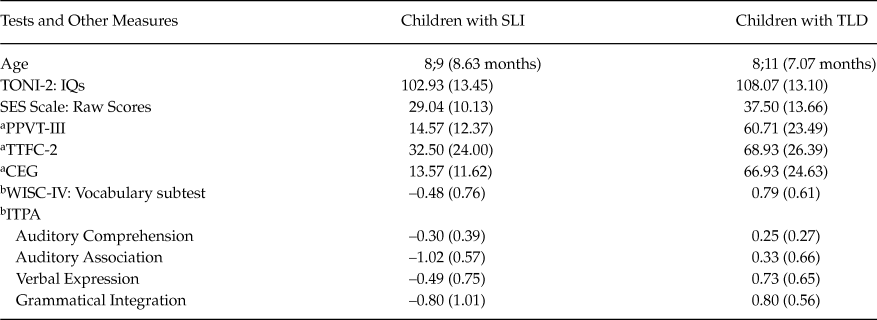
The present research was approved by the Institutional Review Board from the University; parents signed a permission form. All children gave their consent and passed a hearing screening at the onset of each session at 20 dB (500, 1000, 2000, 3000, and 4000 Hz; American National Standards Institute, 2004). Sixteen children with SLI (8; 0–9; 11 years) and 14 age-matched children with TLD (8; 1–9; 11 years, seven boys) participated. Two of the 16 children with SLI (one girl of 9; 0 and one boy of 9; 1 years) were excluded from the analyses because their performance was close to chance level on the LD task, as we detail later. Children were individually tested at the laboratory across a minimum of three sessions, for at least three hours. The timed LD experiment was completed in 20 minutes, including experimenter’s instructions. Of the remaining 14 children with SLI, nine were boys; ten were receiving intervention and four were scheduled to start receiving it at the time of testing. Each participant with SLI was matched with a child with TLD, as far as possible, for age, gender, and IQ (Test of Nonverbal Intelligence, TONI-2, Brown, Sherbenou, & Johnsen, Reference Brown, Sherbenou and Johnsen2000; test Reliability Index, RI = .89). The average age difference (TLD - SLI) was M = 2.14 months, SD = 2.07 (see Table 1). The IQ scores were within normal limits, for children with SLI [range = 84–135] and TLD [89–130], and did not differ significantly according to the pair-wise Student’s t-test, t(13) = 1.49, p = .16, η2 = .14.
Children’s Age, IQs, SES Raw Scores, and Language Tests Percentiles/Standard Deviations in relation to mean scores from the norms: Means and (Standard Deviations) of Scores

Note: aThe scores for PPVT-III, TTFC-2 and CEG tests are given in Percentiles. bThe Vocabulary subtest from WISC-IV and the ITPA subtests scores are given in z-scores or SDs (in relation to mean scores from the norms).
TONI-2 = Test of Nonverbal Intelligence; SES = Social-Economic Status; PPVT-III = Peabody Picture Vocabulary Test; TTFC-2 = Token Test for Children; CEG = Test de Comprensión de Estructuras Gramaticales; WISC-IV = Wechsler Intelligence Scale for Children; ITPA = Illinois Test of Psycholinguistic Abilities.
Instruments
Parents were individually interviewed by the experimenter to help complete a parent questionnaire, and the Hollingshead Social-Economic Status (SES) Scale (Hollingshead, Reference Hollingshead1975). The background questionnaire confirmed that none of the children had a neurological disorder, intellectual disability or hearing impairment. All children were born and grew up in the area of Castelló, came from Spanish-speaking homes, and they had a clear preference for mass media in Spanish. The children spoke Spanish as a native language, according to their teachers and parents. Children came mostly from middle SES (see Table 1), and did not differ significantly on SES according to the pair-wise Student’s t-test, t(13) = 1.76, p =.10, η2 = .18.
We also administered a range of standardized tests measuring language and reading skills. The Spanish Peabody Picture Vocabulary Test (PPVT-III; Dunn & Dunn, Reference Dunn and Dunn2006) was normed and adapted in Spain (RI = .91), on the basis of the English PPVT-III. Four subtests from the Illinois Test of Psycholinguistic Abilities (ITPA; Kirk, McCarthy, & Kirk, Reference Kirk, McCarthy and Kirk2001) were administered: (a) Auditory Comprehension, the child listens to stories and responds to questions about them by pointing to pictures; (b) Auditory Association, the child completes sentences spoken by the examiner; (c) Verbal Expression, a lexical fluency task in which the child says as many items in a stated category as possible in one minute; and (d) Grammatical Integration, the child completes sentences spoken by the examiner according to pictures; (see Girbau & Schwartz, Reference Girbau and Schwartz2007a, Reference Girbau and Schwartz2008, for additional information). Each subtest raw score was converted into a z-score, which was calculated with respect to the M and SD from the corresponding age norms [(raw score - M) / SD]. The z-score was also computed to measure the productive vocabulary using the Vocabulary subtest (word definition) from the Wechsler Intelligence Scale for Children or WISC-IV (Wechsler, Reference Wechsler2007; RI = .84). The Token Test for Children (TTFC-2; McGhee, Ehrler, & DiSimoni, Reference McGhee, Ehrler and DiSimoni2007) measured the ability to follow a sequence of verbal instructions about tokens (RI = .90). The Test de Comprensión de Estructuras Gramaticales (CEG; Mendoza, Carballo, Muñoz, & Fresneda, Reference Mendoza, Carballo, Muñoz and Fresneda2005) is an adaptation of the TROG, on which the child points to the picture that matches an oral sentence (RI = .91). The two receptive tests are given in percentile scores. The Evaluación de los Procesos Lectores Revisada (PROLEC-R; Cuetos, Rodríguez, Ruano, & Arribas, Reference Cuetos, Rodríguez, Ruano and Arribas2007) tested reading skills and was administered for a larger project (RI = .79). Nine out of the 14 children with SLI had reading disabilities. All tests have norms from Spain, except for the TTFC-2 test, whose norms are from the USA but include Hispanic children. Children were also administered two non-standardized tasks in Spanish as part of a larger project: a Non-word Repetition Task (Girbau & Schwartz, Reference Girbau and Schwartz2007a, Reference Girbau and Schwartz2008), and a Relative Clause Comprehension Task or RCCT (Girbau & Schwartz, Reference Girbau and Schwartz2007b) that was translated from Friedmann and Novogrodsky (Reference Friedmann and Novogrodsky2002).
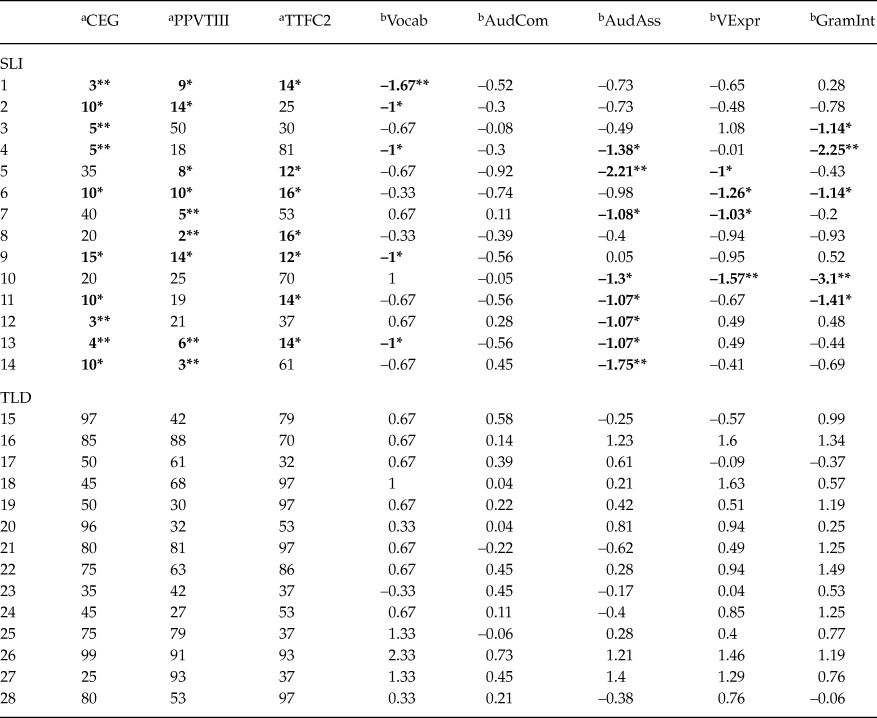
All children with SLI scored at least: (a) ≤ –1 SD (z-score) or ≤ 16th percentile, on at least 3 of the eight Spanish language standardized subtests/tests; or (b) ≤ –1.5 SD (z-score) or ≤ 7th percentile, on 1 of these subtests/tests, and ≤ –1 SD (z-score) or ≤ 16th percentile on at least one other test. Most of the children with SLI (11 out of 14) qualified because of their low scores on at least three of the subtests/tests (Table 2). Ten of the 14 children with SLI had low scores on the CEG test. As we will discuss later, the two additional excluded children with SLI (from the original group of 16) scored particularly poorly, one on four and the other on eight language subtests/tests (below –1 SD), which may explain their poor performance in the LD task (leading to their exclusion from the group analysis). All children with TLD scored within normal limits for all these tests/subtests, with no score close to or below –1 SD (Table 2).
Individual Children’s Language Tests Percentiles / Standard Deviations (in relation to mean scores from the norms): Children with SLI/TLD

Note: aThe scores for PPVT-III, TTFC-2 and CEG tests are given in Percentiles. bThe ITPA subtests and the Vocabulary subtest from WISC-IV scores are given in z-scores or SDs (in relation to mean scores from the norms). *Language standardized subtests/tests scores ≤ –1 SD (z-score) or ≤ 16th percentile. **Language standardized subtests/tests scores ≤ –1.5 SD (z-score) or ≤ 7th percentile.
CEG = Test de Comprensión de Estructuras Gramaticales; PPVT-III = Peabody Picture Vocabulary Test; TTFC-2 = Token Test for Children; Vocab = Vocabulary subtest from the Wechsler Intelligence Scale for Children (WISC-IV); AudCom = Auditory Comprehension subtest (from the Illinois Test of Psycholinguistic Abilities, ITPA); AudAss = Auditory Association subtest (from ITPA); VExpr = Verbal Expression subtest (ITPA); GramInt = Grammatical Integration subtest (ITPA).
All but one child with TLD and one with SLI were right handed (Edinburgh Handedness Inventory; Oldfield, Reference Oldfield1971). All participants except for one child performed the semantic priming task with their dominant hand (27 with the right hand and 1 with the left).
Materials
The materials for the LD task consisted of auditory real words and pseudowords of two syllables that ranged from 4 to 6 sounds/graphemes (Girbau & Schwartz, Reference Girbau and Schwartz2011). The task was adapted from Rissman et al. (Reference Rissman, Eliassen and Blumstein2003) and will be used in our future fMRI study. Twenty-eight common nouns were selected to serve as word targets and 28 common nouns as the semantically-related word primes without any phonological relationship. The 28 semantically related word pairs had a forward strength value (i.e., cue-to-target strength) between .217 and .709, according to an English word association database (Nelson, McEvoy, & Schreiber, Reference Nelson, McEvoy and Schreiber2004). This value gives the proportion of adults who produced a particular target in the presence of the cue word. Because this database was in English and forward strength values were not available for Spanish, we ran this task as a pilot study in 32 Spanish-speaking adults, including 72 semantically-related word pairs. We selected the 28 semantically-related word pairs (e.g., sello-carta, stamp-letter) that had the largest priming effects for these 32 participants. The 28 target words were also paired with a word that bore no semantic or phonological relationship to the target (e.g, hueso-carta, bone-letter). The frequency of use for these words ranged from 2 to 1,568, according to a Spaniard database of 1,800,000 words from children’s texts and reading books (Martínez & García, Reference Martínez and García2004). The pseudowords were phonotactically legal in Spanish and contained no diphthongs. They had high, medium and low frequency single-vowel syllables, which were selected from a sample of 1,156 syllables produced by 6–13 year-olds (Justicia, Reference Justicia1995). Half of the pseudowords began with consonants and the other half with vowel sounds; the stress was also balanced across the two syllable positions.
The duration in milliseconds of the speech prime-target pairs (including the 50-ms ISI) for each condition were as follows: (a) for semantically related words, M = 1011, SD = 21.49, range = [966 – 1044]; (b) for unrelated words, M = 1016, SD = 14.67, [990 – 1042]; (c) for word-pseudoword pairs/set 1, M = 1020, SD = 14.32, [982 – 1043]; and (d) for word-pseudoword pairs/set 2, M = 1021, SD = 19.31, [958 – 1043]. The four sets of two-syllable prime-target pairs did not differ significantly in their duration, according to a one-way repeated-measures ANOVA, F(3, 27) = 2.46, p > .05. The stimulus items were digitally recorded by a female native speaker of Spanish, at a sampling rate of 44,100 Hz to produce 16-bit digital stereo sound files, using Cool Edit Pro (Syntrillium Software Corporation, 2002).
Experimental Design
Trials consisted of pairs of auditory word forms. The two elements in each pair were separated by a 50-ms silence or ISI. Half the pairs consisted of two words (56 pairs), and half consisted of 56 word-pseudoword pairs (e.g., tacón-isllér, heel-isller). Within the word pairs, half consisted of 28 semantically-related word pairs (related condition) and half of 28 totally unrelated word pairs (unrelated condition). The pseudoword condition was divided into two sets of 28 word-pseudoword pairs; each pseudoword or target was repeated twice across the task, as was the case for the target within the two word pair sets. Thus, each word/pseudoword target was repeated twice across the task to control for the possible influence of the target features across the word/pseudoword-pair conditions. The 112 auditory prime-target pairs were presented in four blocks.
The participant’s response window was 3047 ms, i.e., 2000 ms plus the maximum duration for a speech pair (1047 ms). In order to avoid temporal expectancy for trial onset (prime-target), we included null and jittering events between the experimental trials so that the inter-trial interval (ITI) was variable (Friston, Zarahn, Josephs, Henson, & Dale, Reference Friston, Zarahn, Josephs, Henson and Dale1999). The ITIs were jittered (M = 750 ms) using durations of 0 ms, 500 ms, 1000 ms and 1500 ms. These ITIs were pseudo-randomized so that the same ITI did not occur successively. Each block included seven null events or 1020-ms silences following the response window and presented randomly; 28 silences overall. There were never two consecutive null events, or two adjacent ITI events.
The presentation of speech event types was pseudo-randomized so that there were never more than two consecutive events of the same condition (i.e., related, unrelated, or pseudoword). Moreover, there never were more than three consecutive prime-target pairs with a word as a target (i.e., word-word pairs). Finally, there were never two prime-target events with the same target within a block; e.g., sello-carta (stamp-letter) and hueso-carta (bone-letter). In sum, each child performed four experimental blocks; every block had 28 pairs (7 pairs X 4 conditions) and 7 null events, so we maintained the same probability of presentation for each event type within a block.
Procedure
Auditory prime-target pairs were presented via headphones and the experiment was controlled by E-Prime software (Psychological Software Tools, 2002). The sound level was adjusted to a comfortable listening level for each participant.
Instructions
The experimenter explained the task individually to each child to ensure his/her understanding before running the experiment. The program began with some general audio-recorded instructions, which were followed by one block of practice with eight LD trials of the three condition types, different from the experimental trials. Each block, from both practice and experiment, was also preceded by specific instructions. Each participant was instructed to press as quickly and accurately as possible the 1 key, if a pair contained two words, and 2, if the pair contained a pseudoword. Only the practice block had feedback, a smiling/frowning face.
Accuracy and Reaction Time Measures
Participants’ accuracy (percentage of correct responses) and RT in milliseconds were recorded by E-Prime. The RT latencies were measured from the onset of the auditory prime-target pair. Only correct responses were included in RT analyses. Anticipatory responses with latencies < 600 ms were excluded from the analysis, because they would not have permitted the child to hear and make a decision about the second word. Omissions, which include out-of-time response times that were above 3047 ms, and errors were also excluded. Means and SDs for RT and accuracy for each child were calculated for each condition. Values equal or greater than 3 SD from a participant’s mean RT were considered outliers and excluded from any statistical analyses.
Results
Accuracy and RT were analyzed for the auditory LD task with semantic priming. Repeated measures ANOVAs with group (SLI/TLD) as the between subject’s variable and condition (related, unrelated, and pseudoword sets 1 and 2) as the within subject variable were performed. Pearson Product Moment Correlations were used to examine the relationship between the RT performance on the LD task and the language tests scores.
Two children of the original sample of 16 children with SLI were eliminated from analyses of RT, due to accuracy on the overall LD task close to chance (60% and 54%, before eliminating the RT outliers). Of the remaining 14 children with SLI, a total of eight correct responses with RTs < 600 ms were excluded. The lowest correct response time was 694 ms. For children with TLD, omission and error trials totaled 125 (8.0% of total). For children with SLI, 255 trials (16.3%) were excluded (247 omissions and errors, plus 8 early responses). A total of 15 responses for children with TLD and six responses for children with SLI were eliminated as outliers, i.e., values equal or greater than 3 SD from a participant’s mean RT. Thus, there were 8.9% empty cells (140 trials) for children with TLD, and 16.6% (261) for children with SLI.
Accuracy Analyses
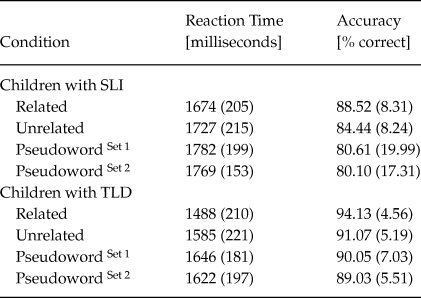
For children with TLD, the mean group accuracy in each condition was high (> 89%), and the individual accuracy scores (range 75% to 100%) were above 75% for all but one score at 75% on pseudowords (see Table 3). The children with SLI showed lower mean values (80–88%) and considerable individual variability (range 39% to 100%) with 14 accuracy averages out of 56 below 76%. Furthermore, the group of children with SLI had twice as many errors and omissions (including out-of-time response times) compared to children with TLD. After an arc-sine transformation of the percentages of correct answers, a repeated-measures 4 X 2 ANOVA was performed with condition (related, unrelated, pseudo-1, pseudo-2) as the within-subject variable and group (TLD, SLI) as the between-subject variable. Results revealed significant main effects for condition, F(3, 26) = 7.06, p < .01, partial η2 = .21, and group, F(1, 26) = 4.16, p < .05, partial η2 = .13, but no condition by group interaction, F(3, 26) = 1.49, p > .05.
Mean (and Standard Deviation) Reaction Times and Accuracy in the Three Conditions of Speech Prime-Target Pairs for the Semantic Priming Blocks: Children with SLI / TLD

Note: Only correct responses were included in the mean reaction times; errors, outliers, anticipatory responses and omissions were excluded. Accuracy is calculated on the basis of the number of correct responses (i.e., excluding errors, omissions, outliers and anticipatory responses) out of 28.
Further examination of the condition effect was conducted separately for each group using Newman-Keuls post-hoc tests, because of our a priori hypotheses. A Newman-Keuls test better controls for multiple pair-wise comparisons than individual t-test or one-way ANOVAs (Howell, Reference Howell2010). Children with SLI were significantly more accurate for the semantically-related words than for word-pseudoword sets (p < .05). No significant differences between conditions were found within the group of TLD, or between the two children’s groups within each condition. Five of the 14 children with SLI had very poor accuracy, with at least one condition below 76%, and an average across conditions between 64% and 84%. These five children had particularly poor language scores, four below –1.5 SD on two subtests/tests and below –1 SD on one or more of them and the fifth child below –1 SD on four subtests/tests (Table 2; children 1, 4, 10, 11, and 13).
Reaction Time Analyses
Group analyses
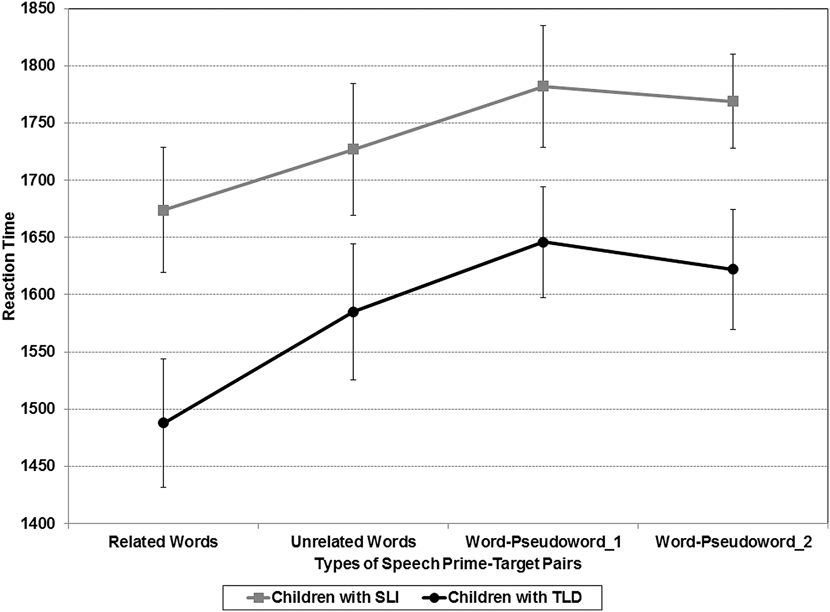
The repeated-measures 4 X 2 ANOVA for RT revealed a significant main effect for condition, F(3, 26) = 17.89, p < .0001, partial η2 = .41, and group, F(1, 26) = 4.61, p < .05, partial η2 = .15, and no significant interaction, F(3, 26) = 0.65, p = .58. Figure 1 reveals the same pattern of findings across the two groups of participants, including the lack of interaction, and that children with TLD showed consistently faster RTs across the conditions than those with SLI.
Speech Prime-Target Pair Type X Children’s Group: Significant main effects on RT.
Reaction Times (ms) means with standard error bars.

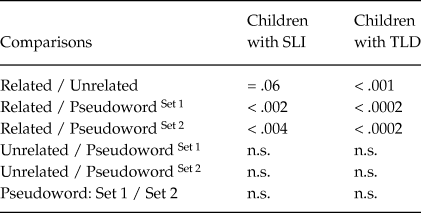
Further examination of the condition effect was conducted separately for each group using Newman-Keuls post-hoc tests, because of our a priori hypotheses that the two groups would show differences in priming and in word pairs versus pseudoword pairs, (Table 4). For the children with TLD, the mean RT for the semantically-related word pairs was significantly shorter than for the unrelated condition and than for each of the two pseudoword sets (see Table 3). The RT difference for the semantically-related and unrelated word pairs for the SLI group approached significance (p = .06). If the two children with SLI who performed close to chance level are included in this analysis, then the priming effect is non-significant, t(15) = 1.09, p =.29. These two children showed slower RT on correct trials for the related compared to unrelated condition, after excluding the outliers. This is just an informative result for comparison with previous studies that did not exclude any children who performed at chance level (e.g., Crosbie et al., Reference Crosbie, Howard and Dodd2004). Finally, we found that the group with SLI was significantly faster for the related condition than for each of the two pseudoword sets (Table 4).
Pair-Wise Newman-Keuls Post-Hoc Test Results (significance of probabilities) for the Reaction Times to the four Types of Speech Prime-Target Pairs within the SLI and TLD groups

Note: For each group, n = 14; two additional children with SLI were eliminated. The significant alpha level was p < .05.
Consistency across lexical items
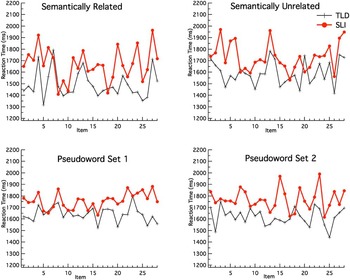
A MANOVA with items as factor could not be undertaken due to too many empty cells, i.e., omissions, errors, and anticipatory responses. However, examination of the mean RTs for each item indicated that no particular item or subset of items was skewing the results (see Figure 2). The children with TLD had shorter RT means than children with SLI for 25 of 28 items in the related condition and in the unrelated condition, and for all but three items of the total 56 items in the pseudoword conditions.
Mean reaction times (in milliseconds) for each of the 28 speech pair items in the four conditions (Semantically Related; Semantically Unrelated, Pseudoword Set 1 and Pseudoword Set 2): Children with TLD/SLI.
Note: The mean reaction times are based on 14 children in each group. Only RTs for correct responses were included; errors, outliers, anticipatory responses and omissions were excluded. The numbers for each speech pair (from 1 to 28) correspond to the numbers in the Appendix from Girbau & Schwartz (Reference Girbau and Schwartz2011).

Overall speed and accuracy of responding
We also examined the trade-off between speed and accuracy to determine whether slower RTs benefited accuracy judgments in the children with SLI. No significant positive correlation between the mean overall accuracy and the mean overall RT in the LD task for children with SLI was found, r = –.28, p > .05.
Relation of LD Response Time to Children’s Language Skills
We calculated Pearson Product Moment Correlations between the RT average for the two word pair sets (average between related and unrelated words) and the RT average for the two word-pseudoword pair sets (average between sets 1 and 2). We found that RT was highly correlated across these conditions for all 28 children or for the SLI and TLD groups separately (r > .86 in these 3 correlations). Thus, RT was collapsed across the four conditions for the following analyses. We chose not to create composite language test scores for the following analyses, since most of the ten language tests/subtests/tasks were largely measuring different psycholinguistic abilities. Pairwise correlations confirmed this decision, with only the CEG test and Relative Clause Comprehension (RCC) task showing a strong relationship (r 2 = .74). Thus, we excluded the non-standardized RCC task from the following correlations.
We then calculated Pearson Product Moment Correlations between the mean overall RT value in the LD task and each of the nine language scores, for the collapsed groups (all 28 children) and for each group separately. The PPVT-III percentiles correlated significantly with RT for the overall group, r = –.44, p = .01, but separate group correlations revealed that this was driven by the SLI group, r = –.71, p = .004. The significant p-value starts at p = .0056 (i.e., .05/9) using the Bonferroni correction, since we conducted 9 correlations in each children’s group. Thus, for children with SLI, slower RT was significantly associated with lower receptive vocabulary scores. Two additional weaker correlations between the overall RT, and the TTFC-2 (for the overall group r = –.48, p = .009, for the TLD group r = –.59, p = .02) and CEG (for the overall group r = –.51, p = .006, for the TLD group r = –.57, p = .03), were driven by the TLD group. No other significant correlations with overall RT were observed. We also examined whether the priming effect (unrelated - related RT) correlated with any of the nine language test measures. Only a weak correlation was observed for children with TLD between priming and the Auditory Association subtest score, r = –.58, p = .03.
Discussion
The present study was designed to examine the question of whether the lexical-semantic system in children with SLI is different at early, more automatic levels of processing and organization from that of age-matched children with TLD. Additional goals were to examine the relationship between lexical access and other language skills in children with SLI/TLD, and whether children with SLI showed slower processing. The patterns of findings will be addressed in detail below.
Evidence of Implicit Semantic Priming
We had predicted that children with SLI would be less likely to exhibit priming effects than children with TLD and that this would indicate weaker activation among semantically-related items. The alternative hypothesis was that only children with SLI would show strong priming effects, but not the group with TLD, indicating compensation for poor phonological and/or grammatical processing. Our findings are consistent with the first position; children with SLI were also slower at responding than those with TLD.
The group of children with SLI who performed significantly better than chance on the LD task only approached a significant priming effect as a group (p = .06). In contrast, age-matched children with TLD showed a robust effect of semantic priming with more consistency (p < .001); they overall showed faster RTs to related than unrelated words. The group with SLI had twice as many errors and omission trials compared to children with TLD, that is, the analyses included more empty cells for items RTs in children with SLI; this lower accuracy may have had some influence on the marginal non-significance for the priming effect in the group with SLI.
Examination of the individual patterns revealed that a subset of the children with SLI, who exhibited particularly poor language scores, did not show any clear priming effects for accuracy. The 14 children with TLD in this study exhibited clear semantic priming. However, using identical LD task in larger groups, eight children with TLD out of 27 did not exhibit RT semantic priming in the predicted direction, but all adults exhibited it. (Girbau & Schwartz, Reference Girbau and Schwartz2011). Radeau (Reference Radeau1983) observed that two out of 24 typical children (6;2 to 7 years old) did not show RT semantic priming in a similar task. Individual differences in children’s semantic network development could influence the amount of priming to a particular stimulus set, even though the words are highly familiar and are acquired at an early age. Furthermore, children in particular show great variability in tasks requiring decisions due to immaturity in executive functions and this variability could mask priming effects in some cases. For example, more immature attentional and working memory abilities in children may lead to occasional lapses in attention to the task and overload processing the prime words. Slower and less automatic activation across the weaker lexical networks or slower decision processes in children compared to adults can also account for some children not showing priming effects. This affects more to children with SLI, whose language skills are poor.
The previous findings of a strong priming effect in children with SLI (Pizzioli & Schelstraete, Reference Pizzioli and Schelstraete2011) is not replicated in our data and, thus, do not support a model of compensation at the semantic level. Our data do not support, either, their non-significant semantic priming effect in the RT for children with TLD. It is possible that a number of design choices in their study allowed for children to employ a conscious, semantic strategy in the task. These include the use of: (a) a longer ISI (150 ms), in conjunction with word forms of variable duration, up to 3-syllable length; (b) more word pairs than word-pseudoword pairs; (c) the same prime words for related and unrelated conditions, besides the usual repetition of targets; and (c) the possible repetition of the same prime word in adjacent or near pairs. The last three factors could lead to developing a response bias for word pairs.
Our study was designed to minimize the possibility of employing conscious, semantic strategies, by using a short ISI of 50 ms, and similar 2-syllable word durations, (Rissman et al., Reference Rissman, Eliassen and Blumstein2003). We also used different prime words for the related, unrelated, and pseudoword pairs, with identical number of pairs across conditions, following the same procedure in the cited study in adults. Thus, our study does not support the claim that children with SLI show compensation at an early, implicit level of lexical semantic processing.
Even if the factors above led to the use of conscious semantic strategies, it would be surprising to find that only children with SLI, but not those with TLD would make use of such a strategy. Their only language inclusion criterion for LI was a significant low score in the receptive TROG test, with no inclusion criteria for TLD. Other research using methods that arguably are highly affected by conscious, controlled variables do not support a model of semantic compensation in children with SLI. For example, Sheng and McGregor (Reference Sheng and McGregor2010) found that children with SLI produced fewer semantic word associations than age-matched or language-matched controls. In Velez and Schwartz (Reference Velez and Schwartz2010) the children with SLI did not exhibit significant semantic priming, at a long ISI of 1000 ms, where a semantic strategy was possible; only children with TLD did. Furthermore, ERP evidence suggesting increased levels of semantic processing would indicate increased effort, but not compensation. Thus, support for a model of semantic compensation at a late level of controlled processing in children with SLI is not supported by the literature.
One finding that is consistent across studies using LD tasks is that responses to pseudowords were less accurate and slower than those to words for both children with TLD and SLI (e.g., Crosbie et al., Reference Crosbie, Howard and Dodd2004; Edwards & Lahey, Reference Edwards and Lahey1996; Pizzioli & Schelstraete, Reference Pizzioli and Schelstraete2011). This result indicates that the lexical search instituted in an LD task is roughly similar in children with TLD and SLI. In the current priming study the RT difference appears to be driven mostly by a difference in responding to the semantically-related words compared to pseudowords, since no significant difference was found between the unrelated words and pseudowords for either children with TLD or those with SLI. The study with a larger number of children with TLD suggests that there was a small but significant difference in RT between the unrelated and pseudoword targets, but that this difference cannot be observed in the smaller sample of 14 used in the current analysis (Girbau & Schwartz, Reference Girbau and Schwartz2011). In the Pizzioli and Schelstraete (Reference Pizzioli and Schelstraete2011) study it is unknown whether the time to make an LD for an unrelated target differed from that for pseudowords because they did not report a comparison of these conditions. In sum, these findings suggest that pseudowords (single or paired with a word) are the most time demanding for processing, but only marginally more than words that are unprimed. Studies manipulating the frequency of lexical items will be needed to further characterize differences in speed of access for unrelated words and pseudowords.
General Slowing of Processing and Other Cognitive Deficits in SLI
Our data are consistent with general slowing of processing models (e.g., Leonard et al., Reference Leonard, Weismer, Miller, Francis, Tomblin and Kail2007; Miller et al., Reference Miller, Kail, Leonard and Tomblin2001, Reference Miller, Leonard, Kail, Zhang, Tomblin and Francis2006). Children with SLI were slower across all conditions and showed more errors in LD accuracy than children with TLD. Two of the three LD studies, in addition to the current study, support the two general findings (Edwards & Lahey, Reference Edwards and Lahey1996; Pizzioli & Schelstraete, Reference Pizzioli and Schelstraete2011). In the present study, the children with SLI were approximately 150 ms slower in responding across conditions compared to children with TLD. Crosbie et al. (Reference Crosbie, Howard and Dodd2004) showed only a trend to be slower, but they included three children with SLI who performed at chance level.
The poor accuracy and larger number of missed responses observed in children with SLI in our study and in other research using LD tasks (Crosbie et al., Reference Crosbie, Howard and Dodd2004; Pizzioli & Schelstraete, Reference Pizzioli and Schelstraete2011) may be associated to slow processing. The children with SLI in our study showed twice as many errors and omissions together as those with TLD, especially in the pseudowords (80% vs. 90%) with results similar to Crosbie et al. (80% vs. 92%). Seven of the 16 children with SLI exhibited particularly poor performance, with two showing chance-level performance, and five showing accuracy levels < 76%. However, as previous research, we found no evidence for a speed-accuracy trade-off, since there was no significant positive correlation between speed and accuracy in the children with SLI. Edwards and Lahey (Reference Edwards and Lahey1996) found that children who were least accurate were also those who responded slower, and Crosbie et al. (Reference Crosbie, Howard and Dodd2004) found this negative correlation only for non-words. Our study showed a non-significant negative relationship in SLI.
In sum, the generally slower RTs may indicate slower lexical access and a less developed automaticity of semantic network. However, the poorer accuracy and the absence of a relationship between accuracy and RT in SLI support claims that other factors, such as verbal working memory contribute to the pattern of poor processing found in timed LD tasks for LI (Leonard et al., Reference Leonard, Weismer, Miller, Francis, Tomblin and Kail2007).
Relationship of LD Response Time to Language Skills
The present study revealed that increased receptive vocabulary knowledge was correlated with faster RTs, in children with SLI, but not in those with TLD. This was a large effect, accounting for 50% of the variance. Considering that the LD task reflects lexical knowledge, it should not be surprising that children with smaller vocabularies may have less certainty, leading to later responses, in making a LD. Thus, vocabulary size as measured at the receptive level by PPVT-III, partly accounts for the speed of responses in children with SLI. A failure to find a correlation with the receptive vocabulary of children with TLD may indicate that by eight years of age their lexicons are firmly established and other factors dominate in determining speed of processing. The only other LD study, but with no priming, that examined the relationship between standardized test measures and RT found that neither receptive language (including PPVT-R) nor expressive language were significant predictors of LD RT for children with SLI using a regression analysis (Edwards & Lahey Reference Edwards and Lahey1996). It appears that the more complex design of our priming LD task may serve as a better index of lexical-semantic knowledge. It will be important to replicate our finding in future research.
No strong correlations were found between any other language measures and overall LD RT or priming RT. The study by Sheng and McGregor (Reference Sheng and McGregor2010) in younger children suggested that poor expressive vocabulary per se (and in relation to PPVT-III receptive scores) might correlate with lexical task measures. Their study specifically found that children with SLI with lower expressive vocabularies appear to have less rich semantic systems in a task designed to elicit/produce semantic associations. The failure to find a relationship between expressive vocabulary and priming in our study may indicate that children with expressive versus receptive deficits show different weaknesses related to lexical-semantics demands. Particularly, the different task demands of word production vs. word reception are likely to tap into different mechanisms of the lexical-semantic system. Our LD receptive task did not request any verbal production, and thus, speed of responding depends on how rapidly the semantic content can be retrieved to allow for the semantic decision. In general, the findings across studies suggest that children with poor receptive vocabularies are slower in accessing lexical information, whereas those with only expressive difficulties may have a deficit in lexical-semantic organization and/or retrieval of semantic/phonological information to select associated words to be produced.
The current findings suggest that some children with SLI develop similar semantic associations between words in their lexicon, allowing for semantic priming, but that others, who have particularly poor language abilities, have deficits in lexical-semantic access and organization. However, children with SLI, whether they do or do not show evidence of typical semantic associations, show deficits in making lexical decision, seen as significantly slower response times and poorer accuracy. These findings suggest slower access of lexical information, which needs to be considered in any intervention program. The negative correlation between the vocabulary scores on the PPVT and the speed of responding suggests that increasing a child’s vocabulary can benefit lexical processing. It is possible that the longer response times interacted with poor vocabulary skills to lead to the poorer accuracy found for the group of children with SLI. We found no support for the proposal that children with SLI show compensation in the lexical semantic system, seen as enhanced priming. Approaches, such as ERP and fMRI, which can reveal the time-course of processing leading up to the behavioral response, will be necessary to extend our understanding of lexical semantic processing in children with SLI.
This research was partly funded by the next 3 grants: “Instituto de Salud Carlos III - Ministerio de Sanidad y Consumo”, FIS-PI041733; Ministerio de Educación y Ciencia”, SEJ2007–60325/PSI; and “UJI - Foundation “Caixa Castelló/ Bancaixa”, P1·1B2007–33; (D. Girbau, P.I.). Support was also provided to the first author by two grants from Generalitat Valenciana (Direcció General d’Investigació i Transferència Tecnològica): CTESPP/2005/035, and BEST/2007/193. The studies were also partly supported by two grants awarded to the third author by Pla de promoció de la investigació de la Universitat Jaume I (Fundació Caixa Castelló-Bancaixa, 2005) and Ministerio de Educación y Ciencia, SAB2006–0048. I thank Richard G. Schwartz for his support on the design of the study, and Valerie Shafer’s comments on the paper.