Introduction
Grape seed extract (GSE) is sold as a supplement for horses in the USA, Australia and Europe. Despite a thorough review of the literature, no information relating to the effects of feeding GSE specifically or proanthocyanidins in general to horses could be found. GSE is derived from the residual inner epidermis and the outer parenchymous cell layers of the seed. It contains a heterogeneous mixture of gallic acid (Palma and Taylor, Reference Palma and Taylor1999) and proanthocyanidins (Fuleki and Ricardo da Silva, Reference Fuleki and Ricardo da Silva1997).
The paper reports on the findings of a preliminary investigation undertaken to elucidate the effects of GSE on horses, with a focus on identifying any adverse effects of GSE inclusion in the diet on animal health, intake and digestion.
Material and methods
Animals and management
Four Thoroughbreds, aged between 5 and 16 years, were used (three geldings and one mare). They were on loan (with informed consent) from their owners for the duration of the trial. Mean body weight (BW) was 534 ± 22.6 kg.
The horses were stabled during the night in individual stalls (3 m × 4.2 m, concrete bases with good drainage). The horses were bedded on barley straw. The water buckets in each stable were filled with fresh water to the required level. Oaten hay was placed into a net and tied to the wall in each stable.
The horses were fed a concentrate feed twice a day at 0730 and 1700 h. Following their morning concentrate feed, the horses were turned out (daily) into individual paddocks, which were bare of pasture. The horses were provided with 40% of their daily allocation of hay via hay nets placed in their day paddock; the remaining hay was provided in their stables at night. GSE daily inclusion was maintained consistently as a percentage of total BW. Daily feed intake was determined by subtracting the weight of feed refusal from the amount of feed offered (both on dry matter (DM) basis).
Experimental design and diets
The trial was based on a Latin square design, involving four dietary treatments and four experimental periods. The horses were brought to the appropriate level of fitness prior to the commencement of the actual feeding trial. This took approximately 4 weeks of light lunge work. Following this was the trial proper with each experimental period within the Latin square design taking 3 weeks. The total experimental period was thus 16 weeks.
Horses were randomly allocated a dietary treatment for each period. Each of the four experimental periods was of 21-day duration, comprising of a 14-day adaptation by a 7-day sampling period.
The four experimental diets were as follows: (1) basal diet – consisting of 3 kg horse muesli (concentrate feed), 1.5 kg oaten chaff, 1 kg lucerne chaff and 10 kg oaten hay; (2) basal diet + 50 mg GSE/kg BW; (3) basal diet + 100 mg GSE/kg BW and (4) basal diet + 150 mg GSE/kg BW. The basal ration contained (on DM basis) 7.7% crude protein and 8.9 MJ digestible energy per kilogram DM. At the level of feeding used, this equated to 1.5 times the NRC (2007) protein and energy requirements for a 500 kg horse undertaking light exercise work.
The horse muesli was formulated and manufactured by Thompson and Redwood Produce Supplies (Perth, Western Australia). The GSE was a proprietary product (Vinlife®; Tarac Technologies Pty Ltd, South Australia). The GSE was a light brown, non-fibrous powder with a characteristic herbal/tannic odour. It is freely soluble in water. Phenolic compounds are the major constituent of GSE, with a total phenolic content (as gallic acid equivalent (GAE)) of 46% and containing 40% oligomeric proanthocyanidins (as GAE).
The actual amount of GSE fed varied and depended on the BW of the horse. The horses were weighed each week and the total amount of GSE fed was adjusted where needed.
Live weight, temperature, heart and respiration rates
Once weekly during the trials, the horses were weighed after their morning feed using a horse weighbridge (Sun Beam True Test AG500 Series Version 3.1). Temperature (rectal), heart and respiration rates were also measured weekly after the horses had completed their evening feed. Respiration rate was measured while the horse was standing and still eating the evening feed.
Exercise
Prior to the start of the trial, a period of 4 weeks was allowed for the horses to undergo basic training in lunging and to gain the necessary level of fitness (Marlin and Nankervis, Reference Marlin and Nankervis2002). The trial required the horses to work at low-intensity speeds of approximately 2 to 4 m/s, which meant the horses only needed to be worked at the gaits of walk and trot (Evans, Reference Evans2000). The horses were worked five times a week on a 20 m circle in an outdoor-fenced sand arena. The horse worked on each rein (right- or left-hand side) for the same duration each session at either gait. The duration and intensity of the lunge session increased as the horses’ fitness improved.
The horses’ fitness was maintained during the 12-week trial by undertaking three lunge sessions per week on a 20 m circle in the outdoor sand arena. Each session involved 20 min at walk (average 1.76 m/s) and trot (average 3.8 m/s) (Marlin and Nankervis, Reference Marlin and Nankervis2002).
A regular lunge session, when the horses were in a fit condition, consisted of 2 min walk (left rein), change the rein, 2 min walk (right rein), transition to trot, 7 min trot (right rein), change rein, transition to trot, 7 min trot (left rein), transition to walk and 2 min walk to cool the horse down.
A lunge test, adapted from Marlin and Nankervis (Reference Marlin and Nankervis2002), was undertaken during weeks 3, 6, 9 and 12 of the trial. Heart rate was recorded using a Polar Equine® (Pursuit Performance Pty Ltd, South Australia) heart-rate monitor.
Analysis and calculations
Fresh faecal samples (100 to 500 g) were collected weekly (a.m.) and the pH was recorded. The samples were taken from the centre of the faecal mass within 30 s of its deposition (Nicol et al., Reference Nicol, Davidson, Harris, Waters and Wilson2002). Three pH readings were taken using an EcoScan pH 5/6 m (Eutech Instruments Pty Ltd, Singapore). The pH probe was placed directly into the faecal balls to obtain the readings.
Once a week, prior to their morning feed, 50 ml urine samples were collected from each horse using a plastic bucket with a long wooden handle. A sub-sample was taken and then stored frozen at −18°C. The urine samples were subsequently analysed for specific gravity as well as minerals and creatinine levels to enable determination of the animals’ fractional excretion ratio (FER) for minerals.
In total, 10 ml venous blood samples were drawn on a weekly basis (immediately following urine collection) directly from the jugular vein using 18 gauge needles, into labelled vacutainers containing lithium heparin as an anticoagulant (BD Vacuatainers™ LH PST™II; AllMed). The samples were centrifuged at 3000 × g for 15 min. Plasma was harvested within an hour of collection and frozen at −18°C for subsequent analyses of minerals, creatinine, glucose and lactate concentrations.
The mineral (Na, K, Cl and Mg) and creatinine analyses of blood and urine and analysis of blood glucose and lactate concentrations were conducted by Vetpath Laboratory Services, Perth, Western Australia (NATA Accreditation no. 14776). All analyses were carried out using the Olympus AU400 analyser using (appropriate) Olympus reagents. For the determination of Na, K and Cl concentrations in both urine and plasma, analysis involved using the ion-specific electrode on the AU400. For plasma lactate analysis, BioMerieux reagents were used. For all analyses, the samples were diluted as necessary to fall within the dynamic/linear range of the AU400.
The FER for minerals was used to determine electrolyte balance in the horses (King, Reference King1994). The determination of electrolyte clearance as a percentage of creatinine (Cr) clearance was calculated using the following equation:

where M is the mineral under investigation, urine, the urinary concentration of a substance and plasma, the plasma concentration of a substance.
Statistical analyses
Treatment means for the various parameters measured or calculated were compared using an analysis of variance, taking into consideration differences among treatments and between periods. This was performed using the computer-assisted statistical analysis system Genstat® (VSN International). For all analyses, P < 0.05 was regarded as significant.
Results and discussion
Animal health
All animals maintained good health throughout the trial. Supplementation with GSE had no effect on either temperature or respiration rate (measured at rest); however, feeding 50 mg GSE/kg BW resulted in a significantly lower (P < 0.05) heart rate (Table 1) and there is no explicable reason for this effect. However, for all the horses for all treatments, the heart rates were within the normal range for an adult horse (Pillner and Davies, Reference Pillner and Davies2000).
Effect of supplementation with GSE on temperature, heart and respiration rates (measured at rest) (mean ± s.d.) of exercised horses

GSE = grape seed extract; BW = body weight.
Values within a column with unlike superscript letters were significantly different (P < 0.05).
The results from this study are similar to findings in other animal studies where GSE had no adverse effects on animal health (Reed, Reference Reed1995; Mittal et al., Reference Mittal, Elmets and Katiyar2003; Iwasaki et al., Reference Iwasaki, Matsui and Arakawa2004).
Intake and BW
Supplementation with GSE had no effect on either feed or water intake of the horses (Table 2). The supplement was readily palatable to the horses at all levels of inclusion. Minimal feed refusals were recorded throughout the trial and this was only for oaten hay.
Effect of supplementation with GSE on feed and water intakes (mean ± s.d.) of exercised horses

GSE = grape seed extract; DM = dry matter; BW = body weight.
Proanthocyanidins, as contained in GSE, have an astringent taste, which can potentially result in reduced palatability and hence decreased voluntary feed intake (Jansman, Reference Jansman1993). However, Gupta and Haslam (Reference Gupta and Haslam1980) suggest that the slight astringent taste actually increases the palatability of feed and stimulates intake. In this study, feeding GSE had no effect on feed or water intakes and on no occasion did any horse leave any concentrate feed, which contained the powdered GSE. Therefore, it must be assumed that GSW is palatable to the horse. Other researchers have found similarly unchanged feed intakes in other species fed comparable amounts of GSE (Gontheir et al., Reference Gontheir, Dovoan, Texier, Felgines, Remesy and Scalbert2003; Balu et al., Reference Balu, Sangeetha, Muralia and Panneerselvam2005). However, Wren et al. (Reference Wren, Cleary, Frantz, Melton and Norris2002) fed much higher doses (102 to 1586 mg/kg BW) to rats and noted an increase in feed intake.
Feeding GSE, at all inclusion levels, had a positive effect (P < 0.05) on the live weight of all animals, with the range of weight gains varying from 0.25 to 1.0 kg/week. This was in contrast to the control diet where two of the horses lost weight (0.67 and 1.0 kg/week) and a third failed to gain weight. However, given the small number of horses and the short duration of each feeding period, it is noted that caution should be taken in interpreting these results. In other species, the effects of GSE inclusion in the diet have been variable. Wren et al. (Reference Wren, Cleary, Frantz, Melton and Norris2002) found feeding GSE to rats at levels of up to 2.0% for a period of 90 days resulted in all groups of animals gaining weight during the trial and that food consumption in the 2.0% group was significantly higher than that of the control group. However, Moreno et al. (Reference Moreno, Nebojsa, Poulev, Brasaemle, Fried and Raskin2003) and Vogel et al. (Reference Vogel, Nijs and Westerterp-Plantengaa2004) reported decreased BWs in mice and rats while other researchers (Yamakoshi et al., Reference Yamakoshi, Saito, Kataoka and Kikuchi2002; Gontheir et al., Reference Gontheir, Dovoan, Texier, Felgines, Remesy and Scalbert2003) found GSE treatments did not produce any significant changes in BW in rats.
Faecal and urinary parameters
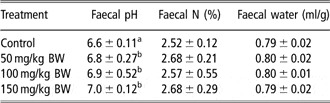
The addition of GSE to the diet of exercised horses had no effect on faecal N or faecal water; however, it resulted in an increase (P < 0.05) in faecal pH (Table 3). Acid faeces are typically found in horses fed diets containing grain (starch) (Zeyner et al., Reference Zeyner, Geissler, Kaske and Fuchs1992; de Fombelle et al., Reference de Fombelle, Jacotot, Drogoul, Bonnefoy and Juilland1999; Al Jassim et al., Reference Al Jassim, Scott, Trebbin, Trott and Pollitt2005). The horses were fed grain-based muesli and thus typically should have produced acid faeces. This was the case with the horses fed the control (no GSE) diet; however, including GSE in the diet resulted in increased faecal pH up to neutral (pH 7.0) when 150 mg GSE/kg BW was fed. It appears that feeding GSE has either decreased the amount of starch entering (the caecum) or changed the nature of fermentation in the caecum.
Effect of supplementation with GSE on faecal pH, faecal N and faecal water (mean ± s.d.) of exercised horses

GSE = grape seed extract; BW =body weight.
Values within a column with unlike superscript letters were significantly different (P < 0.05).
Fermentation of starch in the hindgut is associated with an increase in populations of Gram-positive bacteria (Bailey et al., Reference Bailey, Baillon, Rycroft, Harris and Elliott2003). Jayaprakasha et al. (Reference Jayaprakasha, Selvi and Sakariah2003) found Gram-positive bacteria were completely inhibited by GSE treatment (850 to 1000 p.p.m.). Baydar et al. (Reference Baydar, Sagdic, Ozkan and Cetin2006) also reported antibacterial properties of GSE. Therefore, it is postulated that including GSE in the diet of exercising horses modified the bacterial population of the hindgut, resulting in altered VFA production and more alkaline faeces.
This is a potentially significant finding and warrants further research. Overgrowth of Gram-positive Streptococcal species in the hindgut has been associated with the development of carbohydrate-induced laminitis, which occurs when large amounts of fermentable starch are delivered to the hindgut (Mungall et al., Reference Mungall, Kyaw-Tanner and Pollitt2001; Milinovich et al., Reference Milinovich, Trott, Burrell, van Eps, Thoefner, Blackall, Al Jassim, Morton and Pollitt2006). The antibiotic virginiamycin (Founderguard®; Vetsearch International) is used in Australia for the treatment of carbohydrate-induced laminitis in horses. It prevents the overgrowth of streptococcal species (Rowe et al., Reference Rowe, Lees and Pethick1994), thus reducing lactic acid production and maintaining the hindgut above pH 6.5 (Rowe et al., Reference Rowe, Pethick and Johnson1995). Further investigation is needed to determine whether feeding GSE can reduce the incidence of carbohydrate-induced laminitis in horses and whether this is specifically through action on streptococcal species.
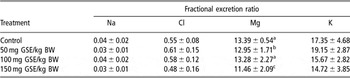
Supplementation with GSE had no effect (P > 0.05) on the FER of Na, Cl and K; however, FER of Mg was significantly (P < 0.05) lower in horses fed 50 and 150 mg GSE/kg BW) compared with the control and 100 mg GSE (Table 4). Feeding 150 mg GSE resulted in a significantly (P < 0.05) lower Mg FER compared with when 50 mg GSE was fed. A decreased FER suggests the conservation of Mg, but there is no apparent explanation as to why the horses fed GSE were conserving Mg more than the control animals.
Effect of supplementation with GSE on the fractional excretion ratio (mean ± s.d.) of major electrolytes in exercised horses

GSE = grape seed extract; BW =body weight.
Values within a column with unlike superscript letters were significantly different (P < 0.05).
Plasma creatinine, glucose and lactate
The inclusion of GSE had no effect (P > 0.05) on plasma creatinine and lactate concentrations taken following exercise. However, blood glucose concentrations were significantly (P < 0.05) decreased when GSE was fed at 100 and 150 mg/kg BW) (5.50 ± 0.26 and 5.32 ± 0.72 mmol/l, respectively) compared with the control diet (5.77 ± 0.31 mmol/l). This decrease in plasma glucose concentrations is in agreement with Pinent et al. (Reference Pinent, Blay, Blade, Salvado, Arola and Ardevol2004) who found a similar effect feeding rats 250 mg GSE/kg BW. They concluded that the proanthocyanidins contained in the GSE lowered blood glucose by at least two mechanisms: a delay in intestinal glucose absorption and an insulin-like effect on insulin-sensitive tissues.
Within the constraints of this study, no apparent effects feeding GSE on horse performance were noted. This allays any concerns that GSE may adversely affect the performance of horses in training. There were some positive effects related to a presumed alteration in hindgut fermentation. Compared with the control horses, the GSE-supplemented horses gained weight and had more alkaline faeces. The actual mechanisms causing these alterations are yet to be elucidated, but could have important implications for the prevention of acidosis.