1. Introduction.Footnote 1
The Germanic languages demonstrate a great variety of reflexes of the Proto-Indo-European (PIE) word for fire, usually cited under the reconstructed form +péh2-  (see table 1). This variety has caused difficulty in tracing the evolution from the PIE etymon to the individual reflexes in Germanic. Furthermore, some Germanic variants, such as Old English (OE) f r and Old Norse (ON) fýr, have been used to support reconstructions of Proto-Germanic (PGmc.) and Proto-Indo-European etyma with a long vowel. This article argues that all the Germanic reflexes of PIE +péh2- derive exclusively from the holokinetic inflection in PIE (+ph2- ōr~+ph2-un-) and that the variety of reflexes in the Germanic languages is the result of a series of analogical changes from the PGmc. period and later. A secondary point made here is that there are reasons to reject reconstructions involving PGmc. and PIE +ū.
Establishing the etymology of this word is hampered by two problems. “Fire” is one of three heteroclitic nouns to have survived in Germanic (alongside “water” and “sun”). The reconstruction of hetero-clites in Indo-European as a class requires the piecing together of at times fragmentary paradigms from various languages. The etymologies presented in this article will both track the descent of these words in the Germanic languages, as well as aid in filling the gaps for the cognates in Proto-Indo-European. Another difficulty one faces in the etymology of these cognates is a number of unique phonological sequences exhibited by their reflexes. Some of these unique sequences are a consequence of the heteroclitic ablaut patterns employed by PIE +péh2- , for example, +ph2- ōr (see section 3 below). Other peculiar sequences are a product of developments within Germanic; for example, the CVVC sequence in OHG fuir (see section 6.1 below). These phonological sequences are problematic in that there are few or no counterexamples from which one can distinguish regular from sporadic sound changes.
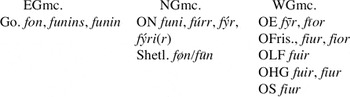
One further difficulty faced in the Germanic descendants of PIE +péh2- is the considerable variety found among the various reflexes. There are approximately eight distinct forms to be accounted for. This article will only treat the reflexes from the earliest attested Germanic languages, unless a later form is relevant to the history of the word. Table 1 presents the words to be discussed.
Cognates for “fire” in Germanic.

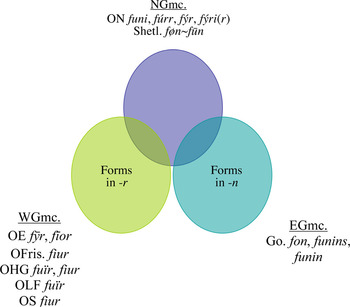
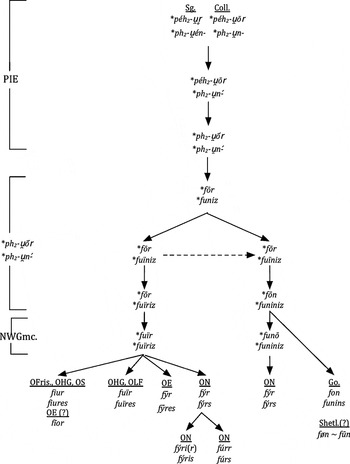
I begin the examination of this word's etymology with the current reconstruction for the PIE etyma. Because the Germanic cognates are often cited as evidence that PIE possessed a variant +pūr, I also explore the history of some of the non-Germanic cognates in order to demon-strate that the reconstruction of PIE +ū is not necessarily warranted. I then turn to the chronological development of the reflexes in Germanic at the Proto-Germanic level and in the individual daughter languages. In treating the development of the reflexes in the daughter languages, however, the reflexes are grouped according to their developments, rather than to their language sub-grouping. Two groupings are evident in the Germanic languages: reflexes that have forms continuing the n-stem of the etymon and reflexes that continue the r-stem of the etymon. This is particularly necessary, given that the NGmc. cognates evidence both varieties (see figure 1).
The distribution of forms in -r and -n in Germanic.

In addition to the phonological and morphological development of these reflexes, it is also clear in some instances that philological issues are important. This has been at times overlooked, but is necessary in order to establish and verify the state of the evidence.
2. The Proto-Indo-European Etymon
2.1. The Proterokinetic and Holokinetic Inflections
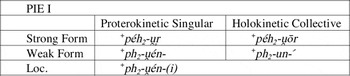
Proto-Indo-European seems to have had two separate inflections for the word for “fire.” The singular followed a proterokinetic inflection, with an accented full-grade root and zero-grade stem in the strong cases and a zero-grade root and accented full-grade stem in the weak cases. The second inflectional pattern, used to denote the collective, was holokinetic. In the locative form, from which the Gmc. dative case seems to have arisen, one would normally expect the stem to have been accented in either paradigm, with the ending in zero-grade, if present at all (Fortson 2004:108, 111, 165; Schindler 1974:10):
The inflection of “fire” in Proto-Indo-European.

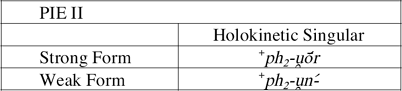
The proterokinetic singular is attested only in Hittite pa ur, pa uenaš, whereas all other Indo-European languages seem to reflect only the holokinetic collective. Ringe (2006:137; 1996:17–18) has sur-mised, based on evidence from Tocharian, that the non-Anatolian reflexes had the nom.-acc. form of the holokinetic inflection restructured to a zero-grade in the root. This originally holokinetic collective was reinterpreted as a singular and had the zero-grade form of the root, +ph2- leveled throughout the paradigm:Footnote 2
The development of the PIE holokinetic paradigm.
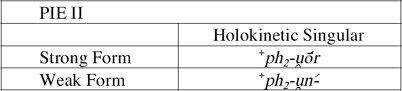
This holokinetic inflection is the most promising candidate as PIE etyma for the Germanic reflexes, as discussed in sections 3 and 4 below. Although it may appear that some Gmc. forms come from +ph2- én- (see sections 5 and 6), it is the position taken here that they descend from the holokinetic paradigm.
2.2. Laryngeal Metathesis and +ū
A number of etymologies argue that the etyma of Germanic reflexes with long /u/ and /y/ in the root syllable should be traced back to a PIE ū which arose from metathesis of u and h2 in the sequence +ph2- u.Footnote 3 Invoking metathesis as an explanation for +ū is problematic. Rasmussen (1989:107, following Hamp), suggests that there might have been a rule in which a laryngeal underwent metathesis with a semivowel (+Hu > +uH) in post-consontantal position. Whereas this works for the word for ‘sun’, + sh2u-> +suh2-, when a consonant immediately follows, the same does not hold true for the word for “fire,” where reflexes of the sequence + ph2u- have retained a short vowel, perhaps due to the different phonetic traits of /s/ and /p/. In his analysis of the relationship between long and short variants of /u/ in a paradigm, Schrijver (1993:525) is less interested in meta-thesis, as in the search for a factor conditioning the length of the reflex of +Hu. From his examination of Greek reflexes, Schrijver sees stress as the conditioning factor at work. When stressed, the sequence +Hu developed as ū. In pre-tonic position, however, +Hu gives short u.Footnote 4 The only reflexes providing direct evidence of laryngeals for “fire” come, of course, from Anatolian, and in those cases the ordering is always HR and not RH.Footnote 5 In the following section the four other branches (Greek, Italic, Armenian, and Slavic) that have potential reflexes of PIE +ū are examined.Footnote 6 In each case I argue that the vowels in these cognates could also be possible products of independent analogical developments. Alternative explanations for reflexes of PIE +ū among Indo-European cognates in combination with other explanations for sources of long vowels should cast doubt as to whether cognates of the word for “fire” in Germanic possess historically long +ū as a reflex of either PIE +-h2u- or -uh2-.
2.3. Greek
Although there are several suggestions as to how PIE +ph2 ōr(nom.-acc.) and +ph2 nés (gen.) became Gk. p ū r (nom.-acc.sg.) and pur—s (gen.sg.), one seems to make the most sense.Footnote 7 The key to understanding the development into Greek is hinted at in the relationship between the long root vowel in the nominative and the short vowel in the oblique cases. For the most part, Greek has leveled out ablaut grade and length distinctions in its nominal paradigms. N-stem nouns, and a handful of r-stems such as pat ē r, exhibit suffixal full grade in the obliques and lengthened grade in the nominative (Sihler 1995:280). The first change from Proto-Indo-European to Greek involved the leveling of the r-stem throughout the holokinetic paradigm, producing a new genitive singular (with an o-grade ending as found with other athematic declensions in Greek):Footnote 8
(1) + ph2-un-és> + punés > pur—s
After the creation of the new oblique forms in pur-, the long vowel of the nominative singular could have been restructured according to a model found in the word for ‘wild pig’, as in example 2.Footnote 9
(2)

In this manner one can account for the length of the root vowel without having to reference laryngeal metathesis or additional and unnecessary sound changes. Rasmussen (1996:77) sees the circumflex accent in p ū r as evidence of an earlier disyllabic form. One should note, though, that words such as h ū s (< PIE +suhx-s) and m ū s(< PIE +mūs < perh. +muhxs) possess circumflex accent in historically monosyllabic words. These monosyllables with circumflex accent speak against the necessity of a disyllabic etymon for p ū r, and would suggest rather that an analogical process was at work.
2.4. Oscan and Umbrian
Given the fragmentary remains of Oscan and Umbrian, reconstruction of the history of Umb. pir (< earlier +pūr) is hampered by limited data. Nonetheless, it is still possible to argue that the length of the vowel in the nom.sg. form is the outcome of independent analogical processes similar to those seen in the development of Gk. p ū r.
The attested oblique forms of Umb. pir are acc.sg. purom-e and abl.sg. pure-to, which indicate a long vowel in the nominative and a short vowel in the obliques. Although one expects neuters to have identical forms in the nom. and acc.sg., Umb. acc.sg. purom is a more recent formation derived from the abl.sg. in analogy with masc.acc.sg. in -om (Buck 1904:129). It appears from the abl.sg. pure that the Umbrian favored the holokinetic paradigm, as with the other non-Anatolian Indo-European languages that reflect this word. In its evolution to the attested Umbrian forms, the r-stem of the nominative/accusative was leveled throughout the paradigm.Footnote 10 One can then view the pre-form of pir, Sabellic +pūr, as the product of analogy with other root nouns where a long vowel in the nom.sg. alternated with a short vowel in the obliques, see Umb. gen.pl. nerum and dat.pl. nerus on the one hand and Osc. níír (< earlier Sabellic +nēr) ‘man’ on the other (Buck 1904:129; cf. Sihler 1995:280).Footnote 11 Although forms for the entire paradigm of either Umb. pir or Osc. níír are not attested, we can conjecture that an analogy would have been possible to produce Sabellic +pūr:
(3)
2.5. Classical Armenian
Evidence available from Arm. howr ‘fire, nom.sg’, and hnoc‘ ‘oven’ (< +hun ó ch a-) (Klingenschmitt 1994:243) is of limited value in determining vowel length, as PIE +ū and +u (along with PIE +ō) merge into Arm. /u/(transliterated as <ow>).Footnote 12 The variation of howr ‘fire, nom.sg.’ and hroy ‘fire, gen.sg.’ is less indicative of vowel length as it is of earlier Armenian accentuation prior to loss of unaccented syllables. A number of other nominal paradigms exhibit the same u ~ zero alternation in their paradigms (cited here in the nominative and genitive): k‘own ~ k‘n-oy ‘sleep’ (< PIE +swopnos), lowc ~ lc-oy ‘yoke’ (< PIE +yugom), and dowstr ~ dst-er ‘daughter’ (< PIE +dh u h2tēr) (Schmitt 1981:38–39). Again it is possible that, as described in sections 2.3 and 2.4 for Greek and Umbrian, Classical Armenian howr ~ hroy is the product of an analogical reformation of the nominative-accusative singular after the model of pre-existing paradigms. In short, one cannot be guaranteed that howr indeed reflects earlier +ū, as it could be the product of analogy or even conceivably derive from the short u of the oblique cases leveled throughout the paradigm.
Klingenschmitt's (1994:234) reconstruction of +pūr ~ + pun é s from Greek, Italic, Armenian, and Germanic is problematic. Although each daughter family appears to reflect the vowel alternations these etyma would have produced, it is nonetheless a possibility that the reflexes are products of nearly identical, though independent changes. Furthermore, one must still bring +pūr ~ + pun é s into accord with the data from Anatolian, such that all reflexes can be explained from a common ancestor, PIE +péh2- and +péh2- ōr. The change from PIE +péh2- ōr ~ +ph2-un- és to +pūr ~ + pun é s carries with it two difficulties. First, in positing a vowel alternation in +pūr ~ + pun é s we cannot be certain that the ablaut relationship +e ~ +ē and +o ~ +ō would be applicable to the vocalic variants of semi-vowels. Taking the general rules of Indo-European samprasaraa into account, we might expect the +u of + pun é s to have been treated as a consonant in secondary derivatives, rather than as a vowel. An analogical reformation of + pun é s should have produced +p ē -r, or possibly, though less likely +p ē-r (provided also that the heteroclisis is preserved).
The second difficulty lies in the analogical innovation and its chronology relative to the leveling of the consonant stem. In Greek, Italic, and Armenian, the r-stem forms of the paradigm became the norm. However, the Germanic cognates demonstrate that leveling of the para-digm as r-stems or n-stems must have taken place separately in each individual language. For Germanic to have preserved the r-stems and n-stems as morphemes separate from the root and ending, we must suppose the same for its etymon. Producing +pūr from + pun é s analogically from paradigms with a similar vowel alternation seems all the more unlikely, as it would require a parsing of the oblique into root and stem as pu-n-, and applying ablaut patterns to a non-canonical CV root, rather than interpreting +pu- as the zero-grade of a more regular CVC root shape.
That four branches of Indo-European possess words which look to be derived from a common ancestor +pūr (Gk. p ū r, Umbr. pir, Arm. howr, and ON. f úrr) is not sufficient evidence for the reconstruction of +pūr in non-Anatolian Indo-European. In the cases of Greek and Umbrian, there is sufficient reason to surmise that in each case a new form +pūr had been created based on models present in the languages, which were not present in the proto-language. In the case of Armenian we may imagine the same, though we are hampered by the Armenian vowel mergers on the one hand, and the lack of sufficient examples of root noun paradigms on the other. Finally, as seen below in section 6, there are reasons to view the existence of long u in the Germanic reflexes as products of independent phonological developments and analogical restructuring in late stages of the daughter languages.
2.6. Slavic
Along with Greek, Italic, Germanic, and possibly Armenian, Slavic appears at first glance to preserve reflexes of earlier +pūr in Cz. pýř ‘glowing embers’, Cz. pýřiti and Slov. pýřit’ sa ‘to redden’, and OSorb. pyrić ‘to heat, melt’, among others (Vasmer 1964–1973:419). As seen in sections 2.3 and 2.4 above, however, the long vowel in Slavic could be an independent development due to analogical change. Balto-Slavic is characterized by “neo-lengthened-grade” reflexes of PIE +i and +u (Fortson 2004:367; Carlton 1990:82); for example, Pol rydz ‘lactarius deliciosus’ (a reddish-hued mushroom) < earlier ryd - < PIE +h1reudh- ‘red’ (Carlton 1990:91). Examples 4a–c exemplify the Slavic length-ening of PIE +u. One will note that the PIE roots below possess no laryngeals and close in obstruents, which would preclude any possible lengthening of preceding vowels by laryngeals in suffixes or endings:
- (4)
a.
b.
c.
As the above sections have indicated, there are alternative explanations to reconstruct a long u in the PIE etymon for “fire.” The possibility exists that these similar reflexes are simply the products of coincidental developments in languages which possessed similar lexical items and similar grammatical paradigms.Footnote 13 I argue below (section 6) that apparent Gmc. reflexes of +ū could be the result of separate phonological and analogical changes.
3. Developments from Proto-Indo-European to Proto-Germanic
As discussed above in section 2.1 the non-Anatolian Indo-European languages seem to have abandoned the old singular proterokinetic para-digm and replaced it with the formerly collective holokinetic paradigm (see tables 2 and 3). Application of relevant sound laws, as Proto-Germanic develops, should present us with the expected paradigm of +fwōr in the nominative and accusative, and + fun- (< PIE +ph2-un-) elsewhere.Footnote 14 Beekes (1996:6) points out that one would expect the sequences +ph2- V-, e.g., the proterodynamic genitive +ph2- én- s, to have produced a vocalized laryngeal reflex, yielding PGmc. +faw-. Were the laryngeal to have vocalized normally, we should expect PIE +ph2- r to have become PGmc. +fáwōr which, in turn, should have produced forms along the lines of Go. + fawar and OE +fēar.
One possible explanation for the loss of the laryngeal is to be found in PGmc. +swīn-a- (n.) ‘pig’ < PIE +suhx-īn-om (syllabified as su.hxī.nom). Between Proto-Indo-European and Proto-Germanic one would suspect an epenthetic bilabial glide to have been inserted in the hiatus between the first two syllables, that is, +su(w)īn-, after which the Cuw sequence resolved to Cw. The same process might have operated in cases of Lindeman's Law variants as well. As a monosyllable with an initial Cw cluster, PIE +ph2- r could have had the variant +ph2-u r. The laryngeal in +ph2-u r would then be lost as it was in all prevocalic environments. Subsequent to laryngeal loss, the pre-Gmc. +pu r became +p r, just as Pre-Gmc. +su(w)īn- became PGmc. +swīn- (Ringe 2006: 121–22).
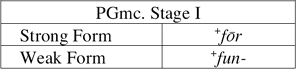
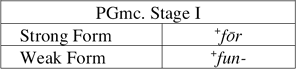
Go. fōn suggests that +w was lost after the labio-dental fricative +f and before the long, rounded vowel +ō.Footnote 15 There are no other examples of w in the same environment to determine if this change is sporadic or regular, though this change would not be surprising (Ringe 2006:136–137). The PIE locative form, +ph2- én-(i), should have entered Proto-Germanic as + fwin(i); however, the absence of any such reflex suggests that the oblique forms were leveled to +fun- according to the forms possessed by the genitive. Whether this took place in Pre-Germanic or Proto-Germanic is indeterminable. We may thus suggest the paradigm in table 4 for the word for “fire” in Proto-Germanic.
The stem variants of “fire” in Proto-Germanic, stage I.
4. Developments within Proto-Germanic
Before splitting into its daughter languages, the word for “fire” under-went several changes during the Proto-Germanic period. I would like to argue that it is during this period that the various Germanic reflexes ultimately arise. There are essential problems to deal with:
• the existence of stems in + fu- along side forms arising from +fuï- (section 4.1)
• the origin of the oblique stem +fun- and addition of -in to it, that is, Go. funins and ON funa (both gen.) (section 4.2)
• the retention of the vowel ō in Go. fōn (section 4.2)
• the leveling of -r and -n in two respective paradigms (section 4.3)
Below we see that the first three items above are interconnected and that they precede the fourth item.
4.1. Extension of the e-Grade n-Stem Suffix
Proto-Germanic inherited from PIE the forms for “fire” designated here as stage I (see table 4). Its subsequent development into the attested Germanic word forms was most likely the result of two factors: the salience of the n-stem forms of the heteroclitic inflection as n-stems, on the one hand, and the unusual shape of a zero-grade n-stem in the singular, on the other. Later leveling of the heteroclitic stem in either -r or -n indicates that the stem consonants were still treated as morpho-logical equals within Proto-Germanic. The equivalence of -r and -n as stems also means that the roots of the PGmc. word for “fire” were parsed as +fō- and + fu-, respectively.
Association of the oblique cases with the regular n-stem inflection opened the door to an analogical reformation of + funiz and + funi. These analogical reformations replaced the unusual zero-grade n-stem of +fun- with the more typical suffix of n-stem singulars, +-in-.Footnote 16 One can make the following analogy with the PGmc. neuter noun + hert-in- ‘heart’:
(5)
As this analogical process would have only affected n-stem forms, the nom.-acc. +fōr would have remained unchanged. At the end of the process, Proto-Germanic would have possessed two distinct inflections for “fire,” the older paradigm (stage I) with zero-grade n-stems, and the newly formed paradigm (stage II) with Gmc. reflexes of e-grade n-stems:
The stem variants of “fire” in Proto-Germanic, stage II.

As I argue below, the newly created form +fuïn- is the source for the NWGmc. words for “fire” in -r. Alternate explanations for +fuïn- are problematic. Rasmussen (1989:77, n10) argues for a derivation of PGmc. +fu n- from a Lindeman's Law variant of the oblique proterokinetic inflection in PIE, that is, +ph2u én-.Footnote 17 The operation of Lindeman's Law with bilabial glides possesses few unambiguous case examples, and what little data there are would suggest + fwin- as the expected Gmc. outcome of PIE +ph2u én- (Ringe 2006:121–122, 277).Footnote 18 Voyles (1992:238; also section 6.3 below) looks to a pre-Germanic form of +pú-er- as a possible source of Gmc. + fuïr-, from which he derives ON fýr. However, +p ú-er- is an unlikely source, because it is evident that the leveling of -r in the paradigm takes place after the Proto-Germanic period. Beekes (1996:6) also attempts to derive +fuïn- from the proterokinetic inflection, though with a metathesized laryngeal and analogically reintroduced n-stem suffix, +puHen-. In a sense, Voyles and Beekes approach what the correct processes probably were; however, their relative chronologies for when these changes occurred are off. Ringe (2006:277) proposes that +fuïn- derives from +funin- via dissimilatory deletion of the first -n-, a change that might better be explained in another manner, discussed below in 4.2.
4.2. Blending of the Two Paradigms
In addition to accounting for the origin of forms based in +fuïn-, substitution of PGmc. +-in for +-n in the oblique cases also motivates the creation of the pre-forms of Go. funins (gen.), funin (dat.) as well as ON funi, funa ‘flame’.Footnote 19 Coexistence of competing oblique bases +fun- and +fuïn- creates an environment in which a form such as +funin- could easily have arisen as a result of a speaker's uncertainty regarding which of the two forms should be used. One could characterize this pheno-menon as hypercorrection where the speaker, in doubt regarding the form of the oblique ending, uses both.Footnote 20 Hock (1986:169) notes in reference to analogical change that “traces consist in the coexistence of the old form with the innovated form […]. Doublets of this sort are very common as transitional stages in all analogical change. Occasionally, however, they may persist for a longer period. In such cases, they are often subject to the analogical process of blending […].”
Such a process is observable also in two Latin reflexes of IE heteroclites: iecur ~ iocineris and iter ~ itineris. In order for itineris to have come about, a third, unattested form +iteris must be assumed. For a time two paradigms coexisted, older +iter ~ +itinis and newer + iter ~ iteris. Latin speakers formed a new genitive by attaching the newer -eris onto the preexisting itin- stem (Sihler 2000:85). It is reasonable to treat PGmc. +funin- as the product of a similar process (see table 6).
The stem variants of “fire” in Proto-Germanic, stages I–III.

The interpretation above has two benefits:
• It accounts for the two stems +fu-n- and +fu-in-.
• It provides for the extension of the e-grade n-stem endings to only the oblique forms, while retaining the original ablaut in the nom.-acc. form, without having to recast the word as an n-stem.
We should take heed to note, however, that the innovation of +funin- involves the double use of an n-stem, and not the reanalysis of the word's root as +fun -, to which an n-stem ending is added.Footnote 21 The reasoning behind this is that reanalysis of +fun- with -n as part of the root rather than of the stem would suggest that +fun- was no longer perceived as possessing an n-stem. If speakers no longer perceived it as an n-stem, reanalysis as a root-noun would seem more logical, and not the addition of another n-stem. Reanalysis of the root would require the paradoxical state of simultaneously belonging to an n-stem inflection and not belonging to an n-stem inflection.
4.3. Leveling of Stem throughout Paradigms
As mentioned above, this heteroclitic noun remained saliently hetero-clitic at the earlier stages of Proto-Germanic. Only later did speakers level both stem consonants such that the heteroclisis disappeared. This is also indicated by the ordering of the steps. For example, reflexes based on +fuïr- (OHG fuir, OE, OFris, OS, and OHG fiur, ON f úrr, fýr, and fýri) must have had their -r replace -n after the spread of -in to forms in +fun-. Otherwise we might expect forms such as +funir-, which is not evidenced. Nonetheless, a few matters remain unclear. First, it is unclear whether these levelings took place toward the end of Proto-Germanic, or whether the leveling took place independently among the daughter languages. One should note, though, that in order for the stems to be leveled throughout the paradigms, two things are required:
• There must have been two separate paradigms, with homophonous forms in the nom.-acc. singular, that is, + fōr ~ funiniz and + fōr ~ +fuïniz, as illustrated in stage III.
• The stem consonants must have been salient morphological units with respect to their roots at the time of leveling.
The first point is suggested by the ways various dialect groupings of Germanic preserved the paradigms: East Germanic preserved only n-stem varieties, West Germanic preserved r-stem varieties, and North Germanic preserved both, though with sociolectally restricted usage. Had we been faced with a situation in which there was only one nom.-acc. form, but multiple obliques (rather than two homophonous nom.-acc. forms) at the point during which + fōr became + fōn, then there would have been no way for the -r to spread to +fuïriz. The converse, however, is still possible. Forms like +fuïriz could have taken on -r prior to the change from + fōr to + fōn. It would be helpful to have a surviving reflex of + fōr; however, none exists. Reflexes bearing -r in Northwest Germanic represent the only traces that it had existed.Footnote 22
In order for leveling to have taken place at all (that is, the change from -r to -n and from -n to -r), a notion of morphological equivalency must have been in play. Although the changes between stage I and stage II, where the oblique stem -n was replaced by its more common form -in, suggest a connection to n-stem nouns, the word(s) for “fire” remained heteroclitic. Only later is there an indication that forms such as funin- were treated as n-stem nouns, as indicated by the ON funi (as discussed in 5.3. below).Footnote 23
The stem variants of “fire” in Proto-Germanic, stages III & IV.

One may speculate that the motivation behind the direction of leveling in each paradigm was driven, in part, by the double-marked stems of +funin-. As these stems have predominantly more “n” than + fōr ~ +fuïn-, it is natural to see the -n leveled into the nom.-acc., producing + fōn. Conversely, in the context of two competing heteroclitic paradigms, the domination of one paradigm by the n-stem blocks, in a sense, the leveling of the n-stem throughout the competing paradigm of + fōr ~ +fuïn-. Therefore, when leveling does take place, it is the r-stem which prevails. The leveling of the stem consonants is a prerequisite for the reformation of these words as members of other inflectional categories in all Germanic languages except Gothic.
5. Development of Forms with /-n/ within EGmc. and NGmc
5.1. Gothic
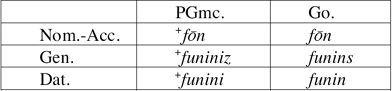
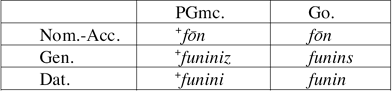
Besides Toch. A puwar and Toch. B pwar, Gothic is the only other historically attested Indo-European language to preserve a clear reflex of the vocalism in PIE +ph2- r. Provided that the leveling of the n-stem in the paradigm is not an independent innovation in Gothic, which the data from ON would suggest it is not, the Gothic forms are more or less the same as their PGmc. predecessors, with necessary phonological changes deleting the final unstressed vowels in inflections:
The development from PGmc. stage IV to Gothic.
A more problematic cognate of Go. fon is Shetl. f⊘n, a taboo replacement for “fire.”Footnote 24 Shetl. f⊘n is first attested in Edmondston's (1866:36) thesaurus of Shetlandic and Orkney Norn, cited as fūn with the note that the vowel's pronunciation is a long /y/, as found in French. Jakobsen (1928:205) cites it later under the form f⊘n. There are a couple of ways of explaining a form such as f⊘n ~ fūn. The pre-Norn form of both could be either ON + f —n or +fún.Footnote 25 If we consider +fún as the preform, then we are forced to provide an explanation of the n-stem and the ū (which would have to have come from ON fúrr). This course of explanation is fraught with ad hoc changes. One would have to ask whether +fún is the product of carrying the vowel of fúrr over to funi and turning it from an n-stem to an a-stem noun, or whether it is the product of carrying the -n- of funi over to fúrr despite the fact that neither word exhibits heteroclisis, among other problems? Following Edmondston's (1866:36) interpretation of fūn as a variant of Shetl. fona (< ON funi), one might also see it as the product of open-syllable lengthening fol-lowed by apocope. This is not without problems, as one must contend with the survival of fona without lengthening and apocope. If, however, we look to hypothetical ON +f—n as the pre-form of Shetl. f⊘n ~ fūn, then the possibility exists that PGmc. +fōn, as found in Go. fon, survived in North Germanic in the remote islands to the north of Scotland, preserved only as a taboo variant in the speech habits of fishermen when away at sea. Caution is warranted here, though, as the amount and quality of data available on Shetlandic Norn is lacking.
5.2. Old Norse
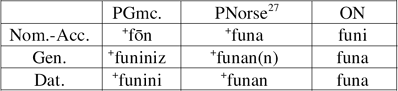
Apart from Shetl. f⊘n (which suggests that PGmc. +fōn was not eliminated from North Germanic by the developments portrayed in table 9) the usual n-stem formation found in Old Norse was recast as an n-stem noun, albeit with a gender change from neuter to masculine and standardized PNorse +-an- < PGmc. +-on-.Footnote 26 This need not have occurred as a result of analogy with ON eldr (Pokorny 1959:828), but rather because the overwhelming majority of n-stems are masculine. This occurred when subjected to the analogical reformation in 6. There are no traces of the n-stem inflection in West Germanic, which only provides evidence of this change as occurring in North Germanic, though it could have conceivably happened at any point from the late PGmc. period on.
(6)
The development from PGmc. stage IV to Old Norse.
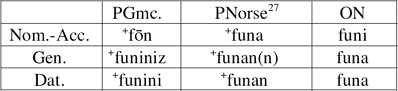
ON funi ‘fire, flame’ continues to exist in Modern Icelandic, despite eldur remaining as the default word for “fire.” The n-stem forms are also attested as late as the 18th to 19th centuries in Norn and Norn remnants in the Shetland Islands. In Norn one finds reflexes of ON funi as Shetl. fona (with variants fenna, finna, fenni, and finni).
6. Development of Forms with /-r/ within Northwest Germanic
Among the NWGmc. languages forms built off of the r-stem variant survive. However, prior to historical attestation, the original nom.-acc. form + fōr fell to the wayside, as the oblique root was leveled throughout the paradigm. The resulting NWGmc. reflexes come to fall together with the neuter a-stem paradigms after they lose stem vowels. Backformation in analogy with root nouns is the first step in this process.
(7)
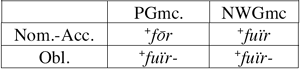
The root-noun inflection is the only one available that can account for the loss of + fōr, as it is the only other paradigm to overlap in endings in the oblique and the nominative cases as +fuïr ~ +fuïriz. After the leveling of the r-stem, the -r- ceased to be perceived as a stem and was analyzed as part of the root. Given that the NGmc. and WGmc. forms share this innovation, it is likely that this stage of leveling took place relatively early. It is entirely possible that the replacement of + fōr by +fuïr took place in a late stage of Proto-Germanic; however, such a process must have taken effect after the leveling of -r (see table 10).
The development from PGmc. stage IV to NWGmc.
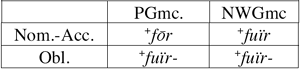
As with other root nouns, the genitive ending found in forms such as ON fýres and OE f res is carried over from the a-stem declension.
6.1. Old High German, Old Low Franconian, and Old English
The Old High German corpus presents us with the best direct evidence of former +fuïr. This variant is present in OHG texts from the eighth century to the mid-ninth century, after which point one finds only OHG fiur (Braune 1987:52), for example, in the Abrogans Footnote 28, as well as the Regula Benedictorum Footnote 29, Tatian Footnote 30, the Weißenburger Katechismus, and the Muspilli Footnote 31. Of these texts, however, Muspilli 59a is of particular interest, as the manuscript, Cod.monac.lat. 14098, preserves the spelling uugi r, which likely indicates a disyllabic pronunciation.Footnote 32
Old Low Franconian also preserves a reflex of unmetathesized +fuïr. The OLF Psalms of the Diez Manuscript preserve five examples of fuir: Psalms 57.9, 65.10, 65.12, 67.3, and 73.7, in all four grammatical cases.Footnote 33 I would take the MS spelling at face value, representing [fuïr] or something similar, rather than viewing the sequence <ui> as a grapheme for a long high front rounded vowel. Fortunately, problems in the interpretation of the graphemic data, that is, whether fuir represents [fuïr] or [fy:r], are not an issue here, as the likeliest source for [fy:r] would have been [fuïr].Footnote 34
OE f r is also a reflex of +fuïr.Footnote 35 This form alongside the ON forms fýr, fúrr, and fýri(r) have been the main reason for the positing the existence of historical ū in this word's etyma.Footnote 36 Although i-umlaut is certainly at work here producing the front rounded vowel, I think it likeliest that the length of this vowel (and that of ON fýr below) is the product of coalescing vowels. As Winter (1965:192–193) points out, the vowel sequence -ui- is unusual in Germanic and was likely restructured to [iw] (see section 6.2). Despite the rarity of the -ui- sequence in Germanic, the development of -ui- > in Old English is paralleled in the loanword from Old Irish druí ‘druid, sorcerer’ > OE dr ‘sorcerer’. One may assume a near identical, though independent, sequence of events for the change from +fuïr to ON fýr, discussed below in section 6.3.
6.2. Old Frisian, Old High German, Old Saxon, and Anglian OE
Whereas Old English and Old Norse dealt with the unusual CV-VC sequence present in +fuïr by the coalescing of syllables, the remaining WGmc. forms “solve” the unusual syllable sequence by metathesis of the two elements, as first pointed out by Winter (1965:192–93).Footnote 37 Here one finds OFris., OHG, and OS fiur. Old FrisianFootnote 38 and Old SaxonFootnote 39 exhibit only the metathesized forms. As mentioned above in section 6.1. OHG fiur tends to dominate and is the sole attested form by the end of the ninth century.
Old English seems to have used f r almost exclusively. There is, however, one possible remnant of a metathesized form more similar to its continental cognates, OS, OFris., and OHG fiur. Verse 45b of the Old English Riming Poem cited without emendation from the ASPR edition of the Exeter Book (Krapp & Dobbie 1936:168) in the context of ll.44b–47a reads:

The lack of rhyme between half lines causes line 45 to stand out in the Riming Poem.Footnote 42 In addition to the absence of end-rhyme, 45b is also metrically deficient. At the very least the verse lacks an unstressed syl-lable after deop and/or feor. A hypermetric off-verse would not be out of the question, as 45a is a relatively rare instance of weak hypermetric on-verse and the verb-initial syntax of 45b is in line with typical hypermetric constructions.
Given verse 45b's metrical and morphosyntactic deficiencies, let us assume that dyre of 45a represents something close to the original rhyme-pair of line 45.Footnote 43 The MS spelling of this word, a reflex of Proto-Germanic +diur-ja-/+diuz-ja ‘dear’, would be typical of late West-Saxon (Campbell 1959:126–128).Footnote 44 This spelling, though, reflects perhaps the last stage in the poem's transmission, as clues in the poem's rhymes point to an original composition in an Anglian dialect (Fulk 1992:365).Footnote 45 The Northumbrian cognate of lW-S d re would have been dīore, and a Mercian form could have been either dēore or dīore (Brunner 1965:113). Taking the first half of the rhyme pair as either dīore or dēore we may posit a possible match with fīore or fēore, as the case may be.Footnote 46 End rhyme and sense could be introduced if we suppose the original composition of verse 45b to have been along the lines of the following:
scriþeÐ nu deop on feore Footnote 47
Why OE fīor would have surfaced only in this text is tied, in part, to the same reason that Old Norse retained a multitude of cognates (see in particular section 6.3). In the OE Riming Poem the formal poetic requirements (in this case, end rhyme) held a dominant position over lexis. The poet employed here a perhaps less common, though under-standable, variant of more usual f r in order to meet the requirements of both semantics and rhyme.
6.3. 6.3. ON Forms in -r
Old Norse preserves the greatest variety of reflexes of “fire.” In addition to funi, funa examined above in section 5.2., Old Norse preserves three reflexes of PGmc. +fuïr-: fúrr, fýr, and fýri(r). Of these three, fúrr and fýri(r) are likely innovations within North Germanic alone. Unlike funi, these three words had a nearly exclusive poetic usage, which explains in part their variety and survival. The switch to ON eldr as the default lexical item for “fire” enabled the earlier synonyms to take on a secondary role as poetic vocabulary.Footnote 48 In West Germanic, where reflexes of PGmc. +fuïr- remained the default lexical item for “fire,” this secondary role as poetic vocabulary was less likely, hence the presence of only two variants, whose differences are purely phonological in nature. Given the demands of skaldic poetry, it would have been advan-tageous to possess synonyms with varying syllable numbers, weights, and vocalic qualities for internal rhymes. In eddic poetry the only variants exhibited are funi and fúrr. The ja-stem variant, fýri(r), is found three times in the corpus, and only in the works ascribed to one skáld, Einarr Gilsson. Each cognate is examined and discussed in turn below.
ViÐb—tarþulr pp.2 (Þl IV pp.2) is home to three of the synonyms, fýr, funi, and fúrr, in lines 3, 7, and 8, respectively. This stanza, found among a listing of 60 heiti for “fire”, contains the only attested use of ON fýr and is extant in only two manuscripts of the Prose Edda (AM 748 and AM 757):
Læygr vafrlogi
linn r ok farr i
bran dr fýr t
sibrími ner till.
viti eimyria
velann fasti
fvni hyrr fæÐir
fvr rok eisa.Footnote 49
Other than the presence of a long, rounded front vowel, there is no reason to suspect that f ýr reflects fýrr, a masc. i-stem variant of earlier +fūr-.Footnote 50 It is apparent from preceding brandr and following t si that these words appear in the nominative form. One would expect the scribe to have written f ýrr, had it been masculine.Footnote 51 A more tenable solution lies in Egilsson's (1913–1916:163) note: “eller fýr ntr?” Whether PGmc. fuïr- would have become ON f ýr, just as it had become OE f r, is unknown, as no additional examples or counterexamples are available to determine the development of PGmc. -uï-. It seems likely, though, that ON fýr reflects earlier +fuïr- rather than metathesized +fiur-.Footnote 52 Barring analogical influence from words such as d ýr ‘animal’ (PGmc. +diuz-a-), one would expect a metathesized variant +fiur- to have become ON + fj —r, cf. ON stj—r, þj—r.Footnote 53
Rather than viewing fýr as an i-stem derivative of fúrr, we should entertain the converse; namely, that fúrr is derived from fýr. Voyles (1992:238) suggested that the [y] of f ýr was reinterpreted as a morpho-logically conditioned umlaut, and that masculine fúrr is the product of R ückumlaut.Footnote 54 This would be possible in analogy with the dative singular of root nouns:
(8)
Subsequently fúrr became an a-stem noun.Footnote 55 ON fúrr continued to survive in the taboo vocabulary of Shetlandic fisherman as Shetl. furin (= fūrin), foorin with the earlier suffixed definite article fused to the noun, that is, from ON fúrrinn (nom.sg.) or fúrin (acc.sg.) (Jakobsen 1928:204).
Just as fýri (dat.sg.) made it possible to recast earlier fýr as fúrr, so too was it possible to create a new variant, modeled after ja-stems:
(9)
Here one should note that all three occurrences of ON fýri(r) are not only restricted to poetic usage, but to the poetry of one fourteenth century individual, Einarr Gilsson.Footnote 56 The three attested instances share other common points as well: they are all in the genitive (leaving us unable to tell whether the noun is neuter or masculine); they all occur in kennings for “man;” they are all found as the final cadence of an off-verse; and they all participate in a Ðalhending rhyme. No other variant of “fire” could have stood in the same position. Funa lacks the requisite syllable weight and rhyme, and neither f ýrs nor fúrs would provide a trochee, though they provide aÐalhending and skothending, respectively. One might question whether this form would have been part of the common poetic stock, or whether it was perhaps the novel coinage of this one clever skáld who required a trochee with a trimoraic first syllable to serve in the dr—ttkvætt and hrúnhent cadences while still satisfying the requirements for aÐalhending in the off-verse. As umlaut in Old Norse during this period was morphologically conditioned (see, for example, Iverson & Salmons 2004:105–107), others would have been capable of deciphering just such a poetic neologism. The relationship between f úrr and fýri (r) would have been morphologically transparent.
7. Conclusion
Though complicated, there are reasonable ways by which one may see the cognates of the word for “fire” in the Germanic languages as the products of a once-unified paradigm in Proto-Germanic. An additional benefit of this etymology is that one may derive the cognates from one single PIE source paradigm, rather than from three different root-shapes (see figure 2).
In addition to the understanding we gain of the development within Germanic, the evidence from these cognates is important in an Indo-European context. Germanic is one of only five branches of Indo-European to preserve reflexes that seem to indicate a development from PIE +ū. However, since there is reason to doubt this in Germanic as well as in Greek, Italic, Slavic, and Armenian, we may also need to rethink the PIE reconstruction; in this case reconstructions not involving laryn-geal metathesis. Important information regarding the vocalism of the nom.-acc. form of the PIE proterokinetic inflection is quite possibly preserved in only three Indo-European languages, two of which are Germanic: Tocharian, Gothic, and Shetlandic Norn.
Finally, as seen in the discussion of the North and West Germanic cognates, comparative linguistic reconstructions can still benefit from philological examinations of the evidence. In some cases (for example in relation to the OHG and OLF data) the role of graphemic evidence must be resolved simultaneously with etymology. As seen from the possible preservations (or not, as the case may be) in the Old English Riming Poem, the existence of evidence is at issue. Lastly, dictionaries and standard reference materials sometimes present information at odds or unsupported by the actual manuscript evidence, as most thoroughly demonstrated in the problematic nature of the Old Norse data.
Relative chronological development of the words for “fire” from Proto-Indo-European to Germanic.

Etymologies are often on-going hypotheses, and it is of the nature of these endeavors that one must sift through much data to arrive at hypotheses. I hope that a better understanding of this one piece of the core vocabulary of Germanic can not only inform us about the develop-ment of the Germanic languages and about the structure of Proto-Germanic and Proto-Indo-European, but also that it might assist in treating related etymological problems.