Introduction
Population dynamics of herbivore insects are influenced by bottom-up and top-down forces (Hawkins, Reference Hawkins2001; Santolamazza-Carbone et al., Reference Santolamazza-Carbone, Velasco, Soengas and Cartea2014) which, acting separately or together and with spatial or temporal variations (Walker & Jones, Reference Walker and Jones2001; Girardoz et al., Reference Girardoz, Quicke and Kenis2007), may result in natural regulation of insect pests (Gratton & Denno, Reference Gratton and Denno2003; Miller, Reference Miller2008). In particular, top-down pressure from a plethora of natural enemies including parasitoids, predators and pathogens, can have a dramatic impact on insects (Colloff et al., Reference Colloff, Lindsay and Cook2013; Calabuig et al., Reference Calabuig, Garcia-Marí and Pekas2014) and is the basis of biological control, a key ecosystem service (Naranjo et al., Reference Naranjo, Ellsworth and Frisvold2015). As such, knowledge gained from ecological studies of insect natural enemies is of immense practical value in pest management (Kidd & Jervis, Reference Kidd, Jervis, Jervis and Kidd1996).
Among herbivore insect guilds, leaf miners support the most diverse parasitoid assemblages and the highest parasitism rates, providing successful cases of classical biological control (Hawkins, Reference Hawkins1994, Karamaouna et al., Reference Karamaouna, Pascual-Ruiz, Aguilar-Fenollosa, Verdú, Urbaneja and Jacas2010). The relative impact of predators and parasitoids on leafminers appears to be variable (Salvo & Valladares, Reference Salvo and Valladares2007), changing between native (Hawkins, Reference Hawkins1994; Eber, Reference Eber2004) and alien species (Grabenweger et al., Reference Grabenweger, Kehrli, Schlick-Steiner, Steiner, Stolz and Bacher2005; Xiao et al., Reference Xiao, Qureshi and Stansly2007) and even along the growing season (Urbaneja et al., Reference Urbaneja, Llácer, Tomás, Garrido and Jacas2000; Queiroz, Reference Queiroz2002) or with environmental conditions (Rott & Ponsonby, Reference Rott and Ponsonby2000).
The citrus leafminer (CLM) Phyllocnistis citrella Stainton (Lepidoptera: Gracillariidae) is a serious pest of commercial citrus production throughout the world (Hoy & Nguyen, Reference Hoy and Nguyen1997; Smith et al., Reference Smith, Beattie and Broadley1997; Mustafa et al., Reference Mustafa, Arshad, Ghani, Ahmad, Raza, Saddique, Asif, Khan and Ahmed2014). Eggs are laid on young leaves and larvae feed within the leaf tissue in distinctive serpentine mines, finally pupating in a pupal cell at the leaf margin. CLM is a multivoltine species, with developmental time ranging from 13 to 52 days depending on temperature (Sarada et al., Reference Sarada, Gopal, Gouri Sankar, Mukunda Lakshmi, Gopi, Nagalakshmi and Ramana2014). Experience has shown that sole reliance on pesticides for the management of CLM is neither biologically nor economically feasible, leading to the current tendency to enhance chemical control by simultaneously favouring natural enemies (Garcia-Marí et al., Reference Garcia-Mari, Vercher, Costa-Comelles, Marzal and Villalba2004; Sarada et al., Reference Sarada, Gopal, Gouri Sankar, Mukunda Lakshmi, Gopi, Nagalakshmi and Ramana2014). Thus, various studies have addressed the identification, biology and incidence of predators (Urbaneja & Jacas, Reference Urbaneja and Jacas2003; Lioni & Cividanes, Reference Lioni and Cividanes2004; Xiao et al., Reference Xiao, Qureshi and Stansly2007) and parasitoids (Legaspi et al., Reference Legaspi, French, Zuniga and Legaspi2001; Hoy & Jessey, Reference Hoy and Jessey2004; Mafi & Ohbayashi, Reference Mafi and Ohbayashi2004; Tsagkarakis et al., Reference Tsagkarakis, Perdikis and Lykouressis2013) on CLM populations over the expanding distribution area of this pest. Although temporal fluctuations in the impact of these mortality agents have been described (Amalin et al., Reference Amalin, Peña, Duncan, Browning and McSorley2002; Karamaouna et al., Reference Karamaouna, Pascual-Ruiz, Aguilar-Fenollosa, Verdú, Urbaneja and Jacas2010), their seasonal trends have not been properly compared. CLM was first detected in Argentina in 1995, and has since spread to all citrus growing areas in the country, on a variety of citrus hosts (Goane et al., Reference Goane, Valladares and Willink2008). In Tucumán province (NW Argentina), its world leading lemon production (FAO, 2012) has been threatened by CLM arrival, with severe risk to young plants. The report of citrus canker in the region 7 years later raised concerns of citrus producers since feeding galleries of CLM on leaves become contaminated with the bacterium, increasing the vulnerability and susceptibility of trees to citrus canker (Christiano et al., Reference Christiano, Dalla Pria, Jesus Junior, Parra, Amorim and Bergamin Filho2007) with a consequent rise of disease incidence (Graham et al., Reference Graham, Gottwald, Cubero and Achor2004) in open field areas. The exotic parasitoid species Ageniaspis citricola Logvinovskaya (Encyrtidae) and Citrostichus phyllocnistoides Narayanan (Eulophidae) were introduced in an attempt to curb the increasing expansion of CLM in the region (Willink et al., Reference Willink, Zaia, Gastaminza, Zamudio, Salas, Casmuz, Medina and Jaldo2002). Although C. phyllocnistoides failed to be established on CLM populations in the region, high parasitism rates were achieved by the exotic A. citricola (Zaia et al., Reference Zaia, Willink, Gastaminza, Salas, Villagrán, Augier and Figueroa2006) and low parasitism rates by native parasitoids have also been recorded (Diez et al., Reference Diez, Peña and Fidalgo2006).
Here, we evaluated the relative importance of predators and parasitoids as top-down control agents on CLM populations in NW Argentina, from 3-year field samplings performed in lemon orchards. Considering the usually dominant role of parasitoids in controlling leaf miner insects (Salvo & Valladares, Reference Salvo and Valladares2007) and the introduction of A. citricola, parasitoids could be expected to be more important than predators in this system. However, generalist predators tend to be earlier colonizers of introduced insect pests in comparison with the usually more specialized parasitoids (Ehler, Reference Ehler1998), thus they could exert strong pressure on the studied populations given their relatively short exposure time (about 10 years). We also asked whether seasonal variations may obscure general trends or, on the contrary, reveal possible associational effects of parasitoids and predators on CLM. Finally, since successful biological control has been associated with density-dependent responses of natural enemies to pest species (Speight et al., Reference Speight, Hunter and Watt2008, but see Matsumoto et al., Reference Matsumoto, Itioka and Nishida2004), we have also analyzed this attribute for parasitoids and predators of CLM.
Materials and methods
Sampling and study area
The study was carried out in four lemon (Citrus limon [L.] Burn) orchards within the commercially producing area of Tucumán province, in NW Argentina. Orchards were located at La Ramada (26°41′15″S, 64°56′51″W), La Granja (26°43′34″S, 65°10′23W), Famaillá (27°03′14″S, 65°24′17″W) and Alberdi (27°35′13″S, 65°37′15″W), thus covering the northern, central and southern areas of the province and reflecting the gradient of environmental conditions prevailing in the lemon producing area. Annual rainfall is lower in the north (700–900 mm), with up to 200 mm water deficit between winter and spring and a frost risk period extending from June to August. Rainfall increases towards the central and southern areas (900–1700 mm), without soil water deficit and with very low or null frost risk (Zuccardi & Fadda, Reference Zuccardi and Fadda1985). Each orchard sustained between 30 and 100 ha of 8–10 year-old lemon trees. Throughout the study period, orchards remained under conventional management consisting of copper oxychloride sprays combined with mancozeb and/or citrus mineral oil. In the orchard from Alberdi, two annual applications of insecticide (abamectin) targeted to CLM control were additionally made.
At each orchard, one shoot with ten new leaves was randomly taken from the middle or upper region of each of ten plants (i.e., 100 leaves per orchard). Plants were randomly chosen from different rows in the middle region of the orchard, and samples were placed in plastic bags and transported to the laboratory. Samplings were performed every two weeks in Alberdi and on a weekly basis in the other orchards, from September 2002 to October 2005.
Identification of CLM mortality causes
All CLM immatures present in the sampled leaves were examined in the laboratory under a stereoscopic microscope within 24 h from field collection, in order to identify and record CLM developmental stage (from first larval instar, till pupa), alive and dead specimens, and causes of mortality. A CLM was considered preyed upon when an empty mine or pupal chamber showed a small hole or when a mine containing visible remains of the CLM larva was perforated or torn (Amalin et al., Reference Amalin, Peña, Duncan, Browning and McSorley2002; Zappalà et al., Reference Zappalà, Hoy and Cave2007). A CLM was considered parasitized when endoparasitoid prepupae or pupae were found within CLM exoskeleton or pupal chambers; e.g., A. citricola, a koinobiont species attacking eggs and early instar larvae of the host (at which the parasitoid is not visible without dissection) and killing it in the pupal chamber. A CLM was also considered parasitized when ectoparasitoid eggs, larvae or pupae were found inside a mine or pupal chamber (e.g., Cirrospilus neotropicus, an idiobiont species parasitizing latest instars of CLM and killing it at the same stage). When death cause was uncertain, CLM were classified as ‘dead by unknown causes’. Deaths caused by ‘host feeding’ were not identified and were possibly included within the last item, since this behaviour was at least proven for the native C. neotropicus (Foelkel et al., Reference Foelkel, Redaelli, Jahnke and Losekann2009). CLM immatures showing ongoing parasitism signs were isolated in hermetic bags (Ziploc® Thai GRIPTECH, Bangkok 10150, Thailand) at 22 ± 4°C, to obtain parasitoid adults. The latter were identified using taxonomic keys.
Data analysis
A first general description of the relative importance of each mortality factor was provided by estimating the annual rates of parasitism, predation and deaths by unknown causes, as percentages of total CLM immatures recorded at each location.
In order to analyse in further detail the impact of predators and parasitoids on CLM populations and their seasonal variations, predation and parasitism rates were adjusted to the precise resource exploited in each case. Thus, parasitism percentage was recalculated considering only the CLM stages at which parasitoids could be observed (third instar larvae and pupae), whereas for predation, second instar larvae were also included. For gregarious species like A. citricola, the presence of several parasitoids in a single host was recorded as a single parasitism event. Parasitism and predation rates thus calculated were compared by generalized linear mixed models (GLMMs), in which parasitism and predation rates (gamma distribution, log link function) were the dependent variables, with season, location and mortality factor (parasitism vs. predation) as fixed factors. Interactions among fixed factors were also included. A variance component structure was estimated to control for data dependence due to successive measures being taken at the same location. Contrasts were performed to look for differences between means. Similar GLMMs were carried out for a more detailed analysis of parasitism rates of the two main parasitoid species in the studied locations and seasons.
Finally, simple linear regressions were performed to analyse density dependence of predation and parasitism in this system, with the average number of CLM individuals per leaf as independent variable and proportion of parasitized or preyed leafminers as dependent variable. Density data were log transformed (log10 (x + 1)), whereas square-root arcsine transformation was used for percentage data. Statistical analyses were performed using the software R 2.11.0.
Results
CLM density and mortality: general trends
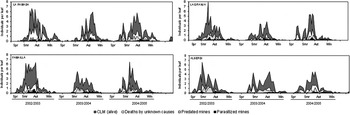
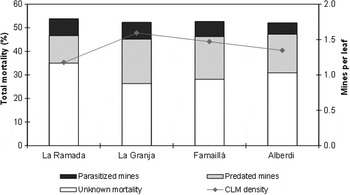
A total of 42,963 CLM immatures were collected throughout the study. CLM density fluctuated widely along the citrus growing season, from nearly null presence in late winter to about eight mines per leaf in summer–autumn, depending on the year and the location (fig. 1). These fluctuations resulted in an annual average of slightly over one mine per leaf, in all locations (fig. 2). Immature stages including egg, larvae and pupae were collected in virtually all sampling dates, even in winter months.
Fluctuations (numbers in 100 leaves) of CLM population and main mortality factors (CLM preyed, parasitized and dead from unknown causes) throughout 3 consecutive years in four locations from NW Argentina. Seasons are indicated as: Spring (Spr), Summer (Smr), Autumn (Aut) and Winter (Win).

Annual mean density (number of mines per leaf) and total mortality (as % of all mines) of CLM in four locations from NW Argentina. Relative rates (as % from all dead individuals) of each mortality factor are represented within each column.

In all the studied locations, about half of CLM larvae did not reach complete development (fig. 2). The dominant mortality factor was represented by unknown causes (30.1% ± 1.5), explaining on average more than half of total mortality and followed by predation (16.2% ± 1.3), which was in turn higher than overall parasitism (6.4% ± 0.5). The fluctuations depicted in fig. 1 also show the number of preyed mines generally increasing from early summer and declining at the end of autumn, with a tendency for parasitoid presence to increase from late summer to autumn.
CLM predation and parasitism: temporal and spatial variations
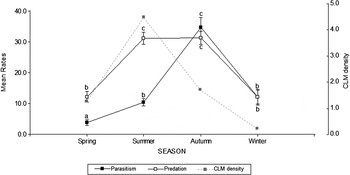
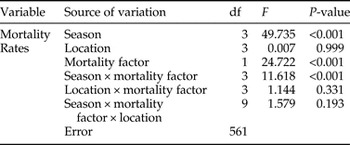
Mortality rates inflicted by predators and parasitoids on CLM populations showed important temporal rather than spatial variations, with no significant effects of location being detected (table 1). There were significant differences between both mortality factors (table 1), with higher overall predation (21.68 ± 2.88%) than parasitism rates (15.26 ± 3.22%), and with a strong interaction between mortality factor and season (table 1, fig. 3). Thus, predation in summer and autumn was about three times higher than in spring and winter, whereas parasitism showed a pronounced peak in autumn (a ten-fold increase from spring), reaching values similar to those of predation; predation led to higher mortality than parasitism in spring and most strongly in summer when CLM density was highest (fig. 3).
Seasonal predation and parasitism rates (% of miners ± SE) on CLM, from 3-year sampling in NW Argentina. Data of the four locations were averaged and vertical bars denote SE (location effects were not significant according to GLMM, see table 1). Means accompanied by different letters are significantly different (GLMM contrast, P < 0.05). Average CLM density is also included for illustration.

Results of GLMMs analysing mortality rates due to predation and parasitism (mortality factor) on CLM populations, considering variations among seasons and locations.

The 2392 adult parasitoids reared from CLM belonged to two families: Eulophidae (three native species) and Encyrtidae (the introduced species A. citricola). The two most abundant parasitoid species were A. citricola and C. neotropicus Diez and Fidalgo, together accounting for over 99% of the specimens, while Elasmus phyllocnistoides Diez, Torrens & Fidalgo (0.75%) and Galeopsomyia fausta LaSalle (0.05%) were scarcely represented.
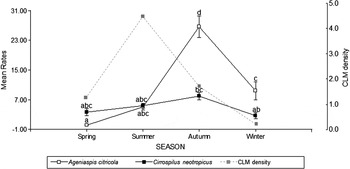
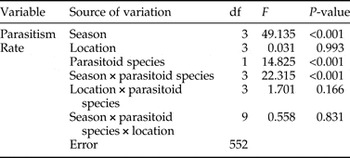
Parasitism rates of CLM by the two dominant species were similar in all the studied locations, but differed among seasons and between species, with a highly significant interaction between both factors (table 2). Parasitism by A. citricola (10.37 ± 2.76%) was on average higher than C. neotropicus (4.89 ± 0.67%) when means for all seasons were combined. However, both species varied along seasons in a different way, as indicated by the species x season interaction, revealing dominance of A. citricola parasitism in autumn and winter months, whereas C. neotropicus was responsible for most of the scarce parasitism recorded in spring (fig. 4).
Seasonal parasitism rates (%) by A. citricola and C. neotropicus on CLM, from 3-year sampling in NW Argentina. Data of the four locations were averaged and vertical bars denote SE (location effects were not significant according to GLMM, see table 2). Means accompanied by different letters are significantly different (GLMM contrast, P < 0.05). Average CLM density is also included for illustration.

Results of GLMMs analysing parasitism rates caused by A. citricola and C. neotropicus on CLM considering variations among season and locations.

Parasitism and predation rates vs. CLM density
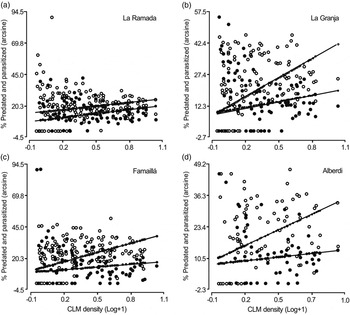
Direct and highly significant relationships were detected when parasitism and predation rates were analyzed with regard to CLM density, indicating density-dependence for both mortality factors (fig. 5).
Regression analysis between preyed (white points) and parasitized (black points) mines to the CLM density. Data from three consecutive citrus growing seasons: La Ramada (parasitism y = 7.88 + 11.96x, R 2 = 0.10; predation y = 14.12 + 10.68x, R 2 = 0.05), La Granja (parasitism y = 9.06 + 10.06x, R 2 = 0.04; predation y = 8.74 + 32.27x, R 2 = 0.29), Famaillá (parasitism y = 8.91 + 7.86x, R 2 = 0.03; predation y = 11.15 + 25.25x, R 2 = 0.25) and Alberdi (predation y = 10.41 + 24.47x, R 2 = 0.20).

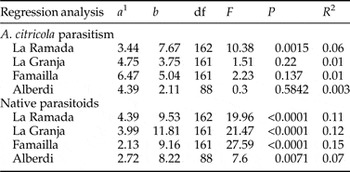
When parasitoid species were separately analyzed, only percentage of parasitism by the native species (C. neotropicus, E. phyllocnistoides and G. fausta) was significantly correlated with CLM density, whereas parasitism exerted by the introduced species A. citricola was independent of host density (table 3).
Results of regression analyses of parasitism rates (%) by introduced (A. citricola) and native parasitoids vs. CLM density.

1 y = a + bx, where y = parasitism percentage, a = linear coefficient, b = quadratic coefficient, x = CLM density.
Discussion
Knowledge of the mortality factors affecting P. citrella, with emphasis on its natural enemies, is a basic step towards a sustainable management of this worldwide pest, for which biological control is considered the best long-term option (Sarada et al., Reference Sarada, Gopal, Gouri Sankar, Mukunda Lakshmi, Gopi, Nagalakshmi and Ramana2014). Here, by exploring temporal and spatial variations on populations of this pest on lemon plants in NW Argentina, we found that approximately half of CLM immatures failed to reach the adult stage, that predation was higher than parasitism having both a remarkably consistent impact across locations but showing different seasonal trends, and that the native parasitoid C. neotropicus revealed some favourable features as a potential biological control agent, such as density-dependence and earlier synchronization with the host in comparison with the introduced A. citricola.
Death from unknown causes accounted for more than half of the total mortality of CLM immatures.
Unexplained mortality is frequently high on leafminers (e.g., Amalin et al., Reference Amalin, Peña, Duncan, Browning and McSorley2002; Lomeli-Flores et al., Reference Lomeli-Flores, Barrera and Bernal2009) and may include bottom-up effects linked to host plant defences, but also diseases, some degree of inadequacy of the species to local environmental conditions, intraspecific competition, unsuccessful parasitism and also ‘host-feeding’ by parasitoids (Auerbach et al., Reference Auerbach, Connor, Mopper, Cappuccino and Price1995; Eber, Reference Eber2004; Gripenberg & Roslin, Reference Gripenberg and Roslin2008). Host-feeding behaviour could increase parasitoid impact on CLM populations (Zhang & Liu, Reference Zhang and Liu2008), and has actually been demonstrated for C. neotropicus in Brazil (Foelkel et al., Reference Foelkel, Redaelli, Jahnke and Losekann2009). Thus, the impact of parasitoids on CLM populations in NW Argentina might be higher than shown by our parasitism data, an interesting possibility that deserves further study.
Predation rates were higher than those of parasitism in NW Argentina. Similar trends, with predation representing a stronger mortality factor than parasitism, have been observed in Spain and USA after relatively recent introductions of the CLM (Amalin et al., Reference Amalin, Peña, Duncan, Browning and McSorley2002; Xiao & Fadamiro, Reference Xiao and Fadamiro2010), in contrast with the lower predator action often associated with leafminers (Salvo & Valladares, Reference Salvo and Valladares2007; Gripenberg & Roslin, Reference Gripenberg and Roslin2008). Although a more accurate assessment of the true impact of each mortality factor would require a life-table approach (Lioni & Cividanes, Reference Lioni and Cividanes2004), adjusting the mortality rates to the specific resource density in each case, as explained in the methodology section, provides an adequate approximation for a species with multiple co-occurring generations. In this study, ants and lacewings were observed eating larvae and pupae of CLM, but the separate impact of these predators was not quantified.
The relatively low rates of parasitism here recorded are not in agreement with common trends for leafminers, in which parasitism often exceeds 50% (Langor et al., Reference Langor, Digweed, Williams, Spence and Saunders2000; Salvo & Valladares, Reference Salvo and Valladares2007). The present results may be explained by the relatively short CLM exposure time to local parasitoids, given that native leafminers are usually heavily parasitized (Hawkins, Reference Hawkins1994; Eber, Reference Eber2004) while alien ones may be instead more preyed than parasitized (e.g., Grabenweger et al., Reference Grabenweger, Kehrli, Schlick-Steiner, Steiner, Stolz and Bacher2005; Xiao et al., Reference Xiao, Qureshi and Stansly2007). However, some invasive leafminer pests have shown remarkably high parasitism levels (Van der Walt et al., Reference Van der Walt, du Plessis and Van den Berg2009). It must be noticed that sampled orchards remained under conventional management, including applications of insecticides, as described in Materials and methods section. Insecticide applications appear to be ineffective to reduce CLM populations in the region (Diez et al., Reference Diez, Peña and Fidalgo2006), but detrimental effects on predators and parasitoids cannot be ruled out, and such effects could underlie the low parasitism rates reported here.
Both predation as well as parasitism rates showed consistent seasonal patterns among locations distant up to 129 km from each other. Predation, with high levels during summer and autumn, provided earlier and more sustained pressure on CLM populations than parasitism, which instead showed wider seasonal variations, spanning an order of magnitude between its lowest values in spring and its peak in autumn. Slow building up of parasitoid populations, with highest parasitism levels in autumn, when CLM populations begin to decrease, have been frequently recorded (Peña et al., Reference Peña, Duncan and Browning1996; Ateyyat, Reference Ateyyat2002; Elekçioğlu & Uygun, Reference Elekçioğlu and Uygun2013). Parasitism and predation in winter, even with extremely low populations of CLM, suggest high host finding capacity of the natural enemies (Zappalà & Hoy, Reference Zappalà and Hoy2004).
Despite the widely known advantages of host-specific natural enemies of the CLM (Sarada et al., Reference Sarada, Gopal, Gouri Sankar, Mukunda Lakshmi, Gopi, Nagalakshmi and Ramana2014), our results show a relevant performance of the native generalist parasitoid C. neotropicus. This species presented highly favourable features as a possible biological control agent, such as density-dependence, a trait often linked to population regulation capabilities (Hixon et al., Reference Hixon, Pacala and Sandin2002). Another favourable attribute of C. neotropicus is its early activity, parasitizing CLM larvae in spring, at the onset of the annual cycle of CLM, whereas the introduced A. citricola showed a delayed population growth. Diez et al. (Reference Diez, Peña and Fidalgo2006) also recorded an early activity of C. neotropicus on CLM populations. Moreover, relatively late action of A. citricola has also been observed in other regions (Amalin et al., Reference Amalin, Peña, Duncan, Browning and McSorley2002), suggesting a delayed response to the increasing host density (Schowalter, Reference Schowalter2006). Being a specific parasitoid of the CLM, A. citricola would find no alternative hosts during the unfavourable season, suffering a temporary population breakdown which takes a couple of generations to recover, resulting in delayed growth (Pomerinke & Stansly, Reference Pomerinke and Stansly1998). Instead, the polyphagous native species C. neotropicus can survive on alternative hosts during the winter months. This situation also emphasizes the importance of adjacent vegetation near citrus crops as reservoirs of native parasitoids (Vivan et al., Reference Vivan, Torres and Veiga2003) and suggests a disadvantage of A. citricola specificity (Berti Filho & Ciociola, Reference Berti Filho, Ciociola, Parra, Botelho, Corrêa-Ferreira and Bento2002; Symondson et al., Reference Symondson, Sunderland and Greenstone2002).
Significant relationships between CLM density and the proportion of preyed and parasitized individuals suggested certain degree of density-dependence, a desirable trait for natural enemies as regulatory agents (Auerbach et al., Reference Auerbach, Connor, Mopper, Cappuccino and Price1995). Nonetheless, such relationships were strongest and most consistent for predation, suggesting this factor could play an important regulatory role for the pest in the studied region. The high mortality rates caused by predation in comparison with parasitism reinforce this possibility. Relatively high correlation between the action of predators and CLM population was also observed by Amalin et al. (Reference Amalin, Peña, Duncan, Browning and McSorley2002).
Our results provide new and needed information about natural control of the CLM, with an approximation to the effect of natural enemies on the pest and to their spatial and temporal fluctuations. From this assessment, predation emerged as an important top-down factor affecting the CLM, suggesting that predator presence should be encouraged in citrus orchards in the region. Also, from a management perspective, delayed action by A. citricola on CLM populations could be overcome by early augmentative releases in spring, although cautious studies about possible competition with native C. neotropicus would be needed. The role of the latter species deserves further study within the current trend favouring augmentative biological control with indigenous species (van Lenteren, Reference van Lenteren2011). Being well adapted to the ecological conditions prevailing in the region and having alternative hosts during the unfavourable season, C. neotropicus appears as an interesting candidate on which the possibility of mass-rearing for inundative releases should be evaluated. Finally, our study highlights the possibility of a complementary role for natural control agents with different phenology, which could prove advantageous in pest management programs.
Acknowledgements
The authors would like to thank Santiago Medina, Martín Bernal, José Lazcano and Sebastián Zapatiel for field assistance. They also thank comments of three anonymous reviewers which improved the manuscript. Funds were provided by Estación Experimental Agroindustrial Obispo Colombres (EEAOC) and a grant by Consejo Nacional de Investigaciones Científicas y Técnicas de la República Argentina (CONICET).