The ability to produce and comprehend relative clauses is a milestone in language acquisition – demonstrating young learners' mastery of recursion and an ability to use and understand non-local dependencies. As such, it has been studied extensively (see Diessel, Reference Diessel2004, for a review). Children start to produce relative clauses fairly early on. In English, they appear in spontaneous production as early as age two (Diessel & Tomasello, Reference Diessel and Tomasello2000). Children also produce them in more controlled elicitation studies as early as age three (McKee, McDaniel & Snedeker, Reference McKee, McDaniel and Snedeker1998). Importantly, children produce both subject relative clauses, where the modified NP is the Agent of the embedded clause, and object relative clauses, where the modified NP is the Patient of the embedded clause.
Children's comprehension of relative clauses follows a more peculiar path. They comprehend subject relatives like (1) but have difficulty with object relatives like (2), even though they both express a modification relation.
(1) Show me the nurse that is drawing the girl
(2) Show me the nurse that the girl is drawing
Their comprehension of object relatives remains poor until quite late: five-year-olds comprehend them correctly only 50% of the time (Correa, Reference Correa1995; Friedmann & Novogrodsky, Reference Friedmann and Novogrodsky2004; Kidd & Bavin, Reference Kidd and Bavin2002). This finding appears to hold across languages and tasks, even though object relatives are as frequent as subject relatives in child-directed speech (Diessel, Reference Diessel2004). Children seem to have more trouble comprehending object relatives than producing them, contra the more common trajectory where comprehension precedes production.
This difficulty has played a central role in shaping accounts of relative clause acquisition. It has been taken to reflect an across-the-board difficulty with object relative clauses, and, to account for it, researchers have appealed to non-adult processing heuristics that bias children towards a subject relative interpretation (Sheldon, Reference Sheldon1974; Tavakolian, Reference Tavakolian and Tavakolkin1981) or to syntactic deficits that prevent children from processing object relatives (Friedmann & Novogrodsky, Reference Friedmann and Novogrodsky2004). This process of acquisition emerges as a discontinuous one, affected by biases not found in adults and that therefore need to be unlearned.
But adults also find object relatives like (2) difficult (Gibson, Reference Gibson1998; Gordon, Hendrick & Johnson, Reference Gordon, Hendrick and Johnson2001; Mak, Vonk & Schriefers, Reference Mak, Vonk and Schriefers2002; Traxler, Morris & Seely, Reference Traxler, Morris and Seely2002; Reali & Christiansen, Reference Reali and Christiansen2007; Warren & Gibson, Reference Warren and Gibson2002). A variety of studies have tracked the source of this difficulty and utilized it to look at factors that influence on-line processing. They reveal that adults do not find all object relatives equally hard. One factor that influences processing is animacy: when the modified NP is animate, adults find object relatives harder, perhaps because this violates thematic expectations (Traxler et al., Reference Traxler, Morris and Seely2002; Mak et al., Reference Mak, Vonk and Schriefers2002). We expect animate entities to be Agents. In subject relatives, the animate NP is the Agent of the embedded clause. In object relatives, the animate NP is the Patient, contra our expectation. Object relatives become easier when they modify an inanimate NP, which we expect to be a Patient like the movie, as in the movie that the director saw.
Object relatives are also harder when the modified NP and the embedded NP are confusable, perhaps because this causes problems in retrieving the modified NP once the verb is reached (Gibson, Reference Gibson1998; Gordon et al., Reference Gordon, Hendrick and Johnson2001). The more similar the two NPs (in terms of referential type, gender, number, etc.), the harder it is to assign the thematic roles correctly in the embedded clause. Object relatives become easier the more distinct the two NPs are, for example when one is a proper name and the other a definite NP (e.g. The man that Peter saw).
Object relatives are also harder when they conflict with the alignment between syntactic position (subject or object) and the discourse status of the NP type (pronoun or lexical NP). In main and embedded clauses, subjects tend to be pronominal, reflecting their status as given, and objects tend to be lexical because they represent new information (Du Bois, Reference Du Bois, Du Bois, Kumpf and Ashby2003; Francis, Gregory & Michaelis, Reference Francis, Gregory and Michaelis1998). Object relatives are easier when they reflect these patterns – when the embedded subject is a pronoun and not a lexical NP (e.g. The man that I saw).
Adult processing of object relatives is influenced by multiple factors: discourse, information structure, memory demands and distributional information all converge to make object relative clauses like (2) harder than subject relatives like (1).
What if the same holds for children? If children's processing of object relatives is affected by the same factors as adults, we wouldn't need to stipulate biases specific to children. For instance, children, like adults, are sensitive to the visual context and to lexical bias in verbs in resolving PP-attachment ambiguities like Put the frog on the napkin in the box (Hurewitz, Brown-Schmidt, Thorpe, Gleitman & Trueswell, Reference Hurewitz, Brown-Schmidt, Thorpe, Gleitman and Trueswell2000; Snedeker & Trueswell, Reference Snedeker and Trueswell2004; Trueswell, Sekerina, Hill & Logrip, Reference Trueswell, Sekerina, Hill and Logrip1999).
The idea that children's processing of relative clauses is influenced by the same factors that influence adults has been explored for production but not for comprehension. In a recent study, Kidd, Brandt, Lieven & Tomasello (Reference Kidd, Brandt, Lieven and Tomasello2007) had children repeat subject and object relative clauses that were varied in the animacy of the head NP and in whether the embedded NP was pronominal or lexical, as shown in (3). They predicted that object relatives would be easier to repeat when the modified NP was inanimate and the embedded subject pronominal. And this was borne out by their results.
(3) This is the dog/the book that you/the girl saw
But what we know about relative clause comprehension is limited in the kinds of relative clauses children have been tested on. Comprehension has been assessed on relative clauses like (1) and (2), with two animate, lexical NPs (Correa, Reference Correa1995; Friedmann & Novogrodsky, Reference Friedmann and Novogrodsky2004; Hamburger & Crain, Reference Hamburger, Crain and Kuczaj1982; Hakansson & Hansson, Reference Hakansson and Hansson2000; Kidd & Bavin, Reference Kidd and Bavin2002, and many more). But these are precisely the object relatives that create difficulty for adults. Studies have varied the attachment site, center embedded vs. right-branching relative clauses (de Villiers, Tager Flusberg, Hukata & Cohen Reference de Villiers, Tager Flusberg, Hukata and Cohen1979; Sheldon, Reference Sheldon1974) and the number of lexical NPs, two vs. three (Correa, Reference Correa1995), but have not looked at relative clauses with inanimate modified NPs or pronominal embedded NPs. Children's poor comprehension, then, might reflect not an across-the-board difficulty with object relatives, but rather difficulty with specific object relative configurations.
The current study explores this hypothesis by comparing children's performance on relative clauses with full lexical NPs (e.g. The nurse that the girl is drawing) to ones with first person pronouns (e.g. The nurse that I am drawing). I focus on Hebrew-speaking children aged 4 ; 6, who have previously been tested only on relative clauses with full lexical NPs and showed poor comprehension (Arnon, Reference Arnon, Brugos, Clark-Cotton and Ha2005; Friedmann & Novogrodsky, 2004). The prediction is that children will show improved comprehension, with no lag behind production, when tested on object relatives with first person pronouns. If so, this would suggest: (a) that children's comprehension of object relatives has been underestimated; and (b) that there is no need to stipulate unique biases or syntactic preferences to explain children's relative clause acquisition.
In the first study, I examine the distribution of NP types in a Hebrew corpus of relative clauses in naturally occurring child and child-directed speech. This is the first corpus study of relative clauses in Hebrew, and the first corpus study to look at the referential properties of both child and child-directed speech. The predictions are that children and adults will use similar NPs in the embedded clause, and that the NP types they produce will be different from what children have been tested on. Both children and adults are predicted to produce more object relatives with first person pronouns than with lexical NPs. The corpus findings provide frequency counts of the relative clause types tested in the second study.
In the second study, I test the effect of NP type on comprehension. I compare children's performance on subject and object relative clauses with embedded lexical NPs to their performance on ones with embedded first person pronouns. The first prediction is that children's difficulty with object relatives will be reduced in the pronoun condition, just as for adults. The second is that children will exhibit high performance in this condition. I included subject relatives to see if they remain easier than object relatives in the pronoun condition. In the same study, I also test the effect of NP type on production of relative clauses. The prediction is that there will no longer be a discrepancy between production and comprehension abilities. Collecting measures of spontaneous speech (Study 1), comprehension, and elicited production (Study 2) will provide us with a comprehensive snapshot of relative clause acquisition at a given point.
Why focus on the embedded NP type?
Adults find object relatives with first or second person embedded NPs like (4) easier than ones with embedded lexical NPs like (5) (Warren & Gibson, Reference Warren and Gibson2002), and no harder (Gordon et al., Reference Gordon, Hendrick and Johnson2001) or even easier (Reali & Christiansen, Reference Reali and Christiansen2007) than their subject relative counterparts (6).
(4) The barber that you admired climbed the mountain. ObjectRC-Pronoun
(5) The barber that the banker admired climbed the mountain ObjectRC-LexicalNP
(6) The barber that admired you climbed the mountain. SubjectRC-Pronoun
An embedded pronoun reduces difficulty with object relatives: it makes the two NPs less confusable, and makes the sentence more similar to spontaneously produced object relatives. In English, object relatives rarely have a lexical NP as the embedded subject (Reali & Christiansen, Reference Reali and Christiansen2007; Roland, Dick & Elman, Reference Roland, Dick and Elman2007). In a large corpus of spoken English (Roland et al., Reference Roland, Dick and Elman2007), 80 percent of object relatives had a first or second person pronoun as the subject. A recent corpus study of child speech in English and German (Kidd et al., Reference Kidd, Brandt, Lieven and Tomasello2007) revealed a similar pattern; children spontaneously produced object relatives most often with a pronominal embedded subject (86 percent).
Notice that both lexical NPs and pronouns can fill Agent and Patient roles, whereas in an animacy manipulation, the change of an animate NP into an inanimate one ‘gives away’ the thematic assignment. And while there is evidence that NP type affects children's ability to repeat relative clauses (Kidd et al., Reference Kidd, Brandt, Lieven and Tomasello2007), no one has studied its effect on comprehension and elicited production.
Why focus on Hebrew?
Hebrew is a basically SVO language in which relative clauses always follow the noun they modify (Berman, Reference Berman1978; Givón, Reference Givón, Corum, Smith-Stark and Wieser1973). Hebrew has several features which make it a useful language for the current study. All pronouns (first, second and third, singular and plural) have different forms in the nominative, the accusative and the oblique (they are unmarked in the nominative and marked differently in the accusative and the oblique). Definite lexical NPs also have different forms in the nominative and the accusative: they appear with a preceding et ‘ACC’ in the accusative but not in the nominative. In Hebrew both first person pronouns and definite lexical NPs are distinguished in the accusative and the nominative – the form is a cue to thematic assignment for both. This is unlike English, where the form of a first person pronoun (I vs. me) gives away its thematic assignment, while the form of a definite lexical NP does not (The girl saw X vs. X saw the girl). In English, but not in Hebrew, first person pronouns carry more cues to thematic assignment than definite lexical NPs.
Hebrew has rich inflectional morphology; verbs agree with the subject in number, gender and often person (for first and second person only in past and future tenses). That is, the verbal morphology provides additional cues to thematic assignment. However, in the present tense, agreement patterns are identical for first person singular feminine and third person singular feminine. The verb alone does not distinguish a first person subject from a third person one. Examples (7) and (8) show the different forms first person pronouns and definite lexical NPs take in the accusative and the nominative. They also show the same verbal agreement for both; the verb provides the same information for both.
(7) ani mecayeret et ha-axot I-NOM draws+Fem ACC the-nurse+Fem ‘I am drawing the nurse.’
(8) ha-axot mecayeret oti the-nurse+Fem draws+Fem me+ACC+Fem ‘The nurse is drawingme.’
Hebrew relative clauses follow the modified noun and are preceded by the obligatory complementizer she ‘that’. Resumptive pronouns are disallowed in subject position, optional in direct object position and obligatory in oblique position (Givón, Reference Givón, Corum, Smith-Stark and Wieser1973). Example (9) shows a subject relative clause with no resumptive pronoun. Example (10) shows an object relative clause without a resumptive pronoun.
(9) raiti et ha-axot še-mecayeret et ha-yalda saw-1st-sg ACC the-nurse+Fem that-draws+Fem ACC the-girl+Fem ‘I saw the nurse that is drawing the girl.’
(10) raiti et ha-axot še-ha-yalda mecayeret saw-1st-sg Acc the-nurse+Fem that-the-girl+Fem draws+Fem ‘I saw the nurse that the girl is drawing.’
STUDY 1: DISTRIBUTIONAL DATA – RELATIVE CLAUSES IN SPONTANEOUS CHILD AND CHILD-DIRECTED HEBREW
To test the prediction that children's comprehension of object relatives is sensitive to distributional patterns, we first need to establish what object relatives look like in Hebrew. The corpus study examines naturally occurring relative clauses in child and child-directed Hebrew, focusing on the kinds of NPs inside the embedded clause. The predictions are that children will show a distribution similar to that in child-directed speech and similar to English and German. Specifically, object relatives will rarely appear with lexical NPs.
METHOD
I extracted Hebrew relative clauses from three sources using the CLAN search application (MacWhinney, Reference MacWhinney2000): the BSF database (Berman & Dromi, Reference Berman and Dromi1984) of cross-sectional speech samples from 100 children collected either in the child's home or in his/her preschool; the Ravid database (Ravid, Reference Ravid1995) of a six-year longitudinal study of two children (aged 1 ; 8 and 0 ; 9 at the beginning of the recordings); and a database of Hebrew narratives elicited with a picture book, Frog, where are you? (Berman & Slobin, Reference Berman and Slobin1994). These narratives were elicited from 84 participants, 12 in each age group (at 3 ; 0, 4 ; 0, 5 ; 0, 7 ; 0, 9 ; 0, 11 ; 0 and 20 ; 0). The three groups under age seven were classified as child speech, and the other four as adult speech. I used the speech of parents, investigators and other caretakers captured on the child tapes as the adult sample. I did this for two reasons. First, there is little available corpora of adult-to-adult speech in Hebrew (but see Blum-Kulka, Reference Blum-Kulka1997). Second, using child-directed speech as the adult sample provided corpus frequencies that match what children hear. While there is no way to assess the degree to which the context itself promoted the production of relative clauses, there is no reason to assume it favored use of one type over another.
Overall, I extracted 221 child relative clauses and 170 child-directed relatives, yielding a total of 391 relative clauses. They came from 40 different children (the mean age of those children was 4 ; 2) and 15 different adults. About one-third came from the two parents in the Ravid database and their two children (this longitudinal record was the largest and most dense source of data).
Coding
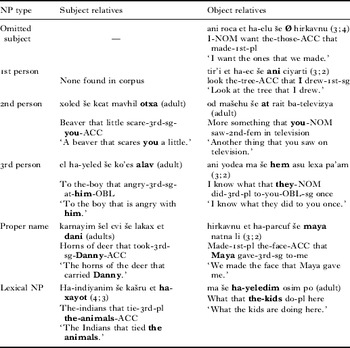
All the relative clauses were hand-coded for clause type (subject, object, oblique, embedded subject). Only transitive subject and object relative clauses were included in the analysis. This reduced the database to 112 child relative clauses and 96 child-directed relative clauses. These were then hand-coded for the type of internal NP using five pronominal and two lexical categories (based on Reali & Christiansen, Reference Reali and Christiansen2007), namely: pronominal first person (ani ‘I’, anaxnu ‘we’, oti ‘me’, otanu ‘us’), second person (ata ‘you-Masc’, at ‘you-Fem’, atem ‘you-PL-Masc’, otxa ‘you-Acc-Masc’, otax ‘you-Acc-Fem’, otxem ‘you-Acc-Pl-Masc’Footnote 1), third person (hu ‘he’, hi ‘she’, hem ‘they-Masc’, hen ‘they-Fem’, oto ‘him’, ota ‘her’, otam ‘them-Masc’, otan ‘them-Fem’), omitted subject (for past tense clauses with first or second person marking on the verb only) and impersonal (ze ‘it’). The two lexical categories were proper name (including kinship terms) and lexical np.
Results and discussion
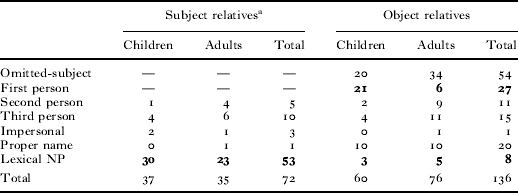
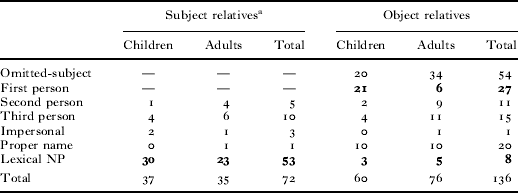
Table 1 shows the frequency of subject and object relative clauses and the distribution of the embedded NP types they appeared with. Table 2 gives examples of these relative clauses. As predicted, children rarely heard or produced object relatives with lexical NPs as the embedded subject. Only 6% of the object relatives they heard, and only 5% of the ones they produced, contained lexical NPs. When looking at the production patterns of children and adults together, 79% of object relative clauses either had no overt subject (a first or second person pronoun can be dropped in Hebrew when the verb is in the past tense) or had a pronominal one.
The distribution of embedded NPs in subject relatives and object relatives for children and adults
a In Hebrew first and second person subjects can be omitted in the past tense. Because the corpus included only transitive relative clauses, there was no equivalent case of object omission for subject relative clauses. The conditions relevant for Study 2 are in bold (first person pronouns and lexical NP).
Examples of relative clauses by type and internal NP (speaker age in parentheses, relevant NP in bold)

The subject relative clauses children heard and produced showed a different pattern; most had lexical NPs as the embedded object. This was true of 66% of the subject relatives children heard, and 82% of those they produced. That is, children don't always prefer to produce pronouns. They produced more pronouns in discourse-given positions (the subject of the embedded clause) and more lexical NPs in discourse-new positions (the object of the embedded clause). This mirrors their input and also documented adult preferences in main clauses (Du Bois, Reference Du Bois, Du Bois, Kumpf and Ashby2003; Francis et al., Reference Francis, Gregory and Michaelis1998).
The similarity between children's input and their output is striking for both subject and object relatives. Of the 111 child-directed transitive relative clauses that formed the database, 31% (35) were subject relatives and 69% (76) object relatives. Of the 97 relative clauses produced by children, 30% (37) were subject relatives and 70% (60) object relatives. A chi-square confirmed there was no difference in the proportions of subject and object relatives for children and adults (χ2 (1, N=208)=0·73, p>0·3). Children and adults also used similar kinds of NPs in the embedded clause, with a similar ratio of pronouns and lexical NPs in subject relatives (χ2 (1, N=72)=1·47, p>0·2), and similar proportions of zero, pronominal and lexical subjects in object relatives (χ2 (2, N=135)=2·15, p>0·3).
Even more striking is the difference between what children hear and produce, and what they have been tested on. Hebrew-speaking children rarely produce object relatives with lexical NPs, but have always been tested on just that type of object relative.
The results reveal a distribution similar to that found in adult English (Reali & Christiansen, Reference Reali and Christiansen2007; Roland et al., Reference Roland, Dick and Elman2007) and in child German and English (Kidd et al., Reference Kidd, Brandt, Lieven and Tomasello2007). They show similarity between adult-to-adult speech, child-directed speech and child speech. My findings confirmed the ecological validity of using a first person pronoun to test comprehension: this is the most frequent overt pronominal form in children's object relatives. These findings also provide evidence that four-year-olds spontaneously produce grammatical object and subject relative clauses.
The corpus study reveals an interesting pattern: when the embedded NP is pronominal, children hear and produce more object than subject relatives. When it is lexical, they produce more subject than object relatives. The same distributional pattern is found in adult English (Reali & Christiansen, Reference Reali and Christiansen2007; Roland et al., Reference Roland, Dick and Elman2007). Recent accounts (Reali & Christiansen, Reference Reali and Christiansen2007) have argued that this pattern is crucial to understanding the difficulty posed by object relative clauses, namely the relation between processing difficulty and frequency. Object relatives with lexical NPs are difficult because the sequence complementizer–lexical np–verb is infrequent. By this logic, subject relatives with pronouns should be harder than object relatives with pronouns because of their lower corpus frequency. Reali & Christiansen (Reference Reali and Christiansen2007) tested this hypothesis and found that adults had more difficulty with pronominal subject relatives (e.g. The woman that visited me enjoyed the meal) than with pronominal object relatives (e.g. The woman that I visited enjoyed the meal).
Does the relation between corpus frequencies and comprehension hold for children? The corpus frequencies of pronominal subject and object relatives mirrored those in English. Based on these frequencies, the prediction is that pronominal subject relatives will be harder than pronominal object relatives, and harder than subject relatives with lexical NPs. Any divergence would indicate a difference in child and adult sensitivity to distributional information. I test these predictions in Study 2 alongside the predictions of better comprehension of object relatives in the pronoun condition.
STUDY 2: EXPERIMENTAL MANIPULATION – THE EFFECT OF NP TYPE ON RELATIVE CLAUSE PRODUCTION AND COMPREHENSION
This study compares children's production and comprehension of relative clauses with embedded lexical NPs vs. embedded first person pronouns. The predictions tested are: (1) children's comprehension of object relatives is improved in the pronoun condition; (2) children show good comprehension in this condition; and (3) their comprehension does not lag behind their production. I also look at the prediction derived from the corpus frequencies of Study 1. If children's difficulty is related solely to frequency of occurrence, then subject relatives should be harder than object relatives in the pronoun condition because they are less frequent.
METHOD
Participants
Twenty-three children participated in the study (twelve male, eleven female). They ranged in age from 3 ; 6 to 5 ; 3 (mean age 4 ; 4). Fifteen of them were between 4 ; 0 and 4 ; 10 (N=15, mean age 4 ; 4), four were 3 ; 6 and five were between 5 ; 0 and 5 ; 3. All were monolingual native speakers of Hebrew attending a private preschool in a mainly middle-class suburb in central Israel. All were developing normally.
Materials
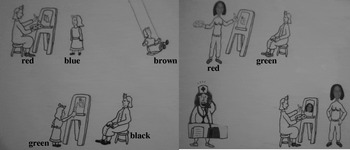
I assessed comprehension and production of object and subject relative clauses using a specially designed picture-selection task, where children looked at pictures and answered questions. The pictures showed two events involving the same entities but with their roles reversed (e.g. a nurse drawing a girl, and a girl drawing a nurse). They also contained a distracter entity (e.g. a nurse talking on the phone). Because there are multiple entities of each kind (two nurses and two girls), use of relative clauses to identify a specific referent is pragmatically felicitous (e.g. Hamburger & Crain, Reference Hamburger, Crain and Kuczaj1982).
Unlike in previous studies, all the entities had the same accessory (e.g. shoes), but painted a different color. I assessed comprehension by embedding relative clauses within questions about the colors of accessories (e.g. ‘What color are the shoes of the nurse that the girl is drawing?’). Note that the potential attachment ambiguity (whether the girl is drawing the shoes or the nurse) is made unambiguous by the pictures (it is clear that the girl is drawing the nurse and not her shoes, as shown in Figure 1). I assessed production with the same pictures by asking questions that identified accessories by color (e.g. ‘Who has black shoes?’). The expected response was one that included a relative clause (e.g. ‘The nurse that the girl is drawing.’). In order to make the elicitation questions pragmatically appropriate, I used a puppet that could not see the pictures as an additional ‘participant’. The production and comprehension trials were interleaved in the experiment (note that whatever priming might occur between the modalities would be the same in all experimental conditions).
Example pictures for the lexical NP and pronoun conditions with colors of shoes (the attribute asked about) indicated on the figure.

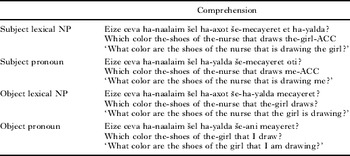
Object and subject relatives were tested in two conditions: with embedded lexical NPs and with embedded first person pronouns. The left-hand pane of Figure 1 shows a picture for the lexical NP condition. The right-hand pane of the figure shows the same event for the pronoun condition. Pictures for the pronoun condition were created by replacing one of the entities with a photo of the author. This enabled me to use relative clauses with a first person (e.g. ‘What color are the shoes of the girl that I am drawing?’) while keeping the items effectively identical (same verb, same distracter). Table 3 shows the comprehension items used with these pictures. I used the same pictures to look at subject and object relatives by targeting the same NP (e.g. the nurse) in different roles (e.g. drawing or being drawn).
Examples of comprehension items in the four conditions

I constructed sixteen pictures using eight transitive verbs (‘push’, ‘catch’, ‘feed’, ‘draw’, ‘wash’, ‘brush’, ‘clean’, ‘kiss’), with each verb used once in the lexical NP condition and once in the pronoun condition. Each picture was used to elicit four responses: comprehension of a subject relative, comprehension of an object relative, production of a subject relative and production of an object relative. Children therefore heard 32 comprehension questions and 32 production questions. They also heard 16 fillers: in comprehension, the fillers contained prepositional phrases (e.g. ‘What color are the shoes of the nurse with the phone?’) to identify the distracter entity, and in production, they targeted the distracter entity by using an adjectival phrase (e.g. ‘Who has yellow shoes?’).
All entities (‘monkey’, ‘nurse’, ‘dog’, ‘lion’, ‘clown’, ‘bear’, ‘cowboy’, ‘giraffe’, ‘girl’, ‘elephant’, ‘cat’, ‘princess’, ‘chicken’, ‘king’, ‘policeman’) and verbs appear on the MacArthur Communicative Development Inventory (CDI) battery for three-year-olds. The nouns had similar frequencies in spoken speech (as measured by the CELEX database for spoken English since there is no such database for Hebrew). All verbs were between two and four syllables long and all nouns were between one and three syllables long. Verbs were presented in the simple present tense.
The set-up provided no non-syntactic cues to thematic assignment. Both NPs could plausibly fill either thematic role (e.g. nurses can draw or be drawn). Importantly, the pronoun condition did not provide more cues than the lexical NP one. Both pronouns and definite lexical NPs are case marked in Hebrew, and verbal agreement is identical for first person and third person, as long as they are of the same grammatical gender.
Design
The study employed a 2×2×2 design, with modality (production vs. comprehension), extraction type (subject relative vs. object relative) and np type (lexical NP vs. first person pronoun) as independent factors.
Procedure
Children were tested in a separate room in their nursery school, after first being asked whether they wanted to play the game. All sessions were tape-recorded and subsequently transcribed by an assistant who was blind to the goals of the study. Children were tested in two sessions, a week apart. Each session lasted twenty minutes.
At the beginning of each session the experimenter (the author) explained the game: looking at pictures and answering questions about colors. The experimenter also introduced a puppet to the child and explained that the experimenter and the child would look at pictures while the puppet hid under the table. For each picture, the experimenter would ask the child one question and the puppet would ask another. Looking together at the first picture, the experimenter described the different actions without using relative clauses (e.g. here the nurse is drawing the girl and here the girl is drawing the nurse and here the nurse is talking on the phone). The experimenter drew the child's attention to the fact that the entities had accessories in different colors and asked the child to identify the colors. This was done to check on the children's color knowledge. The experimenter then asked a question about the color of the distracter entity and corrected the child's response if it was wrong. In all the test trials, children were asked to describe the pictures to ensure that they understood the action being performed and that they recognized the referents depicted.
In each session, children saw all sixteen pictures. Each picture elicited two responses, a production response and a comprehension response, one targeting subject relatives and one object relatives (e.g. a subject relative comprehension question and an object relative production question). The order of elicitation was counterbalanced. Half of the pictures were presented in the first session with a subject relative and in the second session with an object relative, and vice versa. Half the trials in each session began with comprehension and half with production. The NP and pronoun items were presented in a semi-randomized fashion, so children heard no more than two consecutive items of the same type. Across the two sessions, each participant responded to all sixty-four experimental items.
In the comprehension trials, the experimenter asked a question about the accessory color for one entity and the child had to respond with the correct color. In the production trials, the puppet, given a high-pitched voice by the experimenter, asked the child to describe one of the entities in the picture (the puppet could not ‘see’ the picture from under the table). If the child pointed to the correct entity, the puppet responded by saying that it couldn't see the picture. If the child responded with a single NP (e.g. ‘Who has a red hat?’ – ‘The monkey.’), the puppet stressed that there was more than one monkey and asked for a better description. The production utterance coded was the child's first full sentence that uniquely described one of the entities, whether or not it included a relative clause. After the child produced an appropriate description, the puppet came out from under the table, found the referent and congratulated the child on giving a good description. Children were given positive feedback (‘perfect!’) after each trial, whether or not their response was correct.
Coding
Comprehension
I coded both errors and correct responses. Children could make four types of errors corresponding to the four non-target entities in each picture. Take the comprehension question ‘What color are the shoes of the nurse that the girl is drawing?’, which targets the nurse with black shoes. The four possible errors here are:
Reversal error: The child gives the color of the nurse that is drawing the girl instead of the one that is being drawn. This error is one of reversed thematic assignment – the child assigns the nurse the wrong thematic role. For object relatives, the modified NP (the nurse) is assigned an Agent role instead of a Patient role. For subject relatives, the reverse happens; the modified NP is assigned a Patient role instead of an Agent one.
Agent error: The child gives the color of the girl that is drawing the nurse instead of the nurse being drawn. This error shows a non-modifying interpretation – the child responds with the Agent of the embedded clause (the girl) instead of the modified NP (the nurse).
Other error: The child gives the color of the girl that is being drawn by the nurse.
Distracter error: The child gives the color of the distracter entity.
Production
The open-ended nature of the production task led to a variety of responses in addition to transitive subject or object relatives. I coded all responses for appropriateness, accuracy, sentence type and grammaticality. Appropriateness had two values: appropriate when the sentence uniquely described one entity and inappropriate when it didn't. Producing ‘the nurse that is sitting’ in response to the question ‘Who has black shoes?’ would be labeled inappropriate because both nurses in the picture are sitting. Accuracy had two values: accurate when it described the correct entity and inaccurate when it described any of the other entities. Producing ‘the nurse that is drawing’ in response to the question ‘Who has black shoes?’ would be inaccurate because it is the nurse that is being drawn who has black shoes. Sentence type had five values: no response (if the child did not produce a full sentence), no relative (if the sentence was not a relative clause), intransitive subject relative, transitive subject relative, and object relative. Grammaticality had two values: grammatical and ungrammatical.
As a first step, 20 percent of the data were independently coded by the author and a trained research assistant unaware of the hypotheses. They were coded from transcriptions made by a second research assistant who was also blind to the goals of the study. Agreement coefficients were very high and ranged from κ=0·92 for comprehension to κ=0·99 for production. The remaining protocols were all coded by the author.
RESULTS
I used mixed-effect logit models (Bates & Sakar, Reference Bates and Sarkar2007) to analyze the present results. These models are well suited for analyzing categorical data (Baayen, Reference Baayen2007; Jaeger, Reference Jaeger2008). Mixed logit models can be thought of as an extension of logistic regression that includes modeling of random subject and item effects. Including both random factors is necessary to generalize beyond the subjects and items in the current study (Clark, Reference Clark1973). The reported models have random intercepts (adding random slopes proved unnecessary). As in ordinary logistic regression, mixed logit models are well suited for the analysis of categorical response variables. These models can be thought of as predicting the probability of a specific response (a correct answer) in the different conditions (see Agresti, Reference Agresti2002; Jaeger, Reference Jaeger2008). All the reported effects were also significant when I used by-subject and by-item ANOVAs.
For each result, I report the coefficient for each independent variable and its level of significance. As in linear regressions, mixed logit models return a coefficient value for each contrast in the model, making post hoc tests or planned contrasts unnecessary. Coefficients in mixed logit models are given in log-odds (the space in which mixed logit models are fitted to the data). Significant positive coefficients show that a correct answer is more likely in the tested level of the variable than in the other. For example, extraction has two levels, subject relatives and object relatives. Let's say the tested level is subject. If the coefficient of Extraction for subject relatives is positive, then accuracy on subject relatives was higher than on object relatives. Negative coefficients show the opposite. If the coefficient of Extraction for subject relatives is negative then accuracy for subject relatives is lower than for object relatives. All the variables were contrast coded, to make the interpretation of the coefficients easier (contrast coding is the default for main effect testing in ANOVA). For example, for the Extraction variable, subject was coded as −1 and object as 1. The coefficients of the mixed logit model now correspond to the distance from the general Extraction mean. I also report the difference in odds between conditions (odds are simply the exp (log-odds)). Odds range from 0 (for proportions of 0) to positive infinity (for proportions of 1), with proportions of 0·5 corresponding to odds of 1.
Two of the sixteen comprehension items were accidentally corrupted for all participants because the experimenter repeated the same Extraction condition in both testing sessions (using subject relatives twice instead of using one subject relative and one object relative). One production item was corrupted in the same way. Since the mixed logit model can accommodate an uneven number of observations per cell, only the missing condition and not the entire item was excluded (for an item that was repeated twice in the same Extraction condition, only the responses from the first session were included).
Comprehension
The comprehension task yielded 706 comprehension responses: 366 subject relative comprehension responses (182 in the lexical NP condition and 184 in the pronoun condition) and 340 object relative responses (164 in the lexical NP condition and 166 in the pronoun condition).
Did children comprehend object relatives better in the pronoun condition?
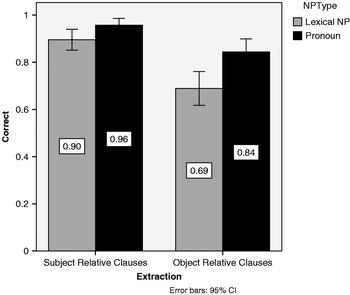
Figure 2 shows the proportion of correct responses by Extraction (subject vs. object) and embedded NP type (lexical NP vs. first person pronoun). As predicted, children comprehended object relatives better in the pronoun condition. In this condition, they showed high comprehension (85% correct) that was significantly better than in the lexical NP condition (69% correct). A mixed-effect logit model with NP type as a fixed effect, and item and subject as random effects, showed a significant improvement in the pronoun condition (log-odds coefficient B=0·96 (SE=0·31), p=0·002; corresponding odds coefficient eB=2·6).
Proportion of correct responses by Extraction and NP type.

A mixed logit model with Extraction and NP type as fixed effects, and item and subject as random effects, revealed two main effects and no interactions. In line with previous findings, children comprehended subject relatives (93%) better than object relatives (77%) (B=1·49 (SE=0·25), p<0·001; eB=4·4). They also performed better in the pronoun condition than with lexical NPs: they comprehended relative clauses with pronouns better (90%) than ones with lexical NPs (79%) (B=1·00 (SE=0·27), p<0·001; exp eB=2·7). The interaction between the two main effects was not significant (B=−0·02 (SE=0·52), p>0·9; eB=0·98): children's comprehension improved in the pronoun condition for both subject and object relative clauses.
Children comprehended subject relatives (96% correct) better than object relatives (84% correct) even in the pronoun condition. A mixed logit model only for pronominal relative clauses showed a significant effect of Extraction (B=1·55 (SE=0·45), p<0·001; eB=4·7). This is not expected under a distributional account of the difficulty (Reali & Christiansen, Reference Reali and Christiansen2007) because subject relatives with pronouns were less frequent than object relatives with pronouns in the corpus. It is also unlike the pattern found in adults: in the pronoun condition, adults comprehended object relatives better than subject relatives (Reali & Christiansen, Reference Reali and Christiansen2007). I will return to this discrepancy between the corpus findings and the experimental results later.
Gender cues
Examination of the stimuli revealed that the gender of the two NPs was not the same for all items. Since verbs are marked for gender in Hebrew, this provided an additional cue for thematic role assignment in some sentences. Where the two NPs differ in gender, the verb is marked as either masculine or feminine, indicating who the Agent is. For example, if the modified NP is masculine and the embedded NP feminine and the verb is marked as feminine, the feminine NP must be the Agent of the action. This held for more items in the pronoun condition (5) than in the lexical NP one (2) and so introduced a potential confound: could the improvement in the pronoun condition be due solely to the additional gender cues on some items?
To test this, I did an additional analysis with a control variable for the potential effect of the gender cue, with items coded as having a gender cue if the NPs were of different gender. This gender cue variable is not balanced in the data (it was not part of the original design), but this is not a problem for the mixed logit analysis used here. As long as co-linearity between independent variables is treated adequately, regression models can be used to analyze unbalanced data (Baayen, Reference Baayen2007; Agresti, Reference Agresti2002). Indeed, they are routinely used to analyze data far more unbalanced than here (Baayen, Feldman & Schreuder, Reference Baayen, Feldman and Schreuder2006).
To see whether the effect of NP type persists when the gender cue is controlled for, I ran an additional mixed logit model with Extraction, NP type Gender cue and all the two-way interactions between them as fixed factors, and subject and item as random effects. None of the interactions reached significance and were removed from the final model (p's>0·6). Crucially, co-linearity was low in the resulting model (all correlations between the fixed factors were not significant (p>0·6)). Table 4 shows comprehension accuracy by Extraction, NP type and Gender cue.
Proportion correct by extraction, NP type and gender cue (SE in parenthesis)

The effect of Extraction was unaffected by the additional control, so subject relatives were still understood better than object relatives (B=1·49 (SE=0·25), p<0·001; eB=4·4). While gender cues do affect comprehension – children comprehended items that had a gender cue better than ones that did not (88% vs. 82%) (B=0·57 (SE=0·25), p=0·02; eB=1·8), the effect of NP type remained significant (B=0·82 (SE=0·25), p<0·001; eB=2·3). As Table 4 indicates, children showed better comprehension of object relatives in the pronoun condition for items both with gender cues (from 77% correct in the lexical NP condition compared to 88% correct in the pronoun one) and without (from 67% correct compared to 79% correct). Evidence for the independent contribution of NP type also comes from a likelihood ratio test comparing a model with NP type (and all other variables mentioned above) to a model without NP type. Likelihood ratio tests are robust against co-linearity (Agresti, Reference Agresti2002). The test confirmed that a model with NP type accounts significantly better for the observed data (chi-square(1)=8·5, p=0·003).
These additional analyses show that the effect of NP type persisted after controlling for gender. They do also show an effect of gender cue: children performed better on items with gender cues, suggesting that they make use of language-specific cues in interpretation.
Comprehension – Which errors are reduced in the pronoun condition?
Error patterns provide additional information about what makes certain configurations harder. The next analysis focuses on the error patterns for object relatives since errors for subject relatives were rare. Children could make four different errors but only two were common: reversal errors, where children interpret object relatives clauses like subject relatives clauses (e.g. choosing the nurse who is drawing instead of the one who is being drawn), and Agent errors, where children choose the Agent of the embedded clause instead of the NP that it modifies (e.g. choosing the girl who is drawing instead of the nurse who is being drawn). Both error types have been observed previously in Hebrew (Arnon, Reference Arnon, Brugos, Clark-Cotton and Ha2005) in a picture-selection task using sentences like ‘Show me the nurse that the girl is drawing’. They were thought to reflect different sources of difficulty, with reversal errors reflecting processing difficulty, and Agent errors reflecting a misunderstanding of modification. Table 5 shows the distribution of errors in the two conditions. A mixed logit model with NP type and gender cue as fixed factors and subject and item as random factors was run separately on the two error types.
Proportion of error types for object relative clauses by NP type (SE in parenthesis)

The presence of a pronoun only reduced reversal errors. While both error types were equally prevalent in the lexical NP condition (15%), reversal errors dropped in the pronoun condition (to 4%) but Agent errors remained much the same (10% error rate). Reversal errors were affected by NP type (B=−1·20 (SE=0·42), p=0·004; eB=0·3), but Agent errors were not (B=−0·65 (SE=0·49), p>0·2; eB=0·52). This is not surprising if the errors reflect different kinds of difficulty. Pronouns reduced children's difficulty in interpreting an object relative but did not reduce the difficulty of understanding modification more generally.
Production
The production data was collected to test the prediction that comprehension of object relatives does not lag behind production. Moreover, production and comprehension data from the same children allows for a more complete picture of the acquisition process.
The task was successful in eliciting relative clauses: children produced relative clauses on 95% of the trials. In the remaining 5%, they either refused to answer or failed to produce a relative clause. Most relative clauses were grammatical (92%). The main source of ungrammaticality was the use of ungrammatical resumptive pronouns in subject relatives and ungrammatical resumptive lexical NPs in object relatives. For example, children would produce a subject relative like ha-axot she hi metzayeret et ha-yalda ‘the nurse that she is drawing the girl’ which has an ungrammatical resumptive pronoun hi ‘she’ in subject position. Children produced more ungrammatical subject relatives (15%) than ungrammatical object relatives (4%). The production results, like the comprehension ones, were analyzed using mixed logit models with item and subject as random effects (as in comprehension, only random intercept proved necessary). All variables were contrast-coded. Interactions were included in the initial models and removed if the significance level (p-value) was bigger than 0·7.
Table 6 shows the proportion of appropriate grammatical relative clauses (they describe the correct entity using a grammatical relative clause) in the four conditions. It does not include ungrammatical responses, relative clauses that described the wrong entity, and intransitive subject relatives (comprehension was tested using only transitive clauses). As before, I ran a mixed logit model with Extraction and NP type as the fixed factors, and subject and item as random factors on the results.
Proportion of appropriate grammatical relative clause responses (SE in parenthesis)

Children produce more subject relatives than object relatives
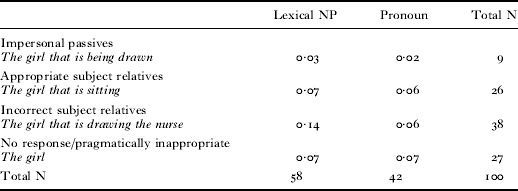
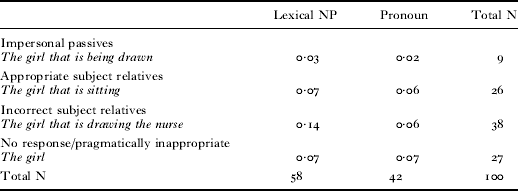
Children produced both subject relatives (82%) and object relatives (72%) but were more willing to produce subject relative clauses (B=0·65 (SE=0·20), p=0·001; eB=1·88). Their preference for subject relatives is also shown by children's readiness to produce the relevant type: in situations calling for subject relatives, children produced them 96% of the time. In situations calling for object relative clauses, children produced them only 73% of the time. Table 7 shows the distribution of non-object relative responses in situations designed to elicit object relative clauses.
Proportion and examples of non-object relative responses when an object relative clause was expected
Avoidance and simplification strategies
Children used two simplification strategies. First, they turned an expected object relative clause into a subject relative. This resulted in the production of incorrect subject relatives 10% of the time, and production of appropriate subject relatives 7% of the time. Interestingly, incorrect subject relatives were produced more often in the lexical NP condition (14%) than in the pronoun condition (6%); this suggests that the need for simplification was greater in lexical NP condition. Second, they used impersonal passives. In Hebrew, these forms have no embedded NP; instead, the verb appears in the plural, indicating there is an unspecified Agent (e.g. ‘the girl that feeding-PL her’). Even though this happened only nine times (2·5%), it shows an interesting way of reducing the number of embedded NPs in an object relative clause.
Did children produce more object relatives in the pronoun condition?
Children comprehend pronominal object relatives better than ones with lexical NPs. If distributional properties affect production too, children should also produce object relatives with more ease in the pronoun condition. This prediction was only partially met. Production of object relatives was facilitated in the pronoun conditions only for items with a gender cue. For those items, children produced object relatives 73% of the time in the NP condition and 89% in the pronoun one (B=1·13 (SE=0·44), p=0·01; eB=3·00). There was no effect for items without gender cue: children produced equal numbers of object relative clauses in the lexical NP and the pronoun condition (72% vs. 70%) (B=−0·37 (SE=0·80), p>0·6; eB=0·69).
Comparing modalities: does comprehension lag behind production?
Previous findings (Hakansson & Hansson, Reference Hakansson and Hansson2000) suggest that comprehension of relative clauses lags behind production. I assessed this claim by comparing the comprehension and production results of the twenty-two children who completed both tasks. Table 8 shows the proportion of correct responses in each condition. I excluded ungrammatical responses and responses that did not include relative clauses of the expected kind (so they would match the structures comprehension was tested on), then ran a mixed-effect model with Modality, Extraction, NP type and Gender cue as the fixed factors.
Proportion correct by modality, extraction and NP type (SE in parentheses)

As predicted, comprehension did not lag behind production (B=0·07 (SE=0·22), p>0·7; eB=1·07). This pattern held across subjects (included as a random factor). Children did better on subject relatives (88% correct) than on object relatives (77% correct) (B=1·43 (SE=0·24), p<0·001; eB=4·12). They also did better in the pronoun condition (87% correct) than in the lexical NP one (78%) (B=0·78 (SE=0·23), p<0·001; eB=2·18), and did better on items with a gender cue (B=0·54 (SE=0·16), p<0·001; eB=1·72) than on ones without. Interestingly, children comprehended object relatives just as well as they produced them in both the lexical NP (67% in comprehension vs. 67% in production) and in the pronoun condition (85% in comprehension vs. 77% in production).
The effect of the pronoun manipulation was larger in comprehension than in production, as indicated by the significant interaction between Modality and NP type (B=−0·68 (SE=0·30), p=0·02; exp (B)=0·50). The difference in performance between subject and object relatives is larger in comprehension, as can be seen from the significant interaction of Modality and Extraction (B=−0·79 (SE=0·31), p=0·01; exp (B)=0·45).
DISCUSSION OF THE EXPERIMENTAL MANIPULATION (STUDY 2)
The main predictions of Study 2 were supported. When tested on object relative clauses like those they hear and produce, four-year-olds show good comprehension (85% correct) on a par with their production. This contrasts with previous claims that four-year-olds in general, and Hebrew-speaking ones in particular, have difficulty understanding object relatives. I found the same pattern of results for the children aged 3 ; 6 that I tested. They also had good comprehension that was slightly ahead of their production (84% comprehension accuracy, 75% production rate). While there were only four three-year-olds, their data suggests that mastery of object relatives may emerge even earlier.
The improvement children demonstrated in the pronoun condition could not have resulted from any interpretative strategy unavailable in the lexical NP condition. Case marking uniquely identified thematic role in both conditions (definite lexical NPs are marked for accusative case in Hebrew). Verbal agreement provided the same cues in both conditions and each of the NPs could plausibly be assigned to either thematic role. Finally, in both conditions, the spatial location of the correct referent in the picture varied.
Children's improvement parallels reports for adult performance and suggests a common sensitivity to complex distributional patterns. Object relatives with pronouns are congruent with the alignment of discourse status and referential form: subjects of embedded clauses are often given, and given entities are most often referred to using pronominal forms (Du Bois, Reference Du Bois, Du Bois, Kumpf and Ashby2003). Children, like adults, are sensitive to this pattern, showing better comprehension of object relatives with pronominal subjects. But the results of this study may not generalize to all pronominal forms; the improvement could depend on first person pronouns only, or might extend to third person pronouns as well.
Though not a planned contrast, the effect of gender cues on children's comprehension revealed another dimension of continuity between the child and the adult parser. The independent significance of both gender cues and NP type suggests that Hebrew-speaking children, just like adults, make use of multiple cues in interpreting relative clauses and are sensitive to language-specific features like grammatical gender.
The relation between distributional features and comprehension is complicated when children's performance on subject relatives is taken into account. They did better on pronominal subject relatives (96%) than on pronominal object relatives (84%), even though the latter were more frequent in the corpus study. This is problematic for accounts that attribute difficulty to frequency of occurrence (e.g. Reali & Christiansen, Reference Reali and Christiansen2007). If clauses are more difficult when the ‘chunks’ they consist of occur less frequently, pronominal subject relatives should be more difficult. For children, frequency of occurrence did not trump other factors: object relatives were harder than subject relatives in all conditions.
Are children therefore less sensitive to distributional patterns? Not necessarily. The object relatives matched corpus frequencies on NP type but not on the animacy of the head NP. Most object relative clauses in the Hebrew corpus have an inanimate head (88% of the object relatives and 40% of subject relatives), but all the experimental items had an animate one (e.g. ‘The nurse that the girl is drawing’). Children were therefore tested on object relatives with an infrequent animacy configuration. Adults may be able to ‘ignore’ some distributional invalidity (all the items used by Reali & Christiansen also had an animate head and adults still performed better on object relatives), but children may need all features to match. They might do better on object relatives with an inanimate head NP and a pronominal internal NP than on the equivalent subject relatives (with ‘What color is the ball that I hit?’ better than ‘What color is the ball that hit me?’).
Or, the discrepancy might be related to granularity. What is the correct grain-size for computing syntactic frequencies? In a detailed study of the frequencies of English structures, Roland et al. (Reference Roland, Dick and Elman2007) suggest that processing complexity may be related to the frequencies of basic word orders (e.g. subject–verb–object, object–verb–subject). This would require calculation of basic word order frequencies in both child and child-directed speech.
Turning back to the performance on object relatives, the error analysis suggests that not all difficulty can be alleviated by the pronoun manipulation. Children were less likely to interpret an object relative as a subject relative in the pronoun condition (fewer Reversal errors) but they were as likely to highlight the Agent of the embedded clause instead of the NP it modifies. In other words, having a pronoun reduced difficulty with processing ‘atypical’ object relatives but did not reduce the difficulty associated with understanding modification more generally.
The comprehension of lexical NPs in this study was higher than in previous studies with the same language and age. Children comprehended object relatives with lexical NPs 69% of the time, compared with earlier findings of 48% (Arnon, Reference Arnon, Brugos, Clark-Cotton and Ha2005) and 58% (Friedmann & Novogrodsky, Reference Friedmann and Novogrodsky2004). The improvement may be related to the picture-selection task, and more specifically to the use of embedded relative clauses within color questions. The color questions demand comprehension – only by understanding the relative clause can the question be answered correctly. Answering color questions is a familiar and usually enjoyable task for children.
Children comprehended object relatives as well as they produced them, the lag in earlier studies was most likely an artifact of underestimating children's comprehension. When comprehension is assessed more accurately, the lag disappears. The production data showed that children can produce both subject and object relatives. It also showed that children produce subject relatives more readily than object relatives. The effect of NP type on elicited production was less clear. Unlike in repetition (Kidd et al., Reference Kidd, Brandt, Lieven and Tomasello2007), children did not produce more object relatives in the pronoun condition. They did however, produce fewer erroneous subject relatives in this condition; they avoided object relatives more in the lexical NP condition. Still, having a pronoun affected comprehension more than production. This difference could be related to the open-ended nature of the elicited production task; more responses were accepted as correct in this task (e.g. producing a correct non-embedded clause). It could also be related to the different processes involved in production and comprehension. The speaker knows what they want to say, the listener has to decipher the intended meaning of the speaker (Levelt, Reference Levelt and Dupoux2001). An infrequent configuration (e.g. a lexical NP subject) may affect comprehension more than production, either by making meaning harder to access or by violating the listener's expectation of how the utterance will unfold. Interestingly, there are no studies looking at the effect of configuration frequency on the production of relative clauses by unimpaired adult populations.
In summary, Study 2 revealed a child learner that, like adults, is sensitive to the type of embedded NP, shows good comprehension of object relative clauses, and is equally good at producing and comprehending them.
GENERAL DISCUSSION
Using corpus data to assess what children actually hear and produce (Study 1) and manipulating sentences along dimensions that influence adult processing and reflect input patterns (Study 2) revealed a developmental snapshot that is less puzzling than previous findings. Four-year-old Hebrew-speaking children spontaneously produced object relatives similar to the ones produced by adults. They showed good comprehension, with no lag behind production, and an improvement that mirrors adult patterns. The findings lend support to accounts in which children's difficulty stems from a parser that is much like the adult one (Arnon, Reference Arnon, Brugos, Clark-Cotton and Ha2005; Kidd et al., Reference Kidd, Brandt, Lieven and Tomasello2007), and show, for another language, that children are sensitive to the distributional properties of relative clauses in the input (Kidd et al., Reference Kidd, Brandt, Lieven and Tomasello2007). The emerging picture is that children, like adults, have trouble with unfamiliar object relative types. Are certain object relative clauses hard because they are infrequent, or are they infrequent because they are hard? In the case of object relatives with first person subjects, multiple factors converge to make the directional question harder to answer. First person pronouns are not only frequent, they also present the perspective of the speaker, are more accessible (Ariel, Reference Ariel1990), are phonologically shorter than lexical NPs, and are marked for case even in English. There are multiple communicative pressures that drive the frequency of first person pronouns.
What are the implications for the study of language acquisition? By paying close attention to the properties of actual child speech, and to the factors that influence adult processing, we can draw a more parsimonious picture of acquisition at a given point. One that relates difficulty to input patterns and processing pressures that play a role throughout the life span (e.g. reducing memory demands). One in which children's performance is predicted by multiple factors. A more nuanced picture of what children know and how they get there. The utility of this approach can be seen in a recent investigation of factors affecting children's use of dative alternations. Using a corpus of children's datives, de Marneffe et al. (Reference de Marneffe, Grimm, Cohen Priva, Lestrade, Ozbek, Schnoebelen, Kirby, Becker, Fong and Bresnan2007) draw on adult models of dative alternation (Bresnan, Cueni, Nikitina & Baayen, Reference Baayen2007) to predict children's productions. The results show that similar, multiple factors govern construction choice in both children and adults.
What are the implications for the study of relative clauses in other populations? Relative clauses have been used as a diagnostic in studies of aphasic and specific language impairment (SLI). Difficulty with object relative clauses has been used to argue for a specific grammatical impairment with unbounded dependencies in the field of SLI (van der Lely, Reference van der Lely1997) and Broca's aphasia (Grodzinsky, Reference Grodzinsky2000). But, in these studies, participants were always tested on relative clauses with two animate lexical NPs. The findings, and their interpretation, may change if they are tested instead on forms that better reflect actual language use.
The present results also have implications for how we define child knowledge of a construction. The fact that children have difficulty with object relatives in one configuration (lexical NP) but not in another (pronoun) shows that mastery of a construction is not a matter of all-or-nothing. Instead, it emerges as a gradual expansion of uses, consistent with usage-based accounts (e.g. Tomasello, Reference Tomasello2003), and inconsistent with models where constructions are fully acquired as soon as the relevant syntactic principles are ‘uncovered’. Children's proficiency is not constant for all variants of a construction, and it depends on input frequencies (see de Villiers, Reference de Villiers1983; Tomasello, Reference Tomasello1992). For example, early uses appear with verbs that are more frequent in that construction in child-directed speech. The current findings go beyond the effect of verbs to show that children register multiple properties of a construction. Not only how frequently verbs appear in a construction but also which NP types and animacy configurations they appear with. This is consistent with learners that are sensitive to distributional patterns (see Clark & Kelly, Reference Clark and Kelly2006) and that build up knowledge of constructions one piece at a time. Learning constructions emerges as a gradual process, shaped by input patterns.
In the big mystery that is language acquisition, relative clauses have been a small mystery, forcing researchers to explain why children find them difficult. The current study makes this mystery somewhat smaller by showing that children's difficulty with object relatives does not require appeal to special heuristics or biases in the learner. Instead, it can be captured by adult psycholinguistic models, and by the role of what children actually hear and produce.
Appendix: Full list of comprehension items
Lexical NP condition

Pronoun condition