




No CrossRef data available.
Article contents
Further evidence for a comparable memory advantage of self-performed tasks in Korsakoff's syndrome and nonamnesic control subjects
Published online by Cambridge University Press: 26 August 2005
Abstract
Two experiments were carried out to examine memory in persons with amnesia using self-performed tasks. In Experiment 1, persons with Korsakoff's syndrome and nonamnesic participants with alcoholism learned action phrases not involving real objects by either self-performed tasks or verbal tasks. As indexed by free recall and recognition tests, a memory advantage favoring self-performed tasks was confirmed in both participant groups. In Experiment 2, persons with Korsakoff's syndrome, nonamnesic alcoholic participants, and young control participants learned object names under three different study conditions that differed from one another as to whether actions for each name were verbally generated and whether actions actually were performed. Verbal generation with or without performing the action facilitated recognition, whereas recall advantage was found only in the verbal generation-plus performance condition. These findings confirm a comparable memory advantage of self-performed tasks for a group with Korsakoff's syndrome and a group of nonamnesic comparison participants. Action memory therefore has potential therapeutic implications for memory rehabilitation. (JINS, 2005, 11, 545–553.)
Information
- Type
- Research Article
- Information
- Journal of the International Neuropsychological Society , Volume 11 , Issue 5 , September 2005 , pp. 545 - 553
- Copyright
- © 2005 The International Neuropsychological Society
INTRODUCTION
Self-performed tasks (SPTs) require participants to listen to action phrases and then perform the actions. It has been demonstrated that SPTs are remembered better than verbal tasks (VTs) in which participants simply listened to action phrases (for review, see Engelkamp, 1998; Engelkamp & Zimmer, 1994). The enactment effect has received considerable attention from memory researchers, particularly because several variables known to affect recall of verbal information exert little influence on SPT recall.
Larsson and Ronnberg (1987) found that persons with traumatic brain injury showed better recall for SPTs than for VTs, despite poorer overall recall in the persons with brain injury than in control participants. Similarly, Mimura et al. (1998) applied the SPT paradigm to persons with amnesia showing a severe deficit in explicitly remembering a prior event. Persons with alcoholic Korsakoff's syndrome, as well as control participants matched by age and educational background, were asked to learn action phrases under SPT and under VT conditions. Although the persons with Korsakoff's syndrome recalled and recognized fewer items than the control participants, a comparable memory advantage of SPTs over VTs was confirmed in both participant groups.
These findings are noteworthy from the perspective of rehabilitation of persons with memory disorders including Korsakoff's syndrome. Persons with Korsakoff's syndrome typically present with a chronic, severe amnesic state following Wernicke's encephalopathy secondary to thiamine deficiency. The most common underlying cause is chronic alcohol consumption although nonalcoholic etiologies also are recognized (Kopelman, 1995). Despite their severely impaired ability to retain and/or recall relevant information, persons with Korsakoff's syndrome are known to consistently acquire new knowledge to a limited extent by means of appropriate cognitive rehabilitation. Specifically, encoding strategies such as the errorless learning approach and the method of vanishing cues have been shown to improve learning of new items (Komatsu et al., 2000). This preservation is assumed to be dependent on intact memory systems. Enactment during encoding is another cognitive intervention that may rely on preserved memory systems in persons with Korsakoff's syndrome.
Such issues carry practical implications for effective memory rehabilitation. This is because learning through enactment is expected to remedy or alleviate memory impairment, which causes difficulty leading an independent life. It remains unresolved, however, whether the memory advantage of SPTs over VTs, found in persons with memory disorders, is attributable to enactment during encoding, because there are only a few studies assessing the enactment effect in such participants. Therefore, we examined applicability of the SPT paradigm to memory rehabilitation for participants with amnesia related to Korsakoff's syndrome.
Two experiments were designed to elucidate two points. The first problem involved the role of real objects in SPT memory. The typical SPT paradigm involves two different kinds of items, namely, those with real objects, such as “put the matches in the box,” and those without real objects, such as “raise your arm.” Yet in previous studies (Larsson & Ronnberg, 1987; Mimura et al., 1998), memory-impaired individuals were tested for SPT memory exclusively by providing real objects during enactment, whereas no real objects were presented under the VT condition. The benefit from SPTs observed in memory-disordered persons thus could be ascribed to selective use of real objects rather than enactment during encoding. In Experiment 1, we explored whether SPT advantage is observable in Korsakoff and control participants even when enactment is performed without real objects.
The second problem emerges from a practical perspective. In the typical SPT paradigm, participants are required to perform actions described verbally by an experimenter. As pointed out by Lichty et al. (1988), real-world performance of activities is rarely dictated by another person, so the SPT paradigm is difficult to apply to actual as opposed to experimental situations, such as in memory rehabilitation. Engelkamp & Zimmer (1994) has suggested that self-generation should be used by presenting objects and asking participants to generate an appropriate action for the object. Methodologically, the typical SPT paradigm and the Self-generation-SPT paradigm each have specific advantages and disadvantages. The typical SPT paradigm permits the experimenter to control the content of actions; in the Self-generation-SPT paradigm, the actual actions rely on the participant's associations, which may preclude meaningful comparison with actions performed under different experimental conditions. The enactment effect in the typical SPT paradigm is demonstrated as an additional effect of performing an action, as compared with simply listening to description of the action. Therefore, one should examine whether persons with amnesia show an enactment effect not only in the typical SPT paradigm but also in the Self-generation-SPT paradigm. In Experiment 2 we addressed this issue.
EXPERIMENT 1
In Experiment 1, persons wth Korsakoff's syndrome and nonamnesic alcoholic participants were presented with brief action phrases that involved no extra-environmental objects. Under the VT condition, participants only listened to descriptions of the actions and tried to memorize them; in the SPT condition, they performed the described actions. They then were tested by free-recall and recognition tests. If the memory advantage of SPTs over VTs found in persons with amnesia (Mimura et al., 1998) was a result of enactment during encoding, a similar effect would be expected to emerge from actions without extra-environmental objects.
Another possibility, however, required consideration. According to a multimodal encoding hypothesis (Backman et al., 1986), performing actions leads to multimodal and contextually rich experiences incorporating features such as color, texture, and shape. The multimodal features are absent in VTs in which the presentation is typically unimodal and the number of features is restricted to verbal aspects of the actions. The presence of real objects during SPTs is assumed to enhance multimodal encoding and thus to contribute to the memory benefit from SPTs over VTs. Previous studies attempted to clarify the effect of presenting real objects in subsequent SPT recall in comparison with enactments without real objects. However, these results were conflicting (e.g., Cohen et al., 1987; Earles, 1996; Norris & West, 1991). Engelkamp and Zimmer (1997) demonstrated that although use of real objects during encoding improved subsequent recall, this improvement was significantly independent of the enactment effect. That is, introducing real objects enhanced not only the recall of SPTs but also that of VTs; indeed, the positive effect was considerably more pronounced in VTs than in SPTs. One therefore may argue that the amnesic persons' memory advantage for SPTs (Mimura et al., 1998) can be attributable to an experimental protocol in which real objects are presented in SPTs but not in VTs.
Method
Design
The study design was a 2 × 2 mixed factorial. The between-participants factor was group (persons with Korsakoff's syndrome vs. nonamnesic alcoholics), and the within-participants factor was study condition (SPTs vs. VTs).
Research Participants
Two groups of participants participated in the experiment. The first group consisted of eight Japanese male persons with alcoholic Korsakoff's syndrome who either reported periodically to a memory clinic at Komagino Hospital, Tokyo, Japan, for follow-up examination or who remained hospitalized at the same hospital. All persons had a history of chronic alcoholism and were more than 1 year post-diagnosis of Korsakoff's syndrome. They were disoriented to place and time, were unable to recall day-to-day events, and showed varying degrees of retrograde amnesia. The second group included eight Japanese male chronic nonamnesic alcoholics who were recruited from among patients hospitalized at the Alcohol Treatment Unit of the same hospital for the alcoholism rehabilitation program. The structured clinical interview for DSM-III-R (Spitzer et al., 1990) was used to diagnose alcohol dependence. None of the alcoholic persons evidenced any signs of other neurologic or psychiatric illness, or of memory problems. Patients were excluded from the study if they had a history of liver cirrhosis, diabetes mellitus, coronary artery disease, cerebrovascular disease, or head injury. Patients with a history of other drug dependence or of a major psychiatric illness (e.g., schizophrenia, affective disorder) were also excluded. The persons with Korsakoff's syndrome [Mean age (standard deviation, SD) + Mean education (SD) = 53.8 (7.9) + 12.0 (2.9)] and nonamnesic alcoholic participants [Mean age (SD) + Mean education (SD) = 51.1 (8.2) + 11.9 (2.6)] did not significantly differ in terms of age, gender, ethnicity, or educational background.
Persons with Korsakoff's syndrome were evaluated with the Wechsler Adult Intelligence Scale–Revised (WAIS–R) and Wechsler Memory Scale–Revised (WMS–R) (Wechsler, 1987) as part of an initial neuropsychological assessment. Mean scores (followed by SD) for verbal and performance IQ on the WAIS–R were 95.6 (12.3) and 90.8 (14.3), and mean scores (SD) for attention/concentration and delayed recall indices on the WMS–R were 88.6 (13.5) and 58.2 (18.1). None of the Korsakoff participants showed difficulty in understanding auditory and/or visual instructions of the WAIS–R and WMS–R. In addition, they were examined with subtests of the Standard Language Test of Aphasia and the Standard Performance Test of Apraxia (Japan Society for Higher Brain Dysfuntion, 1997, 2001, respectively). None of the Korsakoff participants showed evidence of difficulty in spontaneous speech, naming, or limb praxis.
Materials
Forty-eight action phrases were selected as stimulus items. Each item consisted of a body-related action that did not involve any external objects (e.g., raise your arm). These action phrases were divided into four sets of 12 items (see Appendix). For each participant, two of the four sets were presented as study lists under the SPT and VT conditions, respectively; the remaining two sets were used as nonstudied distractors for the recognition tests. The four sets of 12 items were rotated through four experimental conditions orthogonally combining study condition (SPT vs. VT) and item type (studied vs. nonstudied). Thus, each set represented each of these combinations an equal number of times across participants in each participant group. Four additional action phrases involving no external objects were chosen as uniform practice items presented at the beginning of the two study phases.
Procedure
Participants were tested individually. Each person participated in two study-test sessions, separated by at least 1 week (mean interval: 3.3 weeks in persons with Korsakoff's syndrome and 3.0 weeks in nonamnesic alcoholic participants). Each session corresponded to either of two different study conditions: SPT or VT. The order of the SPT and VT conditions between the two sessions was counterbalanced in each group of participants. All participants completed both sessions. All stimulus items were presented using an Apple Macintosh computer.
In the study phase, participants were instructed that a series of action phrases would be presented auditorily and that memory tests subsequently would be given. After two practice trials a total of 12 study items were presented in random order at a rate of 8 seconds per item via computer-generated speech. Under the VT condition, the participants were required to listen to the action phrases and to memorize them. In the SPT condition, they were asked to perform the described actions. After the study phase, the test phase followed. A free-recall test then was administered, in which participants were asked to recall as many phrases as possible irrespective of presentation order. Following the completion of the free-recall test, participants were given a recognition test in which 12 study items and 12 distractor items were visually and auditorily presented in random order.
Results
Free-recall data were scored on the basis of two different criteria: strict and lenient. According to the strict criterion, only responses identical to the corresponding action phrases in the study list were accepted as correct. The lenient criterion additionally permitted synonyms for the actions to be counted as correct. The strict and lenient criteria were thought to reflect verbatim and gist recall performances, respectively. Table 1 shows the mean proportions of correctly recalled items. Data based on the strict criterion demonstrated that recall performance of the nonamnesic alcoholic group (M = .43) was higher than that of the Korsakoff group (M = .24), and that both groups showed better recall for SPTs (M = .43) than for VTs (M = .25). These observations were supported by a 2 (group: Korsakoff vs. alcoholic participants) × 2 (study: SPT vs. VT) mixed ANOVA. A significant main effect of group was present: F(1,14) = 7.84, MSE = .035, p < .05, η2 = .36. A significant main effect of study was noted as well: F(1,14) = 20.79, MSE = .179, p < .001, η2 = .60. The interaction between the two factors did not approach significance [F(1,14) = 1.40, observed power = .20]. A 2 × 2 ANOVA was also performed to analyze recall data scored using the lenient criterion, resulting in similar patterns of results: main effect of group, F(1,14) = 5.10, MSE = .031, p < .05, η2 = .16, and main effect of study, F(1,14) = 15.25, MSE = .012, p < .001, η2 = .52, both were significant without interaction between them (F < 1, observed power = .06).
Experiment 1: Recall

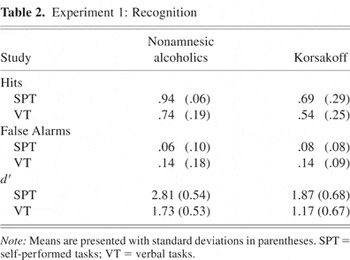
Table 2 shows mean proportions of “hits” and “false alarms” in recognition memory. Based on the signal detection theory, d′ scores also were calculated as a discrimination index, as shown at the bottom of Table 2. These d′ scores were submitted to a 2 (group) × 2 (study) ANOVA. A significant main effect of group was evident: F(1,14) = 12.04, MSE = .376, p < .01, η2 = .46. This indicated that recognition performance of the nonamnesic alcoholic group (M = 2.27) was superior to that of the Korsakoff group (M = 1.52). The main effect of study also was significant [F(1,14) = 17.44, MSE = .369, p < .001, η2 = .56], reflecting that both of the participant groups showed a recognition advantage for SPTs (M = 2.34) over VTs (M = 1.45). Interaction between group and study did not approach significance (F < 1, observed power = .13).
Experiment 1: Recognition

Discussion
Results of Experiment 1 replicated previous findings concerning SPT memory in persons with Korsakoff's syndrome (Mimura et al., 1998). As evaluated using free-recall and recognition tests, the control group exhibited better memory performance following SPTs than following VTs, demonstrating a typical enactment effect. The enactment effect was also confirmed in the persons with Korsakoff's syndrome, although their overall free-recall and recognition performance was poorer than that in the nonamnesic alcoholic group.
The possibility that the memory advantage of SPTs over VTs in memory-impaired individuals might be attributable to presentation of real objects rather than enactment has been difficult to rule out. In previous studies (Larsson & Ronnberg, 1987; Mimura et al., 1998), memory-impaired individuals were required to learn SPTs with real objects and VTs with no real objects. In contrast, the materials used for SPTs and VTs in Experiment 1 were action phrases involving no real objects; the result suggested that enactment enhances recall and recognition performance by persons with Korsakoff's syndrome, even if no real objects are presented.
EXPERIMENT 2
In Experiment 2 we further explored the enactment effect in persons with Korsakoff's syndrome by adding a self-generation procedure to the SPT condition. Participants under the Verbal generation-SPT condition were presented with an object noun and were required to verbally generate and then perform an action. Memory performance under the Verbal generation-SPT condition was compared with that under a Read condition in which participants were to memorize an object name by saying it aloud. As described earlier, one of the problems concerning a Self-generation-SPT paradigm is that the content of actions performed during the study depends on the participant's generation, which impedes comparison of memory performance across different experimental conditions. To parallel the items to be remembered, we asked participants to remember the object nouns rather than the names of actions. In addition to the Verbal generation-SPT and Read conditions, another study condition, called the Verbal generation condition, was designed to detect the contribution of verbal generation without action to memory performance. The Verbal generation and Read conditions were assumed to reflect qualitatively different types of verbal encoding, deep conceptual elaboration and simple repetition, respectively.
Verbally generating an action was expected to enhance memory performance of persons with Korsakoff's syndrome. Generation and enactment are assumed to rely on similar cognitive processes, since both tasks require good item-specific encoding with little reliance on relational encoding (Engelkamp & Zimmer, 1997). Persons with amnesia (Mimura et al., 1998) and persons with Alzheimer's Disease (AD) (Hutton et al., 1996; Karlsson et al., 1989; Lekeu et al., 2002) both have been shown to benefit from SPT encoding. Persons with AD also exhibited memory improvement following generation of a target (Fleischman et al., 1995; Multhaup & Balota, 1997) or generation of a retrieval cue during encoding (Lipinska et al., 1994). Persons with amnesia therefore would be expected to benefit from generation during encoding.
Investigating SPT memory of persons with Korsakoff's syndrome under the Self-generation-SPT paradigm is of great significance from the perspective of memory rehabilitation. In most real-world situations, actions to be performed only rarely are predetermined by another person. For this reason, the Verbal generation-SPT condition is considered a more ecologically valid training situation than the standard SPT condition. Moreover, both generating and performing an action phrase, compared with solely listening to the phrase, would be expected to promote patients' active participation in the learning environment. Wilson et al. (1994) have argued that active participation of amnesic persons is an important prerequisite for successful memory rehabilitation.
To our knowledge, however, little is known about SPT memory in persons with amnesia under the Self-generation-SPT paradigm. A hint may be found in the results of a study by Nilsson and Cohen (1988), in which college undergraduates were given a real object for which they were requested to generate an action and then to perform it. The recall performance under the Verbal generation-SPT condition was compared with that under the SPT condition without generation. Analogously, a verbal generation effect was also examined under VT conditions. Verbal generation was found to enhance the recall of VTs; in contrast, no recall advantage of verbal generation was found for SPTs. Nilsson and Cohen concluded that because sufficient item-specific encoding had been induced by enactment under the SPT condition, little room remained for further improvement when the verbal generation procedure was added under the Verbal generation-SPT condition. One may argue that the overall memory performance of persons with amnesia is decidedly poorer than that of college undergraduates. Accordingly, room for further improvement of memory performance may remain in persons with amnesia. Persons with Korsakoff's syndrome thus were expected to show better memory performance under the Verbal generation-SPT condition than that under the Verbal generation or Read condition. In Experiment 2, we examined whether enhancement by enactment was found under the Verbal generation-SPT paradigm by comparing persons with Korsakoff's syndrome, age-matched nonamnesic alcoholics, and young college students as research participants.
Method
Design
The design was a 3 × 3 mixed factorial with group (Korsakoff vs. nonamnesic alcoholics vs. young controls) as a between-subjects factor and study (Verbal generation-SPT vs. Verbal generation vs. Read) as a within-subjects factor. Each participant was tested for both free recall and recognition.
Research Participants
Included in the experiment were 12 persons with Korsakoff's syndrome, 12 chronic nonamnesic alcoholics, and 18 young adults. All participants were native Japanese. Because the persons with Korsakoff's syndrome and nonamnesic alcoholic individuals in Experiment 2 were recruited at Komagino Hospital 3 to 9 months after the completion of Experiment 1, these participants partially overlapped those in Experiment 1; five of the persons with Korsakoff's syndrome in Experiment 1 also participated in Experiment 2. No signs of additional neurologic or psychiatric illness were present. Mean scores (SD) of persons with Korsakoff's syndrome for verbal and performance IQ on the WAIS–R were 92.6 (11.5) and 89.1 (12.8), and mean scores (SD) for attention/concentration and delayed recall indices on the WMS–R were 90.9 (11.5) and 55.9 (16.8). The nonamnesic alcoholics were selected from the same population as those in Experiment 1, and two of them also had participated in Experiment 1. Persons with Korsakoff's syndrome [Mean age (SD) + Mean education (SD) = 54.3 (7.3) + 13.2 (2.8)] and nonamnesic alcoholics [Mean age (SD) + Mean education (SD) = 52.5 (7.9) + 12.9 (2.6)] were comparable in age, gender, ethnicity, and educational background. The young adults were undergraduate students from Shinshu University (Mean age = 21.2 years) who received course credit for their participation.
Materials
A total of 120 nouns designating an object served as stimulus items. The mean frequencies of these nouns were 0.05 per million (SD = 0.03). The 120 items were divided into six sets of 20 items. For each participant, three of the six sets were assigned as study lists, whereas the remaining three sets were used as distractor items presented in the recognition tests. Assignment of study lists and the assignment of study conditions were counterbalanced across participants. Nine additional nouns representing object names were chosen as standardized practice items presented at the beginning of the three study conditions.
Procedure
Participants were examined individually. Each person participated in three sessions, separated by at least 1 week. Mean intervals between the first and second sessions and those between the second and third sessions, respectively, were 3.2 weeks and 3.4 weeks in persons with Korsakoff's syndrome and 3.1 weeks and 3.2 weeks in nonamnesic alcoholic participants. The order of study conditions was counterbalanced across participants. All participants completed all three sessions.
Each session consisted of study and test phases. In the Verbal generation-SPT condition, participants were instructed to generate an act that could be performed with the object whose name was presented, first by describing this act aloud and then by performing the act. In the Verbal generation condition, participants were instructed to generate an act that they could perform with the object named, and then to speak the phrase that they had generated, but were not requested to perform the act. In the Read condition, participants were instructed to memorize an object name by saying it aloud four times.
After the instructions, a study phase followed. Three practice items were presented visually via an Apple Macintosh computer. Participants in the Verbal generation-SPT and Verbal generation conditions were required to generate the act, but the act was actually performed only in the former condition. If they showed difficulty in generating an act during the practice trials, they were given possible examples of action verbs and were asked to actually perform one of the actions. A list of 20 study items was then visually presented at a rate of 10 seconds per item. Pretest clinical observation established that none of the persons with Korsakoff's syndrome had difficulties in speech/language or ideomotor praxis. All participants successfully obeyed verb generation and enactment commands in the Verbal generation-SPT and Verbal generation conditions.
An immediate free recall test was given after presentation of each list of items. A recognition test was presented as the final memory test. A total of 24 test items including 12 study and 12 distractor items were presented singly in random order. To avoid a ceiling effect, participants in the young adult group were given a retention interval that lasted about 15 minutes, during which they played a computer game.
Results
Mean proportions of items recalled under the three study conditions are shown in Table 3. A 3 (group: Korsakoff vs. nonamnesic alcoholics vs. young controls) × 3 (study: Verbal generation-SPT vs. Verbal generation vs. Read) mixed ANOVA demonstrated a significant main effect of group [F(2,39) = 44.65, MSE = .036, p < .001, η2 = .70] and also of study [F(2,78) = 7.68, MSE = .012, p < .001, η2 = .17]. No interaction occurred between the two factors [F(4,78) = 1.43, MSE = .012, observed power = .43]. Post hoc comparisons using Fisher's least significant difference (LSD) test with an alpha of .05 indicated that the young control group (M = .49) recalled more than the nonamnesic alcoholics (M = .25) or the persons with Korsakoff's syndrome (M = .12), although the difference between the nonamnesic alcoholics and the persons with Korsakoff's syndrome did not reach significance. Post hoc analysis of the main effect of study, using Fisher's LSD with an alpha of .05, demonstrated that recall performance in the Verbal generation-SPT condition (M = .38) was better than that in the Verbal generation and Read conditions (Ms = .29).
Experiment 2: Recall

Table 4 displays hit and false alarm rates, together with d′ scores. Discrimination ability was analyzed by entering the d′ scores into a 3 (group) × 3 (study) ANOVA. Significant main effects were seen for group [F(2,39) = 15.46, MSE = 1.120, p < .001, η2 = .44], and also for study [F(2,78) = 16.77, MSE = .309, p < .001, η2 = .30]. Post hoc analysis using Fisher's LSD with an alpha of .05 demonstrated that d′ scores of the young controls (M = 2.95) and nonamnesic alcoholics (M = 2.80) did not differ, but were superior to the score in the Korsakoff group (M = 1.74). In the Verbal generation-SPT (M = 2.81) and Verbal generation (M = 2.70) conditions, d′ scores did not significantly differ, but they exceeded those for the Read condition (M = 2.16). No significant interaction was detected between the two factors (F < 1, observed power = .25), confirming that the advantage of the Verbal generation-SPT and Verbal generation conditions over the Read condition was observable across the three participant groups.
Experiment 2: Recognition

Discussion
Previous findings predicted that enactment and verbal generation might additively enhance item-specific processing, leading to memory improvement—especially in persons with Korsakoff's syndrome, whose episodic memory is known to be extremely poor. Analysis of recall performance demonstrated that verbally generating an action is not sufficient; performing the action is necessary to produce an advantageous effect over reading an object name. Our finding that a Verbal generation effect failed to emerge for recall, even in young adults, disagreed with that of Nilsson and Cohen (1988). Procedural differences may have contributed to this inconsistency. In Experiment 2, an object name was consistently presented to participants across all study conditions, whereas in Nilsson and Cohen's experiment real objects were presented under the SPT condition but not under the VT condition. Also, in our Experiment 2, participants were asked to remember object names rather than actions that could be performed with the objects; in contrast, to-be-remembered items were action phrases in Nilsson and Cohen's experiment in which the participants under the VT condition were required to remember action phrases yoked to those under the SPT condition.
Results showed a different pattern when they were assessed by recognition memory. Across all participant groups, the typical generation effect showed that the d′ score under the Verbal generation condition was superior to that under the Read condition. Yet, further improvement did not emerge when enactment in addition to generation was introduced under the Verbal generation-SPT condition. Hit rates of comparison groups under the Verbal generation condition revealed a ceiling effect, indicating that further improvement is difficult even when enactment is additionally required. In contrast, hit rates of persons with Korsakoff's syndrome under the Verbal generation condition did not reach a ceiling, but nevertheless the addition of enactment did not enhance the hit rate (Verbal generation-SPT condition).
A conventional hypothesis premised that verbal generation and enactment additively emphasize item-specific processing, which is regarded as the critical determinant for successful recognition. Engelkamp (1998) has proposed a more advanced view of item-specific encoding, where item-specific information should be differentiated further depending on different subsystems involved. More recently, functional brain imaging studies have suggested that object concepts may be represented, in part, by distributed networks of discrete cortical regions that parallel the organization of sensory (e.g., physical form, color) and motor systems (Martin & Chao, 2001). Specifically, access to motion-related attributes is crucial for identification of tools. In addition, motor-related brain areas appear to be activated without actually using tools. Even generating action words to tools (Grafton et al., 1997) or imaging manipulating objects with the right hand (Gerardin et al., 2000) also result in ventral premotor activation.
In Experiment 2, verbal generation of an action is assumed to primarily activate the conceptual type of motor-related information; performing an action is thought to lead to further activation of motor programs, as well as activation of the word nodes and the action concept. Addition of SPTs under the Verbal generation-SPT condition, as compared with the Verbal generation condition, might make no further contribution to conceptual motor-related processing, but still make a key contribution to stable motor-specific processing. In free recall, participants can benefit from enhancement of motor-specific encoding, which enables them during retrieval to directly access the to-be-remembered items (Zimmer et al., 2000). In recognition, however, conceptual motor-related processing may suffice, with actual motor-specific information adding rather little.
GENERAL DISCUSSION
Results of the two experiments reported here suggest that persons with Korsakoff's syndrome can benefit from enactment during encoding under a variety of learning conditions. Whether the benefit from SPTs previously found in persons with Korsakoff's syndrome (Mimura et al., 1998) is attributable to enactment or use of real objects during encoding has been unclear. In our Experiment 1, persons with Korsakoff's syndrome and nonamnesic comparison participants demonstrated a memory advantage of SPTs over VTs when action phrases used in both tasks did not involve any extra-environmental objects. We estimated effect sizes of SPT recall and recognition advantage over VT in our Experiment 1 and those of Mimura et al.'s experiment (1998). Effect sizes (Cohen's d) were calculated by dividing the mean differences (SPT − VT) by the pooled standard deviations (Cohen, 1988). In our Experiment 1, the effect sizes of SPT recall were 1.41 for persons with Korsakoff's syndrome and 0.78 for the nonamnesic comparisons; almost comparable values were obtained in Mimura et al.'s experiment (d = 1.84 for Korsakoff; d = 0.76 for comparisons). In a similar vein, the effect sizes of SPT recognition (d = 1.04 for Korsakoff; d = 2.02 for comparisons) in our Experiment 1 were also comparable to those (d = 1.02 for Korsakoff; d = 2.10 for comparisons) of Mimura et al.'s study. The analysis of the effect sizes hence suggests that an enactment effect occurs to a similar degree irrespective of the presence or absence of real objects during encoding.
Experiment 2 sought to examine whether persons with Korsakoff's syndrome exhibit an enactment effect under yet another condition in which, preceding enactment during encoding, they were required to verbally generate any action that could be carried out with the object designated by its visually presented name. Compared with the Read condition, the Verbal generation-SPT condition enabled persons with Korsakoff's syndrome, as well as nonamnesic young and elderly comparison participants, to improve free-recall of object names. When rich environmental support is available, such as presentation of copy cues in a recognition memory test, either generation or enactment alone appears to be sufficient to enhance memory performance; in contrast, when environmental support is minimal, as in a free-recall test, generation and enactment are thought to contribute additively to memory improvement.
These findings carry practical implications for effective memory rehabilitation in persons with amnesia. Because of impaired ability to retain and/or recall relevant information, persons with amnesia are known to have severe difficulty in adapting to environmental requests. The domain-specific learning approach to memory rehabilitation, proposed by Glisky et al. (1994), aims at teaching persons with amnesia knowledge or skills useful in everyday life by exploiting their residual memory abilities. Relative to explicit memory, implicit memory is well preserved in amnesia. Interventions, believed to capitalize on implicit rather than explicit memory, such as the method of vanishing cues (Glisky et al., 1986) and errorless learning (Baddeley & Wilson, 1994), can lead to memory improvement, thereby alleviating the difficulties that patients face within real-life situations. Enactment during encoding is likely to be another intervention that relies on preserved memory in persons with amnesia. Nilsson et al. (2000) demonstrated, using positron emission tomography (PET), that the advantageous effect of SPTs over VTs was attributable to activity in motor areas of the brain. For this reason, persons with brain damage of differing etiologies but with an intact motor system are expected to benefit from encoding support in the form of enactment, as confirmed by the present study.
Recently, Kessels and de Haan (2003) have conducted a meta-analysis on the treatment effects of two kinds of memory rehabilitation techniques, errorless learning and the method of vanishing cues, both of which are based on intact learning capacity in persons with amnesia. As a result of the meta-analysis, which included eight studies for errorless learning and three for the method of vanishing cues, a large and statistically significant effect size (d = 0.87) was found for errorless learning treatment, but no significant effect size (d = 0.27) was demonstrated for the vanishing cues method. In our Experiment 2, the effect sizes of Verbal generation-SPT recall advantage over VT were 0.84, 0.62, and 0.76 for the young control, nonamnesic alcoholic, and Korsakoff groups, respectively. These values can be considered to be medium to large and to be close to the effect size of errorless learning treatment.
Finally, four limitations of the present study are important to note. First, our small sample size led to poor statistical power, which precluded a firmer conclusion that no interactions took place between participant group and study condition in either Experiment 1 or 2. Second, no independent variables employed in the present study permitted persons with Korsakoff's syndrome to fully compensate for their memory deficit, but SPT encoding or its combination with verbal generation enhanced memory performance in all groups to a similar degree. Third, stimuli were presented only once during study, and only immediate recall was examined. Future studies should investigate the durability of gains from SPT encoding and verbal generation by using multiple learning trials and longer delays between study and test. Fourth, from a rehabilitation perspective, the memory advantage of SPTs found in the present study should extend to real-world tasks, such as learning the layout of the facility.
APPENDIX

References
REFERENCES
Backman, L.,
Nilsson, L.-G., &
Chalom, D.
(1986).
New evidence on the nature of the encoding of action events.
Memory & Cognition,
14,
339–346.CrossRefGoogle Scholar
Baddeley, A. &
Wilson, B.A.
(1994).
When implicit learning fails: Amnesia and the problem of error
elimination.
Neuropsychologia,
32,
53–68.CrossRefGoogle Scholar
Cohen, J.
(1988).
Statistical power analysis for the behavioral sciences
(2nd ed.).
Hillsdale, NJ:
Erlbaum.
Cohen, R.L.,
Peterson, M., &
Mantini-Atkinson, T.
(1987).
Interevent differences in event memory: Why are some events more
recallable than others?
Memory & Cognition,
15,
109–118.Google Scholar
Earles, J.L.
(1996).
Adult age differences in recall of performed and nonperformed
items.
Psychology and Aging,
11,
638–648.Google Scholar
Engelkamp, J.
(1998).
Memory for actions.
Hove, UK:
Psychology Press.
Engelkamp, J. &
Zimmer, H.D.
(1994).
Human memory: A multimodal approach.
Kirkland, WA:
Hogrefe & Huber.
Engelkamp, J. &
Zimmer, H.D.
(1997).
Sensory factors in memory for subject-performed tasks.
Acta Psychologica,
96,
43–60.CrossRefGoogle Scholar
Fleischman, D.A.,
Gabrieli, J.D.E.,
Reminger, S.,
Rinaldi, J.,
Morrell, F., &
Wilson, R.
(1995).
Conceptual priming in perceptual identification for patients with
Alzheimer's disease and a patient with right occipital
lobectomy.
Neuropsychology,
9,
187–197.CrossRefGoogle Scholar
Gerardin, E.,
Sirigu, A.,
Lehéricy, S.,
Poline, J.B.,
Gaymard, B.,
Marsault, C.,
Agid, Y., &
Le Bihan, D.
(2000).
Partially overlapping neural networks for real and imagined hand
movements.
Cerebral Cortex,
10,
1093–1104.CrossRefGoogle Scholar
Glisky, E.L.,
Schacter, D.L., &
Butters, M.A.
(1994).
Domain-specific learning and remediation of memory
disorders. In
M.J. Riddoch &
G.W. Humphreys (Eds.),
Cognitive neuropsychology and cognitive rehabilitation (pp.
527–548).
Hove, UK:
L. Erlbaum Associates.
Glisky, E.L.,
Schacter, D.L., &
Tulving, E.
(1986).
Learning and retention of computer-related vocabulary in
memory-impaired patients: Method of vanishing cues.
Journal of Clinical and Experimental Neuropsychology,
8,
292–312.CrossRefGoogle Scholar
Grafton, S.T.,
Fadiga, L.,
Arbib, M.A., &
Rizzolatti, G.
(1997).
Premotor cortex activation during observation and naming of familiar
tools.
Neuroimage,
6,
231–236.CrossRefGoogle Scholar
Hutton, S.,
Sheppard, L.,
Rusted, J.M., &
Ratner, H.H.
(1996).
Structuring the acquisition and retrieval environment to facilitate
learning in individuals with dementia of the Alzheimer type.
Memory,
4,
113–130.CrossRefGoogle Scholar
Japan Society for Higher Brain Dysfunction
(1997).
Manual for the Standard Language Test of Aphasia.
Tokyo:
Shinko Igaku Shuppan.
Japan Society for Higher Brain Dysfunction
(2001).
Manual for the Standard Performance Test of Apraxia.
Tokyo:
Shinko Igaku Shuppan.
Karlsson, T.,
Backman, L.,
Herlitz, A., &
Nilsson, L.-G.
(1989).
Memory improvement at different stages of Alzheimer's
disease.
Neuropsychologia,
27,
737–742.CrossRefGoogle Scholar
Kessels, R.P.C. &
de Haan, E.H.F.
(2003).
Implicit learning in memory rehabilitation: A meta-analysis on
errorless learning and vanishing cues methods.
Journal of Clinical and Experimental Neuropsychology,
25,
805–814.CrossRefGoogle Scholar
Komatsu, S.,
Mimura, M.,
Kato, M.,
Wakamatsu, N., &
Kashima, H.
(2000).
Errorless and effortful processes involved in the learning of
face-name associations by patients with alcoholic Korsakoff's
syndrome.
Neuropsychological Rehabilitation,
10,
113–132.CrossRefGoogle Scholar
Kopelman, M.D.
(1995).
The Korsakoff syndrome.
British Journal of Psychiatry,
166,
154–173.Google Scholar
Larsson, C. &
Ronnberg, J.
(1987).
Memory disorders as a function of traumatic brain injury.
Scandinavian Journal of Rehabilitation Medicine,
19,
99–104.Google Scholar
Lekeu, F.,
Van der Linden, M.,
Moonen, G., &
Salmon, E.
(2002).
Exploring the effect of action familiarity on SPTs recall
performance in Alzheimer's disease.
Journal of Clinical and Experimental Neuropsychology,
24,
1057–1069.CrossRefGoogle Scholar
Lichty, W.,
Bressie, S., &
Krell, R.
(1988).
When a fork is not a fork: Recall of performed activities as a
function of age, generation, and bizarreness. In
M.M. Gruneberg,
P.E. Morris, &
R.N. Sykes (Eds.),
Practical aspects of memory: Current research and issues
(Vol. 1, pp.
506–511).
Chichester, UK:
Wiley.
Lipinska, B.,
Backman, L.,
Mantyla, T., &
Viitanen, M.
(1994).
Effectiveness of self-generated cues in early Alzheimer's
disease.
Journal of Clinical and Experimental Neuropsychology,
19,
809–819.CrossRefGoogle Scholar
Martin, A. &
Chao, L.L.
(2001).
Semantic memory and the brain: Structure and processes.
Current Opinion in Neurobiology,
11,
194–201.CrossRefGoogle Scholar
Mimura, M.,
Komatsu, S.,
Kato, M.,
Yoshimasu, H.,
Wakamatsu, N., &
Kashima, H.
(1998).
Memory for subject performed tasks in patients with Korsakoff
syndrome.
Cortex,
34,
297–303.CrossRefGoogle Scholar
Multhaup, K.S. &
Balota, D.A.
(1997).
Generation effects and source memory in healthy older adults and in
adults with dementia of the Alzheimer type.
Neuropsychology,
11,
382–391.CrossRefGoogle Scholar
Nilsson, L.-G. &
Cohen, R.L.
(1988).
Enrichment and generation in the recall of enacted and non-enacted
instructions. In
M.M. Gruneberg,
P.E. Morris, &
R.N. Sykes (Eds.),
Practical aspects of memory: Current research and issues
(Vol. 1, pp.
427–432).
Chichester, UK:
Wiley.
Nilsson, L.-G.,
Nyberg, L.,
Klingberg, T.,
Aberg, C.,
Persson, J., &
Roland, P.E.
(2000).
Activity in motor areas while remembering action events.
NeuroReport,
11,
2199–2201.CrossRefGoogle Scholar
Norris, M.P. &
West, R.L.
(1991).
Age differences in the recall of actions and cognitive activities:
The effects of presentation rate and object cues.
Psychological Research,
53,
188–194.Google Scholar
Spitzer, R.L.,
Williams, J.B.W.,
Gibbon, M., &
First, M.B.
(1990).
Structured clinical interview for DSM-III-R (SCID): User's
guide.
Washington, DC:
American Psychiatric Association Press.
Wechsler, D.
(1981).
Manual for the Wechsler Adult Intelligence
Scale–Revised.
New York:
Psychological Corporation.
Wechsler, D.
(1987).
Wechsler Memory Scale; revised manual.
New York:
Psychological Corporation.
Wilson, B.A.,
Baddeley, A.,
Evans, J., &
Shiel, A.
(1994).
Errorless learning in the rehabilitation of memory impaired
people.
Neuropsychological Rehabilitation,
4,
307–326.CrossRefGoogle Scholar
Zimmer, H.D.,
Helstrup, T., &
Engelkamp, J.
(2000).
Pop-out into memory: A retrieval mechanism that is enhanced with the
recall of subject-performed tasks.
Journal of Experimental Psychology: Learning, Memory, and
Cognition,
26,
658–670.Google Scholar

Experiment 1: Recall
Experiment 1: Recognition

Experiment 2: Recall

Experiment 2: Recognition
 You have
Access
- 7
- Cited by