Introduction
Myringoplasty has a long history which dates back to the last decades of the nineteenth century.Reference Adkins and White1 However, some aspects of this surgical operation are still controversial, especially with regard to underlay or overlay placement of the graft in relation to the eardrum remnants, annulus and malleus. The overlay technique provides optimal exposure of the tympanic plane and is particularly suggested for large perforations. Although it guarantees an adequate middle-ear volume, this technique is time-consuming, requires increased healing time, and risks graft lateralisation or blunting and formation of cholesteatoma pearls if removal of the squamous epithelium is incomplete. Underlay myringoplasty is generally preferred to the overlay technique due to its relative simplicity, requiring placement of the graft under the annulus and the manubrium without the need for de-epithelialisation. On the other hand, there is the risk of graft collapse, middle-ear volume reduction and adhesion of the graft to the promontory, especially when the malleus is rotated medially.
In an attempt to minimise the disadvantages of the two techniques, some authorsReference Stage and Bak-Pedersen2–Reference Kartush, Michaelides, Becvarovski and LaRouere4 have reported a modified method in which the graft is placed laterally to the malleus and medially to the tympanic remnants and annulus. This ‘over-under’ myringoplastyReference Kartush, Michaelides, Becvarovski and LaRouere4 allows excellent exposure of the anterior middle ear, facilitates direct placement of an ossicular prosthesis under the malleus, and minimises the risk of medialisation or lateralisation of the tympanic membrane. The results of over-under myringoplasty have been reported to be excellent in terms of graft take, absence of complications and auditory outcome.Reference Potsic, Winawer and Marsh3–Reference Yigit, Alkan, Topuz, Uslu, Unsal and Dadas5 Although no case of obvious lateralisation of the tympanic membrane has been indicated,Reference Potsic, Winawer and Marsh3–Reference Yigit, Alkan, Topuz, Uslu, Unsal and Dadas5 it is unlikely that a graft laying over the manubrium will firmly attach to it down to the umbus, restoring the physiological conical shape of the membrane. The malleus moves inferiorly and medially from the lateral process to the umbus and the degree of medialisation is quite variable, with a distance from the promontory that may be as short as 1 mm or less. Therefore, even a graft which shows complete adhesion to the entire manubrium on completion of surgery may detach from its most medial portion during the healing process because of shrinking and scarring.Reference Yigit, Alkan, Topuz, Uslu, Unsal and Dadas5
In a series of 37 tympanoplasty revisions performed by the authors, the tympanic membrane, reconstructed during the primary operation using the over-under myringoplasty technique, appeared to be detached from the malleus tip for a length of 1 to 4 mm in 22 ears (62.1 per cent) (unpublished data). Based on these findings, we changed our surgical technique of over-under myringoplasty such that the tympanic graft was anchored to the umbus. The present paper illustrates the technical details of the operation, outlines the anatomical and auditory results, and discusses the physiological tenets underlying the need to maintain a conical tympanic membrane.
Material and methods
A total of 78 umbus-anchored over-under myringoplasties were performed from 2004 to 2006 in 63 patients with no prior history of otological surgery. The patients' average age was 38 years (range, eight to 75 years), and the male/female ratio was 1.1:1 Myringoplasty, performed either via the transcanal (n = 18) or postauricular (n = 25) approach, was the sole procedure in 43 ears (55.1 per cent). Twenty-four ears (30.7 per cent) had an associated intact canal wall mastoidectomy via the postauricular approach, due to simple chronic otitis media (n = 14) or cholesteatoma (n = 10). Eleven ears (14.1 per cent) had an endaural atticotomy due to attic cholesteatoma (n = 7) or malleus head fixation (n = 4). Ossiculoplasty was performed in 24 ears (30.8 per cent); in the remaining 54 ears, it was not necessary or was deferred as second-stage surgery.
Surgical technique
The procedure was performed using the transcanal, endaural or postauricular approach, depending on the localisation of the perforation and the possible associated pathology.
The endaural and meatal skin, and postauricular region when necessary, were infiltrated with a 1:100 000 dilution of adrenalin in 2 per cent mepivacaine hydrochloride. Autologous temporal fascia or, alternatively, bovine pericardium (Tutopatch; Tutogen Medical Inc, Alachua, Florida, USA) was used for tympanic membrane repair. The margins of the perforation were refreshed by debriding the epithelium, along with the marginal scar tissue, using a sharp dissector and micro-crocodile forceps.
A posterior meatal skin incision was made from 6 o'clock to 11 o'clock (for the left ear) or from 6 o'clock to 13 o'clock (for the right ear), 6–7 mm from the annulus. A tympanomeatal flap was elevated up to the malleus, with extraction of the posterior annulus from its bony sulcus. Shrapnell's membrane was also raised in continuity with the anterosuperior portion of the eardrum. The antero-inferior portion of the tympanic membrane was occasionally elevated to facilitate exploration of the hypotympanum.
The malleus was then freed from the tympanic membrane in a subperiosteal plane, using a combination of blunt and sharp dissections in a superior to inferior direction. To this end, the tympanic membrane was sharply divided with a sickle knife from the lateral malleolar process, and was then slid along the malleus with the aid of a small cottonoid. Longitudinal periosteal incision along the posterior surface of the malleus was often necessary to facilitate this manoeuvre. The tympanic membrane was left attached to the umbus and occasionally to the adjacent portion of the manubrium.
The middle ear was then inspected and the necessary surgical steps (e.g. removal of inflammatory mucosa or ossiculoplasty) were performed. When indicated, mastoidectomy or atticotomy was also accomplished.
Tympanic membrane reconstruction utilised a large graft fashioned in order to cover the entire area enclosed by the tympanic ring and portion of the posterior osseous ear canal. A radial slit was made in the flap to enable its placement around the attachment of the tympanic membrane to the umbus (Figure 1a). The graft was carefully distended under the tympanic remnants and annulus, and the two tongues were positioned to surround the umbus area. In order to minimise the possibility of dehiscence, the two tongues were overlapped and positioned under the non-perforated portion of the tympanic membrane (Figure 1b). The tympanomeatal flap was then replaced over the graft and the external auditory canal. Spongostan (Johnson & Johnson, Raritan, New Jersey, USA) was placed in the tympanic cavity to support the graft and in the external auditory canal to stabilise the drum remnants on the graft and malleus.
(a) The elevated tympanomeatal flap is left anchored to the umbus, and a radially sliced graft is inserted to engage the area of adhesion between the tympanic membrane and the umbus. (b) The two graft flaps are overlapped to surround the umbus area and restore graft integrity.

Results
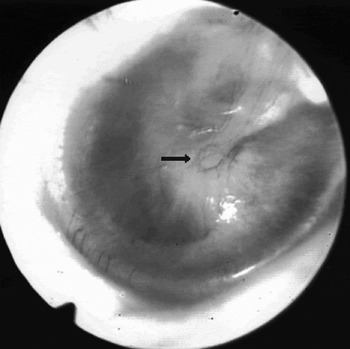
Graft take was obtained in 71 ears (91 per cent). Residual perforations were localised in the anterosuperior (n = 4) and antero-inferior (n = 3) quadrants. One patient showed atelectasis, whereas no lateralisation or blunting were observed. In ears with complete successful repair, the tympanic membrane retained a conical shape, observed via endoscopic and microscopic inspection (Figure 2). At the time of writing, 14 ears had undergone a ‘second look’ to evaluate the persistence of cholesteatoma or to perform ossiculoplasty. All revised ears have shown complete attachment of the tympanic membrane to the manubrium.
The conical shape of the tympanic membrane is preserved after umbus-anchored ‘under-over’ myringoplasty. The arrow indicates perfect adherence of the tympanic membrane to the umbus.

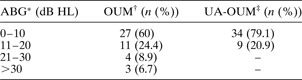
Comprehensive audiometric evaluation was beyond the aim of the present paper, since hearing outcome is influenced not only by the final anatomical outcome of myringoplasty but also by the primary pathology and the associated surgery in the middle ear and/or mastoid. The auditory results for 43 isolated umbus-anchored over-under myringoplasties are briefly reported, and retrospectively compared with results for 45 ears undergoing isolated traditional over-under myringoplasty, from 2002 to 2004. The residual air–bone gap, calculated as the difference between post-operative air and bone conduction thresholds at 0.5, 1, 2, and 3 kHz, was judged as satisfactory (i.e. ≤20 dB) in 100 per cent of ears undergoing umbus-anchored over-under myringoplasty, and in 84.4 per cent of ears undergoing over-under myringoplasty alone (Table I). The average air–bone gap was 6.7 and 11.9 dB, respectively (p = 0.04; Student's t-test).
Residual Air–Bone Gap (ABG) After ‘Over-Under’ Myringoplasty (OUM) and Umbus-Anchored Over-Under Myringoplasty (UA-OUM)
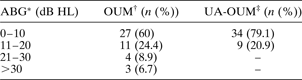
* Calculated as average thresholds at 0.5, 1, 2 and 3 kHz. †n = 45; ‡n = 43. HL = hearing loss
The average bone conduction threshold at 4 kHz was also assessed, in order to investigate possible sensorineural deterioration due to inner-ear trauma. Umbus-anchored over-under myringoplasty yielded an average improvement of 4 dB (range, −15 to 20). In contrast, over-under myringoplasty showed an average deterioration of 8.2 dB at the 4 kHz bone conduction threshold (range, −25 to 18) (p = 0.03; Student's t-test).
Discussion
Over-under myringoplasty is a versatile technique which may be employed to repair most tympanic membrane perforations. It implies complete detachment of the tympanic membrane from the malleus and placement of the graft over the manubrium, under the drum remnants and the annulus. The technique exhibits the advantages of both ‘over’ and ‘under’ myringoplasties, enabling wide visualisation of the tympanic cavity and minimising the risk of graft collapse, residual perforation, volumetric reduction of the middle-ear cavity, lateralisation and blunting.Reference Stage and Bak-Pedersen2–Reference Kartush, Michaelides, Becvarovski and LaRouere4
The main disadvantage of the technique is manipulation of the malleus, a manoeuvre which may traumatise the inner ear, especially when elevating the tympanic membrane from the umbus (to which it is firmly attached). At this level, the connective layer of the tympanic membrane is attached to the periosteum, and dissection must be cautious and necessarily tedious. Since the ossicular chain acts as a first-class lever, any force exerted on the apical portion of the malleus maximises its effects on the resistance arm of the lever (i.e. incus, stapes and inner-ear fluids), with the risk of sensorineural hearing loss. The firm attachment of the membrane to the umbus demands extra caution during dissection, as laceration of the residual tympanic membrane may occur and residual epithelial remnants may be left unnoticed on the malleus. In addition, graft placement under the tympanic remnants and annulus, although able to prevent true lateralisation of the eardrum from the plane of the tympanic ring, should not influence the relationship between the graft and the manubrium, which is mostly medial to this plane. The graft may detach from the malleus, especially from its most medial portion, during the healing process,Reference Yigit, Alkan, Topuz, Uslu, Unsal and Dadas5 with consequent reduction in sound transfer efficiency.
The tympanic membrane and ossicular chain constitute a sophisticated transformer system able to match the impedance of the air in the auditory meatus to the much higher impedance of the cochlear fluids. In particular, the mechanical advantage of the first-class lever constituted by the ossicular chain depends on the length of the arm to which the force is exerted. Since the tympanic membrane adheres to the entire length of the manubrium, there are as many levers as there are sites of contact between the two structures. Another important transformer mechanism is the catenary effect; this depends on the curvature of the tympanic membrane, which is mainly conferred by its strict adherence to the manubrium. This mechanism utilises the principle that the product of velocity and pressure remains constant, with the consequence that pressure is greatest in the least mobile portion of the system, i.e. the manubrium. This mechanism has been indicated by Khanna and TonndorfReference Khanna and Tonndorf6 as the most important determinant of the impedance-matching function of the middle ear.
When the tympanic membrane is not in contact with the distal portion of the malleus, both the lever and catenary effects are impaired. The reduced length of the active arm deprives the lever of its most effective portion, which is located distally to the rotation axis passing through the incudo-malleolar joint. As far as the catenary effect is concerned, the limited area of contact with the manubrium reduces or abolishes the conical shape of the tympanic membrane, which lacks the stiffness needed to drive the malleus. Fay et al.,Reference Fay, Puria and Steele7 utilising a mathematical model with computer simulation of the middle ear, showed that a shallow eardrum transfers less force to the ossicles than a conical eardrum, with a greater than 20 dB loss at high frequencies.
Modification of the over-under myringoplasty by anchoring the graft to the umbus obviates most of the drawbacks of this technique. First, it avoids the need for traumatising manoeuvres during dissection of the tympanic membrane from the malleus, since pressure is exerted on less critical portions of the lever. Second, it reduces the risk of further laceration of the tympanic membrane and creation of residual epithelial debris on the malleus. Third, it preserves the catenary and lever effects.