Natural disasters such as tsunamis can significantly damage infrastructure and cause morbidity and mortality, home damage, and population displacement. Tsunamis, which can occur following an earthquake, are a series of ocean waves generated by any disturbance that displaces a large water mass.Reference Boyarsky and Shneiderman1 Tsunami-related injuries may result from blunt force trauma, and deaths may occur immediately as a result of drowning or injuries sustained in the event aftermath. Illness may occur as a result of water source contamination or increased vector population, and mental health problems may occur because of stress or traumatic experience related to the tsunami.Reference Kiem2 The 2004 Asian tsunami, a particularly devastating event, resulted in more than 175 000 deaths, nearly 50 000 missing persons, and more than 1.7 million displaced persons in the Indian Ocean region.Reference Doocy, Robinson, Moodie and Burnham3
On September 29, 2009, an earthquake measuring 8.3 on the Richter scale struck 190 km southwest of American Samoa,4 an island territory with a population of 57 291 people.5 The resulting tsunami caused 34 deaths and widespread destruction of coastal homes, mainly in the capitol city of Pago Pago and western coast of Tutuila Island near the town of Leone.Reference Ritchie6 The waves damaged public utilities, resulting in immediate, widespread loss of water, electricity, and sanitation throughout Tutuila Island. In addition to injuries and deaths, many families were displaced from their homes and potentially exposed to environmental and other public health hazards.
The American Samoa Department of Health (ASDOH) requested assistance from the US Public Health Service (USPHS) and the Centers for Disease Control and Prevention (CDC) to assess the public health needs and health status of the affected population. In response, a team from the USPHS and the CDC was deployed to assist in conducting an initial (five days after tsunami) and follow-up (three weeks after the tsunami) Community Assessment for Public Health Emergency Response (CASPER).7 CASPER is a type of needs assessment that uses a two-stage cluster sampling method originally developed by the World Health Organization to assess immunization coverage.Reference Henderson and Sundaresan8 This methodology has been used previously to assess community needs and health status following natural disastersReference Bayleyegn, Wolkin and Oberst9Reference Zane, Bayleyegn and Haywood10 and provides household-based estimates of specific needs, injuries, and illnesses after a disaster.Reference Malilay, Flanders and Brogan11
The objectives of the initial CASPER were to rapidly identify basic public health needs of affected communities, special needs, and vulnerable populations, and environmental and other health hazards that might result in further morbidity and mortality. The follow-up CASPER objectives were to identify ongoing and newly emerged community public health issues and to assess the effectiveness of the public health response following the initial CASPER. This report summarizes and compares the findings of the initial and follow-up CASPERs conducted following the American Samoa earthquake and tsunami.
METHODS
Sample Selection
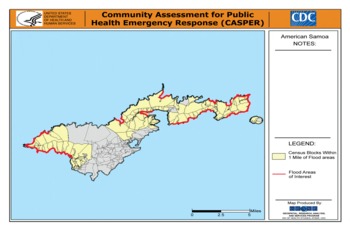
Based on ASDOH's visual surveys of Tutuila Island following the earthquake and tsunami and geospatial data from the National Oceanic and Atmospheric Administration (NOAA),12 our sampling frame for both CASPERs included all coastal census blocks affected by 15 ft of surge water, up to one mile inland (Figure). A total of 244 census blocks with one or more housing units was identified within our sampling frame. For both CASPERs, a two-stage cluster sampling methodology (30 clusters, 7 households) was used. We used ESRI ArcGIS software to select the clusters, represented by a single census block, in the first sampling stage. Using probability-proportionate-to-size, based on the number of housing units in each census block, we selected 30 census blocks (clusters) covering 16 villages from western Fagalii to eastern Alao. For the second stage of sampling, the team selected seven households within each selected census block. Once in the field, the teams randomly chose a starting point within the cluster and then systematically (ie, every nth house) selected the 7 households to interview for a goal of 210 household interviews.
Map of Sampling Frame for Initial and Follow-up CASPERs Following the Earthquake-Tsunami in American Samoa, 2009.

Survey Instrument
ASDOH, USPHS, and CDC jointly developed a two-page questionnaire for each CASPER. The questionnaire covered the following: medical needs; availability of medical care, food, drinking water, and clothing; and earthquake- and tsunami-related injuries, illnesses, and preexisting chronic conditions. For the follow-up CASPER, we adapted questions from the initial CASPER questionnaire and added questions based on ASDOH public health priorities for the recovery phase, including increases in disease vector problems and vector control measures. The interviewers kept tracking sheets to track response rates. We used confidential referral forms to report immediate needs pertaining to safety threats, such as chemical spills or acute medical needs (eg, need for urgent mental health counseling). In addition, we disseminated health education materials pertinent to the disaster and a list of public health and relief agencies to each household approached. The questionnaire was written in English; survey teams, consisting of at least one member who spoke Samoan, translated questions into Samoan when needed.
Data Collection
Before conducting interviews, CDC personnel trained the interview teams, which were composed of CDC and ASDOH staff. The training included instructions on selecting the households in the second stage of sampling, administering the interviews, and completing the referral and tracking forms. CDC also briefed the teams on Samoan culture, safety issues, field communication, and the local incident command system (ICS) structure. Teams conducted interviews from October 5-7, 2009, for the initial CASPER and October 22-24, 2009, for the follow-up. In each household, we interviewed one adult representative, aged at least 18 years or older.
Data Analysis
The data entry and analyses were performed using Epi Info 3.5.1. The percentage and estimates (ie, projected number of households based on weighted analysis using census 2000 data) for questionnaire items were calculated and reported. Contact rates were calculated by dividing the number of completed interviews by the number of all housing units where contact was attempted. Cooperation rates were calculated by dividing the number of completed interviews by the number of all housing units where contact was made. To compare the findings of the initial and follow-up CASPERs, the differences in response percentages were calculated using percent change, with the initial CASPER as baseline.
RESULTS
Initial CASPER
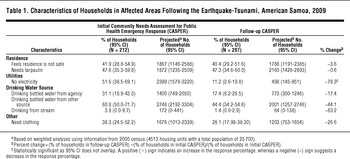
The interview teams conducted 212 interviews, with a contact rate of 77.9% and a cooperation rate of 98.1%. Thirty-two percent of households had at least one child younger than age 2 years, and 30% of households had at least one adult family member who was 65 years of age or older. Approximately 9% of households included at least one pregnant woman. Table 1 shows information on residence, utilities, drinking water, and other needs. During the initial CASPER, 42% of households believed that their house was not safe to live in, 47.6% reported needing a tarpaulin, and 51.6% reported a lack of electricity. Most households reported using bottled drinking water from either a relief agency (31.1%) or another source (60.8%), while a small percentage (3.8%) reported drinking stream water. Approximately 37% of households reported a need for clothing.
Characteristics of Households in Affected Areas Following the Earthquake-Tsunami, American Samoa, 2009

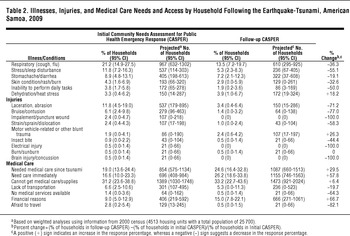
During the initial CASPER, the most frequent self-reported symptoms or conditions were respiratory conditions (21.2%), stress or sleep disturbance (11.8%), and stomach ache or diarrhea (9.0%). Lacerations (11.8%); bruises or contusions (6.1%); impalement or puncture wounds (2.4%); and strains, sprains, or dislocations (2.4%) were the most frequently reported injuries (Table 2). Nineteen percent of households reported needing medical care or supplies since the tsunami, 16.7% reported having immediate medical needs, and 23.5% reported anticipating needs within 3 to 7 days (Table 2). Thirty-nine percent of households reported barriers to obtaining medical care or supplies, including financial reasons (9%) and fear of traveling after the tsunami (2.8%).
Illnesses, Injuries, and Medical Care Needs and Access by Household Following the Earthquake-Tsunami, American Samoa, 2009

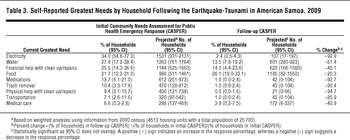
Table 3 shows households' greatest reported needs; respondents often gave more than one response. During the initial CASPER, the most frequently reported needs included electricity (34.0%), water (27.8%), and financial help (25.5%). Interview teams also made more than 25 medical referrals for persons in need of immediate medical care or supplies and arranged transportation for one critically ill patient to the emergency department.
Self-Reported Greatest Needs by Household Following the Earthquake-Tsunami in American Samoa, 2009

Follow-up CASPER
Three weeks after the tsunami, the interview teams conducted the follow-up CASPER, completing 207 interviews, with a contact rate of 88% and a cooperation rate of 99%. During the follow-up CASPER, 37% of households had at least one child younger than age 2 years, and 35.1% of households had at least one adult family member who was 65 years of age or older. Approximately 10% of the households included at least one pregnant woman. Forty percent of households felt their homes were not safe to live in, 47.3% reported needing a tarpaulin, and 11.2% reported a lack of electricity (Table 1). The majority (62.8%) of households reported using bottled water as their sole potable water source, and approximately 28% of the households reported a need for clothing.
During the follow-up CASPER, 13.5% of households reported respiratory symptoms, and 16% reported fever (Table 2). At least one household member sustained lacerations (3.4%), motor vehicle injuries (2.4%), and bruises or contusions (1.4%) in the aftermath of the tsunami. Approximately 25% of households reported needing medical care or supplies since the tsunami; 26% reported having immediate medical needs (Table 2). Thirty-three percent of households reported having barriers to obtaining medical care or supplies, including financial reasons (15%) and lack of transportation (5.3%).
Table 3 shows households' self-reported greatest needs three weeks after the tsunami: food (26.1%), financial help with cleanup (14%), water (13.5%), and medical care (3.9%). Interview teams also made 11 medical referrals for persons in need of medical care or supplies and arranged transportation for one critically ill patient to the emergency department.
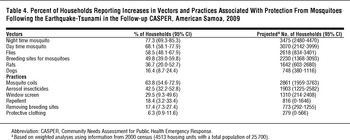
The follow-up CASPER assessed current vector problems compared to pre-tsunami and use of mosquito protection; these vector issues were not assessed during the first CASPER. As shown in Table 4, households reported increases in vector problems such as night time (which can result in malaria) (77%) and day time (which can result in dengue fever) (68%) mosquito bites; increases in mosquito breeding sites (50%); and increases in flies (59%), rats (37%), and stray dogs (16%). The most commonly reported methods for preventing mosquito bites included mosquito coils (64%), aerosol insecticides (43%), and window screens (18%). Almost 7% of households reported not using any type of mosquito prevention method (Table 4).
Percent of Households Reporting Increases in Vectors and Practices Associated With Protection From Mosquitoes Following the Earthquake-Tsunami in the Follow-up CASPER, American Samoa, 2009

Evaluation of the Initial and Follow-up CASPERs
Compared to the initial CASPER, results from the follow-up CASPER indicated that the number of households reporting a lack of electricity had decreased by approximately 78.3% (Table 1). Consumption of bottled water from relief agencies and other sources decreased by 17.4% and 44.1%, respectively, and the need for clothes decreased by 26.6%.
Table 2 compares illnesses and injuries between the initial and follow-up CASPERs. The largest decreases in percent change were reported for stress or sleep disturbance (55.1%) and respiratory illness (36.6%). An increase of 18.2% was observed in dehydration or heat stress illnesses. Decreases in all injuries were reported, with the exception of an increase in motor vehicle-related or blunt trauma (26.3%). However, none of these percent changes were statistically significant.
Table 2 compares medical care needs captured in the initial CASPER to those of the follow-up. Medical care needs increased by 29.5%, while a need for immediate care increased by 57.8%. The number of households reporting an inability to obtain medical care and supplies increased by 6.4%; the majority (66.7%) resulted from lack of financial resources.
Table 3 compares households' greatest needs between the initial and follow-up CASPERs. Household needs for electricity and trash removal decreased by 92.9% and 90.4%, respectively. Similarly, the needs for medications, physical help with cleanup or repairs, and transportation decreased by 92.7%, 94.6%, and 85.9%, respectively.
DISCUSSION
To our knowledge, this study is the first to compare findings of CASPERs conducted during the response and recovery phases of an earthquake and tsunami disaster response. Our findings show the extent of tsunami-related public health problems during the response and recovery phase in American Samoa. CASPER results were used to assess the effectiveness of ASDOH relief efforts.
Early identification of affected communities' disaster-associated needs can guide resource management during the immediate response, especially when limited information is available about characteristics of the affected population.131415 During the recovery phase, assessment of response efforts and identification of emerging needs are equally important.Reference Malilay16 Follow-up assessments are often recommended during the recovery phase to monitor affected communities' changing needs.Reference Malilay, Flanders and Brogan11 Only limited information is available about characteristics of the affected population.131415 These assessments can elucidate the changing patterns of access to medical care, basic household needs, and other health needs.
Electricity outage following a disaster is common.13 As demonstrated by results from the initial CASPER, a significant number of households in American Samoa lost electricity because of tsunami-related damage. Immediately following the tsunami, many households in the affected area evacuated at least one night, and a substantial number had residence-related safety concerns. Many reported the need for additional sheltering materials, such as a tarpaulin. At the time of the initial CASPER, four to five days post-tsunami, we estimated that 600 households in affected Tutuila areas were still displaced. Three weeks after the tsunami, many households reported their houses were still not safe to inhabit.
Another common concern after any natural disaster is availability of potable drinking water, as most of the population uses municipal water for daily needs.Reference Noji17 At the time of the follow-up CASPER, nearly 60% of households were still using bottled water. We also estimated that 60 households in the affected areas on Tutuila Island were drinking water from streams, in spite of endemic risks of water-associated infectious diseases, including leptospirosis.Reference Victoriano, Smythe and Gloriani-Barzaga18
The ASDOH indicated that the number one priority of relief agencies was to provide basic needs (such as food, water, and shelter) to affected households. During the initial CASPER, households' self-reported greatest needs included electricity, water, and financial help with cleanup. ASDOH informed the American Samoa Power Authority about the estimated number of households without public utilities, using data from the initial CASPER. Providing information throughout the power restoration prioritization process facilitated rapid restoration of electric and water services. With the help of the American Red Cross, ASDOH also provided meals to families in need. Even though a significant decrease in need for electricity (−78.3%) and water (−44.1%) was reported during the follow-up CASPER three weeks after the tsunami, food and water remained the most commonly reported greatest needs.
The follow-up CASPER identified access to medical care as an ongoing public health need. Tutuila Island has only one hospital, and after the tsunami its medical services were limited, and its three well-baby clinics were understaffed. Limited medical capacity and persistent post-tsunami medical needs may have hindered access to medical services. Compared with the initial CASPER, the follow-up CASPER found an increase in the percent of households reporting problems related to access to medical care, including the need for immediate medical care and inability to get medical supplies. Previous studies suggest that the majority of disaster-related illnesses and injuries occur during the post-impact (ie, cleanup) phase.Reference Zane, Bayleyegn and Haywood1019 However, these findings show an overall decrease in illnesses and injuries three weeks after the tsunami (ie, cleanup phase).
Limitations
These results are subject to several limitations. First, because the survey was conducted only in accessible households, these estimates may underestimate the actual impact of the disaster. For example, houses completely destroyed or vacated were not included in initial and follow-up CASPERs. Second, because the estimated number of households was reported using census 2000 data, the weighted analysis does not account for changes in the number of housing units from 2000 to 2009. Third, if participants believed that their responses were linked to relief resources, this perception could have introduced bias.
Strengths
Despite these limitations, CASPER provided a rapid and effective method to determine the immediate needs of communities in American Samoa following the tsunami. CASPER objectively quantified disaster-affected population needs that may have been identified anecdotally but not enumerated. CASPER has been used in many other disaster situations to provide population-based estimates within a few days or hours after data collection. Findings were provided to ASDOH officials within 72 hours of each CASPER; this information assisted in decisions about deploying resources to tsunami-affected areas. While determining the proportion of households with a particular need is useful, the projection of an estimate of the number of households with a specific need is even more useful. This information provided the ASDOH disaster response with quantities needed in their recovery efforts (eg, estimated housing units in need of tarpaulins or how much food/water to take to an affected area). Because the findings determined the greatest needs of the affected population, they were also used to help identify and prioritize needs (such as water, food, and shelter) and to target delivery to affected communities of resources such as medication, which was especially in need at that time because of the H1N1 pandemic, an additional strain on the ASDOH. Another problem was the limited medical resources in American Samoa. The territory has only one 128-bed hospital, which was overburdened after the tsunami. ASDOH used the information provided by CASPER to plan short- and long-term intervention programs, including distribution of food and water in affected areas. Confidential referrals made during the assessment helped ASDOH address individuals' most urgent issues immediately by directing appropriate resources. ASDOH used this opportunity to assess local capacity to conduct future CASPERs and collaborated with CDC to implement disaster epidemiology training for ASDOH staff to enhance disaster preparedness and response capacities.
CONCLUSIONS
The results of the initial CASPER highlighted environmental and other health hazards that could lead to further morbidity and mortality. Immediately following the tsunami, many households in affected areas left their dwelling for at least one night, and a substantial number were projected to have residence-related safety concerns. Fears about the safety of municipal water resulted in a boil-water advisory. Based on data from the initial CASPER, the following recommendations were made:
• Provide a continuing source of potable water, especially to those dependent on relief agencies for water deliveries.
• Provide immediate, appropriate shelter for displaced persons.
• Provide a short-term food distribution program for displaced populations depending on food banks or shelters for meals.
The follow-up CASPER identified ongoing public health needs for food, water, and access to medical care. Survey results also indicated that a small number of households reported family members with injuries and acute illnesses. Based on the follow-up CASPER findings, the CDC team made recommendations to disseminate community education materials regarding safe drinking and bathing water sources, including promoting American Samoa Power Authority's (ASPA) water as a safe drinking water source, and disseminating infectious disease brochures (eg, dengue fever, H1N1, leptospirosis). CASPER provided information about the changing public health needs of the affected community. These findings helped the ASDOH and emergency managers to prioritize and direct resources to address immediate and ongoing needs, as well as to assess response efforts.
The most common natural hazards experienced by American Samoa are cyclones or hurricanes and flooding caused by hurricanes.20 American Samoa lies just to the northern end of Tongan Trench, one of the most active seismic areas worldwide; therefore, the area experiences frequent earthquakes that can result in tsunamis.20Reference Dunbar and Weaver21 While the public health consequences of earthquakes in American Samoa have ranged from destruction of infrastructure to mass casualties and fatalities, no earthquake fatalities were noted in this event, probably also due in part to a well-developed emergency operations plan, which describes a public preparedness plan during a natural disaster event. However, before the 2009 tsunami, the last confirmed tsunami in American Samoa occurred in 1837.Reference Dunbar and Weaver21 Response efforts during the 2009 earthquake and tsunami post-disaster operations, including findings from initial and follow-up CASPERs, helped ASDOH to revise and improve their hazard vulnerability assessment and emergency operations plan for tsunamis.