Two patients are waiting for a kidney transplant. Without it each will die in the near future. Suddenly one becomes available. As the surgeon, it is up to you to decide who to give the kidney to. Assume both that the kidney must be given to one patient and that the first patient, Alma, has a stronger claim to the kidney than the second patient, Bob. What does fairness require? Is it fairer to give the kidney to Alma because she has the strongest claim? Or is it fairer to hold a lottery giving each a chance of getting the kidney? Does the answer depend on how much stronger Alma's claim is?
The question of what is fairest ought not to be conflated with the question of what is best, all things considered. There are other values besides fairness such as beneficence. To see this, suppose that Bob is the sole parent of two small children. Then, even though Alma has a stronger claim (perhaps, for example, because she bears less responsibility for her condition) our concern for the well-being of his children may speak in favour of giving the kidney directly to Bob. The values of fairness and beneficence will be in conflict. The question at hand is not what other values might compete with fairness, or what is best all things considered, but what fairness requires per se.
This article explores John Broome's conception of fairness and contrasts it with an alternative conception. The two conceptions give different answers to the Alma and Bob case. By way of a preview, the Broomean conception holds that whether it is fairer to give the kidney directly to Alma or to hold a lottery depends upon how much stronger Alma's claim is than Bob’s, while the alternative conception holds that it is fairer to give the kidney directly to Alma as her claim is strongest.Footnote 1 I argue in favour of the alternative conception.
The article comes in four sections. The first and second sections present the Broomean conception of fairness and the alternative conception, respectively. The third provides a series of arguments for preferring the alternative conception to the Broomean conception. The fourth concludes.
I. BROOME’S CONCEPTION OF FAIRNESS
For Broome, fairness is a matter of the proportionate satisfaction of claims.Footnote 2 This statement needs unpacking. I will treat ‘claims’, ‘proportionate’ and ‘satisfaction’ in turn.
Claims are a kind of moral reason. To say that a person has a claim to a good is to say that there is a certain type of reason why she should have it. Claims are distinct from some other moral reasons in that they are held by particular individuals and their satisfaction is a duty owed to the holder. When a person has a claim to a good it is important that she receives the good, not simply that someone does. Rights that act as side constraints are also owed to particular persons, but claims are distinct from rights. Unlike rights, claims can be defeated by other reasons. They do not determine directly what ought to be done. Sometimes we should undertake certain actions even though they create unfairness in the proportionate satisfaction of claims.Footnote 3
The following statement helps illustrate what Broome intends by both ‘proportionate’ and ‘satisfaction’:
[Fairness] requires, I suggest, that claims should be satisfied in proportion to their strength. I do not mean ‘proportion’ to be taken too precisely. But I do mean that equal claims require equal satisfaction, that stronger claims require more satisfaction than weaker ones, and also – very importantly – that weaker claims require some satisfaction. Weaker claims must not simply be overridden by stronger ones.Footnote 4
With respect to ‘proportionate’, the important point is that the satisfaction of claims is a relative matter. So, for example, if you and I both have claims to a good but my claim is twice as strong as yours, perfect fairness will only be achieved if my claim receives twice as much satisfaction (whatever satisfaction is taken to require). The contrast with a conception of fairness that requires claims to be satisfied absolutely can be brought out if we suppose that claims are equal. Equal claims will be satisfied proportionately, and for Broome fairly, even when neither claimant receives any satisfaction. A conception of fairness that requires absolute satisfaction would deny that this is fair.
Now consider what the satisfaction of a claim requires and, in particular, why Broome states that weaker claims cannot simply be overridden by stronger claims. For Broome, claims cannot be satisfied simply by weighing them against other reasons, other claims, or by the application of a fixed rule. This is because of the kind of reason a claim is. It is because claims are owed to particular persons and persons are separate. An analogy with a debt may be illuminating. When I weigh all relevant reasons, or apply some fixed rule, I may determine that I should not repay a debt to a creditor. But, even if I am correct that I should not repay the debt (perhaps I should feed my children or repay a different debt instead), it is clear that my having weighed all relevant reasons is not sufficient to satisfy the debt. The debt is owed to a particular person and there remains, even after my previous right action, a reason to repay her. Claims operate in a similar way. Because they are owed to persons and because persons are separate, simply weighing claims is not sufficient to satisfy them.
What can satisfy a claim? For Broome, whether a claim is satisfied is primarily determined with reference to whether or not an individual receives a good in outcome. In a particular case, perfect fairness requires that each claimant receives an amount of the good that is proportionate to the strength of her claim. But Broome also adds another element to his theory. He argues that in certain cases, such as when a good is indivisible so that all claims cannot be satisfied in outcome, holding a lottery may provide a sort of surrogate satisfaction for each individual's claim. For example, if claims are equal, a good is indivisible, and must be distributed, Broome believes that the fairest thing to do is to hold a lottery where each individual is given an equal chance of winning the good.Footnote 5 Finally, and most interestingly, Broome believes that if claims cannot be perfectly fairly satisfied in outcome the contribution to fairness of entering claims into a lottery, and so providing them with some surrogate satisfaction, ought to be weighed against, and can outweigh, what fairness can be achieved in outcome directly. For example, in cases where claims are unequal and a good is indivisible Broome believes it will sometimes be fairer to hold a lottery, or better a lottery weighted in proportion to the strength of an individual's claims, than simply to give the good to the individual with the strongest claim. As he puts it, what is fairest to do depends on a complicated judgement:
The result of a lottery will generally be that the good goes to candidates who do not have the strongest claims. This is less fair than the result of giving it directly to those who do. The likelihood of this less fair result will have to be weighed against the contribution to fairness of the lottery itself.Footnote 6
With these comments in place we can identify Broome's conception as holding the following five commitments:
(1) Fairness is a matter of the proportionate satisfaction of claims.
(2) Whether a claim is satisfied proportionately is a matter of how well it is satisfied relative to other claims.
(3) The satisfaction of claims is achieved by satisfying them in outcomes.
(4) Entering a claim into a lottery may provide surrogate satisfaction for a claim.
(5) When it is impossible to satisfy perfectly all claims in outcome, the contribution to fairness from entering claims into a lottery, and so providing them with some surrogate satisfaction, ought to be weighed against, and can outweigh, what fairness can be achieved in outcome directly.
II. THE ALTERNATIVE CONCEPTION
The alternative conception I have in mind departs from Broome's account in one important way: it rejects a commitment to (5). Rather than holding that the contribution to fairness from entering claims into a lottery ought to be weighed against, and can outweigh, what fairness can be achieved in outcome directly, it holds that the fairness that can be achieved in outcome directly is lexically prior to the contribution to fairness from entering claims into a lottery. Or, for shorthand, on the alternative conception fairness in outcome is lexically prior to the fairness provided by lotteries.Footnote 7
The following tables give a fuller representation of how the two positions diverge over what is fairest to do in a particular case. Assume that we have two otherwise equally situated individuals, Dillon and Emma. Dillon has a claim of strength 6 and Emma has a claim of strength 4. The value of the good to be divided between them is 100. When one of the options has more than one number assigned to it, it is because Broome's theory underdetermines the order and each position is a possibility.
The Broomean conception:
1. Give 60 to Dillon and 40 to Emma
2/3/4. Destroy the good
2/3/4. A weighted lottery – 60% chance of 100 to Dillon, 40% chance of 100 to Emma
3/4/5. Give 100 to Dillon
3/4/5. Toss a coin – 50% chance of 100 to either.
6. Give 100 to Emma
The alternative conception:
1. Give 60 to Dillon and 40 to Emma
2. Destroy the good
3. Give 100 to Dillon
4. A weighted lottery – 60% chance of 100 to Dillon, 40% chance of 100 to Emma
5. Toss a coin – 50% chance of 100 to either
6. Give 100 to Emma
The ranking on the Broomean conception can be explained as follows. Dividing the good is the most fair as it proportionately satisfies all claims. To destroy the good is more fair than giving the good directly to Dillon, since neither involves a lottery and destroying the good ensures that Dillon and Emma's claims are more proportionately satisfied in outcome. To hold a weighted lottery is more fair than holding a lottery at equal odds, since a weighted lottery provides a more proportionate surrogate satisfaction of each claim. Giving the good directly to Emma is the least fair since there is no surrogate satisfaction from a lottery and claims are least proportionately satisfied in outcome. However, apart from these conditions, Broome is not explicit about how the contribution to fairness of a lottery is to be weighed against fairness in outcome, saying only that it depends on a ‘complicated judgment’. For example, in deciding whether a weighted lottery is more fair than either destroying the good or giving it directly to Dillon we need some further method or principle that determines how to weigh the contribution to fairness of the lottery against the additional unfairness it might cause in outcome. Broome can invoke a further principle but so far he has not done so.Footnote 8
The ranking of the alternative conception already provides a fully determinate ranking. Dividing the good in proportion to the agents’ claims is the most fair. Destroying the good is more fair than giving the good directly to Dillon because it satisfies claims more proportionately in outcome. Giving the good directly to Dillon is more fair than holding a weighted lottery since it has a better expected fairness in outcome. A weighted lottery is more fair than a lottery at equal odds since it provides a more proportionate surrogate satisfaction of each claim. Giving the good directly to Emma is the least fair since there is no lottery and claims are least proportionately satisfied in outcome.
One clarification: when talking about fairness in lotteries and the surrogate satisfaction a claim receives by being entered into a lottery, I am talking specifically about non-voluntarily lotteries. Lotteries that are voluntarily accepted, or in some relevant sense responsibly accepted, have a different character. By voluntarily accepting a lottery, one can transform one's initial claim to a good into a claim on the outcome of the lottery. Therefore, in voluntarily accepted lotteries, since one's claim is to the outcome of the lottery itself, the fairness of the lotteries and fairness in outcome can be identical. I will now turn to argue for the alternative conception and against the Broomean conception.
III. ARGUMENT
A. What is surrogate satisfaction?
Sometimes, when deciding what is fairest to do, we will have to make comparisons between people who have received some amount of good and others who have received only chances. Consider an example. Two individuals, Clive and Diana, are initially equally deserving and so have equal claims to benefit. Later Clive receives a pair of chances in a lottery neither of which pay off, while Diana receives some amount of good. In order to assess the situation with respect to fairness and what fairness requires in the future distribution of goods we will need to compare how well satisfied each claim has been by these events. Making this sort of comparison requires that we know what sort of satisfaction is provided to a claim by entering it into a lottery. Broome says that entering a claim into a lottery provides it surrogate satisfaction. But this is ambiguous between at least two possible interpretations that I will now explore in turn.
First, Broome may mean that a claim is partially satisfied. On this reading representing a claim in a lottery means that the claim is satisfied to some degree, but not fully. Further, importantly, on the partial satisfaction interpretation the satisfaction a claim receives from being entered into a lottery is not lexically posterior to satisfaction in outcome. It is a kind of satisfaction of the same order as satisfaction in outcome. Consider how the partial satisfaction interpretation works in the Clive and Diana case. We have supposed that Clive has received a pair of chances in a lottery. On the partial satisfaction interpretation it is possible that these chances have provided a greater level of satisfaction to Clive's claim than Diana's claim has received as a result of her getting some actual good. In other words, it is possible that we should view the state affairs as unfair towards Diana because her claim is less well satisfied than Clive’s. If we were tasked with distributing a good in the present, it is possible that Diana would be due a greater share than Clive even though he has received no actual good and Diana has some.
The partial satisfaction interpretation gives rise to an argument against the Broomean position. Imagine someone living in extreme non-responsible poverty and someone else who is non-responsibly very well-off, each of whom had antecedently equal claims. On the partial satisfaction reading such an inequality could be entirely fair provided that the first extremely badly-off individual had her claim entered into a sufficient number of lotteries. This is true even though neither party ever accepted that her claim should be represented in a lottery. Indeed, the partial satisfaction reading will label limitless non-responsible inequalities in outcome as potentially fair. This is implausible.
There is a second reading of Broome's conception that saves him from this implausibility. On this reading, ‘surrogate satisfaction’ does not constitute ‘partial satisfaction’, rather it constitutes an ‘improvement in fairness without satisfaction’. Individual claims would not diminish at all through repeated entry into lotteries and, therefore, the inequalities identified in the earlier cases could not be labelled as fair. Unfortunately this interpretation faces a new problem. Take an amended version of the Clive and Diana case. Suppose that while Clive has received two chances in a lottery neither of which have paid off Diana has received nothing. You arrive also holding a pair of lottery tickets that you must distribute between Clive and Diana. On the new ‘improvement in fairness without satisfaction’ interpretation the fact that Clive has previously had his chances in lottery has no impact on the strength of his current claim. Accordingly, this view suggests that since claims are perfectly balanced one lottery ticket should be given to each. But this seems like the wrong result. The correct result is that Diana should be given both tickets since her claim has been less well satisfied than Clive's as a result of her not having been given chances previously. The ‘improvement in fairness without satisfaction’ interpretation does not seem to capture our intuitions in cases involving the iterated distribution of chances.
The alternative conception I endorse can accommodate our intuitions in both of the above cases because it orders the distribution of outcomes and the distribution of chances lexically. It denies that giving someone a chance to a good leads to the partial satisfaction of her claim in a way that is commensurate with satisfaction in outcome. But it allows that her claim is given a kind of satisfaction, only a satisfaction of a lower order. If we suppose that Clive has received only chances and Diana has received some good, and an indivisible good is to be distributed, the alternative conception says that the good should be given to Clive. If we suppose that Clive has received only chances and Diana has received nothing, it says that the next chance should be distributed to Diana. Broome might argue that he also thinks we should distribute chances in the way I have suggested, but I do not know what in his conception explains why chances and outcomes should be treated in this way. The alternative conception explains why. It is because the satisfaction a claim receives from being entered into a lottery is lexically posterior to the satisfaction it receives in outcome.
Broome might object that his theory is not supposed to deal with the type of cases I have imagined. He might deny that his theory is compatible with the adding up of the satisfaction of claims. But then his theory would fail to be able to give an account of how we should treat cases where we must compare a person who has received chances of a good and a person who has received a good. This is an important set of cases. A theory of fairness should be able to give an account of how these cases should be viewed. The alternative conception gives us a plausible account.
B. Baby swapping
In ‘Equality of Opportunity and Moral Arbirariness’, Brian Barry imagines a world in which nurses have, unbeknownst to everyone else, undertaken a large-scale policy of baby swapping. Babies are taken from their biological parents and reallocated to other parents on a random basis. He considers what light this example can shed on what equality of opportunity requires:
Suppose that this has in fact been carried out secretly over many years in some country marked by great inequalities of opportunity in the ordinary sense (a rigid caste system if you like). When we now find out about this random switching of babies, do we react by saying something like this? ‘Those people who were pressing for reforms in the social system to increase equality of opportunity were wasting their time – we now know that opportunity was already perfectly equal all along’. I do not think this sounds very plausible.Footnote 9
The example makes clear that we do not commonly think non-voluntary lotteries are entirely sufficient for making outcomes fair. Of course, this point is already agreed upon by the Broomean conception and the alternative conception. What is important is whether the example can be modified to pump intuitions regarding whether the fairness of entering a claim in a lottery should be weighed against fairness in outcome.
Suppose again that in the world we live in today, or at least a world characterized by similar levels of inequality in outcome, a huge baby swapping programme has taken place. Now suppose you have to choose whether the world we live in today is more fair than an otherwise similar world where the baby swapping has not taken place but which has marginally less inequality in outcome. I would judge the other world more fair.
A further point can be gleaned from the example: note that our intuitive judgements about fairness in lotteries often depend in part on one's temporal position relative to the lottery. When lotteries are in the past, and one had no choice whether or not to enter them, it is harder to see their contribution to fairness. By contrast, if a lottery is a prospect in the future it is easier to view it as something that fairness might require. What might explain the difference in intuition is that when the lottery is in the future we often slip into thinking the lottery is being voluntarily accepted. This tendency of thought, if it happens, is unhelpful since voluntarily accepted lotteries generate different moral issues from non-voluntary lotteries, as noted earlier. This may also constitute a debunking argument against the intuitions supporting the Broomean conception. Some of the intuitive appeal of the Broomean conception may rest on a conflation of voluntary and non-voluntary lotteries.
C. The separateness of persons and the uniqueness of experience
In section I, I showed that the conjunction of two facts – (1) that claims are held by particular persons and (2) that persons are separate – explains why claims cannot be satisfied simply by weighing them against one another. I want to suggest that another fact is relevant to what fairness requires with respect to the satisfaction of claims. This is the fact that a person experiences only the one life she actually leads, and not the other possible lives that there was a probabilistic chance she might have led. For ease of exposition, I will call this fact ‘the uniqueness of experience’. Specifically, I want to suggest that while the separateness of persons explains why claims cannot be satisfied by weighing, the uniqueness of experience explains why fairness in lotteries is at most lexically posterior to fairness in outcome.
Allow me first to recapitulate how the separateness of persons combines with the fact that claims are held by particular persons to explain why claims cannot be satisfied simply by weighing them against one another. Consider a utilitarian view of what is required to satisfy claims. On one description of utilitarianism, each person holds claims to utility, but these claims are satisfied simply by weighing.Footnote 10 Provided each person's claim to utility is properly weighed, and overall utility maximized, each person's claim is satisfied. The fact of the separateness of persons raises an objection to this view: the utilitarian view does not give due attention to the fact that, as each person lives only his own life, the maximization of overall utility is no compensation to those who must suffer in order to achieve it. It does not give due attention to the fact that the destitute are made no better off by others living in opulence. If persons were not separate, weighing claims against one another would be sufficient for fairness. Then the issue would be no different from when an individual weighs his own interests against one another. But the separateness of persons makes an ethical difference.
Now consider the uniqueness of experience. When faced with some event with different possible outcomes the individual will experience only one of those outcomes. She does not experience more than one possible outcome. Nor does she experience the possible outcomes in proportion to their probability of occurring. The relevance of this fact for the satisfaction of claims can be brought into relief by considering what David Wasserman calls the distributive view of the fairness of lotteries.Footnote 11 On the distributive view, the fairness of lotteries lies in the fact that something, specifically chances, is being distributed. But what is the value of these chances in light of the fact of the uniqueness of experience? Suppose that unbeknownst to me someone flips a coin, with the expectation that if it falls on heads I will be made the beneficiary of a vast fortune. The coin falls on tails. What have I gained? I might have gained a lot. But I have actually gained nothing. I do not experience what I might have gained. I experience only what I have. Given this, it seems false to say that in being given a chance that did not materialize, and which I had not accepted, I have been given anything of a value comparable to something I actually have. Just as the badly-off do not benefit from the fact that others are well-off, so any individual does not benefit from the possible lives she has not had. If my analogy holds, the uniqueness of experience may support the alternative conception of what is required to satisfy a claim over the Broomean account.
Allow me to clarify the line of argument. The separateness of persons and the uniqueness of experience each combine with the fact that claims are held by particular persons. Each combination tells us something about what fairness requires in the satisfaction of claims. The separateness of persons tells us that claims cannot be satisfied merely by weighing: to allow claims satisfaction simply by weighing would be to allow the gains of distant people to count as a person's own gains. The uniqueness of experience tells us that the satisfaction of claims in outcome is lexically prior to their surrogate satisfaction in lotteries: to allow the representation of claims in a lottery any greater value than this would be to count the gains one might have had as relevant for what one actually has. The idea of experience is important to both facts. The separateness of persons is significant because individuals do not experience how others fare. The uniqueness of experience is significant because individuals do not experience other possible lives they might have had.
D. A Broomean objection: the problem of marginally stronger claims
I have provided three arguments in favour of the alternative conception. There is one important type of case that supports the Broomean conception and gives us reason to reject the alternative conception. This is the case of marginally stronger claims. When claims are of nearly equal strength and a good is indivisible many people believe that it is fairest to hold a lottery with equal odds, or a weighted lottery, rather than awarding the good to the individual with the strongest claim. Broome's conception accommodates this judgement. The alternative conception does not.
To expose the intuition, allow me to add some detail. Consider a new version of the kidney example. Suppose that Alma and Bob had antecedently equal claims to the means for a good life, simply in virtue of their personhood. This is what grounds their claims to the kidney. The reason that Alma now has a stronger claim to the kidney is that Bob has already had his claim to the means for a good life better satisfied than Alma's claim. But Bob's claim has only been marginally better satisfied. He has received only one additional unit of the relevant metric; for example, he is one day older. The kidney will extend either individual's life for thirty years. The defender of the alternative conception holds that it is fairer to award the kidney directly to Alma than to hold a lottery to determine who should receive the good. Many people find this implausible. They are moved by the fact that the difference between the current satisfaction of each claim is slight in comparison to the value of the good to be distributed. In these types of cases, the fairness of giving claims surrogate satisfaction in a lottery seems like something that should be weighed against, and can outweigh, the fairness of satisfying claims in outcomes.
How may the defender of the alternative conception respond to the problem of marginally stronger claims? One move would be to argue that many apparently compelling cases rest on a kind of mistake. What seems like a marginally stronger claim is often actually an equally strong claim. In elaborating the kidney example, I described Alma as one day older than Bob and, correspondingly, supposed that her antecedently equal claim to the means of a good life had been better satisfied than Bob’s. But it might be that a single day cannot count as providing any satisfaction. Perhaps, given the special kind of thing a life is and the extended periods it takes to complete meaningful projects, satisfaction can only be provided by larger blocks of time. Maybe only blocks like a month or a year count. Yet even if this move is successful in the kidney example it cannot, as a matter of definition, be successful in all cases. So long as it is possible to have a marginally stronger claim, the difficulty these cases present must be confronted.
A second move is to examine whether the professed abstract intuition about what is fairest in the case of marginally stronger claims actually translates into our everyday ethical practice. If it doesn’t we might again view the abstract intuition as a mistake. For an example of where it does not seem to translate into practice, consider queuing. One way to conceptualize a queue is in terms of claims. The people in a queue have claims to the good or service at the end of the queue. The strength of one's claim is proportional to either the length of time one has been waiting or the order in which one joined the queue. In queues it is generally accepted that those with the strongest claim ought to receive the good or service. Even in cases where two people join at nearly the same moment it is generally accepted that it would be less fair to toss a coin to see who goes first rather than allow the person who is actually first to go first. Now, it may be that some other reason undermines this example. Perhaps queues are a special case, or the ethics of queues is not properly conceptualized in the language of claims. But, at least, the case gives us reason to doubt that in practice our standard ethical response to marginally stronger claims is a lottery.
A final move is to clarify the implications of the alternative conception. The defender of the alternative conception does not believe that the fairest thing to do is to give the kidney to Alma. She believes the fairest thing to do would be to destroy the kidney. I have supposed that that option is not available but, even with this assumption, it is still not true that the supporter of the alternative conception judges the outcome in which Alma is awarded the kidney fair. All she is committed to is that it is marginally more fair than either giving the good to Bob or holding a lottery. Serious unfairness is unavoidable in this case. This clarification allows a new way of explaining the fact that some people judge a lottery to be more fair than awarding the good to the person with the strongest claim. When one faces a case where claims are nearly equal one faces a fine judgement. Fine judgements are very difficult to make. People's intuition will be prone to error in these types of cases and the defender of the alternative conception can suggest that this is true of people who judge a lottery to be more fair. Their judgement is distorted by the fact that a lottery is almost the fairest thing to do.
E. Why include the distribution of chances?
As my arguments have downplayed the significance of the fairness value of non-voluntary lotteries it is worth explaining why I include in the alternative conception any commitment to their contribution to fairness. It is this commitment, after all, that distinguishes the alternative conception from other views, such as the views of David Wasserman and Peter Stone, which hold that lotteries do not provide any surrogate satisfaction for a claim.Footnote 12 The answer is that counting non-voluntary lotteries as making some contribution to fairness ensures that the alternative conception conforms with our intuitions in certain cases. For example, it was by counting non-voluntary lotteries as making some contribution to fairness that we arrived at the correct result in the cases explored in section II.A where chances were distributed across time. For another example, consider the following case given by Peter Diamond:Footnote 13
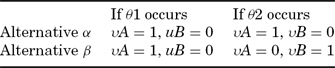
Consider a society composed of two identical individuals, A and B, facing a choice between two alternatives, α and β, with two possible and equally probable states of nature, θ1 and θ2. Let us further assume that social choice. . .is symmetric in its treatment of the two individuals. It is assumed that under alternative α, the utility of A is 1 and that of B is zero, independent of the state of nature; while under β, these are the utility levels if θ1 occurs, but they are reversed if θ2 occurs. In tabular form, we have
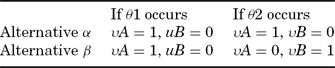
Diamond suggests that we have reason to choose alternative β rather than alternative α because it gives each individual a chance of getting 1 and this is more fair than giving 1 to A for certain. By allowing that entering a claim into a lottery provides it with a sort of satisfaction we can accommodate this judgement.Footnote 14 We do not have to view alternative α as equivalent in terms of fairness to alternative β.Footnote 15
IV. CONCLUSION
Consider the kidney case discussed in the introduction one last time. What does fairness require? Is it fairer to give the kidney to Alma because she has the strongest claim? Is it fairer to hold a lottery giving each a chance of getting the kidney? Does the answer to this question depend on how much stronger Alma's claim is? The alternative conception holds we should give the kidney directly to Alma because her claim is strongest and that this answer does not depend on how much stronger Alma's claim is. More generally, it holds that the fairness associated with representing claims in a lottery, and so providing them with some surrogate satisfaction, is lexically posterior to the fairness of satisfying claims in outcome. I have provided a pair of case-implication arguments and one theoretical reason, the uniqueness of experience, for believing this. I have also sought to undermine the force of the most powerful case-implication argument in the Broomean arsenal, the case of marginally stronger claims. I do not expect that my arguments will have convinced everyone who holds the Broomean view. And there are other conceptions of fairness that I have not argued against, most obviously conceptions of fairness that include an absolute component. Nevertheless, I hope that the arguments presented have at least made the case for the alternative conception stronger.Footnote 16