INTRODUCTION
Arbuscular mycorrhizal (AM) fungi are ubiquitous soil-borne micro-organisms belonging to the phylum Glomeromycota (Schüβler et al. Reference Schüßler, Schwarzott and Walker2001) that inhabit the roots of land plants in an obligate biotrophic relationship. These symbioses create a living connection between plant roots and soil and play a key role in promoting the uptake of nutrients, especially when such nutrients are scarce (Smith & Read Reference Smith and Read2008). Nutrient uptake is increased mainly by the highly absorbent surface of the hyphal net, its ability to explore the soil volume and its effectiveness at absorbing and utilizing nutrients (Miyasaka & Habte Reference Miyasaka and Habte2001). Although the advantages of AM symbiosis have been demonstrated with respect to the uptake of phosphorus (Barea et al. Reference Barea, Werner, Azcón-Aguilar, Azcón, Werner and Newton2005), the effect of the symbiosis on plant nitrogen (N) status and the impact of absorbed N on plant N balance are still unclear (Hodge et al. Reference Hodge, Helgason and Fitter2010). Some studies have shown that AM fungi are involved in the uptake of N from inorganic sources (Ames et al. Reference Ames, Reid, Porter and Cambardella1983; Johansen et al. Reference Johansen, Jakobsen and Jensen1993), namely nitrate (Tobar et al. Reference Tobar, Azcón and Barea1994) and ammonium (Hawkins et al. Reference Hawkins, Johansen and George2000). In addition, AM fungi may be important in the uptake of organic N (Cliquet et al. Reference Cliquet, Murray and Boucaud1997) and recent findings indicate that AM fungi possess at least part of the enzymatic machinery needed for the direct uptake of amino acids (Cappellazzo et al. Reference Cappellazzo, Lanfranco, Fitz, Wipf and Bonfante2008). Such results are consistent with work by Hodge et al. (Reference Hodge, Campbell and Fitter2001) and Whiteside et al. (Reference Whiteside, Treseder and Atsatt2009) indicating that AM fungi promote the decomposition and subsequent uptake of organic N. The mechanisms through which AM fungi stimulate organic N mineralization are still uncertain. Recent findings have shown that colonization by AM fungi can alter rhizodeposition (Wamberg et al. Reference Wamberg, Christensen, Jakobsen, Müller and Sørensen2003), affecting bacteria and other micro-organisms in the soil that are responsible for the decomposition of organic matter (OM). Thus AM fungi can play an indirect stimulatory role in the uptake of N from organic sources (Hodge et al. Reference Hodge, Helgason and Fitter2010). It has been suggested that the small size of AM hyphae (Jones et al. Reference Jones, Healey, Willett, Farrar and Hodge2005) and their ability to synthesize pectinases and cellulases (García-Romera et al. Reference García-Romera, García-Garrido, Martinez-Molina and Ocampo1991; García-Garrido et al. Reference García-Garrido, García-Romera and Ocampo1992) allow the mycorrhizal extraradical mycelium (ERM) to penetrate into decomposing OM; this permits the AM fungi to compete with bacteria for the decomposition products. However, although there is good evidence that AM fungi benefit from OM in the soil (Leigh et al. Reference Leigh, Hodge and Fitter2009; Hodge et al. Reference Hodge, Helgason and Fitter2010), it is still unclear whether this can be an advantage for a plant host. In some research, the presence of AM fungi did not increase plant N content (Hawkins et al. Reference Hawkins, Johansen and George2000; Hodge et al. Reference Hodge, Campbell and Fitter2001; Hodge Reference Hodge2003; Leigh et al. Reference Leigh, Hodge and Fitter2009), whereas other research showed that AM fungi did indeed enhance root N uptake (Faure et al. Reference Faure, Cliquet, Thephany and Boucaud1998; Leigh et al. Reference Leigh, Fitter and Hodge2011). Hodge et al. (Reference Hodge, Helgason and Fitter2010) showed that AM fungi can acquire large quantities of N from OM but also that they use large proportions of it to satisfy their own nutritional needs. It is likely that even if AM fungi, plant hosts and bacteria could collaborate in accelerating the decomposition of OM, they would have to compete for the decomposition products, particularly when N is scarce.
The present research tested the hypothesis that AM fungi, in an environment of limited N, can enhance plant N uptake from OM added to soil by influencing OM decomposition through bacterial activity either directly or indirectly. To do so, wheat plants were inoculated with AM fungi, and the effects on soil enzymatic activities related to the mineralization of organic N (both in soil amended with 15N-labelled-maize leaves and in untreated soil) and on further wheat N capture were examined.
MATERIALS AND METHODS
Experimental design
The experiment was conducted at the Zaidín Experimental Station (CSIC; Granada, Spain, 37° 10′ N, 3° 35′ W, 680 m a.s.l.), in a climate-controlled glasshouse with 25/19 °C day/night temperature and a photoperiod of 16 h. Additional light at a photosynthetic photon flux density of 460 μmol/m2/s was provided, if necessary.
A complete randomized factorial design replicated four times was adopted. Treatments were (1) AM inoculation: Glomus mosseae (Nicol. &. Gerd.) Gerd. & Trappe isolate BEG 12 (+Myc) and uninoculated control (–Myc); and (2) addition of OM: soil amended with 15N-enriched maize leaves (+OM) and unamended soil (–OM).
For mycorrhizal treatments, the inoculum was obtained from a thoroughly homogenized rhizosphere sample removed from an open-pot culture of Sorghum bicolor L. and consisting of soil, spores (70 spores/g soil) and mycelia. The AM inoculum was added to the appropriate pots at a rate of 1 g inoculum per pot. For the OM treatments, 15N-enriched OM was prepared by cultivating maize on 15N-enriched soil. Maize was harvested at anthesis and separated into roots, stems and leaves. Leaves were oven-dried at 80 °C for 1 day, chopped (c. 2 mm) and used as organic amendment. The N concentration of maize leaves was 19·0 g/kg (with an isotopic composition of 4·78 atom% 15N) and the C:N ratio was 22·6 : 1.
Each pot (diameter 100 mm, height 110 mm) was filled with 600 g of a quartz sand:soil mixture (2 : 1). Soil properties were as follows: 37% (by volume) sand, 43% silt and 20% clay; 10·44 g/kg organic carbon (C), pH 8·1 (soil:water 1 : 2); 0·12 mS/cm saturated electrical conductivity (E.C.) (25 °C); 1·05 g/kg total N (Kjeldhal); 6·2 mg/kg phosphorus (P, as P2O5; Olsen); 132 mg/kg potassium (K, as K2O); 10·06% total calcium (Ca); 99 mg/kg soluble Ca; and 16 mg/kg magnesium (Mg). Both soil and sand were sieved through a 2 mm mesh and autoclaved at 121 °C for 20 min. The 15N-enriched maize biomass was added at a rate of 4·6 g dry OM/kg mixture and both OM-amended and unamended mixtures were steam-sterilized at 95 °C for 1 h on three consecutive days. Soil autoclaving and steam sterilization were performed in order to completely impair soil biological (both fungal and bacterial) activity. The bacterial microflora was extracted by suspending 500 g soil or AM inoculum in 1·5 litres distilled water. After shaking and decanting, the suspension was filtered (11 μm mesh) to discard natural AM fungi. Before starting the experiment, each pot received 30 ml of soil suspension filtrate to reintroduce the natural microbial community and 30 ml of AM inoculum suspension filtrate to normalize the starting microbial community. The amount of OM added with the AM inoculum was negligible compared with the quantity added in the OM treatment.
Seeds of durum wheat (Triticum durum Desf.; cv Simeto) were surface-sterilized and germinated on wet filter paper in Petri dishes for 3 days. Five seedlings were transplanted into each pot; 4 days after transplantation, pots were thinned to three plants each. During the experiment, each pot received 5 ml modified Hoagland's solution (Hoagland & Arnon Reference Hoagland and Arnon1950) once every 5 days and 50 ml tap water once every 3 days. The modified Hoagland's solution used in the experiment lacked P and had only 10% N to limit the amount of inorganic N available for plant growth, as in prior studies (Reynolds et al. Reference Reynolds, Hartley, Vogelsang, Bever and Schultz2005).
Pots were harvested 7 and 9 weeks after transplanting (WAT). At each harvest, a bulk soil sample was taken from each pot and total plant biomass was measured. Soil samples were stored at −80 °C for further analysis.
Plant and soil analysis
Plant biomass was immediately separated into roots and shoots, and fresh weights were recorded. Roots were rinsed free of soil, cut into 10 mm fragments and mixed thoroughly. Representative root samples were taken to determine the overall colonization of roots by AM fungi and to measure metabolically active (alkaline phosphatase (ALP)) AM fungal infection. Shoots and the remaining roots were oven dried at 80 °C for 24 h and dry weights recorded. To measure total root infection by AM fungi, root samples were cleared with 100 g/l potassium hydroxide (KOH) and stained with 50 mg/l trypan blue following the method described by Phillips & Hayman (Reference Phillips and Hayman1970). To measure ALP activity, root samples were cleared (as described by Vierheilig et al. Reference Vierheilig, Schweiger and Brundrett2005) for 2 h in a solution containing 0·05 m Tris/citric acid (pH 9·2), 50 mg/l sorbitol, 15 units/ml cellulase and 15 units/ml pectinase (both enzymes from Aspergillus niger). Root samples were subsequently rinsed in distilled water and placed in the appropriate staining for ALP as described in Tisserant et al. (Reference Tisserant, Gianinazzi-Pearson, Gianinazzi and Gollote1993). Measurements of root AM infection and ALP activity were made by observing root fragments under the microscope and counting 250–300 total intersections using the grid intersect method (Giovannetti & Mosse Reference Giovannetti and Mosse1980).
Shoots and roots of wheat were analysed for total N and 15N enrichment using an elemental analyser–isotope ratio mass spectrometer (EA–IRMS, Carlo Erba NA1500).
Total bacterial counts (TBC) were performed on soil samples (2 g) taken from each pot. Soil samples were serially diluted, and each dilution was plated onto nutrient agar (OXOID, Milan, Italy) treated with 15 mg/l nystatin to impair fungal growth (Seeley & VanDemark Reference Seeley and VanDemark1981) and aerobically incubated at 30 °C. Colony-forming units were counted after 4 days and again after 7 days to allow for the development of slower growing colonies. Analyses were carried out in duplicate.
The activity of four soil enzymes was measured: dehydrogenase, as an index of microbial activity (García et al. Reference García, Hernandez, Costa, Ceccanti and Ganni1993); casein protease (also referred to as ‘casein hydrolysing activity’ or ‘caseinase’), as a measure of protein hydrolysis to mono – and dipeptides (Ladd & Butler Reference Ladd and Butler1972); benzoylargininamide (BAA)-protease; and urease, as a measure of amino acid deamination (Kandeler & Gerber Reference Kandeler and Gerber1988; Tabatabai Reference Tabatabai, Weaver, Angel and Bottomley1994). For the dehydrogenase assay, 1·0 g soil samples were mixed with 0·2 ml of 2-p-iodophenyl-3-p-nitrophenyl-5-phenyl tetrazolium chloride (INT) at a concentration of 40 mg/l in distilled water for 20 h at 22 °C in darkness. Then 10 ml of a mixture of 1 : 1·5 ethylene chloride:acetone was added and the solution was shaken for 1 h to extract iodonitrotetrazolium formazan (INTF). The solution was filtered through Whatman no. 5 filter paper and INTF was measured spectrophotometrically at 490 nm. Dehydrogenase activity was expressed as μg INTF/g/h.
For the caseinase assay, 1·0 g soil samples were incubated in 12 ml tubes at 50 °C for 2 h in 2·5 ml of 100 mg/l casein dissolved in 0·1 m TRIS-HC1 buffer at pH 8·1. Enzyme activity was stopped by adding 1 ml of 175 ml/l trichloroacetic acid (TCA). Tubes were centrifuged, 2·0 ml supernatants were extracted, and absorbance (700 nm) was measured colorimetrically after adding 3·0 ml of 2·8 n Na2CO3 and 1 ml of three-fold diluted Folin–Ciocalteu reagent. After subtraction of blanks, caseinase activity was computed as μg Tyrosine/g/h.
For urease and BAA-protease assays, 1·0 g soil samples were mixed with 2 ml of 0·1 m , pH 7·0 phosphate buffer and with 0·5 ml of 6·4 m urea or 0·03 m Na-BAA for urease and BAA-protease, respectively. Shaken incubation was performed for 2 h at 37·0 °C (for urease) or 39 °C for (for BAA-protease). The ammonium released in the hydrolytic reaction was extracted by adding 8 ml of 2-M potassium chloride (KCl) (which is also meant to suppress further hydrolysis of urea). Supernatants (0·5 ml) were transferred to clean tubes and mixed with 0·2 ml of a nitroprusside sodium dihydrate and sodium salicylate solution and 0·2 ml of a mixture of trisodium citrate, sodium hydroxide (NaOH) and dichloroisocyanuric acid sodium salt dehydrate, as described in García et al. (Reference García, Hernandez, Costa, Ceccanti and Ganni1993). Absorbance was measured at 690 nm and expressed as g N hydrolysed/g dry soil.
Calculations and statistical analysis
The N recovery fraction of wheat on a per-pot basis and percentage basis was calculated as follows:
 $$ {\rm N}_{{\rm REC}} = {\rm N}_t \times \displaystyle{{^{\it 15} {\rm N}_a - ^{\it 15} {\rm N}_b} \over {^{{\it 15}} {\rm N}_c - ^{\it 15} {\rm N}_b}} \;;\;\;\% \;{\rm N}_{{\rm REC}} = \displaystyle{{{\rm N}_{{\rm REC}}} \over f} \times 100$$
where NREC is the amount of N (mg/pot) from OM detected in wheat biomass; Nt is the total N content (g/pot) in wheat; 15Na, 15Nb and 15Nc are the 15N isotopic concentrations of wheat grown with the organic amendment, without the organic amendment and of the organic amendment itself, respectively; and f is the total N (mg/pot) in the organic amendment. The ratio between the plant N derived from OM and total plant N capture (NREC/Nt) was calculated.
Data on plant production, quality, root AM infection, ALP and soil enzymatic activities were subjected to analysis of variance (ANOVA) according to the experimental design. Variables corresponding to proportions were arcsine transformed before analysis to assure a better fit with the Gaussian law distribution. Normality was confirmed using a Kolmogorov-Smirnov test.
RESULTS
Mycorrhizal colonization and fungal activities in roots
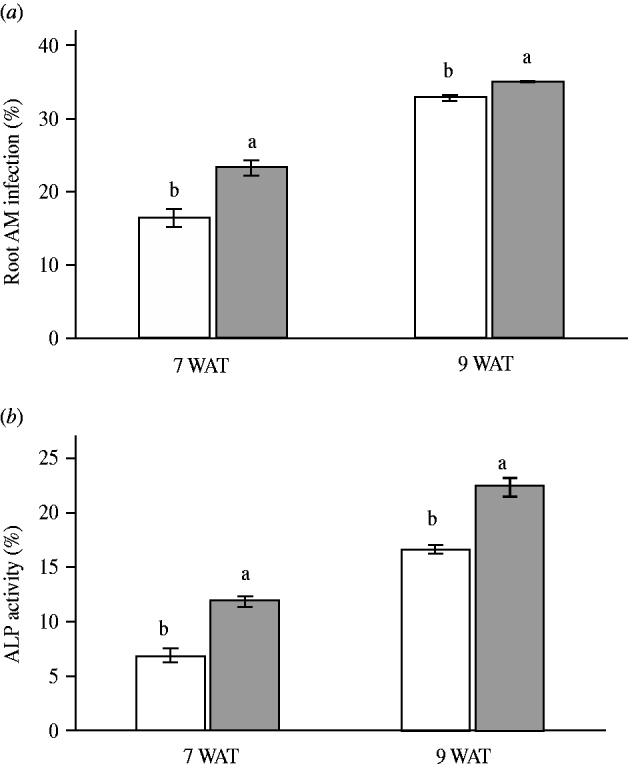
No mycorrhizal infection was observed in uninoculated pots. In mycorrhizal plants, root AM colonization was, on average, 19·8% at 7 WAT and 34·0% at 9 WAT. Root AM colonization (Fig. 1a) and fungal ALP activity (Fig. 1b) were significantly higher (P < 0·01) in +OM than –OM treatments in both samplings.
Root colonization by (a) AM fungi and (b) fungal ALP activity in roots of wheat grown in soil without (open bars) or with (closed bars) added OM at 7 and 9 WAT. Different letters represent significant differences (P < 0·05). Data are means±s.e. (n = 4).

Plant growth and N uptake
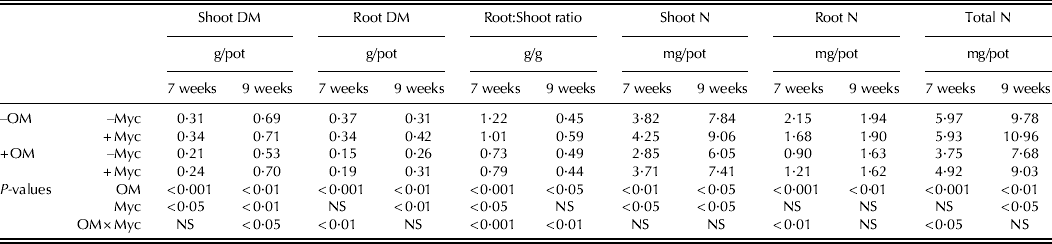
Addition of OM markedly decreased wheat growth. At 7 WAT, the total biomass of plants in +OM treatments was 41% lower than that of –OM plants; differences between treatments diminished at 9 WAT (−15%; Table 1). The AM symbiosis had a positive effect on plant growth: mycorrhizal wheat yielded 7% more biomass than the non-mycorrhizal control at 7 WAT and the advantage increased to 20% at 9 WAT. Although the interaction between treatments (AM inoculation × OM addition) was not always significant, the benefit of AM symbiosis on shoot and root growth of wheat was greater in +OM than in –OM treatments, particularly at 9 WAT.
Shoot and root dry matter and nitrogen (N) capture in wheat inoculated with the AM fungus G. mosseae (+Myc) or not inoculated (−Myc) grown in soil amended with OM (+OM) or without OM (−OM) at different harvest time points (7 and 9 WAT)
The addition of OM resulted in a reduction of total N uptake by wheat at both 7 and 9 WAT. N uptake was higher in +Myc than in –Myc plants, especially in +OM treatments.
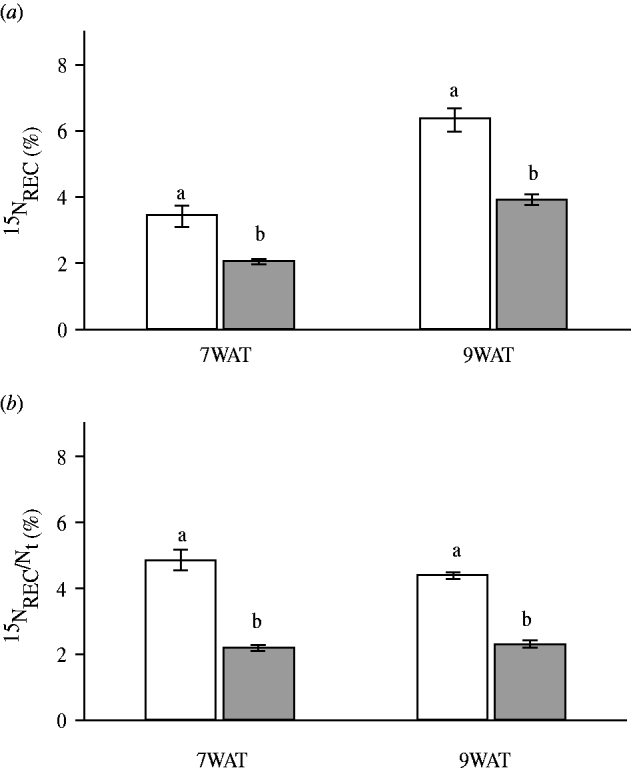
The %NREC from OM detected in wheat biomass was, on average, 2·73% at 7 WAT and 5·14% at 9 WAT. In both samplings,%NREC was 40% lower in +Myc than in –Myc treatments (Fig. 2a). Therefore, the ratio NREC/Nt was significantly lower in mycorrhizal than in uninoculated plants (−55% at 7 WAT and −47% at 9 WAT; Fig. 2b).
(a) Nitrogen recovery (%15NREC) and (b) 15NREC/Nt of N released from OM on total wheat N in uninoculated (open bars) and mycorrhizal treatments (closed bars) 7 and 9 WAT. Different letters represent significant differences (P < 0·05). Data are means±s.e. (n = 4).
Total bacterial count and enzymatic activities
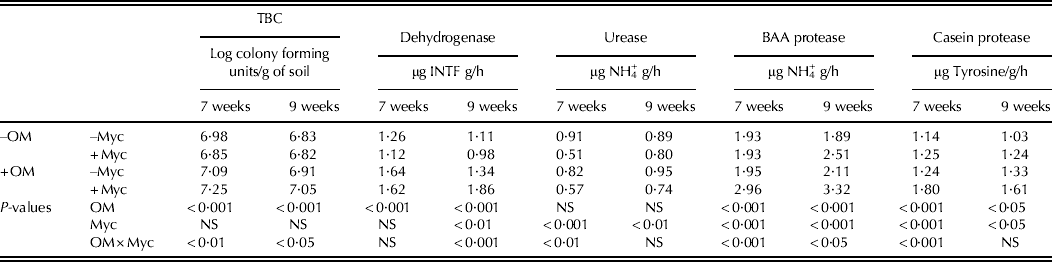
The addition of OM resulted in a significant increase in TBC at both 7 and 9 WAT (Table 2). Mycorrhyzal inoculation did not affect TBC in –OM soil but significantly increased the concentration of bacteria in +OM soil.
Total bacterial counts, dehydrogenase, urease, BAA-protease and casein protease in soil amended with OM (+OM) or without OM (−OM), in which wheat was grown in symbiosis with AM fungus G. mosseae (+Myc) or grown without fungus (−Myc) at different plant harvest time points (7 and 9 WAT)
On average, all enzymatic activities except for urease were significantly higher in +OM than –OM soil on both sampling dates (Table 2). Similarly, although the AM inoculum negatively affected urease, it caused an increase in all other enzymatic activities (dehydrogenase, caseinase and BAA-protease) and the effects were more evident in the +OM treatments. At 9 WAT, in particular, AM symbiosis markedly increased dehydrogenase activity in +OM treatments. At 7 WAT, caseinase was enhanced by the presence of the AM fungi, especially in the +OM treatments (+45% compared with uninoculated soil), whereas at 9 WAT, inoculation with AM fungi increased caseinase activity by 20% in both +OM and –OM soil. BAA-hydrolysing activity was markedly higher in +Myc than in –Myc treatments, especially at 9 WAT, whereas urease activity in both samplings was slightly but significantly reduced by AM fungi. The overall deamination activity (urease + BAA-protease) in soil was higher in inoculated pots than in their control counterparts.
DISCUSSION
Mycorrhyzal root colonization and ALP activity were higher in wheat plants grown in soil to which OM was added than in unamended soil. This result contrasts with the findings of Hodge et al. (Reference Hodge, Robinson and Fitter2000a), who found that mycorrhizal colonization of Plantago lanceolata roots was not affected by OM added to soil. One reason for this discrepancy could be the fact that the soil fertility, particularly the mineral N availability, was markedly lower in the present experiment. In fact, Staddon et al. (Reference Staddon, Jakobsen and Blum2004) and Gamper et al. (Reference Gamper, Peter, Jansa, Lüscher, Hartwig and Leuchtmann2004) found a reduction in mycorrhizal root colonization when plants were grown in nutrient-rich soils; in such soils it is easier for plants to autonomously satisfy their nutritional needs without expending photosynthates on mycorrhizae. In the present experiment, the addition of OM may have caused a temporary sequestration of nutrients (favoured by the high C : N ratio of the added organic residues, as also observed by Killham Reference Killham1994 and Geisseler & Horwath Reference Geisseler and Horwath2009), thus reducing their availability and increasing plant dependence on AM symbiosis. In fact, the addition of OM increased the concentration and activity of bacteria in the soil. This means that bacteria outcompete plants for nutrients in the short term (Jackson et al. Reference Jackson, Schimel and Firestone1989; Kaye & Hart Reference Kaye and Hart1997), causing a decrease in plant growth and N uptake, as observed in other studies (Seligman et al. Reference Seligman, Feigenbaum, Feinerman and Benjamin1986; Hodge et al. Reference Hodge, Stewart, Robinson, Griffiths and Fitter1998).
On average, AM fungi resulted in an increase in the concentration and activity of bacteria in the soil only when OM was added. Several studies have shown that the presence of AM fungi can stimulate microbial growth and alter the structure of the microbial population (Secilia & Bagyaraj Reference Secilia and Bagyaraj1987; Marschner & Crowley Reference Marschner and Crowley1996; Andrade Reference Andrade, Varma, Abbott, Werner and Hampp2004); such effects can lead to faster OM decomposition. Several mechanisms can explain the effects of AM fungi on soil bacteria: the bacteria can use the ERM as a vehicle for spreading into soil organic residue (Ravnskov et al. Reference Ravnskov, Nybroe and Jakobsen1999); AM fungi can modify the amount, nature and distribution of plant-derived C compounds in the soil (Toljander et al. Reference Toljander, Lindahl, Paul, Elfstrand and Finlay2007); or the ERM may bring available organic C to micro-organisms in the hyphosphere, favouring the mineralization of OM in the soil (Schimel & Weintraub Reference Schimel and Weintraub2003). The different C availability could explain why AM fungi had a different effect on the concentration and activity of bacteria in the +OM and –OM treatments.
On average, plants inoculated with G. mosseae yielded 13% more biomass relative to non-mycorrhizal plants. Several studies have shown that AM symbiosis improves plant growth and nutrient uptake, especially when plants are grown under nutrient-limiting conditions (Azcón & Ocampo Reference Azcón and Ocampo1981; Vierheilig & Ocampo Reference Vierheilig and Ocampo1991), as in the present study. Other studies of AM infection in wheat, however, have shown responses that vary depending on factors such as the plant and AM fungal genotypes and symbiotic efficiencies and different growth conditions (Al-Karaki & Al-Omoush Reference Al-Karaki and Al-Omoush2002; Li et al. Reference Li, Zhu, Marschner, Smith and Smith2005, Reference Li, Smith, Holloway, Zhu and Smith2006). In accordance with other studies (Tobar et al. Reference Tobar, Azcón and Barea1994; Azcón et al. Reference Azcón, Ruiz-Lozano and Rodríguez2001), a higher N uptake was observed in +Myc than in –Myc plants. Through AM fungi, plants can better scavenge the soil volume (Miyasaka & Habte Reference Miyasaka and Habte2001), which enhances their ability to absorb available N. This effect is particularly important when AM extraradical hyphae explore soil volumes different from those explored by the plant root system (Hodge et al. Reference Hodge, Campbell and Fitter2001). In pots, however, the wheat root system is often able to explore the entire soil volume. This could make AM symbiosis less advantageous for nutrient uptake. Therefore, as suggested by Hodge et al. (Reference Hodge, Robinson and Fitter2000b), AM symbiosis could improve N uptake in host plants because it is more effective than roots alone in competing with soil micro-organisms for inorganic N. An indirect confirmation of this mechanism can be found in the higher proteolytic activity observed in the +AM than in the –AM rhizosphere. In fact, because soil proteases are inducible enzymes released progressively (by bacteria, but not by AM fungi; Smith & Read Reference Smith and Read2008) when the organic to inorganic N ratio of soil increases (Gill & Modi Reference Gill and Modi1981), the higher proteolytic activity in +AM than in –AM treatment may depend on a mycorrhizal depletion of inorganic N.
The percentage of 15NREC from OM in non-mycorrhizal treatments was 3·4% at 7 WAT and 6·4% at 9 WAT. These values are comparable with those observed by Hodge et al. (Reference Hodge, Stewart, Robinson, Griffiths and Fitter1998), who found, after 39 days of growth, %Nrec values in different grasses ranging from 3·2 to 5·0% from OM when Lolium perenne shoots with a 31 : 1 C : N ratio were added to soil. In the present experiment, root infection with AM fungi (+Myc treatments) strongly reduced the recovery of 15N applied with OM (−41% on average compared with –Myc treatments). By contrast, Atul-Nayyar et al. Reference Atul-Nayyar, Hamel, Hanson and Germida2009 reported that AM symbiosis increases the uptake of N from added OM; however, they found that only the ERM and not the plant roots were allowed access to the OM in the soil, whereas in the present study both mycorrhizal hyphaea and mycorrhizal roots had access to the added OM.
Therefore, the seemingly contradictory results of the present study show that although the AM fungus enhanced total plant N uptake and OM decomposition, particularly when OM was added, it still decreased plant N uptake from the added OM. AM symbiosis increased both plant uptake of inorganic N from the soil solution and the amount of bacteria in soil. Therefore, in +AM treatments compared with the uninoculated control, the higher N demand of the bacteria and the lower N availability in the soil may have induced the bacteria to rely more on the organic N; this may in turn have reduced the availability of N from OM for the plant. Another hypothesis for the contradictory results could be that, as suggested by Hodge et al. (Reference Hodge, Helgason and Fitter2010), OM represents the major N source for the fungus's own growth, reducing the plant's uptake of N from OM. Clearly, these hypotheses should be assessed in future research and validated experimentally.
In conclusion, the present findings have practical implications for crop production in low-input systems because an effective AM symbiosis can increase both plant N uptake and soil fertility, enhancing soil biological activity.
The experiment was funded by the Università degli Studi di Palermo, Italy (project ‘Ruolo della simbiosi micorrizica sull'efficienza di utilizzazione dell'azoto in differenti genotipi di frumento’), by MiPAF (project SICOBIOS) and by the Ministerio de Ciencia e Innovación (MICINN), Spain (project ‘AGL2008-00742/AGR’).