How do you capture a person? Say in a few words what makes a man? Lauding John would be
the last thing he wants. So, for the most part, I limit myself to facts that reveal
John’s character and accomplishments.
His parents met in England during World War I, his father a sergeant in the American
expeditionary forces, his mother English. John was born on February 24, 1920, in
Portland, Oregon. His parents divorced when John was in high school. Among his early
successes were reading every book in the local library and winning the vocabulary
competition. More important to him was the jazz piano and his dance band,
“John Merryman and his Merry Men,” which played the music of his
heroes, Benny Goodman and Duke Ellington.
Upon his graduation from Roosevelt High in 1938, John spent a semester studying music,
then switched to chemistry at the University of Portland, thinking it would provide a
more secure future. He graduated, got his Master’s from Notre Dame, and began
a Ph.D at the University of Chicago on a prestigious Eli Lilly scholarship. And now a
more recognizable John: thinking he lacked the commitment to be a first-rate chemist, he
went to law school.
Why law school? John doesn’t know. He supposes it was because he likes to
argue. Returning to Notre Dame and supporting himself by teaching undergraduates
chemistry, he graduated first in his class and editor of the [Notre
Dame] Law Review.
After graduating, he taught at Santa Clara School of Law, playing jazz piano evenings at
nightclubs and strip joints. In 1953 he met Nancy Edwards. She swept him off his feet.
Six weeks later, John married beautiful Nancy and became stepfather to three strapping
boys, Len 11, Sam 10, and Bruce 6. And so began John’s most important and
rewarding career: his life with Nancy as father of three. Returning from his honeymoon,
John was notified that he was fired from his job—the means of supporting his
new family—because of his un-Catholic marriage to a divorced woman.
This led to the second most important and rewarding career in John’s life:
Stanford Law School. Because of his reprehensible firing, the dean at Santa Clara
contacted the dean at Stanford, and John was hired on a two-year contract to teach legal
writing and evaluate its writing program. The rest, as they say, is history.
But, like me, some of you may not know this history before John helped father the fields
of art and cultural property law. In 1955, after two years at [Stanford] Law School,
John became its librarian. Then, in 1960, the school asked John to specialize in
comparative law. At that time, comparative law was in its infancy. It provided
descriptive analyses of national laws, in particular those of France and Germany. It was
not comparative. John took a different approach. He studied Italian law as a working
legal system, not just as written statutes. This provided a realistic understanding of
how Italy’s legal culture functioned and permitted comparison with other
countries’ laws. John received Italy’s Order of Merit, three
honorary degrees, and two Festschrifts for this work.
Art and cultural property law is the second field John helped father, this beginning also
fortuitous.
Nancy had become interested in contemporary American art. When John was on fellowship at
the Max Planck Institute in Hamburg writing his renowned classic The Civil Law
Tradition,Footnote 2 Nancy’s interest grew, leading her to become a dealer in prints.
On returning to Stanford in 1970, John hatched the idea of teaching art law with his best
friend, the incomparable Al Elsen, noted Stanford art historian and Rodin scholar. Two
years later, with a text comprised of magazine and newspaper articles, relevant history,
and what there was of reported cases, John taught the first course, with Elsen, as a
student put it, providing color commentary. The course examined how a legal system
expresses the values and attitudes of a culture, raised basic questions about art,
artists, and cultural property, and broached comparative, ethical answers. John had come
into his own (Figure 1).
Figure 1.John Merryman: Teacher, Scholar.
No more need be said. John’s accomplishments are legend: 60 years of committed
teaching; innovative, groundbreaking scholarship; 25 books and 200 articles.
Nevertheless, I cannot help mentioning a personally inspiring few: “Thinking
about the Elgin Marbles,” “Two Ways of Thinking about Cultural
Property,” “The Public Interest in Cultural Property,”
and “The Refrigerator of Bernard Buffet.”Footnote 3 John’s work is seminal. He articulated, in concise, no-nonsense
language, the critical questions, developed the basic vocabulary and way of thinking
about them, analytic and well-reasoned, passionate but not emotional, which, thankfully,
whether one agrees with John or not, remain the core of art and cultural property law.
But here again, there are John’s contributions that many of you may not know.
In addition to his groundbreaking scholarship, John was embodying his ideas and values
in practical, nonscholarly ways. He was an expert witness in Peru v. Johnson,Footnote 4 the trailblazing case on cultural property export laws—which reads as
if he had written it. He helped author California’s moral rights legislation,
the first of its kind. He was an advisor on UNIDROITFootnote 5 and numerous ethical codes. And, because of his intellectual rigor and principled
fairness, he mediated and helped amicably resolve disputes. And, together with Al Elsen,
he brought distinguished art to Stanford’s campus.
These are John’s achievements until now—he teaches still, and an
article on art preservation is on its way. It is much more difficult to capture what in
John explains so much (Figure 2).
Figure 2.John Merryman and Nancy.
I think what best characterizes John is his omnivorous interest and unquenchable
curiosity in just about everything. This linked with a love of learning, and innovation
and creativity in what he undertakes. And undertakes he does; his scholarship is not
ivory towered, but grounded and practical, witness the [International Cultural Property]
Society and its journal. He takes and makes his opportunities, runs with them; once
begun, he does not tire but brings things to completion—and then some.
But trying to capture what in John is his source of success does not begin to grasp what
is most personal: John as mentor, model, friend. As teacher and mentor, John is direct.
You know what he values and thinks and why. He challenges you to think and justify your
thoughts, but never inappropriately. He expresses his differences, makes known his
disappointments, not as personal criticisms leading to frustration or defeat, but in
ways that buoy one to be better.
As scholar and writer, John is the uncommon academic: He is as hard and honest with
himself as he is with others. Although as entrenched as the rest of us in what he
believes, he welcomes criticism and correction—I think he may even delight in
it. Forever striving, he is a model for taking the next step, going further than before.
As a friend he is loyal, nurturing, encouraging, and kind. He is as warm as he is
rational, as generous as he is smart. I don’t think anyone who has met John
is not the better for it.
In all of this, what John has done and is in himself, he is more than the sum of his
parts, more than fathering fields, more than comparativist or internationalist. He is
all-encompassing, a universalist, someone who allows for the particulars of culture, the
law of Italy, the iconic art of a nation, but puts them in a larger, human context,
culture to be shared by all.
This leads to my final words. John thinks his most important and least successful effort
has been to stem or at least point out the dangers of cultural nationalism. Though
cultural nationalism is still in its ascendancy, this will not last forever. Just as
good will, critical reason, and hope for something better abound in John, the
limitations of being bound by and seeking to retain one’s own culture will
likely lose out in a more inclusive, ecumenical, truly catholic world. In this John will
ultimately be model, guide, and friend.
Incredibly, John is this to countless more than me: students, scholars, colleagues, and
acquaintances. All of this John would disclaim and deny, and so I hope he will forgive
me this.
Stanford
8 November 2013





 You have
Access
How do you capture a person? Say in a few words what makes a man? Lauding John would be the last thing he wants. So, for the most part, I limit myself to facts that reveal John’s character and accomplishments.
His parents met in England during World War I, his father a sergeant in the American expeditionary forces, his mother English. John was born on February 24, 1920, in Portland, Oregon. His parents divorced when John was in high school. Among his early successes were reading every book in the local library and winning the vocabulary competition. More important to him was the jazz piano and his dance band, “John Merryman and his Merry Men,” which played the music of his heroes, Benny Goodman and Duke Ellington.
Upon his graduation from Roosevelt High in 1938, John spent a semester studying music, then switched to chemistry at the University of Portland, thinking it would provide a more secure future. He graduated, got his Master’s from Notre Dame, and began a Ph.D at the University of Chicago on a prestigious Eli Lilly scholarship. And now a more recognizable John: thinking he lacked the commitment to be a first-rate chemist, he went to law school.
Why law school? John doesn’t know. He supposes it was because he likes to argue. Returning to Notre Dame and supporting himself by teaching undergraduates chemistry, he graduated first in his class and editor of the [Notre Dame] Law Review.
After graduating, he taught at Santa Clara School of Law, playing jazz piano evenings at nightclubs and strip joints. In 1953 he met Nancy Edwards. She swept him off his feet. Six weeks later, John married beautiful Nancy and became stepfather to three strapping boys, Len 11, Sam 10, and Bruce 6. And so began John’s most important and rewarding career: his life with Nancy as father of three. Returning from his honeymoon, John was notified that he was fired from his job—the means of supporting his new family—because of his un-Catholic marriage to a divorced woman.
This led to the second most important and rewarding career in John’s life: Stanford Law School. Because of his reprehensible firing, the dean at Santa Clara contacted the dean at Stanford, and John was hired on a two-year contract to teach legal writing and evaluate its writing program. The rest, as they say, is history.
But, like me, some of you may not know this history before John helped father the fields of art and cultural property law. In 1955, after two years at [Stanford] Law School, John became its librarian. Then, in 1960, the school asked John to specialize in comparative law. At that time, comparative law was in its infancy. It provided descriptive analyses of national laws, in particular those of France and Germany. It was not comparative. John took a different approach. He studied Italian law as a working legal system, not just as written statutes. This provided a realistic understanding of how Italy’s legal culture functioned and permitted comparison with other countries’ laws. John received Italy’s Order of Merit, three honorary degrees, and two Festschrifts for this work.
Art and cultural property law is the second field John helped father, this beginning also fortuitous.
Nancy had become interested in contemporary American art. When John was on fellowship at the Max Planck Institute in Hamburg writing his renowned classic The Civil Law Tradition,Footnote 2 Nancy’s interest grew, leading her to become a dealer in prints.
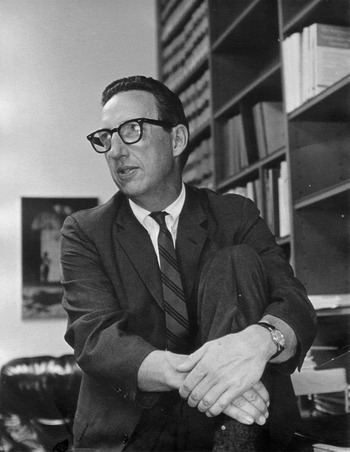
On returning to Stanford in 1970, John hatched the idea of teaching art law with his best friend, the incomparable Al Elsen, noted Stanford art historian and Rodin scholar. Two years later, with a text comprised of magazine and newspaper articles, relevant history, and what there was of reported cases, John taught the first course, with Elsen, as a student put it, providing color commentary. The course examined how a legal system expresses the values and attitudes of a culture, raised basic questions about art, artists, and cultural property, and broached comparative, ethical answers. John had come into his own (Figure 1).
John Merryman: Teacher, Scholar.
No more need be said. John’s accomplishments are legend: 60 years of committed teaching; innovative, groundbreaking scholarship; 25 books and 200 articles. Nevertheless, I cannot help mentioning a personally inspiring few: “Thinking about the Elgin Marbles,” “Two Ways of Thinking about Cultural Property,” “The Public Interest in Cultural Property,” and “The Refrigerator of Bernard Buffet.”Footnote 3 John’s work is seminal. He articulated, in concise, no-nonsense language, the critical questions, developed the basic vocabulary and way of thinking about them, analytic and well-reasoned, passionate but not emotional, which, thankfully, whether one agrees with John or not, remain the core of art and cultural property law.
But here again, there are John’s contributions that many of you may not know. In addition to his groundbreaking scholarship, John was embodying his ideas and values in practical, nonscholarly ways. He was an expert witness in Peru v. Johnson,Footnote 4 the trailblazing case on cultural property export laws—which reads as if he had written it. He helped author California’s moral rights legislation, the first of its kind. He was an advisor on UNIDROITFootnote 5 and numerous ethical codes. And, because of his intellectual rigor and principled fairness, he mediated and helped amicably resolve disputes. And, together with Al Elsen, he brought distinguished art to Stanford’s campus.
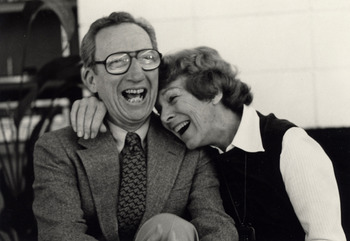
These are John’s achievements until now—he teaches still, and an article on art preservation is on its way. It is much more difficult to capture what in John explains so much (Figure 2).
John Merryman and Nancy.
I think what best characterizes John is his omnivorous interest and unquenchable curiosity in just about everything. This linked with a love of learning, and innovation and creativity in what he undertakes. And undertakes he does; his scholarship is not ivory towered, but grounded and practical, witness the [International Cultural Property] Society and its journal. He takes and makes his opportunities, runs with them; once begun, he does not tire but brings things to completion—and then some.
But trying to capture what in John is his source of success does not begin to grasp what is most personal: John as mentor, model, friend. As teacher and mentor, John is direct. You know what he values and thinks and why. He challenges you to think and justify your thoughts, but never inappropriately. He expresses his differences, makes known his disappointments, not as personal criticisms leading to frustration or defeat, but in ways that buoy one to be better.
As scholar and writer, John is the uncommon academic: He is as hard and honest with himself as he is with others. Although as entrenched as the rest of us in what he believes, he welcomes criticism and correction—I think he may even delight in it. Forever striving, he is a model for taking the next step, going further than before.
As a friend he is loyal, nurturing, encouraging, and kind. He is as warm as he is rational, as generous as he is smart. I don’t think anyone who has met John is not the better for it.
In all of this, what John has done and is in himself, he is more than the sum of his parts, more than fathering fields, more than comparativist or internationalist. He is all-encompassing, a universalist, someone who allows for the particulars of culture, the law of Italy, the iconic art of a nation, but puts them in a larger, human context, culture to be shared by all.
This leads to my final words. John thinks his most important and least successful effort has been to stem or at least point out the dangers of cultural nationalism. Though cultural nationalism is still in its ascendancy, this will not last forever. Just as good will, critical reason, and hope for something better abound in John, the limitations of being bound by and seeking to retain one’s own culture will likely lose out in a more inclusive, ecumenical, truly catholic world. In this John will ultimately be model, guide, and friend.
Incredibly, John is this to countless more than me: students, scholars, colleagues, and acquaintances. All of this John would disclaim and deny, and so I hope he will forgive me this.
Stanford
8 November 2013