I. Introduction
We begin this article with the proposition that compliance with the law is likely to be shaped by three interrelated factors. First, compliance is driven in part by the degree of societal consensus that the proscriptions and prescriptions set forth in the new law make sense and align with the social norms of groups targeted by the law. If the law is widely seen to be a donkey, or as Dickens's Mr. Bumble would put it, “a ass‐a idiot,” then it is likely to be widely flouted (e.g., prohibition on liquor, which also had the unanticipated consequences of increasing the scale of organized crime). Also important is the capacity to pursue those who break the law, along with penalties that are sufficiently prohibitive to dissuade widespread noncompliance (e.g., strict punishment for committing murder, or economic sanctions). Third, it is essential that the requirements of the specific law be widely understood. As Ellickson (Reference Ellickson1991) notes, ignorance of the law is widespread.
Along with these three broad factors, the degree to which transgression and noncompliance with the law is visible must be considered as compliance is measured and assessed. One might assume that drivers are more likely to break speed limits outside of urban areas or late at night when they imagine the risk of being caught is much lower. In a similar vein, the breach of a building or health and safety code is much more difficult to discover if the noncompliance occurs inside a dwelling unit or in a backyard. An example here would be the sharing of rooms by multiple undocumented migrants in a lower‐end apartment block in violation of a city's occupancy limits. Absent proactive inspections by the code department, the violation is likely to be discovered only if an accident occurs, if the infringement is denounced by an outside third party, or where noncompliance could result in dismissal of an insurance claim.
Those who eschew the law and formal regulation may seek workarounds. They can innovate or adopt an alternative strategy that is legal. For example, they may continue to carry a licensed gun but with reduced magazine capacity. Other workarounds may be illegal (e.g., dumping or burning one's household garbage), or they may be informal, such as paying low‐cost garbage collectors to remove it (Ward et al. Reference Ward, Olmedo, Rojas and Sullivan2010, 62). Here, too, knowledge is key. Working around a law is unlikely when a group has no knowledge of the law to begin with.
These ideas about lawmaking, compliance, and informality are the starting point for this article. Here, we look for law's impact in the context of property titling in low‐income colonias and informal subdivisions in Texas, focusing on contracts for deed (CFDs). Sometimes called a poor man's mortgage, or installment contract, the CFD is a risky, informal mechanism for purchasing a home whereby a buyer obtains title to the property only after completing a series of payments directly to the seller. The CFD has been a major vehicle for financing and conveyancing property to low‐income homebuyers in colonias and other poor communities across the United States in areas where there is an ample supply of affordable land or homes (often in substandard condition) and a pool of interested buyers ineligible for bank financing (Ward Reference Ward1999; Ward and Peters Reference Ward and Peters2007; Way Reference Way2009; Way and Wood Reference Way and Wood2013). In the 1990s, in response to reports of widespread CFD abuses by developers in the Texas colonias—who relied almost exclusively on unrecorded CFDs to finance land sales—the Texas Legislature set out to regulate the use of CFDs and to make CFDs less attractive to developers (Jensen Reference Jensen1996). Targeting colonias in particular, a series of sweeping legal reforms containing numerous protections for buyers were adopted from 1995 to 2005, including a recording requirement, extensive notice requirements, and harsh penalties for sellers failing to abide by the new legal requirements. Indeed, after the adoption of the Texas reforms, concerns were raised that the new laws would be so effective in curtailing the use of CFDs that they would shut down homeownership opportunities for the poor (Clemmer Reference Clemmer2007).
More than ten years after the peak of the implementation of the Texas CFD reforms, we set out to learn whether sellers of property in colonias and other areas shut out from traditional bank financing can fairly be viewed as having been impacted by, or responsive to, penalties designed to shift them toward titling and seller‐financing vehicles more protective of buyers. Would the Texas CFD story present an example of the successful regulation of developers through the greater use of incentives commonly advocated by urban planners and others who wish to tweak behavior with increasingly finely honed legislative tools (Burby, May, and Patterson Reference Burby, May and Patterson1998)? Alternatively—and equally consistent with the view of the CFD seller as responsive to incentives—would we find that the reforms have been honored primarily in the breach by sellers intent on creating highly innovative workarounds to avoid burdensome provisions protective of buyers? In the same breath, we wondered whether knowledge of the law in these informal settlements—in which buyer and seller alike are often isolated from the traditional channels through which information about new laws is commonly spread—would lead to any change in behavior at all. As Ellickson (Reference Ellickson1991) has demonstrated, where those regulated are ill‐informed about the content of the law, it is highly unlikely that a fear of sanctions will impact their behavior.
This article examines these questions by closely analyzing the nature and extent to which different land sellers in the colonias continued to use recorded and unrecorded CFDs in low‐income subdivisions after the legislative reforms. Our analysis draws heavily on a major study that we conducted from 2011 to 2012 at the University of Texas at Austin on behalf of the Texas Department of Housing and Community Affairs (TDHCA). After providing background on the informal homeownership market and the Texas legislative reforms, we present an overview of our methodology and the challenges we faced gathering our data across two main phases of our study: First, we relied on information from public and private title company records in six border and two central Texas counties, which allowed us to track the changes in the use of recorded CFDs between 1990 and 2010 (Ward, Way, and Wood Reference Ward, Way and Wood2012).Footnote 1 Second, we set out to examine changes in the use of the now‐unlawful, unrecorded CFD, utilizing findings from a major randomized household survey we conducted of roughly 1,300 households, combined with an intensive and complex mining of public records. This part of the study also allowed us to build on what we were seeing in the real property records in terms of the use of recorded CFDs and deeds with deeds of trust. We also delved deeply into a group of purposively selected subdivisions to understand developer workarounds and to examine how consumers have fared under the new regulatory regime.
In the next section of the article, we discuss our findings, which, taken together, suggest that the Texas legislative reforms have indeed had a significant impact on the overall use of CFDs, especially unrecorded CFDs, as a mechanism for developers financing land sales. At the same time, at least some developers have found a number of workarounds to the legislation, such that low‐income consumers buying homesteads in the postreform era may actually be no better off—or even worse off in some ways—than consumers buying homesteads prior to the reforms. In contrast, sales by current low‐income homeowners living in colonias on the Texas border with Mexico and in low‐income subdivisions outside the border—a growing group of sellers in the informal homeownership market—appear to have been largely unaffected by the legislation, and are actually using unrecorded CFDs with increasing frequency as this group of sellers becomes more common in the older established colonias. The ongoing persistence of both the recorded and unrecorded CFDs for two decades after the Texas legislative reforms, along with new breeds of sales tactics by developers, underscores the need for additional and more expansive reforms and interventions.
II. Colonias and the Contract for Deed: A Brief History
The history of the development of the colonias along the Texas‐Mexico border has been widely described and analyzed and will not be recounted in detail here (see Ward Reference Ward1999, Reference Ward, Roy and Sayyad2003; Ward et al. Reference Ward, Giusti, Larson and de Souza2011; Durst, Reference Durst2014b). Summarily defined, a colonia is a state designation for a neighborhood within 150 miles of the Mexico border comprised primarily of low‐income and very‐low‐income households and defined by poor physical and economic conditions, including limited infrastructure and substandard housing. Land developers began creating colonias along Texas's border with Mexico as early as the 1950s. Subdividing agricultural or low‐value rural land, the developers platted large tracts into individual lots, typically one‐third to one acre, and then sold the vacant lots via unrecorded CFDs to very poor families, creating unincorporated subdivisions that became known as colonias (Davies and Holz Reference Davies and Holz1992; Larson Reference Larson1995; Ward Reference Ward1999).
Housing production in the colonias is self‐managed and often self‐built by the families themselves, many of whom delay occupying the lot until they have secure means of private transport and sufficient resources to self‐build the core housing unit that they extend over time. Others move a trailer onto land, and then, over time, replace the manufactured home with a larger and newer single or doublewide. Thus, homes often end up as hybrid arrangements and combinations of manufactured homes with extensions and build‐outs (Ward Reference Ward1999, 2003). The housing is made affordable by low initial land costs, a lack of infrastructure and low associated servicing costs, the flexibility of decision making by the family, and the gradual nature of investment and home improvement.
By the late 1980s the lack of potable water and wastewater services, irregular platting, continual flooding, substandard dwelling units, and unscrupulous sales tactics by many developers generated appalling living conditions among very‐low‐income and primarily Hispanic populations for whom self‐built or self‐managed housing offered the only route to homeownership, albeit at considerable social costs to the households (Ward Reference Ward1999, Reference Ward, Mukhija and Loukaitou‐Sideris2014). In the early 1990s, an estimated 400,000 people were living in around 1,500 colonias in Texas (Texas Water Development Board 1992, 1995; Ward Reference Ward1999; Durst Reference Durst2014c). Since then, the population has increased to more than half a million in the Texas border region alone, mostly in older colonias developed prior to 1989, when the Texas Legislature first stepped in to prohibit any further colonia development, through the adoption of model subdivision rules requiring that new residential subdivisions in certain parts of the state include basic levels of infrastructure, such as water and wastewater services (Ward Reference Ward1999; Durst 2014c).
The current demographics of these Texas communities underscore the fact that widely documented poverty persists alongside a strong and vibrant culture of homeownership. Though a majority of colonia residents live in deep poverty—57 percent of owners make less than $1,600 a month—about three‐quarters of residents own their homes (Ward, Way, and Wood Reference Ward, Way and Wood2012, Executive Summary, IV–V).Footnote 2 In large part because of their low incomes, very few colonia residents qualify for formal mortgage financing from a lending institution when they purchase their homesteads. Colonia households have high rates of marriage and relatively low rates of divorce,Footnote 3 forming relatively stable households as well as relatively large families (Ward, Way, and Wood Reference Ward, Way and Wood2012, Ch. 5, 5). The average household size far exceeds both Texas and national averages.Footnote 4
Once established in a colonia, low‐income owners tend to remain and build out their dwellings gradually over a long period through a process called housing consolidation, often leading to a substantial housing asset worth $50,000 or more (Durst and Ward Reference Durst and Ward2014). In our study, three‐quarters of owners were found to have been living on their lots for ten or more years and in many cases considerably longer.Footnote 5 It is under these conditions—deep and enduring poverty coupled with the dogged determination to achieve homeownership and lack of bank financing—that the CFD was historically the dominant financing vehicle for homestead purchases in the colonias, going back to the 1950s, with the genesis of the first colonias in Texas (see, e.g., Federal Reserve Bank of Dallas, Office of Community Affairs n.d., 7, which discusses the risks inherent in the reliance on CFDs as well as the history of development in the colonias and other issues related to colonias).
It is important to recognize that colonia land and housing markets, by virtue of their informal, “off the radar” nature, and reliance almost exclusively on seller financing, are less vulnerable to external “shocks” and housing market conditions than are formal residential markets with their heavy reliance on bank financing (Lyndon B. Johnson School of Public Affairs 2000, 111–13; Ward, Giusti, and de Souza Reference Ward, Guisti and de Souza2004; Giusti and Estévez Reference Giusti and Estévez2011). Until legislation was adopted in the 1990s, colonia developers in Texas sold land largely off the radar screen of public officials and throughout the history of colonias, only a small fraction of buyers have used formal lending services of banks and mortgage providers to acquire their lots.
Of course, the wider financial crisis and rising unemployment brought on by the collapse of the US housing market in the last decade did affect colonia residents’ incomes and the cost of making home improvements (Ward et al. Reference Ward, Olmedo, Rojas and Sullivan2010; Durst and Ward Reference Durst and Ward2014), as well as day‐to‐day living expenses, including gas prices, given the lack of public transportation to colonias. But generally, colonia land and housing markets are inured to outside market forces by virtue of their informality, and the form of seller financing that a developer chooses to utilize—the focus of this article—is even less influenced by outside market forces. Thus, in our study we were confident that we were able to gauge the direct impact of the Texas legislative reforms on different forms of seller financing and conveyancing.
Informality and the Contract for Deed
Among middle‐income households in the United States, home purchases are typically undertaken through the formal market and paid for with third‐party financing from a lending institution, utilizing a note secured by a deed of trust or mortgage, with title transferred from the seller up front at the closing, via a recorded deed. The bank‐financed loan typically comes with legal documents prepared by attorneys, title insurance coupled with review of the title history, a survey, an appraisal, and a host of regulatory protections for consumers (Way Reference Way2009). However, this traditional and formal path to homeownership is rarely utilized by colonia residents, given their credit and incomes and the poor housing conditions in colonias. In the colonias we studied in the six border counties, 73 percent of homebuyers relied on seller financing (whether through CFD or a formal deed); only 11.7 percent secured loans from lending institutions such as banks and credit unions (another 15 percent paid in full up front) (Ward et al. Reference Ward, Giusti, Larson and de Souza2011; Ward, Way, and Wood Reference Ward, Way and Wood2012, Appendix D.iv; Durst and Ward Reference Durst and Ward2014).Footnote 6
When a buyer is unable to secure bank financing to purchase a home and does not have the means (either personally or through the family) to pay cash up front for the purchase, the most common recourse is to obtain seller financing, making payments to the seller toward the purchase price over a period of time, typically ranging from five to thirty years. Some more formal systems of seller financing exist whereby the buyer executes a note and deed of trust to the seller and the buyer receives the title (via a deed) from the seller as soon as the closing documents are signed and the down payment is made. Both the deed of trust and the deed are recorded in the public land records. Although these transactions are still much less formal than those involving a bank or credit union, title is nonetheless conferred up front at the closing. If the buyer defaults on the loan, the seller must follow an official foreclosure process to reobtain the title to the property (Way Reference Way2009).
In contrast, a CFD is a much more flexible and open‐ended seller‐financing instrument whereby the seller promises to issue title to the buyer only after the latter has paid the entire purchase price, which may take as long as thirty years. Meanwhile, the contract typically includes a forfeiture clause. Historically, with these clauses, if the buyer missed a payment or otherwise violated the terms of the contract, the seller was entitled to terminate the contract, regain possession, and retain all the buyer's prior payments as liquidated damages—without the utilization of foreclosure proceedings.Footnote 7 As with other forms of seller financing, CFDs typically include interest rates significantly higher than conventional financing rates: 12 percent to 18 percent interest rates are common, although rates as high as 20 percent are also used. Some unscrupulous investors utilizing CFDs and other forms of seller financing also require a large balloon payment after only a few years, making it almost impossible for the buyer to complete the purchase (Way and Wood Reference Way and Wood2013).
Our fieldwork in 2011 to 2012 confirmed that CFDs may be placed on a continuum, or across a spectrum, of formality. At the formal end are those documents used in developer‐to‐consumer transactions, which usually involve a two‐ or three‐page typed contract, although these, too, vary in the extent to which they specify the parties’ responsibilities under the contract and in which they disclose the penalties for violating the contract. At the other end of the spectrum are consumer‐to‐consumer transactions, whereby the current resident attempts to sell the property to a new resident. The most informal of these contracts are merely oral agreements or handwritten notes in Spanish stating the terms of the sale, which may or may not be accompanied by receipts (Ward 2014).Footnote 8
Because CFD sales lack many of the safeguards available to buyers in traditional third‐party mortgages, where title is conferred up front, homebuyers using these contracts are prime targets for a host of abusive practices by unscrupulous sellers who lure would‐be owners into arrangements that are very unlikely to result in homeownership and that have a high likelihood of leading to repossession (Way Reference Way2009; Way and Wood Reference Way and Wood2013). It is important to underscore that CFDs and their accompanying risks are not unique to the Texas‐Mexico border. These risky contracts are used widely elsewhere in sales to poor homebuyers in Texas and in many other low‐income communities across the United States (Jensen Reference Jensen1996; Larson Reference Larson2002; Way Reference Way2009; Donelson and Holguin Reference Donelson, Holguin, Donelson and Esparza2010; Ward, Way, and Wood Reference Ward, Way and Wood2012).
The Texas Reforms
By the late 1980s, with the rapid proliferation of colonias along the Texas border, land investors’ abusive sales practices and the plight of the residents in colonias had caught the attention of the Texas Legislature,Footnote 9 especially the abject housing conditions and the almost total lack of infrastructure, contributing to what the press and others were beginning to describe as third‐world living conditions in Texas's back yard (Davies and Holz Reference Davies and Holz1992).
The lack of consumer protections for buyers entering a CFD was a major area of concern. Prior to 1995, the main financing instrument for Texas colonia residents buying homesteads was the unrecorded CFD (House Committee Bill Analysis for Committee Substitute Senate Bill 336 1995; Federal Reserve Bank of Dallas, Office of Community Affairs n.d., 7).Footnote 10 As an unregulated financing instrument, the unrecorded CFD allowed sellers to place undisclosed liens on lots after the sale, to sell the same lot to multiple buyers, and quickly to evict a buyer from the lot for a missed payment or any other transgression. Even if a buyer knew about the protections provided by recording the CFD, many of the contracts actually barred buyers from recording them.
Buyers, who were predominantly very‐low‐income Spanish speakers, entered into CFDs written in English that they could not read, and routinely purchased properties with preexisting liens and other title issues that were not disclosed by the seller, and about which they were unaware and could not readily discover. Sellers charged buyers exorbitant late fees and failed to provide accounting statements to buyers so that buyers could see how much they still owed on the contracts and the extent to which sellers were applying their payments toward late fees instead of toward the purchase price. Sellers also sold lots in flood plains as well as lots that had been improperly platted, or sold buyers the wrong lot (such as their next door neighbor's lot) by utilizing the incorrect legal description. Other abuses included sellers failing to disclose, or even lying about, the lack of availability of potable water, wastewater services, and electric services, as well as sellers refusing to issue title documents to the buyer after payments had been completed.
Community organizations such as Valley Interfaith and El Paso Interreligious Sponsoring Organization, together with statewide advocacy organizations such as Texas Low Income Housing Information Services, lobbied hard for reforms and, in 1987, forced Governor White and Lieutenant Governor Hobby to commit the first $100 million for infrastructure in the colonias (Wilson and Menzies Reference Wilson, Menzies and Wilson1997, 249). Two years later, in 1989, and then again in 1993, the legislature adopted a wave of legislative reforms that focused primarily on addressing unregulated subdivision practices and lack of infrastructure along the border. Senate Bill 2 provided major funding for water provision to colonias, the creation of designated Economically Distressed Areas Program counties, and, in order to stop the proliferation of new colonias, required counties along the border to adopt Model Subdivision Rules prescribing basic levels of infrastructure, including water and wastewater services, in all new subdivisions.
A second set of colonia reforms, adopted in 1995, focused on two sets of issues. First, because the Model Subdivision Rules originally applied only to subdivisions platted after 1989 and not to the large number of colonias already platted and thus grandfathered, legislation provided counties with the mechanism to cancel certain subdivisions that had not yet been developed (1995 Senate Bill 542). House Bill 1001 required developers to provide infrastructure (or to place a bond) on any new lot sales in colonias. Effectively, after 1995, developers’ freedom to sell lots without adequate infrastructure was tightly constrained, and several unscrupulous developers were prosecuted as an example (Ward Reference Ward1999; Ward, Giusti, and de Souza, Reference Ward, Guisti and de Souza2004).
The 1995 reforms also included legislation, the Colonias Fair Land Sales Act, to regulate CFDs for the first time, in an attempt to provide buyers in colonias with greater security and the ability to build equity over time in their lots. The Colonias Fair Land Sales Act, contained in Senate Bill 336, included the following reforms: requirements for the contracts to be recorded in the county deed records; requirements for annual accounting statements and other consumer disclosures; a requirement to provide notice and right to cure for late payments; a ban on prepayment penalties; limits on late fees; and requirements for documents to be in Spanish when negotiations are conducted in Spanish (Colonia Fair Land Sales Act 1995).Footnote 11 The new recording requirement provided significant protection for buyers in that it put lien holders and other buyers on notice that the property is under a CFD and mandated that the instrument be in writing. The passage of the Act was the result of the cumulative efforts of the Border Low Income Housing Coalition (a grassroots coalition of stakeholders formed in 1993 that included residents and nonprofit groups), as well as legislators from the border, lawyers and law students, and nonprofits.
Crucially, with these reforms, buyers under CFDs no longer automatically forfeit all prior payments when they miss one or several consecutive payments or otherwise default under the contract. Instead, if a buyer has paid less than 40 percent of the amount owed, the buyer has at least 30 days to make a late payment. In cases where the buyer has made either 40 percent or 48 months of payments, the buyer is entitled to a foreclosure process, including the right to recapture any equity in the home. In the event of a default under the contract, the seller must then follow a nonjudicial foreclosure process.
Most of the 1995 CFD regulations were originally limited to counties along the Texas‐Mexico border but were strengthened and extended statewide in 2001 (S.B. 198, 77th Reg. Sess. [enrolled] [Tex. 2001] [amending Texas Prop. Code, Subchapters D and E]).Footnote 12 The 2001 reforms included a requirement that the seller provide the buyer with information regarding the taxes and insurance for the property. Failure to provide this information can result in treble damages as well as rescission of the contract and seller's forfeiture of all payments received under the contract. Additional reforms adopted in 2001 included a requirement on language that must be included in the contract concerning oral agreements, and enhanced penalties ($250 a day) for failure to provide an accounting statement.
Four years later, in 2005, the Texas Legislature adopted a final set of major reforms, providing CFD buyers with even greater protections and eliminating loopholes that developers had adopted to work around the previous reforms. These reforms included extending the CFD protections to lease‐to‐own contracts, requiring sellers to maintain fee simple title free from liens, and granting buyers the right to convert their CFD into a deed of trust and deed.Footnote 13 With the imposition of very strict penalties against sellers who violated the CFD laws, advocates who helped draft the reforms hoped that the new laws would lead developers in informal settlements eventually to abandon the CFD and instead to utilize a deed of trust and deed at the time of sale.
Since the colonia and CFD legal reforms have been added to the books, there has been little in the way of general public education campaigns targeted toward consumers about the reforms. In contrast, lawyers representing developers in these transactions appear to have become very well informed about the reforms, given all the information available in various law publications targeted to attorneys about the reforms.
When it comes to the policing and enforcement of the new laws, legal aid attorneys have played an active role in bringing about enforcement actions against developers in the colonias who attempt to skirt CFD laws. Enforcement actions in other parts of the state have been much more limited. Although the state has played an active role in bringing well‐publicized enforcement actions against developers who illegally subdivided land and failed to provide required utility services to lots, the state's policing and enforcement role has been very minimal at best when it comes to the CFD laws—such as the recording requirements, the disclosure requirements, and the limits on late fees.
III. Methodology
In our study, we first sought to measure the impact of the Texas statutory reforms on seller financing in the colonias by considering whether sellers and buyers chose to record their CFDs in compliance with the new recording requirements, which were adopted for the border region in 1995 and extended to the interior counties of Texas in 2001. With the minor role that bank financing has played in colonias throughout their existence, our study, perforce, focused almost entirely on trends in seller financing. As a result of the recording mandate and strict penalties for noncompliance contained in the legislation, we anticipated an increase in recordings of CFDs by sellers in 1995 for the border counties and in 2001 for the interior counties.
Because of the numerous other restrictions and penalties contained in the Texas legislation, we also wanted to see what impacts the reforms might have had beyond simple rates of recording. Specifically, we wanted to examine whether the restrictions and stringent penalties enacted in the new laws reduced over time the extent to which sellers utilized CFDs (recorded and unrecorded) in colonias. Although we knew going into the study that sellers relied almost exclusively on unrecorded CFDs in the colonias prior to 1995, we anticipated that many sellers, after the round of legislative reforms from 1995–2005, would switch over to the other form of seller financing available in Texas, namely, a note secured by a deed of trust, which is utilized with a deed. Finally, we sought to examine what was happening to buyers in informal settlements where developers had begun using deeds with deeds of trust exclusively and whether the reforms had improved buyers’ security of ownership and housing tenure.
Phase 1 Methodology: Tracking Use of Recorded CFDs Over Time
In Phase 1 of our study, we looked at recording rates across a period of approximately twenty years: from 1989 through 2010. Although many colonias were platted in the 1970s and 1980s (and some were developed as early as the 1950s), most colonias saw households beginning to buy (if not occupy) lots from the early 1980s on (Ward Reference Ward1999). We set 1989 as our start date since this year represents the initial phase of government (federal and state) interventions to tackle the physical and social needs in such neighborhoods (Ward Reference Ward1999; Durst 2014c). Moreover, from legislative reports and advocates working in the colonias, we knew that developers in colonias relied almost exclusively on unrecorded CFDs prior to 1995.Footnote 14 We focused on six counties that the TDHCA had expressly asked us to research, which together are estimated to account for approximately 70 percent of colonia residents in Texas. Knowing that colonia‐type subdivisions and CFD usage are widespread in other counties, including those beyond the border, we also added several additional border and interior counties for the sake of comparison.Footnote 15
We went into the project thinking it would be fairly straightforward to have reports run from the deed records in each of the counties we studied, quantifying the total number of CFDs that had been recorded. Instead, the study proved to be a lesson in the deficiencies of the recording systems in place for public land records in Texas. Each of the counties in our dataset had a different system for classifying contracts of deed and other real property transactions in the land records. We also discovered that the systems were often internally inconsistent, with those in charge of categorizing deed records lacking a reliable system for classifying when a recorded document qualifies as a CFD, while in several instances the categorization systems had changed over time.Footnote 16
To deal with these and other issues, our research team first created a project‐specific definition of what to count as a CFD in order to ensure that we were applying the same definition across counties as we reviewed thousands of contracts.Footnote 17 Unfortunately, the variability in data we could access across counties forced us to accept data from a variety of sources, including not only the county deed records, but also tax appraisal districts and title companies—wherever the data could best be accessed.Footnote 18 The formality of the recorded CFDs we encountered in this phase of our research was wide ranging. Many of the CFDs we came across in the public records were titled “Contract for Sale” or “Contract” or “Agreement.” Some had no heading at all and contained very cursory language regarding the rights and obligations of the parties to the contract. Some were typed, while others were handwritten.Footnote 19
Estimating the overall number of sales of real property by year in each county proved even more challenging. We wanted to estimate the number of CFDs as a fraction of overall land sales in each county by year. This was important if we were to arrive at a sense of the overall prevalence of the CFD in each county and in documenting the use of the recorded CFD over time, against a backdrop of wider housing and land market fluctuations and growth. Thus in our methodology we developed a means to assess whether the increases and then drops we observed in the use of CFDs might be associated with an increase or drop in overall land sales during any given timeframe and found no clear association.
Phase 2 Methodology: Tracking the Use of Unrecorded CFDs Over Time
Tracking the impacts of the legislative reforms via the total number of recorded CFDs tells only part of the story. To understand the impact of the Texas legislation more fully, we had to develop a way to uncover the extent of sellers’ noncompliance with the recording requirements through the use of unrecorded CFDs. To the extent the reforms were successful in lowering the use of both recorded and unrecorded CFDs, we wanted to understand whether developers had moved out of the sales market or had instead adopted other practices to finance and sell lots in informal communities.
We were able to use local government records to estimate the number of recorded CFDs by county; however, no similar data sources were available to ascertain the prevalence of unrecorded CFDs, given the very nature of these documents. In essence, we had to identify the extent to which buyers had entered into a CFD without having ever recorded the document, information that could not be obtained from government records and could at best only be obtained from in‐person surveys of residents.
To obtain these data, we first employed random selection to select the colonias and households to survey in the six border counties identified by the state.Footnote 20 Overall, we surveyed 998 residents in the randomly selected colonias. We surveyed an additional 289 resident households that we randomly selected in a number of purposively selected newer subdivisions in the border (116), and in central Texas (154 households in Guadalupe and Hays counties). This latter set of communities was purposively selected so that we could understand seller practices in newer informal communities that were not formally classified as colonias because of the presence of basic infrastructure (Ward and Peters Reference Ward and Peters2007). Ninety‐seven percent of the surveys were conducted via in‐person interviews. In all cases, when a respondent was found not to be at home after three visits, we left a preaddressed mail‐back interview form (in Spanish and English). However, our attempts to obtain responses via mail were, as we expected, largely unsuccessful and disappointing (around 2.5 percent).Footnote 21
One of the main challenges we confronted in the survey was that the residents often did not know the legal typology of document they had signed at the time that they purchased the home or lot site. Not only did many residents not know whether they had entered into a CFD, or a deed with deed of trust, many residents also did not know whether or not their documents had been recorded. As a result, we had to juxtapose the information we obtained in the surveys with the public records in the applicable county clerk and county appraisal district offices. Through these methods, we were able to arrive at estimates of the number of unrecorded CFDs by determining which of the homebuyers we interviewed had no record of ownership in the public record.
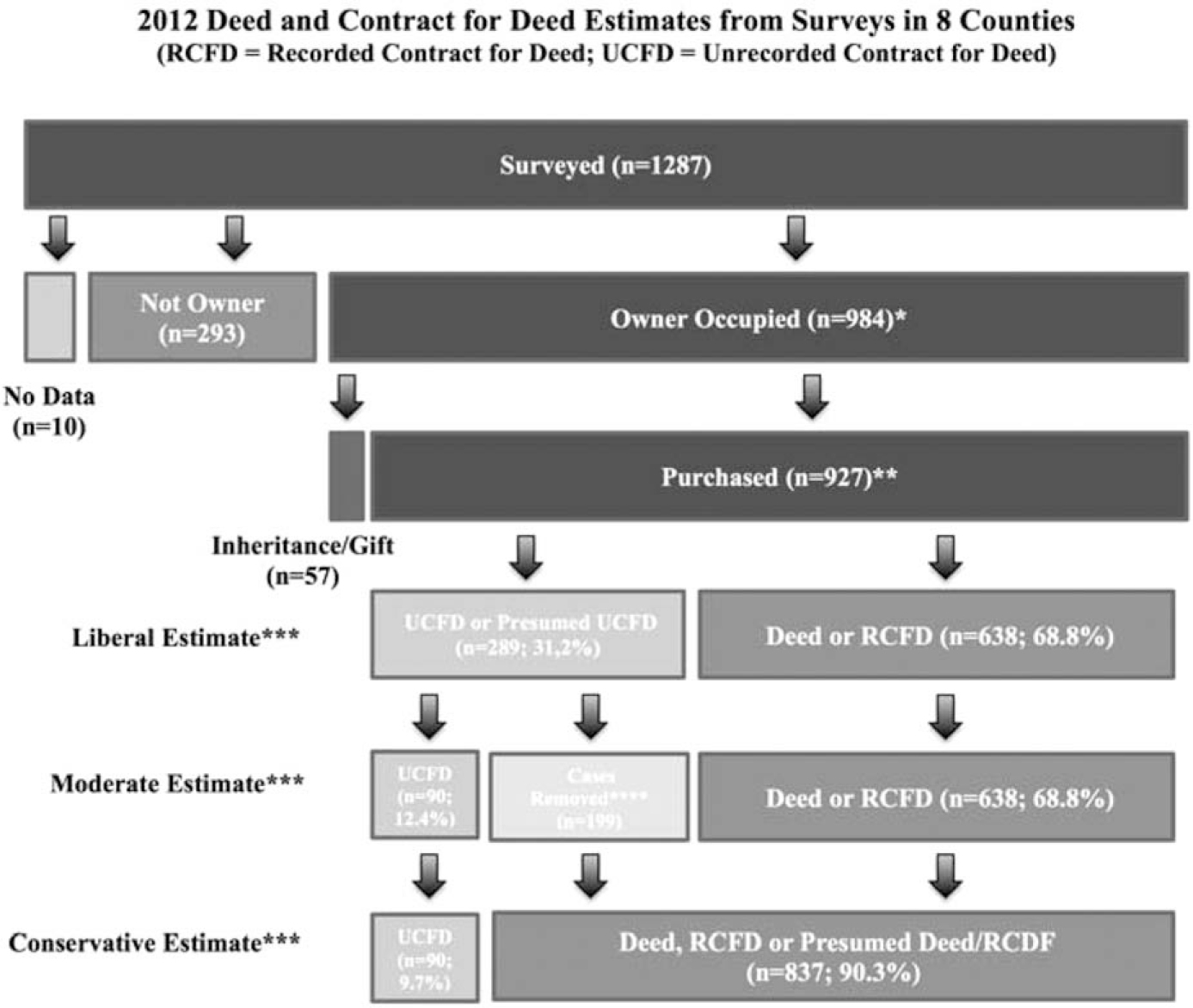
We employed the methodology pictured in Figure 1 systematically to all of our survey data across eight counties. We first removed the small population of renters and nonowners (19 percent of those sampled). We then sought to exclude false positives that would have been created by owners reporting having inherited the property or having received the property through a gift. The remaining owners we surveyed who did not appear as owners in the real property title records were categorized as having purchased under an unrecorded CFD that had not yet been converted to a deed. Those owners who did appear in the title records as having a deed or a recorded CFD in their name were also included as having initially purchased with an unrecorded CFD if they reported having purchased their property more than three years prior to the appearance of their deed or CFD in the public records.
Current Deed and Contract for Deed Estimates from Surveys in Eight Texas Counties, 2012
*The sample size for owner occupied lots is actually 992, although 8 cases were excluded due to coder error. These miscodes represent eight cases labeled as “No Data.” **The sample size for purchased lots in fact contains all owners that did not explicitly report having inherited or received the lot as a gift. Thus, certain cases in which the mode of acquisition (purchased, inherited, etc.) was unclear are included in this count.***These estimates differ slightly from those shown in Table 1 of this paper. This is due to the fact that the above estimates refer to counts in all eight counties, whereas those in Table 1 are extrapolated data for the six border counties.****Deed type unknown.
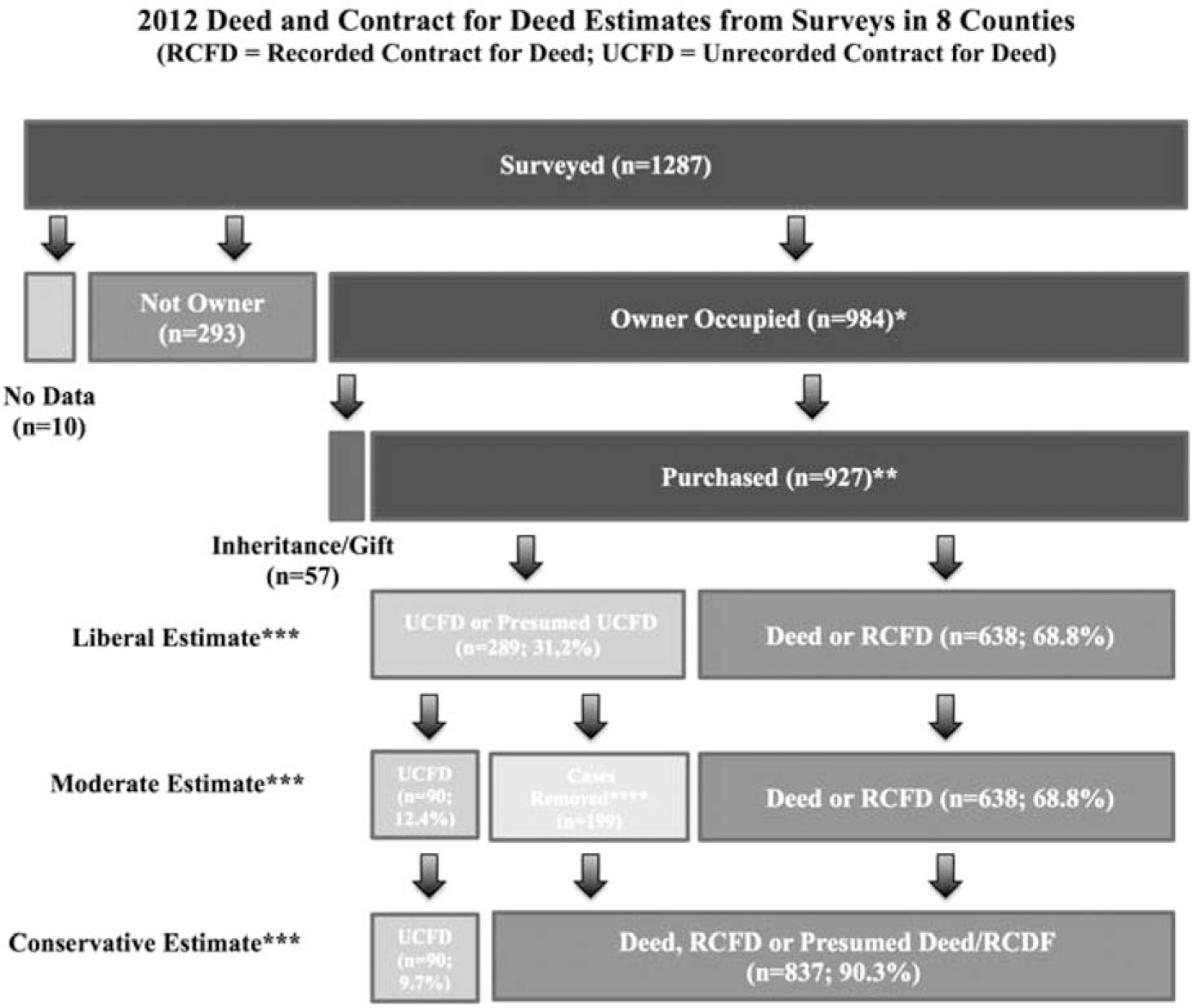
To determine whether a particular owner had a recorded deed or recorded CFD, we attempted to match the owner's name with any public records we could obtain about the ownership of the lot. We did this by attempting to gather as much information as possible about the last four prior recorded transfers of the properties from multiple sources. This was often very difficult due to the poor quality of county clerk and appraisal district records in some counties.Footnote 22 To address these problems, when we identified any type of name match between the head of household we surveyed and the public records, we first categorized the nature of the name match to reflect our degree of confidence in the match. Next, we condensed the types of public records we encountered into four categories: (1) deeds; (2) CFDs; (3) ambiguous document types, including those labeled as “other,” “conversion,” or “unknown”; and (4) irrelevant transactions that clearly did not confer ownership or imply a CFD.
These two steps allowed us to arrive at two distinct estimates of the current unrecorded CFDs in the colonias for each of the six border counties where we were required to undertake extrapolated total estimates. For the liberal calculation, any recorded transactions with missing names in the central (county) appraisal district (CAD) records were deemed not to have a record of ownership in the name of the purported owner we interviewed, as were all ambiguous transactions that we found for each case. Similarly, we assumed that the lots we were unable to identify in the CAD or county clerk records did not have a recorded CFD or deed in the surveyed owner's name, and also made the same assumption for those lots that, while identified in the CAD records, had no record of any transaction. Each of these assumptions increased the instances in which we labeled an owner as having an outstanding unrecorded CFD.
The conservative estimate resolves these gaps in information in the opposite direction, assuming in the wake of uncertainty that there was a recorded CFD or deed in the surveyed owner's name, thereby yielding a much lower estimate of outstanding unrecorded CFDs. That is, when these same data ambiguities are resolved in favor of an assumption that the owner does have a deed or recorded CFD in his name and therefore does not have a UCFD, the estimate of owners with an unrecorded CFD drops.
As is so often the case, we suspect the truth lies somewhere in between the liberal and conservative estimates. It does not make much sense to resolve all missing data points against recorded ownership, nor does it make a lot of sense to resolve ambiguities in favor of recorded ownership all the time. Our moderate estimate uses the clean data cases to predict, or impute, the missing data for the ambiguous cases. The moderate estimate is almost certainly an undercount of unrecorded CFDs, even though we prefer it to the more liberal estimate for the reasons outlined above.
For owners who held a deed to their property at the time they were interviewed, we also needed to distinguish between those owners who bought initially with a deed from those who purchased with an unrecorded CFD that had since been converted to a deed. To calculate whether an unrecorded CFD had been agreed to at the time of purchase and was later recorded or supplanted by a deed, we analyzed the period or gap between the purchase date that the surveyed owners reported to us and the date of any deeds or recorded CFDs that appeared in the public record after the date of the purchase to account for instances in which buyers did not recall correctly the purchase year. We also created cut‐off years, after which we considered the absence of a recorded deed or CFD in the owner's name as evidence that an unrecorded CFD was utilized at the original purchase.Footnote 23 The actual findings are described in the following section.
IV. Research Findings
Compliance with Recording Requirements and a Shift to Using Regular Deeds by Land Developers
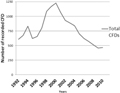
Chief among our research findings from the first phase of our study, after accounting for fluctuations in overall land sales in the counties,Footnote 24 is that the enactment of the statutory recording requirements was followed by a rush to the deeds office to record CFDs for approximately five years immediately following the enactment of the recording requirements. Whereas, prior to 1995, the recording of CFDs in colonias was rare, from 1995 to 2001 the recording of CFDs more than doubled in the counties we examined. As one can observe in Figure 2, the overall number of recorded CFDs increased significantly around the passage of the first recording requirement applicable to border colonias in 1995, peaking around 2000.
Total Number of Recorded Contracts for Deed 1989–2010 (Three‐Year Running Mean)
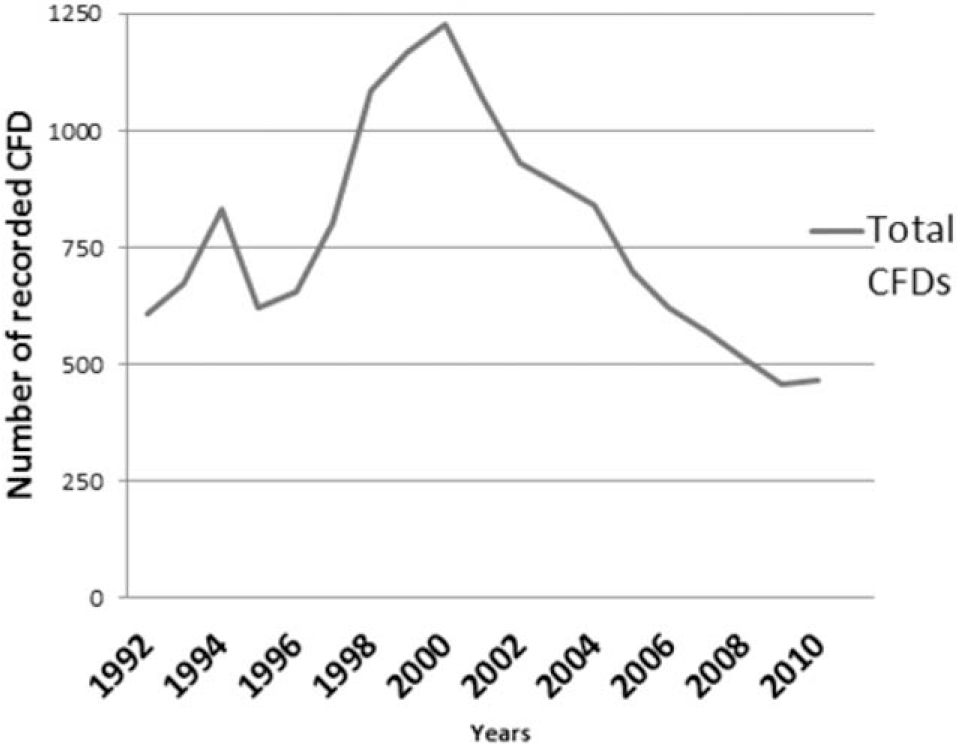
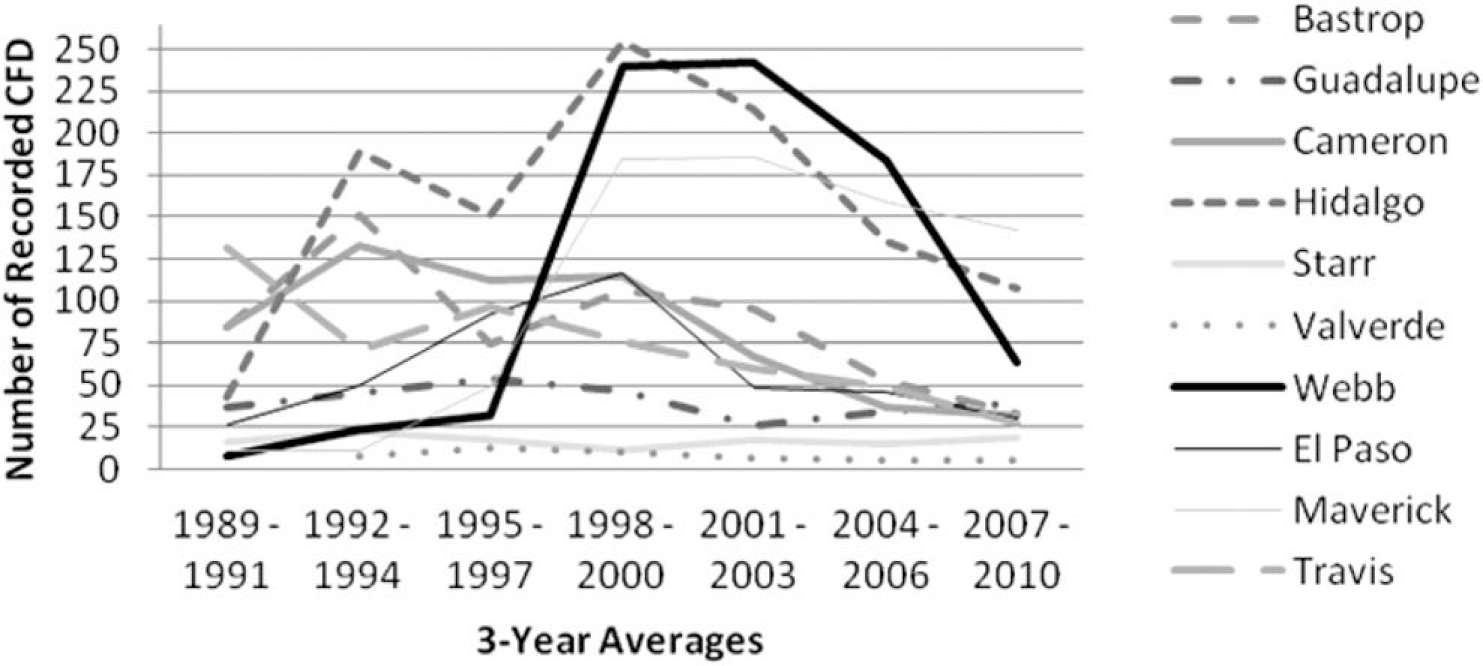
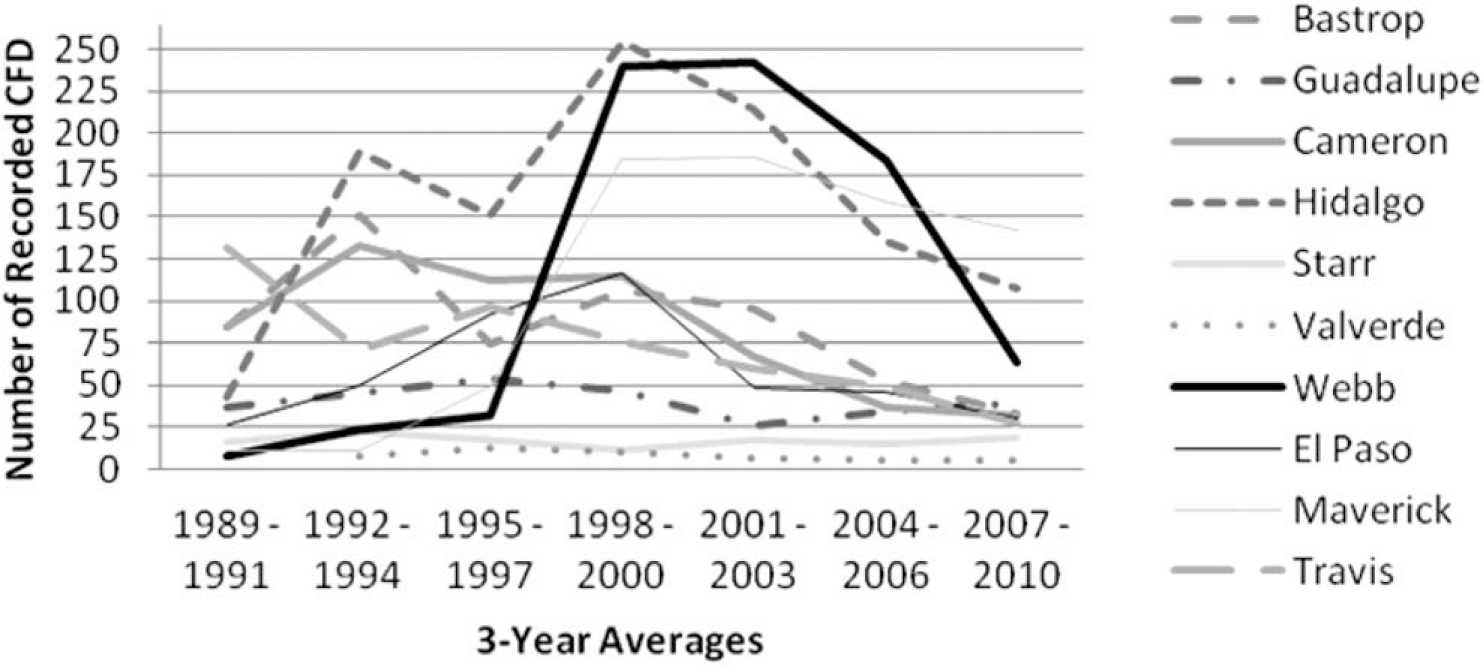
After this rush to record, the Texas Legislature adopted additional sets of CFD regulations, which were coupled with severe penalties for violations. Following these reforms, our Phase 1 and Phase 2 methodology and findings, again accounting for overall fluctuations in land sales, established that private land developers largely shifted away from all uses of CFDs, both recorded and unrecorded, relying instead on deeds and deeds of trust to finance their sales. Thus, beginning in around 2000–2001, the overall use of recorded CFDs started to decline considerably, and continued to decline throughout the following ten years of our study. By 2010, the annual number of CFD recordings combined across all ten counties included in this phase of research had leveled out from a high of 1,226 in 2001, to approximately 450 as of 2010.Footnote 25 Since 2001, with some exceptions such as Bastrop and other counties we studied in central Texas, almost all the individual counties in our study have also seen an ongoing decrease in the number of recorded CFDs (see Figure 3). Below we discuss Phase 2 of our study in relation to recorded CFDs, which reinforced the findings in Phase 1 in relation to the increased reliance by developers in recent transactions on deeds and deeds of trust instead of CFDs.
Three‐Year Running Mean: Recorded Contracts for Deed by County 1989–2010 *
*As discussed further in Ward, Way and Wood (Reference Ward, Way and Wood2012), Final Report Appendix A.ii., the totals for Cameron and Webb counties are likely undercounts.
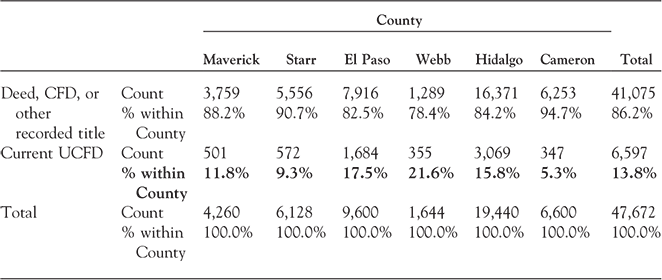
As we described earlier using our Figure 1 flowchart, our data gathering and analysis in Phase 2 of our study presented a number of challenges for analyzing the extent to which developers still utilized unrecorded CFDs following the legislative reforms, given the unrecorded nature of these transactions. Thus, for the six counties in which we undertook randomized selection, we generated three sets of estimates. These resulted in estimates of between 10 and 30 percent for buyers with currently held unrecorded contracts. Table 1 projects the total extrapolated numbers using the moderate estimate. The bottom line here is that unrecorded CFDs remain alive in large numbers.
Extrapolation of Survey Data by Deed Types for Randomly Selected Colonias in Six Border Counties Showing Moderate Estimations of Current Unrecorded Contracts for Deed (Highlighted Row)

| County | ||||||||
|---|---|---|---|---|---|---|---|---|
| Maverick | Starr | El Paso | Webb | Hidalgo | Cameron | Total | ||
| Deed, CFD, or other recorded title | Count | 3,759 | 5,556 | 7,916 | 1,289 | 16,371 | 6,253 | 41,075 |
| % within County | 88.2% | 90.7% | 82.5% | 78.4% | 84.2% | 94.7% | 86.2% | |
| Current UCFD | Count | 501 | 572 | 1,684 | 355 | 3,069 | 347 | 6,597 |
| % within County | 11.8% | 9.3% | 17.5% | 21.6% | 15.8% | 5.3% | 13.8% | |
| Total | Count | 4,260 | 6,128 | 9,600 | 1,644 | 19,440 | 6,600 | 47,672 |
| % within County | 100.0% | 100.0% | 100.0% | 100.0% | 100.0% | 100.0% | 100.0% | |
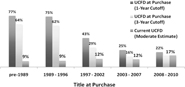
As to what extent the use of unrecorded CFDs has declined over time, we found that after the 1989–1996 period, the use of unrecorded CFDs dropped more than 50 percent and continued to drop in the following years. Figure 4 shows the dramatic decline in the use of unrecorded CFDs, dropping from a high of 64 percent to 77 percent of current owners surveyed who purchased their homesteads prior to 1989 to a far lower 16 percent to 25 percent in 2003–2007, and 17 percent to 22 percent during the 2008–2010 period. This decline in the use of unrecorded CFDs is even more notable when the data for developer sales are disaggregated from sales by residents. Whereas it is widely acknowledged that developers selling property in South Texas colonias prior to the 1995 reforms relied largely on the unrecorded CFD, 73 percent to 83 percent of the residents surveyed who had bought from developers in the years 2003–2010 utilized a deed and a deed of trust financing mechanism. These data suggest that developers, who relied largely on unrecorded CFDs prior to the legislative reforms, steered away from the unrecorded contracts in the postreform era.
UCFDs at Time of Purchase vs. Current UFCD
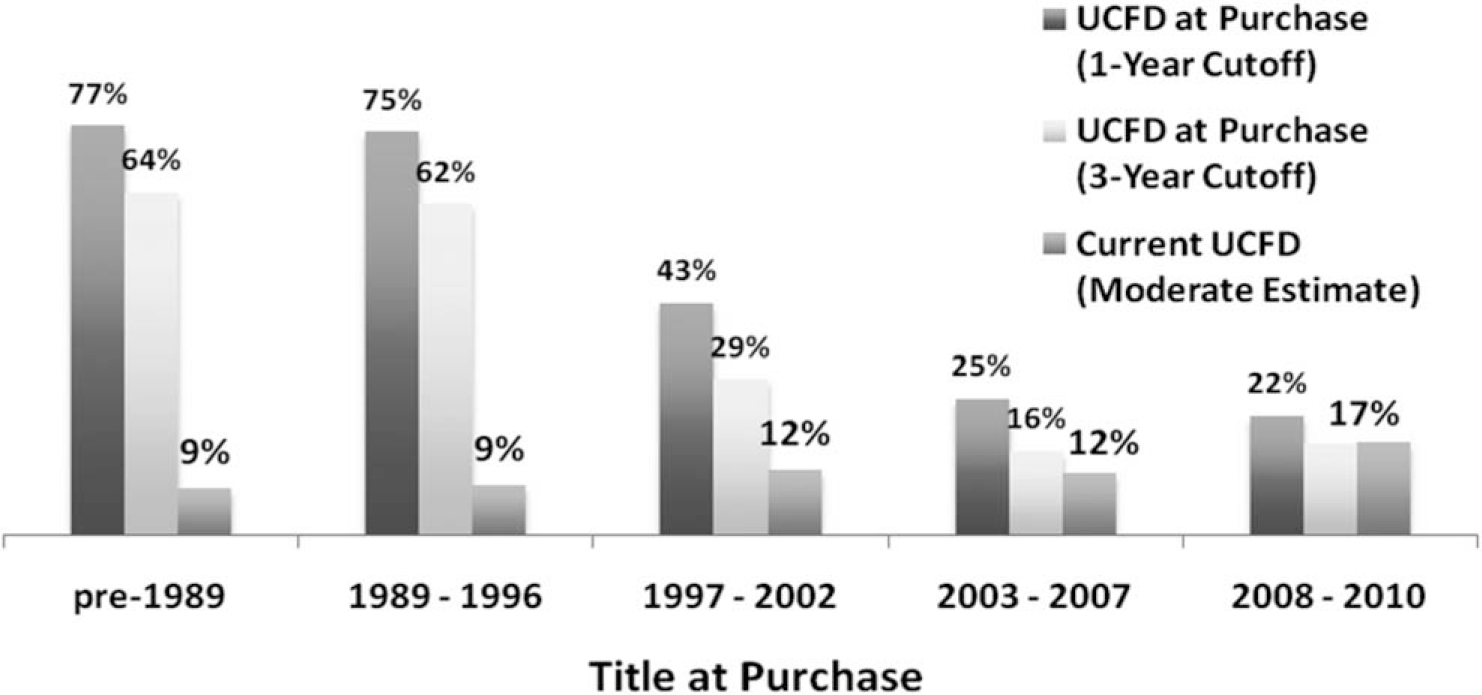
Although we had already measured the number of CFDs recorded annually by county during Phase 1 of our research, we paused here to look for evidence of use of recorded CFD in our Phase 2 data, given the limitations of the Phase 1 data in documenting the number of recorded CFD sales in relation to total sales occurring in colonias.Footnote 26 Within our survey sample of current owners in colonias, we found only three instances of recorded CFDs at purchase out of 220 owners who bought during the years 2005 through 2010. Each of these three purchases was made from a developer‐seller.
Our conclusions here could be questioned on the grounds that the Phase 2 survey data do not capture prior buyers who had attempted to buy the same parcel from the developer‐seller utilizing a recorded or unrecorded CFD, but had not completed the purchase or had otherwise moved prior to the survey period. We think this concern is adequately addressed by the fact that the focus of these data is to capture current developer practices. Through our concentrated analysis of particular subdivisions, we observed that a developer typically utilizes the same type of financing in all transactions in that subdivision in the same period, and that once a developer makes a switch from CFD to deeds, the developer sticks with deeds. Thus, if a developer was utilizing a recorded CFD in selling the same parcel to a prior buyer, but used a deed in the sale to the current buyer, we feel comfortable concluding that the developer has likely made the switch for all transactions of the same period and for further sales moving forward. Even though we cannot pinpoint with accuracy the date that this switch occurred, we know that this switch to deeds took place at some point after 1995, given the widespread recognition that developers were largely using CFDs prior to 1995, and our Phase 1 data point to the switch happening with greater frequency after the 2001 legislative reforms.
To address further the fact that our focus on current residents led us to overlook the use of recorded CFD by prior residents who had lost properties due to payments missed or who voluntarily left, we went beyond the owners we interviewed in order to examine, where possible, the last three, and in a few cases four, recorded transactions for each of the properties whose owners we surveyed to see if a recorded CFD had been utilized in a prior transaction. In looking at the overall number of transactions in the property record that possibly could have been recorded as a CFD, we found only 115 former recorded CFD transactions. Critically, we found that of these 115 cases, only ten were recorded during or after 2005. Eight of these ten recorded CFDs were in the border counties from which our extrapolative results were derived, and of these, half (four recorded CFDs) appear to have been transacted by one particular developer in Maverick County. These findings strongly echo our Phase 1 findings that most of the recordings of CFDs were undertaken prior to the final batch of legislative reforms from 2001–2005 and that, in the border region especially, recorded CFDs were rarely in active use after 2005.
In summary, the story of the CFD legislative policy reforms is largely one of success in terms of having contributed to developers shifting away from unrecorded and recorded CFDs to utilizing deeds and deeds of trust—presumably less risky transactions that confer title at the closing. Although a few nefarious developers may continue to use CFDs, most are unlikely to do so. Switching over to deeds of trust from the CFD was a rational response to the numerous reporting requirements and significant penalties imposed by the legislation for violations, including treble damages and the right of rescission for certain violations. These requirements and penalties, together with buyers having the right to convert their CFDs into warranty deeds with deeds of trust, as well as the right to a nonjudicial foreclosure process after a certain number of payments had been completed, eliminated all the benefits of the CFD, leading Texas lawyers to advise their developer clients to stop using CFDs. Meanwhile, sellers could readily access an alternative form of seller financing: the note secured by a deed of trust.
In the words of a Texas real estate lawyer who represents developers: “Add up the numbers and one can easily see that the potential downside [of CFDs] is significant …. [T]he risks of an investor of engaging in [CFDs] have nearly eliminated their use in the residential context” (Willis n.d.).Footnote 27 Another Texas attorney concluded, after analyzing the reforms: “The legislature's attempts to make contract for deed transactions more like mortgage law and its attempt to deter lawyers and sellers from utilizing contracts for deed as a financing method are good reasons to eliminate their use altogether and simply apply mortgage law …. Once sellers understand the downside created by the regulations, they will probably see that the risks outweigh the benefits of utilizing contracts for deed” (Lee Reference Lee2005, 18).
The Rising Role of Consumers as Sellers and Impacts on Informality
Contrary to the expectations of those advocating for the regulation of CFDs, the implementation of the recording requirement and other legislative protections did not entirely extinguish the CFD, especially not outside the border counties. Although the use of recorded and unrecorded CFDs plummeted on the heels of the legislative reforms, the contracts continue to be used at significant rates in the border region and also in interior counties far from the border. However, the primary driver of this ongoing utilization of CFDs and noncompliance with the recording requirements is the growing role of low‐income consumers as land sellers.
As colonias age, residents are gradually replacing developers as the dominant actors in land sales. In colonias developed prior to 1989, we found that consumer‐to‐consumer transactions have become by far the most predominant form of land sales. Of those owners we surveyed who recently (2008–2012) bought their lot in a colonia or other informal subdivision developed prior to 1989, 83 percent of owners bought from another consumer. In contrast, of those who recently purchased from a post‐1996 developed colonia or informal subdivision, 89 percent bought from a developer. While up‐front all‐cash sales play a larger role in consumer‐to‐consumer sales (21 percent) compared to developer sales (8 percent), our study found that seller financing is still the norm in these transactions, with 63 percent of consumer‐to‐consumer sales utilizing seller financing.Footnote 28 We conclude that the legislative reforms have largely left this group of consumer‐sellers untouched. We found that these consumer‐financed transactions have by far much higher overall levels of informality and an array of related issues, with pervasive levels of unrecorded CFDs, in contrast to sales by developers. Out of the current owners we surveyed who recently (2008–2012) bought their homesteads and have an active unrecorded CFD, 78 percent bought from the prior resident, and only 22 percent bought from a developer (see Figure 4). As another way to present the data, for conservative and moderate estimates, respectively, between 29 percent and 38 percent of current households who recently purchased from another consumer entered into an unrecorded CFD, in contrast to between 9 percent and 12 percent of those who purchased from a developer.
The CFDs used in these consumer‐to‐consumer transactions typically end up as improvised and informal agreements, ranging from handwritten scraps of paper to typed documents that are cobbled together. These documents often lack basic information about the terms of the transaction, along with the statutorily mandated consumer disclosures, notices, and other provisions required by the Texas Property Code.
The high levels of informality in consumer sales are likely due in large part to the fact that most consumers in these transactions do not use lawyers, banks, real estate agents, or closing assistance from a title company, placing the buyers in an especially vulnerable position. As the sellers and buyers venture out on their own to handle their own land sales, consumers lack awareness about legal requirements governing the sales transaction, as well as access to good legal forms. Many of them are outright unaware of the importance of deeds, the importance of checking the status of the title, and how to record their documents. As mentioned above, for example, many of the residents we surveyed were unaware of what type of title they had received, if any, and if it had been recorded. We heard repeatedly in follow‐up interviews with selected owners that they could have been benefited greatly from having had more information about the land sales process and access to affordable assistance in preparing or reviewing their sales documents. Another possible contributing factor for the higher levels of informality and legal noncompliance in consumer sales is that almost one in five (18.5 percent) involve a purchase from a family member. In interfamily transactions, one would expect to see less formality.
In summary, the Texas CFD laws have left consumer‐to‐consumer transactions largely untouched. Lacking information about the legal requirements that would bring stability and protection for both buyer and seller, consumers are selling their lots to new residents, and many are doing so illegally. And as developers continue to move out of the picture in older colonias, we expect that not only will consumer‐to‐consumer sales continue to increase over time, but that the number of informal (and illegal) sales will also grow over time in these particular communities.
The Impact on Homeownership
In response to the concerns raised that the CFD reforms were too restrictive and would be likely to shut down homeownership opportunities for the poor in colonias, our data suggest that has turned out to not be the case. Low‐income households are still moving into (preexisting) colonias and buying homesteads. Despite the legislative reforms, low‐income buyers are continuing to buy land informally from other residents, or via more formal sales from developers. While renting appears to be on the rise,Footnote 29 we suspect that rather than being a result of the CFD reforms, this is a strategy that is being adopted in response to the challenges that residents face in selling their property and buyers’ inability to access bank financing.
Despite the pitfalls of homeownership, this drive toward homeownership continues in part because colonia residents are still finding that owning land provides a stable place to live. As mentioned earlier, our research found that 56 percent of the residents we surveyed across all counties had been homeowners on the same lot for at least ten years, and 19.5 percent had been homeowners on the same lot for at least twenty‐four years, while in the six border counties the average year of purchase was 1993 (and median 1994—almost twenty years prior to the survey). These findings contrast with renters—73 percent of renters had lived in their homes for four or less years. In addition to the relative stability that owning a home provides compared to renting, owning a home also provides an asset that families can pass onto their children one day. A separate study in Starr County found that the average value of properties is over $50,000—not a large amount, but an important asset nonetheless—and that significant ongoing investment both in the home and in the community infrastructure is evident (Durst and Ward Reference Durst and Ward2014). Other benefits for residents include the ability to enter the market with low up‐front costs, the ability to live intergenerationally with extended family members, and the promise of eventually paying off the financing and thus not having a monthly housing payment.
Recorded CFDs and Ongoing Risks to Consumers
During Phase 1 of our study, we were also interested in trying to gauge the extent to which the consumer protections contained in the legal reforms brought about greater security for homeowners who purchased under a recorded CFD. We pursued this analysis in Maverick County—where the use of recorded CFDs was especially high and where we were able to obtain useful data from a title company—by examining the extent to which buyers with a recorded CFD eventually were successful in obtaining title to their land via a deed.Footnote 30
The data comprise the transaction status for a 10 percent sample of 239 cases of recorded CFDs in Maverick County. They show the number of CFDs recorded between 1989 and 2011 that were then followed by a deed (18 percent), which were subsequently cancelled (i.e., did not progress to a deed: 45 percent), or which remained a CFD. The latter, we assumed, are more recent sales or those that, for one reason or another have, still have payments outstanding (37 percent). Of course, a proportion of the latter may conclude in a final deed outcome. These data suggest that close to half of those purchasing a lot through a recorded CFD in Maverick County ended up never completing the purchase and obtaining the deed, and thereby likely forfeited any equity they may have held in the property.
The high rate at which Maverick County homebuyers lost their lots through the cancellation of their CFDs (45 percent) and were thus unsuccessful in obtaining a deed is a new and very important finding. To our knowledge, ours is the first examination of the success rate of those low‐income would‐be homeowners making it through informal self‐help and self‐managed informal housing production systems. Add to this the likely high nonsuccess rate of unrecorded CFDs (which we could not measure), and it is clear that while many households and would‐be owners acquire and consolidate their property through informal housing production, an equal number appear to fail in their quest.
Moreover, even though the Texas legislative reforms in 2005 granted consumers the right to convert their CFDs into deeds and deeds of trust, the Maverick County data show that very few buyers with CFDs have taken advantage of this right. Although the conversion right is a strong protection for consumers, the consumers must first have information about the right and then, typically, the assistance of a lawyer to complete the conversion process. Moreover, even with the other consumer protections contained in the Texas legislative reforms, CFD buyers in Maverick County have still been extremely vulnerable to losing their homes rapidly. Although it is possible that the Maverick case study is an aberration, we suspect that it is not. It seems very likely that a large percentage of homebuyers in other counties who have legally recorded CFDs fail in their endeavors to obtain secure titles to their lots, and that a high percentage of lots are reverting back to the original seller, or are later abandoned (Ward, Way, and Wood 2012, ch. 5; Durst and Ward forthcoming). The case of Maverick County hints at the reality that the legislative protections have not necessarily brought increased security for buyers with a CFD, even in cases in which sellers have recorded CFDs in compliance with the legal reforms.
Title Without Security? New Subdivisions in the Border Region
A final part of our study examined the impacts of the Texas CFD reforms in terms of making developer sales with deeds and deeds of trust safer and less risky for the low‐income buyers. As discussed above, one of the primary intents of advocates behind the reforms was to incentivize developers to move away from the CFD and to begin using traditional deeds and deeds of trust. This raises an important policy question: Do these deeds come with any greater levels of security for the buyers?
Our study found that at least some developers in Texas utilizing deeds in low‐income settlements have found other ways to exploit low‐income buyers. By purchasing in a market that still lacks adequate oversight and consumer protections, buyers utilizing seller financing from developers still face a range of exploitative practices. These practices include the use of extremely high interest rates, aggressive filing of foreclosure actions for missed payments, and negative amortization schedules created by aggressive late fee charges rolled over into the principal. In our surveys, we also came across cases of developers who charged special assessments to close out the contract and provide the final deed.Footnote 31
One of the most alarming findings from the study was a recent pattern of rapid and aggressive repossession by developers selling vacant lots in the newly developed subdivisions with full services under model subdivision rules in Cameron, Hidalgo, and El Paso counties. The buyers in these transactions were some of the poorest residents we came across in our study.Footnote 32 In one new subdivision where the seller was utilizing deeds with deeds of trust as the financing mechanism, 45 percent of the lots sampled had been foreclosed upon at least once, and 44 percent of those foreclosures had occurred within a year of purchase (Ward, Way, and Wood 2012, ch. 5, 16). This lack of stability and security among the low‐income buyers with deeds resembles the lack of security we found among buyers with recorded CFDs in Maverick County.
In short, even though more homebuyers in seller‐financed transactions are receiving deeds in newer, serviced subdivisions, many are confronted with the same issues of volatility and home or lot loss that may have been rampant in the 1980s and early 1990s when Texas policymakers first began regulating CFDs. Ironically, unlike the purchasers of the 1980s—many of whom have since successfully obtained deeds to their homes, made improvements, and built substantial equity—many of the purchasers in these new subdivisions are in worse condition. They have limited prospects for paying off their financing, investing in substantial improvements, or building equity. Faced with little likelihood of ever owning their lot and homestead, many of the buyers on these lots live in extremely poor housing conditions, including rudimentary shacks, campers, and old dilapidated trailers, with little prospect of improvement. Given the high risk of the lot being repossessed, any home investment is likely to be in items like a washing machine or fridge placed outside the dwelling under a rudimentary porch, rather than in the dwelling structure itself. These purchasers have become de facto renters living on a serviced lot in some of the most substandard housing conditions that can be found in Texas.
V. Analysis of Compliance and Development of Appropriate Policy Responses
Responsive Sellers: Intentional Compliance
Returning to our initial questions, we find evidence that most developers were indeed responsive to the CFD reform laws, both in moving from unrecorded to recorded CFDs and, subsequently, in turning away from CFDs altogether in favor of deeds of trust. Policy responses building on this finding of basic responsiveness and targeting developers still violating the law could include the coupling of existing legal mandates with additional and more effective policing and enforcement of violators. In Texas, the policing and enforcement of the CFD laws has been left largely to overburdened legal aid attorneys. Although the legal aid attorneys have been able to bring a number of successful actions to compel developers to comply with the new laws, legal aid offices are understaffed and overextended and thus limited in their ability to go after violators. A subset of developers (although much smaller than was the case before the reforms were enacted) will continue to violate the CFD laws unless they know they will be held accountable. In other words, to the extent our results are consistent with the view of these developers as both knowledgeable of the law and sensitive to the legal penalties, the remaining violators will be reached when the penalties are higher or enforcement more likely, or both.
Responsive Sellers: Intentional Compliance via a Workaround
Also consistent with our conclusion that developers were impacted by, and have been largely responsive to, the legal reforms is the evidence we found of new workarounds discussed above. Historically, with each stage of legal reform in Texas, a subset of developers has created workarounds of the legal requirements, enabling them to flip land quickly and extract a quick profit from unwary and vulnerable buyers. For example, soon after the 1995 legislation, many developers and other sellers switched over to lease‐purchase options (a.k.a. rent‐to‐own contracts) to circumvent the reforms. A subsequent legislative amendment resolved this issue by making lease‐purchase option contracts exceeding six months subject to most of the CFD restrictions (Tex. Prop. Code 2012, § 5.062(a)(2)). A second workaround that developers have used in Texas involves the misuse of deeds in lieu of foreclosure, or security deeds. In these transactions, the seller utilizes traditional seller financing with a note and deed of trust, but then requires the buyer to waive the right to foreclosure proceedings and to give the deed back to the seller to hold as security in the event the buyer defaults on the note. Advocates have since persuaded the Texas Legislature to ban this workaround (Tex. Bus. & Commerce Code 2012, § 21.002).
The evidence of high flip rates found in our study strongly suggests a third and quite successful workaround through which sellers responsive to the law may have succeeded in bypassing the overarching goal of the reforms—increased security to buyers—while still complying with the law. Additional research will be needed to understand the exact nature of these workarounds, and to identify ways to reduce flipping as the emergent barrier to secure title in these communities.
Nonresponsive Sellers: Intentional (But Rational) Noncompliance
Viewing a particular behavior as evidence of nonresponsiveness to a law is difficult in a world in which one cannot see what the behavior would have been absent the legal reform. We have highlighted the fact that we saw one set of sellers—land developers—appear largely to abandon the CFD, both recorded and unrecorded, postreform. Sellers residing in their homes and selling to a new low‐income resident, on the other hand, appear not to have made the switch.
Why, then, have low‐income sellers continued largely to ignore the legal reforms? While we can only speculate at this juncture as to the reasons, one factor that may be driving noncompliance is the fact that these consumer‐to‐consumer transactions are almost entirely invisible. Because most of these transactions are undertaken without bank loans or other credit, there is very little, if any, third‐party scrutiny of the sales transaction. Moreover, sellers engaging in fewer than two transactions in a twelve‐month period face significantly lower penalties under the Texas CFD laws (Tex. Prop. Code 2012, § 5.077(c)), as well as very low odds of being caught violating the law, given the lack of policing by outside parties. Finally, because sales via CFD among close family members are exempted from much of the law,Footnote 33 some of the unrecorded CFDs we came across are actually not evidence of noncompliance at all.
Nonresponsive Sellers: Unintentional Noncompliance
Another likely factor driving noncompliance by low‐income resident sellers is ignorance of the law. In our interviews of residents, we found widespread ignorance as to what types of titling and financing mechanisms exist. Residents were largely unaware of whether they had title to their home and, if so, what type of title they had. Moreover, most were purchasing and selling land without assistance of a real estate agent or attorney. The residents also lacked information about what the CFD reforms require in the way of disclosures, what contractual terms are prohibited, and how recording operates to protect both buyer and seller.
Such unintentional noncompliance counsels strongly in favor of a large, grass‐roots community education campaign around homebuyers’ rights and responsibilities. But even beyond this, where custom or tradition especially favors a particular set of behaviors, eradicating these informal ways of transacting may require much more than mere knowledge of the law (Ellickson Reference Ellickson2012). Even when residents are aware of the legal requirements governing CFD, there is no readily accessible portal with sale transaction forms and other information on how to execute sales documents properly. Coupled with consumer education, the promulgation of a simple deed and deed of trust template for consumer‐to‐consumer transactions (in Spanish and English) that can substitute for the handwritten notes and other informal documents could go far in bringing these sellers into legal compliance, while at the same time reducing vulnerability and risk to the seller. These forms should carry clear instructions about notarization and filing requirements and how these may be achieved at minimal cost and without prejudice or fear of reprisals.
Given the challenges that anyone can confront in navigating a home purchase without a real estate agent or title agent, some kind of legal assistance to identify potential title issues and ensure proper execution of documents is also highly desirable. Currently, there is an almost total lack of legal services available within these communities to help buyers with these transactions. Legal assistance programs and continued pro bono efforts by the State Bar of Texas are badly needed to help low‐income homebuyers in seller‐financed transactions review the sales transaction documents, advise them about reviewing the title, and assist with the overall transaction, as well as with the enforcement of buyers’ rights following purchase.
For the low‐income resident seller, CFDs and informal workarounds will remain commonplace, and can best be analyzed as rational responses to what are often intractable structural problems of poverty, the lack of alternative financing options targeting the low‐income housing market, and inadequate communication and information dissemination systems. Only by sensitively addressing these issues will informal responses be reduced and made less rational. Criminalizing or penalizing informal behaviors by these low‐income sellers is only likely to exacerbate the unintended (or unpredicted) consequences of public policy interventions.
The heart of the problem facing unwary low‐income consumers who end up caught in the snares of risky homeownership transactions in informal subdivisions is their lack of access to bank financing and their resulting dependence on seller financing. Legislation enhancing residents’ access to bank credit would obviate the need for continued reliance on seller financing in any form, bringing immediate and lasting relief to these communities. Laws fostering the expansion of community‐based nonprofit lending institutions and supporting community development corporations in their provision of assistance to low‐income homebuyers with safer forms of home financing and avenues to homeownership would also help address these issues.
VI. Conclusion
In this article we have analyzed the impact and outcomes of a set of major housing legislature reforms from 1995 and 2001 designed primarily to provide greater consumer protection to prospective low‐income homeowners in Texas colonias. The primary target of this legislation was CFDs, which offered a low‐entry‐cost system of property conveyance (mostly in the form of unserviced lots in the urban hinterlands of counties), and that were widely known to leave buyers extremely vulnerable to developers. We have found that the legislation had a significant impact in two principal ways. First, it caused developers to take steps to ensure that any CFDs utilized were recorded in the county property records. To that end, the legislation was largely a success, and has helped ensure that developers on the border and elsewhere record CFDs.
We have also found that developers in informal settlements—rather than withdrawing from the promotion of low‐income housing development altogether—eventually switched their forms of seller financing and titling following the legislative reforms. Specifically, they have moved from CFDs to giving buyers deeds up front, with a deed of trust as the financing instrument. This might be considered a desired and anticipated outcome, although in many ways it has coincided with the period when developers were already moving out of new colonia development, as well as moving out of older colonias, and being supplanted by residents selling their property after they had eventually obtained full title to their land. Another and more negative (and largely unanticipated) outcome has been that developers are now shifting their investments into new model subdivisions and, while relying largely on deeds and deeds of trust, are utilizing presumably legal workarounds that are leaving low‐income buyers increasingly vulnerable to rapid repossession by the developer. These new transactions are expediting repeated flipping of lots, often after a very short period of a year or less (Ward, Way, and Wood 2014, ch. 5).Footnote 34 The high likelihood of default and repossession are reducing the capacity for buyers to participate in self‐help home improvements.
While fully serviced and meeting the legislative requirements designed to prevent further growth of colonias, these model subdivisions are giving rise to some of the worst housing conditions near the border. The lack of a clear path to stable homeownership means that these buyers are de facto renting the property with little or no prospect of ever becoming owners in many cases. Faced with such vulnerability, it is little wonder that there is no incentive to consolidate and improve the home.Footnote 35
Given these changing practices, Chapter 6 of our TDHCA Report (Ward, Way, and Wood Reference Ward, Way and Wood2012) recommends a range of policies and next steps to address these ongoing abusive sales practices, including usury limits, the creation of mission‐driven, community‐based lending institutions, legal assistance to homebuyers, and more policing and enforcement by the state and legal aid organizations. The lack of safe and affordable rental housing options in colonias also leads to our proposal that the state create a program in partnership with nonprofit organizations to pool vacant lots in colonias for construction of new rental housing.
A second major finding presented in this article is that unrecorded CFDs are still common in property transactions between resident owners and new buyers and may be growing in spite of the robust legislative CFD reforms, given the increased prevalence of consumer‐to‐consumer sales in older colonias. This is especially problematic for a number of reasons. First, unrecorded transactions make the buyers vulnerable to a host of lien issues, including tax liens and child support liens, for obligations not met by the seller. Second, a buyer with an unrecorded CFD is unable to obtain a homestead tax exemption, which can result in significant property tax savings and the right to defer property taxes until death if the owner is a senior or person with disability. Third, with an unrecorded transaction, we have seen cases where the seller denies he sold the property to the buyer—meaning that the buyer is in a leasehold transaction and not accruing any equity in the property.
To the extent that CFDs continue to be important, legislation and additional incentives need to focus on ensuring that those transactions are recorded and that sellers can easily switch over to using a deed and deed of trust. Here, too, we have outlined several policy proposals in our report, such as public awareness programs and making sales instruments readily available in Spanish and English. Those who do buy from another resident with an unrecorded CFD—often very informal and improvised—are likely to be very vulnerable to repossession, albeit now from another colonia resident rather than a developer. Without secure title—whether through a CFD or a deed—land market sales will be depressed, as will be the asset value of the land and home itself, and the incentive to invest in the home. Again, policy reforms to bring about the creation of mission‐driven, community‐based lending institutions; legal assistance to homebuyers; and more policing and enforcement by the state and legal aid organizations could all go a long way in bringing about safer financing tools for buyers in colonias.
Finally, this article speaks to several of the points raised at the outset and the reasons why developers and consumers responded differently to the CFD reforms. First, compliance with new laws is driven in part by the degree of societal consensus that the proscriptions and prescriptions set forth in the new law make sense and align with the social norms of groups targeted by the law. In the case of the CFD reforms, we found evidence of workarounds by developers leading to the aggressive flipping of lots, despite their technical compliance with the new laws, through the use of deeds and deeds of trust, suggesting that at least some of those actors regulated by the law did not agree with its aims and sought to avoid its impact. With regard to the consumer‐seller population, the law is hardly an expression of their consensus around the importance of recording or of up‐front transfer of title, as few residents we met were familiar with either concept.
Second, we found in the story of CFD reform that strong penalties and enforcement are indeed important. We believe that the high penalties to which developers were exposed if they violated the CFD laws and the highly publicized intervention by the Attorney General's Office in the early 1990s to imprison and sanction several notorious developers in the colonias, along with the subsequent efforts of legal aid lawyers in Texas to enforce these laws against developers along the border, almost certainly contributed to the increased use of deeds by developers in what were once almost uniformly unrecorded CFD transactions.
In contrast, with regard to the consumer‐seller population, many of the severe penalties in the legislation did not extend to consumer‐to‐consumer transactions. The residents—both sellers and buyers—also lacked access to the kind of legal counseling that could have helped usher in an era of consumer‐seller compliance. And fortunately for these consumer‐sellers—and perhaps unfortunately for their buyers—the law has yet to be enforced in any meaningful way in the tightly knit communities in which these consumer‐to‐consumer sales are occurring.
This study most clearly illustrates the third of our earlier stated propositions, which is that a law must be adequately and widely understood to have significant impact. Although it appears as though developers have become well informed about these reforms, and have altered their behaviors accordingly, the high rates of unrecorded CFD usage among consumer‐sellers, combined with their lack of understanding of title more generally, speaks strongly to the importance of community education around new laws.
In short, taking the case of CFD regulation in Texas, we have argued that policymakers are more likely to be successful where they seek to understand the rationale that underpins noncompliance among low‐income populations better. Policymakers need to also anticipate the likely workarounds that will occur as well as the unintended consequences of their actions to formalize informality. While developers mostly complied with the legislative mandate to record CFDs and responded to the high penalties for noncompliance by switching over to deeds and deeds of trust, the now reduced flexibility and profit opportunities offered by CFDs in Texas prompted at least some developers to switch to other forms of nefarious sales practices. The outcome has been to create new realms of vulnerability and inequity among low‐income homebuyers.