


Introduction
Study of nonlinear phenomenon as a subject of experimental and theoretical research in laser plasma physics is an active area in modern plasma research. Interaction of laser radiation with plasma gives rise to a number of nonlinear processes such as self-focusing, self-modulation, harmonic generation etc. It is important to study the underlying principle of this nonlinear phenomenon. The laser beam propagation in plasma has potential relevance due to their applications in X-ray sources (Zhang et al., Reference Zhang, He, Chen, Li, Zhang, Lang, Li, Feng, Zhang, Tang and Zhang1998; Miller et al., Reference Miller, Welch, Rose, Campbell, Oliver, Webb and Flicker2012), laser-driven plasma accelerators (Hoffmann et al., Reference Hoffmann, Blazevic, Ni, Rosmej, Roth, Tahir, Tauschwitz, Udera, Vanentsov, Weyrich and Maron2005; Xie et al., Reference Xie, Aimidula, Niu, Liu and Yu2009), harmonic generation (Salih et al., Reference Salih, Tripathi and Pandey2003), and fast ignition concept (Ghoranneviss et al., Reference Ghoranneviss, Malekynia, Hora, Miley and He2008). Further, such electromagnetic interactions are also important on account of their relevance in exotic ionospheric phenomena like profile modification and distortion of radio wave signal. In order to practically realize the laser plasma-based applications, it is desirable that laser beam should propagate hundreds of Rayleigh lengths. When high power laser beam propagates through plasma, instabilities, and nonlinear phenomenon like self-phase modulation, filamentation instability, group velocity dispersion, the finite pulse effects, relativistic and ponderomotive self-focusing become important.
Among the fundamental processes self-focusing and self-trapping are important nonlinear phenomena. The self-focusing is a process in which electromagnetic beam of light comes to focus as a consequence of nonlinear response of a material medium. In a nonlinear medium, a high power electromagnetic beam creates a refractive index profile across its cross-section corresponding to its intensity profile. The refractive index of the medium increases with the beam intensity. As a result, the beam focuses of its own. Self-focusing was reported for the first time by Askar'yan (Reference Askar'yan1962) and since then, it has been focus attention of scientific community for nearly five decades because it affects a number of other processes. In laser–plasma interaction, it plays a crucial role in the beam propagation. The self-focusing is strongly affected by the transverse distribution of beam irradiance.
As mentioned above, the basic physical mechanism responsible for self-focusing is nonlinear refractive index of the medium which is an increasing/decreasing function of laser intensity and thus modifies the dielectric characteristics of the medium. This mechanism takes place by various methods like ohmic heating (Litvak, Reference Litvak1966), ponderomotive force and relativistic mass modification (Hora, Reference Hora1975). When the laser power is sufficiently large, the electric field associated with high power laser pulse leads to quiver motion of electrons with a velocity comparable with the velocity of light in vacuum. This quiver motion of electrons in laser beam further expels the electrons from high-intensity region to low intensity region due to ponderomotive force. This will set up a space charge field that retards the electrons and a quasi-steady state is created. This modifies the refractive index of the plasma, causes curvature of the wavefront and focuses the beam. The transverse gradient of the nonlinear refractive index is responsible for relativistic self-focusing (Singh and Walia, Reference Singh and Walia2010; Bokaei and Niknam, Reference Bokaei and Niknam2014; Abari et al., Reference Abari, Sedaghat and Hosseinnejad2017; Kaur et al., Reference Kaur, Gill and Mahajan2017a).
Self-focusing of the laser beam results in a minimum spot size due to relativistic nonlinearity. As a consequence, the diffraction leads to increase in spot size and nonlinearity weakens. This is followed by oscillating self-focusing/defocusing. To increase the focusing length in a plasma, density ramp (Bonabi et al., Reference Bonabi, Habibi and Yazdani2009) and density ripple (Kaur and Sharma, Reference Kaur and Sharma2008) are used. Kaur and Sharma (Reference Kaur and Sharma2009) studied the effect of density ripple on self-focusing of the laser beam in a plasma. A suitable wave number m = k n−nk 1 is of the rippled in the direction of laser propagation provides uncompensated momentum to turn the process into resonant one, where m is the ripple wave number, k n is the wave number of the harmonics, k l is the wave number of the fundamental laser beam and n is an integer.
Most of the research work carried out is confined to focusing of the laser beam with Gaussian intensity profile (Kruglov and Vlasov, Reference Kruglov and Vlasov1985; Singh and Walia, Reference Singh and Walia2013). Only a few investigations have been reported on self-focusing of cosh-Gaussian (Patil et al., Reference Patil, Navare, Takale and Dongare2009), dark hollow Gaussian beam (Gill et al., Reference Gill, Mahajan and Kaur2010b), super-Gaussian beam (Gill et al., Reference Gill, Kaur and Mahajan2015), Hermite cosh-Gaussian beam (Kaur et al., Reference Kaur, Kaur, Kaur and Gill2017b) and so on. These types of beams have different types of irradiance across their wavefront. The optical beam having central shadow known as dark hollow beams which are known by its potential applications in modern physics, atomic optics and plasma (Yin et al., Reference Yin, Gao and Zhu2003; York et al., Reference York, Milchberg, Palastro and Antonsen2008). Similarly, Hermite cosh Gaussian (HChG) beam is one of the solutions of the paraxial wave equation and it can be obtained in the laboratory by the superposition of two decentered Hermite-Gaussian beams. Further, HChG can possess high power in comparison with that of a Gaussian laser beam. Moreover, the self-focusing phenomenon of such beams is very sensitive to the decentered parameter b and different mode indices. Decentered parameter plays a crucial role in propagation characteristics of these beams.
In a recent investigation, researchers have presented a modified paraxial like approach to study the self-focusing of a hollow Gaussian beam in a plasma by taking into account ponderomotive, collisional and relativistic mass nonlinearities by Sodha et al. (Reference Sodha, Mishra and Misra2009). Self-focusing of super-Gaussian laser beam in a plasma with the transverse magnetic field in the relativistic regime is studied by Gill et al. (Reference Gill, Mahajan, Kaur and Gupta2012). Aggarwal et al. (Reference Aggarwal, Vij and Kant2014) have used density ripple in a plasma to show the significant enhancement in self-focusing of cosh-Gaussian laser beam in the relativistic-ponderomotive regime. Kaur et al. (Reference Kaur, Kaur, Kaur and Gill2017b) have reported the comparative study between relativistic self-focusing/defocusing of HChG laser beam in plasma in the presence and absence of density ripples and observed strong focusing due to density ripples and decentered parameter.
Several analytical methods are used to study the self-focusing of the laser beam. These are paraxial ray approximation (PRA) (Akhmanov et al., Reference Akhmanov, Sukhorukov and Khokhlov1966), moment theory approach (Lam et al., Reference Lam, Lippmann and Tappert1975), variational approach (Firth, Reference Firth1977; Anderson and Bonnedal, Reference Anderson and Bonnedal1979), and source dependent expansion method (Sprangle et al., Reference Sprangle, Hafizi and Penano2000). Akhmanov et al. (Reference Akhmanov, Sukhorukov and Khokhlov1966) demonstrated PRA which is further developed by Sodha et al. (Reference Sodha, Ghatak and Tripathi1976) and it has been used extensively by the various scientific community due to its mathematical simplifications. The PRA method is based on the expansion of the dielectric constant and eikonal up to r 2, where r is the radial distance from the beam axis. In this method, the shape of the radial profile of the beam remains unchanged as the beam propagates into the medium. This theory qualitatively agrees with the experimental results. The paraxial theory is valid for 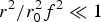 $r^2/r_0^2 f^2 \ll 1$ and it is adequate to predict the position of the focus, corresponding to the minimum width of the beam, where r is radial co-ordinate of the cylindrical co-ordinate system, r 0 is the spot size of the laser beam at z = 0 and f is the dimensionless beam width parameter.
When the radial profile of laser beam departs from Gaussian distribution then higher order approach is more appropriate. Many investigators (Liu and Tripathi, Reference Liu and Tripathi2000; Faisal et al., Reference Faisal, Mishra, Verma and Sodha2007; Gill et al., Reference Gill, Mahajan and Kaur2010b; Kaur et al., Reference Kaur, Gill and Mahajan2017a) have developed self-consistent paraxial theory by incorporating the higher order terms to account for the off-axis approximation where eikonal (S), dielectric constant and irradiance of the laser beam is expanded up to fourth order of r/r 0.
In recent experiments, measurement of the intensity profile of vulcan petawatt laser, it was found that intensity profile departs from Gaussian intensity distribution. Nakatsutsumi et al. (Reference Nakatsutsumi, Davies, Kodama, Green, Lancaster, Akli, Beg, Chen, Clark, Freeman, Gregory, Habara, Heathcote, Hey, Highbarger, Jaanimagi, Key, Krushelnick, Ma, Macphee, Mackinnon, Nakamura, Stephens, Storm, Tampo, Theobald, Woerkom, Weber, Wei, Woolsey and Norreys2008) suggested that q-Gaussian distribution given as,
 $$f\,(r) = f\left( 0 \right)\left[ {1 + {\left( {r/4.4539\,{\rm \mu m}} \right)}^2} \right]^{ - 1.4748},$$
Further investigation of laser beam spot profile in Rutherford Appleton laboratory (Davies, Reference Davies2010), it was proposed that intensity profile be given in the following form,
 $$f\left( r \right) = f\left( 0 \right)\left( {1 + \displaystyle{{r^2} \over {qr_0^2}}} \right)^{ - q},$$
Recently, this distribution attracted the attention of several researchers. Sharma and Kourakis (Reference Sharma and Kourakis2010) studied the spatial evolution of q-Gaussian laser beam in a relativistic plasma. A nonparaxial theory was used, taken into account nonlinearity via relativistic decrease of the plasma frequency. Analytical and numerical dynamics of the relativistically guided beam exhibited the dependence on q-parameter. Singh and Gupta (Reference Singh and Gupta2015) reported an investigation of relativistic self-focusing of a q-Gaussian beam in a preformed parabolic plasma channel. They employed the moment theory approach and studied the role of relativistic self-focusing of q-Gaussian beam on second harmonic generation (SHG). The detailed effects of laser beam intensity, q-parameter and depth of the plasma channel on self-focusing and SHG were investigated. Kaur et al. (Reference Kaur, Gill and Mahajan2017a) studied the relativistic effect on the evolution of q-Gaussian beam in the magnetoplasma. Higher order terms in the expansion of the dielectric function and eikonal were considered and the phenomenon of self-trapping was investigated under a variety of parameters. It was found that q-parameter and higher order terms play a key role in determining the self-focusing/ defocusing of the beam. Recently, Wang et al. (Reference Wang, Hong, Sun, Tang, Yang, Zhou, Tian and Duan2017) also studied the propagation of q-Gaussian laser beam in a preformed plasma channel. They used the variational approach to obtain a nonlinear differential equation so that we can study the variation of beam width parameter. The effects of relativistic self-focusing, ponderomotive self-channeling and preformed plasma channel were addressed. They further observed that focusing the power of q-Gaussian laser beam is lower than that of a Gaussian laser beam.
The aim of this paper is to investigate self-focusing of q-Gaussian laser beam due to relativistic nonlinearity in a periodically modulated density profile. In order that laser plasma-based applications are plausible, laser should propagate over several hundred of Rayleigh lengths in the plasma. The idea of density transition/density ramp profile is introduced for improvement of the self-focusing (Suk et al., Reference Suk, Barov, Rosenzweig and Esarey2001; Gupta et al., Reference Gupta, Hur, Hwang, Suk and Sharma2007; Bonabi et al., Reference Bonabi, Habibi and Yazdani2009). Furthermore, the self-focusing can also be increased by introducing density ripple in the plasma. Lin et al. (Reference Lin, Chen, Pai, Kuo, Lee, Wang, Chen and Lin2006) made use of longitudinal spatial structure to achieve arbitrary plasma structure. Kuo et al. (Reference Kuo, Pai, Lin, Lee, Lin, Wang and Chen2007) reported enhancement of the harmonic generation in a preformed periodic plasma waveguide. Liu and Tripathi (Reference Liu and Tripathi2008) studied the third harmonic generation of a short pulse laser in a plasma density ripple. We have used the analytical theory of self-focusing in higher order PRA and nonlinear parabolic partial differential equation governing the evolution of complex envelope in slowly varying approximation is solved. In section ‘Intensity variation of q-Gaussian laser beam’, we have given the description of the q-Gaussian intensity profile for different q-values. In section ‘Self focusing of q-Gaussian laser beam’, we have developed the basic formalism to derive the wave equation for the beam width parameter by using higher order paraxial theory in the presence of modulated density profile. The section ‘Results and discussion’ is devoted to discussion of results, followed by a conclusion.
Intensity variation of q-Gaussian laser beam
The initial intensity profile of q-Gaussian laser beam along its wavefront is given by Sharma and Kourakis (Reference Sharma and Kourakis2010) is;
 $$E^2 \vert _{z = 0} = E_{00}^2 \left( {1 + \displaystyle{{r^2} \over {qr_0^2}}} \right)^{ - q}$$
where E is the normalized laser field, E 00 is the initial normalized value of field amplitude, r is radial co-ordinate of the cylindrical co-ordinate system, r 0 is the spot size of the laser beam at z = 0, q is a parameter which defines the deviation from the Gaussian intensity distribution. Figure 1 shows the normalized intensity distribution of q-Gaussian laser beam for different q-values. The intensity distribution of the beam gradually converges to the Gaussian profile as the q-value increases and becomes exactly Gaussian as q→∞ (Fig. 1). We know that  $a =0.85 \times 10^{ - 9}\sqrt I \times {\rm \lambda}$, where I is expressed in W/cm2 and λ is expressed in μm.
Variation of normalized intensity 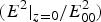 $(E^2 \vert_{z = 0}/E_{00}^2 )$ with normalized radial distance r/r0 for different values of q that is q = 3, 5, 100.

Self-focusing of q-Gaussian laser beam
We assume the equilibrium electron density n 0 be sinusoidal,
 $$n_0 = n_0^0 \left( {1 + {\rm \alpha} _2{\rm Cosmz}} \right)$$
where 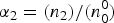 ${\rm \alpha} _2 = (n_2)/(n_0^0 )$ is the depth of density modulation,
 $n_0^0 $ is the maximum electron density and m is the ripple wave number.
Let us consider a circularly polarized laser beam propagating in the axial z-direction,
 $$E(r, z) = A(r, z)(e_x + ie_y){\rm exp}\left[ { - i({\rm \omega} t - kz)} \right]$$
where e x and e y are the unit vectors along the x- and y-axis respectively. The amplitude A is a slowly varying function of space (r, z). The electric field satisfies the wave equation (Eqs. 6, 8).
The general wave equation governing the propagation of electromagnetic waves is
 $$\left( {\nabla _ \bot ^2 + \nabla _\parallel ^2} \right){\vec E} + {\vec\nabla} \left( {\nabla. {\vec E}} \right) + \displaystyle{{{\rm \omega} ^2} \over {c^2}} \epsilon {\vec E} = 0$$
One may note that it can be directly derived from Maxwell's equation. For transverse field
 $$\nabla \cdot {\vec E} = {\vec k} \cdot {\vec E} = 0$$
here  ${\mathop k \limits^{\rightharpoonup}} $ being the propagation vector. We note that a term
 $\nabla \left( {\nabla \cdot {\vec E}} \right)$ has been neglected in deriving Eqs. (6, 8) even for
 ${\vec E}$ has a longitudinal component, the term
 $\nabla \left( {\nabla \cdot {\vec E}} \right)$ can be neglected provided
 $(c^2)/({\rm \omega} ^2)\left \vert {(1/{\rm \varepsilon} )\nabla ^2{\rm ln}{\rm \varepsilon}} \right \vert \ll 1$, which is satisfied in most of the cases. Several approximations are used to reduce the vectorial wave equation to the scalar wave equation. First, we assume that the electric field remains linearly polarized along the
 ${\hat e}_t$ that is transverse to the propagation axis (z-axis in the present case). Thus,
 ${{\vec E}} = E{\hat e}_t$,
 $\vec J = J {\hat e}_t$ and
 $\vec P = P {\hat e}_t$. In other words, electric field and plasma response take place in the direction perpendicular to
 $\vec k$. The carrier distribution as a result of a relativistic effect takes place along the wavefront. In that case,
 ${\vec\nabla} ({\vec\nabla}. {\vec{ \,E}})$ can be neglected. This assumption breaks down when numerical aperture is significant leading to developement of longitudinal component E z. Thus Eq. (6) can be written as,
 $$\left( {\nabla _ \bot ^2 + \displaystyle{{\partial ^2} \over {\partial z^2}}} \right){\vec E} + \displaystyle{{{\rm \omega} ^2} \over {c^2}} \epsilon {\vec E} = 0$$
The effective plasma permittivity ε(r, z) is given by,
 $${\rm \varepsilon} \left( {r, z} \right) = {\rm \varepsilon} _{00} - \displaystyle{{{\rm \omega} _{\,p0}^2} \over {{\rm \omega} ^2}}\left( {1 - \displaystyle{{\left( {1 + {\rm \alpha} _2{\rm Cosmz}} \right)} \over \gamma}} \right){\rm \;} $$
where 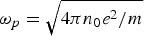 ${\rm \omega} _p = \sqrt {4{\rm \pi} n_0e^2/m} $ is the plasma frequency, e and m are the electronic charge and rest mass, γ = (1 + a 2)1/2 is the relativistic Lorentz factor depends upon the intensity of laser beam and a = (e|E 0|)/(mωc) is the normalized laser amplitude at z > 0. For ωp/γω<1, the equation can be solved iteratively.
The relativistic nonlinear dielectric constant which appears in Eqs (6, 8) can be expressed in the nonparaxial approximation as:
 $${\rm \varepsilon} \left( {r, z} \right) = {\rm \varepsilon} _0\left( z \right) - {\rm \varepsilon} _2\left( z \right)\displaystyle{{r^2} \over {r_0^2}} - {\rm \varepsilon} _4\left( z \right)\displaystyle{{r^4} \over {r_0^4}} $$
where ε0(z), ε2(z) and ε4(z) are coefficients in the expansion of nonlinear dielectric constant.
By substituting Eq. (5) in Eqs (6, 8) and neglecting (∂2A/∂z 2) (A to be slowly varying function of z) one obtains,
 $$\eqalign{& -2ik\displaystyle{{\partial A} \over {\partial z}} - 2iz\; \displaystyle{{\partial A} \over {\partial z}}\displaystyle{{\partial k} \over {\partial z}} - 2iA\displaystyle{{\partial k} \over {\partial z}} - 2Azk\displaystyle{{\partial k} \over {\partial z}} - iAz\displaystyle{{\partial ^2k} \over {\partial z^2}} \cr & \quad - Az^2\left( {\displaystyle{{\partial k} \over {\partial z}}} \right)^2 + \left( {\displaystyle{{\partial ^2A} \over {\partial r^2}} + \displaystyle{1 \over r}\displaystyle{{\partial A} \over {\partial r}}} \right) + \displaystyle{{{\rm \omega} ^2} \over {c^2}}\left( {{\rm \varepsilon} \left( {r, z} \right) - {\rm \varepsilon} _0} \right)A = 0} $$
Equation (11) represents the evolution for the field envelope and includes the effect of diffraction, focusing and nonlinearity. In this equation, the term in the parentheses  $(\partial ^2A)/(\partial r^2) + (1/r)(\partial A)/(\partial r)$ represents Laplacian in the perpendicular direction which is a diffraction term. The last term where ε(r, z) is nonlinear dielectric constant, is a function of intensity and represents self-focusing phenomenon and ε0 is a linear part of dielectric constant. The long-standing problem of understanding the interplay between finite beam effects and medium nonlinearity in the presence of both transverse and longitudinal diffraction must be addressed. In PRA, it is neglected and it reduces to usual nonlinear Schrodinger equation. In the nonlinear Schrodinger Eq. (8), the second term in the parenthesis ∂2E/∂z 2 represents the ultra-narrow beam may result in beam evolution that involves strong focusing stage, even when the input beam is reasonably paraxial. Parameter
 ${\rm \kappa} = (1/\in _0)({\rm \lambda} /r_0)^2$ reflects the role of the transverse size of the beam and the tendency for light to travel off-axis in nonlinear propagation. PRA becomes invalid as light focuses down to the dimension of the optical wavelength. For a chosen set of parameters κ is 10−3 and as observed from the dimensionless propagation (in Rayleigh lengths) in Figure 2, the PRA is valid over a few wavelengths. Hence, the neglect of term (∂2A/∂z 2) is justified.
Variation of beam width parameter (f) with a normalized distance of propagation (ξ) for different q-values q = 3, 9, and 100. The other parameters are  $({\rm \omega} _{p0}^2 )/({\rm \omega} ^2)$ = 0.038,
 $a_{00}^2 $ = 0.7, d = 75, α2 = 0.2, and ωr 0/c = 75.

The complex amplitude A(r, z) can be expressed as:
 $$A(r, z) = A_0(r, z)e^{ - ikS\left( {r, z} \right)}$$
where S is known as eikonal and A 0 (r, z) and S (r, z) are real functions of space variables. By substituting Eq. (12) in Eq. (11), a complex differential equation with real and imaginary parts is obtained.
The real part of the resulting equation is given by,
 $$\eqalign{& 2\displaystyle{{\partial S} \over {\partial z}} + \displaystyle{{2S} \over k}\displaystyle{{dk} \over {dz}} + \displaystyle{{2zS} \over {k^2}}\left( {\displaystyle{{\partial k} \over {\partial z}}} \right)^2 + \displaystyle{{2z} \over k}\displaystyle{{\partial S} \over {\partial z}}\displaystyle{{\partial k} \over {\partial z}} + \displaystyle{{2z} \over k}\displaystyle{{\partial k} \over {\partial z}} \cr & \quad + \displaystyle{{z^2} \over {k^2}}\left( {\displaystyle{{\partial k} \over {\partial z}}} \right)^2 + \left( {\displaystyle{{\partial S} \over {\partial r}}} \right)^2 = \displaystyle{1 \over {2k^2A_0^2}} \left( {\displaystyle{{\partial ^2A_0} \over {\partial r^2}} + \displaystyle{1 \over r}\displaystyle{{\partial A_0} \over {\partial r}}} \right) \cr & - \displaystyle{1 \over {4k^2A_0^4}} \left( {\displaystyle{{\partial A_0^2} \over {\partial r}}} \right)^2 - \displaystyle{{r^2} \over {r_0^2}} \displaystyle{{{\rm \varepsilon} _2\left( z \right)} \over {{\rm \varepsilon} _0\left( z \right)}} - \displaystyle{{r^4} \over {r_0^4}} \displaystyle{{{\rm \varepsilon} _4\left( z \right)} \over {{\rm \varepsilon} _0\left( z \right)}}} $$
And imaginary part is given by,
 $$\eqalign{& \displaystyle{1 \over {A_0^2}} \displaystyle{{\partial A_0^2} \over {\partial z}} + \displaystyle{z \over {kA_0^2}} \displaystyle{{\partial A_0^2} \over {\partial z}}\displaystyle{{dk} \over {dz}} + \displaystyle{2 \over k}\displaystyle{{dk} \over {dz}} + \displaystyle{z \over k}\displaystyle{{\partial ^2k} \over {\partial z^2}} \cr & \quad + \left( {\displaystyle{{\partial ^2S} \over {\partial r^2}} + \displaystyle{1 \over r}\displaystyle{{\partial S} \over {\partial r}}} \right) + \displaystyle{1 \over {A_0^2}} \displaystyle{{\partial A_0^2} \over {\partial r}}\displaystyle{{\partial S} \over {\partial r}} = 0} $$
Further, the higher order terms are introduced in beam irradiance  $A_0^2 \left( {r, z} \right)$ and eikonal S(r, z) can be expressed as:
 $$A_0^2 = \displaystyle{{E_0^2} \over {\,f^2}}\left( {1 + a_2\displaystyle{{r^2} \over {r_0^2 f^2}} + a_4\displaystyle{{r^4} \over {r_0^4 f^4}}} \right)\left( {1 + \displaystyle{{r^2} \over {qr_0^2 f^2}}} \right)^{ - q}$$
and
 $$S\left( {r, z} \right) = S_0\left( z \right) + \displaystyle{{r^2} \over {r_0^2}} S_2\left( z \right) + \displaystyle{{r^4} \over {r_0^4}} S_4\left( z \right)$$
where r 0 is the initial radius of the q-Gaussian laser beam and a 2, a 4, S 0, S 2, S 4, and f are the functions of z. f is the dimensionless beam width parameter. The parameters S 0, S 2, and S 4 are the eikonal (S) components, here S 2 represent the spherical curvature of the wavefront and S 4 indicates its departure from the spherical nature. The parameters a 2 and a 4 represents the departure of the beam from q-Gaussian nature. This prompts us to write the expression for beam radiance given by Eq. (15), where higher order corrections are included.
Using  $A_0^2 $ and (S) from Eqs (15) and (16) in Eq. (14) and following (Liu and Tripathi, Reference Liu and Tripathi2000; Sodha and Faisal, Reference Sodha and Faisal2008; Gill et al., Reference Gill, Kaur and Mahajan2010a), one obtains the following equations,
 $$\eqalign{& S_2 = \displaystyle{{r_0^2} \over {2f}}\displaystyle{{df} \over {dz}} + \displaystyle{{zr_0^2} \over {4f\,{\rm \varepsilon} _0}}\displaystyle{{df} \over {dz}}\displaystyle{{d{\rm \varepsilon} _0} \over {dz}} - \displaystyle{{r_0^2} \over {4{\rm \varepsilon} _0}}\displaystyle{{d{\rm \varepsilon} _0} \over {dz}} \cr & \quad + \displaystyle{{zr_0^2} \over {16{\rm \varepsilon} _0^2}} \left( {\displaystyle{{d{\rm \varepsilon} _0} \over {dz}}} \right)^2 - \displaystyle{{r_0^2 z} \over {8{\rm \varepsilon} _0}}\displaystyle{{d^2{\rm \varepsilon} _0} \over {dz^2}}} $$
 $$\eqalign{ \displaystyle{{da_2} \over {d{\rm \xi}}} &= - 16S_4^{\prime} f^2\left[ {1 + \displaystyle{{\rm \xi} \over {2{\rm \varepsilon} _0}}\displaystyle{{d{\rm \varepsilon} _0} \over {d{\rm \xi}}}} \right]^{ - 1} + \,\left( {a_2 - 1} \right)\cr &\quad \times\left[ {\displaystyle{1 \over {{\rm \varepsilon} _0}}\displaystyle{{d{\rm \varepsilon} _0} \over {d{\rm \xi}}} - \displaystyle{{\rm \xi} \over {4{\rm \varepsilon} _0^2}} {\left( {\displaystyle{{d{\rm \varepsilon} _0} \over {d{\rm \xi}}}} \right)}^2 + \displaystyle{{\rm \xi} \over {2{\rm \varepsilon} _0}}\displaystyle{{d^2{\rm \varepsilon} _0} \over {d{\rm \xi} ^2}}} \right] \cr & \quad \times \left[ {1 + \displaystyle{{\rm \xi} \over {2{\rm \varepsilon} _0}}\displaystyle{{d{\rm \varepsilon} _0} \over {d{\rm \xi}}}} \right]^{ - 1}} $$
 $$\eqalign{ \displaystyle{{da_4} \over {d{\rm \xi}}} &= a_2\displaystyle{{da_2} \over {d{\rm \xi}}} + \left( {\displaystyle{1 \over {2q}} + a_4 - \displaystyle{{a_2^2} \over 2}} \right)\left[ {1 + \displaystyle{{\rm \xi} \over {2{\rm \varepsilon} _0}}\displaystyle{{d{\rm \varepsilon} _0} \over {d{\rm \xi}}}} \right]^{ - 1} \cr & \quad \times \left[ {\displaystyle{2 \over {{\rm \varepsilon} _0}}\displaystyle{{d{\rm \varepsilon} _0} \over {d{\rm \xi}}} + \displaystyle{{\rm \xi} \over {{\rm \varepsilon} _0}}\left( {\displaystyle{{d^2{\rm \varepsilon} _0} \over {d{\rm \xi} ^2}} - \displaystyle{1 \over {2{\rm \varepsilon} _0}}{\left( {\displaystyle{{d{\rm \varepsilon} _0} \over {d{\rm \xi}}}} \right)}^2} \right)} \right] \cr & \quad - \displaystyle{{8S_4^{\prime} \left( {a_2 - 1} \right)} \over {\,f^2}}\left[ {1 + \displaystyle{{\rm \xi} \over {2{\rm \varepsilon} _0}}\displaystyle{{d{\rm \varepsilon} _0} \over {d{\rm \xi}}}} \right]^{ - 1}} $$
where
 $$S_4^{\prime} = S_4\displaystyle{{\rm \omega} \over c}$$
Eliminate  $S_4^{\prime} $ from Eqs (18) and (19) and integrate the resulting equation with the initial conditions a 4 = 0 and a 2 = 0 at ξ = 0, Eqs (18) and (19) can be used to obtain a 4 in terms of a 2. Similarly using the value of
 $A_0^2 $ and S from Eqs (15) and (16) in Eq. (13) and equating the coefficients of r 2 and r 4 in the resulting equation to zero, we obtained the following equations which govern the beam width parameter f and
 $S_4^{\prime} $:
 $$\eqalignno{& \displaystyle{{d^2f} \over {d{\rm \xi} ^2}}\left[ {1 + \displaystyle{{\rm \xi} \over {2{\rm \varepsilon} _0}}\displaystyle{{d{\rm \varepsilon} _0} \over {d{\rm \xi}}} + \displaystyle{{{\rm \xi} ^2} \over {2{\rm \varepsilon} _0^2}} {\left( {\displaystyle{{d{\rm \varepsilon} _0} \over {d{\rm \xi}}}} \right)}^2} \right] \cr & \quad = \displaystyle{{\left( {1 + 8a_4 - 3a_2^2 - 2a_2 + \displaystyle{4 \over q}} \right)} \over {{\rm \varepsilon} _0f^3}} - \displaystyle{{{\rm \varepsilon} _2{\rm \rho} ^2f} \over {{\rm \varepsilon} _0}} \cr & - \displaystyle{{df} \over {d{\rm \xi}}} \left[ \matrix{\displaystyle{1 \over 2}\displaystyle{{d{\rm \varepsilon} _0} \over {d{\rm \xi}}} + \displaystyle{1 \over {2{\rm \varepsilon} _0}}\displaystyle{{d{\rm \varepsilon} _0} \over {d{\rm \xi}}} + \displaystyle{{\rm \xi} \over {4{\rm \varepsilon} _0}}\left( {\displaystyle{{d{\rm \varepsilon} _0} \over {d{\rm \xi}}}} \right)^2 \hfill \cr \quad + \displaystyle{{\rm \xi} \over {2{\rm \varepsilon} _0}}\displaystyle{{d^2{\rm \varepsilon} _0} \over {d{\rm \xi} ^2}} - \displaystyle{{{\rm \xi} ^2f} \over {2{\rm \varepsilon} _0}}\left( {\displaystyle{{d{\rm \varepsilon} _0} \over {d{\rm \xi}}}} \right)^2 - \displaystyle{{\rm \xi} \over {2{\rm \varepsilon} _0}}\displaystyle{{d{\rm \varepsilon} _0} \over {d{\rm \xi}}} - \displaystyle{{\rm \xi} \over {4{\rm \varepsilon} _0}}\displaystyle{{d^3{\rm \varepsilon} _0} \over {d{\rm \xi} ^3}} \hfill} \right] \cr & - f\displaystyle{{d^2{\rm \varepsilon} _0} \over {d{\rm \xi} ^2}}\left[ { - \displaystyle{{\rm \xi} \over {8{\rm \varepsilon} _0}}\displaystyle{{d{\rm \varepsilon} _0} \over {d{\rm \xi}}} - \displaystyle{3 \over {4{\rm \varepsilon} _0}} + \displaystyle{{\rm \xi} \over {4{\rm \varepsilon} _0}}\displaystyle{{d{\rm \varepsilon} _0} \over {d{\rm \xi}}} + \displaystyle{{{\rm \xi} ^2} \over {32{\rm \varepsilon} _0^3}} {\left( {\displaystyle{{d{\rm \varepsilon} _0} \over {d{\rm \xi}}}} \right)}^2} \right. \cr & \quad \left. { + \displaystyle{{{\rm \xi} ^2} \over {8{\rm \varepsilon} _0^2}} {\left( {\displaystyle{{d{\rm \varepsilon} _0} \over {d{\rm \xi}}}} \right)}^2 + \displaystyle{{{\rm \xi} ^2} \over {64{\rm \varepsilon} _0^2}}} \right] - f\left( {\displaystyle{{d{\rm \varepsilon} _0} \over {d{\rm \xi}}}} \right)^2\left( {\displaystyle{7 \over {8{\rm \varepsilon} _0^2}} - \displaystyle{1 \over {4{\rm \varepsilon} _0}}} \right) \cr &- f\,{\rm \xi} \left( {\displaystyle{{d{\rm \varepsilon} _0} \over {d{\rm \xi}}}} \right)^3\left( {\displaystyle{1 \over {16{\rm \varepsilon} _0^2}} - \displaystyle{3 \over {4{\rm \varepsilon} _0^3}}} \right) - \displaystyle{{\rm \xi} \over {4{\rm \varepsilon} _0}}\displaystyle{{d^3{\rm \varepsilon} _0} \over {d{\rm \xi} ^3}} + \displaystyle{{{\rm \xi} ^2f} \over {32{\rm \varepsilon} _0^4}} \left( {\displaystyle{{d{\rm \varepsilon} _0} \over {d{\rm \xi}}}} \right)^4 \cr &- \displaystyle{{5{\rm \xi} ^2f} \over {64{\rm \varepsilon} _0^2}} \left( {\displaystyle{{d{\rm \varepsilon} _0} \over {d{\rm \xi}}}} \right)^4 - \displaystyle{{{\rm \xi} f} \over {4{\rm \varepsilon} _0}}\displaystyle{{d{\rm \varepsilon} _0} \over {d{\rm \xi}}} \displaystyle{{d^3{\rm \varepsilon} _0} \over {d{\rm \xi} ^3}}\quad\quad\quad\quad\quad\quad\quad\quad\quad\quad\quad\quad(20)}$$
 $$\eqalign{& \displaystyle{{dS_4^{\prime}} \over {d{\rm \xi}}} \left( {1 + \displaystyle{{\rm \xi} \over {{\rm \varepsilon} _0}}\displaystyle{{d{\rm \varepsilon} _0} \over {d{\rm \xi}}}} \right) = \displaystyle{{\left( {a_2^3 + 6a_2^2 - 6a_2a_4 + \displaystyle{{2a_2} \over q} - \displaystyle{6 \over {q^2}}} \right)} \over {{\rm \varepsilon} _0f^6}} - \cr & - \displaystyle{{{\rm \varepsilon} _4{\rm \rho} ^2} \over {2{\rm \varepsilon} _0}} - \displaystyle{1 \over {{\rm \varepsilon} _0}}\displaystyle{{d{\rm \varepsilon} _0} \over {d{\rm \xi}}} S_4^{\prime} - \displaystyle{{{\rm \xi} S_4^{\prime}} \over {2{\rm \varepsilon} _0}}\displaystyle{{d{\rm \varepsilon} _0} \over {d{\rm \xi}}} - 8S_4^{\prime} \cr & \quad \left( {\displaystyle{1 \over f}\displaystyle{{df} \over {d{\rm \xi}}} + \displaystyle{{d{\rm \varepsilon} _0} \over {d{\rm \xi}}} \left( {\displaystyle{{\rm \xi} \over {2f\,{\rm \varepsilon} _0}}\displaystyle{{df} \over {d{\rm \xi}}} - \displaystyle{1 \over {2{\rm \varepsilon} _0}} + \displaystyle{{\rm \xi} \over {8{\rm \varepsilon} _0^2}} \displaystyle{{d{\rm \varepsilon} _0} \over {d{\rm \xi}}} - \displaystyle{{\rm \xi} \over {8{\rm \varepsilon} _0}}\displaystyle{{d^2{\rm \varepsilon} _0} \over {d{\rm \xi} ^2}}} \right)} \right)} $$
where  ${\rm \xi} = cz/{\rm \omega} r_0^2 $ and ρ = ωr 0/c are the dimensionless distance of propagation and dimensionless original beam width.
Now introducing the q-dependent field distribution of laser beam from Eq. (15) in Eq. (9), we obtained the components of dielectric constant in Eq. (10) as,
 $${\rm \varepsilon} _0\left( z \right) = {\rm \varepsilon} _{00} + \displaystyle{{{\rm \omega} _{\,p00}^2} \over {{\rm \omega} ^2}}\left[ {1 - {\left( {1 + \displaystyle{{a_{00}^2} \over {\,f^2}}} \right)}^{ - {1 \over 2}}} \right]\,\left( {1 + {\rm \alpha} _2{\rm Cosd}{\rm \xi}} \right)$$
 $${\rm \varepsilon} _2\left( z \right) = \displaystyle{1 \over 2}\displaystyle{{{\rm \omega} _{\,p00}^2} \over {{\rm \omega} ^2}}\left( {1 + {\rm \alpha} _2{\rm Cosd}{\rm \xi}} \right)\left( {1 + \displaystyle{{a_{00}^2} \over {\,f^2}}} \right)^{ - 3/2}\displaystyle{{a_{00}^2} \over {\,f^2}}\displaystyle{{\left( {1 - a_2} \right)} \over {\,f^2}}$$
 $$\eqalign{& {\rm \varepsilon} _4\left( z \right) = \displaystyle{{{\rm \omega} _{\,p00}^2} \over {{\rm \omega} ^2}}\left( {1 + {\rm \alpha} _2{\rm Cosd}{\rm \xi}} \right)\left( {1 + \displaystyle{{a_{00}^2} \over {\,f^2}}} \right)^{ - 3/2}\displaystyle{{a_{00}^2} \over {\,f^6}}\left( {1 + \displaystyle{{a_{00}^2} \over {\,f^2}}} \right)^{ - \textstyle{1 \over 2}} \cr & \quad\quad\quad \times \left[ {\displaystyle{3 \over 8}\displaystyle{{a_{00}^2} \over {\,f^2}}\displaystyle{{{\left( {a_2 - 1} \right)}^2} \over {{\left( {1 + \displaystyle{{a_{00}^2} \over {\,f^2}}} \right)}^{ - 1/2}}} - \displaystyle{1 \over 2}\displaystyle{{\left( {a_4 - a_2 + \displaystyle{{q + 1} \over {2q}}} \right)} \over {\left( {1 + \displaystyle{{a_{00}^2} \over {\,f^2}}} \right)}}} \right]} $$
where ξ = z/R d is the normalized propagation distance and d = m R d is the normalized ripple wave number, where m is the ripple wave number and R d is the diffraction length.
Results and discussion
The evolution of the q-Gaussian beam profile can be analyzed by numerically solving the coupled differential equation using appropriate boundary conditions for evaluating the beam width parameter f as a function of z. The initial boundary conditions taken are, (df)/(dξ) = 0, S 4 = 0 and a 2 = 0 at ξ = 0 for an unperturbed initial plane wave. Lin et al. (Reference Lin, Chen, Pai, Kuo, Lee, Wang, Chen and Lin2006) used a 10 Terawatt (TW), 45 femtosecond (fs), 810 nanometre (nm) and 10 Hertz (Hz) of Ti: Sapphire laser in spatial light modulator to produce rippled density structure by ionizing a gas by machining beam and probe beam. Eqs (18), (20) and (21) are nonlinear coupled ordinary differential equation governing the evolution of a 2, f, and S 4 as a function of the dimensionless distance of propagation. The evolution of q-Gaussian beam can also be analyzed numerically by solving the ordinary differential Eq. (20) coupled with (18), (19) and (21). We have performed a numerical computation for the following laser plasma parameters I 0 = 4.2X 10¹⁷ W/cm2, r 0ω/c = 75,  ${\rm \omega} _{p0}^2 /{\rm \omega} ^2$ = 0.038,
 $a_{00}^2 $ = 0.2, d = 75, α2 = 0.2, 0.7, and q = 1.4, 3, 5, 100.
For the paraxial theory of ring formation to be valid, which demands the following inequality to be satisfied (Misra and Mishra, Reference Misra and Mishra2009)
1 < a 2 < 1.27 for the bright ring
−1.47 < a 2 < 0.76 for the dark ring.
Figure 1 represents the variation of normalized intensity 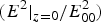 $(E^2 \vert_{z = 0}/E_{00}^2 )$ with normalized radial distance r/r 0 for different q values that is q = 3, 5, 100. We found that large value of q corresponds to Gaussian distribution, where the small value of q indicates a departure from the Gaussian profile. In Figure 2, we have displayed the variation of beam width parameter f with the normalized distance of propagation ξ for the chosen set of parameters. This figure displays the self-focusing effect for different value of q parameter. A small change in self-focusing is observed for lower q-values. The focusing of the beam dominates over diffraction due to the nonlinear effect of relativistic mass variation in nonparaxial regime. For q = 100 (green dotted line), beam acts like a Gaussian distribution and diffraction effects are relatively smaller whereas for the lower value of q, decreased focusing is observed. Therefore, lower value of q has expanded wings of intensity distribution which will require higher power for self-focusing in comparison of the larger value of q in the intensity distribution. Focusing becomes faster in the nonparaxial case as in comparison with the paraxial case.
Figure 3 displays f as a function of the dimensionless distance of propagation ξ for three values of the density ripple d = 30 (blue solid line), 55 (dotted red line), 85 (dotted green line). The other parameters are,  ${\rm \omega} _{p0}^2 /{\rm \omega} ^2$ = 0.038,
 $a_{00}^2 $ = 0.2, q = 1, α2 = 0.7 and r 0ω/c = 85. Self-focusing length decreases with a decrease in ripple wave number. A wiggle is seen in the graph for lower wave number of the ripple. The spot size r 0f 0 decreases and the beam self-focuses on the distance of propagation. The self-focusing length is increased for higher d value.
Variation of beam width parameter (f) with a normalized distance of propagation (ξ) for different values of ripple wave number d = 30 (blue line), 55 (dotted red line), and 85 (dotted green line). The other parameters are  $({\rm \omega} _{p0}^2 )/({\rm \omega} ^2)$ = 0.038,
 $a_{00}^2 $ = 0.2, q = 1, α2 = 0.7, and ωr 0/c = 85.

Figure 4 shows the variation of the beam width parameter f as a function of distance of propagation for different intensity profile  $a_{00}^2 $ = 0.2, 0.7 with other parameters
 ${\rm \omega} _{p0}^2 /{\rm \omega} ^2$ = 0.038, α2 = 0.2, q = 1, d = 75 and ωr 0/c = 75. Self-focusing is observed in both the cases. At
 $a_{00}^2 $ = 0.2 (solid blue line), the beam focuses and after the minimum is attained, the beam defocuses due to diffraction. However, increase in intensity, leads to stronger self-focusing. For higher intensity
 $a_{00}^2 $ = 0.7 (dotted red line) the self-focusing length increases. As the value of normalized laser amplitude increases further beyond the critical value, the laser undergoes sharp self-focusing up to z = 0.23Rd. Laser power corresponding to this value of critical power for self-focusing may be treated as PP cr = (cc 3/8) (0.7 mmωrr 0/ee)2. The physics behind this is as follows: A laser beam self-focuses with the distance of propagation and the spot size monotonically decreases and attains a minimum. Beyond this point diffraction effect dominates, but they are not sufficient to overcome self-focusing, with a result laser beam continue to focus. For low-intensity region, diffraction effect prevails and beam defocuses. Overall, there is a strong focusing and beam width parameter f decreases with increasing laser intensity.
Variation of beam width parameter (f) with normalized distance of propagation (ξ) for different laser intensities  $a_{00}^2 = 0.2$ (blue line) and 0.7 (dotted red line). The other parameters are
 $({\rm \omega} _{p0}^2 )/({\rm \omega} ^2) = 0.038$, α2 = 0.2, q = 1, d = 75, and ωr 0/c = 75.

Figure 5 represents the variation of beam width parameter f as a function of the distance of propagation ξ for different depth of modulation α2 = 0.2 (solid blue line) and 0.7 (dotted red line) for relativistic case  $a_{00}^2 $ = 0.7. Significant enhancement in self-focusing for the higher value of depth of modulation is observed. One would have expected the focusing effect to dominate over density crest and diffraction effect to prevail near the trough. The ripple wave number is so large that curvature of the wavefront continuous to focus the beam in the trough region. Thus the role of ripple to enhance the self-focusing is observed for the higher value of the depth of density modulation.
Variation of beam width parameter (f) with normalized distance of propagation (ξ) for different depth of modulation α2 = 0.2 (blue line) and 0.7 (dotted red line). The other parameters are  $({\rm \omega} _{p0}^2 )/({\rm \omega} ^2) = 0.038$,
 $a_{00}^2 $ = 0.7, q = 1, d = 30, and ωr 0/c = 75.

Figure 6 indicates a comparative graph for propagation characteristics of q-Gaussian laser beam in a ripple density plasma with paraxial and nonparaxial theory. The variation of beam width parameter f with the normalized distance of propagation ξ for the following parameters  ${\rm \omega} _{p0}^2 /{\rm \omega} ^2$ = 0.038,
 $\; a_{00}^2 $ = 0.2, d = 75, α2 = 0.2, q = 1.95 and ωr 0/c = 75 have been studied. It is noteworthy to observe that there is focusing in both cases, nontheless nonparaxial study indicates strong and sharp self focusing in case of rippled density plasma. Although in paraxial study (blue line) the beam width parameter monotonically decreases, obtained a minimum spot size up to ξ = 0.13R d whereas for nonparaxial study (dotted red line) which is a complete study of propagation as it accounts for off axis approximation demonstrate that self focusing occur at lower values of distance of propagation in comparison with paraxial study. In the present investigation density ripple in nonparaxial regime yields superior propagation characteristics.
Variation of beam width parameter (f) with normalized distance of propagation (ξ) for simple paraxial theory, that is a 2 = 0 (blue line) and higher order paraxial theory that is a 2 ≠ 0 (dotted red line). The other parameters are  $({\rm \omega} _{p0}^2 )/({\rm \omega} ^2) = 0.038$,
 $a_{00}^2 $ = 0.2, d = 75, α2 = 0.2, q = 1.95, and ωr 0/c = 75.

Conclusion
In the present research work, we have studied nonparaxial theory for self-focusing of q-Gaussian laser beam in a rippled density plasma. The other parameters  ${\rm \omega} _{p0}^2 /{\rm \omega} ^2$ = 0.038,
 $a_{00}^2 $ = 0.2, 0.7, d = 30, 55,75, 85, α2 = 0.2, 0.7 and q = 3, 9, 100. In the paraxial study, self-focusing is observed. However, in nonparaxial study, strong and fast self-focusing is observed with a lower value of ξ. We also elucidate that higher value of density ripple and intensity enhances self focusing whereas a lower value of q-parameter small change in self focusing is observed. Depth of density modulation also play a key role in this study. With the inclusion of higher order terms, one can understand self-focusing/defocusing of the beam. This study is useful in inertial fusion, fast ignition, high energy X-ray radiography and high energy density physics research.



