Introduction
Impulsivity and impaired decision-making have been proposed as obsessive-compulsive disorder (OCD) cognitive endophenotypes, running in OCD independent of symptom severity and medication status.Reference Cavedini, Zorzi, Piccinni, Cavallini and Bellodi 1 , Reference Chamberlain, Fineberg and Menzies 2 OCD patients display higher levels of motor impulsivity (expressed by motor response inhibition impairments), and we and others showed that they also display increased cognitive impulsivity (ie, reflection impulsivity, expressed as reduced accumulation of evidence prior to decision) compared to healthy controls.Reference Chamberlain, Fineberg and Menzies 2 – Reference Benatti, Dell’Osso, Arici, Hollander and Altamura 4 In addition, impaired decision-making is consistently found in patients with OCD compared to healthy controls using decisional paradigms under ambiguity.Reference Grassi, Pallanti and Righi 3 , Reference Pushkarskaya, Tolin and Ruderman 5 , Reference Zhang, Dong and Ji 6
Deep brain stimulation (DBS) is an effective treatment for treatment-refractory OCD, for example targeting the ventral limb of the internal capsule (vALIC) and the nucleus accumbens (Nacc).Reference Alonso, Cuadras and Gabriëls 7 , Reference Denys, Mantione and Figee 8 The effectiveness of vALIC-DBS for OCD has been linked to its effects on a frontostriatal network implicated in reward processing.Reference Figee, Luigjes and Smolders 9 , Reference Figee, Vink and de Geus 10 Effective vALIC-DBS for OCD is able to normalize excessive connectivity between the Nacc and (lateral and medial) prefrontal cortex, and normalize blunted Nacc activity during reward anticipation.Reference Figee, Luigjes and Smolders 9 Apart from reward processing, these frontostriatal changes may also be relevant for motor and cognitive impulsivity and decision-making.Reference Ruff and Fehr 11 , Reference Menzies, Chamberlain, Laird, Thelen, Sahakian and Bullmore 12 For example, neuroimaging studies show recruitment of prefrontal areas and the ventral striatum, including the Nacc, during decision-making and impulsivity tasks in healthy controls.Reference Esslinger, Braun and Schirmbeck 13 , Reference Li, Lu, D’Argembeau, Ng and Bechara 14
While some studies showed that impulsivity and impaired decision-making in OCD are not restored by effective treatment as usual (TAU) with medication or behavioral therapy,Reference Cavedini, Zorzi, Piccinni, Cavallini and Bellodi 1 , Reference Yamamuro, Ota, Iida, Kishimoto, Nakanishi and Kishimoto 15 little is known about the effects of vALIC-DBS in OCD on impulsivity and decision-making. To date, 1 clinical study reported increased impulsivity in 2 OCD patients treated with vALIC-DBS,Reference Luigjes, Mantione, van den Brink, Schuurman, van den Munckhof and Denys 16 whereas a case report of an OCD patient did not report any significant change between pre- and post Nacc-DBS on motor impulsivity (assessed through the Stop Signal Task) and decision-making under risk (assessed through the Cambridge Gambling Task).Reference Grant, Odlaug and Chamberlain 17
The aim of the current study is to investigate with a cross-sectional design reflection impulsivity and decision-making under ambiguity in OCD patients undergoing effective vALIC-DBS, compared to outcomes in OCD patients with effective TAU and healthy individuals. Our hypothesis is that contrary to patients with effective TAU, patients with effective vALIC-DBS perform as healthy controls on decision-making and impulsivity tasks, as these cognitive functions are associated to a frontostriatal network modulated by vALIC-DBS.
Materials and Methods
Participants
We recruited 20 OCD patients successfully treated with vALIC-DBS at the Academic Medical Center in Amsterdam, 40 OCD outpatients successfully treated with conventional pharmacotherapy or/and cognitive behavioral therapy (CBT) (treatment as usual, TAU) at the Academic Medical Center in Amsterdam or the OCD unit of the University of Florence, and 40 healthy controls recruited by advertisements and word of mouth. All groups were matched for sex, age, and educational attainment. Both the DBS-treated group and the TAU group had a primary diagnosis of OCD, without current comorbid mental disorders (except for chronic tic disorders and personality disorder if not as primary diagnosis). Effective treatment with vALIC-DBS or TAU was defined according to international guidelines as at least 35% symptom reduction on the Yale–Brown Obsessive-Compulsive Scale (Y-BOCS).Reference Goodman, Price and Rasmussen 18 – Reference Pallanti, Hollander and Bienstock 20 TAU was defined as follows: (1) CBT (at least 16 sessions); (2) serotonin reuptake inhibitors (SRIs) at the maximum tolerable dose for at least 12 weeks; (3) SRIs plus antidopaminergic medications (risperidone, aripiprazole, haloperidol, quetiapine); or (4) medications plus CBT. All DBS-treated patients received a bilateral vALIC-DBS and, after electrodes implantation, each patient underwent a variable period of DBS parameter optimization in order to reach the best clinical outcome. (For a detailed description of DBS targeting and procedures, see Figee et al Reference Denys, Mantione and Figee 8 and van den Munckhof et al.Reference van den Munckhof, Bosch, Mantione, Figee, Denys and Schuurman 21 )
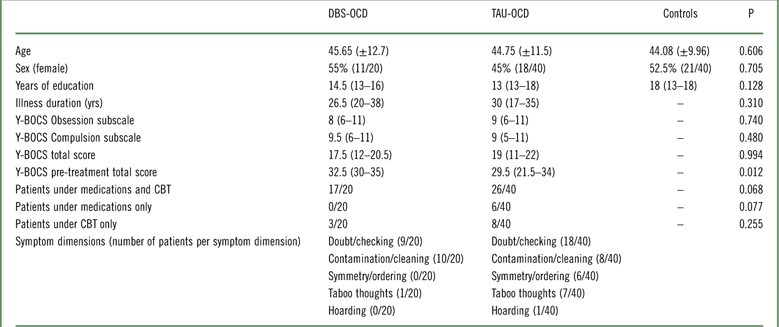
Inclusion criteria for both patient groups were as follows: (1) presence of Diagnostic and Statistical Manual of Mental Disorders, Fourth Edition (DSM-IV) criteria for OCD, established by a psychiatrist and confirmed by the Structured Clinical Interview for DSM-IV Axis-I Disorders/Patient Edition (SCID-I/P)Reference First, Spitzer, Gibbon and Williams 22 ; (2) good insight, established by a psychiatrist and rated trough the Y-BOCS specific sectionReference Goodman, Price and Rasmussen 18 , Reference Goodman, Price and Rasmussen 19 (this criterion was selected in order to avoid a putative effect of delusional beliefs on the beads task); and (3) age between 18 and 65 years. We excluded potential patients with any of the following conditions: (1) current DSM-IV Axis I diagnosis other than OCD (except for chronic tic disorders) and/or lifetime DSM-IV diagnosis of bipolar I or II disorder, schizophrenia or other psychotic disorders, substance abuse/dependence, or Tourette’s disorder; (2) any primary Axis II clinical diagnosis (established by a clinical interview conducted in accordance to the Structured Clinical Interview for DSM-IV Axis II Personality Disorders (SCID-II) flow-chart)Reference First, Gibbon, Spitzer, Williams and Benjamin 23 ; (3) illness duration less than 2 years; (4) hospitalization in the last 6 months; (5) changes in pharmacological treatment or DBS settings in the last 3 months; or (6) mental disorder due to a general medical condition or history of mental retardation. Healthy controls did not have any personal or family history of OCD or any other mental disorder, as confirmed by the SCID-I/NP (Non-Patient Edition).Reference First, Spitzer, Gibbon and Williams 24 Demographic and clinical variables of all subjects are displayed in Table 1.
Clinical and demographic variables

Data are expressed as percentage, mean (± standard deviation) for the variable age, or median (interquartile range) for the other variables.
Y-BOCS: Yale–Brown Obsessive-Compulsive Scale; CBT: cogntive-behavioral therapy; DBS-OCD: obsessive-compulsive disorder patients treated with deep brain stimulation; TAU-OCD: obsessive-compulsive disorder patients treated with treatment as usual.
The study procedures were carried out in accordance with the Declaration of Helsinki. The study was approved by the internal Institutional Review Board of the University of Florence and of the Academic Medical Center in Amsterdam and all participants had to sign the informed consent to be included in the study. All procedures occurred in 1 day.
Procedures and assessments
Clinical assessments
OCD symptoms and severity were assessed by independent evaluators using the Y-BOCS (range 0–40, with higher scores representing greater severity) and the Y-BOCS symptom checklist (Y-BOCS-SC).Reference Goodman, Price and Rasmussen 18 – Reference Goodman, Price and Rasmussen 19 On the basis of the Y-BOCS-SC, patients’ primary symptoms were classified as 1 of 5 a priori dimensions: (1) doubt/checking, (2) contamination/cleaning, (3) symmetry/ordering, (4) unacceptable/taboo thoughts, (5) hoarding. The subclassification on these a priori 5 dimensions was based on factor analysis performed on previous studies.Reference Brakoulias, Starcevic and Berle 25 We also performed a clinical interview to assess social and demographic variables, duration of illness, current or past history of tics, and current pharmacological or CBT treatments. Clinical variables of TAU-OCD and DBS-OCD subjects are displayed in Table 1.
Reflection impulsivity
Reflection impulsivity, defined as the accumulation of evidence prior to decision, was assessed with the Beads Task.Reference Phillips and Edwards 26 This task has a standard paradigm in which participants are required to judge from which jar (out of 2) different colored beads are being drawn. One jar might contain 85 beads of one color (green) and 15 beads of another color (purple). The second jar contains the same number of beads, but with the reverse distribution (15 green and 85 purple). Participants-knowing a priori the distribution of beads in the jars-are shown a series of beads that are drawn 1 at a time from 1 of the 2 jars, with each bead being replaced in its original jar after the participant has seen it. Participants are required to indicate when they are confident enough to make a judgment on which jar the beads are being drawn from. A maximum of 20 beads was presented to each participant in each trial. If participants did not make a decision after 20 beads, the computer prompted them to do so. We implemented a computerized version of the Beads Task on the basis of literature evidence recommendations.Reference Stratta, Pacifico, Patriarca and Rossi 27 The performance was measured by recording the number of beads requested before reaching a decision (“draws to decision”), as a measure of the amount of information needed to make a decision. According to previous studies, we considered 1 or 2 draws to decision as the threshold to define high reflection impulsivity.Reference Ormrod, Shaftoe and Cavanagh 28
Decision-making
To assess decision-making we used the Iowa Gambling Task (IGT), a card game that is widely used to study decision-making under ambiguous conditions (the probability of different outcomes is unknown).Reference Bechara, Damasio, Damasio and Anderson 29 , Reference Brand, Recknor, Grabenhorst and Bechara 30 . Decision making behaviors on the IGT can discriminate between “risky-players” who prefer immediate reward despite negative future consequences and “risk-avoidant” players who prefer small but long-term rewarding choices.Reference Cavedini, Zorzi and Baraldi 31 In the IGT, the subject must select 100 cards from four decks (A, B, C, and D), and the objective is to obtain the maximum profit. At the beginning of the test the subjects receive a loan of play money. After turning over each card, subjects are either given money or asked to pay a penalty according to a programmed schedule of reward and punishment. Gains and losses are different for each deck. Decks A and B (disadvantageous decks) are high paying but disadvantageous in the long run, because the penalties are even higher. Decks C and D (advantageous decks), on the other hand, are low paying but advantageous because the penalties are lower, resulting in an overall gain in the long run. In this study, we used a computerized version of the original IGT.Reference Bechara, Damasio, Damasio and Anderson 29 The performance was measured using the net score, defined by choices from advantageous (C and D) minus disadvantageous (A and B) decks, with higher scores indicating a risk-avoidant pattern of decision making. The net score for each block of 20 cards was also considered to evaluate the choice behavior during the task.
In order to minimize the effects of a miscomprehension of both tasks (IGT and Beads Task), each trial was preceded by a pre-explanation of the task after which the participants had to prove their understanding of the tasks.
Statistical analyses
Normality of all variables was evaluated using the Shapiro–Wilk test. Normally distributed variables were as follows: age, IGT Net Score2, Net Score3, and IGT final Net Score. Non-normally distributed variables were as follows: years of education, illness duration, YBOCS Obsession subscale, YBOCS Compulsion subscale, YBOCS total score, pretreatment Y-BOCS score, IGT Net Score1, Net Score4, Net Score5, and number of draws in Beads Task. In order to compare the groups on sociodemographic and clinical variables, Fisher’s exact test was used for gender and for the proportion of subjects who made only 1 or 2 draws to decision in the Beads Task. YBOCS scale and subscales were compared using the Wilcoxon test.
Primary outcomes were the difference in Beads Task draws to decision (for the reflection impulsivity task) and IGT total net score (for the decision-making task) between the DBS-OCD, TAU-OCD, and healthy control groups. Bonferroni–Holm adjustment was used for the analyses of the 2 primary outcomes. Secondary outcomes were percentage of subjects who made only 1 or 2 draws to decisions during the Beads Task and IGT net scores per block during the IGT. Analysis of variance (ANOVA) and the Kruskal–Wallis rank sum test were used to compare continuous or interval variables between the 3 groups. Bonferroni–Holm adjustment was used for all post-hoc analyses. The Correlated Seasonal Mann-Kendall test for continuous variables over time was used to assess the presence of an upward (IGT net scores increase) or downward (IGT net scores decrease) trend in IGT performance over time. Spearman’s rank and Point-Biserial correlation tests (to correlate continuous and dichotomous variables) were used to evaluate the interaction of clinical variables (symptoms severity, symptoms’ reduction after effective TAU or DBS, presence or history of tics, duration of illness, medication and/or CBT status) with IGT final Net Score and Beads Task draws to decision. Statistical tests were 2-tailed. Level of significance was set at p=0.05. All analyses were carried out using R 3.3.3, R Core Team (2017).
Results
Demographic and clinical characteristics
There were no significant differences between the 3 groups with respect to sex, age, and education (see Table 1). TAU-OCD and DBS-OCD patients did not differ with respect to illness duration, Y-BOCS obsession subscale, Y-BOCS compulsion subscale, or Y-BOCS total score (see Table 1). Thus, TAU-OCD and DBS-OCD patients were homogeneous in terms of current symptom severity, stability of current treatments, and “responder” status (all patients in both groups were classified as responders and were under stable medications and/or DBS settings for at least 3 months). Seventeen out of 20 DBS-OCD patients and 32 out of 40 TAU-OCD patients were under ongoing treatment with medication (SRIs or SRIs plus antidopaminergic medication). All DBS-OCD patients were under ongoing CBT, while 8 TAU-OCD patients were under CBT only. In the TAU-OCD group, 26 out of 40 patients were under medications plus CBT (see Table 1). DBS-OCD and TAU-OCD patients did not differ in the presence of chronic tic disorders comorbidity (Pearson’s chi-squared test with Yates’ continuity correction X-squared=1.4092, df=1, p-value=0.2352).
Reflection impulsivity
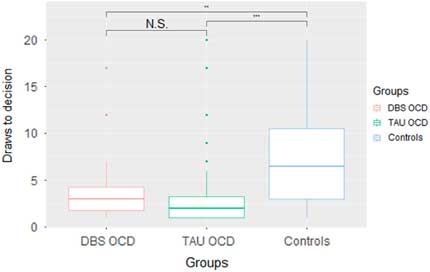
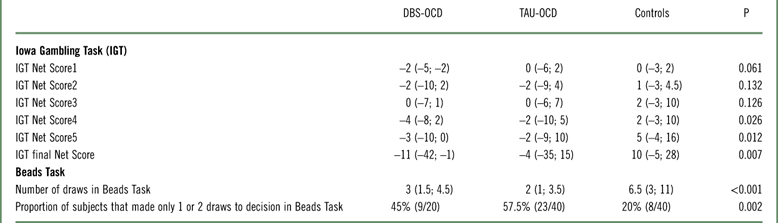
We found a significant difference on Beads Task draws to decision between the 3 groups (H(2)=17.52, adj. p<0.001). Post-hoc test revealed that healthy controls made significantly more draws to decision (median 6.5) than DBS-OCD (median 3, adj. p=0.008) and TAU-OCD patients (median 2, adj. p<0.001) (see Table 2 and Figure 1). No statistically significant difference was found between TAU-OCD and DBS-OCD groups (adj. p=0.260). The percentage of subjects who made only 1 or 2 draws to decision in the Beads Task was 20% in the control group, 45% in the DBS-OCD group, and 57.5% in the TAU-OCD group. This percentage was significantly different between the 3 groups (p=0.002). Post-hoc test showed a significant difference between the TAU-OCD and control groups (adj. p=0.003), but not between the DBS-OCD and TAU-OCD groups or controls (adj. p=0.418 and p=0.135, respectively) (see Table 2).
Box and whiskers plot of beads draws for DBS-OCD patients, TAU-OCD patients, and healthy controls. The bottom and top of the box are the first and third quartiles, the band inside the box is the median, the ends of the whiskers represent the lowest datum still within 1.5 times the inter-quartile range of the lower quartile, and the highest datum still within 1.5 times the inter-quartile range of the upper quartile. The circles are outliers. *p<0.05; **p<0.01; ***p<0.001.

Iowa Gambling Task and Beads Task performances

Data are expressed as percentage for proportion of subjects that made only 1 or 2 draws to decision in Beads Task and median (interquartile range) for the other variables.
DBS-OCD: obsessive-compulsive disorder patients treated with deep brain stimulation; TAU-OCD: obsessive-compulsive disorder patients treated with treatment as usual.
Decision-making
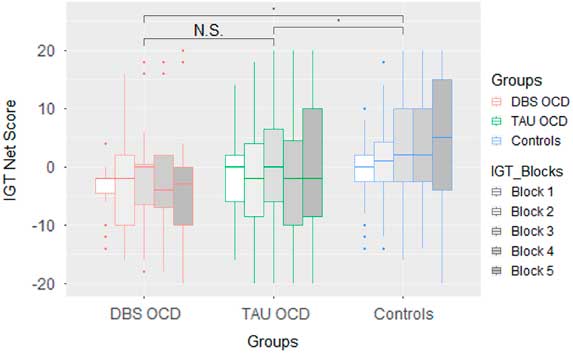
The 3 groups showed a significant difference on IGT final Net Score (F(2)=5.27, adj. p=0.007). Post-hoc test revealed that IGT Net Score was statistically significantly lower in the TAU-OCD group (median –4 (–35; 15), adj. p=0.037) and the DBS-OCD group (median –11 (–42; –1), adj. p=0.011) compared to controls (median 10 (–5; 28)) (see Table 2). There was no statistically significant difference between the TAU-OCD and DBS-OCD groups (adj. p=0.307). The 5 IGT blocks series showed a significant upward trend in the control group (IGT net scores increase from block 1 to block 5) (Z=2.1, p=0.037). The TAU-OCD (Z=0.8, p=0.432) and DBS-OCD (Z=0.2, p=0.871) groups did not show significant trends (see Figure 2).
Box and whiskers plot of the five IGT blocks for DBS-OCD, TAU-OCD patients, and healthy controls. *p<0.05; **p<0.01; ***p<0.001.

Correlation analysis
Spearman correlation coefficients between clinical variables (symptoms severity, symptoms reduction after effective TAU or DBS, presence or history of tics, illness duration, medications and/or CBT status), IGT final Net Score and Beads Task draws to decision were not statistically significant in TAU-OCD and DBS-OCD patients. We also tested for the presence of correlations between Y-BOCS scores, symptom dimensions, the other clinical variables, and impulsivity and decision-making measures for OCD patients as a whole group (TAU-OCD and DBS-OCD patients combined), and no statistically significant results were found.
Discussion
To the best of our knowledge, this is the first study investigating reflection impulsivity and decision-making under ambiguity in OCD patients treated with effective vALIC-DBS. Contrary to our hypothesis, OCD patients successfully treated with vALIC-DBS or TAU show increased reflection impulsivity and impaired decision-making compared to healthy controls, without differences between DBS or TAU.
In the current literature, there are very limited data on impulsivity and decision-making in OCD patients effectively treated with DBS or other therapies. Our results are in line with a case report of a patient with OCD with motor impulsivity (stop-signal deficits) that did not change after effective Nacc-DBS.Reference Grant, Odlaug and Chamberlain 17 Another case study reported increased impulsivity in 2 OCD patients with vALIC-DBS, though impulsivity in these patients was not measured with cognitive tests.Reference Luigjes, Mantione, van den Brink, Schuurman, van den Munckhof and Denys 16 In line with our other result, ie, impulsivity and impaired decision making despite effective TAU, a recent study in paediatric and adolescent OCD patients showed that SSRIs reduced OCD symptoms, but did not affect impulsivity (measured with a behavioral task) and did not rescue the diminished hemodynamic responses in prefrontal areas observed during this task.Reference Yamamuro, Ota, Iida, Kishimoto, Nakanishi and Kishimoto 15 Also comparable to our results, impaired decision-making under ambiguity was still found after acute administration of escitalopram in OCD patients.Reference Lochner, Chamberlain, Kidd, Fineberg and Stein 32
Several hypotheses could account for our results. First, vALIC-DBS may not primarily affect brain networks involved in impulsivity and decision-making. Previous studies showed that vALIC-DBS reduces hyperconnectivity between the Nacc and the lateral and medial prefrontal cortex and normalizes Nacc activity during reward processing.Reference Figee, Luigjes and Smolders 9 Neuroimaging studies during the IGT and the Beads Task showed activation of a frontostriatal network activation that includes medial-prefrontal and ventral-striatal areasReference Esslinger, Braun and Schirmbeck 13 , Reference Li, Lu, D’Argembeau, Ng and Bechara 14 and thus overlaps with the network changes observed with vALIC-DBS for OCD. However, the IGT and the Beads Task also recruit other brain networks that may be not be primarily targeted with vALIC-DBS. The IGT also recruits the dorsolateral prefrontal cortex for working memory, the posterior cingulate cortex for representations of emotional and somatic states through its afferent projections from the hypothalamus and brainstem nuclei, and the anterior cingulate/supplementary motor area for implementing behavioral decisions.Reference Li, Lu, D’Argembeau, Ng and Bechara 14 The decision process of the Beads Task has been associated with activity in the midbrain, thalamus, and medial occipital cortex.Reference Esslinger, Braun and Schirmbeck 13 Therefore, we could speculate that vALIC-DBS is able to restore motivational networks but may not directly affect cognitive control and decision-making networks.
Second, impulsivity and impaired decision-making may constitute cognitive endophenotypes that are not affected by DBS or TAU. In support of this notion, motor impulsivity and impaired decision-making are observed in OCD patients independent of symptom severity and medication status, but also in their healthy relatives.Reference Cavedini, Zorzi, Piccinni, Cavallini and Bellodi 1 , Reference Chamberlain, Fineberg and Menzies 2 , Reference Lochner, Chamberlain, Kidd, Fineberg and Stein 32 In fact, impulsivity and impaired decision-making may represent broader vulnerability factors for the development of a series of disorders within an impulsive-compulsive spectrum, as they are also present for example in addiction and attention deficit hyperactivity disorder.Reference Fineberg, Chamberlain and Goudriaan 33 , Reference Ersche, Turton, Pradhan, Bullmore and Robbins 34 Our findings indicate that vALIC-DBS may not have influenced these general vulnerability traits.
Third, impulsivity and impaired decision-making are linked to the presence of OC symptoms. Indeed, both DBS-treated and TAU-treated patients in our study were still symptomatic to a “moderate” level after effective treatments. Despite the fact that we did not find any correlation between impulsivity and/or decision-making performance and symptom severity, a recent study showed that impulsivity and compulsivity could mediate OC symptoms.Reference Prochazkova, Parkes and Dawson 35 Thus, further studies investigating these dimensions in recovered patients or patients with “minimal” OC symptoms are needed to elucidate this issue.
Finally, it could be that DBS or medications are causally related to the cognitive impairments we observed. Previous longitudinal studies in DBS-treated patients did not show cognitive worsening after treatment on most cognitive measures.Reference Bergfeld, Mantione, Hoogendoorn and Denys 36 However, a recent longitudinal study on vALIC-DBS treated OCD patients showed a trend toward reduced performance on measures of visual working memory.Reference Mantione, Nieman, Figee, van den Munckhof, Schuurman and Denys 37 Visual working memory functions may also be involved during the IGT and the Beads Task, as subjects need to remember their previous deck choices on the IGT, and remember the 2 initial bead jars on the Beads Task. Thus, we cannot exclude that DBS effects on visual working memory could have affected the patients’ performance on both tasks.
Several limitations are worth of mentioning. The main limitation is the cross-sectional design of the study that does not allow us to draw firm conclusions on the effects of vALIC-DBS on impulsivity and decision-making since we did not include pretreatment performances on these tasks of both groups. Thus, only prospective measurements before and after surgery or TAU would allow any conclusion. Moreover, both DBS and TAU patients were highly selected since they were without current comorbidities, and therefore the observed performances on impulsivity and decision-making tasks may not be generalizable to the broader cohort of patients in clinical settings. Also, in this study we did not use any measure of patients’ functioning and quality of life and thus we could not investigate the impact of cognitive impulsivity and impaired decision-making on patients’ global functioning and quality of life. Thus, the clinical relevance of impulsivity and decision-making in OCD patients remains an open question needing further investigation. Finally, we did not assess motor impulsivity, so we cannot conclude if DBS or TAU did not affect impulsivity tout court rather than cognitive impulsivity only.
Conclusions
In conclusion, our study showed that OCD patients, irrespective of treatment modality (DBS or TAU), demonstrate increased reflection impulsivity and impaired decision-making compared to healthy controls. Longitudinal studies with a pre- and post-treatment assessment are needed to clarify if impulse control and decision-making are affected by DBS and/or TAU or constitute cognitive vulnerability factors that are not affected by treatments. Also, further studies should try to elucidate the clinical relevance and impact of impaired impulse control and decision-making on patients’ functioning and quality of life, since these cognitive facets are present even after effective treatments.
Disclosures
The authors have nothing to disclose.