Introduction
From the 1970s to the late 1980s, industrialised states relied on sectoral plans and policies to tackle comparatively straightforward environmental problems, such as urban smog, acid rain and freshwater pollution. The silver bullets of early environmental policies were command-and-control regulations that usually prescribed end-of-pipe measures, each conceptualised in elaborate environmental plans. Since then, more complex environmental problems, such as biodiversity loss or climate change, have emerged. They affect several policy sectors, and all levels of governance are resistant to simple technological fixes and challenge established patterns of governance, policymaking, economic practices, social norms and individual behaviours (Gupta Reference Gupta2007; Delmas and Young Reference Delmas and Young2009). During the 1990s, policymakers and researchers realised that more complex environmental problems cannot be tackled with end-of-pipe policies conceptualised in narrow sectoral plans, but instead require comprehensive responses matching the spatial and sectoral scopes of underlying problems. This is the background against which policymakers resorted to integrated multi-sectoral strategies that were expected to function effectively in cross-sectoral and multi-level settings (Howlett and Rayner Reference Howlett and Rayner2006a; Steurer Reference Steurer2008). These spread with an astonishing speed on various issue areas worldwide. Governments, in particular those of Western Europe, developed integrated strategies on issues such as land management (Rayner and Howlett Reference Rayner and Howlett2009), natural resources (Howlett and Rayner Reference Howlett and Rayner2006a), sustainable development (Steurer and Martinuzzi Reference Steurer and Martinuzzi2005; Steurer Reference Steurer2008), climate change mitigation (Kerr Reference Kerr2007) or adaptation (Biesbroek et al. Reference Biesbroek, Swart, Carter, Cowan, Henrichs, Mela, Morecroft and Rey2010; Bauer et al. Reference Bauer, Feichtinger and Steurer2012). Thus, integrated strategies are a significant phenomenon of contemporary policymaking – in particular in the environmental domain.
The present paper describes, analyses and compares integrated strategies concerned with sustainable development, climate change mitigation and adaptation in the EU-15, that is, the EU Member States as of April 2004. Sustainable development aims to minimise trade-offs and maximise synergies between economic, social and environmental goals (Vig and Kraft Reference Vig and Kraft2010). Consequently, sustainable development strategies (SDS) aim at better integrating these three “dimensions” horizontally across sectors, vertically across spatial scales and timewise across short- and long-term horizons (Steurer Reference Steurer2008, 93). Climate change mitigation, in turn, aims at limiting global warming to an average temperature increase under 2°C in the long run by reducing global greenhouse gas emissions and enhancing sinks (Wilbanks and Sathaye Reference Wilbanks and Sathaye2007). Since greenhouse gas emissions result from the activities of many sectors, integrated mitigation strategies ideally prioritise action in high-emitting sectors, such as energy, transport and industry (Bartle and Vass Reference Bartle and Vass2007, 39). Finally, adaptation refers to the adjustments of natural and human systems in response to climate change (Biesbroek et al. Reference Biesbroek, Swart, Carter, Cowan, Henrichs, Mela, Morecroft and Rey2010). Since adaptation requires more variegated and context-related responses than those taken in sustainable development or mitigation, integrated adaptation strategies are ideal-typically “top-down instruments that frame bottom-up measures” of adaptation (Swart et al. Reference Swart, Biesbroek, Binnerup, Carter, Cowan, Henrichs, Loquen, Mela, Morecroft, Reese and Rey2009, 29; Termeer et al. Reference Termeer, Biesbroek and van der Brink2009). Although properly designed climate change mitigation and adaptation responses are “part and parcel of sustainable development” (Rogner et al. Reference Rogner, Zhou, Bradley, Crabbé, Edenhofer, Hare, Kuijpers and Yamaguchi2007, 100) and vice versa (Wilbanks et al. Reference Wilbanks, Leiby, Perlack, Ensminger and Wright2007, 714; Yohe et al. Reference Yohe, Lasco, Ahmad, Arnell, Cohen, Hope, Janetos and Perez2007), governments across Western Europe have developed respective strategies successively with only weak conceptual and institutional linkages (IPCC 2007a; Wilbanks et al. Reference Wilbanks, Leiby, Perlack, Ensminger and Wright2007, 715; see the Similarities, differences and linkages section).
There is considerable research on integrated strategies addressing sustainable development (Steurer and Martinuzzi Reference Steurer and Martinuzzi2005; Volkery et al. Reference Volkery, Swanson, Jacob, Bregha and Pintér2006; Steurer Reference Steurer2008; Reference Nordbeck and SteurerNordbeck and Steurer forthcoming) and, more recently, climate change adaptation (Mickwitz et al. Reference Mickwitz, Aix, Beck, Carss, Ferrand, Görg, Jensen, Kivimaa, Kuhlicke, Kuindersma, Máñez, Melanen, Monni, Branth Pedersen, Reinert and van Bommel2009b; Swart et al. Reference Swart, Biesbroek, Binnerup, Carter, Cowan, Henrichs, Loquen, Mela, Morecroft, Reese and Rey2009; Biesbroek et al. Reference Biesbroek, Swart, Carter, Cowan, Henrichs, Mela, Morecroft and Rey2010; Bauer et al. Reference Bauer, Feichtinger and Steurer2012). Although mitigation strategies are as widespread as other integrated strategies, researchers focus rather on the broader notion of Climate Policy Integration and only occasionally on the role of national mitigation strategies (NMS) in this endeavour (Berger et al. Reference Berger, Hametner and Steurer2007; Kerr Reference Kerr2007; Mickwitz et al. Reference Mickwitz, Kivimaa, Hildén, Estlander and Melanen2009a, Reference Mickwitz, Aix, Beck, Carss, Ferrand, Görg, Jensen, Kivimaa, Kuhlicke, Kuindersma, Máñez, Melanen, Monni, Branth Pedersen, Reinert and van Bommel2009b; Adelle and Russel Reference Adelle and Russel2013). Moreover, these integrated strategies have hitherto not been compared to each other, even though they are thematically related, and previous works comparing other integrated strategies evidence the rewards of a comparative perspective (Hogl et al. Reference Hogl, Nordbeck and Kvarda2009; Rayner and Howlett Reference Rayner and Howlett2009). We address this research gap by answering the following questions: What are the key characteristics of the three types of integrated strategies? In how far did they succeed in reshaping policies? In how far are they similar? How well are they integrated (or coordinated) with each other? Do they complement or compete with each other?
The desk research presented here draws on the rich repertoire of scholarly works (including policy analyses and evaluations), guidelines, progress reports, audits and other reports issued by national, international or supranational public agencies (such as the European Environment Agency and national audit offices), and finally on the strategy documents and related material issued by national authorities. We focus on the EU-15, because these countries have accepted binding climate change mitigation targets through the burden/efforts sharing agreement starting in 1998, which specifies how the EU is to reach its Kyoto emission reduction target of 8% by 2010–2012 (Haug and Jordan Reference Haug and Jordan2010, 86f). Moreover, the EU-15 provides an interesting variance of leaders and laggards in the formulation and implementation of environmental policies in general and of integrated strategies in particular.
The paper first elaborates the concept of integrated strategies. It then describes the three types of integrated strategies in Western Europe with regard to their origins, rationale, actual prevalence, governance characteristics and performance. The empirical sections are followed by a comparison of the three types of integrated strategies. The paper concludes with a discussion and an outlook on how to develop integrated strategies further.
Integrated strategies: policy, governing process and capacity building
Integrated strategies are a relatively novel approach to govern highly complex issues that involve several sectors and levels of governance (Rayner and Howlett Reference Rayner and Howlett2009). They are a key tool to foster not only sustainable development but also environmental policy integration or ecological modernisation, concepts that promoted the integration of environmental concerns into sectors with significant environmental ramifications (such as industry, agriculture and transport) long before sustainable development dominated the environmental discourse (Graborsky Reference Graborsky1994; Hajer Reference Hajer1995; Mol and Spaargaren Reference Mol and Spaargaren2000; Lafferty and Hovden Reference Lafferty and Hovden2003; Nilsson and Persson Reference Nilsson and Persson2003; Persson Reference Persson2004). Integrated strategies can be “grand” programmes that address many sectors, levels of governance and actors or focus on just a few sectors or regions (Lim and Spanger-Siegfried Reference Lim and Spanger-Siegfried2004, 186). Irrespective of their scope, they are “intended to address the perceived shortcomings of previous, more ad hoc, policy regimes” by rationalising multiple goals and the systematic use of policy instruments, so that multiple sectoral policies “support rather than undermine one another in the pursuit of those goals” (Rayner and Howlett Reference Rayner and Howlett2009, 100). While sectoral strategies (e.g. on poverty reduction, employment or forestry) can (and should) consider other sector goals and policies beyond their immediate concern, integrated strategies (in particular those analysed here) have, by definition, a cross-sectoral character.
Integrated strategies have been developed worldwide, especially at the national level. The rapid diffusion of the three types analysed here fits well with global trends of policy diffusion resulting from international politics (Dobbin et al. Reference Dobbin, Simmons and Garrett2007; Füglister Reference Füglister2011). Summits, such as the 1992 Rio Conference on Environment and Development or the 2002 Johannesburg World Summit on Sustainable Development (Steurer and Martinuzzi Reference Steurer and Martinuzzi2005), and international agreements, such as the Agenda 21, the United Nations Framework Convention on Climate Change (UNCED 1992) or the Kyoto Protocol (United Nations 1998), all played important roles in both diffusing and shaping integrated strategies along similar ideal-typical lines. First, integrated strategies are policy documents that aim to (re-) construct a cross-sectoral policy domain with a number of (long-term) key principles, values and policy objectives. The objectives ought to be complemented by details on measures and policy instruments either in the strategies themselves or in periodical action plans, sectoral strategies and/or regional strategies. The periodical action plans bring us to a second major function that integrated strategies should fulfil. In contrast to the one-off environmental plans of the 1970s and 1980s, integrated strategies are framed as cyclical governing processes that are mainly concerned with horizontal and vertical policy integration (Howlett and Rayner Reference Howlett and Rayner2006b, 251–252; Steurer Reference Steurer2008). Thus, those responsible for the strategies ought to involve policymakers from other sectors and/or levels of governance on a continuous (institutionalised or ad hoc) basis (Lim and Spanger-Siegfried Reference Lim and Spanger-Siegfried2004, 189; Jacob et al. Reference Jacob, Münch and Büttner2012, 12). Other key elements of cyclical governing processes are reflexivity and learning through monitoring and reporting activities, which bring us to the third major ideal-typical function of integrated strategies. In addition to their policy and governance dimensions, integrated strategies aim to build respective capacities. They are supposed to raise awareness for certain issues, build a knowledge base that facilitates the formulation and implementation of policy measures, establish policy networks and establish monitoring, evaluation and reporting routines that inform policymakers periodically about progress made and stalemates encountered (Steurer and Martinuzzi Reference Steurer and Martinuzzi2005; Mulgan Reference Mulgan2009, 75–113; Jacob et al. Reference Jacob, Münch and Büttner2012, 12–15). These “softer” communication aspects of integrated strategies are relevant for policymaking, because they can shape the public perception of complex environmental issues. Research has shown that having an impact on perceptions, for instance by building scientific capacities or raising awareness for an issue, can help policymakers shape broader political agendas, influence the media and ultimately steer policy outputs (Weingart et al. Reference Weingart, Engels and Pansegrau2000; Sharp and Richardson Reference Sharp and Richardson2001).
Obviously, these policy, governance and capacity-building dimensions imply that integrated strategies are something more than a policy instrument (let alone a policy document). They are supposed to represent comprehensive governing processes that have a lot in common with the notion of meta-governance or “the governance of governance” (Meuleman Reference Meuleman2008, 67). As such, they aim to achieve policy objectives more effectively by providing direction, structure and control with regard to governance modes (e.g. hierarchy, networks, market), policy instruments and actors (Sorensen Reference Sorensen2006; Meuleman Reference Meuleman2008). In a narrow, government-centred sense, this is accomplished by agreeing on strategic objectives, orchestrating different policy instruments and monitoring their performance (Peters Reference Peters2010, 44). In a wider, governance-centred sense, meta-governance can reach far beyond the governmental domain, aiming to coordinate not only governmental policies but also governance by businesses and civil society actors (Steurer Reference Steurer2013). In this wider form of meta-governance, a government is concerned with “harnessing the capacities of markets, civil society and other institutions to accomplish its policy goals” (Gunningham Reference Gunningham2005, 338). It is particularly pronounced in complex policy fields, such as sustainable development and climate change, in which governing relies heavily on non-state actors (Steurer Reference Steurer2013).
The following sections explore in how far integrated strategies on sustainable development, climate change mitigation and adaptation live up to this ideal-type picture, and to more detailed guidelines introduced for the respective strategies below.
SDS
Policy rationale
SDS represent the most comprehensive governance approaches for promoting the societal guiding model (Gjoski et al. Reference Gjoski, Sedlacko and Berger2010, 2). The architecture of SDS have been shaped by guidance from the UN and the OECD (e.g. UNCED 1992, Chapter 8; OECD 2000, 2001a, 120, 2006, 10; OECD-DAC 2001, 18ff; UNDESA 2001). According to these “maximalist guidelines”, SDS should (1) review existing economic, social and environmental policies, strategies and plans with a people-centred approach; (2) build consensus on long-term visions, establish a clear time frame for implementation and secure the commitment of all political parties, in particular, high-level politicians; (3) modify and strengthen national institutional structures and procedures to support the integration of social, economic and environmental issues in various sectors in the long run; (4) assess the environmental implications of sectoral policies; (5) integrate sustainable development priorities into the budgeting process; (6) facilitate coherent policies across levels of government; (7) ensure the widest possible participation of stakeholders, basing their involvement on trust, mutual respect and transparency; (8) rely on flexible integrative management that allows for adjustments during and after the implementation stage; and (9) establish comprehensive monitoring and assessment procedures that help to improve policies iteratively (see also Steurer and Martinuzzi Reference Steurer and Martinuzzi2005, 458; Steurer Reference Steurer2008, 95; Steurer et al. Reference Steurer, Berger and Hametner2010, 72; Steurer and Berger Reference Steurer and Berger2011, 100).
Prevalence and characteristics
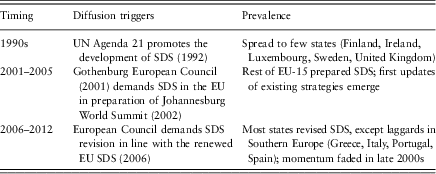
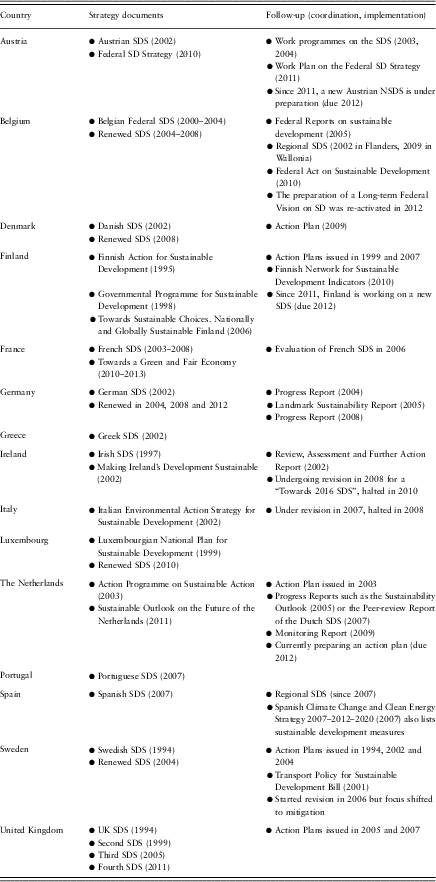
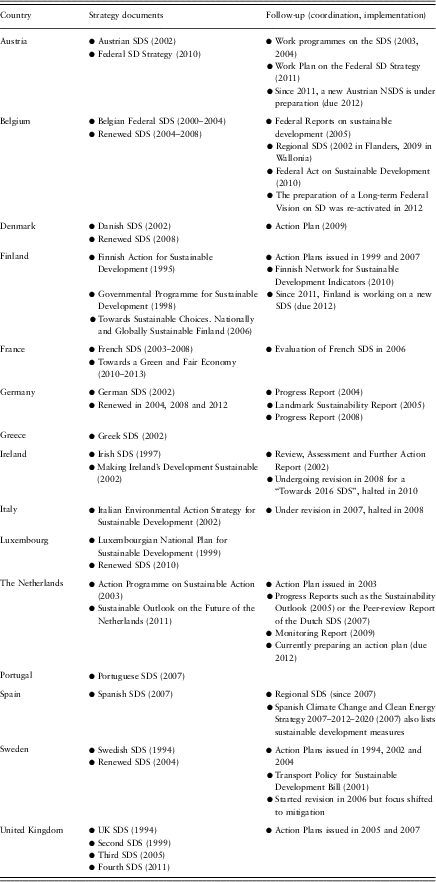
SDS emerged around the turn of the millennium, triggered by various international and European decisions. Since then, all EU-15 states have developed a strategy (see Table 1 for a summary and Appendix 1 for further details). However, the impetus to renew or continue implementing SDS has gradually faded recently, both at the national and EU level, in favour of climate mitigation and adaptation strategies (Mickwitz et al. Reference Mickwitz, Aix, Beck, Carss, Ferrand, Görg, Jensen, Kivimaa, Kuhlicke, Kuindersma, Máñez, Melanen, Monni, Branth Pedersen, Reinert and van Bommel2009b, 80).
Diffusion triggers and prevalence of SDS in the EU-15
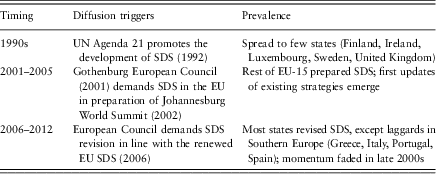
Note: SDS = sustainable development strategies.
Source: Own illustration based on UNCED (1992), Steurer (Reference Steurer2008), European Council (2006a, 2006b), Steurer and Berger (Reference Steurer and Berger2011).
Contentwise, most strategies focus on environmental issues, but they also cover economic and social concerns such as competitiveness, budget deficits, poverty reduction or international issues (Steurer Reference Steurer2008, 97). Although most strategies cohere in these terms, they differ in the details regarding the type and number of actors involved, the measures proposed, the way they envisage their governance (in particular with regard to horizontal, temporal and vertical integration) and the procedures for monitoring, evaluation and reporting (Steurer et al. Reference Steurer, Berger and Hametner2010). This reflects the fact that SD is a politically constructed concept, which allowed policymakers sufficient latitude to develop different interpretations and operational definitions of the concept (Nilsson and Persson Reference Nilsson and Persson2003, 338). It also reflects that the policy rationale summarised above did not become a commonly accepted blueprint for SDS across Europe (Gjoski et al. Reference Gjoski, Sedlacko and Berger2010, 4).
SDS are usually spurred by environmental ministries. These ministries coordinate the strategies as a governing process and are generally responsible for implementing and monitoring them. Although other ministries usually play marginal roles in formulating and implementing them (Finland and Sweden), their involvement represents the primary mechanism for the integration of SD across sectors (Steurer Reference Steurer2008, 99). Most strategies prescribed the creation of institutions where middle-level civil servants (and sometimes political actors) from different ministries as well as other stakeholders meet on a regular basis (Steurer and Martinuzzi Reference Steurer and Martinuzzi2005, 461; Wurzel Reference Wurzel2008; ESDN 2012). The documents stemming from such fora are action plans (general or departmental), as well as sectoral reports (Gjoski et al. Reference Gjoski, Sedlacko and Berger2010), which aim to translate long-term visions expressed in the SDS into short- and medium-term policy measures. However, such cyclical implementation mechanisms are relatively rare, and most countries stopped employing them after one or two cycles.
With respect to vertical integration, numerous countries did not involve sub-national levels in their SDS substantially (Denmark, Finland, Ireland, Luxembourg, Portugal, Spain), and most other strategies foresee relatively few mechanisms to link national and sub-national entities. In Belgium, for example, competences on SD are clearly divided across levels of governance. The German Laender collaborate regularly with the Parliamentary Advisory Council on SD through the State's Secretaries Group, and in the United Kingdom, national objectives are taken into account in sub-national strategies and plans (ESDN 2012).
Stakeholder participation mainly provided political guidance and critical reviews. Sometimes, stakeholders also played a role in better coordinating and integrating policies (Gjoski et al. Reference Gjoski, Sedlacko and Berger2010). While most countries involved only social partners and other well-organised interest groups, some also attempted to involve a wide variety of actors (France, Portugal) or even the public at-large (Germany, Luxembourg), the latter usually with little success (Raggamby et al. Reference Raggamby, Knoblauch, Berger, Sedlacko, Zwirner and Martinuzzi2010). Besides ad hoc participation (roundtable discussions, conferences and online consultation), most SDS institutionalised stakeholder participation in the form of councils or partnerships (Steurer Reference Steurer2008, 99; Niestroy Reference Niestroy2012).
Finally, monitoring and reporting tends to be biannual or quadrennial (Austria, Germany, Luxembourg, Portugal), reflecting the fact that SDS are iterative governing processes that “do not have discrete beginnings or ends” (OECD 2001b). Most indicator and/or progress reports are produced by the lead ministry, and they build upon comprehensive sets of indicators such as poverty rate, GDP per capita and carbon emissions (Steurer Reference Steurer2008, 102). The number and nature of indicators and their linkages to policy objectives vary drastically across countries (Steurer and Hametner Reference Steurer and Hametner2013). To evaluate their strategies, governments resort to internal (Belgium, Finland), external (Austria, Finland) and/or peer reviews (France, Germany, the Netherlands) carried out by independent researchers or consultants (Austria, Finland), public agencies (Denmark), audit courts (Austria), internal oversight bodies (Belgium, Finland) or peers from neighbouring and developing countries.
In conclusion, most strategies did trigger a domestic governing process, with emphasis placed on the integration of SD concerns across sectors and monitoring (un)sustainable trends. Despite the fact that SDS undoubtedly led to some governance innovations (such as inter-ministerial coordination and cyclical monitoring and reporting, see Steurer and Martinuzzi Reference Steurer and Martinuzzi2005; Steurer Reference Steurer2008), most “lack the recommended basic design and implementation elements” suggested by the UN and the OECD (2006, 7), a judgement still valid today.
Performance
Apart from the contracted reviews and evaluations mentioned above, several independent studies assessed SDS in Europe – rather critically in various respects (e.g. Dalal-Clayton and Bass Reference Dalal-Clayton and Bass2002; Dalal-Clayton et al. Reference Dalal-Clayton, Bass, Sadler, Thomson, Sandbrook, Robins and Hughes2002; Martinuzzi and Steurer Reference Martinuzzi and Steurer2003; Swanson et al. Reference Swanson, Pintér, Bregha, Volkery and Jacob2004; Volkery et al. Reference Volkery, Swanson, Jacob, Bregha and Pintér2006; Steurer Reference Steurer2008; Gjoski et al. Reference Gjoski, Sedlacko and Berger2010). Contentwise, strategies usually focus on environmental issues and attempt to incorporate economic impacts but neglect the social pillar (OECD 2006, 11). Although most countries dealt with socio-economic issues through other strategies, and some weakened the environmental focus when renewing their SDS, cross-sectoral trade-offs are largely ignored.
Looking at the actors steering the strategies, the central role played by traditionally weak environmental ministries hindered cross-sectoral integration (Steurer Reference Steurer2008). This was most visible in fiscal policies, with few states involving finance ministries. Vertical integration is an even bigger governance failure (Steurer Reference Steurer2008, 101), inter alia because many countries did not establish vertical coordination mechanisms in the first place, and when they did, goals were often too broad and the institutions created often lacked a clear mandate (OECD 2006, 7; Volkery et al. Reference Volkery, Swanson, Jacob, Bregha and Pintér2006; Berger and Steurer Reference Berger and Steurer2008).
Stakeholder participation was non-existent (Greece), controversial (Portugal, Spain) or ad hoc and pro forma (Austria, Italy; Gjoski et al. Reference Gjoski, Sedlacko and Berger2010, 33). In addition, only a few of the institutionalised stakeholder councils were able to establish themselves as policymaking “watchdogs” (but, see the German Council for SD or the UK SD Commission, the latter having closed in early 2011).
Finally, monitoring and evaluating progress towards SD are some of the few lasting achievements of SDS, albeit not without drawbacks. First, most indicator sets and reports do not monitor actual implementation but rather socio-economic and environmental trends more generally, thus reducing their political relevance (Steurer Reference Steurer2008, 102; Steurer and Hametner Reference Steurer and Hametner2013). Second, indicator monitoring often relies on outdated data, making it difficult to revise policies in a timely and adequate manner (Lyytimäki Reference Lyytimäki2012, 104). Third, findings from monitoring and evaluation efforts are used by administrators and researchers, while politicians (including parliaments) and the public rarely notice them (Steurer Reference Steurer2008, 103; Wachter Reference Wachter2010).
To conclude, SDS started out an innovative arrangements to govern sectoral interdependencies (Steurer and Martinuzzi Reference Steurer and Martinuzzi2005). To a certain extent, they went beyond being strategy documents, for example, by establishing innovative governance approaches. Nevertheless, scholars are generally critical, because they have produced only few, minor policy outputs. Since most SDS lack political commitment, they are “administered processes” incapable of shaping governmental agendas or major political decisions (Steurer Reference Steurer2008, 106; Steurer et al. Reference Steurer, Berger and Hametner2010, 82). If progress in environmental policymaking was achieved, it usually had nothing to do with SDS, not even rhetorically (Tils Reference Tils2007; Steurer Reference Steurer2008). Given this poor record, one wonders why some countries still update their SDS – and established integrated strategies on other complex issues such as climate change.
Climate change mitigation strategies
Policy Rationale
NMS are supposed to play a key role in orchestrating mitigation policies, in particular, across sectors (Simeonova and Diaz-Bone Reference Simeonova and Diaz-Bone2005, 2541). The only available guidelines that touch on the characteristics of NMS in developed countries focus mainly on the accounting of and the reporting on domestic emissions and national mitigation action (Berger et al. Reference Berger, Hametner and Steurer2007, 2; IPCC 2007a, 2007b). In addition, the OECD developed a set of principles on how to promote NMS among stakeholders and the public (de Serres et al. Reference de Serres, Llew-ellyn and Llewellyn2011).
According to the Kyoto Protocol, Demonstrable Progress Reports (Articles 5 and 7) and National Communications (Articles 4 and 12) should include (1) transparent, consistent, comparable, complete and accurate national emissions data for greenhouse gases; (2) information on national mitigation policies and measures, notably on the steps taken to price carbon emissions; and (3) information on institutional and financial arrangements (UNFCCC 2011, 3). Guidelines on National Communications add three more criteria, namely to (4) use mitigation scenarios describing the emission trends without and with measures (UNFCCC 2008a); (5) provide analyses for the most important sectors (e.g. energy, forestry, agriculture, waste management, transport); and (6) develop a set of indicators to facilitate the assessment of (sectoral) mitigation actions (UNFCCC 2008b). As we will see below, these guidelines are mirrored in NMS. More recent reporting guidelines engage more explicitly with NMS as integrated strategies. They also ask for (11) operationally feasible and credible targets; (12) politically accepted measures; (13) cross-sectoral linkages; (14) flexible implementation; and (15) stakeholder participation (de Serres et al. Reference de Serres, Llew-ellyn and Llewellyn2011; UNFCCC 2011).
The EU also influenced the NMS of its member states in several respects. First, the EU Kyoto target was allocated disparately in a burden and effort sharing agreement (European Commission 2006, 2009; Haug and Jordan Reference Haug and Jordan2010). Second, a key instrument to reach these targets is the EU Emissions Trading Scheme (ETS), a cap-and-trade system to reduce emissions from industry introduced in 2004 (van Asselt Reference Van Asselt2010). Since the ETS established its own allocation and reporting schemes, NMS do not say much on industrial emissions and policies. Third, the EU released two climate change programmes, several climate-related strategies and directives (e.g. on energy efficiency, renewable energy or the Europe 2020 strategy; see European Commission 2010), all affecting the contents of NMS.
Prevalence and characteristics
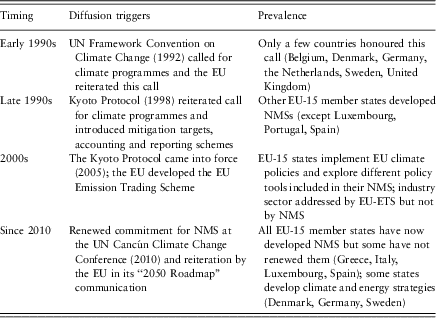
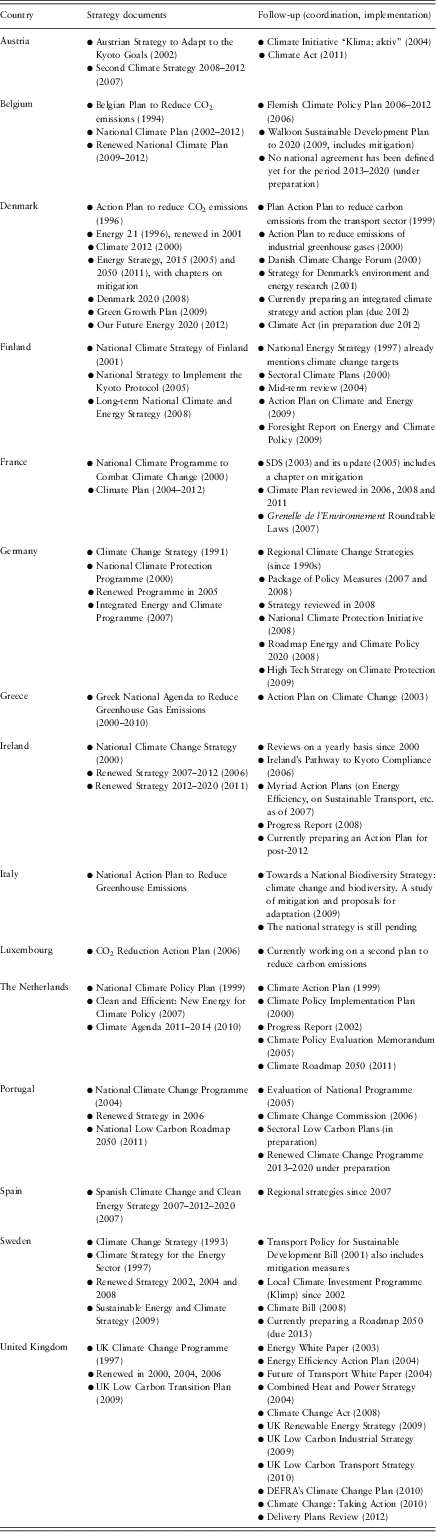
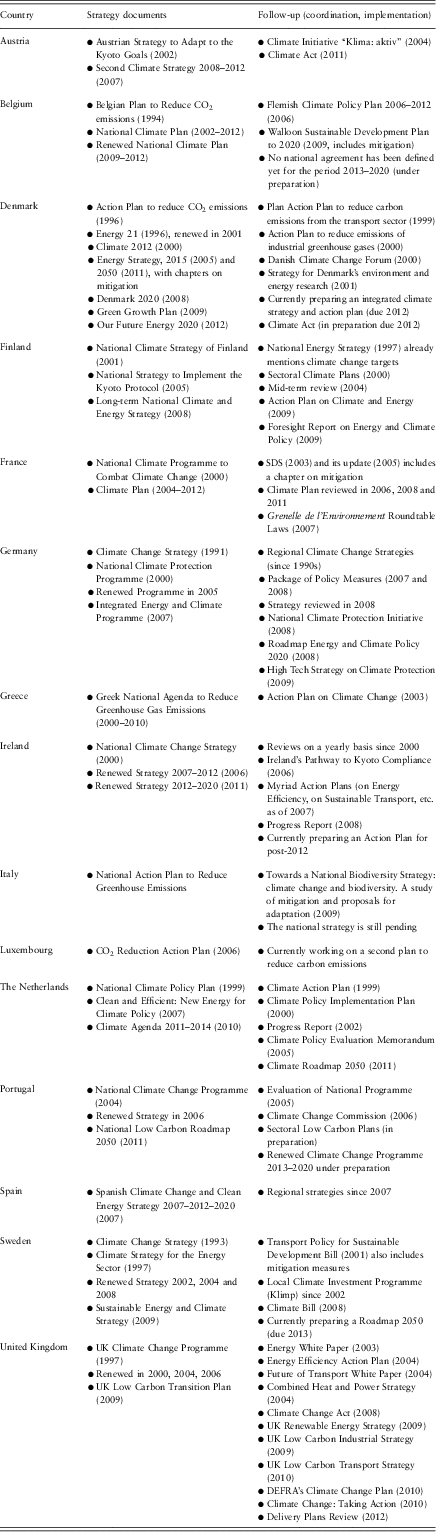
One of the commitments of the UN Framework Convention on Climate Change from 1992 reads as follows: “All Parties, taking into account their common but differentiated responsibilities and their specific national and regional development priorities, objectives and circumstances, shall […] [f]ormulate, implement, publish and regularly update national and, where appropriate, regional programmes containing measures to mitigate climate change and measures to facilitate adequate adaptation to climate change” (United Nations 1992, 5; reiterated in the Kyoto Protocol from 1998; see United Nations 1998, Article 10). While adaptation entered political agendas in Europe only from the mid-2000s onwards (see the Climate change adaptation strategies section), most of the EU-15 states formulated national climate change mitigation programmes in the course of the 1990s, and a few laggards followed in the 2000s. Other important triggers for their development were also EU policies and international accounting and reporting obligations (Gupta Reference Gupta2010, 640; Ellis et al. Reference Ellis, Moarif and Briner2010, 12). More recently, some governments have shifted their focus towards integrated climate and energy strategies (see Table 2 for an overview and Appendix 2 for further details).
Diffusion triggers and prevalence of NMS in the EU-15
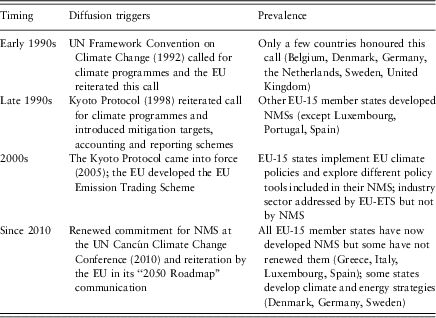
Note: ETS = Emissions Trading Scheme; NMS = national mitigation strategies.
Source: Own illustration based on European Council (1990, 1993), Wurzel (Reference Wurzel2008), Beck et al. (Reference Beck, Kuhlicke and Görg2009), Dolsak (Reference Dolsak2009), European Commission (2011).
Most countries explicitly consider the strategies useful to fulfil international and EU mitigation obligations (Austria, Finland, Spain). In some cases, NMS should promote leadership and reap first-mover benefits in the transition towards a low-carbon economy (Denmark, Germany, Sweden, United Kingdom). In addition, energy security/diversity (Finland, Ireland, Sweden, United Kingdom), sustainable energy generation (France, Spain, United Kingdom) and decoupling economic growth from emissions (Austria, Belgium, Finland, Germany, Ireland) motivate the development of NMS. Carbon emission targets are stated in all EU-15 NMS, resembling either the EU's burden and effort sharing agreement or more ambitious ones (Denmark, France, Germany, Ireland, Sweden, United Kingdom; Mickwitz et al. Reference Mickwitz, Aix, Beck, Carss, Ferrand, Görg, Jensen, Kivimaa, Kuhlicke, Kuindersma, Máñez, Melanen, Monni, Branth Pedersen, Reinert and van Bommel2009b, 64). Most of these targets cover the middle (2020) and long-term (2050), reflecting EU time horizons.
NMS usually start with a narrative overview of international climate negotiations, EU policies, national positions and historical emission trends. Then, NMS usually explore national policies and impacts under different scenarios. Finally, most NMS provide an account of measures and policies organised around themes/sectors, notably energy, building, transport, waste management, agriculture and forestry. In addition, the policy documents cover cross-sectoral issues such as financial policies, research and development, communication and information. Most strategies rely on a portfolio approach that foresees the adoption of a variety of policy instruments without a particular order (Belgium, France, Ireland, Portugal, Spain). In contrast, others pursue a phased approach that foresees the implementation of policy instrument packages (Denmark, the Netherlands, United Kingdom). Most measures are accompanied by an estimate of carbon emission reductions, their economic impact, sectoral and regional responsibilities, a time frame and a set of monitoring indicators. In addition, NMS address flexible mechanisms to offset emissions abroad.
With the exception of three Scandinavian countries (where climate ministries lead), environmental ministries steer the formulation of NMS. The strategies are usually approved by a National Council/Commission on Climate Change (affiliated with the environmental ministry), or, in rare cases, by parliament (Finland, United Kingdom). Since NMS serve mainly the horizontal integration of climate policies, other ministries are involved during both the formulation and the implementation phases. While some countries have established new inter-ministerial arrangements for this purpose (Belgium, Denmark, Finland, Germany, Ireland), others rely on existing arrangements (Sweden, United Kingdom) or are silent on this issue (Greece, Italy, Luxembourg). Like SDS, NMS are less explicit on vertical integration. While some countries involve regional representatives in the implementation and/or the review of their strategies (Germany, Ireland, the Netherlands, Spain), only few explicitly allocate responsibilities to different government levels (Belgium, France). Most governments also involve non-state stakeholders (Simeonova and Diez-Bone Reference Simeonova and Diaz-Bone2005, 2551), for example, through a council or forum (Austria, Denmark).
While NMS were triggered by the UNFCCC and by international reporting requirements, reporting on NMS themselves is not required. Nevertheless, most countries address them in their Progress Reports and National Communications under the UNFCCC as evidence for domestic mitigation action (Ellis et al. Reference Ellis, Moarif and Briner2010). In addition, most EU-15 countries monitor their NMS continuously with indicators and evaluate them regularly (often internally). Only in a few countries does parliament play a role in reviewing implementation (Sweden, United Kingdom).
Overall, Western European countries have embraced the use of NMS as cyclical governing processes that are packed with policies and measures for a large number of sectors and supported by various governance arrangements. Taken at face value, they promise significant cuts in carbon emissions.
Performance
Since NMS did not emerge as organised and visible as other integrated strategies, comparatively few scientific works have assessed their performance (Simeonova and Diaz-Bone Reference Simeonova and Diaz-Bone2005; Kerr Reference Kerr2007; Beck et al. Reference Beck, Kuhlicke and Görg2009; Mickwitz et al. Reference Mickwitz, Kivimaa, Hildén, Estlander and Melanen2009a, Reference Mickwitz, Aix, Beck, Carss, Ferrand, Görg, Jensen, Kivimaa, Kuhlicke, Kuindersma, Máñez, Melanen, Monni, Branth Pedersen, Reinert and van Bommel2009b). More frequent are internal reviews that tend to be partial (focusing on a particular sector) and uncritical (Hulme et al. Reference Hulme, Neufeldt, Colyer and Ritchie2009, 20). Hence, this section can address only selected key issues.
First, although some countries have made significant progress in integrating climate mitigation in other sectors (such as energy and housing), it is not always clear how important NMS were in this development. Furthermore, sectoral incoherences are still the norm in most countries (OECD 2007). Interactions between policies and sectors are either not well understood or managed (Hood Reference Hood2011, 15), or incoherences exist due to political conflicts or ignorance within governments (Höhne et al. Reference Höhne, Burck, Eisbrenner, Vieweg and Grießhaber2009, 5; Mickwitz et al. Reference Mickwitz, Aix, Beck, Carss, Ferrand, Görg, Jensen, Kivimaa, Kuhlicke, Kuindersma, Máñez, Melanen, Monni, Branth Pedersen, Reinert and van Bommel2009b). The following examples illustrate these points. Although the UK government aims to become a leader in climate policy and puts strong emphasis on its NMS, the implementation of legally-binding carbon budgets failed, inter alia, due to political conflicts between departments and poor policy design. In Finland, conflicts between the environment and transport ministries resulted in the exit of the latter from the NMS process. In Germany and Spain, coal subsidies will be maintained until 2018 despite contradicting their climate policies (UNDP 2007, 128).Footnote 1 Second, NMS are even weaker with regard to vertical integration. They link national climate policies to the international and European levels through reporting, but they are generally silent on how to involve sub-national actors, even in federal settings. Since, for example, the Austrian NMS has weak linkages to the regions, progress in integrating climate change mitigation in building policies (a policy field with key competencies at the Laender level) was not due to the NMS but to EU policies (Steurer & Clar, Reference Steurer and Clarforthcoming).
Third, although reporting is a key task of NMS, it is often patchy, inaccurate and/or outdated (Mickwitz et al. Reference Mickwitz, Aix, Beck, Carss, Ferrand, Görg, Jensen, Kivimaa, Kuhlicke, Kuindersma, Máñez, Melanen, Monni, Branth Pedersen, Reinert and van Bommel2009b, 78; Ellis et al. Reference Ellis, Moarif and Briner2010, 10). A frequent inacurracy is that governments make inflated claims about the links between strategies, measures and policies on the one hand, and emission trends and scenarios on the other hand (Kerr Reference Kerr2007). Clearly, flawed reports make it difficult to improve NMS and their implementation iteratively.
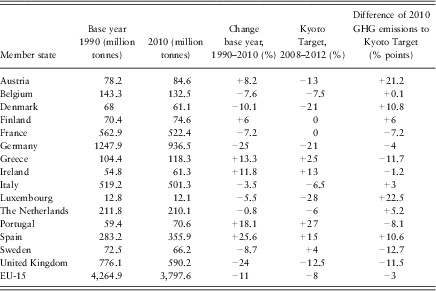
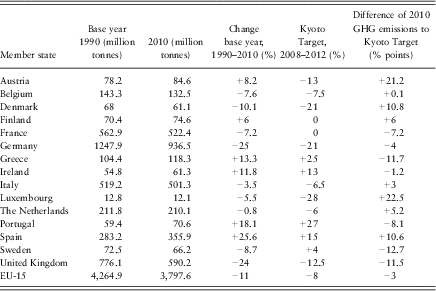
Although NMS made the wide and abstract mitigation policy field more tangible, most of them failed to become an effective governing process. NMS are bold in setting general aspirational targets for the distant future (2020 or 2050) and in listing policy options, but are weak in devising sectoral implementation mechanisms (UNDP 2007, 118, 131; Beck et al. Reference Beck, Kuhlicke and Görg2009, 30). They emphasise their cyclical character, but instead of revising policies in a timely manner once failure is imminent, they tend towards “greenwashing” government policies (Hale Reference Hale2008, 5; Compston Reference Compston2009, 660; de Serres et al. Reference de Serres, Llew-ellyn and Llewellyn2011, 11). As monitoring data highlight, NMS have generally been spurious in mitigating greenhouse gas emissions: while the EU as a whole and a number of countries (France, Germany, Greece, Ireland, Portugal, Sweden, United Kingdom) outperformed their Kyoto targets, several others did not reach them domestically (Austria, Belgium, Denmark, Finland, Italy, Luxembourg, the Netherlands, Spain; for further details see Apendix 3). As Kerr (Reference Kerr2007, 425) shows, emissions reductions seem unrelated to NMS but rather result from “serendipity”. Serendipity materialises in economic downturns (Greece, Spain, Portugal), energy mix shifts, for example, from coal to natural gas (Finland, France, United Kingdom; UNDP 2007, 119), geo-political developments (such as the German “wall-fall effect”; Simeonova and Diaz-Bone Reference Simeonova and Diaz-Bone2005, 2540; Beck et al. Reference Beck, Kuhlicke and Görg2009, 25), weather patterns and world market fuel prices. Neither of these developments nor most other major policy changes (such as the promotion of renewable energy) can be traced back to NMS. Obviously, NMS were not able to bring laggards onto their Kyoto path and seemed to play, at best, marginal roles among outperformers.
Climate change adaptation strategies
Policy rationale
National adaptation strategies (NAS) became standard tools across Western Europe in recent years alongside SDS and NMS (Hanger et al. Reference Hanger, Pfenninger and Dreyfus2010, 8; Rayner and Jordan Reference Rayner and Jordan2010, 148; Dumollard and Leseur Reference Dumollard and Leseur2011, 13). NAS build upon the guidelines issued by various organisations, with the UNDP being especially influential (UNDP 2003, 17; see also Lim and Spanger-Siegfried Reference Lim and Spanger-Siegfried2004). These guidelines were originally conceived for developing countries but later were also adopted by the OECD (2009), the EEA (2007, 19) and the EU (European Commission 2009). Summarising the main points promoted by these organisations, NAS should (1) derive a set of adaptation actions based on assessments addressing vulnerabilities, risks and opportunities in the short- and long term across regions and key sectors; (2) evaluate, prioritise and select various adaptation options based on the precautionary principle by using multiple information sources, criteria and methods (including scenarios); (3) specify responsibilities and the financial and operational resources allocated to implementing the strategy; (4) seek coherence with EU, national and sectoral policies to avoid “maladaptation” (Mickwitz et al. Reference Mickwitz, Aix, Beck, Carss, Ferrand, Görg, Jensen, Kivimaa, Kuhlicke, Kuindersma, Máñez, Melanen, Monni, Branth Pedersen, Reinert and van Bommel2009b, 19); (5) identify and involve key stakeholders; (6) take the implementation process into account early on and design it flexibly to adjust for “climate surprises”; (7) define targets and indicators to simplify monitoring and reviewing the strategy; and (8) secure strong institutional and political support, for example, by engaging prime minister's offices, various ministries and parliaments (Mickwitz et al. Reference Mickwitz, Aix, Beck, Carss, Ferrand, Görg, Jensen, Kivimaa, Kuhlicke, Kuindersma, Máñez, Melanen, Monni, Branth Pedersen, Reinert and van Bommel2009b, 23; Smith et al. Reference Smith, Vogel and Cromwell2009, 54). The OECD (2009, 56) adds that NAS should (9) build upon a variety of measures (stand-alone and policy mixes) that are cost-effective, efficient, legitimate and equitable (de França-Doria et al. Reference de França-Doria, Boyd, Tompkins and Adger2009); (10) re-organise government structures and adjust legal and regulatory frameworks to better address adaptation; (11) improve access to national-level climate information and raise awareness and preparedness (Smith et al. Reference Smith, Vogel and Cromwell2009); and, (12) incorporate adaptation in existing planning instruments such as environmental impact assessments. Similar to SDS, the normative foundation of NAS is obviously strong.
Prevalence and characteristics
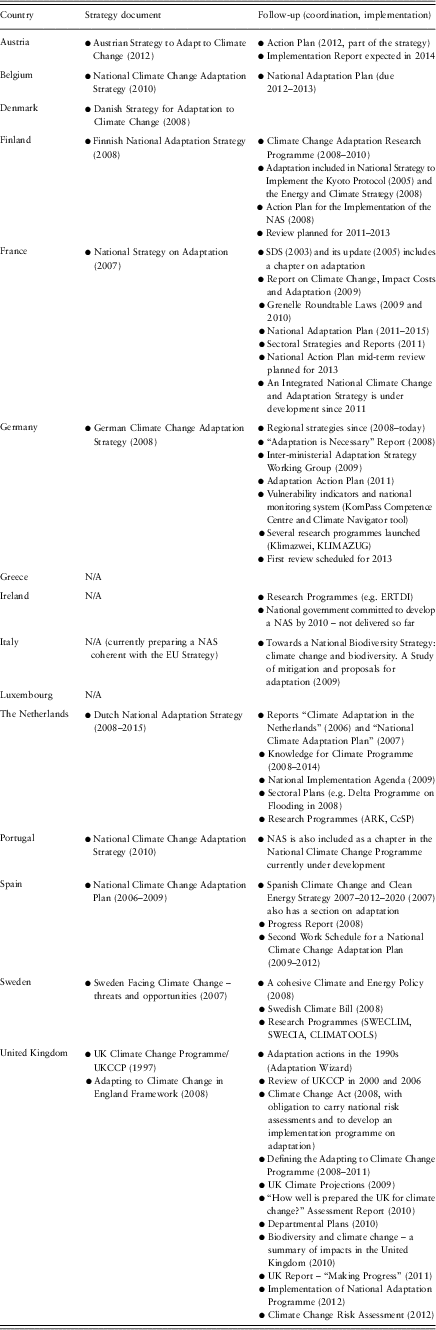
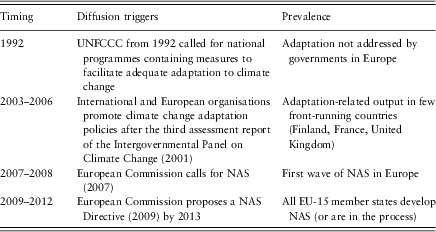
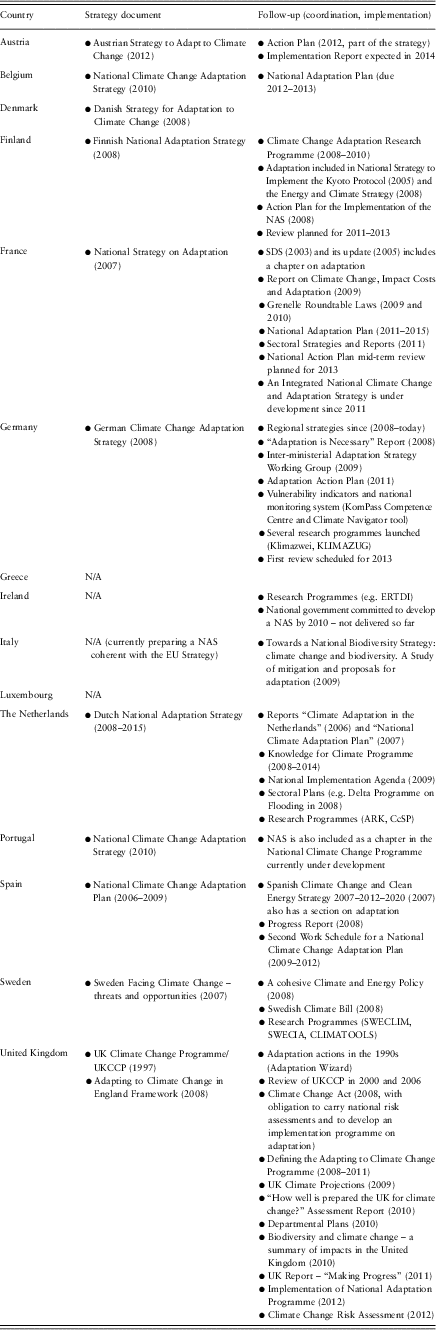
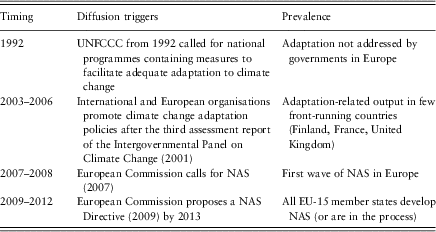
Although Article 4 of the UNFCCC from 1992 required all parties to adopt national programmes that contain measures to mitigate climate change and “to facilitate adequate adaptation” (United Nations 1992, 5; for a longer quote see the Climate change mitigation strategies section), the first mitigation strategies were silent on adaptation (at least in Europe), and NAS did not emerge until the mid-2000s (Swart et al. Reference Swart, Biesbroek, Binnerup, Carter, Cowan, Henrichs, Loquen, Mela, Morecroft, Reese and Rey2009, 44). On the one hand, this reflects that the international community could not agree on how to pursue adaptation for many years (Europe in particular feared that adaptation efforts could weaken mitigation efforts) (de França-Doria et al. Reference de França-Doria, Boyd, Tompkins and Adger2009, 810; Rayner and Jordan Reference Rayner and Jordan2010). On the other hand, it also shows that adaptation was widely perceived as a policy issue best handled at sub-national levels (Mickwitz et al. Reference Mickwitz, Aix, Beck, Carss, Ferrand, Görg, Jensen, Kivimaa, Kuhlicke, Kuindersma, Máñez, Melanen, Monni, Branth Pedersen, Reinert and van Bommel2009b, 37; Preston et al. Reference Preston, Westaway and Yuen2011, 427). Currently, the EU-15 are at different stages of formulating or implementing their NAS (see Table 3 for a summary and Appendix 4 for further details).
Usually, NAS are developed and coordinated by environmental ministries, sometimes in close cooperation with environmental agencies and scientists (Bauer et al. Reference Bauer, Feichtinger and Steurer2012). Most NAS were adopted at the highest governmental level (Cabinet) and sometimes also discussed in parliament (Swart et al. Reference Swart, Biesbroek, Binnerup, Carter, Cowan, Henrichs, Loquen, Mela, Morecroft, Reese and Rey2009, 127). Looking at their contents, NAS usually refer to climate change as a threat that requires a strategy to overcome vulnerabilities and strengthen resilience. Some also refer to the benefits and opportunities of climate change (Belgium, Denmark, Finland, Germany, Sweden). NAS usually build upon simulations and projections of key climate indicators (e.g. rainfall or temperature averages) for various scenarios. In addition, some NAS link scenarios to EU targets (Denmark) or detailed socio-economic (Finland), environmental (Sweden) or sectoral analyses (Austria, Finland, France, Portugal). Adaptation measures are perceived as inherently uncertain in all strategies, but only a few face this challenge head-on (e.g. by using probabilities in Germany) or indirectly (e.g. by focusing on no-regret or win-win measures in Austria, Belgium, Denmark, France, Germany). This explains why virtually all NAS emphasise the need for further research to better understand and tackle adaptation. Some scholars even frame NAS as “research roadmaps” (Hanger et al. Reference Hanger, Pfenninger and Dreyfus2010, 7) that provide guidance for future scientific action (Belgium, Finland, France, Spain). Other strategies (Austria, Germany, Sweden) attempt to balance scientific needs with political action.
Adaptation strategies include a mix of policies and measures that are supposed to reduce a country's vulnerability to climate change (Termeer et al. Reference Termeer, Biesbroek and van der Brink2009, 8; Biesbroek et al. Reference Biesbroek, Swart, Carter, Cowan, Henrichs, Mela, Morecroft and Rey2010, 441). Most of the measures listed in NAS concern raising awareness and are short term and reactive rather than long term and anticipatory. The sectors or cross-sectoral challenges usually covered in NAS are water, coastal zone and land management, biodiversity, health, forestry, agriculture, energy and tourism (Massey and Bergsma Reference Massey and Bergsma2008, 27; Dumollard and Leseur Reference Dumollard and Leseur2011, 7). In sum, water and respective problems (i.e. flooding, drought, receding snow lines, etc.) represent one of the key themes that touch on many sectors.
Despite having a broad cross-sectoral focus, NAS are not always explicit about how to achieve horizontal integration (Hanger et al. Reference Hanger, Pfenninger and Dreyfus2010, 5). In some cases, integration is facilitated with cross-sectoral goals and priorities that are delegated to ministries (Finland), often without explicitly mentioning their responsibilities and tasks (Swart et al. Reference Swart, Biesbroek, Binnerup, Carter, Cowan, Henrichs, Loquen, Mela, Morecroft, Reese and Rey2009, 35; Dumollard and Leseur Reference Dumollard and Leseur2011). In other cases, strategies resort to coordination bodies at technical, administrative and political levels to undertake this task. They rely on expert advice on how to operationalise and implement adaptation measures. Integration is also pursued by including adaptation in existing assessment or planning instruments (Germany).
Although most NAS emphasise the importance of local and regional adaptation policies, sub-national actors tend to be involved early in the process only in federal states such as Austria, Belgium, Germany or Spain (Hanger et al. Reference Hanger, Pfenninger and Dreyfus2010; Dumollard and Leseur Reference Dumollard and Leseur2011, 11; Bauer et al. Reference Bauer, Feichtinger and Steurer2012). The Belgian strategy constitutes the only NAS that were developed bottom-up by the federal and regional governments jointly. Some other strategies address vertical integration in the implementation phase through a detailed breakdown of roles and responsibilities across levels of government (Sweden) or with communication and capacity-building actions targeting particular communities (Denmark).
Even though NAS call for the involvement of non-state actors and aim to build adaptive capacities among them (Austria, France, Spain; Swart et al. Reference Swart, Biesbroek, Binnerup, Carter, Cowan, Henrichs, Loquen, Mela, Morecroft, Reese and Rey2009, 121; Hanger et al. Reference Hanger, Pfenninger and Dreyfus2010, 5; Dumollard and Leseur Reference Dumollard and Leseur2011, 6; Bauer et al. Reference Bauer, Feichtinger and Steurer2012), those involved in the formulation of NAS were often confined to small circles of NGOs and scientists (Swart et al. Reference Swart, Biesbroek, Binnerup, Carter, Cowan, Henrichs, Loquen, Mela, Morecroft, Reese and Rey2009; Dumollard and Leseur Reference Dumollard and Leseur2011, 8).
With regard to monitoring, measurable objectives and indicators are included only in a few NAS (Finland, Sweden), while most others are still developing their monitoring schemes (Swart et al. Reference Swart, Biesbroek, Binnerup, Carter, Cowan, Henrichs, Loquen, Mela, Morecroft, Reese and Rey2009). Some NAS rely also on regional reporting (Belgium, France; Swart et al. Reference Swart, Biesbroek, Binnerup, Carter, Cowan, Henrichs, Loquen, Mela, Morecroft, Reese and Rey2009, 153). So far, only the Finnish NAS has been reviewed internally (see below).
To conclude, many NAS reflect some of the guidelines summarised earlier – at least on paper. They, for example, refer to vulnerabilities, risks and opportunities across regions and key sectors, and they discuss uncertainty. In many cases, strategies have led to the development of further policy documents (such as regional and sectoral strategies or national action plans) and research programmes. Notwithstanding these advances, the performance of NAS runs the risk of following the fates of other integrated strategies once they mature.
Performance
Since NAS are by far the youngest integrated strategies reviewed here, official reviews and reliable performance assessments are still rare (e.g. Ministry of Agriculture and Forestry 2009). Nevertheless, numerous adaptation scholars already see enough evidence for critical assessments. The most significant point of critique is that most NAS focus on awareness raising and communication instead of effectively coordinating and implementing anticipatory adaptation policies across sectors and levels (Massey and Bergsma Reference Massey and Bergsma2008; Mickwitz et al. Reference Mickwitz, Aix, Beck, Carss, Ferrand, Görg, Jensen, Kivimaa, Kuhlicke, Kuindersma, Máñez, Melanen, Monni, Branth Pedersen, Reinert and van Bommel2009b, 59; Swart et al. Reference Swart, Biesbroek, Binnerup, Carter, Cowan, Henrichs, Loquen, Mela, Morecroft, Reese and Rey2009; Termeer et al. Reference Termeer, Biesbroek and van der Brink2009; Biesbroek et al. Reference Biesbroek, Swart, Carter, Cowan, Henrichs, Mela, Morecroft and Rey2010; Hanger et al. Reference Hanger, Pfenninger and Dreyfus2010; Dumollard and Leseur Reference Dumollard and Leseur2011; Preston et al. Reference Preston, Westaway and Yuen2011). Although NAS reflect on adaptation in various sectors and often foresee inter-departmental coordination, the concern for adaptation is often still weak in non-environmental departments (Dumollard and Leseur Reference Dumollard and Leseur2011, 18), inter alia, because the political relevance of the inter-departmental bodies linked to NAS is limited (for Austria, see Hanger et al. Reference Hanger, Pfenninger and Dreyfus2010, 6).
The performance of NAS with respect to vertical integration is also regarded as weak (Swart et al. Reference Swart, Biesbroek, Binnerup, Carter, Cowan, Henrichs, Loquen, Mela, Morecroft, Reese and Rey2009; Biesbroek et al. Reference Biesbroek, Swart, Carter, Cowan, Henrichs, Mela, Morecroft and Rey2010; Hanger et al. Reference Hanger, Pfenninger and Dreyfus2010, 7; Pfenninger et al. Reference Pfenninger, Hanger, Dreyfus, Dubel, Hernández-Mora, Esteve, Varela-Ortega, Watkiss and Patt2010). Barriers identified in this context are the lack of communication, transparency and coordination across levels of government (Portugal) and unclear (often shared) responsibilities (France, Portugal). Other barriers (an important research agenda in the context of adaptation) are political short termism (Ford et al. Reference Ford, Berrang-Ford and Paterson2011, 333) and the lack of high-level political commitment (Austria, Greece, Ireland, Italy) and adequate resources (Hanger et al. Reference Hanger, Pfenninger and Dreyfus2010, 1; Bauer et al. Reference Bauer, Feichtinger and Steurer2012; Clar et al. Reference Clar, Prutsch and Steurer2013).
Despite tackling a “burning issue” (Gupta Reference Gupta2010, 647), the performance of relatively young NAS looms as another disappointment, similar to those described above for SDS and NMS – at least if one expected them to integrate adaptation horizontally across sectors and vertically across levels of government. While many NAS are de facto “one-off” documents with little implementation clout (Mickwitz et al. Reference Mickwitz, Aix, Beck, Carss, Ferrand, Görg, Jensen, Kivimaa, Kuhlicke, Kuindersma, Máñez, Melanen, Monni, Branth Pedersen, Reinert and van Bommel2009b; Swart et al. Reference Swart, Biesbroek, Binnerup, Carter, Cowan, Henrichs, Loquen, Mela, Morecroft, Reese and Rey2009, 166), most of them focus mainly on research, awareness raising and communication.
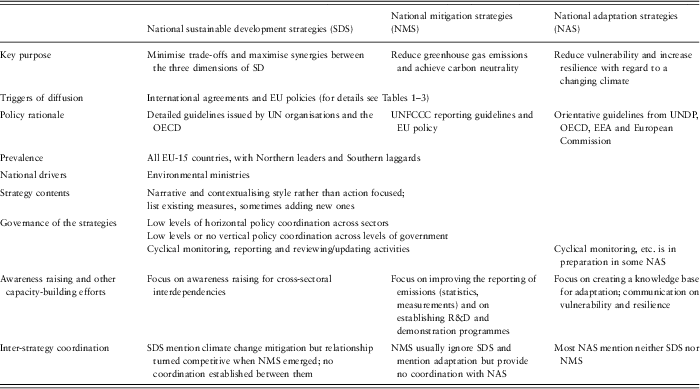
Similarities, differences and linkages
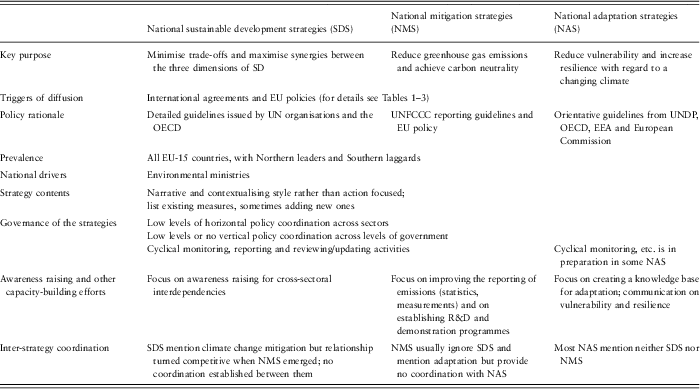
Based on the reviews provided above, we now compare the three thematically related, integrated strategies and explore in how far they are linked to each other (see Table 4 for a summary). Looking at their prevalence, a group of Northern European leaders adopted integrated strategies on all three issues early on, while a group of Southern European laggards usually followed several years later. The same pattern can be observed for reviewing and revising integrated strategies: while some Northern European countries have their fourth generation of SDS in place, some southern member states did not go beyond their first generation. Thematically, it appears that, in all countries, momentum has shifted from SD in the early 2000s to climate change mitigation in the late 2000s, and finally to adaptation around 2010. In addition, early mitigation strategies are now being replaced by climate and energy strategies. Although international agreements played a key role in the diffusion of integrated strategies on SD and climate change mitigation, EU policies were decisive factors in all three policy domains, in particular in climate change adaptation.
Integrated strategies in comparison
Source: Own illustration.
Despite idiosyncratic differences with regard to the problems tackled, the basic rationales of all three integrated strategies resemble the ideal-typical characteristics of adaptive strategies, conceptualised as “living documents” that emphasise cyclical governing processes (including regular feedback and revision) and capacity building efforts, with the ultimate goal to provide direction in terms of what to achieve and how. Regarding the how, integrated strategies are expected to effectively orchestrate (or meta-govern) the roles that state and non-state actors (ought to) play and the policy instruments to be used. Obviously, guidelines and scholarly research both reflect essential parts of a widely shared consensus on contemporary strategising in the public sector that emerged from decades of strategic management research (Steurer and Martinuzzi Reference Steurer and Martinuzzi2005; Mulgan Reference Mulgan2009).
While the ideal-type characteristics of integrated strategies remain visible throughout the empirical parts of the paper, respective shortcomings are also all too obvious, in particular for older SDS and NMS. First, the integrated strategies reviewed here are all grand programmes with many (sometimes too many) largely vague goals and plenty of contextual information. In addition, the strategies (or their follow-up documents) provide details on measures and policy instruments, existing or planned. However, few of these measures ended up being implemented, and when they were, critics questioned their effectiveness, because implementation often suffered from inadequate policy designs, insufficient resources and/or meagre political support. Second, most of the three integrated strategies constitute cyclical governing processes that are mainly driven by environmental ministries. However, since these ministries suffer from a relatively weak governmental standing, their efforts to involve other ministries rarely resulted in durable collaboration or coordination, and if they did, respective interactions were politically rather insignificant. Consequently, major policy changes (such as pension scheme reforms relevant for SDS or energy transitions relevant for SDS and NMS) did not occur because of, but in parallel to, integrated strategies. Third, the integrated strategies themselves represent awareness raising and capacity building rather than policy coordination efforts, inter alia, by providing policy directions and by facilitating learning via cyclical feedback. In addition, they trigger a number of informational policies and small-scale (lighthouse) projects that aim to raise awareness for particular issues among policymakers and the public. Apart from these general achievements, SDS seem to focus on awareness raising for cross-sectoral interdependencies, NMS are closely affiliated with greenhouse gas inventory reporting, and NAS have a clear emphasis on building the knowledge base for adaptation.
Although environmental governance scholars (Berger et al. Reference Berger, Hametner and Steurer2007; Wilbanks and Sathaye Reference Wilbanks and Sathaye2007; Wilbanks et al. Reference Wilbanks, Leiby, Perlack, Ensminger and Wright2007), IPCC authors (IPCC 2003; Klein et al. Reference Klein, Huq, Denton, Downing, Richels, Robinson and Toth2007; Yohe et al. Reference Yohe, Lasco, Ahmad, Arnell, Cohen, Hope, Janetos and Perez2007) and policymakers (e.g. those who authored the NMS of Finland, Ireland and the United Kingdom) emphasise the necessity to better link the three thematically related integrated strategies, they are rarely coordinated with each other. Since many SDS devote entire sections to climate change mitigation (Berger et al. Reference Berger, Hametner and Steurer2007), the relationship between SDS and NMS is rather competitive than collaborative in most countries. As Steurer and Berger (Reference Steurer and Berger2011, 105) note for the peak of the climate change discourse in 2007–2008, those responsible for SDS were “concerned about the dominance of climate change issues and the direct linkages that were established between climate and economic policies […] without their involvement. This concern is obviously not about the substance of SD but about the marginalised role SDS play across Europe”. Likewise, linkages between SDS and NMS on the one hand and NAS on the other are also weak (UNDP 2007), although adaptation was initially incorporated into many NMS. Only recently, some states have started exploring integrated climate strategies addressing mitigation and adaptation jointly (Austria, France, Portugal). In short, although a key purpose of integrated strategies is to facilitate the horizontal integration of various sectoral policies, the actors mainly responsible for them relapse to the same turf-defending rationale that policymakers often show as a reflex when confronted with claims for policy integration (Mulgan Reference Mulgan2009, 182–196).
Concluding discussion
This paper analysed how governments in Western Europe orchestrate their policies on sustainable development, climate change mitigation and adaptation by means of integrated strategies. It has shown that the scholarly literature and practical guidance issued by international organisations envision integrated strategies not primarily as policy documents but rather as cyclical governing processes and capacity building efforts, all three aiming to better coordinate sectoral policies. As we have shown, most strategies go beyond being mere policy documents that provide guidance, which we acknowledge as progress compared to the one-off environmental planning of the 1970s and 1980s. However, while their capacity building and communication efforts are difficult to assess and require the study of public discourses, it is clear that they usually fail as integrative governing processes. The integrated strategies reviewed here have proved to be comparatively weak administrative routines (or informational policy instruments) and preoccupied with low-key communication rather than high-profile policy coordination. Consequently, they are usually not capable of implementing the policies necessary to meet the targets they specify.
Even though integrated strategies are a relatively novel instrument to govern complex policy areas, they perpetuate many of the dilemmas raised by the implementation literature for decades (see, e.g. Moran et al. Reference Moran, Rein and Goodin2006; Mulgan Reference Mulgan2009). Like environmental policies in general, integrated strategies also remain constrained by three sets of variables. First, despite their win-win rhetoric, the economy–environment axis usually ranks the environment second, in particular when global economic competitiveness is at stake. Second, integrated strategies were not able to change the fact that policymaking remains compartmentalised and the actors involved continue to think along sectoral and regional lines. Finally, institutional, social and cultural factors (including path dependency and inertia) continue to thwart timely and adequate implementation. When viewed from the implementation literature, integrated strategies remind us of “new skins for tainted wine”. Unfortunately, the “new skins” themselves have several design flaws that reinforce these dilemmas. Above all, most integrated strategies lack a clear prioritisation of what to do, because they aim to be as comprehensive as possible, have failed to engage adequately with economic realities and failed to secure high-level political commitment and adequate resources. According to Mulgan (Reference Mulgan2009), every single one of these factors is crucial for strategies to be successful.
Two puzzling questions remain in this concluding discussion. First, why do most governments continue to update already existing integrated strategies or adopt new ones on new topics given that the instrument has failed in better coordinating and integrating policies? Second, what alternatives do governments have to the status quo of piling one integrated strategy on top of another and not caring enough about their implementation? We address these puzzles with knowledge-based speculations.
Regarding the first question, integrated strategies are still attractive for governments, because they cost almost nothing (except for the work time of public administrators and stakeholders involved) while fulfilling purposes other than policy coordination. By adopting integrated strategies, governments can meet international obligations, develop a “walking aid” that helps them to make the first steps in new cross-sectoral policy domains, pretend activity and commitment for a while (in particular when cyclical actions are foreseen) and have a communication tool at hand that helps to outline a vision for society in general and for the public sector in particular. Thus, integrated strategies still exist because they fulfil some functions that go beyond symbolic politics (for a similar conclusion on SDS, see Steurer Reference Steurer2008). Regarding alternatives, policymakers could first try to improve their integrated strategies, either by approximating them to the guidelines described above or to some other ideal-type policymaking approach (such as meta-governance). Obviously, this option requires a strong belief in policymaking as a rational process that aims primarily to solve problems. Second, governments could abandon integrated strategies altogether and return deliberately to disjointed incrementalism, policy layering and policy drift (Steurer and Martinuzzi Reference Steurer and Martinuzzi2005; Howlett and Rayner Reference Howlett and Rayner2006a). Since integrated strategies are more than governing processes, this option implies losing their two other, more appropriate functions that lead us to the third option. Third, governments could recalibrate integrated strategies from coordination to communication instruments, so that they can be more effective in pursuing the functions they are able to fulfil. They could focus on providing direction as a policy document and to build capacities and raise awareness for the problems they cover, for example, by systematically building knowledge bases, educating and training public administrators, informing and convincing the public in general and non-state decision makers in particular. Based on the findings presented here, we recommend the recalibration of integrated strategies towards communication and capacity building instruments. By doing so, public authorities are at least better equipped to affect political and societal action indirectly by shaping the perceptions of complex environmental problems over time (Weingart et al. Reference Weingart, Engels and Pansegrau2000; Sharp and Richardson Reference Sharp and Richardson2001).
Despite our focus on integrated strategies, we finally speculate that none of these three options can replace more focused strategies that embrace sustainable development, climate change mitigation and adaptation issues on a narrower, perhaps sectoral basis. Although narrower integration strategies may have difficulties in overcoming fragmentation (in particular when not backed by comprehensive ones that provide a common roof), they seem to be more fruitful (Adelle and Russel Reference Adelle and Russel2013, 9). For future research, we hypothesise that policy integration is more effective when advocates of a particular issue or problem feed into focused strategies that have clear priorities and that are owned by those who have the responsibilities and the power to implement them. If this hypothesis proved correct, a major design flaws of integrated strategies would be that they aim to facilitate policy integration by “intruding into sectoral territory”, ultimately running against sectoral actors who are eager to defend their power of decision. Since “[t]here is no single formula for organising strategy in public organizations” (Mulgan Reference Mulgan2009, 3), the environmental strategies of the future should be cautious in following global guidance and pursue tailored approaches that mirror the problems they tackle in their national context.
Acknowledgements
We thank the Austrian Climate Research Programme (ACRP) for funding the CLIP-IN project (Project No. K10AC0K00054) that led to this article and three anonymous reviewers as well as the editors from the Journal of Public Policy for their comments and suggestions that helped us to improve it.
Appendix
Overview of national sustainable development strategies in EU-15
Overview of climate change mitigation strategies in EU-15
Greenhouse gas emissions in CO2 equivalents (exclusively LULUCF) and Kyoto targets for 2008–2012 in EU-15
Overview of climate change adaptation strategies in EU-15