Introduction
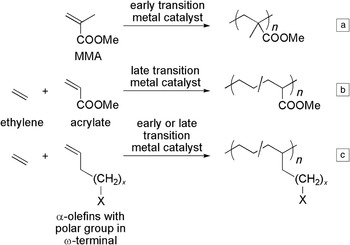
Transition metal-catalyzed homopolymerization of polar vinyl monomers, especially acrylate and methacrylates, has been extensively studied ( Scheme 1 a).Reference Chen 1 , Reference Chen 2 Ziegler-Natta catalysts such as TiCl4/AlR3 (R = alkyl group) have been known to promote polymerization of polar monomers such as methyl methacrylate (MMA). Homogeneous catalysts (catalysts soluble in reaction solvents such as zirconocenes and lanthanocenes) are effective for stereospecific polymerization of methacrylates.Reference Chen 1 , Reference Chen 2 C 2-symmetric zirconocenes (zirconocenes with two-fold symmetry) and C s-symmetric zirconocenes (zirconocenes with a plane of symmetry) bring about isospecific (the ester side chains are located on the same side of the macromolecular backbone) and syndiospecific (the ester side chains are located on alternating sides along the macromolecular backbone) polymerization of MMA, respectively.
(a) Polymerization and (b) copolymerization of polar vinyl monomers. (c) Copolymerization of α-olefins with polar groups. Note: Me, methyl; X, polar functional group; x, 1–8; n, degree of polymerization; MMA, methyl methacrylate.

Because the early transition metal catalysts show catalytic activity for polymerization of both ethylene or α-olefin and MMA, one would expect that the polymerization of ethylene or α-olefin in the presence of MMA by the catalysts would afford the polymer containing the repeat units from both monomers (copolymerization). Polyethylene or polyolefins having polar functional groups have been known to show improved adhesionability, dyeability, and compatibility. Compared to the homopolymerization of polar vinyl monomers, however, copolymerization of the polar vinyl monomers with ethylene or α-olefins is more challenging and less explored (Scheme 1b).Reference Boffa and Novak 3 – Reference Nakamura, Ito and Nozaki 7 One of the reasons for the difficulty in the copolymerization is that the early transition metal, the active center of the catalyst, tends to form a strong bond with the oxygen atom (oxophilic character). The addition of polar vinyl monomers often retards the smooth reaction of ethylene and α-olefins. Another reason is the difference in active species of the polymerization: Polymerization of ethylene and α-olefins proceeds via metal-alkyl species, whereas the polymerization of acrylates and methacrylates generally proceeds via metal-enolate species. Metal-alkyl species often allow insertion of acrylates and methacrylates, but insertion of ethylene and α-olefins to metal-enolate is generally much more difficult. The polymerization by less oxophilic late transition metal catalysts, especially Pd catalysts, enables copolymerization of those monomers.
α-Olefins with a polar functional group in the ω-terminal have been frequently utilized as the comonomer for copolymerization with ethylene or other α-olefins (Scheme 1c).Reference Boffa and Novak 3 , Reference Yanjarappa and Sivaram 4 They do not retard the smooth chain growth, and the polar functional group of the monomer is incorporated on the terminal of the side chains in the produced copolymer. Allyl monomers such as allyl alcohol and allyl halides are also attractive monomers for transition metal-catalyzed polymerization and copolymerization. Copolymerization of ethylene or α-olefins with allyl monomers would afford the copolymer having the functional group in close proximity to the polymer main chain, compared to the copolymer with the monomers having longer spacers between the vinyl group and polar functional group. Abundant availability of the allyl monomers is also attractive, and they can also be transformed to other functionalized monomers via various allylation reactions such as the Tsuji-Trost reaction (Pd-catalyzed allylation of nucleophiles)Reference Tsuji 8 and Hosomi-Sakurai allylation (Lewis acid-promoted allylation of electrophiles by allylsilanes).9 Although many allyl monomers are commercially available or easily synthesized, they have not attracted much attention. One of the reasons is the difficulty in obtaining high molecular weight polymers due to suppressed chain growth after the reaction of allyl monomers, such as coordination of the polar groups to the metal center to form chelate structure or formation of stable π-allyl species (vide infra), which do not allow further reaction of the monomer. However, recent progress in transition metal catalysis allows efficient incorporation of the polar allyl monomers, affording a high mass polymer with the polar functional groups.
There are excellent reviews on homopolymerization of acrylates and methacrylates as well as copolymerization of polar monomers with ethylene and α-olefins.Reference Chen 1 – Reference Nakamura, Ito and Nozaki 7 This review covers recent progress in polymerization and copolymerization of polar allyl and diallyl monomers catalyzed by homogeneous Ziegler-Natta catalysts.
Copolymerization of allyl monomers with ethylene
Zirconocene-catalyzed polymerization
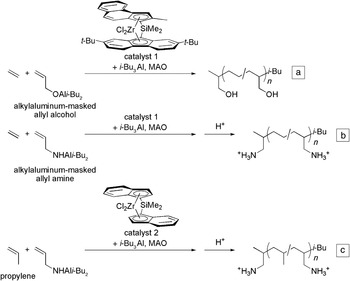
Copolymerization of propylene with allyl alcohol was first reported using TiCl3/ethyl aluminum sesquichloride.Reference Arit, Binsack, Grogo and Neuray 10 However, the catalytic activity and the incorporation of the allyl alcohol in the copolymer were very low. Recent research has aimed to obtain a copolymer with increased incorporation of the polar allyl monomers. Imuta reported that a zirconocene catalyst with large substituents (catalyst 1, Scheme 2 a) promotes copolymerization of ethylene with alkylaluminum masked allyl alcohol (Scheme 2a).Reference Imuta, Kashiwa and Toda 11 , Reference Kashiwa, Matsugi, Kojoh, Kaneko, Kawahara, Matsuo, Nobori and Imuta 12 When i-Bu3Al (triisobutyl aluminum) is used, the produced copolymer contains hydroxymethyl groups on both side chains as well as the terminating end. The presence of the hydroxymethyl group on the terminal of the polymer indicates predominant chain transfer to alkylaluminum attached to the hydroxymethyl group. The use of Me3Al (trimethyl aluminum) or Et3Al (triethyl aluminum) results in the incorporation of the hydroxyl group only to the terminal of the polymer. Catalyst 1 is also effective for the copolymerization of ethylene with allyl amine masked with i-Bu3Al. However, the incorporation of the comonomer in the copolymer is low (ca. one aminomethyl side chain and one aminomethyl terminal end in the copolymer) (Scheme 2b).Reference Imuta, Toda, Matsugi, Kaneko, Matsuo, Kojoh and Kashiwa 13
Copolymerization of ethylene with alkylaluminum-masked (a) allyl alcohol and (b) allyl amine. (c) Copolymerization of propylene with alkylaluminum-masked allyl amine. Note: Bu, butyl, t-Bu, tert-butyl; i-Bu, isobutyl; Me, methyl; MAO, methylalumoxane; n, degree of polymerization.11–14

Copolymerization of propylene with alkylaluminum-masked allyl alcohol and allyl amine was also investigated using a metallocene complex (catalyst 2)/methylalumoxane (MAO) catalyst system (Scheme 2c).Reference Hagihara, Tsuchihara, Sugiyama, Takeuchi and Shiono 14 Copolymerization of propylene with alkylaluminum-masked allyl alcohol by the catalyst only results in the copolymer with very low amount of alkylaluminum-masked allyl alcohol (0.04–0.08 mol%). The use of Me3Al-treated allylamine improved the incorporation of the comonomer up to 0.65%, but the aminomethyl group is located only at the chain end. The chain transfer to alkyl aluminum accounts for the formation of aminomethyl-terminated polypropylene. The copolymerization of ethylene with the Me3Al-masked allylamine in the presence of i-Bu3Al, on the other hand, results in the copolymer having aminomethyl groups both on the main chain and at the chain end (0.63 mol%). The microstructure of the polypropylene is highly controlled in isotactic configuration (the methyl substituents are located on the same side of the macromolecular backbone), where the meso pentad (content of the five consecutive repeat units where all the methyl substituents are located on the same side of the macromolecular backbone) = 83.8 mol%).
Pd-catalyzed polymerization
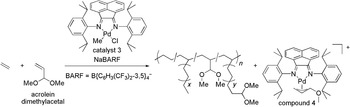
Late transition metal catalysts are less oxophilic and frequently used as the catalyst for copolymerization of ethylene with polar vinyl monomers. A diimine Pd complex (catalyst 3), which is effective for the copolymerization of ethylene with acrylate, promotes copolymerization of ethylene with acrolein dimethylacetal (up to 2.02 mol% incorporation) ( Scheme 3 ).Reference Li, Zhang, Meetsma and Hessen 15 The dimethylacetal moiety is incorporated on a chain/branch end or within a chain/branch. The formation of inactive π-allyl Pd species (compound 4) is also observed (Scheme 3), which indicates that catalyst deactivation takes place to some degree. A significant amount of copolymer forms before the catalyst deactivation via formation of compound 4. The attempted copolymerization of ethylene with allyl ethyl ether, on the contrary, only gives rise to the inactive π-allyl Pd complex without the formation of a copolymer. The Pd complex also brings about copolymerization of ethylene with N-pentenylcarbazole (up to 18.8 wt% incorporation).Reference Li, Zhang, Meetsma and Hessen 16 However, the reaction of ethylene with N-allylcarbazole by the catalyst only results in homopolyethylene. The diimine Pd complex reacts with allyl dimethyl amine and N-allylcarbazole to only afford inactive N-coordinated five-membered and three-membered chelate complex, respectively, which would be the reason for the unsuccessful formation of the copolymer.
Copolymerization of ethylene with acrolein dimethylacetal. Note: Me, methyl; n, degree of polymerization; x and y, positive integer.Reference Li, Zhang, Meetsma and Hessen 15

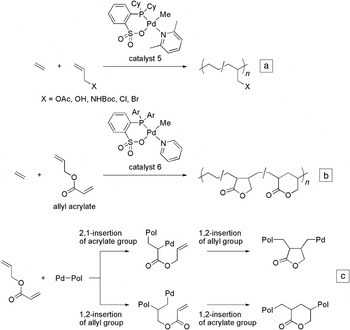
Pd complexes with phosphine-sulfonate ligands (catalyst 5 in Scheme 4 ) have attracted recent attention as catalysts for copolymerization of ethylene with wide varieties of polar vinyl monomers such as acrylates and vinyl acetate.Reference Nakamura, Ito and Nozaki 7 Quite recently, catalyst 5 has been reported to be effective for copolymerization of ethylene with polar allyl monomers, including allyl halide, allyl acetate, and Boc-protected allyl amine (Boc = tert-butoxycarbonyl) (Scheme 4a).Reference Ito, Kanazawa, Munakata, Kuroda, Okumura and Nozaki 17 The acetate group and Boc-NH group of the copolymer can be transformed to hydroxyl and amino groups, respectively. The incorporation of the allyl monomers in the copolymer is in the range of 1–8 mol%. This value is much higher than that obtained by zirconocene-catalyzed copolymerization of ethylene with alkylaluminum-masked allyl amine. Differential scanning calorimetry of the copolymer of ethylene and allyl acetate showed a higher melting point of the copolymer compared to the copolymer of ethylene and vinyl acetate obtained by radical polymerization (the polymerization proceeds via successive addition of a free radical to the monomer).
(a) Copolymerization of ethylene with allyl monomers by Pd complexes. (b) Copolymerization of allyl acrylate with ethylene by phosphine-sulfonate Pd complex. (c) Formation of cyclic repeat units through 1,2-allyl insertion followed by 1,2-acrylate insertion (upper) and through 1,2-acrylate insertion followed by 1,2-allyl insertion (lower). Note: Ac, acetyl; Boc, tert-butoxycarbonyl; n, degree of polymerization; Cy, cyclohexyl; Ar, aryl; Pol, polymer; X, polar functional group.Reference Ito, Kanazawa, Munakata, Kuroda, Okumura and Nozaki 17 , Reference Daigle, Piche, Arnold and Claverie 18

Allyl acrylate undergoes copolymerization with ethylene in the presence of a phosphine-sulfonate Pd complex (catalyst 6, Scheme 4b).Reference Daigle, Piche, Arnold and Claverie 18 The copolymer contains both a δ-valerolactone and γ-butyrolactone structure in the main chain (Scheme 4b). These cyclic repeat units are formed via 1,2-allyl insertion followed by 1,2-acrylate insertion, and 2,1-acrylate insertion followed by 1,2-allyl insertion, respectively (Scheme 4c). Single peaks in the 13C nuclear magnetic resonance (NMR) signals of these cyclic units indicate their controlled stereochemistry. The copolymer also contains uncyclized units. The amount of uncyclized units with allyl-pendants is larger than that with acrylate-pendants, which indicates that the acrylate moiety is more reactive than the allyl moiety.
Polymerization of allylsilanes and diallylsilanes
Stereoselective polymerization of allylsilanes
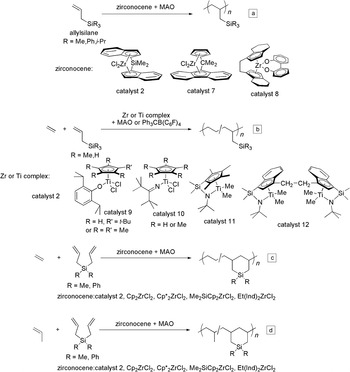
Although allylsilanes do not have polar groups, they are included in this review because these monomers can be easily obtained by allylation of chlorosilanes, and the silyl group is known as a masked hydroxyl group, which is generated by oxidative cleavage of the silicon-carbon bond (Tamao oxidation).Reference Tamao 19 Allyltrimethylsilane undergoes polymerization in the presence of zirconocenes ( Scheme 5 a). Similar to the polymerization of propylene and α-olefins, the stereochemistry of the produced polymer is largely affected by the symmetry of the complex. C 2-symmetric catalysts such as rac-Me2Si(Ind)2ZrCl2 (Ind = indenyl) (catalyst 2)/MAO yield an isotactic polymer, whereas C s-symmetric catalysts such as Me2C(Cp)(Flu)ZrCl2 (catalyst 7)/MAO (Cp = cyclopentadienyl, Flu = fluorenyl) afford syndiotactic polymers.Reference Ziegler, Resconi, Balbontin, Guerra, Venditto and De Rosa 20 The polymerizability of the monomers depends on the substituents on the silicon atom. Bulky monomers such as allyltriphenylsilane or allyltriisopropylsilane tend to form low molecular weight oligomers with low yield. Optically active ethylenebis(4,5,6,7-tetrahydro-1-indenyl)zirconium dichloride (catalyst 8) and the corresponding hafnium complex bring about asymmetric oligomerization of those bulky monomers to afford an optically active oligomer.Reference Habaue, Baraki and Okamoto 21
Polymerization of allylsilanes and diallylsilanes. (a) Polymerization of allyltrialkylsilane in the presence of zirconocenes. (b) Copolymerization of ethylene with allyltrimethylsilane or allylsilane. Copolymerization of (c) ethylene or (d) propylene with diallyldimethylsilane or diallyldiphenylsilane. Note: MAO, methylalumoxane; Me, methyl; Ph, phenyl, i-Pr; isopropyl; n, degree of polymerization, t-Bu, tert-butyl; Cp, cyclopentadienyl; Cp*, pentamethylcyclopentadienyl; Ind, indenyl; Et, ethylene.20–26

Copolymerization of ethylene with allylsilanes has also been reported. The copolymerization of ethylene with allyltrimethylsilane by rac-Et(Ind)2ZrCl2 (catalyst 2)/MAO yields a copolymer containing a small amount of the repeat unit from allylsilane (up to 3.7 mol%) (Scheme 4b).Reference Lipponen and Seppälä 22 The presence of the allylic silane chain end can be explained by chain transfer reaction via 1,2-insertion of allyltrimethylsilane and subsequent β-hydrogen elimination (abstraction of β-hydrogen of the alkyl group attached to the metal center to form hydride metal species and a vinyl-terminated polymer). NMR spectra of the copolymer also show the presence of inner allylic silane groups, which are suggested to form via allylic activation after β-hydrogen elimination and ethylene insertion. Half-titanocenes with anionic ancillary donor ligands such as phenoxide or imide (catalysts 9, 10) allow efficient introduction of allyltrimethylsilane in the copolymerization with ethylene (incorporation as high as 60.4%).Reference Liu and Nomura 23 CGCTiMe2 (catalyst 11)/Ph3CB(C6F5)4 (Ph = phenyl) promotes copolymerization of ethylene with allylsilane (incorporation of allylsilane = up to 54%).Reference Amin and Marks 24 Allylsilane also acts as a chain transfer agent and produces a polymer having a terminal allylsilyl group. The molecular weight of the produced copolymer is increased by using the dinuclear titanium complex 12, although its activity is lower than the mononuclear complex.
Cyclopolymerization of diallylsilanes
The cyclopolymerization of non-conjugated dienes affords polymers with cyclic repeat units, which would increase the thermal stability of the polymer. Control of cyclization efficiency is important from the view of controlling properties of the polymer. Furthermore, the uncyclized repeat units often lead to cross-linking of the polymer chain. Zirconocene catalysts bring about copolymerization of ethylene with diallyldimethylsilane or diallyldiphenylsilane (Scheme 5c).Reference Naga 25 Most of zirconocenes examined, including Cp2ZrCl2, Cp*2ZrCl2, Me2SiCp2ZrCl2, and Et(Ind)2ZrCl2 (Cp* = pentamethylcyclopentadienyl), promote polymerization with quantitative cyclization of diallylsilane to yield the copolymer with silacyclohexane units in the main chain. In contrast, the copolymer produced by Me2Si(Ind)2ZrCl2 (catalyst 2) contains repeat units with a pendant allyl group, formed by insufficient cyclization of the diallysilane. No cross-linked polymer is formed because all of the polymer is soluble in boiling ortho-dichlorobenzene. The stereochemistry of the silacyclohexane units is unclear.
Copolymerization of propylene with diallylsilane is also promoted by the zirconocene catalysts (Scheme 5d).Reference Naga 26 Diallyldimethylsilane undergoes preferential cyclization in the copolymerization with propylene. The produced copolymer contains silacyclohexane repeat units, as in the copolymerization with ethylene. The cis/trans ratio of the six-membered ring is 84:16 to 77:23. In contrast, uncyclized repeat units are contained in the copolymer of diallyldiphenylsilane with propylene due to the insufficient cyclization efficiency during the chain growth.
Cyclopolymerization of polar diallyl monomers
Cyclopolymerization of diallyl monomers
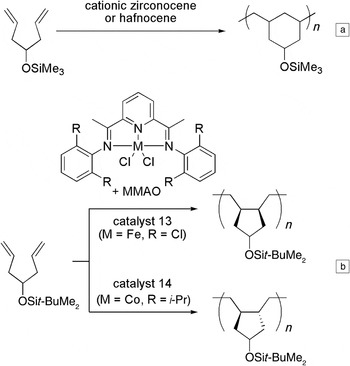
Cyclopolymerization of 1,6-heptadiene by early transition metal complexes such as zirconium and hafnium complexes has been reported to produce polymers with 1,3-disubstituted six-membered rings.Reference Coates and Waymouth 27 , Reference Edson and Coates 28 Cationic zirconocene complexes are effective for the cyclopolymerization of 4-trimethylsiloxy-1,6-heptadiene ( Scheme 6 a),Reference Kesti, Coates and Waymouth 29 which can be easily obtained by the reaction of allylmagnesium bromide and formates followed by trimethylsilylation. [Cp*2HfMe]+X– complexes bring about the cyclopolymerization of 4-trimethylsiloxy-1,5-heptadiene in the absence of a solvent at –25°C to yield a polymer with M n (number average of the molecular weight) = 46,000. The siloxy group of the polymer can be transformed into a hydroxy group by treatment with HCl. No unsaturation was observed in 1H NMR, which indicates complete cyclization during the polymerization. The polymerization of other diallyl monomers such as diallyl ether, diallylphenylamine, and diallyl sulfide does not take place in the presence of the zirconocene catalyst.
Cyclopolymerization of 4-siloxy-1,6-heptadienes. (a) cyclopolymerization of 4-trimethylsiloxy-1,6-heptadiene with cationic zirconocene or hafnocene. (b) Cyclopolymerization of 4-tert-butyldimethylsiloxy-1,6-heptadiene using Fe and Co complexes. Note: Me, methyl; n, degree of polymerization; t-Bu, tert-butyl; i-Pr, isopropyl; MMAO, modified methylalumoxane.29–31

Cyclopolymerization of 4-tert-butyldimethylsiloxy-1,6-heptadiene is achieved by using Fe and Co complexes with bis(imino)pyridine ligands (catalysts 13,14, Scheme 6b).Reference Takeuchi, Matsuura, Park and Osakada 30 , Reference Takeuchi, Matsuura, Fukuda and Osakada 31 In contrast to the polymers obtained by the zirconocene and hafnocene catalysts, the produced polymers have 1,2-disubstituted five-membered rings in their repeat units. The stereochemistry of the cyclopentane rings in the polymer obtained by Fe and Co catalysts is controlled in cis- and trans-structure, respectively (Scheme 6b). The polymer with the cis-structure has a melting point at 133°C, whereas that with the trans-structure undergoes a glass transition at 3.2°C.
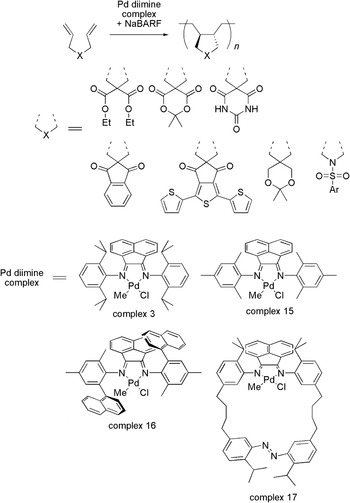
Pd diimine complexes promote the cyclopolymerization of 1,6-heptadienes with various functional groups on the 4-position, which enables the synthesis of polymers with these functional groups on their side chain ( Scheme 7 ).Reference Park, Takeuchi and Osakada 32 – Reference Takeuchi 34 These monomers are readily available via allylation of active methylene compounds, for example by the Pd-catalyzed reaction of allyl alcohol or allyl halides with malonic esters. Allyl amines with electron-withdrawing sulfonate groups are also usable. The polymers having electronegative terthiophene pendants can be successfully synthesized by the Pd-catalyzed cyclopolymerization.Reference Ie, Yoshimura, Takeuchi, Osakada and Aso 35 In all cases, the polymerization proceeds with quantitative cyclization of the diene monomer. The obtained polymers have a trans-1,2-ethylene cyclopentane repeat unit. Highly isotactic and syndiotactic polymers can be obtained using the C 2-symmetric complex 16 and cyclic complex 17,Reference Miyamura, Kinbara, Yamamoto, Praveen, Kato, Takata, Takano, Matsushita, Lee, Lee and Aida 36 respectively. The syndiotactic polymer adopts an ordered aggregate structure.Reference Miyamura, Park, Kinbara, Leibfarth, Hawker and Aida 37
Cyclopolymerization of 1,6-heptadienes by Pd diimine catalysts. Note: Me, methyl; Et, ethyl; Ar, aryl; BARF, B{C6H2(CF3)2-3,5}4; n, degree of polymerization.Reference Park, Takeuchi and Osakada 32 – Reference Miyamura, Park, Kinbara, Leibfarth, Hawker and Aida 37

The Pd diimine complex also brings about copolymerization of dienes with ethylene or α-olefins. The copolymer contains trans-fused five-membered rings and polar functional groups along the polymer chain. The quantitative cyclization of the diene also takes place in the copolymerization. Although polyethylene obtained by the Pd diimine complex is highly branched and is an oil, the copolymer of ethylene and diene adopts a less branched structure and is solid at room temperature.Reference Xiang, Ye, Morgan, Xia and Liu 38 This is accounted for by the suppressed chain-walking reaction across the repeat unit from the diene.
Double cyclopolymerization of diallyl monomer with trans-2-butylene tether
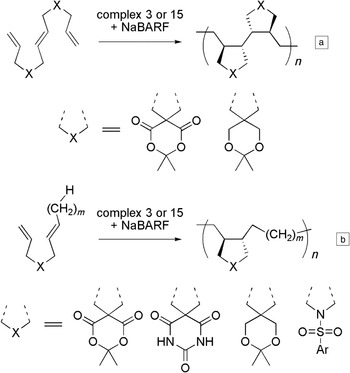
1,6,11-Dodecatrienes are derived from monoallylated malonates and 1,4-dibromo-trans-2-butene and further functional group transformation. The trienes undergo double-cyclopolymerization in the presence of Pd diimine complexes ( Scheme 8 a).Reference Motokuni, Okada, Takeuchi and Osakada 39 The produced polymers contain two trans-1,2-cyclopentane rings in every repeat unit. Quantitative double cyclization of the three vinyl groups takes place during the polymerization. The relative stereochemistry between the two five-membered rings is controlled in the racemic structure. The polymer obtained using complex 3 is of 91% syndiotacticity. The polymer with acetal groups can be transformed to the polymer with diols by hydrolysis.
(a) Double cyclopolymerization of trienes and (b) isomerization cyclopolymerization of alkyl-substituted dienes. Note: Ar, aryl; BARF, B{C6H2(CF3)2-3,5}4; n, degree of polymerization; X, polar functional group; m, 1–10.Reference Motokuni, Okada, Takeuchi and Osakada 39 – Reference Okada, Takeuchi and Osakada 41

Isomerization cyclopolymerization of diallyl monomers with alkyl substituents
Diallylmalonates with alkyl-substituents on one of the allyl group, even though they contain less reactive inner olefin, also undergo smooth cyclopolymerization in the presence of a Pd diimine catalyst.Reference Okada, Park, Takeuchi and Osakada 40 The obtained polymers do not contain alkyl branches, and the alkyl group in the monomer is included in the polymer chain as an oligomethylene spacer between the trans-fused cyclopentane groups (Scheme 8b). The length of the spacer can be varied by the length of the alkyl group of the monomer, and the glass transition temperature of the polymer can be controlled by changing the length of spacers. Thus, the thermal properties of the polymer can be fine-tuned by using the monomer with appropriate length of the alkyl group. The polymerization of dienes with cyclic acetal groups proceeds in living fashion, without termination or chain-transfer reaction. The diene monomers with a branched alkyl group yield polymers with branches in precisely controlled positions.Reference Okada, Takeuchi and Osakada 41
Summary
In the last decade, polymerization and copolymerization of polar allyl monomers have been developed by the controlled design of homogeneous Ziegler-Natta catalysts. The initial examples mainly used masked allyl monomers such as Al-masked allyl alcohol and allylamine, and allylsilanes. Recent advances in late-transition metal-catalyzed olefin polymerization allow copolymerization of various unmasked allyl monomers with ethylene to yield copolymers having polar functional groups on side chains. Stereoselective cyclopolymerization and copolymerization of allyl acrylate, diallylsilanes, and diallylmalonates have been also achieved. The produced polymers having polar side groups have shown superior adhesion, dyeability, and compatibility, compared to polyethylene or polyolefins. It is also worth noting that the polar side groups can be further transformed to other functional group via post-polymerization modification. Further progress in transition-metal catalyzed polymerization would make allyl and diallyl monomers much more attractive monomers and comonomers for the synthesis of functionalized polyolefins.
Acknowledgments
The author is grateful to Kohtaro Osakada of the Tokyo Institute of Technology for helpful discussions.