Introduction
Timely diagnosis of dementia is important as it enables people with dementia and their families to engage with appropriate treatment and support services, thereby facilitating access to appropriate care pathways (Burns and Iliffe, Reference Burns and Iliffe2009). Furthermore, cost benefit analyses suggest that the initial costs of diagnosis and early intervention provide “net savings of around US$10,000 per person with dementia across the disease course” (Prince et al., Reference Prince, Bryce and Ferri2011).
Around 50–80% of people with dementia are believed to be undiagnosed (Prince et al., Reference Prince, Bryce and Ferri2011) and research suggests that primary care physicians do not regularly screen for, recognize, or discuss dementia with their patients (Millard et al., Reference Millard, Kennedy and Baune2011; van den Dungen et al., Reference van den Dungen2012). It may be particularly difficult for general practitioners (GPs) to identify individuals with mild dementia due primarily to the lack of symptom severity (Mitchell et al., Reference Mitchell, Meader and Pentzek2011). Healthcare providers have identified their own knowledge gaps about dementia, including diagnosis, dementia-specific services and/or support services, and the legal rights of patients (Turner et al., Reference Turner2004; Hansen et al., Reference Hansen, Robinson, Mudge and Crack2005). In one study, two-thirds of GPs lacked confidence in dementia symptom management (Turner et al., Reference Turner2004).
There are also barriers for patients, carers, and healthcare providers seeking information about dementia services and diagnosis, with some family carers describing “futile searching for information within a seemingly disorganized healthcare system” (Robinson et al., Reference Robinson, Elder, Emden, Lea, Turner and Vickers2009). Open referral policies (self- or health professional referrals) have been proposed to enable people with dementia to “leapfrog” primary care physicians in their requests for timely diagnosis (Scott and Donnelly, Reference Scott and Donnelly2005; Robinson et al., Reference Robinson, Elder, Emden, Lea, Turner and Vickers2009).
Memory clinics can facilitate resolution of diagnostic, management, and care coordination issues by providing a single point of entry to dementia services and information. Traditionally, memory clinics are found in high income countries, run by multidisciplinary teams (MDT), including a core team of clinicians (Jolley et al., Reference Jolley, Benbow and Grizzell2006; Woodward and Woodward, Reference Woodward and Woodward2009; Prince et al., Reference Prince, Bryce and Ferri2011). Good links and networks with local services and social and healthcare systems are an important hallmark of memory clinics (Jolley et al., Reference Jolley, Benbow and Grizzell2006). Woodward and Woodward's (Reference Woodward and Woodward2009) description of 23 Australian memory clinics (most located in the state of Victoria) identified that neuropsychologists, geriatricians, and nurses were usual clinical staff, with doctors typically undertaking the initial assessment.
Traditional memory clinics are considered the “gold standard” of dementia diagnosis (Drašković et al., Reference Drašković, Vernooij-Dassen, Verhey, Scheltens and Rikkert2008) and are clearly intensive with nearly five clinical hours spent on each patient (Woodward and Woodward, Reference Woodward and Woodward2009). However, given the level of under-diagnosis and the projected increases in dementia prevalence, sustaining these clinics is a resourcing challenge (Gladman et al., Reference Gladman, Jones, Radford, Walker and Rothera2007). Furthermore, some locations may lack the availability of multidisciplinary clinical staff to contribute to such a clinic, so alternatives must be sought to increase access to dementia diagnosis.
Nurse-led clinics are an alternative means of diagnosis that are seeding internationally. Nurse-led memory clinics (NLMCs) can potentially provide quality diagnostic services while drawing on fewer financial and personnel resources. The literature supporting nurse-led clinics is growing (Hatchett, Reference Hatchett2008), and there is increasing use of nurse-led clinics and services across different health services. Nurse practitioners (NPs) may be particularly well suited to lead memory clinics, as NPs complete a Master's level degree and clinical training in a specific area of nursing. They develop “extended skills, knowledge and experience in the assessment, planning, implementation, diagnosis and evaluation of care as required” (Gardner et al., Reference Gardner, Carryer, Dunn and Gardner2004). The capacity for NPs to specialize and develop comprehensive knowledge of dementia is a key aspect of diagnosis (Woodward and Woodward, Reference Woodward and Woodward2009).
Nurses with advanced training have demonstrated their capacity to diagnose cognitive impairment in one study. The specialist nurses’ structured assessment resulted in a very high degree of agreement between nurse and MDT diagnoses (Page et al., Reference Page, Hope, Bee and Burns2008). Those diagnosed are also benefited by earlier linking to appropriate care pathways than those waiting for MDT.
The memory clinic described here differs from conventional approaches to dementia diagnosis in two important ways: It is nurse-led, and employs an open referral policy. This is not the first nurse-led memory service to be reported (for example, Mullins and Fitch, Reference Mullins and Fitch2000), and evidence indicates that nurses have capacity to screen for dementia as a preliminary to specialist diagnosis (Seymour et al., Reference Seymour, Saunders, Wattis and Daly1994; Mullins and Fitch, Reference Mullins and Fitch2000; Page et al., Reference Page, Hope, Bee and Burns2008). However, nurses screening for dementia as opposed to diagnosing dementia is an important distinction. With the exception of the study reported by Scott and Donnelly (Reference Scott and Donnelly2005), the vast majority of nursing service publications describe nurses screening for MDT memory clinics.
In contrast, the nurse practitioner (NP) within the NLMC described here both screens and diagnoses for dementia while maintaining strong links with ongoing dementia care services and specialists. Although screening tools provide scoring ranges which suggest cognitive impairment, a formal diagnosis involves detailed history and physical examination, observing the patient's presentation, with additional information benefits from an informant interview (Prince et al., Reference Prince, Bryce and Ferri2011). It is the synthesis of these various components that enables the diagnosis of cognitive impairment/dementia.
However, better information about NLMCs, including the characteristics of those who attend, and the potential influence of an open referral policy would help policy makers who are responsible for meeting the rising diagnosis demand. This paper aims to identify the demographics, assessment scores, and diagnostic profiles of those attending an NLMC with an open referral policy and to assess how it differs from other memory clinic profiles.
Methods
Design
This study collected descriptive data relating to demographics, assessment scores, and diagnosis of consenting consecutive patients attending the NLMC over a 25-month period in 2011–2013. The clinic was held for one day per week, initially at the Menzies Research Institute of the University of Tasmania (as part of the Wicking Dementia Research and Education Centre), and then based within the Older Persons Mental Health Service of the Tasmanian Department of Health and Human Services. The NLMC draws from a primarily urban population base of approximately 250,000 in greater Hobart, the capital city of Tasmania, Australia. People aged 65 years and older constitute over 15% of the greater Hobart population. The study received ethical approval from the Tasmania Health and Medical Human Research Ethics Committee. This was part of a larger study assessing processes, effectiveness, and impact of the NLMC with the full protocol published elsewhere (Bentley et al., Reference Bentley, Minstrell, Bucher, Morrissey, Robinson and Stirling2014).
Historically, dementia diagnosis in this area of Tasmania was typically through geriatricians, GPs, and a specialized state health service (i.e. Older Persons Mental Health). Geriatricians conducted a memory clinic through the local public hospital (requiring GP referral); this changed to a generalist geriatric clinic around the same time as the NLMC was launched with waiting times commonly over three months.
Participants
Consent to participate in the study was obtained from patients attending the memory clinic, and all the attendees agreed to participate (n = 106). Twelve patients were excluded; four patients had missing data, four already had a dementia diagnosis from a specialist, therefore did not complete assessments and only had the “follow-up consultation” (i.e. diagnosis implications), three were referred to an old aged psychiatrist, and one was only curious about the NLMC. The “open referral policy” allowed referrals from a wide range of sources, including self-referral.
Process
Patients were encouraged to bring an accompanying person to provide corroboration during their assessment. (If the NP was concerned about possible dementia based on her investigations and history taking, she would contact an informant. However, some patients requested that informants not be contacted to protect their privacy.) GPs were asked to forward any blood tests on the patient's file from the previous 12 months, and in some cases the usual battery of blood tests had been pre-ordered. The NP only ordered blood tests if patient's history and presentation, as described below, were suggestive of dementia. Imaging was ordered only when clinically indicated (e.g. MRI for specific vascular risk), and CT scans were not routinely ordered.
The NP screened patients using assessment tools (see “Instruments”), conducted a comprehensive medical history and physical review of each patient, including separate interviews with the patient and accompanying person, collating this information within a visit summary report. (When patients attended alone, the NP obtained corroborative history via telephone in almost all cases.) This report detailed each patient's diagnosis, recommendations provided by the NP, and intentions with respect to following up each case. Assessments required two hours contact time (with patient and family and/or informant), ranging from 1.5–2.5 hours. This compares with five hours contact time traditionally allotted by MDT clinics.
The NP's diagnoses were based on her synthesis of assessment scores, corroborative history, patient presentation, and other aspects of physical examination using the Diagnostic and Statistical Manual of Mental Disorders, 4th Edition (DSM-IV) diagnostic criteria. Patients were categorized as having no cognitive impairment, mild cognitive impairment (MCI), or dementia. Other possible reasons for the cognitive changes, such as depression, hypothyroidism, or adverse medication effects, were considered in the diagnostic process and excluded by clinical reasoning, supported by diagnostic tests, physical examination, and a thorough history. Patients diagnosed with MCI were differentiated from those decreed to have a dementia by the lack of global cognitive impairment and/or general functional decline associated with their identified cognitive deficits.
Importantly, a collaborative agreement between the NLMC and the Older Persons Mental Health Service of the state health department formed a vital support base and resource for NP, ensuring she was not an isolated entity. Specifically, NP diagnoses were discussed with an old age psychiatrist (post hoc) within the context of a supervisory relationship. As confidence between both individuals grew, cases were only discussed to enable the old age psychiatrist to commence pharmacological treatments (e.g. cholinesterase inhibitors), or order brain scans if necessitated (as NPs across Australia are not allowed to initiate this care). Complicated cases (n = 3) were referred for comprehensive specialist review following initial NLMC triage assessment (and excluded from the research) due to complex presentations not consistent with the DSM-IV diagnostic framework and/or presenting with complex past history (e.g. complicated mental health history). The researchers played no role in the clinic, quarantining their involvement to research.
The NLMC was advertised twice during the study period: a local newspaper article at the initial launch (resulting in 65 referrals), and a small article in the local GP newsletter in the second year. The clinic was also highlighted in local television news items during a visit by a prominent politician. No additional advertisement was undertaken in an effort to ensure waiting lists were not extensive.
Instruments
The assessment battery comprised the following validated and established assessments: Neuropsychiatric Inventory Questionnaire (Kaufer et al., Reference Kaufer2000); the Australian version of the Addenbrooke's Cognitive Examination – Revised (ACE-R) (Mioshi et al., Reference Mioshi, Dawson, Mitchell, Arnold and Hodges2006), which incorporates the Mini-Mental State Examination (MMSE); the short form of the Geriatric Depression Survey (Yesavage and Sheikh, Reference Yesavage and Sheikh1986); the Frontal Assessment Battery (Dubois et al., Reference Dubois, Slachevsky, Litvan and Pillon2000); the short form of the Informer Questionnaire on Cognitive Decline in the Elderly (Jorm, Reference Jorm1994); and Frontal Behavioural Inventory (Kertesz et al., Reference Kertesz, Davidson and Fox1997). The instruments were selected on advice from an old age psychiatrist and a neuropsychologist, based on a combination of the instruments’ ability to be useful in diagnosis and in research. The researchers do not suggest that the full assessment battery is required within memory clinics. However, its use provided more data for comparison and assisted the NP to refine her own assessment skills and determine which tools are most informative to her personally in the diagnostic process.
Analysis
Researchers extracted data from visit summary reports and entered it into SPSS version 19.0.0.1 for analyses. The data were arranged in the following categories: (1) patient background characteristics; (2) medical history; (3) lifestyle factors; and (4) assessments. Simple descriptive statistics were calculated across participant groups in this study to describe demographics, assessments, and diagnosis. Missing data were low (and more likely due to the difficulties of clinical history taking than biases on the part of the NP who collected the data). In case n ≠ 106, valid percentage was used. Comparisons were made with similar studies, but as the studies varied considerably, no quantitative analysis was undertaken to describe these differences.
Comparison studies
Six studies, described in seven papers provided suitable comparisons with this data. Studies were selected based on the publication of similar data categories for comparison (e.g. demographics, assessment scores, and diagnostic profiles), ideally in the assessment of memory clinics or services. The comparison studies were held in Australia and the United Kingdom, where assessments were either clinic- or home-based. In only one case was a nurse solely responsible for diagnosis, and this was limited to an initial diagnosis which was later assessed by the clinic's MDT (Page et al., Reference Page, Hope, Bee and Burns2008). All comparison study memory clinics or services relied mostly on referrals from medical professionals. One study across two papers provided normative data of individuals previously diagnosed with either MCI or dementia (Ellis et al., Reference Ellis2009; Sona et al., Reference Sona2012). While comparison groups are useful, research cohorts may not be a representative of dementia service users.
Results
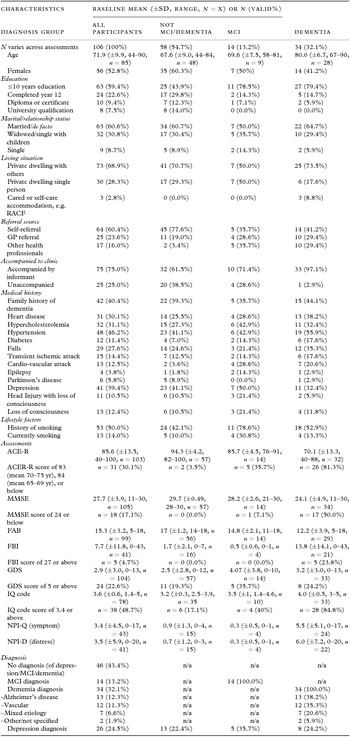
Table 1 presents the demographics, assessment scores, and diagnostic profiles of 106 participants in this study. Participants had a mean age of 71.9 years (±9.9, 44–90, n = 85), 87 participants (82.0%) had 12 or less years of education, 63 participants (60.6%) were in a married or de facto relationship, and 56 (52.8%) were women. Medical histories of patients most commonly included hypertension (46.2%), family history of dementia (40.4%), depression (39.4%), and hypercholesterolemia (31.1%). Fifty-three patients (50%) had a history of smoking, and 30 (28.3%) lived alone in a private dwelling. Patients mostly self-referred (60.4%) to the NLMC, but referrals were also received from GPs (23.6%) and other health professionals (16.0%), including specialists and allied health professionals. Mean ACE-R score was 85.60 (±13.5, 40–100, n = 103) out of 100 for all patients, while mean MMSE score was 27.69 (±3.9, 11–30, n = 105) out of 30. Mean ACE-R and MMSE scores were lower for patients diagnosed with MCI and dementia. Twenty-four patients (22.6%) scored 5 or more on Geriatric Depression Scale (GDS).
Descriptive profile of all the participants, and in-patient sub-groups, demonstrating demographics, assessment scores, and diagnoses

Sixty participants (56.6%) received a diagnosis from the NLMC; 47 (44.3%) with MCI or dementia, and a further 13 (22.4%) were diagnosed with depression without cognitive impairment. (Twenty-four (92%) of the 26 patients diagnosed with depression had a GDS score of greater than or equal to 5.) Of note, nine of the 13 diagnosed with depression without cognitive impairment were self-referred (69%). Fourteen patients (13.2%) received an MCI diagnosis and 34 (32.1%) received a dementia diagnosis. Of the 34 patients diagnosed with dementia, 12 (35.3%) were diagnosed with vascular dementia, and 13 (38.2%) with Alzheimer's disease. The NP did not identify clients presenting with diagnostic criteria suggestive of fronto-temporal dementia, Lewy Body Disease, or other less common dementia types during the study period. Overall, 26 patients (24.5%) were diagnosed with depression. Less than half of the patients (43.4%) did not receive a depression, MCI, or dementia diagnosis.
Patients typically attended the NLMC accompanied by a family member or friend (n = 75, 75.0%). Of the 25 “unaccompanied” patients, 1 (4%) had dementia, while 43 (57.3%) of the “accompanied” patients were diagnosed with MCI or dementia, and 33 (44.0%) specifically with dementia. Three (12%) of the “unaccompanied” patients were self-referred, and had received MCI diagnoses.
Fourteen (56%) of the 25 participants referred by GPs received an MCI or dementia diagnosis, whereas 19 (29.7%) of the 67 self-referred participants were similarly diagnosed. All the 9 allied health professional referrals resulted in MCI or dementia diagnoses (3 MCI and 6 dementia), and of the 8 other health service provider referrals, 6 (75%) resulted in an MCI or dementia diagnosis. Similarly, depression was diagnosed in 12 (19%) self-referrals, 8 (33%) GP referrals, and 6 (38%) other health professional referrals.
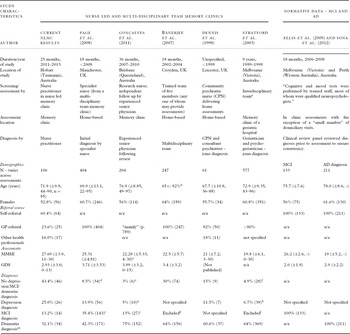
To understand how the features of an open referral policy and nurse-led service might influence the demographics, assessment scores, and diagnostic profiles of the NLMC in this study, publications presenting similar variables were sought from the literature. Table 2 displays the published results of the studies most suitable for comparison with this study's results.
Comparisons across memory clinics/service studies highlight proportional differences in gender, referral sources, and diagnoses. Study characteristics identify differences in study location, and who provides assessments and diagnoses. Differences in gender, MMSE assessment scores, and proportions of diagnoses are clear

Notes: aThe team included a psychiatrist, geriatrician, social worker, nurse, occupational therapist, speech pathologist, and neuropsychologist.
bAge data provided as age in parentheses.
cStandardized Mini-Mental State Examination (SMMSE) administered rather than MMSE; however results are comparable.
dCombined categories of “no problem identified” and “none of the above.”
eSubjective memory complaints.
fStratford et al. (Reference Stratford, LoGiudice, Flicker, Cook, Waltrowicz and Ames2003) combine patients diagnosed as “normal” and with “functional psychiatric disorders,” which does not include those diagnosed with “organic cognitive impairment.”
gIncludes anxiety.
hCalculated by summing diagnosis categories “depressive episode (single)” and “recurrent depressive disorder.”
iMCI or VCI.
jMCI and cognitive impairment no dementia (CIND).
kWhile similar data for these categories were published in these articles, these cases were excluded from comparison as they were not referred to as MCI and did not match our definition.
lAs above.
mWhere an overall dementia diagnosis figure has not been provided, sub-diagnoses (e.g. Alzheimer's disease, vascular dementia and so forth) have been combined.
The participants in this study were generally similar to those of other memory clinic studies; however, this study had a smaller proportion of female patients (52.8% as compared with a range of 56–64%). Patients in this study had lower education levels than a dementia research cohort, yet similar levels to another Australian memory clinic study. Specifically, 87 (82%) patients had 12 years or less of education in this study, as compared with 79% within another Australian study (Gonҫalves et al., Reference Gonҫalves, Arnold, Appadurai and Byrne2011), and 59% of the Australian Imaging, Biomarkers and Lifestyle (AIBL) study's dementia cohort (Sona et al., Reference Sona2012). Gonҫalves et al. (Reference Gonҫalves, Arnold, Appadurai and Byrne2011) only presented data from memory clinic attendees who were accompanied by an informant, and reported finding a correlation between accompanied attendees and an increased likelihood of cognitive impairment diagnosis.
Medical histories of patients varied as well. Specifically, the participants of this study had relatively high proportions of falls in their medical history, and a history of depression was similar and/or more common than other reports. A history of falls was reported by 29 (27.6%) of the NLMC participants as compared with 15% within another service (Page et al., Reference Page, Hope, Bee and Burns2008). A medical history of depression was reported for 41 (39.4%) patients in this study as compared with 39.9% from the other nurse-based clinic (Page et al., Reference Page, Hope, Bee and Burns2008), and 23.3% and 27% of AIBL's MCI and AD cohorts respectively.
Referral sources were strikingly different from other memory clinics. Over 80% of the referrals were from GPs in other memory clinic studies, whereas the NLMC had 25 (23.6%) GP referrals. Similarly, Australian memory clinics reportedly received the majority of referrals from medical professionals and/or services: GPs (59%), other external doctors (16%), affiliated services (13%), and self-referrals (12%) (Woodward and Woodward, Reference Woodward and Woodward2009).
This study reported proportionally fewer dementia diagnoses than previous studies. While other studies demonstrated 61 to 75% of patients being diagnosed with dementia (Dennis et al., Reference Dennis, Furness, Lindesay and Wright1998; Stratford et al., Reference Stratford, LoGiudice, Flicker, Cook, Waltrowicz and Ames2003; Banerjee et al., Reference Banerjee, Willis, Matthews, Contell, Chan and Murray2007; Gonҫalves et al., Reference Gonҫalves, Arnold, Appadurai and Byrne2011), our study identified only 34 patients (32.1%) with dementia, although the proportion of dementia diagnosis from health professional referrals was higher (47.6%). The most similar proportions were reported by Page et al. (Reference Page, Hope, Bee and Burns2008), who reported 42% of the cases receiving dementia diagnosis, while a typical Australian memory clinic profile was calculated to be 48% (Woodward and Woodward, Reference Woodward and Woodward2009).
This study had a similar proportion of MCI diagnosis as Gonҫalves et al. (Reference Gonҫalves, Arnold, Appadurai and Byrne2011), yet both had smaller proportions than Page et al. (Reference Page, Hope, Bee and Burns2008; 13.2% and 13% as compared with 35.4%). A typical Australian memory clinic profile was calculated to be 20% (Woodward and Woodward, Reference Woodward and Woodward2009). This study had the highest proportion of patients who did not receive a diagnosis of depression, MCI, or dementia (43.4%), with one study reporting 30% (Banerjee et al., Reference Banerjee, Willis, Matthews, Contell, Chan and Murray2007) and the remaining reporting 15% or less. Yet, NLMC participants expressed less depression symptoms – as per their GDS scores (2.93 compared with 3.4–3.99) – than other memory clinic studies (Banerjee et al., Reference Banerjee, Willis, Matthews, Contell, Chan and Murray2007; Page et al., Reference Page, Hope, Bee and Burns2008; Gonҫalves et al., Reference Gonҫalves, Arnold, Appadurai and Byrne2011).
NLMC patients diagnosed with MCI (n = 14) received relatively high MMSE scores. Upon reviewing these cases, the NP reported determining an MCI diagnosis through a fuller picture for each patient rather than relying on any one assessment score. This review demonstrated the importance of factors other than screening tests (mainly detailed corroborative history and integrating results from patient presentation at interview and physical exam) in arriving at a cognitive impairment diagnosis.
In comparison to the AIBL study cohorts, participants diagnosed with dementia and MCI in this study had higher MMSE scores. Specifically, those diagnosed with MCI and dementia in this study had MMSE scores of 28.2 (±2.6) and 24.1 (±4.9) as compared with those in the AIBL study 26.2 (±2.6) and 19 (±5.2) (Ellis et al., Reference Ellis2009; Sona et al., Reference Sona2012).
Discussion
The results discussed here are descriptive patterns, and not significant statistically. The relatively low sample size needs to be acknowledged when interpreting these results. Other study limitations include the naturalistic setting, the limited published data available for comparison, and the inclusion of two distinct but related processes (i.e. nurse-led and open referral policy) makes it difficult to clarify the contribution of each process toward the outcomes identified. The different demographics, assessment scores, and diagnostic profiles of patients from the NLMC when compared with more traditional memory clinics may however warrant further study as dementia prevalence increases. The differences may have resulted from the open referral policy and/or having an NP conduct both assessments and diagnoses; and some possible reasons for these differences are discussed below.
The male–female split in this study's patient base reflects the expected proportion of dementia prevalence for participant's age (Prince, Reference Prince2008), but the proportion of males was higher compared with most other reported studies. Being male has been linked with limited health literacy and associated with decreased healthcare access (Sudore et al., Reference Sudore2006). While men's adherence to traditional masculinity may deter their health seeking behavior more broadly, it is possible that the NP's perceived diminished position of power was less threatening to men (Boman and Walker, Reference Boman and Walker2010). Thus, the NP clinic model may provide a more acceptable assessment entry point for men than traditional medical and clinic services.
Low education levels have also been linked to diminished healthcare access, even in countries providing universal care (Adler and Newman, Reference Adler and Newman2002; Sudore et al., Reference Sudore2006); thus, the low education levels of NLMC participants in this study is of interest. Previous research has demonstrated that individuals with less education and income use fewer specialist services (Adler and Newman, Reference Adler and Newman2002); therefore the non-specialist environment of the NLMC in this study and the research nurse in the Gonҫalves et al. (Reference Gonҫalves, Arnold, Appadurai and Byrne2011) study may have been more acceptable and/or accessible to them. It may be that those with lower education levels felt more comfortable visiting a nurse for assessment rather than a doctor, specialist, or MDT.
The nurse-led feature of this memory clinic might have also influenced patient's attendance more broadly. Informal feedback from the NP suggests that patients were more comfortable bringing subtle issues to an NP earlier than to a doctor (e.g. “not enough changes to bother a doctor”). This fits with a growing body of literature that shows patients’ comfort in communicating with nurses compared with doctors (Williams and Jones, Reference Williams and Jones2006).
This study highlights the importance of publishing fuller data sets for others to make comparisons, as it was difficult to locate full published data sets. Unfortunately, this meant that one of the few means of comparison was screening assessment scores, which are only part of the diagnostic picture. The most commonly available assessment scores for comparison were the MMSE and GDS, which fit with Woodard and Woodward's (Reference Woodward and Woodward2009) finding that the MMSE and clock drawing are the most common assessment tools used in Australian memory clinics.
However, while the MMSE may be common as it is accessible and easy to administer, its reliability has been questioned, as patients with presentations and clinical histories indicative of dementia may still score highly (Terpening et al., Reference Terpening, Cordato, Hepner, Lucas and Lindley2011) as did our study participants. Our study participants may have had higher MMSE scores because patients with early symptoms were able to receive a timely and full assessment as a result of self-referral. Higher MMSE scores for self-referred patients compared with GP-referred patients were found in another memory clinic study (Barker et al., Reference Barker, Carter and Jones1994), while the majority of patients from another nurse-led self-referral service were diagnosed with mild to moderate cognitive impairment (Scott and Donnelly, Reference Scott and Donnelly2005). The open referral policy of this NLMC likely meant that its patients gained entrance when they may have experienced delayed access elsewhere due to poor physician recognition skill as noted by Mitchell et al. (Reference Mitchell, Meader and Pentzek2011).
Self-referral may have also been the reason why lower percentage of dementia diagnosis was found in this study. While the NP-screened referrals to ensure potential patients were genuinely concerned about memory changes, many ultimately had subjective memory concerns. However, there was often a family history of dementia, and patients were genuinely worried and needed reassurance. For example, one GP referred two patients who needed confirmation that they were aging normally. The NLMC provided an avenue for patient's concerns being addressed when GPs were unable to provide this service or expertise, or when patients required further reassurance as was the case with these patients. In addition, the NLMC played a role in promoting brain health, and providing information on how to minimize risk factors for developing dementia. A follow-up study of patients attending this clinic revealed that some attended to benchmark their own aging as compared with the rest of society (Stirling et al., Reference Stirling, Campbell, Bentley, Bucher and Morrissey2013), thus it is intuitive that self-referred patients would have a lower dementia incidence than those referred by health professionals. Patients referred by health professionals are likely to have been experiencing symptoms and/or seeking diagnosis for longer, and likely to typically have more pronounced symptoms. It is also possible that a proportion of those who were described as normal may have had a different outcome if they underwent a fuller diagnostic assessment commonly utilized in more traditional memory clinics.
The lower proportion of dementia diagnosis could also be partly because some spouses undergo assessment themselves in order to encourage their partner. The NP was aware of at least three patients attending the NLMC in an effort to encourage spouse with a cognitive impairment concern to attend as well. Therefore, a small proportion of participants attended with a concern about their partner's cognition. Although this can be construed as a downfall, it can also be viewed as an evidence that an open referral policy within an accessible non-threatening diagnostic service may provide an important avenue to overcome some of the challenges to diagnosis, i.e. partners and family members experiencing difficulty broaching their concerns with – and/or prompting assessments of – individuals they suspect may have cognitive impairment and/or dementia.
The NLMC also diagnosed depression within this study, both with and without MCI or dementia. The number of self-referred patients diagnosed with depression without cognitive impairment suggests that the NLMC model can help to identify depression in the wider community.
As over half of the patients were not diagnosed with dementia, MCI, or depression, this does raise the question of whether this memory clinic format is viable or worthwhile. Such a decision may require a value judgment and economic analysis. In the case of the NLMC, the financial outlay for services was relatively low (requiring an NP, room, and administrative staff to book appointments), with the NP assessing two patients and following up with one patient on an average day. Even when staffing costs are lower than traditional memory clinics, there are considerable cost implications of having a lower percentage of attendees diagnosed with dementia. However, this type of memory clinic can increase access to the diagnostic process to assist in managing the ever increasing need for dementia assessment. Furthermore, patients without diagnosis are less resource-intensive (e.g. one visit as compared with two visits), and NLMC attendance provides opportunities for health promotion, learning about aging, and reassurance. Future studies comparing the dementia diagnostic rate in an NLMC with GP-only referrals could be informative. Further research could also identify the impact and cost-effectiveness of the clinic across the spectrum of services and patient experiences (including depression). The benefits of early diagnosis may offset the costs associated with assessing individuals without MCI or dementia (Getsios, Reference Getsios2012).
Overall, this study suggests that an open referral policy may lower diagnostic barriers for males, and those with lower levels of education, potentially reaching those from lower socioeconomic groups (although the data were not collected). It may also be possible that the nurse-led feature of this memory clinic diminished patient-driven barriers to accessing diagnosis. A further possible benefit of open referral is that it allows earlier identification of MCI. National dementia strategies of high-income countries consistently identify early diagnosis and intervention as key policy priorities (Prince et al., Reference Prince, Bryce and Ferri2011). This outcome needs to be carefully considered by policy makers as there is disagreement over what an MCI diagnosis implies, as conversion rates to dementia are still tentative. Notwithstanding this, MCI diagnoses may be particularly relevant to future care when improved prediction of conversion from MCI to dementia is found through potential future use of biomarkers, for example.
In conclusion, this study found that differing memory clinic features – specifically an open referral policy and being nurse-led – although not significantly associated with patient profiles, did demonstrate some unusual patterns that suggest these features may facilitate diagnoses of MCI and dementia.
The authors recommend that the future research investigates and publishes more patient data (e.g. referral source), as this information can help others to understand the type of patients and services that are described as well as providing data for comparison. In addition, future studies should assess whether NLMCs are indeed effective. While the present evidence points to the effectiveness of nurses to diagnose dementia, further research could build the evidence and increase confidence in NLMCs, specifically if NP's cognitive impairment diagnoses are consistent with those of specialists, who have been diagnosing dementia more traditionally.
Conflict of interest
None.
Description of authors’ roles
Christine Stirling led the chief investigators in designing the study, obtaining funding, overseeing the data analysis, and paper writing. Chief investigators Martin Morrissey, Hazel Bucher, and Andrew Robinson assisted in designing the study and obtaining funding, and provided critical feedback on the paper. Hazel Bucher also implemented the assessment procedures and collected the data. Carl Higgs inputted and analyzed the data, and assisted in writing the paper. Michael Bentley imputed data and provided critical feedback on the paper. Melinda Minstrell analyzed the data, and took the lead on writing this paper through the presentation of data and ideas. All authors assisted in revising the paper.
Acknowledgments
The authors gratefully acknowledge The Mason Foundation – Judith Jane Mason and Harold Stannett Williams Memorial Foundation, administered by ANZ Trustees for their grant supporting the NLMC research. From July 2011, the clinic was funded by a project grant from the Commonwealth Department of Health and Ageing. This is an Australian Government initiative trialing aged care nurse practitioner models. These sequential sources of funding were supplemented throughout by in-kind contributions from the Tasmanian Department of Health and Human Services in the way of professional supervision for the NP. The authors also sincerely thank the NLMC patients and their families for participating, and the reviewers and editorial teams for their constructive feedback.