Introduction
The field of palliative care is a humanized context in which the frailty and suffering of patients and their families make it especially necessary to respect the life and dignity of the person, values that are essential in the nursing profession (Cibanal et al., Reference Cibanal, Siles and Arce2001). Palliative care is interdisciplinary in its approach, with a fundamental role for nursing given the number of practitioners, the time dedicated to caring for the patient and their family, and the priority that care occupies in the discipline and profession of nursing.
There are several studies outlining the values and competencies of good palliative care nurses, such as the Davies and Oberle (Reference Davies and Oberle1990) model of supportive care, which considers six interrelated dimensions: valuing, connecting, empowering, doing for, finding meaning, and preserving integrity (Canadian Hospice Palliative Care Association Nursing Standards Committee, 2002), or Reed's (Reference Reed2010) unitary-caring conceptual model, based on the quality standards established by the European Association for Palliative Care (EAPC) in 2009 to improve advanced practice nursing in palliative care (Dobrina et al., Reference Dobrina, Tenze and Palese2014). Kirkpatrick et al. (Reference Kirkpatrick, Cantrell and Smeltzer2017), based on the Walker and Avant (Reference Walker and Avant2005), propose that the care experience, knowledge, and self-awareness of professionals should contribute to the development of competences such as being compassionate, holistic, flexible, realistic, resolute, and ethical. In Spain, the Spanish Association of Nursing in Palliative Care (AECPAL) has established a working group with the following declared values and competences for the palliative nursing professional: self-knowledge and emotional self-control, maturity to enable personal growth and trust in our actions, understanding to comprehend the feelings of others, compassion, empathy, and assertiveness (Codorniu et al., Reference Codorniu, Guanter and Molins2013). In addition to these values, the evaluation of the quality of palliative nursing care has been based primarily on measuring the advanced knowledge and skills of nurses through various instruments essentially comprising three categories: holistic patient care, support for the family, and professional requirements such as ethics, coping with death, and collaboration skills (Soikkeli-Jalonen et al., Reference Soikkeli-Jalonen, Stolt and Hupli2020). However, one field of research is still open: how the advanced knowledge and skills that have been identified are reflected in the specific actions involved in good palliative nursing care.
Although the traits and dimensions required by the palliative nursing professional have been described, there is little empirical work on the role that these values may play in the quality of end-of-life care. Moreover, few empirical studies have been conducted on the quality of specific palliative nursing care, and further research is therefore needed to improve our understanding of the variables that may influence it.
Variables related to the quality of palliative nursing care
The dimension of spirituality in the comprehensive care of people at the end of life has become increasingly important in recent years (Vachon et al., Reference Vachon, Fillion and Achille2009). Nurses who are aware of their spiritual experience, their values, or priorities and who find meaning in their lives are better at identifying the spiritual and existential needs of their patients and perceive more personal benefits in their end-of-life care (Vachon et al., Reference Vachon, Fillion and Achille2012).
In the field of palliative care, the variable meaning is considered one of the main dimensions in the concept of spirituality. Experiencing meaning in the task of palliative care involves asking questions that transcend everyday reality, such as the presence of death and the purpose of existence (Ablett and Jones, Reference Ablett and Jones2007). Several studies suggest that the experience of meaning in the work of palliative nurses goes beyond every day, since the act of caring for the lives of others involves a process of relationship and bonding between patients, family members, and professionals with great emotional impact (Nencetti et al., Reference Nencetti Pereira Rocha, Ramos Pereira and Silva2020). Furthermore, the meaning that nurses find in their own lives through their work is understood in terms of individual values, and it is precisely the realization of these values that give meaning to their care (Malloy et al., Reference Malloy, Fahey-McCarthy and Murakami2015). The perception of meaning is facilitated, for example, when the nurse feels that they have helped to alleviate pain or when the patient has had the opportunity to finalize matters pending with their loved ones (Santisteban and Mier, Reference Santisteban and Mier2006). This care can be difficult to deliver when time and autonomy are lacking, which can, in turn, lead to a loss of meaning in different situations (Gama et al., Reference Gama, Barbosa and Vieira2014).
One of the areas of research on meaning among palliative care nurses is the application of the Meaning-Centered Intervention (MCI) program, based on Víctor Frankl's logotherapy. Various studies have shown the effect of MCI on job satisfaction and the quality of life of palliative care nurses (Fillion et al., Reference Fillion, Duval and Dumont2009), and its usefulness for the growth of spiritual awareness in four aspects: awareness of life's finiteness, opening up to new meanings and purposes of suffering, awareness of sources of meaning and purpose of life, and accessing states of mindfulness (Vachon et al., Reference Vachon, Fillion and Achille2011).
Several studies reflect greater acceptance of death and less death anxiety in palliative care nurses compared to nurses in other services. Peters et al. (Reference Peters, Cant and Payne2013) showed that emergency room nurses had higher levels of death anxiety and fewer coping skills than palliative care nurses. These higher levels of anxiety, also found in nurses in critical care units, may be explained by the greater time that palliative care nurses spend with people at the end of life, leading to a more positive attitude toward death and care (Dunn et al., Reference Dunn, Otten and Stephens2005). In palliative care units, exposure to a higher number of patient deaths makes it easier to see death and the dying process as an expected phenomenon that can be talked about, so the level of death anxiety [the intense emotional reaction to stimuli related to death, one's own or that of others (Limonero, Reference Limonero1997)] is lower. Several studies have also analyzed the relationship between the attitude toward death, quality of care, and self-efficacy in palliative care (Barnett et al., Reference Barnett, Reed and Adams2020).
This greater frequency of contact with people at the end of life and their families appears to be an important source of job satisfaction (Grunfeld et al., Reference Grunfeld, Zitzelsberger and Coristine2005). With respect to satisfaction and well-being at work, engagement is defined as a positive work-related state of mind, characterized by vigor, dedication, and absorption. Vigor is measured by high levels of energy and mental resilience while working, the willingness to invest effort in one's work, and persistence even in the face of difficulties. Dedication refers to being strongly involved in one's work, and experiencing a sense of significance, enthusiasm, inspiration, pride, and challenge. Finally, absorption occurs when one is fully concentrated and happily engrossed in one's work, whereby time passes quickly and one has difficulties with detaching oneself from work (Bakker et al., Reference Bakker, Rodríguez-Muñoz and Derks2012).
Engagement in nurses is affected by variables such as meaning and the absence of value conflicts (Freeney and Tiernan, Reference Freeney and Tiernan2009), the presence of personal values that lead to a positive attitude toward end-of-life care (Ranse et al., Reference Ranse, Yates and Coyer2016), and feeling rewarded on seeing how their care affects people's lives and receiving the thanks of relatives and/or patients (García-Sierra et al., Reference García-Sierra, Fernández-Castro and Martínez-Zaragoza2017). This aspect is also confirmed in the qualitative study by Ablett and Jones (Reference Ablett and Jones2007), in which palliative care nurses cited a positive attitude toward work and job satisfaction as important variables in relation to the quality of their care. Greater death anxiety appears to hinder engagement (Ranse et al., Reference Ranse, Yates and Coyer2016), although as part of this negative relationship, the presence of high levels of absorption may increase exposure to death and, accordingly, stress (Samson and Shvartzman, Reference Samson and Shvartzman2018).
In terms of the dimensions of engagement in nursing professionals, García-Sierra et al. (Reference García-Sierra, Fernández-Castro and Martínez-Zaragoza2017) used interviews to identify vigor as enthusiasm and joy at work, and dedication as meaning and a source of personal growth. However, in relation to absorption, no unit of similarly associated meaning was found, resulting in a new definition of the construct in nursing staff as “a positive, fulfilling state of mind related to the profession, characterised by vigour, dedication and intrinsic reward” (p. 52).
The presence of meaning and the relationship with death can also affect well-being, not only at the work level, but also personally. Shiri et al. (Reference Shiri, Wexler and Marmor2020) showed hope and meaning in life to be predictive of subjective well-being, but they did not see this impact of meaning on work engagement, concluding that, in a context of tragedy or suffering, the locus of meaning is internal and does not necessarily come from the work environment. Ryff (Reference Ryff1989) and Ryff and Keyes (Reference Ryff and Keyes1995) introduced the term “psychological well-being” as the development of one's true potential and proposed a multidimensional model with six components: self-acceptance, positive relations with others, environmental mastery, autonomy, personal growth, and purpose in life. Of these, one would expect to find greater personal growth and purpose in life in those professionals who manage to find meaning in their care and who have succeeded in controlling and reducing death anxiety.
Nevertheless, few studies have focused on the role that these variables play in the quality of palliative nursing care. It would thus be interesting to examine whether meaning and death anxiety predict the quality of care through changes in personal and professional well-being (engagement).
Objectives
The aim of this study was to identify the role of the variables meaning and death anxiety in the quality of palliative nursing care. Specifically, our study hypothesis was that the significant relationship between death anxiety and meaning with the quality of care can be explained by the mediating influence of psychological well-being and engagement.
Methods
Design is a correlational and cross-sectional study.
Participants
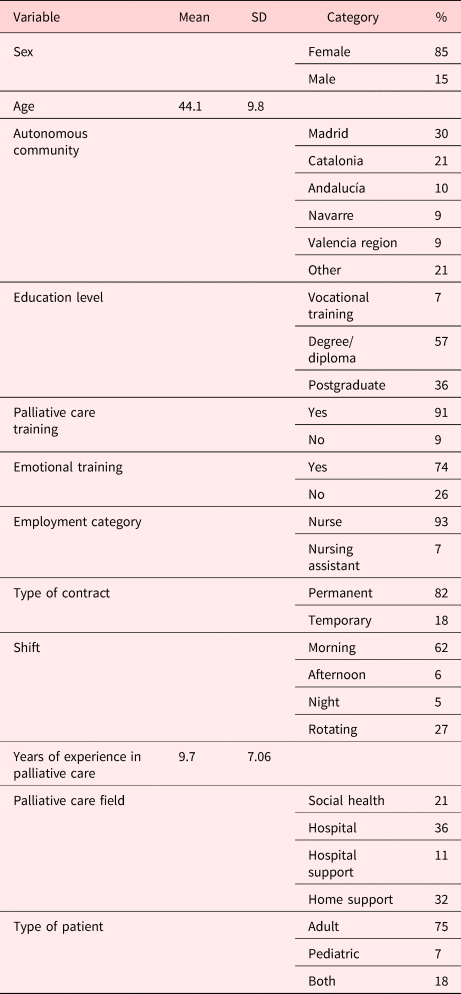
One hundred and seventy-six Spanish palliative care nurses out of a total population of 1,016 professionals (Oriol et al., Reference Oriol, Gómez and Gándara2014) participated in the study. Table 1 shows the descriptive distribution of the sociodemographic and work variables of the sample.
Distribution of sociodemographic and work variables of the sample

Participants were selected by non-probabilistic convenience sampling using the snowball technique. In order to contact nurses, a meeting was held with the nursing supervisors and palliative care coordinators of the Community of Madrid Health Service, while representatives of the AECPAL board of directors were approached directly in the other autonomous communities in Spain to explain the study aims and request collaboration.
Data were collected between January and May 2018.
Instruments
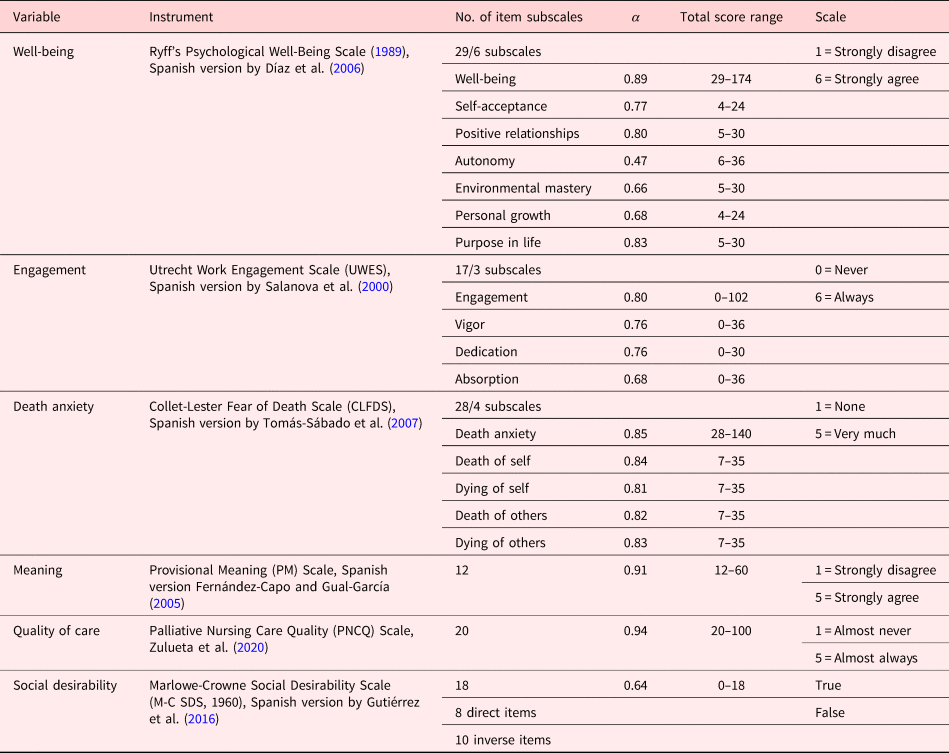
We used the short form of Ryff's Psychological Well-Being Scale (1989), adapted and validated in the Spanish population by Díaz et al. (Reference Díaz, Rodríguez-Carvajal and Blanco2006). It comprises 29 items, with a score ranging from 1 to 6 (where 1 = strongly disagree, 6 = strongly agree), distributed in six subscales: Self-acceptance, Positive Relations with Others, Environmental Mastery, Personal Growth, Purpose in Life, and Autonomy. In our study, the reliability of the total Psychological Well-being score was good, with a Cronbach's α of 0.89. The internal consistency values of the six subscales ranged from 0.47 for Autonomy to 0.83 for Personal Growth. Given the low reliability of the Autonomy subscale, its results were not considered in the analysis.
The Utrecht Work Engagement Scale (UWES) (Schaufeli and Bakker, Reference Schaufeli and Bakker2003) adapted to Spanish by Salanova and Schaufeli (Reference Salanova and Schaufeli2009), comprises 17 items organized in three subscales, Vigour, Dedication, and Absorption. Responses reflect the frequency of feelings experienced at work, scored on a 7-point scale (0 = never, not once, 6 = always, every day). Cronbach's α values in our study were 0.80 for the total UWES score and between 0.68 and 0.76 for the three subscales.
The Collet-Lester Fear of Death Scale (CLFDS) (Lester and Abdel-Khalek, Reference Lester and Abdel-Khalek2003) was validated and adapted to Spanish by Tomás Sábado et al. (Reference Tomás-Sábado, Limonero and Abdel-Khalek2007) in a sample of nursing professionals and students. It consists of 28 items across four subscales measuring the degree of anxiety regarding the death of self, dying of self, death of others, and dying of others. Each Likert-type subscale has seven items, with responses scored from 1 (not disturbed or anxious) to 5 (very anxious). In our study, the death anxiety scale presented good internal reliability, with Cronbach's α values between 0.81 and 0.85.
The Provisional Meaning (PM) scale is part of the Meaning of Care Scale (MCS), the Spanish version of the Finding Meaning Through Caregiving Scale (Farran et al., Reference Farran, Miller and Kaufman1999), translated and validated in Spanish by Fernández-Capo and Gual-García (Reference Fernández-Capo and Gual-García2005). The PM scale was adapted for a pilot study with 123 palliative care nurses and showed good internal consistency in our study, with a Cronbach's α of 0.91. It consists of 12 items such as: “caring for my patients and/or relatives gives my life a purpose and a sense of meaning,” with scores ranging from 12 to 60, where higher scores reflect greater meaning of care.
The Palliative Nursing Care Quality (PNCQ) scale was designed and validated by Zulueta Egea et al. (Reference Zulueta Egea, Prieto-Ursúa and Bermejo Toro2020) in a sample of palliative care nurses. The scale assesses the perception of nursing professionals regarding the most representative dimensions of palliative nursing care, such as control and relief of symptoms, family and/or main caregiver, therapeutic relationships with the patient and family, spiritual support, and continuity of care. It consists of a single factor and 20 items such as “supporting family members and/or main caregiver in their work of caring for and accompanying the patient”; responses are scored on a Likert-type scale with values from 1 (almost never) to 5 (almost always), with a total score ranging from 20 to 100 points and higher scores indicating the higher perceived quality of palliative nursing care. The scale yielded good internal reliability, with a Cronbach's α of 0.94. Given that this is a self-reporting questionnaire, we controlled for possible social desirability biases in nurses’ responses regarding their care.
The Marlowe-Crowne Social Desirability Scale (M-C SDS, 1960) was adapted and validated in a general Spanish population in a short form by Gutiérrez et al. (Reference Gutiérrez, Sanz and Espinosa2016). It consists of 18 items organised into 8 direct items reflecting socially desirable but infrequent behaviors and traits, such as “I have never felt a deep dislike for anyone,” and 10 inverse items reflecting behaviors and traits that are socially undesirable but very frequent, such as “sometimes I like to gossip.” In our study, the scale yielded acceptable reliability, with a Cronbach's α coefficient of 0.64. Table 2 shows the measuring instruments used.
Instruments

Data analysis
A descriptive and correlational analysis was carried out using IBM SPSS Statistics for Windows, Version 24.0 (Armonk, NY: IBM Corp). Pearson's correlation coefficient was used to indicate effect size, where values between 0.10 and 0.29 reflect a weak relationship, values between 0.30 and 0.49 a medium-strength relationship, and values equal to or greater than 0.50 a high effect size (Cohen, Reference Cohen1988).
To perform the simple and multiple mediation analyses, we used the PROCESS macro by Hayes and Rockwood (Reference Hayes and Rockwood2016). We used a bootstrapping procedure to test for mediation, with the number of samples to generate confidence intervals (CI) set at 10,000, so that a statistically significant mediation effect can be concluded when the CI of the indirect effect does not include zero. First, simple mediation analyses were performed, with meaning and death anxiety taken as antecedents in the models. Measures of well-being and engagement were introduced as mediating variables, both in their overall scores and subscales, and quality of care as a consequent variable, with sex, age, and social desirability as controlling variables. To show indirect effect size, we calculated the standardized coefficients and CI of each indirect effect (Miočević et al., Reference Miočević, O'Rourke and MacKinnon2018). This coefficient indicates the increase in the number of dependent variable standard deviations (SD) caused by the change in the mediating variables when the independent variable rises by one SD. Finally, to verify the comparative size of the indirect effect of each mediator, we tested a multiple mediational model with the total scores in engagement and well-being as parallel mediators, simultaneously including the antecedent variables, and with sex, age, and social desirability as controlling variables.
Ethical considerations
The attached approval report from the Ethics Committee of the Institution where the research was carried out was presented to participating professionals, who were informed of the voluntary nature of participation and the anonymous and confidential treatment of data.
Results
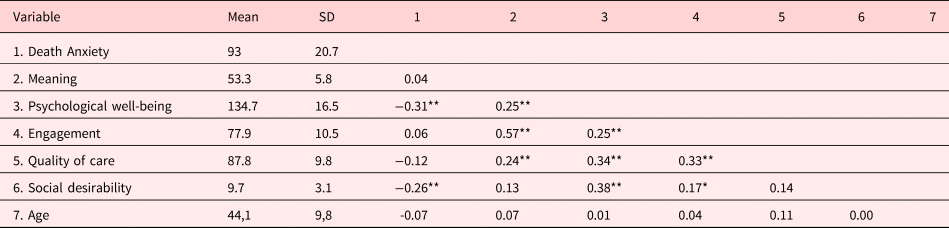
Death anxiety correlated negatively with psychological well-being and social desirability, while meaning correlated positively with psychological well-being, engagement, and quality of care, and moderately with engagement. Engagement, in turn, showed a moderately positive correlation with psychological well-being and care quality. Psychological well-being presented the highest correlation effect with the quality of care, followed by engagement and meaning. Finally, it was observed that social desirability was significantly correlated with death anxiety and psychological well-being (Table 3).
Descriptive and correlations of the variables

** p < 0.01, *p < 0.05.
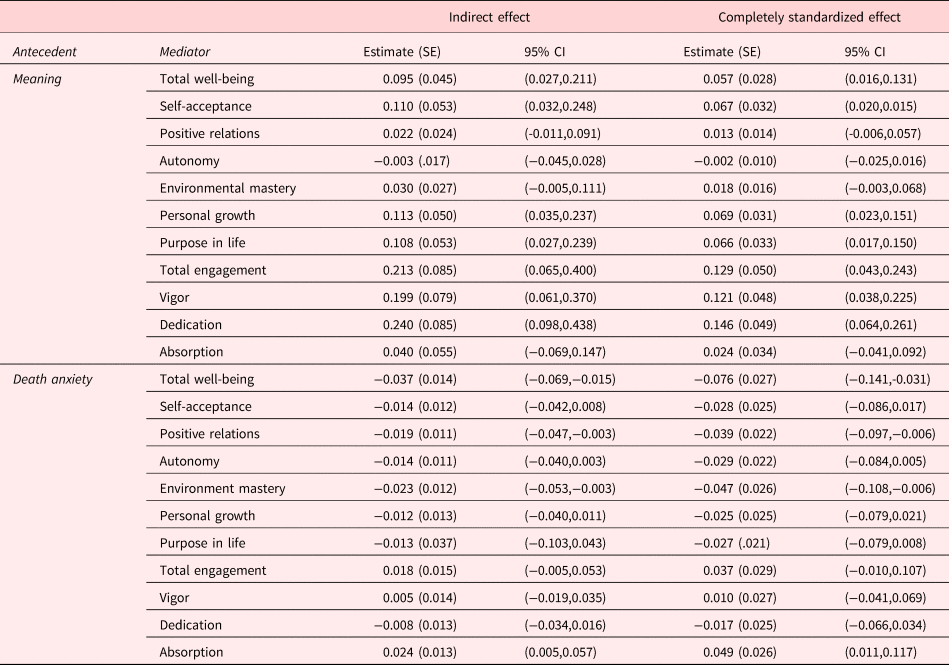
Table 4 presents the results for each simple mediation analysis performed with the two independent variables (meaning and death anxiety), the different mediators (measures of well-being and engagement), and the quality of care as a dependent variable. With regard to well-being, the effect of meaning on quality is mediated by self-acceptance, personal growth, and purpose in life, while positive relationships and environmental mastery mediate the negative impact of anxiety on quality. With respect to engagement, vigor and dedication mediate the impact of meaning on quality, while absorption mediates the effect of anxiety on quality. standardized measures reveal that the mediational effect is particularly important in mediating the impact of meaning on quality through vigor and dedication.
Simple mediational analyses: indirect effect on the quality of care

Controlled for sex, age, and social desirability.
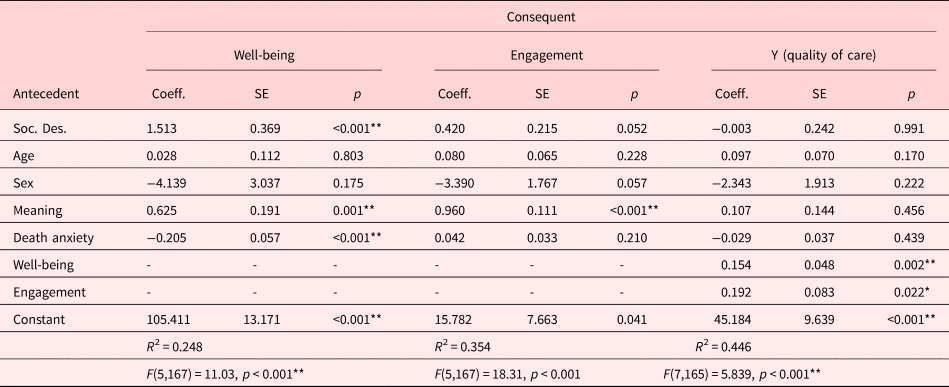
To establish whether meaning and death anxiety are associated with the quality of care through well-being and engagement, we tested a multiple mediation model with these two mediators, two predictor variables and three controlled variables (sex, age, and social desirability). As shown in Table 5, the prediction of the quality of care was statistically significant (F(7,165) = 5.839, p < 0.001, R 2 = 0.446).
Regression coefficients, standard errors, and model summary information for the parallel multiple mediator model

**p < 0.01, *p < 0.05.
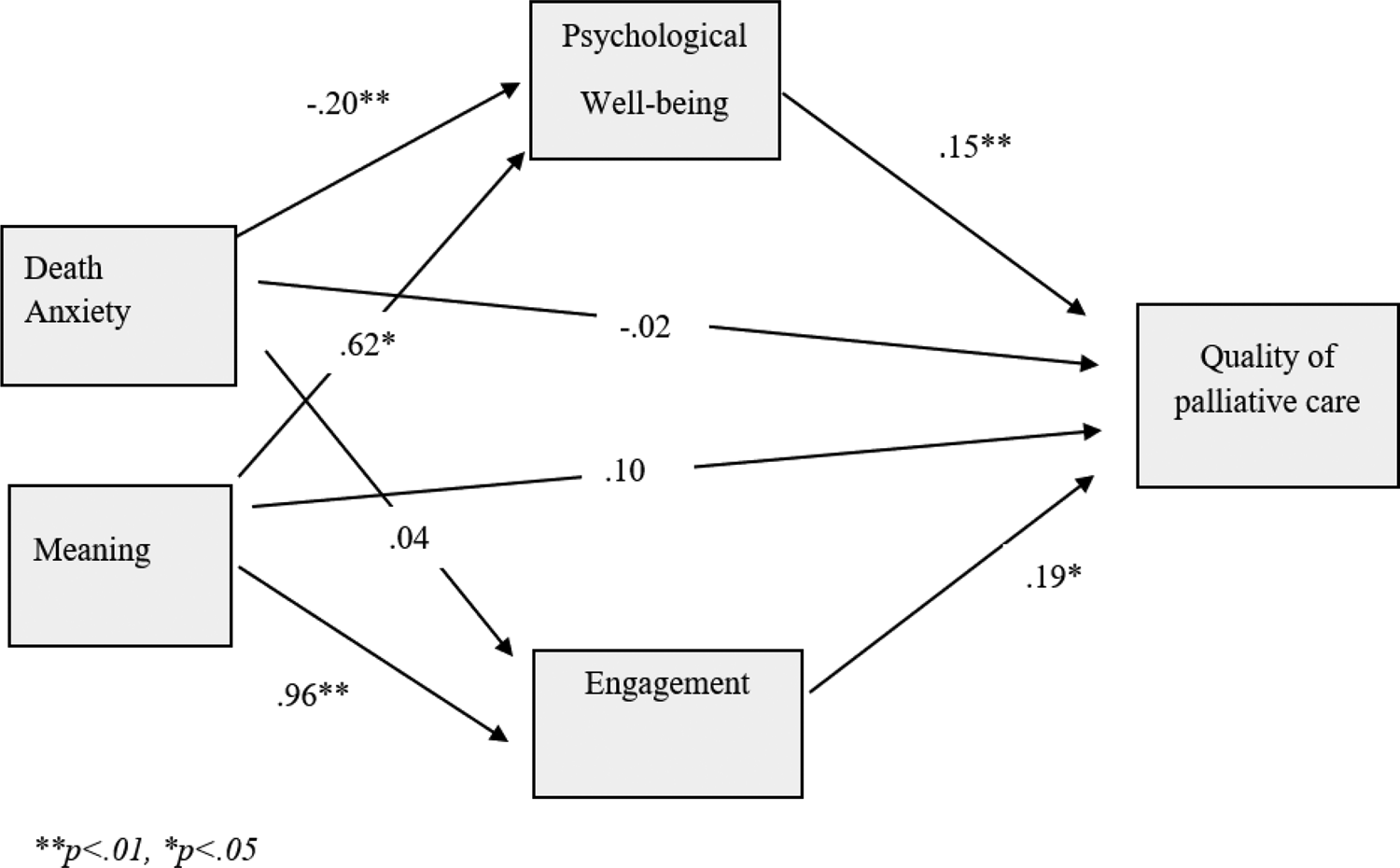
This effect may be explained by the mediation of both engagement and well-being, while all the direct effects proved to be non-significant. Thus, well-being mediated the impact of meaning (indirect effect = 0.096, SE = 0.044, 95% CI: 0.028, 0.213) and death anxiety (indirect effect = −0.032, SE = 0.013, 95% CI: −0.064, −0.010) on the quality of care. On the other hand, engagement only mediated the impact of meaning (indirect effect = 0.185, SE = 0.085, 95% CI: 0.035, 0.372), while the indirect effect of death anxiety with the quality of care through engagement was not statistically significant (indirect effect = 0.008, SE = 0.009, 95% CI: −0.004, 0.032).
Figure 1 shows a graph of the significant mediation models.
Model of mediation of psychological well-being and engagement in the relationship between death anxiety, meaning, and quality of care.

Discussion
The purpose of our study was to identify the role of the variables meaning and death anxiety in the quality of palliative nursing care and to analyze the possible mediating role of psychological well-being and engagement.
Our data confirm that death anxiety does not have a direct relationship with the quality of care, but rather has an effect via psychological well-being, a variable that acts as a mediator between the two. Having death anxiety is linked to lower psychological well-being and, more specifically, with less ability to maintain stable positive relationships and master or create favorable environments. Although it is difficult to compare our results with other studies, given the paucity of research aimed at studying this relationship, our findings are consistent with Watson's transpersonal theory (Reference Limonero1997), in which the acceptance of death by nurses is one of the 10 factors necessary for good care, and in line with the study by Oliver et al. (Reference Oliver, Sansó and Galiana2017) confirming the moderately positive relationship in palliative care nurses between psychological well-being and strategies for coping with death. Other studies have analyzed the variable self-efficacy, and found a relationship with environmental control or mastery, concluding that caregivers with a higher level of self-efficacy in their care have lower levels of anxiety (Mystakidou et al., Reference Mystakidou, Parpa and Panagiotou2013) and greater ability to cope with stressful situations (Limardi et al., Reference Limardi, Stievano and Rocco2016); they also confirm the relationship between having more positive attitudes toward care of the dying and the perceived ability to respond to the concerns of people at the end of life (Barnett et al., Reference Barnett, Reed and Adams2020). Engagement, however, does not seem to play an important mediating role between death anxiety and quality of care, mediating only through absorption. One of the reasons that death anxiety does not significantly impact engagement may be that nurses assume contact with death as something intrinsic to the profession, even more so in the palliative setting, and that this does not prevent them from having positive energy and feeling involved in work. Moreover, absorption seems to be a less relevant dimension of engagement from the perspective of nursing professionals, where recognition by patients and family members has greater value (García-Sierra et al., Reference García-Sierra, Fernández-Castro and Martínez-Zaragoza2017). Engagement refers more to a persistent affective-cognitive state over time than to a specific and temporal one (Salanova et al., Reference Salanova, Schaufeli and Llorens2000); this consideration appears to be related to the findings of Santisteban and Mier (Reference Santisteban and Mier2006), who concluded that exposure for a time to a greater number of patient deaths enhances the ability to talk about death and the dying process and reduces stress at work. Conversely, Samson and Shvartzman (Reference Samson and Shvartzman2018) argue that increased absorption leads to higher levels of exposure to death and therefore greater exhaustion and stress. One possible explanation is that as the difficulty in disconnecting from work increases, the ability to separate from the suffering of the patient and/or family diminishes, which may lead to higher levels of anxiety.
The effect of meaning on the quality of care is explained by the mediation of both well-being and engagement, with vigor and dedication revealed as mediating most in this impact. The value of the nursing profession appears to lie in feeling that our care has a purpose and a meaning that transcend the standard practice of effective, problem-solving work, especially in situations of suffering and uncertainty such as the proximity of death, where the person comes face to face with life's finiteness. It is precisely in these situations that we professionals have the greatest need to perceive the coherence, alignment, and internal logic of what we experience or what happens around us (Benito et al., Reference Benito, Dones and Babero2016). The palliative care setting is an environment where professionals interpret the sense of meaning differently than in other contexts. This may be due, on the one hand, to their attitudes toward suffering, death, or spiritual awareness and, on the other, to their commitment to a more humanized work environment where interpersonal relationships and teamwork take on special relevance (Shiri et al., Reference Shiri, Wexler and Marmor2020).
Among the dimensions of psychological well-being, self-acceptance, personal growth, and purpose in life were found to play a significant and mediating role in the relationship between meaning and quality of care. The importance of self-acceptance and self-knowledge of nurses in providing good care to people at the end of life is reflected in the values proposed by AECPAL and in Reed's unitary-caring conceptual model (Reference Reed2010). Along these lines, Barnett et al. (Reference Barnett, Moore and Garza2019) conclude that the presence of meaning in hospice nurses is related to a higher level of positive effect and that self-esteem mediates between the presence of meaning and low levels of psychological distress and burnout. This significant role seems to be consistent with several lines of research, such as that of Vachon et al. (Reference Vachon, Fillion and Achille2011, Reference Vachon, Fillion and Achille2012), noting that end-of-life care can be a personal growth experience for nurses and provide greater awareness of sources of meaning and their purpose in life after participating in the MCI. Sinclair (Reference Sinclair2011) also shows how experience with death and the dying process offers a unique opportunity for growth, meaning, and continuity of life for palliative professionals, while Moreno-Milan et al. (Reference Moreno-Milan, Cano-Vindel and Lopez-Dóriga2019) have established a model where the meaning of work mediates and is related to personal growth.
In summary, it is clear that the influence of personal variables on the quality of care can be best explained from the perspective of well-being, and this is confirmed by the important predictive value shown in our mediation model. Many of the dimensions of psychological well-being are similar to the fundamental principles of palliative nursing care quality, and of these, several are associated with the meaning and acceptance of death. Principles such as self-reflection, awareness of spirituality, acceptance of the mysteries of life and death, or experiencing existential growth and enjoyment at work in the therapeutic relationship (Poblete-Troncoso et al., Reference Poblete-Troncoso, Valenzuela-Suazo and Merino2012; Dobrina et al., Reference Dobrina, Tenze and Palese2014) are related to self-acceptance, personal growth, and life purpose dimensions of psychological well-being.
Limitations
First, the sample is neither representative nor very large. However, it must be remembered that palliative nurses are a very specific group whose population is not very large. The participating sample includes more than 17% of the population, which is considerable and gives the relevance of our results.
Second, although the mediation analysis helps understand the relationship between the variables, using a longitudinal design that includes the antecedent, mediating, and consequent variables at three different times would clarify the direction of these influences. Finally, measures of death anxiety and psychological well-being appear to be affected by social desirability bias.
Conflict of interest
There are no conflicts of interest.
Funding
This research did not receive any specific grant from funding agencies in the public, commercial, or not-for-profit sectors.