Healthcare settings pose unique challenges for preventing transmission of highly communicable diseases like COVID-19 due to the nature, duration, and number of interactions between patients and staff members. Surveillance for hospital-acquired (HA) cases of COVID-19 has been recommended by the Centers for Disease Control and Prevention. 1 However, given the long incubation period of COVID-19, definitive attribution of hospital-acquisition in patients with stays <14 days is challenging. Likewise, time-based electronically defined rates of HA-COVID-19 using only positive test results on or after hospital day 14 are subject to error. Reference Habermann, Tande, Pollock, Neville, Ting and Sampathkumar2
Previous studies reporting HA-COVID-19 incidence are limited in number, and most include only data from the early pandemic. Reference Habermann, Tande, Pollock, Neville, Ting and Sampathkumar2–Reference Kobayashi, Trannel and Holley6 Our 3-hospital health system performed contact tracing of healthcare worker (HCW) and inpatient COVID-19 cases. We report our rates of HA-COVID-19 and our experience adjudicating the source of infection acquisition.
Methods
We performed a retrospective analysis of prospectively collected data from routine infection prevention and employee contact tracing operations. The study included all patients admitted to 1 of 3 acute-care hospitals (ie, a 957-bed academic hospital, 354-bed community hospital, and 175-bed community hospital) in the Raleigh-Durham region of North Carolina between April 1, 2020, and February 28, 2021. Patients whose first positive COVID-19 test in our medical record was collected after hospital day 7 met our electronic definition of possible HA-COVID-19. Reference Rhee, Baker and Vaidya4
Electronically defined cases were further adjudicated as follows:
-
1. Community-acquired (CA): first positive COVID-19 test at outside facility prior to admission OR COVID-19 symptoms present at the time of admission but initial COVID-19 testing negative leading to delayed diagnosis
-
2. Recovered: history of COVID-19 within last 90 days at outside facility and asymptomatic but repeat testing performed as part of preprocedural or discharge screening
-
3. Hospital-acquired due to healthcare worker exposure: cared for by positive HCW during HCW’s infectious period 2–14 days prior to positive test or was identified as part of a unit cluster, defined as ≥3 epidemiologically linked cases
-
4. Hospital-acquired due to visitor exposure: visited by a positive individual within that person’s infectious period 2–14 days prior to positive test
-
5. Hospital-acquired unknown: positive test hospital day 14 or later and no identified exposure to HCW or visitor
-
6. Indeterminate: positive test hospital day 8–13 and no identified exposure to HCW or visitor OR positive test hospital day ≥14 but signs/symptoms present earlier in stay and no identified exposure to HCW or visitor
HA-COVID-19 rates were calculated as cases per admissions lasting >7 days, trended by month, and correlated with community COVID-19 activity in the surrounding 7-county region.
Most inpatient rooms at all 3 hospitals are private. All hospitals implemented similar COVID-19 mitigation policies and procedures, including universal masking of staff and visitors. Admission testing of high-risk patients including those coming from congregate living facilities, displaying symptoms of COVID-19, or unable to provide history and preprocedure testing of patients prior to elective surgeries and high-risk aerosol-generating procedures began in March 2020. Universal testing of all admitted patients was fully implemented at all 3 hospitals by July 2020.
Visitors were restricted for all patients during the early pandemic. Beginning June 24, 2020, a single adult visitor could be designated for the duration of an adult patient’s hospitalization and visiting hours were restricted. Two designated support persons were allowed for pediatric and obstetric patients. Visitors were screened daily and prohibited from visiting if any COVID-19 symptom or exposure was reported.
All HCWs were screened for symptoms or exposure to COVID-19 daily. Those with reported symptoms were excluded from work until tested and cleared to return. Those with household COVID-19 exposures were quarantined. Individuals with COVID-19 exposures outside of work or home were allowed to work as long as they remained asymptomatic and followed all safety protocols.
Results
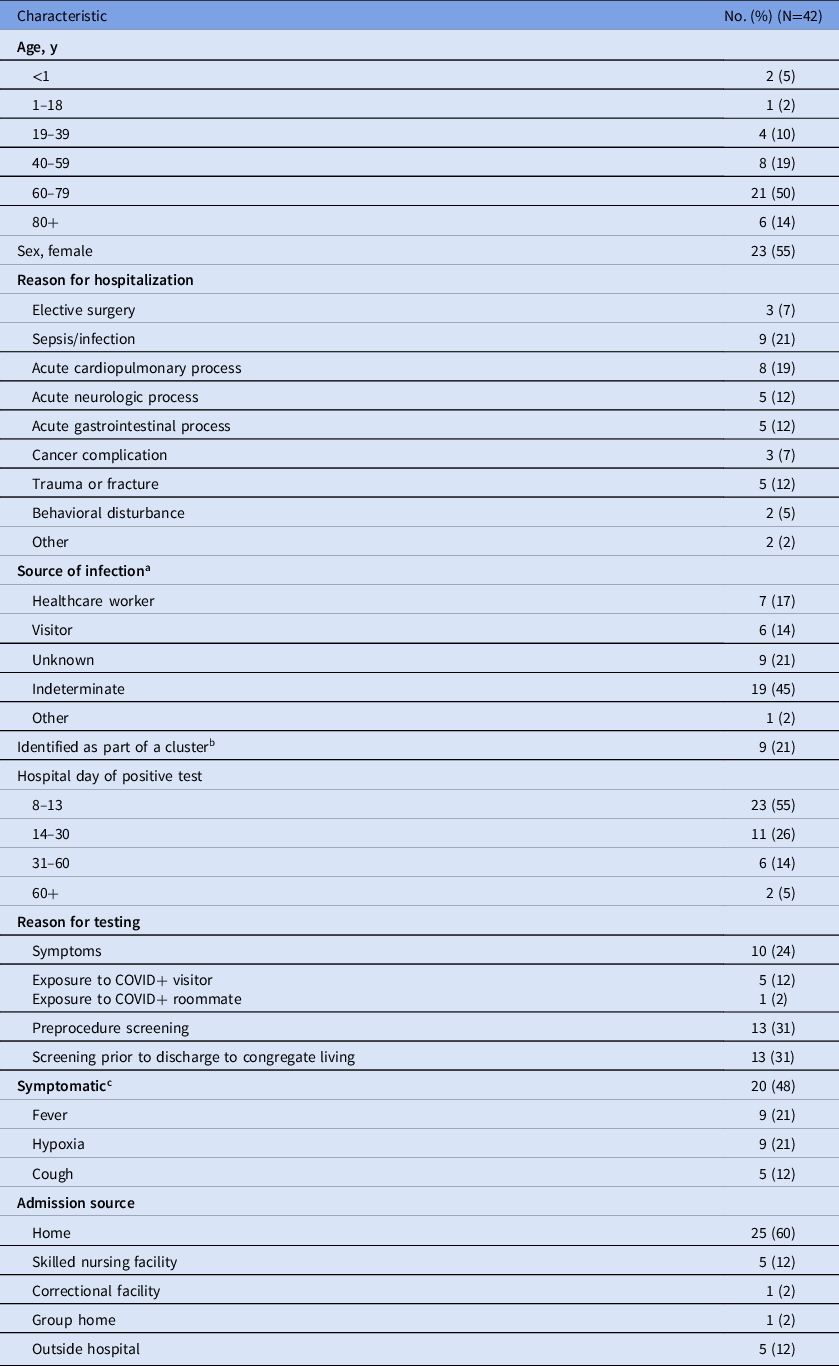
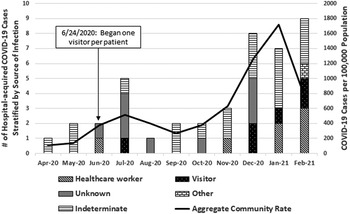
Of 14,668 patient admissions lasting >7 days, 74 (0.5%) patients had a first positive COVID-19 test after hospital day 7, meeting our electronic definition of possible HA-COVID-19. However, only 42 (57%) electronically defined HA-COVID-19 cases were adjudicated as definite or possible HA-COVID-19 cases, yielding an incidence rate of 0.29 cases per 100 admissions. Characteristics of the 42 patients are shown in Table 1. Monthly trends in definite or possible HA-COVID mirrored COVID-19 activity in our local community (Fig. 1).
Characteristics of 42 Patients with Definite or Possible Hospital-Acquired COVID-19: Duke Health April 2020–February 2021

a Definitions: healthcare worker, cared for by positive HCW during the HCW’s infectious period 2–14 days prior to positive test or identified as part of a unit cluster; visitor, visited by a positive individual within that person’s infectious period 2–14 days prior to positive test; unknown, positive test hospital day 14 or later and no identified exposure to HCW or visitor; indeterminate, positive test hospital day 8–13 and no identified exposure to HCW or visitor or positive test hospital day ≥14 but signs/symptoms present earlier in stay and no identified exposure to HCW or visitor; other, organ donor-derived.
b Cluster is defined as ≥3 epidemiologically linked patients or healthcare workers. Overall, 9 patients were identified as part of 6 clusters.
c New onset of ≥1 symptom of COVID-19 temporally correlating with the positive COVID-19 test. Ten patients had symptoms of COVID-19 on retrospective review but were tested for reasons other than symptoms.
Definite or possible hospital-acquired COVID-19 cases stratified by source of infection compared to COVID-19 incidence in the surrounding community. Definitions: Healthcare worker, cared for by positive HCW during HCW’s infectious period 2-14 days prior to positive test or identified as part of a unit cluster; visitor, visited by a positive individual within that person’s infectious period 2–14 days prior to positive test; unknown, positive test at hospital on day 14 or later and no identified exposure to HCW or visitor; indeterminate, positive test at hospital on day 8–13 and no identified exposure to HCW or visitor or positive test hospital day ≥14 but signs and symptoms present earlier in stay and no identified exposure to HCW or visitor; other, organ donor–derived. The aggregate community rate reflects COVID-19 incidence rate for Chatham, Durham, Granville, Orange, Person, and Wake counties, North Carolina. Data were obtained from the Johns Hopkins University COVID-19 dashboard. 7

Of the remaining 32 electronically defined HA-COVID-19 cases, 25 (33%) were adjudicated as CA-COVID-19 and 7 (9%) were adjudicated as recovered. Misclassification of CA-COVID-19 cases occurred most often when initial testing was performed at an outside facility but was repeated due to hospital policy (test-based clearance, n = 13; pre-procedure, n = 5) or unclear reasons (n = 5). Two CA-COVID-19 patients had negative testing on admission and persistent symptoms, resulting in delayed diagnosis.
Discussion
Despite high levels of community COVID-19 transmission in our area, we observed a low incidence of definite or possible HA-COVID infection (0.29%), similar to rates reported by other centers in the setting of robust infection prevention programs. Reference Rhee, Baker and Vaidya4,Reference Kobayashi, Trannel and Holley6 However, direct comparison of rates is limited by differences in surveillance definitions and case-finding methods.
Our data highlight several important findings. First, electronic surveillance for HA-COVID-19 using time-based definitions without adjudication was inaccurate for our cohort; nearly half of such cases were adjudicated as CA-COVID-19 or recovered after review. Hospitals and agencies should use caution when interpreting automated rates of HA-COVID-19. At minimum, cases should be reviewed to confirm that a COVID-19 diagnosis was not made at an outside facility prior to admission.
Second, while the overall incidence of HA-COVID-19 remained low, trends reflected rates of transmission of COVID-19 in our community. Despite significant visitor restriction and screening, we observed a small number of COVID-19 transmissions from visitors to patients. Visitors may have been less likely to follow universal masking policies and may have engaged in more prolonged close interactions with patients than HCWs. Limiting visitation comes with other potential patient safety risks, however, and hospitals are tasked with balancing multiple competing and sometimes unquantifiable risks when determining operational plans during a pandemic.
Third, our real-time assessment of possible HA-COVID-19 cases for potential epidemiologic links to HCW cases informed our mitigation strategy. Specifically, when HA-COVID-19 cases occurred in the setting of suspected transmission among HCWs in a hospital ward, we pre-emptively isolated and tested additional patients and performed surveillance testing of HCWs to mitigate further transmission.
Finally, most patients with definite or possible HA-COVID-19 remained asymptomatic. Among those who developed symptoms, fever and hypoxia were commonly documented. As long as COVID-19 transmission remains moderate or high in our communities, clinicians must maintain a high index of suspicion for HA-COVID-19.
Our study has notable limitations. First, we did not routinely test patients following exposure to masked HCWs, conduct repeated asymptomatic screening of inpatients, or perform postdischarge surveillance. Additionally, we limited our surveillance to the small subset of patients whose hospitalizations lasted > 7 days, given the long incubation period of COVID-19. Thus, our data likely underrepresent the true incidence of HA-COVID-19. Finally, adjudication of acquisition source was conducted prospectively as part of our infection control operations and relied on the completeness of information obtained through the contact tracing process.
In summary, HA-COVID-19 incidence at our 3-hospital system remained low in the setting of robust infection control measures but was likely underestimated. Our experience highlights challenges in identifying hospital acquisition of a highly transmissible infection with a long incubation period and high level of asymptomatic disease, such as COVID-19.
Acknowledgments
The authors thank the Duke Health Infection Prevention and Employee Occupational Health and Wellness team members for their dedication and tireless efforts throughout the pandemic, and specifically for their efforts supporting the patient and employee contact tracing program.
Financial support
This work was supported by US Centers for Disease Control and Prevention Epicenters Program (grant no. U54CK000483 to D.J.A.).
Conflicts of interest
All authors report no conflicts of interest relevant to this article.