Implications
Breeding for feed efficiency in dairy cattle offers an opportunity for more profitable and environmentally sustainable dairy production through reducing feed costs and emissions from dairy farming. In addition, beef production based on dairy herds generates fewer emissions per unit meat than beef production from suckler cow systems. To enable more sustainable and profitable production of both milk and beef, the economic effects of including feed efficiency and beef traits in the breeding goal for dairy cattle were assessed considering combined milk and beef production systems under the economic conditions in Finland.
Introduction
National self-sufficiency in livestock products constitutes an important role in safeguarding future food security. Currently, Finland is self-sufficient in milk (Statistic Finland, Reference Pryce, Wales, de Haas, Veerkamp and Hayes2016). However, as a result of a declined number of dairy cows and a low profitability of beef production, current production is not sufficient to meet the domestic demand in beef (Statistic Finland, Reference Pryce, Wales, de Haas, Veerkamp and Hayes2016). Dairy breeds are the major source of beef production in all Nordic countries (Åby et al., Reference Zehetmeier, Baudracco, Hoffmann and Heißenhuber2014). In Finland, ~80% of produced beef is originated from dairy operations (Niemi and Ahlstedt, Reference Nguyen, Hermansen and Mogensen2013).
The income for dairy farmers from beef has been generally low reducing the motivation to improve the beef production potential of dairy herds in Finland. Therefore, and because the dairy cattle industry has traditionally concentrated on improving the profitability of milk production, selection pressure on beef production traits has been weak or non-existing in the Nordic dairy cattle breeding programs for the last decades. For example, beef traits are not included in the current Nordic Total Merit (NTM) index (Kargo et al., Reference Hietala, Wolfová, Wolf, Kantanen and Juga2014) for Nordic Red dairy cattle (RDC). However, given that beef production based on dairy herds seems to be more profitable under the economic conditions in Finland (Karhula and Kässi, Reference Kargo, Hjortø, Toivonen, Eriksson, Aamand and Pedersen2010; Hietala et al., Reference Hietala, Bouquet and Juga2014a) and produces fewer greenhouse gas (GHG) emissions per unit of meat (e.g. Nguyen et al., 2010; Gerber et al., Reference Gao, Lund, Zhang and Su2013) compared with beef production from suckler cow systems, the intensification of beef production from dairy herds could be the most promising option to increase the level of self-sufficiency in beef.
Feed costs are a major determinant of profitability in dairy production, and thus improving feed utilization in dairy cattle is an important breeding objective for the dairy industry. In addition, an improvement of feed efficiency could play an important role in reducing GHG emissions per output and improving the resource use efficiency in livestock production to meet increasing global demand for food (Berry and Crowley, Reference Banos and Coffey2013; Connor, Reference Brøndum, Rius-Vilarrasa, Strandén, Su, Guldbrandtsen, Fikse and Lund2015). So far, the use of feed efficiency as a breeding objective for dairy cattle has been limited mostly due to lack of an accurate cost-efficient method of measuring feed efficiency in commercial dairy herds. Some countries have already introduced feed efficiency indexes based on indicator traits such as mature live weight (LW) of cows to reduce the maintenance costs of animals and select for improved gross feed efficiency (Pryce et al., 2014 and Reference Pryce, Gonzalez-Recio, Nieuwhof, Wales, Coffey, Hayes and Goddard2015). However, a selection index including BW is unlikely to capture all of the genetic variation existing for feed efficiency (Pryce et al., 2014).
In the recent literature, one of the most commonly proposed selection criterion to account for the actual genetic variation in feed efficiency has been residual feed intake (RFI), which is defined as a difference between the animal’s actual feed intake and predicted feed intake, the prediction usually based on a model accounting for energy requirements for maintenance and production during a specific period (Koch et al., Reference Karhula and Kässi1963; Connor, Reference Brøndum, Rius-Vilarrasa, Strandén, Su, Guldbrandtsen, Fikse and Lund2015). Because of the relationship between RFI and dry matter intake, selection for lower RFI in dairy cattle has the potential to reduce milk and beef production costs as well as GHG emissions from the three major sources of dairy farming: feed production, enteric methane and manure outputs (Connor, Reference Brøndum, Rius-Vilarrasa, Strandén, Su, Guldbrandtsen, Fikse and Lund2015). RFI is already implemented as a part of the ‘feed saved’ breeding value in Australia (Pryce et al., Reference Pryce, Gonzalez-Recio, Nieuwhof, Wales, Coffey, Hayes and Goddard2015) and can be expected to become more popular as a selection objective also in other countries in the near future. However, Connor (Reference Brøndum, Rius-Vilarrasa, Strandén, Su, Guldbrandtsen, Fikse and Lund2015) recently pointed out several challenges that need to be accounted for before including RFI in dairy cattle total merit indexes such as lack of accurate estimates for the genetic correlations between RFI and other breeding goal traits as well as availability of a cost-efficient selection method for RFI. The use of genomic selection and correlated indicator traits, such as RFI predicted from mid-infrared (MIR) spectrum (McParland et al., Reference Kvalnes, Engen, Sæther and Jensen2014), rumen activity and different measures based on feed, feces and urine samples (Egger-Danner et al., Reference Daetwyler, Villanueva and Wooliams2015), have been proposed to be the most promising selection methods for RFI (Egger-Danner et al., Reference Daetwyler, Villanueva and Wooliams2015).
To enable more sustainable and profitable production of both milk and beef, the inclusion of feed efficiency and beef traits in the future breeding goal for dairy cattle should be considered. Therefore, the main aim of this study was to assess economic benefits of including growth together with carcass traits and feed efficiency in the breeding goal for a combined dairy and beef production system. In this simulation study, the model parameters defined for Finnish Ayrshire (FAy) under the economic conditions in Finland were applied. The economic effects of including feed efficiency in the breeding goal were studied by selecting for LW with production traits (improving gross feed efficiency) and for RFI traits.
Material and methods
The inclusion of new traits in the breeding program was modeled using the software ZPLAN+ (Täubert et al., Reference Thomasen, Egger-Danner, Willam, Guldbrandtsen, Lund and Sørensen2010). The deterministic simulation program ZPLAN+ enables modeling of complex breeding structures accounting for different biological, technical and economic parameters. In addition, this version of the program allows integration of both genomic and phenotypic information in a breeding program design.
Population structure and selection paths
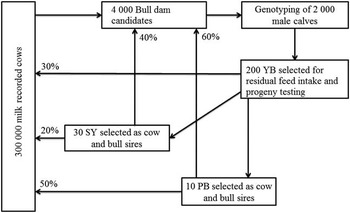
The structure of the modeled breeding scheme (Figure 1) reflecting the current breeding scheme of FAy was intermediate in terms of the use of both genotyped young bulls and progeny tested bulls as bull sires. The population consisted of 300 000 milk recorded cows of which 4000 cows with the highest estimated breeding values (EBV) based on family information were screened as bull dam candidates for producing 2000 bull calves that would be genotyped per year. From the genotyped bull calves, the 200 with the highest genomic estimated breeding values (GEBV) were selected for progeny testing and 30% of milk recorded cows were mated with these young bulls. Each year, out of young bulls, 30 superior young bulls were selected based on their GEBVs for the use as bull and cow sires contributing 40% and 20% to the inseminations in bull and cow dams, respectively. In the scenarios, where RFI traits were included in the breeding goal, young bulls were tested for RFI and superior young bulls were selected based on their GEBVs including information on RFI measured in a test station. Lastly, 10 proven bulls were selected per year when their daughter proofs were available. Proven bulls were used for 60% and 50% of the inseminations in bull and cow dams, respectively.
The structure of modeled breeding scheme and the proportions of bull dams and milk recorded cows mated with young bulls (YB), superior young bulls (SY) and proven bulls (PB).

Breeding goal and indicator traits
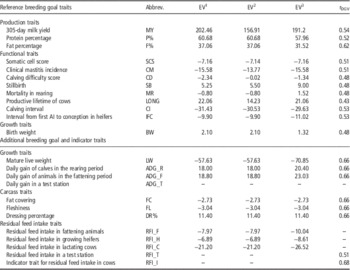
In all selection paths, animals were selected based on the overall breeding goal. The breeding goal of the reference scenario consisted of 12 different traits reflecting the current breeding scheme of FAy with LW, growth, carcass and RFI traits excluded. In the scenarios, where the integration of RFI traits into the breeding goal was studied, the additional breeding goal traits were RFI in lactating cows (RFI_C), RFI in growing heifers (RFI_H) and RFI in fattening animals (RFI_F). These traits were selected through two indicator traits; RFI measured during a performance test of young bulls in a test station (RFI_T) and an indicator trait for RFI measured in lactating dairy cows (RFI_I). RFI_I was assumed to be a trait that is possible to measure at low cost in commercial herds since the identification of the most suitable indicator trait for RFI in lactating cows is still under investigation. Additional growth and carcass traits were LW after the third calving, average daily gain of calves in the rearing period (ADG_R), average daily gain of animals in the fattening period (ADG_F), fat covering, fleshiness and dressing percentage.
The breeding goal traits, indicator traits and economic values of traits used in different scenarios are summarized in Table 1. The economic values of traits used in this study were taken from the earlier study by Hietala et al. (Reference Harper and Henson2014b). The used economic values accounted for returns (including agricultural subsidies) and costs resulting from a combined milk and beef production system in Finland and are given per genetic standard deviation without discounting. Details of the derivation of the economic values and the definitions of the studied breeding goal traits are described by Hietala et al. (Reference Harper and Henson2014b).
Breeding goal and indicator traits, abbreviations (Abbrev.), economic values (EV) and accuracies of genomic breeding values (rDGV) for the studied traits

1 Economic values used in scenarios from 1 to 4.
2 Economic values of traits derived with the declined milk price used in scenario 5.
3 Economic values of traits derived with the increased feed price used in scenario 6.
Description of scenarios
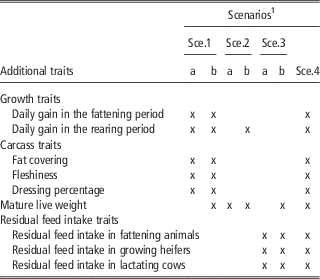
Four scenarios studying the economic consequences of including additional traits in the breeding goal are summarized in Table 2. In addition, the following two scenarios were constructed to assess the sensitivity of the economic changes of the breeding program to different economic conditions applying the same breeding goal assumptions as in scenario 4.
Additional breeding goal traits in the different scenarios

1 Additional breeding goal traits in different scenarios: Sce.1. (a) Average daily gain of animals in the rearing and fattening periods and carcass traits (b) with mature live weight; Sce.2. (a) mature live weight (b) with average daily gain of animals in the rearing period; Sce.3. (a) Residual feed intake traits (b) with mature live weight; Sce.4. mature live weight, growth, carcass and residual feed intake traits.
Scenario 5. The economic values of breeding goal traits were derived for the market situation, where the producer price for milk declined by 25%.
Scenario 6. The economic values of breeding goal traits were derived for the market situation, where the feed price increased by 25%.
In the reference scenario, a combined milk and beef production system was assumed where beef production had an economic value. Therefore, the correlated economic responses to selection in beef traits and, in addition, in all other new breeding goal traits were taken into account when evaluating profitability of each scenario. In general, ZPLAN+ calculates the profit of the breeding program only based on the economic values of breeding goal traits. Therefore, when the economic values of correlated genetic responses in non-breeding goal traits were defined, a correlated economic response in a trait achieved in each selection path was calculated by multiplying a genetic response in a trait by its economic value weighted with a standardized discounted expression for a corresponding selection and trait group. The main evaluation criteria for assessing different scenarios were annual genetic gain in single traits, undiscounted annual monetary genetic gain, discounted monetary genetic gain in different sets of traits and discounted profit of the breeding program.
Input parameters
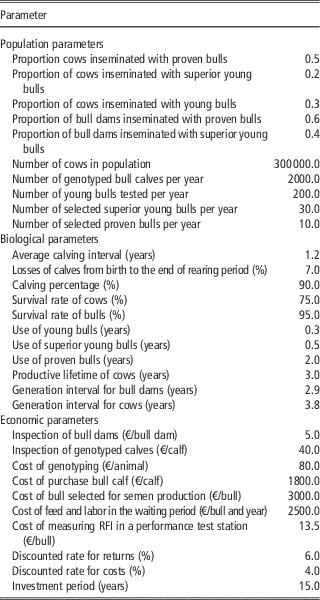
The most important population, biological and economic parameters used in the simulation are presented in Table 3. The population and biological parameters were defined based on three different sources which were as follows: first, the field data of Finnish milk recorded herds collected between 2010 and 2014 received from the breeding organization Faba (Hollola, Finland), second, Finnish milk recording statistics from 2013 (ProAgria, Reference Oltenacu and Broom2013), and third, AI bull statistics for RDC (Himanen A., personal communication). The applied economic parameters of AI program costs were based on the values used in the study by Thomasen et al. (2014) and on information received from VikingGenetics (Himanen A., personal communication). Adding the studied new traits to the breeding goal would only affect the variable costs of the breeding program connected with the selection process of sires because the initial investments needed for recording RFI traits (e.g. constructing suitable testing facilities) were not considered in this study. Therefore, only the aforementioned costs of the breeding program were taken into consideration when comparing different scenarios.
Main population, biological and economic input parameters used for modeling breeding scheme

RFI=residual feed intake.
Genetic parameters
Heritabilities together with phenotypic and genetic correlations of the studied traits are given in Supplementary Table S1. In addition, the list of references used to construct the correlation matrix is given in Supplementary Material S1. These parameters were mainly taken from literature, first, prioritizing parameters derived for the Ayrshire breed. Second, for traits, where no information for the Ayrshire breed was available, parameters derived for the Holstein breed were used. Lastly, genetic correlations of sires’ EBVs between trait groups in the NTM index were applied for traits similar to those included in the sub-indexes, if no estimates were found for genetic correlations between individual traits. These correlations were based on EBVs of RDC bulls with daughter proofs born between 2004 and 2008 (Pösö J., personal communication). The sensitivity of the selection response to very small correlations can be assumed to be negligible. Therefore, to obtain less complex correlation matrix among traits correlations smaller than 0.10 found between single traits or estimated for sires’ EBVs between the sub-indexes of trait groups were set to zero. In addition, genetic correlations between traits, for which no information was available in the literature or based on genetic correlations of sires’ EBVs were assumed equal to zero. The used genetic correlation matrix was converted into a nearest positive semidefinite matrix using the software R with lmf package (Kvalnes et al., Reference Koch, Swiger, Chambers and Gregory2013).
The heritability of RFI_T (0.25) was assumed to be the same as the heritability of RFI in growing animals. In addition, the moderate heritability (0.20) was given to RFI_I. In general, information available on genetic correlations between different RFI traits as well as between RFI and other traits in dairy cattle is limited. In this study, genetic correlations between different RFI traits were assumed to range from 0.40 to 0.70. Connor (Reference Brøndum, Rius-Vilarrasa, Strandén, Su, Guldbrandtsen, Fikse and Lund2015) summarized genetic and phenotypic correlations between RFI and several traits in growing and lactating dairy cattle reported in the literature. In these reported studies, there were mainly no correlations or when found they not statistically significant or agreeing between RFI and traits similar to those included in our study. Therefore, and due to the lack of a better course of action, the genetic correlations between RFI and other traits were set to zero in our reference assumptions. However, given that a few studies have indicated, even though not statistically significantly, an antagonism between RFI and fertility (Vallimont et al., Reference Täubert, Reinhardt and Simianer2013; Gonzalez-Recio et al., Reference Gerber, Steinfeld, Henderson, Mottet, Opio, Dijkman, Falcucci and Tempio2014), the sensitivity of selection responses to the possible antagonistic genetic correlation between RFI and fertility traits was evaluated in Supplementary Material S2.
The genetic correlations between LW, ADG_F, ADG_R as well as birth weight were defined based on the study by Groen and Vos (Reference Gonzalez-Recio, Pryce, Haile-Mariam and Hayes1995). However, the trait definitions used in our study differ from the definitions for the corresponding traits in their study (e.g. LW of heifers after first calving applied in their study cannot be expected to be exactly the same trait as mature LW of cows after third calving applied in our study). Therefore, slightly lower correlations between LW, ADG_F, ADG_R and birth weight were used than estimated by Groen and Vos (Reference Gonzalez-Recio, Pryce, Haile-Mariam and Hayes1995). The investigation of the sensitivity of selection responses to used correlations between growth traits and LW can be found in Supplementary Material S2.
Information sources in selection index and accuracy of genomic breeding values
The computer program ZPLAN+ calculates the reliability of an index based on the different information sources separately for each selection path. For the reference breeding goal traits, the phenotypic information sources used in the selection index of each selection path were records on half-sibs of sire and dam and on paternal half-sibs. Proven bulls received their daughter proofs at the age of 4.6 years. These daughter proofs were based on 120 daughter records for the reference breeding goal traits, which corresponded to the current progeny group size for proven RDC bulls considering both superior young bulls and young bulls (Pösö J., personal communication). This was also the used size of different half-sib groups. One measurement per trait and animal was assumed in all phenotypic information sources. Young bulls that were genotyped shortly after birth had direct genomic breeding values (DGV) for all reference breeding goal traits. Genotyping of cows was not considered in this study. For the scenarios, where growth traits, carcass traits and LW were included, phenotypic information sources (records on half-sibs of sire and dam, on paternal half-sibs and on progeny) and genomic information sources (DGV for genotyped bulls) for ADG_R, ADG_ F, LW and carcass traits were the same as for the reference breeding goal traits.
The average values based on two studies on the reliabilities of genomic predictions for the traits in the NTM index for the RDC population (Brøndum et al., Reference Berry and Crowley2011; Gao et al., Reference Flysjö, Cederberg, Henriksson and Ledgard2013) were used to define the accuracies of DGVs for most of the studied traits except RFI. For a single trait, the accuracy of DGV for a corresponding trait group was applied. The used accuracies of DGVs for studied traits can be found in Table 1.
Measuring residual feed intake traits
For the scenarios, where RFI traits were included, no phenotypic or genomic information were available for RFI breeding goal traits (RFI_F, RFI_H and RFI_C). Phenotypic records on RFI_T were assumed to be available from a performance test of young bulls, right after young bulls started semen production at about 1 year of age. Because RFI_I was recorded on all cows in milk recording, the same phenotypic information sources for RFI_I were applied as for the reference breeding goal traits. Genotyped bulls had DGVs for RFI_T and RFI_I. To our knowledge, no estimates for the accuracy of DGV for RFI traits in the RDC population have been published to date. Therefore, the accuracies of DGVs for RFI_T and RFI_I were calculated using a formula described by Daetwyler et al. (Reference Connor2008 and 2010) as presented in Supplementary Material S3.
Because selection for RFI breeding goal traits was carried out by using indicator traits and genomic selection, the additional costs resulting from the inclusion of these traits in the breeding goal were realized through the costs of recording RFI_T. Costs connected with measuring RFI_T were the costs of feed sample analyzes and labor (weighting of animals, data analyzes and collecting grass silage as well as concentrate samples). In total, time for labor related to the RFI test was assumed to be 120 h/200 tested animals applying the labor costs of 15.9 €/working hour. For the costs of analyzing feed samples, the prices of ARTTURI – Forage Analysis for the year 2014 were applied. The initial investments needed for constructing suitable testing facilities for measuring individual feed intake were not taken into account in the calculations. RFI_I was assumed to be recorded on a large scale in commercial herds at low cost. However, because the most cost-efficient indicator trait in cows for RFI is still under investigation and, thus, no information on the recording costs of this trait, these costs were not taken into account in this study.
Results
Annual genetic gain in studied traits
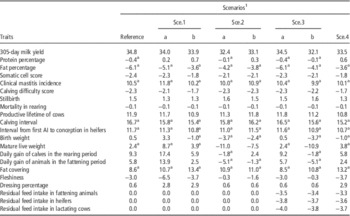
The mean generation interval of the breeding program was 3.9 years. The annual genetic gain in each trait for scenarios 1 to 4 introducing new traits in the breeding goal is presented in Table 4. In all scenarios, 305-day milk yield had the largest annual genetic response. In general, undesired genetic changes were observed in different traits. This was mainly due to the high economic value of 305-day milk yield dominating the breeding goal and, therefore, determining the rate and direction of genetic response in other traits. In addition, unprofitable beef production influenced the economic values of traits and punished an increase in the number of fattening animals. The effects of the subjective modification of the economic values of traits affecting the number of fattening animals to avoid undesired genetic changes are presented in Supplementary Material S2.
Annual genetic gain in traits for the scenarios to study the inclusion of mature live weight (LW), average daily gain in the rearing (ADG_R) and fattening periods (ADG_F), carcass and residual feed intake (RFI) traits in the breeding goal (in genetic standard deviations×100)

aGenetic gains are in the undesired direction with given economic values (e.g. increasing birth weight is favorable from an economic point of view when not taking into account non-economic aspects).
1 Additional breeding goal traits in different scenarios: Sce.1. (a) ADG_R, ADG_F and carcass traits (b) with LW; Sce.2. (a) LW (b) with ADG_R; Sce.3. (a) Residual feed intake (RFI) traits (b) with LW; Sce.4. LW, growth, carcass and RFI traits.
Given that the used economic value for LW favored smaller LW, an unfavorable correlated genetic change in LW was observed in all studied scenarios where selection was based on the selection index excluding LW. However, when including LW alone in the breeding goal in scenario 2a, a desired genetic response was obtained in LW that would lead to genetically smaller LW. The use of a selection index that included growth and carcass traits while preventing larger LW in scenario 1b resulted in a smaller antagonistic change in LW, but also obtained genetic gains in ADG_R and ADG_F were substantially lower compared with scenario 1a excluding LW. This situation was expected, as correlations between growth traits and LW are strong and positive and LW was the third most important trait in terms of the economic values of traits. Among carcass traits, the highest response to selection was observed in fleshiness in all scenarios where included. In general, genetic gains in RFI traits were relatively small in all scenarios when included in the breeding goal and no substantial differences in genetic responses in RFI traits between those scenarios were observed.
Economic evaluation of different scenarios
The discounted costs of the breeding program were 10.1 €/cow for the investment period of 15 years. The inclusion of RFI traits in the breeding program did not substantially increase the costs of the breeding program per cow. This is because the additional costs (13.5 €/tested bull) connected to testing 200 bulls for RFI were spread over all animals in the large cow population.
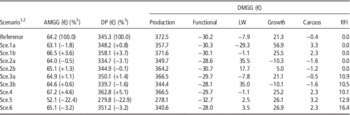
The undiscounted annual monetary genetic gain, discounted profit and discounted monetary genetic gain for the different sets of traits in different scenarios are summarized in Table 5. In scenario 4, where all new traits were added together to the breeding goal the discounted profit was 5.1% higher than in the reference scenario. Among the scenarios not including all new breeding goal traits simultaneously, the inclusion of growth and carcass traits together with LW resulted in the highest increase in the discounted profit of the breeding program (+3.7%) (scenario 1b). This selection index that prevented larger LW resulted in a substantially higher increase in the profit than the selection index that excluded LW (+0.8%) in scenario 1a. When only LW was added or it was added in combination with ADG_R to the breeding goal, the profit of the breeding program reduced by −3.1% and by −0.1% in scenarios 2a and 2b, respectively. This was mainly due to a smaller economic response to selection in milk production and growth traits. When including RFI traits in the breeding goal, a minor increase in the discounted profit was observed (+1.4%) in scenario 3a.
Undiscounted annual monetary genetic gain per cow (AMGG), discounted profit per cow for the investment period (DP) and discounted monetary genetic gain for the sets of traits per cow for the investment period (DMGG) in the different scenarios

1 Additional breeding goal traits in different scenarios: Sce.1. (a) Average daily gain of animals in the rearing and fattening periods and carcass traits (b) with mature live weight (LW); Sce.2. (a) LW (b) with average daily gain of calves in the rearing period; Sce.3. (a) Residual feed intake (RFI) traits (b) with LW; Sce.4. LW, growth, carcass and RFI traits.
2 Sensitivity scenarios: Sce.5. The used economic values derived with the declined milk price; Sce.6. The used economic values derived with the increased feed price.
3 Scenarios from 1 to 4 compared with the reference scenario; scenarios 5 and 6 compared with scenario 4.
The inclusion of growth and carcass traits in the breeding goal was profitable especially when comparing discounted profits of the breeding program. This is due to the fact that genetic gains in ADG_R, ADG_F and carcass traits are realized earlier in animals’ life cycle than LW. Therefore, when considering undiscounted monetary genetic gains with a similar weighting in different traits, the inclusion of LW showed to be more beneficial than found according to the discounted profits. However, the selection index that included growth and carcass traits together with LW (scenario 1b) resulted in the highest increase (+3.6%) also in the undiscounted monetary genetic gain of the breeding program after scenario 4 including all new traits (+4.6%).
In scenario 5, with the economic values derived applying the declined producer price of milk, the profit of the breeding program and the economic response in milk production traits were much lower than in scenario 4. However, no substantial differences in monetary genetic gains in other sets of traits were found because even with a lower economic value of milk production traits they remained dominant. In scenario 6, with the increased feed price, the economic response was slightly lower in production traits, and, in contrast, higher in LW and RFI traits compared with scenario 4. The sensitivity of results to the economic production conditions is discussed in Supplementary Material S2.
Discussion
The results in this study suggest that selection for a better growth performance of fattening animals and replacement heifers together with smaller LW would be the most promising option to improve the profitability of the combined dairy and beef production systems. This was expected due to relatively high economic values found for both daily gain in the fattening and rearing periods by Hietala et al. (Reference Harper and Henson2014b). In addition, LW had the third highest economic value right after 305-day milk yield and protein percentage, which highlighted the economic importance to prevent an increase in LW when selecting for growth traits. However, the economic impact of including fleshiness and fat covering in the breeding goal was only marginal due to their low economic value. The current NTM index of FAy does not include growth or carcass traits. However, commercial slaughterhouse data is routinely received for the genetic evaluation of both Holstein and RDC breeds in the Nordic countries (NAV, Reference McParland, Lewis, Kennedy, Moore, McCarthy, O’Donovan, Butler, Pryce and Berry2013). Therefore, the additional cost of including these traits in the breeding goal would be negligible.
In general, growth and carcass characteristics of both main dairy breeds in Finland are weak. Even though the correlation between the growth sub-index and the current NTM index is favorable, the genetic trend for the growth sub-index in Finnish Holstein has been negative and no substantial change in the genetic trend in FAy has been observed during the last few decades (NAV, 2016). This weak beef production potential combined with the low producer prices has been one of the main reasons for the poor profitability of dairy beef production and a considerable limitation for enhancing beef production in Finland to meet the domestic demand. However, increasing beef production as a by-product from dairy operations is supported by the fact that it is likely to be more profitable in Finnish production conditions than increasing production based on a suckler cow system (Karhula and Kässi, Reference Kargo, Hjortø, Toivonen, Eriksson, Aamand and Pedersen2010; Hietala et al., Reference Hietala, Bouquet and Juga2014a). In addition, the need for mitigating climate change supports an increase in beef production from dairy herds due to its lower emissions per kg of beef produced (e.g. Nguyen et al., 2010; Gerber et al., Reference Gao, Lund, Zhang and Su2013) when assuming no consequential changes in milk production per cow.
Growing public concerns about environmental and ethical aspects of livestock production will likely affect the relative consumption of animal-based food products (Oltenacu and Broom Reference Niemi and Ahlstedt2010) and consequently, the continuity and profitability of milk and beef production. In several European countries, the current specialization of dairy breeds has led to a situation, where excessive dairy calves are used either in veal production or slaughtered before 1 week of age; practises considered unethical by animal welfare groups and an increasing number of consumers (Harper and Henson, Reference Groen and Vos2001). Improving the profitability of beef production by selecting for beef traits in dairy cattle could ensure that purebred dairy calves have a market value also in the future instead of being culled at a very young age or raised for veal production.
From an environmental point of view, although the improved productivity of dairy cows has been proposed to mitigate GHG emissions per unit of milk, the current specialization of milk production will probably not lead to reduced overall GHG emissions from livestock production at constant milk and beef production levels (Flysjö et al., Reference Egger-Danner, Cole, Pryce, Gengler, Heringstad, Bradley and Stock2012; Zehetmeier et al., Reference Veerkamp2012). This is due to the fact that higher milk yield per cow usually leads to reduced number of dairy cows. To meet a constant demand for beef, this reduced beef supply from dairy animals has to be compensated for by increasing specialized beef production with negative environmental impacts. The results of the study by Zehetmeier et al. (Reference Veerkamp2012) showed that with constant milk and beef outputs, increasing milk yield per cow would result in higher total GHG emissions if milk yield was already relatively high. Therefore, in Finnish dairy production with high-producing dairy cows, the further specialization of milk production could potentially lead to increasing total GHG emissions when considering that both milk and beef production are to remain constant.
The inclusion of LW alone in the breeding goal resulted in a decrease in the profit (−3.1%) of the breeding program. However, the inclusion of LW in the selection index that included growth and carcass traits increased the economic benefits resulted from breeding for beef traits. Therefore, to improve feed efficiency, the inclusion of LW in the breeding goal that contains beef traits could be a more promising option than the inclusion of RFI due to lower recording costs. Based on the study by Banos and Coffey (Reference Åby, Kantanen, Aass and Meuwissen2012) different linear conformation traits could be used for predicting LW rather accurately when recording of actual LW on a large-scale is not needed. As the body sub-index including several linear conformation traits having a strong genetic correlation with LW (e.g. Banos and Coffey Reference Åby, Kantanen, Aass and Meuwissen2012) is already published for RDC (NAV, Reference McParland, Lewis, Kennedy, Moore, McCarthy, O’Donovan, Butler, Pryce and Berry2013), even though excluded from the current NTM index, selection for smaller LW would be possible to implement immediately without additional operational costs. However, it should be mentioned that selecting for smaller LW with milk yield is associated with a risk to select for a lower body condition score and, consequently, to increase negative energy balance of cows (e.g. Veerkamp, Reference Vallimont, Dechow, Daubert, Dekleva, Blum, Liu, Varga, Heinrichs and Baumrucker1998). Therefore, the inclusion of LW in the breeding goal should be implemented with caution, for example, by using LW adjusted for body condition score or a restricted selection index.
Under the current economic conditions, the impact of including RFI in the breeding goal on the profit of the breeding program would be minor (+1.4%). This is in line with findings by Gonzalez-Recio et al. (Reference Gerber, Steinfeld, Henderson, Mottet, Opio, Dijkman, Falcucci and Tempio2014), who found a relatively small increase in the profit (+2.4%) when including RFI in the Australian dairy cow breeding goal. However, based on the results of our study, because RFI is at least phenotypically independent of growth and its other predictor traits (LW and milk production traits) (Pryce et al., 2014), the inclusion of RFI traits in the selection index excluding growth and carcass traits could result in economic benefits as opposed to the inclusion of LW. To assess more carefully the overall benefits of selecting for RFI traits, more information on the genetic correlations between RFI and other breeding goal traits in the population studied is needed as well as on the most suitable indicator traits for RFI.
In our study, the costs of measuring RFI in a test station made only a marginal contribution to the costs of the breeding program when considering a population-wide perspective. However, it should be pointed out that the used cost of recording RFI in a test station is an approximate estimate and does not take into account the initial investments needed for constructing suitable testing facilities. In addition, the cost of recording an indicator trait for RFI in lactating cows is yet unknown, because the suitable indicator traits are still under investigation. One option could be to predict RFI in lactating cows based on the MIR spectroscopy analysis of milk samples as proposed by McParland et al. (Reference Kvalnes, Engen, Sæther and Jensen2014). As all milk samples are routinely available through milk recording and are subject to the MIR analysis, the marginal costs to implement a prediction equation for RFI in lactating cows based on the milk MIR spectra would be minor (McParland et al., Reference Kvalnes, Engen, Sæther and Jensen2014) and potentially possible to include in the costs of milk recording. However, according to the results of this study, if recording of a new indicator trait generates extra costs the genetic response from selection for RFI would allow only an additional discounted cost of 5 €/cow and year before the profit of the breeding program turns negative.
Using the economic values and assumptions from the current production system, milk production traits strongly dominated the breeding goal leading to a deterioration of functional traits in all studied scenarios. In our study, the used economic values were derived based on a purely economic objective to maximize farm profit (Hietala et al., Reference Harper and Henson2014b). However, from an ethical perspective, the deterioration of functional traits should be avoided in a breeding program. Therefore, in order to ensure generally sustainable and socially acceptable milk and beef production in the future, the breeding goal should be modified by also accounting for the non-economic values of traits. Traditionally, the subjective modification of the breeding goal has been a common practice in the Nordic dairy cattle breeding programs. Also in the current NTM index, socio-ethical aspects are to some extents taken into account (Kargo et al., Reference Hietala, Wolfová, Wolf, Kantanen and Juga2014).
In general, when comparing alternative breeding schemes it is more beneficial to include all economically important traits in the model than to study only a few most important traits or combined trait groups such as functional and production traits, as important information on genetic responses in single traits or on unwanted correlated responses can be lost. In our study, the breeding goal consisted of 12 to 21 different traits resulting in a very complex correlation structure among traits. A drawback of models that include many different traits is that the correlations used are only estimates often with high level of uncertainty and can be partly unknown; also a common situation in many practical breeding programs. Despite the fact that some correlations between the studied traits were unknown, the results of this study show the relative importance of the traits in the breeding goal which clearly indicate that the economic benefits achieved by selecting for RFI would be only marginal and the inclusion of growth traits together with LW in the breeding goal would be the most cost-efficient way to improve the profitability and environmental efficiency of the combined milk and beef production systems under the current economic conditions. However, it should be mentioned that because of several unknown genetic relationships, one of the main risks to select for a new trait would be an undesired correlated response in some other economically important trait. Especially, the possible antagonistic relationship between RFI and fertility should be taken into account (Gonzalez-Recio et al., Reference Gerber, Steinfeld, Henderson, Mottet, Opio, Dijkman, Falcucci and Tempio2014). Therefore, before any implementation of new traits into the breeding goal can be recommended, the genetic correlations between the new traits and all other traits in the current breeding goal are needed so that consequences of selection for these traits can be more carefully evaluated.
Lastly, it should be pointed out that the results of this study cannot directly be compared with the NTM index due to many differences in the model, but the goal was to study the potential of new traits to be included in the breeding goal for a combined dairy and beef production system to improve the profitability and sustainability of production. This information can be used as a starting point for further investigation when developing the breeding goal for FAy or other dairy breeds that are used for both milk and beef production.
Conclusions
The results of this study showed that among the studied traits the inclusion of growth traits together with LW in the breeding goal would most potentially improve the profitability of the breeding program of a combined milk and beef production system under Finnish market conditions. Therefore, in production systems similar to Finland, where the majority of produced beef originates from dairy herds and beef production fall below consumption, adding beef traits in the breeding goal for dairy breeds could enable more sustainable and profitable milk and beef production. Considering feed efficiency related traits, the inclusion of LW in the selection index that includes growth and carcass traits could be a more promising option compared with the inclusion of RFI since the costs of measuring LW can be expected to be lower and it is readily available. However, to assess more carefully the effects of including RFI in the breeding goal for combined dairy and beef production, it is important to investigate the most suitable indicator traits for RFI or feed efficiency as well as the genetic correlations between RFI and other breeding goal traits.
Acknowledgments
The present study is a part of a project Towards genetic improvement of feed efficiency in dairy cattle coordinated by Natural Resources Institute Finland (Luke) (Helsinki, Finland). Raisio Plc Research Foundation (Raisio, Finland) is acknowledged for financial support. The data were received from Faba (Hollola, Finland).
Supplementary Material
To view supplementary material for this article, please visit 10.1017/S1751731116001877