INTRODUCTION
Previous research notes that firms are subject to legitimacy pressures from their environment, leading them to adopt conforming elements – structures and processes – in order to gain, maintain, and repair legitimacy, a critical resource for firm survival (Meyer & Rowan, Reference Meyer and Rowan1977; Zucker, Reference Zucker1987; Suchman, Reference Suchman1995). Whereas legitimacy has been defined in numerous ways over the wide application of this construct (Bitektine, Reference Bitektine2011), definitions generally converge to refer to a quality that is conferred onto firms when they appear to conform to the customs and practices of their environment. Thus, being perceived as legitimate results in substantial benefits, such as the firm’s right to exist, obtain resources, and thrive (Dowling & Pfeffer, Reference Dowling and Pfeffer1975; Suchman, Reference Suchman1995).
The importance of firm legitimacy to survival and success has become a foundational element of several theories of the firm – such as agency, resource dependence, and institutional theory among others – making legitimacy an ‘anchor-point’ (Suchman, Reference Suchman1995) to our understanding of firm behavior. Yet, few studies explore the richness of the interplay between the pressures existing in a firm’s dynamic environment and the strategic legitimating actions that firms undertake in response; that is, the actions that firms effect in order to enhance others’ perceptions of their legitimacy (cf. Oliver, Reference Oliver1991; Suchman, Reference Suchman1995; Zimmerman & Zeitz, Reference Zimmerman and Zeitz2002). Research suggests that a primary action firms take to engage in strategic legitimation is altering their board of directors (Hillman, Cannella, & Paetzold, Reference Hillman, Cannella and Paetzold2000; Zimmerman & Zeitz, Reference Zimmerman and Zeitz2002; Certo, Reference Certo2003; Higgins & Gulati, Reference Higgins and Gulati2006; Adams, Hermalin, & Weisbach, Reference Adams, Hermalin and Weisbach2010; Perrault, Reference Perrault2014).
Accordingly, in this paper we draw on previous literature suggesting that a firm’s legitimacy depends on how closely its governance aligns with the expectations of its environment (Suchman, Reference Suchman1995; Stoker, Reference Stoker1998; Zimmerman & Zeitz, Reference Zimmerman and Zeitz2002; Monk, Reference Monk2009), and on research suggesting that firms respond to changes in their environment by altering board composition (Pfeffer, Reference Pfeffer1972; Hillman, Cannella, & Paetzold, Reference Hillman, Cannella and Paetzold2000). We extend these previous conceptions by positing that board characteristics represent an important device in a firm’s attempt to mitigate legitimacy pressures through strategic action. In doing so, we build on recent research suggesting that the board’s role and characteristics are dynamic concepts that are tied to a firm’s life cycle (cf. Zahra & Pearce, Reference Zahra and Pearce1989; Lynall, Golden, & Hillman, Reference Lynall, Golden and Hillman2003; Bonn & Pettigrew, Reference Bonn and Pettigrew2009).
Indeed, previous research shows that legitimacy pressures evolve with a firm’s environment, such that considerations of context (Jawahar & McLaughlin, Reference Jawahar and McLaughlin2001; Aguilera & Jackson, Reference Aguilera and Jackson2003) and temporality are relevant to an understanding of board evolution (Bonn & Pettigrew, Reference Bonn and Pettigrew2009). However, these concepts have been scarcely integrated in corporate governance studies to date. Zahra and Pearce (Reference Zahra and Pearce1989) argue that internal and external contextual factors, such as those encompassed by the life cycle model, are key to understanding optimal board configurations. Bonn and Pettigrew (Reference Bonn and Pettigrew2009) set forth a research agenda premised on the idea that the three primary roles of the board identified by agency, decision-making, and resource dependence theory become predominant at different stages of the firm’s life cycle, further impacting board characteristics.
As such, we note that the composition of the board of directors fulfills both a substantive and a symbolic role in the firm’s quest for legitimacy (Mizruchi, Reference Mizruchi1996; Zimmerman & Zeitz, Reference Zimmerman and Zeitz2002; Certo, Reference Certo2003). For instance, Arthaud-Day, Certo, Dalton, and Dalton (Reference Arthaud-Day, Certo, Dalton and Dalton2006) argue that an organization’s legitimacy is interconnected with the image of its strategic leaders such that stakeholders favor associations with firms whose leaders appear more proper and appropriate. Zimmerman and Zeitz (Reference Zimmerman and Zeitz2002) claim that an important role of the board is to increase the legitimacy of new ventures by formalizing network ties with relevant external organizations. Certo (Reference Certo2003), and Higgins and Gulati (Reference Higgins and Gulati2006), propose that prestigious directors enhance the legitimacy of the firm to investors in the initial public offering (IPO) stage, while Pfeffer and Salancik (Reference Pfeffer and Salancik1978) suggest that such prestigious directors provide endorsement to external audiences of the value of the firm.
Following these indications, we advance theorizing on corporate governance by suggesting that board composition primarily reflects substantive and symbolic responses to a firm’s dynamic environment. Accordingly, our research questions are: (1) How do firms’ legitimating strategies evolve across life cycle stages? And (2) how do firms strategically alter their board of directors’ characteristics, both substantively and symbolically, to effect their evolving legitimation strategy? We examine these relationships in the context of the four most commonly studied board characteristics: board size, director independence, board capital, and diversity (Johnson, Daily, & Ellstrand, Reference Johnson, Daily and Ellstrand1996; Daily, Dalton, & Cannella, Reference Daily, Dalton and Cannella2003; Johnson, Schnatterly, & Hill, Reference Johnson, Schnatterly and Hill2013). We do so by illustrating how each of these characteristics may evolve across a firm’s life cycle to enhance the legitimation strategy of the firm by both substantively addressing the evolving concerns of their stakeholders (such as those captured in the life cycle model) and symbolically signaling conformance with the expectations of their environment. While the development of our arguments is primarily rooted in a rigorous analysis of the literature, we also track the changes in the board structure and composition of three companies in the semi-conductor industry through stages of life cycle: Pixelworks, Monolithic Power Systems (MPS), and Advanced Micro Devices (AMD). We use these examples to demonstrate how the propositions we develop throughout are reflected in practice.
Our inquiry is guided by a general call in corporate governance research for the application of theoretical perspectives other than agency and resource dependence theories (Adams, Hermalin, & Weisbach, Reference Adams, Hermalin and Weisbach2010; Dalton & Dalton, Reference Dalton and Dalton2011; Grosvold, Reference Grosvold2011; Johnson, Schnatterly, & Hill, Reference Johnson, Schnatterly and Hill2013) and for the consideration of the contextual factors that contribute to explanations for the lack of strong correlation between board characteristics and financial performance (Daily, Dalton, & Cannella, Reference Daily, Dalton and Cannella2003; Hillman & Dalziel, Reference Hillman and Dalziel2003; Sur, Lvina, & Magnan, Reference Sur, Lvina and Magnan2013). We do so by centering our understanding of firm behavior on the quest for legitimacy, which enables us to transcend narrow theoretical underpinnings in exploring the processes through which firms assimilate and respond to the pressures of their environment through their central governance function, the board of directors.
Indeed, while the relationship between the board characteristics of public firms and financial performance has spurred vast interest and rich investigation in the corporate governance literature, this focus on performance has eclipsed the importance of the legitimating role vested in directors. The present paper builds on the idea that in addition to substantive functions – such as providing access to resources, expertise, network connections, and monitoring (Hillman & Dalziel, Reference Hillman and Dalziel2003) – by virtue of their role, directors cannot escape that stakeholders perceive their characteristics as signals that contribute to the firm’s legitimacy, a highly coveted asset in firms’ success (Higgins & Gulati, Reference Higgins and Gulati2006; Adams, Hermalin, & Weisbach, Reference Adams, Hermalin and Weisbach2010). As a result, our analysis also provides an alternative explanation for the vexing lack of correlation between board composition and firm financial performance noted in prior governance research (Zahra & Pearce, Reference Zahra and Pearce1989; Dalton, Daily, Ellstrand, & Johnson, Reference Dalton, Daily, Ellstrand and Johnson1998; Dalton, Daily, Johnson, & Ellstrand, Reference Dalton, Daily, Johnson and Ellstrand1999; Daily, Dalton, & Cannella, Reference Daily, Dalton and Cannella2003).
Second, by incorporating dynamism into a theory of board evolution and firm legitimacy, we answer a call for contributions toward a more comprehensive theory of boards based on organizational life cycle (Zahra & Pearce, Reference Zahra and Pearce1989; Lynall, Golden, & Hillman, Reference Lynall, Golden and Hillman2003; Bonn & Pettigrew, Reference Bonn and Pettigrew2009) and take into account considerations pertaining to board evolution pre- and post-IPO (Baker & Gompers, Reference Baker and Gompers2003; Certo, Reference Certo2003; Higgins & Gulati, Reference Higgins and Gulati2003). In doing so, we provide a framework that is broadly applicable to public firms operating under dispersed ownership across institutional contexts, and explains board characteristics based on firm-specific internal and external factors. Thus, we contribute to understanding the mechanisms that underpin the evolution of board characteristics, what remains to date a largely unaddressed area of research. Finally, our examination furthers our understanding of the broader interplay between legitimacy as an exogenous constraint on firm behavior and strategic legitimation as a proactive firm response (Oliver, Reference Oliver1991; Suchman, Reference Suchman1995; Zimmerman & Zeitz, Reference Zimmerman and Zeitz2002; Monk, Reference Monk2009) by examining how this dynamic plays out in the context of corporate governance.
FIRMS’ LEGITIMATING STRATEGY AND STAGES OF LIFE CYCLE
Research on corporate boards demonstrates that board characteristics are related to firms’ internal and external complexity (Markarian & Parbonetti, Reference Markarian and Parbonetti2007; Lehn, Patro, & Zhao, Reference Lehn, Patro and Zhao2009) as well as their legitimating environment (Aguilera & Jackson, Reference Aguilera and Jackson2003; Li & Harrison, Reference Li and Harrison2008; Sur, Lvina, & Magnan, Reference Sur, Lvina and Magnan2013). In turn, firm complexity and specific legitimacy pressures have been shown to evolve in patterns representing stages of firms’ generic life cycle (Quinn & Cameron, Reference Quinn and Cameron1983; Miller & Friesen, Reference Miller and Friesen1984; Kazanjian, Reference Kazanjian1988; Hanks, Watson, Jansen, & Chandler, Reference Hanks, Watson, Jansen and Chandler1993; Jawahar & McLaughlin, Reference Jawahar and McLaughlin2001). For instance, Lehn, Patro, and Zhao (Reference Lehn, Patro and Zhao2009) show that board size and composition are driven by firm size, growth opportunities, merger activity, and geographical expansion, representing typical milestones of life cycle stages. Stages of life cycle thus capture rather accurately the temporal and sequential complexity of firms (Van de Ven & Poole, Reference Van de Ven and Poole1995).
In this paper, we use the firm life cycle model as a stylized archetype to help us model the evolution of firms’ legitimating strategies, which firms effect in response to the internal and external presures that typify each stage. Whereas numerous life cycle models exist (Downs, Reference Downs1967; Greiner, Reference Greiner1972; Churchill & Lewis, Reference Churchill and Lewis1983; Adizes, Reference Adizes1989) we rely on Miller and Friesen’s (Reference Miller and Friesen1984) and Quinn and Cameron’s (Reference Quinn and Cameron1983) foundational integrative efforts and adopt a generic four-stage model: entrepreneurial, growth, maturity, and decline, viewing each stage as a ‘unique configuration of variables related to organization context and structure’ (Hanks et al., Reference Hanks, Watson, Jansen and Chandler1993: 7). As we do so, we note that in extant research the generic four-stage model has been shown to represent the prevalent pattern of firm evolution. Since the life cycle model is based on changes in the most significant substantive functions of a firm, it offers a relevant framework to understand the evolution of the substantive role of the board.
We also note that firms may not progress through life cycles at a steady pace. Rather, it is more realistic to envision firms’ evolution as phases of equilibrium punctuated by disruptive events – such as an IPO, a major acquisition, or a legitimacy crisis – that propel the firm through life cycle stages. For example, a firm may remain in the entrepreneurial stage for many years before engaging in a short, explosive growth phase that results from a strategic acquisition that quickly drives the firm to an IPO and into maturity. As a result, we urge readers to interpret our model as a schematized illustration of firm and board evolution processes, nonetheless one that characterizes most firms.
In conjunction with the evolving structure and activities of the firm, external pressures on firms to appear desirable and appropriate also affect board characteristics. These pressures to conform to the regulatory, socio-political, and cultural aspects of society (Scott, Reference Scott1995; Zimmerman & Zeitz, Reference Zimmerman and Zeitz2002) call for largely symbolic signals that the firm operates consistently with stakeholders’ expectations regarding the norms, accreditation bodies, traditions, and customs of interaction. For example, post-IPO, significant regulative pressures such as New York Stock Exchange and NASDAQ policies require firms to present a majority of independent directors. Since the firm’s legitimacy is largely defined by its stakeholders (Patriotta, Gond, & Schultz, Reference Patriotta, Gond and Schultz2011), whose prominence evolves across a firm’s life cycle (Jawahar & McLaughlin, Reference Jawahar and McLaughlin2001), legitimacy pressures also tend to shift as firms grow.
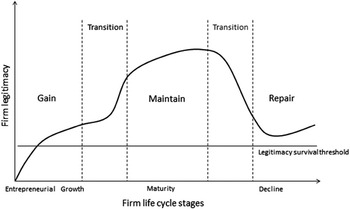
In response, previous literature converges in its suggestion that firms engage in strategic actions to gain, maintain, or repair legitimacy. That is, firms effect strategic choice to manipulate their type and level of legitimacy in pursuit of their objectives (Child, Reference Child1972; Ashforth & Gibbs, Reference Ashforth and Gibbs1990; Oliver, Reference Oliver1991; Suchman, Reference Suchman1995; Zimmerman & Zeitz, Reference Zimmerman and Zeitz2002). We extend previous literature by suggesting that a natural extension of legitimacy pressures and stakeholder dominance progression is that firms’ legitimating strategies also evolve, paralleling the firm’s life cycle with punctuated equilibria surrounding transition phases.
For instance, gaining legitimacy is the challenge of firms plagued with the ‘liability of newness’ (Stinchcombe, Reference Stinchcombe1965; Aldrich & Fiol, Reference Aldrich and Fiol1994; Suchman, Reference Suchman1995), that is, those seeking to win the support of potential constituents without a proven reputation to support their claims (Ashforth & Gibbs, Reference Ashforth and Gibbs1990; Petkova, Rindova, & Gupta, Reference Petkova, Rindova and Gupta2008). Such is the case of entrepreneurial ventures, that seek the support of critical stakeholders to gain access to resources (Zimmerman & Zeitz, Reference Zimmerman and Zeitz2002), and of growing firms, that must acquire legitimacy with initial market investors in order to move to the IPO stage (Certo, Reference Certo2003; Higgins & Gulati, Reference Higgins and Gulati2003). Indeed, a critical task of entrepreneurial ventures is to convince the external environment that its purpose is legitimate, and then to garner support for its right to exist (Kazanjian, Reference Kazanjian1988; Aldrich & Fiol, Reference Aldrich and Fiol1994; Navis & Glynn, Reference Navis and Glynn2011). In the growth phase, firms are quickly growing output, which generally involves increasing the number of employees, the capacity of its facilities, and many other firm factors that are underpinned by the availability of capital (Jawahar & McLaughlin, Reference Jawahar and McLaughlin2001). For these reasons, the growth stage often includes the firm’s decision to become publicly-held through an IPO (Higgins & Gulati, Reference Higgins and Gulati2003), during which the firm must overcome its liability of market newness by gaining legitimacy with new and growing stakeholders.
As they reach maturity, firms’ internal and external environments have become more complex, leading mature firms to focus on structure and formalization while enjoying the benefits of a widely-accepted legitimate standing among stakeholders (Quinn & Cameron, Reference Quinn and Cameron1983; Ashforth & Gibbs, Reference Ashforth and Gibbs1990). However, mature firms face three somewhat problematic conditions pertaining to the maintenance of their legitimacy: (1) stakeholder audiences are heterogeneous, (2) the momentum of the firm may prevent its responsiveness to emerging stakeholder concerns, and (3) attempts to maintain legitimacy may in themselves spur delegitimation by fringe audiences (Suchman, Reference Suchman1995). As a result, mature firms focus their efforts on maintaining legitimacy, and they do so largely by issuing symbolic signals of reassurance that the firm continues to conform with the expectations of its environment, which serve to preserve the status quo (Ashforth & Gibbs, Reference Ashforth and Gibbs1990).
While firms can enter decline following any stage of life cycle (Downs, Reference Downs1967; Miller & Friesen, Reference Miller and Friesen1984), in this stage firms face an evident need to repair legitimacy because of threats that arise from an unforeseen crisis or the inability to fulfill a constituent’s expectations in a significant way (Ashforth & Gibbs, Reference Ashforth and Gibbs1990; Suchman, Reference Suchman1995). As an example, a decrease in sales indicates that stakeholders begin to withdraw their support for the firm, either because the firm’s output no longer fulfills consumers’ needs, or following a moral legitimacy concern, such as a boycott of lettuce to support better conditions for farm workers. In turn, investors and creditors may also withdraw their financial support (D’Aveni, Reference D’Aveni1990), questioning the pragmatic appeal of the firm’s stock in view of declining sales or a moral crisis. Thus, firms in decline are prone to a ‘retraction cascade’ (Suchman, Reference Suchman1995: 597) that begins with a lack of product appeal, a decrease in financial performance, and ends with the exodus of top management, including prominent board members (D’Aveni, Reference D’Aveni1990; Hambrick & D’Aveni, Reference Hambrick and D’Aveni1992). As a result, firms in decline must re-establish their legitimacy via appropriate legitimating acts, and such acts often translate into new directors whose characteristics are meant to mitigate the specific source of the loss of legitimacy.
In sum, by juxtaposing firms’ legitimating strategies and life cycle, we can better account for the effect of both internal and external factors on boards’ characteristics. The underpinnings of the framework we develop for understanding board evolution are summarized in Figure 1. The legitimacy survival threshold delimits the minimum level of legitimacy needed for the firm to survive, undergirding challenges faced at every stage of life cycle. The transition phases reflect the periods of turmoil at the intersection of two phases. For example, it is well known that firms ‘gear up’ for an IPO by adding prestigious directors to their board (e.g., see Higgins & Gulati, Reference Higgins and Gulati2006), even while those directors may not stay in position as the firm proceeds to maturity. Thus, these transition periods enable us to better model the reality of firms as they undergo substantive functional changes related to their life cycle, all the while reflecting the evolving legitimating pressures of their environment.
Firms’ legitimation strategy and life cycle evolution

The companies we use to illustrate our arguments in the following section present different life cycle trajectories, further supporting the value of our framework. Briefly, MPS is a good example of a firm that progresses steadily through the entrepreneurial, growth and mature stages of life cycle. It was founded in 1997, did an IPO in 2004, and has reached a market capitalization of $1,830 million by the Fall of 2014. By contrast, Pixelworks was also founded in 1997, then did a ‘nano cap’ IPO on the NASDAQ in 2000 and has grown to a micro cap company with a capitalization of $156 million by the Fall of 2014. It represents an example of a company executing successful entrepreneurial and growth stages, but that suffers decline before getting to maturity. Finally, AMD was founded in 1969, did an IPO in 2000 as a large mature company, and entered a decline stage in 2012, thus providing the opportunity to observe board changes during this life cycle stage. More comprehensive board data for these companies is provided in Appendix.
THE EVOLUTION OF BOARD COMPOSITION: SUBSTANTIVE AND SYMBOLIC ACTIONS TO EFFECT LEGITIMATING STRATEGIES
Legitimating strategies generally refer to changes in the firm’s practices or visible signals aimed at conveying the firm’s conformance to the environment’s expectations (Ashforth & Gibbs, Reference Ashforth and Gibbs1990; Deephouse & Carter, Reference Deephouse and Carter2005). In this section, we build on extant literature (Stoker, Reference Stoker1998; Certo, Reference Certo2003; Arthaud-Day et al., Reference Arthaud-Day, Certo, Dalton and Dalton2006; Higgins & Gulati, Reference Higgins and Gulati2006; Monk, Reference Monk2009) to suggest that the role, structure and composition of a firm’s board of directors is impacted by actions taken by the firm as part of its legitimating strategy. Specifically, we suggest that strategies to gain, maintain, and repair legitimacy are enacted through changes in a board’s characteristics, representing intertwined substantive modifications to the firm’s practices and symbolic signals used to convey the firm’s responsiveness to its environment (Epstein & Votaw, Reference Epstein and Votaw1978; Ashforth & Gibbs, Reference Ashforth and Gibbs1990).
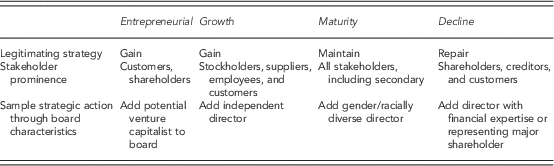
To illustrate our arguments, we focus on the four board characteristics most prevalent in governance research (Daily, Dalton, & Cannella, Reference Daily, Dalton and Cannella2003; Dalton & Dalton, Reference Dalton and Dalton2011; Johnson, Schnatterly, & Hill, Reference Johnson, Schnatterly and Hill2013): board size, the proportion of independent directors, board capital, and board diversity. Below, we explain how we envision each of these board characteristics to evolve with firms’ legitimating strategies across their life cycle. We juxtapose firms’ legitimating strategies, their salient stakeholders at each stage, and propose exemplar legitimating actions firms take with their board in Table 1.
Firm life cycle, legitimating strategy, and board composition

Board size
Although entrepreneurial firms have the greatest need for acquiring legitimacy through external linkages and thus should present larger boards (Pfeffer & Salancik, Reference Pfeffer and Salancik1978), there is reason to believe that entrepreneurial boards will be small in size, indicative of the firm’s concentrated ownership and the fewer stakeholder groups to whom the organization is accountable (Jawahar & McLaughlin, Reference Jawahar and McLaughlin2001). Smaller boards have been shown to be more efficient in decision-making, creative in problem-solving, and swift in initiating strategic action (Goodstein, Gautam, & Boeker, Reference Goodstein, Gautam and Boeker1994; Dalton et al., Reference Dalton, Daily, Johnson and Ellstrand1999; Garg, Reference Garg2013), which represent common needs of entrepreneurial ventures. Thus, keeping the board small and populated with directors heavily invested in the entrepreneurial firm enables these firms to gain legitimacy with key constituents.
In turn, growing firms can strategically acquire legitimacy with potential market investors through strategic board appointments. Previous research shows that growing firms appoint independent, prestigious directors when getting ready to undertake an IPO, precisely to enhance their legitimacy with investors (Higgins & Gulati, Reference Higgins and Gulati2006). As they do so, firms begin to expand the size of their board.
At maturity, firms answer to a wider array of external stakeholders and also become internally more complex, such that they may require a greater number of directors to address the many issues they confront. In addition, as firms become accountable to more stakeholders, they may strategically co-opt their participation by offering directoral appointments (Zimmerman & Zeitz, Reference Zimmerman and Zeitz2002), further increasing the size of the board. For instance, mature firms may signal their legitimacy by including representatives of key stakeholder groups on their board to prevent activism and maintain stakeholder support (Freeman & Evan, Reference Freeman and Evan1990). At decline, similar dynamics occur as the firm seeks to regain the support of critical stakeholder groups and access a wider pool of resources needed to spur new growth (Hambrick & D’Aveni, Reference Hambrick and D’Aveni1992).
Previous empirical research shows that more complex firms, which have greater advising requirements than simple firms, present larger boards (Coles, Daniel, & Naveen, Reference Coles, Daniel and Naveen2008), as do larger firms, those with greater geographical coverage (Lehn, Patro, & Zhao, Reference Lehn, Patro and Zhao2009), and those that present more tangible assets (Baker & Gompers, Reference Baker and Gompers2003). Similarly, Boone, Field, Karpoff, and Raheja, (Reference Boone, Field, Karpoff and Raheja2007) show that board size increases with the time elapsed since a firm’s IPO, while Booth and Deli (Reference Booth and Deli1996) find a positive relationship between board size and the complexity of a firm’s stakeholder network. Likewise, a larger board has been shown to relate to greater scrutiny and increased pressure for conformance with stakeholder expectations (Hillman, Shropshire, & Cannella, Reference Hillman, Shropshire and Cannella2007; Bonn & Pettigrew, Reference Bonn and Pettigrew2009), which are characteristic of firms in later stages of life cycle. For these reasons, we expect the size of the board to increase across the firm’s life cycle:
Proposition 1: Boards of directors become larger as firms progress through their life cycle.
Our examples support a growth trend in board size across stages of life cycle. For instance, Pixelworks had four board members in 1999, a year before IPO. By 2012, the board had grown to nine directors. Likewise, MPS had five board members in 2003, the year before IPO, and eight by 2012. We also note that in both of these cases, the investors require class voting on board participation in the entrepreneurial stage in order to assure the representation of lead investors. In turn, this limits board size in the early stages of the firm’s life as detailed above.
Independent directors
Given that a principal task of entrepreneurial firms is to develop strategic adaptability (Zimmerman & Zeitz, Reference Zimmerman and Zeitz2002; Navis & Glynn, Reference Navis and Glynn2011), entrepreneurial firms can benefit from having a greater proportion of inside directors who are familiar with the inner workings of the organization (Baysinger & Hoskisson, Reference Baysinger and Hoskisson1990; Goodstein, Gautam, & Boeker, Reference Goodstein, Gautam and Boeker1994). Indeed, Garg (Reference Garg2013) argues that board independence is less relevant in entrepreneurial ventures because chief executive officers’ (CEO) financial interests are closely aligned with other firm owners (Graebner & Eisenhardt, Reference Graebner and Eisenhardt2004; Wasserman, Reference Wasserman2006). Around the IPO stage, however, firms need to acquire legitimacy with market investors, resulting in a mounting concern for effective monitoring of management (Garg, Reference Garg2013) and the display of board independence (Certo, Reference Certo2003). Indeed, since investors’ interests are protected largely through directors’ monitoring (Jensen & Meckling, Reference Jensen and Meckling1976; Eisenhardt, Reference Eisenhardt1989), the role of the board in demonstrating legitimacy to investors – through accountability and the viability of future rents – becomes critical at the IPO stage (Certo, Reference Certo2003; Higgins & Gulati, Reference Higgins and Gulati2006; Bonn & Pettigrew, Reference Bonn and Pettigrew2009). For instance, it is reported that TIAA-CREF declared it would only invest in firms that have a majority of independent directors, while CALPERS recommends that the CEO be the only non-independent director (Coles, Daniel, & Naveen, Reference Coles, Daniel and Naveen2008).
These comments reinforce the New York Stock Exchange and NASDAQ requirements effected in 2004 that independent directors comprise the majority of the board (Public Company Advisory Group, 2013). In this setting, an independent director is defined as ‘one who is not an officer or employee of the company, and who in the board’s opinion has no relationship that would interfere with the exercise of independent judgment,’ and firms are accorded 1 year post-IPO to comply with this rule.
Mature firms are under yet greater scrutiny in their governance practices, sustaining the pressure for independent directors. Westphal and Graebner (Reference Westphal and Graebner2010) find that firms can signal legitimacy to analysts – an important stakeholder of mature firms – by making the board more independent. Similarly, governance studies suggest that board independence increases with firm size, complexity, and diversity (Boone et al., Reference Boone, Field, Karpoff and Raheja2007; Coles, Daniel, & Naveen, Reference Coles, Daniel and Naveen2008; Lehn, Patro, & Zhao, Reference Lehn, Patro and Zhao2009), which grow as firms advance through their life cycle stages. In the decline stage, a common practice is to change the top leadership of the firm to include outsiders, who bring the fresh perspective needed for the firm’s strategic turnaround (Cannella & Lubatkin, Reference Cannella and Lubatkin1993) and sustain shareholders’ confidence in the firm (Hambrick & D’Aveni, Reference Hambrick and D’Aveni1992; Jawahar & McLaughlin, Reference Jawahar and McLaughlin2001). We posit:
Proposition 2: Boards of directors present an increasing proportion of independent directors as firms progress through their life cycle.
To illustrate this trend, we note the significant addition of independent directors in Pixelworks in the growth phase. As an entrepreneurial firm, it had four board members that included the founder, two venture capitalists, and one independent director. Within a few years post-IPO, the two venture capitalists were removed from the board and all the new directors (five) were independent. At MPS, the five directors that composed the board in the entrepreneurial phase included only one independent member. one independent director was added the year of the IPO, and three more shortly thereafter. As the firm entered maturity, two more independent directors joined the board. In both cases, we note that these independent directors expanded the size of the board while also replacing venture capitalists and insiders that composed a majority of the entrepreneurial firm’s board. We also notice that in Pixelworks’ decline, spurred by a decline in financial performance, several changes take place on the board, most notably the addition of five independent directors, including three with strong financial expertise, and the removal of the two insiders on the board (including the founder). This is consistent with our prior arguments describing the removal of top management from the board and their replacement by independent directors with an expert financial background that serve to repair legitimacy with investors in the decline stage.
Board capital
Board capital encompasses both the human and social capital of directors, that is, their skills and experience, and the resources they have access to through their network of relationships, respectively (Hillman & Dalziel, Reference Hillman and Dalziel2003; Stevenson & Radin, Reference Stevenson and Radin2009; Johnson, Schnatterly, & Hill, Reference Johnson, Schnatterly and Hill2013). Thus, it also includes the prestige of directors, described as their membership in privileged social circles, such as elite educational backgrounds (Zimmerman & Zeitz, Reference Zimmerman and Zeitz2002; Certo, Reference Certo2003; Higgins & Gulati, Reference Higgins and Gulati2003), board memberships, previous officer positions in other corporations (Pfeffer & Salancik, Reference Pfeffer and Salancik1978; Filatotchev & Bishop, Reference Filatotchev and Bishop2002) or in political and military organizations (D’Aveni, Reference D’Aveni1990). We conceptualize board capital to evolve across a firm’s life cycle such that the importance of directors’ human and social capital is greater in earlier stages of firm life, giving way to their representation of critical stakeholder groups in both substantive and symbolic ways in the later stages of firm life. Such is the case because as firms evolve through stages of life cycle, they develop internal capabilities that fulfill the firm’s needs, previously surrogated by directors’ capital, while external stakeholder groups increasingly demand representation in the firm’s decision-making. These demands follow the increasing visibility of the firm’s board to external constituents: from non-existent in the entrepreneurial stage to limited visibility in the growth stage (mostly through the S1 filings before IPO), and high scrutiny in the mature and decline stages.
Specifically, entrepreneurial ventures gain legitimacy by appealing to the legitimating eye of two dominant stakeholder groups: customers, who provide the primary source of revenues, and shareholders and creditors, who provide the primary source of capital (Jawahar & McLaughlin, Reference Jawahar and McLaughlin2001). A principal way through which entrepreneurial firms do so is by composing their board with directors that convey conformance with generally accepted values and beliefs (Pfeffer, Reference Pfeffer1972; Zimmerman & Zeitz, Reference Zimmerman and Zeitz2002), which anchors these firms’ claim to legitimacy in people that signal the soundness of the firm’s purpose for being and its ability to become successful (Pfeffer & Salancik, Reference Pfeffer and Salancik1978; Aldrich & Fiol, Reference Aldrich and Fiol1994; Hillman & Dalziel, Reference Hillman and Dalziel2003). These directors further enable entrepreneurial firms to gain access to the necessary resources to grow, which facilitates their crossing the survival legitimacy threshold (Chen & Hambrick, Reference Chen and Hambrick1995; Chen, Hambrick, & Pollock, Reference Chen, Hambrick and Pollock2008; Katila, Rosenberg, & Eisenhardt, Reference Katila, Rosenberg and Eisenhardt2008; Garg, Reference Garg2013).
For example, venture capital providers serve a strategic signaling function facilitating a firm’s ability to establish social ties with critical economic agents (Megginson & Weiss, Reference Megginson and Weiss1991; Ferrary & Granovetter, Reference Ferrary and Granovetter2009). Therefore, entrepreneurial firms will seek high human and social capital in their board members, as these directors can gain legitimacy for the firm through their experience, skills, and network of contacts (Zimmerman & Zeitz, Reference Zimmerman and Zeitz2002). With similar reasoning, Certo (Reference Certo2003) argues that growing firms can gain legitimacy when undertaking an IPO with boards that signal rationalized elements appealing to investors’ pragmatic evaluations of the firm. Specifically, prestigious directors are expected to play a key role in influencing investors’ favorable perceptions of the firm at IPO (Filatotchev & Bishop, Reference Filatotchev and Bishop2002; Certo, Reference Certo2003) because they increase perceptions of the firm’s legitimacy (Higgins & Gulati, Reference Higgins and Gulati2006).
When firms grow to maturity, they reach a level of social anchoring that renders less importance to their reliance on the board of directors for access to tactical resources (Johnson, Schnatterly, Bolton, & Tuggle, Reference Johnson, Schnatterly, Bolton and Tuggle2011; Acharya & Pollock, Reference Acharya and Pollock2013). Instead, these firms are increasingly pressured to respond to moral pressures from their environment by adding stakeholder representatives to their board (Luoma & Goodstein, Reference Luoma and Goodstein1999). Stakeholder theorists generally support that given firms’ moral obligation to consider the interests of groups that stand to be affected by the firm’s activities (Donaldson & Preston, Reference Donaldson and Preston1995), a logical extension concerns the involvement of stakeholders in firms’ decision-making and governance (Freeman & Evan, Reference Freeman and Evan1990; Phillips, Freeman, & Wicks, Reference Phillips, Freeman and Wicks2003), which also aids in maintaining the firm’s legitimacy (Jones & Goldberg, Reference Jones and Goldberg1982; Suchman, Reference Suchman1995).
Indeed, since mature firms tend to be larger and more visible (Chen & Hambrick, Reference Chen and Hambrick1995), they are increasingly scrutinized by a variety of stakeholders (Jawahar & McLaughlin, Reference Jawahar and McLaughlin2001). In turn, these constituents perceive and evaluate the firm along their concerns for social welfare, and are thus highly responsive to signals that the firm emits to convey legitimacy (Musteen, Datta, & Kemmerer, Reference Musteen, Datta and Kemmerer2010). As such, mature firms maintain their legitimacy largely by increasing the visibility of their social responsiveness through signals that they are doing the ‘right thing,’ paying increased attention to the symbolic meaning of their directors’ characteristics.
However, these concerns arise later in the firm’s life, generally after an IPO, when the firm answers to a much broader array of stakeholders. At this time, the expertise of directors that was so critical to the early stages of the venture’s growth are generally replaced by the expertise of internal managers. In turn, the board’s growing symbolic role requires board capital that provides strategic ties to stakeholder groups that are key in maintaining or repairing the firm’s legitimacy. Similarly, since firms in decline face the challenge of repairing legitimacy with few resources to spare, they especially need the endorsement of critical stakeholder groups to survive. Such stakeholders may be offered a board seat to secure their participation in the renewal of the firm. We suggest:
Proposition 3: Boards of directors present a decreasing (increasing) need for board capital (stakeholder representatives) as firms progress through their life cycle.
We find this proposition to reflect several changes exemplified by the companies we follow. At Pixelworks, we notice a trend of declining insiders on the board, and increasing industry representatives. This likely helps support the firm as it builds connections across the industry while expanding its stakeholder network in the growth phase. At decline, we noted in the previous section the significant addition of directors with financial expertise, attempting to regain the critical endorsement of shareholders. At AMD, the largest of all three firms, we note the influence of stakeholder scrutiny on the firm’s preference for prestigious and diverse directors. In this case, prestige is exemplified by the number of directors with prior CEO positions. In decline, two of the five new directors were recommended or appointed by investors, the main stakeholder with whom the firm needs to repair legitimacy in this phase. These examples also illustrate that the capital needed from the board in earlier stages (mostly of substantive nature) evolves to include increasingly symbolic representations that serve the firm’s legitimating strategy with key stakeholders.
Board diversity
The importance of board diversity, generally encompassing race and gender (Carter, Simkins, & Simpson, Reference Carter, Simkins and Simpson2003), increases with the diversity of the firm’s stakeholders. Board diversity may also shift from being primarily of substantive to symbolic value to the firm’s legitimacy. For instance, entrepreneurial and growing firms may value diversity tangentially, through directors’ expertise contributing to innovation and ties to capital, while mature firms may be more concerned with responding to stakeholder pressures through appearances of diversity contributing to the firm’s reputation (Miller & del Carmen Triana, Reference Miller and del Carmen Triana2009; Bear, Rahman, & Post, Reference Bear, Rahman and Post2010).
The intensifying issue of board diversity is evidenced in the 2010 SEC rule 407(c)(2)(vi) requesting that publicly traded firms add in their proxy statements disclosure regarding their board of directors’ diversity (www.sec.gov). In recent years, there has also been exponential growth in the number of shareholder proposals by activists representing several stakeholder types requesting that firms report on, and include, more women and minorities on their board of directors (Perrault, Reference Perrault2014). Since 92% of entrepreneurial firms are founded by men (www.cbinsights.com), and since social networks tend to present homophily (McDonald, Khanna, & Westphal, Reference McDonald, Khanna and Westphal2008), it seems natural that the representation of diversity only becomes a preoccupation of firms in later stages of their life cycle, when they are pressured by stakeholders to consider such normative issues.
For instance, while mature firms benefit from well-established legitimacy, they can hardly effect real change in practices to satisfy the multiple, growing expectations of their stakeholders. As a result, they may engage in ceremonial conformity – a strategy whereby firms adopt certain visible practices to explicitly demonstrate legitimacy while continuing to operate as usual (Meyer & Rowan, Reference Meyer and Rowan1977; Ashforth & Gibbs, Reference Ashforth and Gibbs1990). Previous research demonstrates that mature firms use the configuration of their board of directors to emit such signals of conformity to maintain legitimacy (Musteen, Datta, & Kemmerer, Reference Musteen, Datta and Kemmerer2010). For example, Bernardi, Bean, and Weippert (Reference Bernardi, Bean and Weippert2002) show that firms with a large proportion of women on their board include pictures of them in their annual reports so as to signal care for gender equality and the advancement of women (Bear, Rahman, & Post, Reference Bear, Rahman and Post2010). Therefore, we posit:
Proposition 4: Boards of directors present an increasing proportion of diverse directors as firms progress through their life cycle.
We note the increasing diversity of MPS and AMD’s board as they near or reach the maturity stage. MPS adds a woman on the board 3 years post-IPO, while at AMD we notice the replacement of an existing woman director by another woman director. We also make note of the increasing ethnic diversity on both of these boards compared with that of Pixelworks, which has not reached the maturity stage.
Firms’ real ability to effect change on their board
As we seek to contribute to a theory of board evolution, we would be remiss not to address the factors that affect firms’ real ability to effect change in their board’s characteristics. Previous research suggests that the more the firm’s environment favors the diffusion of consistent norms, values, and practices, and the more the firm stands to gain from conforming to these legitimacy pressures, the more likely the firm is to effect changes that support the firm’s legitimating strategy (Oliver, Reference Oliver1991). However, even when the firm actively seeks to effect such changes, structural and relational elements of boards may hinder firms’ exercise of their discretion to do so. Specifically, previous research finds that the power of the CEO (Baker & Gompers, Reference Baker and Gompers2003; Lynall, Golden, & Hillman, Reference Lynall, Golden and Hillman2003; Combs, Ketchen, Perryman, & Donahue, Reference Combs, Ketchen, Perryman and Donahue2007), the composition of the nomination committee (Kaczmarek, Kimino, & Pye, Reference Kaczmarek, Kimino and Pye2012), the entrenchment of directors (Walsh & Seward, Reference Walsh and Seward1990), the firm’s ownership structure (Denis & Sarin, Reference Denis and Sarin1999), and the classification of boards (Faleye, Reference Faleye2007) can significantly impact firms’ ability to effect board change.
Nevertheless, previous research shows that a substantial proportion of firms do present changes in board characteristics in any given year, indicating that board characteristics are much more dynamic than is commonly believed (Denis & Sarin, Reference Denis and Sarin1999). With a rapidly decreasing proportion of staggered boards and SEC mechanisms in place to reduce the power of the CEO, barriers to board change are eroding. To be sure, even if board changes take a year or two to come into effect, the firm’s progression through stages of life cycle allows time for boards’ responsiveness and alignment with the firm’s legitimating strategy, as modeled in this paper.
We also note that barriers to board change may be more or less predominant given a configuration of firm variables captured in its stage of life cycle. For instance, entrepreneurial and growing firms may be less susceptible to the structural constraints of boards, such as the classification of boards and managerial entrenchment, since their boards are young and more fluid. By definition, these firms are experiencing rapid changes in product development, capacity, and institutionalization, which forces constant restructures. In addition, entrepreneurial and growing firms are under great scrutiny from a small number of critical stakeholders – such as financiers – who hold much power in the decisions concerning these firms’ governance. These constituents are either astutely aware of the characteristics the board needs in order to gain legitimacy, or represent in and of themselves the legitimacy pressures affecting the firm, further supporting changes made within the legitimating strategy of the firm.
By contrast, mature firms and those in decline are more likely to present inherited staggered structures and managerial entrenchment. Mature firms may also be led by higher status CEOs, who have the power to control the boards’ characteristics to their advantage, while firms in decline are altogether more challenging in terms of director recruitment. Nevertheless, we suggest that none of these barriers to change prevents firms from effecting their legitimating strategy as elaborated previously in this paper. Rather, we acknowledge that the pace of change may differ for firms at various stages. We propose:
Proposition 5: Entrepreneurial and growing firms present a greater ability to effect rapid change in their board’s characteristics that is congruent with their legitimating strategy than mature firms and firms in decline.
In our examples, the greatest board stability is found in MPS, which presents a generic maturity phase. In the entrepreneurial phase, both MPS and Pixelworks had rules of 1 year terms with class election characteristics. In the growing phase, new term classes were established at IPO, ranging from 1 to 3 years. These rules are generally set to enable critical stakeholders – such as venture capitalists – to effect rapid change on the board while preserving their influence. At the same time, as more board members are hired under longer terms and relationships are established across the industry, director appointments become slightly ‘stickier’ in the mature and decline stages.
DISCUSSION
The main argument of this paper is that as firms progress through their life cycle, they face evolving legitimacy pressures of both substantive nature (based on functional changes related to life cycle) and symbolic value (because of the firm’s changing stakeholder environment). These evolving pressures lead firms to pursue legitimating strategies that are supported by, and reflected in, their board’s evolving roles and characteristics. As we anchor our arguments in the concept of legitimacy, our work contributes to a theory of corporate governance that takes into account firms’ dynamic environment. In addition, whereas previous literature using the firm life cycle framework largely focuses on firms’ effectiveness (Cameron & Whetten, 1981; Quinn & Cameron, Reference Quinn and Cameron1983), we apply this framework to map the ways in which firms strategically align their board of directors’ characteristics with their legitimation strategy. Accordingly, our new lens on corporate governance as tied to the legitimating strategies that firms pursue across their life cycle provides rich directions for future research as well as managerial and policy implications.
Future research
Recently, studies of corporate governance have noted that antecedents of boards’ role, structure, and composition are tied to piecemeal aspects of firm life cycle and legitimating strategies, such as firm size, complexity, and stakeholder-related legitimacy pressures (Higgins & Gulati, Reference Higgins and Gulati2006; Boone et al., Reference Boone, Field, Karpoff and Raheja2007; Markarian & Parbonetti, Reference Markarian and Parbonetti2007; Coles, Daniel, & Naveen, Reference Coles, Daniel and Naveen2008; Adams, Hermalin, & Weisbach, Reference Adams, Hermalin and Weisbach2010). Against this background, our effort to integrate these important determinants of boards’ role and characteristics into a theory of board evolution centered on the firm’s quest for legitimacy suggests implications for research on both the antecedents and consequences of board characteristics.
A natural extension of our paper is to test the five propositions we offer in a sample including firms at various stages of life cycle. We propose that the evolving role of the board in supporting the firm’s legitimating strategies may be better captured through a qualitative methodology, including interviews, surveys, and/or cases, while the evolving characteristics of the board can be examined through large sample quantitative tests. Such research would center on the question of whether boards display characteristics that are significantly different across life cycle stages in the areas of size, independence, board capital, and diversity, and further inform research on the determinants of board structure and composition.
Our research also generates two implications for research on the relationship between board characteristics and firm financial performance. First, and in line with nascent conceptual research (Bonn & Pettigrew, Reference Bonn and Pettigrew2009; Garg, Reference Garg2013), our framework suggests that the role and characteristics of boards is best studied by isolating a stage of the firm’s life cycle. Whereas extant research generally studies mature firms, few articles address the particular specifications of the board needed by entrepreneurial, growing or declining firms, which together represent an important understudied population. To add nuance to our understanding of the ways in which board characteristics enhance the firm’s financial performance, future research could investigate the specific relationship between the four characteristics addressed in this paper and the firm’s financial performance at a given stage of life cycle. Comparisons across peer firms at the same life cycle stage and in the same industry would be particularly insightful.
Second, the arguments presented in this paper offer a plausible explanation to the vexing lack of correlation between board characteristics and firm financial performance (Zahra & Pearce, Reference Zahra and Pearce1989; Johnson, Daily, & Ellstrand, Reference Johnson, Daily and Ellstrand1996; Dalton et al., Reference Dalton, Daily, Ellstrand and Johnson1998; Daily, Dalton, & Cannella, Reference Daily, Dalton and Cannella2003; Dulewicz & Herbert, Reference Dulewicz and Herbert2004) by revisiting the assumption that board characteristics contribute directly and immediately to the firm’s financial performance. By contrast, we suggest that board membership may also serve to signal the firm’s conformance with the expectations of its environment and thus fundamentally – albeit indirectly – contribute to its success and/or survival. That is, we build on the idea that in addition to substantive functions – such as providing access to resources, expertise, network connections, and monitoring (Hillman & Dalziel, Reference Hillman and Dalziel2003) – by virtue of their role, directors cannot escape that stakeholders perceive their characteristics as signals that contribute to the firm’s legitimacy, a highly coveted asset in firms’ success (Higgins & Gulati, Reference Higgins and Gulati2006; Adams, Hermalin, & Weisbach, Reference Adams, Hermalin and Weisbach2010).
Accordingly, a fruitful avenue of future research is in the distinction between the substantive and symbolic legitimating actions (Ashforth & Gibbs, Reference Ashforth and Gibbs1990) represented in the board’s characteristics. Indeed, few scholars have empirically explored the specific strategies that firms undertake in response to the legitimacy pressures of their environment, through modifications to their board’s characteristics (Westphal & Zajac, 1995, excepted). For instance, where strategic legitimation typologies such as Oliver’s (Reference Oliver1991) or Zimmerman and Zeitz’s (Reference Zimmerman and Zeitz2002) are helpful to conceptualize a range of actions that firms undertake, a similar record of actions manifested in the board’s characteristics could provide a useful base for researchers studying the relationship between board characteristics and firm performance, as well as for managers in their quest for firm legitimacy.
Our framework also addresses firms’ varying ability to effect changes on their boards by taking into account structural and relational barriers to change. Despite the common belief that boards change slowly, if at all, over time, research has shown boards to change often (Denis & Sarin, Reference Denis and Sarin1999), and that barriers to change are eroding with public pressure deterring directors’ homophilous, non-diverse networks (Perrault, Reference Perrault2014). We find this avenue of research highly interesting, since few studies to date have adopted the longitudinal design necessary to gain insight into the stickiness or path dependence of directoral appointments. In turn, cross-sectional studies examining the turnover rate and rate of change in characteristics of directors of firms at various stages of life cycle would enrich our knowledge of these dynamics.
Finally, a note on the relationship between the evolution of board characteristics and the firm’s life cycle is worthy to address here. Whereas we have presented the temporal evolution of a firms’ life cycle as linearly progressive, as suggested by organizational life cycle models (Quinn & Cameron, Reference Quinn and Cameron1983; Miller & Friesen, Reference Miller and Friesen1984), it is possible that when applied to the study of corporate governance, firms in decline effectively begin a regression path, where we would expect a schism in the trends followed by the characteristics of boards of progressing firms (those in the entrepreneurial, growth, and mature stages). As a result, it is possible that board characteristics follow a different logic for firms in decline than for firms in progression, and future research making light of these conditions would provide important insights to the organizational life cycle models and to our understanding of boards.
Implications for management and public policy
In aggregate, we provide managers, directors, as well as the growing industry of director recruitment considerations in their search for and selection of directors for optimal configuration in light of the board’s task in mitigating the legitimacy pressures of the firm’s environment. By being more cognizant of the challenges that characterize the firm at each stage of its life cycle, managers and directors are better equipped to respond to the demands of their stakeholders, increase the board’s effectiveness, and potentially heighten the board’s contribution to the firm’s financial performance.
This said, it is interesting to note that while practitioners and regulators support ‘one size fits all’ board configurations (Coles, Daniel, & Naveen, Reference Coles, Daniel and Naveen2008; Sur, Lvina, & Magnan, Reference Sur, Lvina and Magnan2013), our analysis shows that optimal board characteristics evolve with the internal and external contingencies of each individual firms, such as prescribed by life cycle stage. Thus, promoting uniform board configurations across a population of firms may be counter-productive to the board’s role in enhancing firm success. Rather, our model suggests that mechanisms to render boards more effective may lie in the attenuation of the barriers that firms face to effecting changes to their board’s characteristics.
CONCLUSION
This paper contributes to a dynamic theory of board evolution anchored in firms’ strategy to gain, maintain, and repair legitimacy. In a novel framework, we juxtapose firms’ evolution through stages of life cycle with their legitimating strategy to propose that board characteristics reflect the substantive and symbolic actions a firm undertakes in response to both the functional changes related to its life cycle and the legitimacy pressures of its environment. We further examine how boards’ role and the four most studied board characteristics – board size, independence, capital, and diversity – evolve within this paradigm, while acknowledging the barriers firms face when attempting to effect real change in their board. Our new lens on corporate governance as tied to the firm’s evolving legitimating strategy provides an alternative explanation to the vexing lack of correlation between board characteristics and firm financial performance noted by prior research, while suggesting that boards are active instruments at the intersection of firms’ internal and external environments. Therefore, it sets stimulating new directions for future research as well as worthy considerations for the ongoing public policy debates surrounding corporate boards.
Appendix
Note: In these examples, we determine life cycle stage based on financial performance, with a significant drop in market capitalization that is sustained for >1 year indicating decline. Similarly, a large percent growth in sales and valuation indicates growth, while a modest but positive growth in sales and valuation indicates maturity.
Monolithic power systems (small cap, founded in 1997)

Pixelworks (micro cap, founded in 1997) – entrepreneurial and growth stages

Pixelworks continued – decline stage

Advanced micro devices (mid cap, founded in 1969) – maturity stage

Advanced micro devices continued – decline stage