


Introduction
The effects of the 1990s reforms to the electoral system of Japan's House of Representatives have been among the most frequently discussed topics in political science research on the country. These reforms saw the replacement of a hitherto single nontransferable vote (SNTV) system by a mixed-member majoritarian (MMM) system with a strong Single Member District (SMD) and a weaker Proportional Representation (PR) component. Many studies have suggested that the reforms may have had significant impact on the strategies of political parties. Generally, SMD systems have been widely thought to favor larger parties, while PR systems are more beneficial to small and medium-sized parties. On the content side, larger parties seeking control of the government would try to win the support of large numbers of floating voters by campaigning on universal/programmatic policy appeals, as opposed to particularistic interests. In contrast, smaller parties would cater towards their core supporters’ preferences. Previous studies have noted that the old SNTV system in Japan had produced results similar to PR systems (Reed Reference Reed2003). Japan's electoral reform may have thus changed the strategy of large parties, which would need to win more seats in the SMDs to gain (or hold onto) power, while smaller parties have continued to try and win seats via the PR tier. Therefore, the reform provides valuable research material in so far as we can simultaneously observe different effects by the SMD and the PR systems on parties of different sizes.
Analyzing these predictions requires data on party policies before and after the electoral reform, as well as data on other potential influencing factors that may affect party. But few studies have been based on such long-term data, while controlling for the latter. For this study, we have collected party—as opposed to candidate—election manifestoes describing the official policy appeals of Japan's major political parties from 1960 to 2014, and recoded them according to the Comparative Manifesto Project's (CMP) coding scheme. The subjects of our inquiry are the Liberal Democratic Party (LDP), the Socialist Party/Social Democratic Party (JSP/SDP), the Japan Communist Party (JCP), the Clean Government Party (Kōmeitō, CGP), the New Frontier Party (NFP), and the Democratic Party of Japan (DPJ), all of which have been important ruling and opposition parties in postwar politics. In an attempt to tease out the effect of electoral reform, we have controlled for the political contexts as well as a wide variety of socioeconomic and demographic macro factors that we could expect to influence party platforms. For most of the period under our analysis, the LDP, a comprehensive and conservative party, was the largest ruling party, but only in the 2012 general election was the DPJ the largest ruling party and the LDP the largest opposition party. Our analysis shows that the largest opposition parties, forced to compete with the LDP in many elections, have indeed moved towards the center-right position with a large distribution of voter preferences after the electoral reform. On the content side, even when controlling for macro factors such as political, economic, and social conditions, we observed that the largest ruling party has placed a reduced emphasis on right particularistic policy appeals. Meanwhile, the largest opposition parties have increased their emphasis of right programmatic policy appeals. Thus, our study demonstrates that the introduction of the MMM system with a strong SMD component in Japan has made the larger parties (especially the largest opposition parties) more center-right and inclusive.
Theory and reality of electoral reform in Japan
A prominent theoretical examination of the relationship between electoral systems, the distribution of voter preferences, and the positioning of political parties is Downs (Reference Downs1957). He assumed that parties align their policies with a larger distribution of voter preferences. He argued that, for example, under the conditions of two major party competition, a one-dimensional axis such as a left–right ideological scale, and a unimodal distribution of voter preferences that is convex in the center, a majoritarian SMD system would bring about competition between the two major political competitors, as they aim to maximize their vote share by adjusting their positions to the center, i.e., the preferences of the median voter. However, if the distribution of voter preferences is titled to the left or right, then political parties competing in the SMD will adjust their policies in line with this distribution, to maximize their share of votes. As we shall see below, this is the case in Japan.
As examples of studies based on empirical analyses, Cox (Reference Cox1990; Reference Cox1997) postulated that the district magnitude was a key indicator for party and candidate policies and electoral strategies, with larger district sizes resulting in more extreme policy positions and smaller district sizes coming with centripetal incentives. Also, many studies on issue voting have shown that the policies of large parties tend to be moderate and those of small parties tend to be extreme (Rabinowitz and Mcdonald Reference Rabinowitz and Macdonald1989; Reference Rabinowitz and Macdonald1998, Merrill and Grofman Reference Merrill and Grofman1999, or Adams, Merrill, and Grofman 2005). According to the results of international comparisons, Adams (Reference Adams2012) found that larger “mainstream” parties were more likely to be moderate, while smaller “niche” parties had greater incentive to calibrate their electoral policies so that they align with their core supporters’ preferences. Similarly, Calvo and Hellwig (Reference Calvo and Hellwig2011) in a study of 13 democracies have highlighted that only policy positions of parties benefitting from SMD's are likely to show centripetal tendencies. Meanwhile, a PR system had a centrifugal effect on smaller parties, forcing them into more radical policy positions though Ezrow (Reference Ezrow2008) did not find PR systems to have such effects.
As for the policy content, studies have long argued that vote maximizing parties competing in SMDs were forced to appeal on universalist policies, if they were to reach a broad voter spectrum. Meanwhile, smaller parties competing in the PR tier were focused on proposing policies in line with the preferences of their core clientele (Ezrow Reference Ezrow2008). Other studies, however, have suggested that organized voters remain highly relevant to both types of parties, because they were more predictable than the large number of fickle unaffiliated voters (Hacker and Pierson Reference Hacker and Pierson2010).
Electoral reform in Japan makes for an interesting case study to test these arguments. Since most of the studies on the impact of SMD and PR on the position and content of parties' policies compare them among countries that have adopted those electoral systems, it is difficult to deny that there is an endogenous correlation between the characteristics of parties and the adopted electoral systems. However, in Japan, the SNTV system, which was said to produce results similar to those of proportional representation (Reed Reference Reed2003), has been replaced by an MMM system featuring an SMD component (currently 289 seats) and a PR tier (currently 176 seats), allowing researchers to compare the effects of multiple electoral systems within the same country in a time-series and quasi-experimental manner (Giannetti and Grofman Reference Giannetti and Bernard2011).
Below, we examine how different parties have competed under these electoral systems in Japan. Postwar politics were initially centered on the so-called 1955 regime, a party system based on competition between the ruling LDP and the largest opposition party, the JSP, both of which were established in 1955. When placed on a one-dimensional left-right scale, the major parties under the 1955 regime would slot in as follows: the LDP on the right, the CGP and the Democratic Socialist Party (DSP) on the center-left, the JSP on the left, and the JCP on the far left (Kabashima Reference Kabashima2004, Proksch, Slapin, and Thies Reference Proksch, Slapin and Thies2011). One major reason for the long-term rule by the LDP and the absence of a successful challenger to its grip on power was the SNTV electoral system then in place (Reed Reference Reed2003). To win a majority seats, parties had to successfully field and get elected more than one candidate per district, but the JSP and smaller parties did not run more than one candidate for fear of collusion. During later stages of the 1955 regime, the opposition parties, with the notable exception of the JCP, cooperated on the national level, but their efforts failed to unseat the LDP. This was the consequence of the SNTV sharing characteristics with a PR system, in that each party's candidate sought (re)election with the support of its own support network of interest groups (trade unions, religious organizations, etc.). The latter had very different agendas and priorities, thus limiting the possibilities of electoral cooperation.
After a series of scandals and internal strife saw the LDP fall from power for the first time in 1993, JSP, DSP and CGP were part of short-lived eight-party coalition government under Morihiro Hosokawa. The aforementioned electoral reforms were a compromise between these parties and the LDP. The LDP and parts of its competition favored an SMD system to gain or stay in power, while smaller opposition parties lobbied for the inclusion of a PR tier, to ensure their survival. To challenge the LDP more effectively under the new electoral system that came into effect in 1996, the DSP, parts of the CGP, and several new center-right parties that LDP defectors like Ichirō Ozawa and Hosokawa had founded earlier joined forces in the NFP. The NFP became the first large center-right challenger to the LDP's throne. This first experiment of an almost united opposition fell apart within a mere two years, after failing to unseat the LDP (Ishikawa and Yamaguchi Reference Ishikawa and Jiro2010, 185–186; Stockwin Reference Stockwin1999, 14, 83). The replacement of what used to be primarily a center-left/leftish opposition camp by a large, center-right competitor to the LDP could be interpreted as an adjustment to realities under the new electoral system: fielding an effective challenge against an LDP candidate in an SMD required winning over a broad(er) coalition of voters than before.
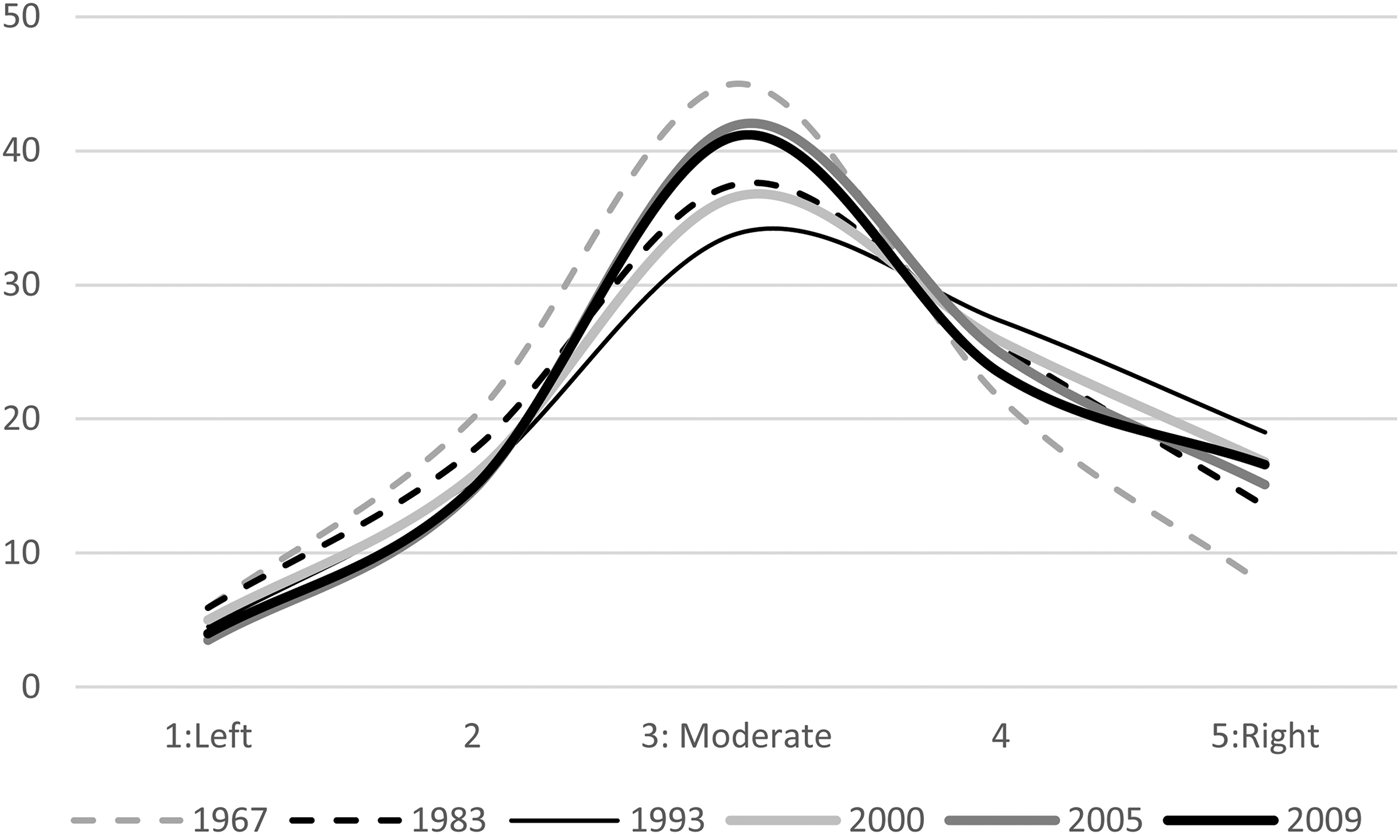
Figure 1 shows the results of a poll highlighting the distribution of left–right ideology among Japanese voters. On a five-point scale, the value 1 indicates the most left-leaning position, the value 3 a centrist position, and value 5 the most right-leaning position. According to this data (which unfortunately, is unavailable for the entire period of our analysis), the median value has consistently been in the middle category “3,” but the position of mean has been slightly to the right (3.3) because the proportion of those identifying as “right” (“4” and “5”) is substantially higher than those who identify as left (“2” and “1”). Therefore, it is reasonable for a party seeking to win seats in the SMD to take a center-right position where voter preferences are more highly concentrated.
Distribution of left and right ideology among voters (Kabashima and Takenaka Reference Kabashima and Takenaka2012, 144)

This, in fact, happened in the late 1990s, when the (new) DPJ rose from the ruins of the NFP and quickly took the mantle of the LDP's main challenger.Footnote 1 Meanwhile, the re-founded CGP decided to join the LDP in government. After some setbacks, the DPJ eventually managed to wrestle control of first the Upper House and then the Lower House from the LDP, becoming the party in power from 2009 through 2012 (Kobayashi Reference Kobayashi2012; Shinoda Reference Shinoda2013, 153–229). Giannetti and Taniguchi (Reference Giannetti and Naoko2011) and Taniguchi and Winkler (Reference Taniguchi and Winkler2020) have shown that the distance between the LDP and the DPJ decreased substantially, especially in comparison to the distance between the LDP and the JSP. On the other hand, the positions of the CGP, the JCP, and the JSP's successor, the SDP, are less well studied quantitatively, even though some have suggested that the CGP and its voters have aligned their positions with those of the LDP (Ehrhardt et al. Reference Ehrhardt, Klein, McLaughlin and Reed2014). Based on the above, we could expect the distance between the largest governing party (in almost all cases the LDP) and the largest opposition party to shrink after electoral reform. Based on what we have said above regarding the slightly right-tilting distribution of the Japanese electorate, we could expect that these two major parties have both moved to the right of the left-right scale's center. This is our first hypothesis (H1).
The aforementioned observations, however, posit not only a change in party policy positioning, but also in content. Under the 1955 regime, each party catered primarily to its own set of vested interest groups: The LDP to a broad coalition of particularistic interests including farmers, construction industry, small and medium-sized businesses, doctors, etc., the CGP to the members of its parent organization, the Buddhist lay organization Sōka Gakkai, and the DSP, JSP, and JCP to trade union federations (Ramseyer and Rosenbluth Reference Ramseyer and Rosenbluth1997, 8–9, Pempel Reference Pempel1998, 63–73; George Mulgan Reference George Mulgan2005, 150–151; Scheiner Reference Scheiner2012, 69–73). After electoral reform this arrangement became unsustainable: the introduction of the “first-past the post” system has parties competing for maximum vote share in the SMDs, thus requiring appeals to a broader coalition of voters, including unaffiliated, urban voters making up around half of the electorate; moreover, the importance of previously underrepresented urban districts increased, as malapportionment has declined since and to some extent as a result of electoral reform (see, e.g. Kasuya 2015). Unlike rural, organized voters, the allegiance of these unaffiliated urban voters was fickle and could not be bought by pork barreling. Instead, they demanded programmatic policy goods (Ramseyer and Rosenbluth Reference Ramseyer and Rosenbluth1997, 81–82; Noble Reference Noble2010). Reacting to the demands of this new “clientele,” the LDP “did its best to remake itself as a party of urban consumers and competitive businesses” (Rosenbluth and Thies Reference Rosenbluth and Thies2010, 177). Several studies have since concluded that electoral reform forced the LDP into more strongly emphasizing programmatic policy appeals, e.g., public order, foreign policy or welfare, at the expense of particularistic policy pledges (Noble Reference Noble2010, Fujimura Reference Fujimura2015, Catalinac Reference Catalinac2016). Similarly, Abe and Endo (Reference Abe and Endo2014) also pointed out how the CGP has aligned itself more closely to the LDP on matters of security policy, while the DPJ had emphasized programmatic policy appeals since its foundation (Uekami and Tsutsumi Reference Uekami and Tsutsumi2011).
Others, however, have emphasized the continued relevance of particularistic policy appeals. Natori (Reference Natori2002) questioned, whether electoral reform alone was sufficient to do away with pork barreling. Scheiner (Reference Scheiner2012, 358) concluded that “clientelism continued to play front and center in Japanese politics [which] led many observers to be gravely disappointed by the reforms.” MacLachlan (Reference MacLachlan2014) has shown that both LDP and DPJ have actually competed for the support of noncompetitive organized votes such as postmasters and agricultural cooperatives, since they—once won over—provide some electoral certainty, compared to fickle unaffiliated voters. Noble (Reference Noble2016, 96) noted that politicians respond “to highly motivated interest groups, from farmers and doctors, to big business and recipients of government pensions.” Hence, there is no consensus as to how substantially the positions and contents of Japanese parties have changed as a result of electoral reform. Thus, the literature on Japanese party politics mirrors the comparative literature discussed above.
Furthermore, we must consider the possibility that Japan's MMM system has had a unique impact on the electoral strategies of each party. The LDP has nominated candidates in almost all SMDs, and also utilized the dual candidacy system, which allows the same candidate to run in both the SMD tier and the PR tier, to efficiently save candidates with high marginal defeat rates in their districts via the PR tier (Krauss and Pekkanen Reference Krauss and Pekkanen2010). The NFP, while challenging the LDP in many districts, rarely adopted the above strategy. Later, the DPJ adopted the same strategy as the LDP, running candidates in most districts, but manipulating the proportional rankings of double-listed candidates. Interestingly, the CGP which formed a coalition with the LDP after the dissolution of the NFP, has been able to get its candidates elected in some SMDs with the cooperation of the LDP. Nevertheless, two-thirds of the CGP's House of Representatives winners were elected proportionally, suggesting that the party has placed more emphasis on proportional representation. The SDP, the successor to the JSP, has seen a marked decline in its strength, and in some cases, it has secured seats exclusively via PR. The JCP has adopted a strategy of fielding candidates in many districts to promote its policies, but its MPs are almost entirely elected in the PR tier. In recent years, it has been cooperating with the Democrats and other opposition parties and reduced the number of SMD candidates.
For example, in the 2014 House of Representatives elections, the LDP and DPJ won more seats in the SMD, while the CGP, the SDP, and the JCP won more seats through proportional representation.Footnote 2 In other words, in Japan's MMM, large parties aiming to win or hold onto the government tend to focus on winning in the SMD, while smaller parties mainly focus on securing seats through PR. If this is the case, then, as discussed above, we can predict that large parties will make policy appeals that suit the preferences of many voters in order to win more votes, while small and medium-sized parties will make more individualized policy appeals to secure the votes of their core supporters.
As shown in Figure 1, the position of the Japanese median voter may be in the center on the left–right axis, but the distribution of voters on this axis has a slightly rightish tilt. This slightly right-leaning distribution of voter preferences is one reason the center-right LDP has been able to stay in power for so long. Therefore, parties seeking to maximize their vote share in the SMD may move towards this right-center position (H1). Needless to say, the LDP has always been relatively close to this position, meaning we could expect more movement from the largest opposition party competing with the LDP in the SMD than the LDP itself. Accordingly, we postulate the following hypotheses regarding the parties’ positions and the content of their policy appeals.
Hypothesis 1: After electoral reform, the largest ruling and opposition party have aligned their policies to a center-right position of the policy space in line with the distribution of Japanese voter preferences (as shown in figure 1).
Hypothesis 2: post-electoral reform, large parties seeking to win seats primarily in the SMD have increased their universal/programmatic policy appeals.
Analytical framework
Data
To test these hypotheses, we have collected the official party election platforms/manifestoes published by the LDP, JSP-SDP, CGP, NFP, DPJ and JCP before each Lower House election from 1960 to 2014. We have newly coded these documents using the coding scheme of the Comparative Manifesto Project (CMP).Footnote 3 We have chosen to utilize this party platform data based on the CMP coding scheme for multiple reasons: First, unlike candidate manifestos (see, e.g., Tsutsumi Reference Tsutsumi1998, Reference Tsutsumi2002, Fujimura Reference Fujimura2015, Catalinac Reference Catalinac2016), party election platforms have to speak to the entire electorate or at least those parts of the electorate that the party wishes to target. Hence, it stands to reason that they are more likely to be influenced by external socioeconomic factors than an individual candidate's election platform geared mainly towards voters in a particular district. This distinction has become more important in recent years, as elections have become increasingly nationalized, meaning the party's—as opposed to each candidate's—message has gained in relevance (Mori McElwain Reference Mori McElwain2012, Association for Promoting Fair Elections 2015). By using official party documents, we can avoid the strong influence of district particularities (e.g., urban versus rural) on candidates’ appeals (see, e.g., Kobayashi Reference Kobayashi1997, Reference Kobayashi2008 or Taniguchi Reference Taniguchi2006). Furthermore, party election platforms have played an important role in multiple recent elections.Footnote 4
Second, to our knowledge, no other dataset at present offers the opportunity to analyze long-term changes in party policy appeals, in our case more than five decades. Most longer-term studies examine comparatively short periods of time, in many cases either the decades before or after electoral reform. For instance, Inoguchi (Reference Inoguchi1983) or Kobayashi (Reference Kobayashi1997) examine only the pre-reform period. In contrast, newer research based on official party documents discusses exclusively the post-reform period (see, e.g., Kabashima Reference Kabashima2004, Shinada Reference Shinada2010, Reference Shinada2012; Uekami and Tsutsumi Reference Uekami and Tsutsumi2011). The same is true for the University of Tokyo–Asahi Shimbun (UTAS) survey of candidates running in national elections, which has only been available since 2003 (Taniguchi and Okawa Reference Taniguchi and Okawa2012, Kabashima and Takenaka Reference Kabashima and Takenaka2012).
In keeping with CMP conventions, we have limited our analysis to House of Representatives elections. The CMP's coding scheme has a trained human coder split up an election platform into quasi-sentences. Each sentence is assigned one out of 56 different codes representing a broad policy area such as law and order or support for welfare policies. These codes are grouped into seven different categories (100: External Relations, 200: Freedom and Democracy, 300: Political System, 400: Economy, 500: Welfare and Quality of Life, 600: Fabric of Society, and 700: Social Groups).
With the CMP's database already featuring Japanese data, one may question the necessity for new data; however, the Japanese data within the CMP's database up to the year 2000 (which, for instance, serves as the foundation of Ōmura Reference Ōmura2012) is based primarily on the coding of comparatively short newspaper articles, instead of the actual party documents. The latter are considerably longer, and they touch upon more policy areas than the comparatively short interviews printed in the newspapers. Given that the CMP measures the frequency of mentions of each policy area/code, the short texts result in rather instable data (Proksch et al. Reference Proksch, Slapin and Thies2011, Winkler Reference Winkler2014). For reference, our database consists of more than 20,000 sentences.
We are aware that the use of election platforms is open to criticisms, e.g., concerning their questionable reflection of post-electoral policies or the limited reflection of competing interests within each party. Hence, we would like to clarify that we do not claim that election platforms are entirely reflective of the actual policies realized by a governing party. However, multiple studies have shown that electoral pledges and policies do, in fact, correlate with each other to some extent, rather than the former being merely a collection of “feel good” promises quickly forgotten after election day (Rallins Reference Rallins1987, McDonald and Budge Reference McDonald and Budge2005, 215–216). Furthermore, the DPJ had to endure heavy criticism during its short stint in power partially because it had proposed a consumption tax hike, without having outlined this policy in its election platform (Winkler Reference Winkler2014, 410). In other words, there is a linkage between pre-election policy pledges and post-election policies.
We are also well aware that political parties are not monolithic entities, but bring together different, at times diverging interests and actors who may disagree on electoral strategy and policy goals (Bawn and Thies Reference Bawn and Thies2003). Nonetheless, Japanese political parties either have been traditionally unified in their support for a particular policy agenda and electoral strategy (CGP, JCP) or recently adopted a more top-down decision-making process regarding personnel and policy decisions (LDP). Following the introduction of the SMD, LDP headquarters, for instance, has centralized decision making over candidate endorsement (Krauss and Pekkanen Reference Krauss and Pekkanen2010, 204, 240). This increase in power for party HQ at the expense of the factions, finds its parallel in stronger influences of the PM/party president on the drafting process of election platforms (Nishio and Iio Reference Nishio and Iio2004; Estévez-Abe Reference Estevez-Abe2008). In light of these developments and considering the lack of available long-term data for policy positions of party leaders, we believe the use of election platforms makes for a reasonable foundation for the analysis at hand.
Dependent variables
Next, we shall explain the analytical framework for testing our hypotheses using the aforementioned data. One way to analyze changes in the positions of parties’ policy appeals is to quantify them on a left–right axis. Arguably the most frequently used one-dimensional axis to describe party positions is the CMP's RILE scale. A party's position on this scale is determined by calculating the percentages of a predetermined list of left and right policy codes (originally derived from a factor analysis of European parties’ policy appeals) in the respective election platforms (Budge and Klingemann Reference Budge and Klingemann2001). However, precisely because the RILE scale is based on observations from European parties, it is not necessarily an effective tool to precisely measure left–right positions in other countries or regions (Jahn Reference Jahn2011).
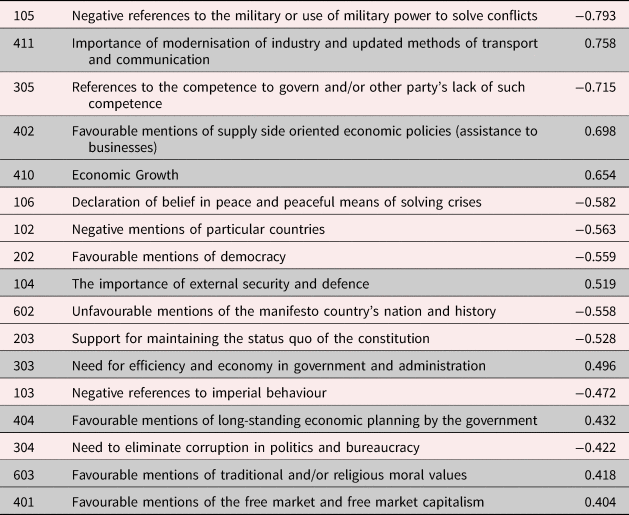
Therefore, we applied factor analysis (principal component method) to the coding results of Japanese parties’ policy appeals in the same way the RILE scale was calculated to derive left and right policy codes (omitting codes whose relative mention drops below 0.1%). As highlighted in Table 1, codes with positive values correspond well to the policies of right-wing parties, while codes with negative values correspond well to the policies of left-wing parties in Japan. Specifically, the LDP and other conservative parties have emphasized economic and infrastructure development (401, 402, 410, 411), external security and defense (104), administrative reform (303), and traditional values (603), while leftist parties have promoted disarmament (105), peace (106), anti-imperialism (103), advanced criticism of government (304, 305), and defense of the constitution and democracy (202, 203), and have been critical of traditional morality (602). These sets of appeals accurately reflect the ideological fault lines in Japanese politics, as a glimpse at the existing literature confirms (Kabashima and Takenaka Reference Kabashima and Takenaka2012; Taniguchi Reference Taniguchi2020).
Results of principal component analysis of coding data for policy appeals of Japanese political parties (first principal component)

Note: We show the codes that have absolute factor loading of 0.4 and more. The contribution ratio of the first principal component is 16.5%. = Right policy codes.
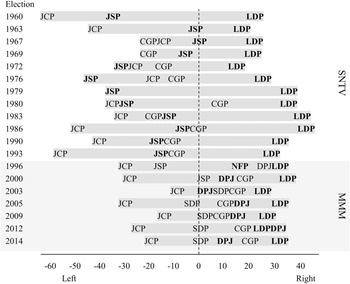
In keeping with RILE conventions, we created a Japanese version of the RILE scale (JRILE) by subtracting the percentage of leftist codes from the percentage of rightist codes in each party's policy appeals. As Figure 2 shows, no party other than the LDP scored in the plus (right) spectrum prior to electoral reform. Both the JCP and to a lesser extent the LDP's main rival, the JSP stayed consistently on the left. This clearly highlights the left-right divide of the 1955 regime. The LDP occupied the center-right position from the 1960s to the mid-1970s, but moved considerably to the right in the 1980s under Prime Minister Nakasone. This trend continued during the Koizumi and second Abe cabinets. The JSP briefly moderated its position in the 1960s, but in the 1970s it leaned further left than even the JCP. In the 1990s, its policy appeals became more centrist, as a result of the end of the Cold War, joining the LDP in government, and electoral reform. During the pre-reform period, the JCP was on the far left in opposition to the LDP's rightward shift. Post-reform, it has become somewhat more moderate, but still continues to distance itself from the competition. Before electoral reform, the CGP sat left of the center, but afterwards it morphed into a center-right party, probably because of it joining an LDP-led coalition. However, it is often further away from the LDP than the DPJ, suggesting that the two long-term coalition partners have maintained their own identities. Before the first election under the new system, the center-right NFP was formed to unseat the LDP. The DPJ, which appeared at the same time, was a right-wing reform party, even closer to the LDP than the NFP. In the 2000s, the DPJ gained seats as a centrist alternative and took power from the LDP in 2009 against the backdrop of scandals, the Lehman Shock and problems with the pension system. Perhaps because its policies became realistic as the ruling party, the DPJ scored slightly to the right of the LDP in the 2012 election; after losing power, it distanced itself from the LDP in an attempt to emphasize its distinctiveness (Taniguchi Reference Taniguchi2020). These changes are reflected in parties’ movements (or the lack thereof) we can observe in Figure 2.
Japanese party positions on the JRILE scale of each general election
Note: The CGP was founded only in 1964; hence there are no data points for the party in 1960 and 1963.The following election platforms are missing: JCP 1979 and CGP 1979; NFP = New Frontier Party, DPJ = Democratic Party Japan

In order to examine how electoral reform has affected these changes in parties' policy positions, we must control for other factors that might influence changes in policy positions. To test hypothesis 1, we use the distance between different points and each party's position on the JRILE scale as the dependent variable (as we have no other way to quantify the center-right position of the largest distribution of voters throughout the entire period of analysis). A party with a smaller distance from the 0 mark would be centrist, a party with a smaller distance from the 20-point mark would be center-right, and a party with a smaller distance from the 40-point mark would qualify as right-wing.Footnote 5 We conduct multiple regression analyses with variables indicating the political, economic, and social conditions that are likely to affect the parties' policies as control variables, and dummy variables indicating post-electoral reform, the largest ruling and opposition parties, and their interaction terms as explanatory variables. It will be important to determine whether the position of the largest ruling or opposition parties approached the 0 / 20 / 40-point marks after electoral reform. Furthermore, if hypothesis 2 holds true, we should be able to observe a post-reform increase in universalist/programmatic policy pledges and decline in particularistic policy appeals for the major parties aiming to compete in the SMD. However, the universalist/programmatic policies analyzed by Catalinac (Reference Catalinac2016), for example, include both right-wing (i.e., national defense) and left-wing appeals (i.e., social welfare). Policies related to particularistic interests include agricultural policies that right-wing parties tend to appeal on and labor policies that left-wing parties emphasize. Thus, within universalist/programmatic and particularistic interest policies, there is a mixture of left and right policies. Therefore, we analyze the changes in four clusters of left and right universalist/programmatic policies and left and right special interest policies.
In line with the existing literature,Footnote 6 we define right particularistic policies as beneficial to traditional conservative interest groups, i.e., agriculture (703), infrastructure (411), support for small- and medium-sized businesses (403), and (trade) protectionism (406), while we define left particularistic policies beneficial to left-liberal interest groups to be education expansion (506), labor groups (701), minority groups (705), and non-economic demographic groups (706). Meanwhile, right programmatic/universalist policies include emphasis on external security and defense (104), governmental and administrative efficiency (303), free enterprise (401), economic orthodoxy (414), national way of life (601), traditional morality (603), and law and order (605) while the left programmatic policy cluster emphasizes peace (106), internationalism (107), freedom and human right (201), constitutionalism (203), environmental protection (501), and welfare state expansion (504). We sum up the percentage of these codes in each party's policy appeals for each of the four clusters. Using the above as dependent variables, we will analyze what changes have occurred before and after electoral reform.
Independent variables
The following variables are used in the analyses as independent variables:
– LRP: Dummy variable indicating largest ruling parties (largest ruling parties = 1, other parties = 0)
– LOP: Dummy variable indicating largest opposition parties (largest opposition parties = 1, other parties = 0)
– Reform: Dummy variable indicating pre/post electoral reform (before electoral system reform = 0, after the reform of the election system = 1)
– Cross terms of dummy variables indicating largest ruling or opposition parties multiplied with reform variable: Variables indicating the policy appeals of largest ruling parties / largest opposition parties after electoral reform
– Internal political conditions: Dummies indicating that the elections were held in the 1960s, 1970s, 1980s, 1990s, 2000s, and 2010s (the base category for analyses is the 1960s dummy). These dummy variables are expected to absorb the other effects of the individual context of each electoral decade (political background such as major issues, intra-party and inter-party relations, and individual incidents such as scandals and disasters).
– External political conditions: The percentage of articles on national defense in the Asahi Shimbun daily newspaper, a variable that signifies the emergence of national defense issues as external political conditions. Samuels (Reference Samuels2007) and Pyle (Reference Pyle2007), for instance, have detailed the substantial post-Cold War changes to the discourse on Japan's foreign and defense policy (e.g., dispatching the SDF abroad, counter-balancing China and North Korea, etc.).
– Economic conditions: Economic growth rate, and unemployment rate. Durr (Reference Durr1993) and Stevenson (Reference Stevenson2001, 632) concluded “people want policy to move to the left when the economic is expanding and right when the economic is contracting,” because in the latter case opposition to further expenditures increases. Obviously, parties can ill afford to ignore changing (macro) economic conditions when drafting their election platforms. Previous studies have noted adjustments, for instance, to account for the effects of globalization (Haupt Reference Haupt2010, Ward, Ezrow, and Dorussen Reference Ward, Ezrow and Dorussen2011).
– Social conditions: Aging rate, birth rate, and ratio of articles referring to environmental issues in the Asahi Shimbun daily newspaper. Declining birthrates and aging population are major domestic policy issues in Japan, which may affect the composition of welfare policies. Environmental issues are also a policy issue of increasing importance. We believe the impact of these issues should be controlled for, as they are likely to influence policy demands.
To our knowledge, other than Ōmura (Reference Ōmura2012) and Catalinac (Reference Catalinac2016) no long-term studies of party policy appeals have controlled for changes in the above macro-level factors. And even those two studies controlled only for few external factors. Ōmura's analysis was limited to eight policy fields and her sole macro variable was the consumer price index. Catalinac, whose findings are based on individual candidate election platforms, has tested for four alternative explanations (ideological changes for voters and electorate, replacement of candidates, rising interest in national security), but not socioeconomic macro factors. To better isolate any potential effects of electoral reform on different parties’ positioning and the content of their appeals, we have included the aforementioned factors as control variables.
Analytical results
Testing Hypothesis 1: Positional changes
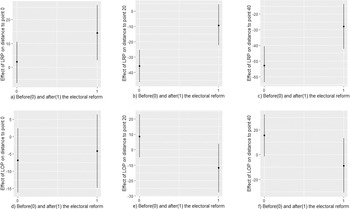
To test our hypothesis 1, we define the distance between the point 0 (=centrist) / 20 (=center-right) /40 (=right) marks and each party's position on the JRILE scale as the dependent variables, and factors indicating the political, economic, and social conditions that are likely to influence parties' policies as control variables, and the dummy variables indicating the term after electoral reform (0 = before the reform, 1 = after the reform), the largest ruling party (0 = other type of parties, 1 = the largest ruling party), the opposition party (0 = other type of parties, 1 = the largest opposition party), and their interaction terms as explanatory variables. Based on the results of multiple regression analyses, we show the marginal effects of party types on the distance and standard errors in Figures 3a–f.
The marginal effects of the party types on the distances between the parties and each point on the JRILE scale

For example, Figure 3a shows how the effect of being the largest ruling party (the LDP except in the 2012 general election) on the distance between its position and the point 0 (=centrist) position on the JRILE scale differs before and after the electoral reform. On the X-axis, 0 indicates pre-electoral reform and 1 indicates post-reform. Negative values on the y-axis indicate that being the largest ruling party (LRP) results in a smaller distance from the 0-point (centrist) position, while positive values indicate that being the largest ruling party results in a larger distance from that point. Thus, this figure suggests that the largest ruling party positioned itself away from the centrist position after electoral reform. The coefficient of the interaction terms made from the electoral reform dummy variable and the largest ruling party dummy variable showed a significant positive effect at the 10 percent level. In Figures 3b and 3c, the Y-axis values are negative, indicating a smaller distance between the 20-point mark (=center-right) / the 40-point (=right) mark and the position of the largest ruling party on the JRILE scale. The tendency for the largest ruling party to be closer to the center-right or right-wing position than the other parties before the electoral reform suggests that the left-right distances between the largest ruling party and other parties were larger prior to reform. Under the old SNTV system, the largest ruling party was always the right-wing LDP and the largest opposition party was the left-wing JSP. However, the NFP and the DPJ, which became the largest opposition parties post-electoral reform, were center-right parties. The coefficients of interaction terms treated in Figures 3b and 3c showed significant positive effects at the 5 percent level.
Next, let us check the change in the effect of the largest opposition party (LOP). Figure 3d shows the effect of the largest opposition party dummy on the distance between the 0-point (centrist) mark and the position of the largest opposition party on the JRILE scale, but the difference before and after the electoral reform is not clear. On the other hand, Figure 3e shows the most interesting result, indicating that pre-electoral reform the largest opposition party was far away from the 20-point (center-right) mark, but post-reform it moved closer to that point. Figure 3f also shows that the distance between the position of the largest opposition party and the 40-point mark (right-wing position) was larger before the electoral reform and smaller after the reform. The coefficients of interaction terms treated in Figures 3e and 3f show significant negative effects at the 10 percent level. These results indicate that the largest ruling party moved more distinctively away from the center post-reform, but that its tendency to be closer to the center-right or right-wing position relative to the other parties was more distinct pre-reform. The latter may suggest that the effect of being the largest ruling party has lessened post-reform, as other parties have also moved in the right direction as shown in Figure 2. On the other hand, the largest opposition party showed an interesting trend of moving closer to the center-right position after the electoral reform. These results suggest that Hypothesis 1 applies to the largest opposition party.
Testing Hypothesis 2: The changes of contents
Next, we will examine how electoral reform has changed the content of political parties' policy appeals. We performed multiple regression analyses using the same independent variables as in the previous section, with the proportion of universal/programmatic and particularistic policy claims of the left and right side as the dependent variable.
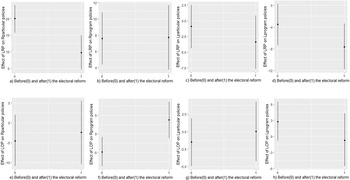
Figure 4a shows the result of the analysis of the effect of the largest ruling party (LRP) on right-wing particularistic policy appeals such as agriculture, small and medium-sized enterprises, infrastructure development, and promotion of protectionist trade policies. The values of the Y-axis are always positive before and after electoral reform, so the policy appeals of the largest ruling parties can be characterized as more right-wing particularistic than those of other parties. However, after reform, the effect of the largest ruling party dummy has declined. The interaction term of the dummy variables indicating the post-reform term and being the largest ruling party shows a negative coefficient at the 1 percent significance level, suggesting that the largest ruling parties have reduced their right-wing particularistic policy appeals post-reform. This also implies that the LDP's strategy of focusing on the interests of right-wing particular interest groups has changed since the electoral reform.
The marginal effects of the party types on the content of policy appeals

Figure 4b shows the result of the analysis about the effect of the largest ruling party on the right programmatic policy appeals, e.g., external security and defense, governmental and administrative efficiency, free enterprise, economic orthodoxy, national way of life, traditional morality, and law and order. The largest ruling party always tends to emphasize these more so than other parties, but no significant change is observed before and after electoral reform.
Next, the y-axis of Figure 4c–d is negatively skewed, indicating that the largest ruling parties always tend to be less assertive in their leftist particularistic and universalist policies than the other parties. After the electoral reform, that tendency appears to have strengthened, and the coefficient of the interaction term between the dummy variables indicating the post-reform period and being the largest ruling party was also negative, but not statistically significant. Thus, although some studies argue that “the LDP increased programmatic policy appeals after electoral reform,” controlling for international, economic, and social factors, it cannot be said that there are more programmatic polices in the LDP's election platforms than in those of other parties.
Figures 4e–h show the results of the analyses on the effects of the largest opposition party (LOP) dummy on the proportion of the four types of policy appeals. In particular, Figure 4f shows that the largest opposition party did not appeal on universal/programmatic right-wing policies before electoral reform, whereas it conversely increased those appeals post-reform. The interaction term between the (post) reform dummy variable and the largest opposition party dummy shows a significant positive coefficient at the 1 percent level. For the other three types of policy appeals, there was no clear evidence of a change in the strategy of the largest opposition party after electoral reform.
These analyses of the content of policy appeals showed that post-reform, the largest ruling party deemphasized right-wing particularistic policy appeals, while the largest opposition party emphasized right-wing programmatic appeals. Hypothesis 2 was thus partially supported, but its inner workings are somewhat more complicated. The results confirm that the LDP, which was the largest ruling party for much of the period, refrained from focusing on the interests of particular support groups on the right to win more votes in the SMDs after reform. However, controlling for the effects of the political, economic, and social environment, we found no evidence of an increase in the LDP's right-wing programmatic policy appeals, such as on defense and security issues, after electoral reform, compared to other parties. If the LDP did increase these policy appeals, we can assume that it was due to factors other than electoral reform.
Rather, it is interesting to note that the largest opposition party increased its right-wing programmatic policy appeals after electoral reform. Post-reform, the largest opposition parties were the NFP and the DPJ, which have tried to gain the support of many center- to center-right voters by touching on economic growth, deregulation, and constitutional reform arguments. While there are differences in the way the largest ruling and opposition parties have changed, from an overarching perspective, it can be said that they have tried to appeal to a larger number of voters in the SMD system. The LDP used to make far more (right) particularistic policy appeals than its competition, but after electoral reform, these appeals declined by a statistically significant level. Interestingly, the largest opposition parties have increased such appeals after the electoral reform. This might the result of the LDP paying less attention to specific interests, while the center/left parties are expanding their appeals to farmers and small and medium-sized enterprises, which they see as sectors in need of protection and thus potential voters. MacLachlan (Reference MacLachlan2014) has previously noted such a competition taking place over the votes of highly motivated vested interest groups.
Conclusion
Electoral reform has been no doubt one of the most thoroughly studied topics in Japanese politics. Our goal is not to rewrite the overall argument that previous studies have made, but to augment them, by making several improvements that we think are of relevance, tracking policy changes over a long term and controlling for the effects of various internal and external variables that could potentially influence party policies. Therefore, we have collected the manifestos of Japanese political parties since the 1960s and recoded them using the CMP method. We used this data to identify left and right policies and produce a Japan specific RILE scale, and then conducted multiple regression analyses with positional changes as the dependent variables.
The position of the LDP on the left-right axis did not change substantially, but since the NFP and later the DPJ replaced the JSP as the largest opposition party, the distance between the LDP and the former two major opposition parties has decreased, as these new opposition parties aligned themselves with the slightly right-tilted policy preferences of the electorate. We could confirm this trend to be statistically significant even when controlling for various internal and external variables. This finding in itself might be considered a matter of course, yet it has proven to be difficult to verify, as previous studies had relied on shorter term data, candidate manifestos, and/or controlled for few macro variables.
Furthermore, we observed several noteworthy trends pertaining to the contents of policy appeals: the largest ruling party (the LDP in the case of all but one election) reduced its appeals to right particularistic interests, the largest opposition parties post-reform emphasized right-wing programmatic policy appeals such as defense, law and order, patriotism, or support for free enterprise. These results are generally in line with the hypotheses of this article and the literature that has suggested an increase in universalist/programmatic policy appeals, but with an important twist: we might have observed an increase in right-wing programmatic policy appeals, but the same does not hold true for leftist programmatic policy appeals such as welfare. The shift towards programmatic appeals at the expense of particularistic ones is thus not as universal as it may have seen at first glance.
These results of our analysis are valuable in that they reaffirm the findings of previous studies, but also force some revisions. First, the average left–right position of Japanese voters is slightly to the right, and this can be said to be a factor that has sustained subsequent center-right LDP-led governments. Therefore, it is reasonable for parties competing for seats in the SMDs against the LDP to move closer to the latter's policy positions, unlike under the SNTV system. Also, electoral system reform in Japan did not result in all large parties appealing on universal/programmatic rather than particularistic policies. Nor has the increase in programmatic policies occurred in either the left or right dimension. Instead, we found that the largest ruling party reduced the number of right-wing particularistic policies and the largest opposition party increased the number of right-wing programmatic policies in order to capture the votes of a relatively large number of center-right voters. Our study quantitatively shows that Japan's electoral reforms, particularly the introduction of the SMD system, have had different effects on different types of parties, which has made the largest opposition parties more right leaning and inclusive in challenging the largest ruling party, which has long obtained the support of center-right voters.
However, while Japan's electoral system is strictly a parallel system of constituencies and proportional representation, we do not analyze the effects of the parallel system itself. The effects of the new system may be more complex, including the system of multiple candidacies and the mechanism of resurrected elections. This point will require further research.
Acknowledgements
Earlier versions of this paper were presented at the IPSA in Brisbane (2018) and the Japanese Political Science Association Meeting in Tokyo (2019). Based on the commentators’ comments we have significantly revised our analysis and based thereon our conclusions.
We would like to thank the editorial board of the journal and two anonymous reviewers for their helpful comments on earlier draft versions.
Conflicts of Interest
The authors declare none.
Funding information
This work was supported by JSPS KAKENHI Grant Number 15K03270.