



1. Introduction
The magnetic fields responsible for the “stellar activity” are generated by the interaction between convection and stellar rotation (stellar dynamo). Therefore, the rotation period is a critical parameter in the characterization of stellar chromospheric activity. Moreover, empirical relationships have shown that the rotation rate of solar-type stars is directly correlated with the length of the activity cycle. In particular, this relationship does not seem to be univocal, and the periods of activity are distributed into two branches (inactive and active). Several solar-type stars even present two coexisting activity cycles distributed across these two branches simultaneously. This double cycle could be the result of the local action of plasma turbulence (
 $\alpha$
effect) operating simultaneously on the surface and in the tachocline of the star. Interestingly, the Sun does not lie on either of these branches, occupying an intermediate and apparently atypical position in such diagrams. This peculiar location in the solar cycle could indicate that the solar dynamo is currently in transition. Along these lines, it has been noted that stars with rotation periods between 23 and 30 days are rarely reported as cyclic.
In order to provide observational evidence for this discussion, we present a preliminary study of the long-term activity of a set of 44 solar-type stars, with rotation periods shorter than, similar to, and longer than that of the Sun. To achieve this, we employ our own spectra obtained at the Complejo Astronómico el Leoncito (CASLEO)
Footnote 1
under the observing program HK
 $\alpha$
Project and other public databases. To complement this observational approach, we are able to build non-linear axisymmetric dynamo models that can reproduce multiple activity cycles in solar-type stars. In the present work, we present the dynamo simulations of a hypothetical solar twin with rotation periods shorter than and longer than that of the Sun.
2. Sample Selection
This work focuses on solar-type stars originally observed by the HK
 $\alpha$
Project, a sample characterized by a broad range of rotation periods, from 7.78 to 71.00 days (as detailed in Table 2 of Reference Cincunegui, Díaz and MauasCincunegui et al. (2007)).
With the aim of detecting long cycles (active branch) and short cycles (inactive branch) in solar-type stars with a range of rotation periods between 3 and 60 days (subsolar, solar, and supersolar), this work studies a sample of stars with rotation periods within this range that were repeatedly observed throughout the HK
 $\alpha$
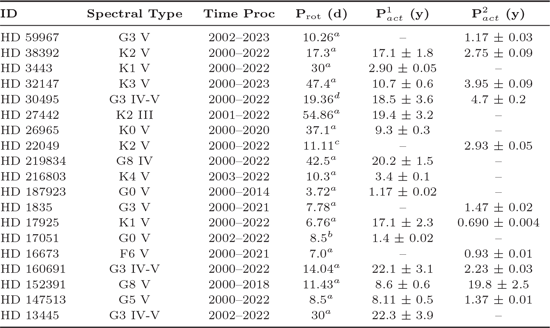
Project. Therefore, taking into account stellar parameters, cadence, and time span of observations, we restricted the sample to 44 stars. Table 1 lists the sample of stars studied that presented activity cycles (19 stars), their main parameters, the observational data from CASLEO, and the results obtained in this work. The rotation periods of the stars in this list are taken exclusively from the literature Cincunegui et al. (Reference Cincunegui, Díaz and Mauas2007); Metcalfe et al. (Reference Metcalfe, Basu, Henry, Soderblom, Judge, Knölker, Mathur and Rempel2010, Reference Metcalfe, Buccino, Brown, Mathur, Soderblom, Henry, Mauas, Petrucci, Hall and Basu2013); Egeland et al. (Reference Egeland, Metcalfe, Hall and Henry2015).
Activity cycles in solar-type stars. Selection of solar-type stars from the HK
 $\alpha$
Project (with 3 days
 $<P_{\mathrm{rot}}<$
60 days), their main parameters, the years of observation at CASLEO, the number of CASLEO observations used, and the results obtained in this work. Rotation periods were taken exclusively from the literature (a–Cincunegui et al. Reference Cincunegui, Díaz and Mauas2007, b–Metcalfe et al. Reference Metcalfe, Basu, Henry, Soderblom, Judge, Knölker, Mathur and Rempel2010, c–Metcalfe et al. Reference Metcalfe, Buccino, Brown, Mathur, Soderblom, Henry, Mauas, Petrucci, Hall and Basu2013, d–Egeland et al. Reference Egeland, Metcalfe, Hall and Henry2015).

Table 1 Long description
A table with 44 rows and 6 columns. The columns are labeled ID, Spectral Type, Time Proc, P rot (d), P act (y), and P 2act (y). Each row lists a star's ID, spectral type, time period of observation, rotation period in days, active cycle period in years, and second active cycle period in years. The table includes stars with various spectral types and rotation periods ranging from 3 to 60 days. Notable stars include HD 59967, HD 38392, HD 3443, and others, with their respective observational data and cycle periods.
3. Long-Term Activity
To compile the long-term activity records of our sample stars, we employed CASLEO spectra, public ESO data from HARPS and FEROS spectrographsFootnote 2 , and Mount Wilson indexes reported in (Baum et al. Reference Baum, Wright, Luhn and Isaacson2022). The Mount Wilson index S (Vaughan et al. Reference Vaughan, Preston and Wilson1978) was calculated following Ibañez Bustos et al. (Reference Ibañez Bustos, Buccino, Messina, Lanza and Mauas2020), with HARPS and FEROS indices calibrated to S using Lovis et al. (Reference Lovis, Dumusque, Santos, Bouchy, Mayor, Pepe, Queloz, Ségransan and Udry2011) and Jenkins et al. (Reference Jenkins, Jones, Pablenko, Pinfield, Barnes and Lyubchik2008), respectively. CASLEO indices were intercalibrated with quasi-simultaneous S measurements from HARPS (preferably) or FEROS, and in some cases with values from Baum et al. (Reference Baum, Wright, Luhn and Isaacson2022).
Long-term magnetic activity cycles were searched using the Generalized Lomb-Scargle (GLS) periodogram (Zechmeister and Kürster Reference Zechmeister and Kürster2009), which is consistent with the approach used in previous studies (Ibañez Bustos et al. Reference Ibañez Bustos, Buccino, Flores and Mauas2019; Ibañez Bustos et al. Reference Ibañez Bustos, Buccino, Flores and Mauas2019; Ibañez Bustos et al. Reference Ibañez Bustos, Buccino, Messina, Lanza and Mauas2020). A star was classified as cyclic if its periodic variability reached a significance threshold of FAP
 $<$
10%. Following Colombo et al. (Reference Colombo, Buccino, Oviedo, Ibañez Bustos, Martinez and Mauas2024), all other stars were designated as irregular variables or constants.
As an example of cyclic stars with double activity cycles, we present the K3V star HD 32147, which has a rotation period of 47.4 days (Cincunegui et al. Reference Cincunegui, Díaz and Mauas2007), and an effective temperature of 4550 K (Baum et al. Reference Baum, Wright, Luhn and Isaacson2022).
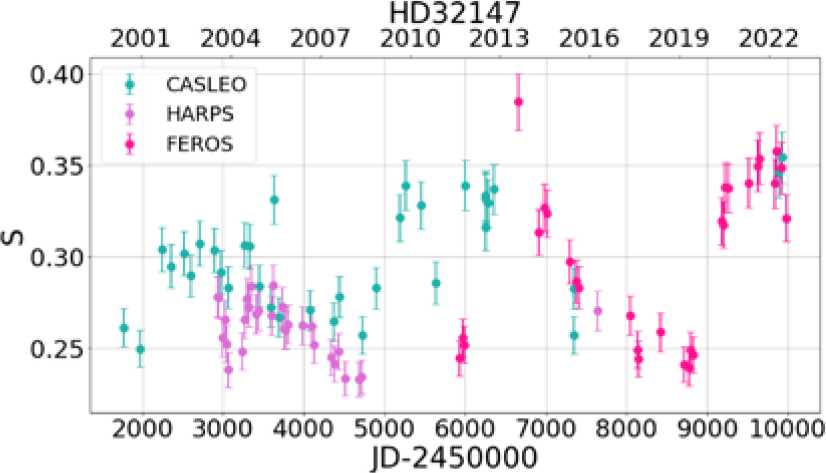
Figure 1 shows the S-index time series built with 38 CASLEO spectra obtained between 2000 and 2022, and 264 HARPS and FEROS spectra taken between 2004 and 2023, both monthly averaged.
S-index of HD 32147 between 2000–2023.

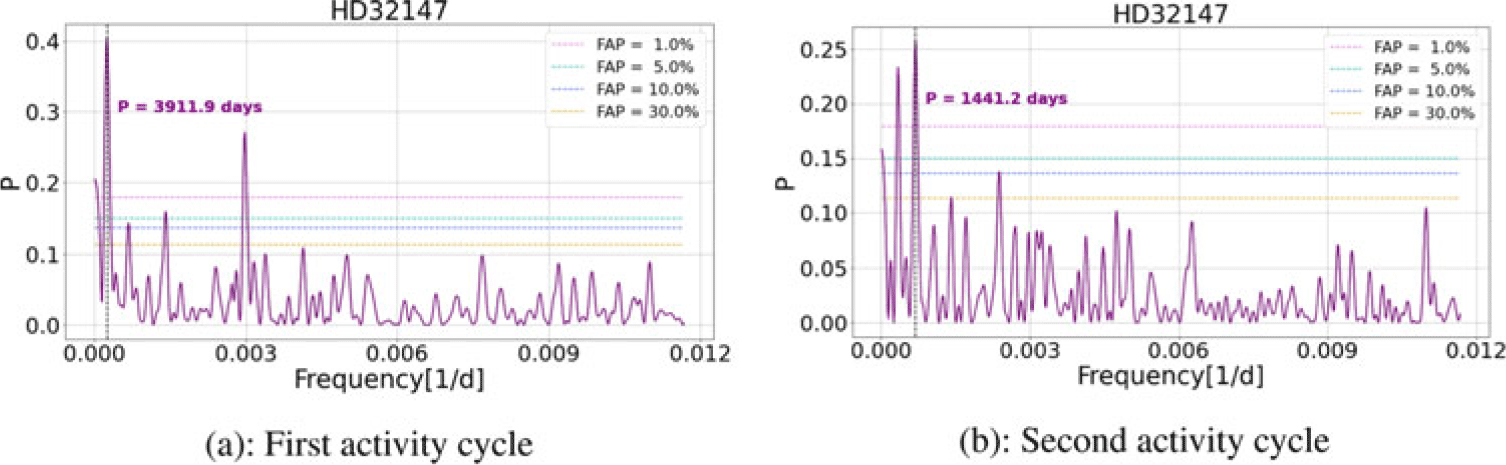
We computed the GLS periodogram in Figure 2a for the S index in Figure 1, which reveals a significant peak at P = (3911.9
 $\pm$
215.5) days
 $\sim$
(10.7
 $\pm$
0.6) years, with FAP = 3.4
 $\times$
10
 $^{-9}$
.
GLS periodograms of HD 32147 with the detections of the first activity cycle of (3911.9
 $\pm$
215.5) days and the second activity cycle of (1441.23
 $\pm$
33.99) days.

Figure 2 Long description
Two line graphs depict the periodograms of HD 32147, showing activity cycles. Panel A: First activity cycle. The line graph shows the probability (P) on the vertical axis and frequency (1/d) on the horizontal axis. The graph includes horizontal lines representing false alarm probabilities (FAP) at 1.0 percent, 5.0 percent, 10.0 percent, and 30.0 percent. A peak is labeled with a period of 3911.9 days. Panel B: Second activity cycle. The line graph shows the probability (P) on the vertical axis and frequency (1/d) on the horizontal axis. The graph includes horizontal lines representing false alarm probabilities (FAP) at 1.0 percent, 5.0 percent, 10.0 percent, and 30.0 percent. A peak is labeled with a period of 1441.2 days.
After removing the harmonic component of this primary period from the original time series, we computed the periodogram in Figure 2b, a secondary cycle at P = (1441.23
 $\pm$
33.99) days
 $\sim$
(3.95
 $\pm$
0.095) years is still evident, with FAP = 9.4
 $\times$
10
 $^{-5}$
.
4. Simulated Activity Cycles in Identical Solar Twins with Varying Rotation Rates
In order to clarify the atypical position of the Sun in the
 $P_{\mathrm{cyc}}$
–
 $P_{\mathrm{rot}}$
diagrams (Böhm-Vitense Reference Böhm-Vitense2007; Metcalfe et al. Reference Metcalfe, Egeland and van Saders2016), we applied a large-scale axisymmetric dynamo model with feedback effects (Sraibman and Minotti Reference Sraibman and Minotti2019) to six solar twins. The formulation of this model, along with an example of its application to the solar dynamo, is fully described in Sraibman and Minotti (Reference Sraibman and Minotti2019). This model, which allows us to obtain equations for the mean values of the fields and velocities, is derived by applying the formalism developed in Minotti (Reference Minotti2000) to the equations of magnetohydrodynamics.
To simulate these six solar twins, we kept all solar parameters fixed and varied only their rotation periods, obtaining different activity periods for each case (Figure 4). Simulations were carried out for rotation periods between
 $0.5\omega_\odot$
and
 $3\omega_\odot$
. Figure 3 shows the evolution of the three components of the magnetic field at the stellar tachocline, derived from the described model for half and double solar rotation periods. From visual inspection, different cycle lengths are appreciable in both figures; the magnetic maps for
 $0.5\omega_\odot$
exhibit an activity cycle of
 $\sim$
20 years, while the maps corresponding to the
 $2\omega_\odot$
-rotation rate are related to a
 $\sim$
5-year activity cycle.
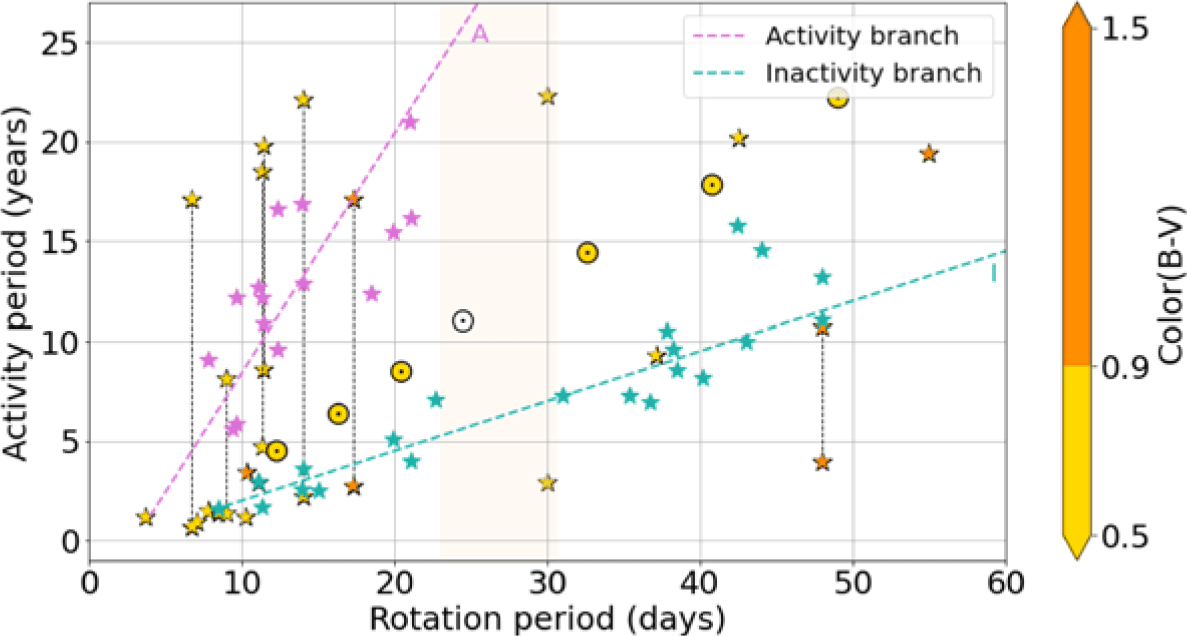
Stars belonging to the active branch (A) are indicated in magenta and those of the inactive branch (I) in cyan (Saar and Brandenburg Reference Saar and Brandenburg1999; Metcalfe et al. Reference Metcalfe, Basu, Henry, Soderblom, Judge, Knölker, Mathur and Rempel2010, Reference Metcalfe, Buccino, Brown, Mathur, Soderblom, Henry, Mauas, Petrucci, Hall and Basu2013; Hall et al. Reference Hall, Lockwood and Skiff2007; Böhm-Vitense Reference Böhm-Vitense2007; Egeland et al. Reference Egeland, Metcalfe, Hall and Henry2015). The dotted magenta and cyan lines are the linear fit reported by Böhm-Vitense (Reference Böhm-Vitense2007), while the Sun is indicated with its typical symbol. The symbols joined with dotted lines correspond to activity periods of the same star. The yellow and orange ones are the results obtained in the present work listed in Table 1. Based on the model developed in Sraibman and Minotti (Reference Sraibman and Minotti2019), we built solar dynamos for different rotation periods. In this figure the simulated cycles are shown with the a yellow classical solar symbol.

Toroidal (
 $B_\phi$
), radial (
 $B_r$
), and polar (
 $B_{\theta}$
) magnetic fields as a function of time for different rotation rates.

5. Periods of Activity vs the Rotation Period.
Table 1 compiles the main characteristics of the stars in the studied sample that presented activity cycles, along with the results obtained in this work.
Upon determining reliable rotation and activity periods for the target stars, we proceeded to construct a diagram (Figure 4) correlating the activity cycle length with the stellar rotation rate, incorporating data from previous studies (Saar and Brandenburg Reference Saar and Brandenburg1999; Metcalfe et al. Reference Metcalfe, Basu, Henry, Soderblom, Judge, Knölker, Mathur and Rempel2010, Reference Metcalfe, Buccino, Brown, Mathur, Soderblom, Henry, Mauas, Petrucci, Hall and Basu2013; Hall et al. Reference Hall, Lockwood and Skiff2007; Böhm-Vitense Reference Böhm-Vitense2007; Egeland et al. Reference Egeland, Metcalfe, Hall and Henry2015).
Among the set of 44 stars analysed, activity cycles were detected in 19 stellar objects: HD 59967, HD 38392, HD 3443, HD 32147, HD 30495, HD 27442, HD 26965, HD 22049, HD 219834, HD 216803, HD 187923, HD 1835, HD 17925, HD 17051, HD 16673, HD 160691, HD 152391, HD 13345, HD 147513. Six of these stars were previously studied by Metcalfe et al. (Reference Metcalfe, Egeland and van Saders2016) and are included in the original
 $P_{\mathrm{cyc}}$
–
 $P_{\mathrm{rot}}$
diagram (magenta and cyan stars). The cycle of HD 17051, the short cycle of HD 22049, and the long cycle of HD 32147 seem to coincide with the reported cycle, while the long cycle of HD 22049 reported in Metcalfe et al. (Reference Metcalfe, Buccino, Brown, Mathur, Soderblom, Henry, Mauas, Petrucci, Hall and Basu2013) was not detected, and the short cycle of HD 152391 is 10% lower than the one obtained in Saar and Brandenburg (Reference Saar and Brandenburg1999). However, a short cycle was found for HD 1835 that had not been previously reported in the literature. The observed differences are presumably a consequence of the differing time span and sampling density of our dataset. Also, a non-previously reported short cycle for HD 3217 and a long cycle for HD 152391 were detected. Similarly, we found a single long activity cycle for HD 30495, which is outside the range of periods reported by Egeland et al. (Reference Egeland, Metcalfe, Hall and Henry2015). A more exhaustive analysis will be necessary to reach a definitive conclusion. Moreover, in Figure 4, we can see that there are three stars that present long cycles, which exceed the values expected from the active branch and could eventually belong to the superactive branch considered in Saar and Brandenburg (Reference Saar and Brandenburg1999). Finally, simulated solar cycles seem to fall between both branches for slow and fast rotator suns, consistent with the 11-year solar cycle.
 α

 ±
 ±

 Bϕ
 Br
 Bθ


