The subfamily Anthiinae (family: Serranidae) comprises some 24 genera and more than 100 species of beautifully coloured fish that inhabit coral and deep reef habitats in tropical and warm temperate seas. Anthiine fish are usually small in size, but a new genus, Meganthias, was described by Randall & Heemstra (Reference Randall and Heemstra2006) for two large (34 and 28 cm SL) anthiine fish previously known as Holanthias or Odontanthias natalensis (Fowler, Reference Fowler1925) from South Africa and Holanthias kingyo Kon, Yoshino & Sakurai, Reference Kon, Yoshino and Sakurai2000 from Okinawa, Japan. Another large species, based on two fish of 24 and 30 cm SL discovered off the coast of Nigeria, Atlantic Ocean has also been added to the genus as M. carpenteri Anderson, Reference Anderson2006. Another species of Meganthias was collected from the Andaman Sea, off the south-western coast of Thailand and reported by Sirimontraporn & Bussarawit (Reference Sirimontraporn and Bussarawit1993) as Holanthias chrystosticus (Günther, Reference Günther1872). This 29 cm SL fish was later described as a new species M. filiferus by Randall & Heemstra (Reference Randall and Heemstra2007) due to its marked variations from other congeneric species in coloration, larger head proportion (head length 2.5 in SL), corner of preopercle strongly angular and dorsal filament morphology.
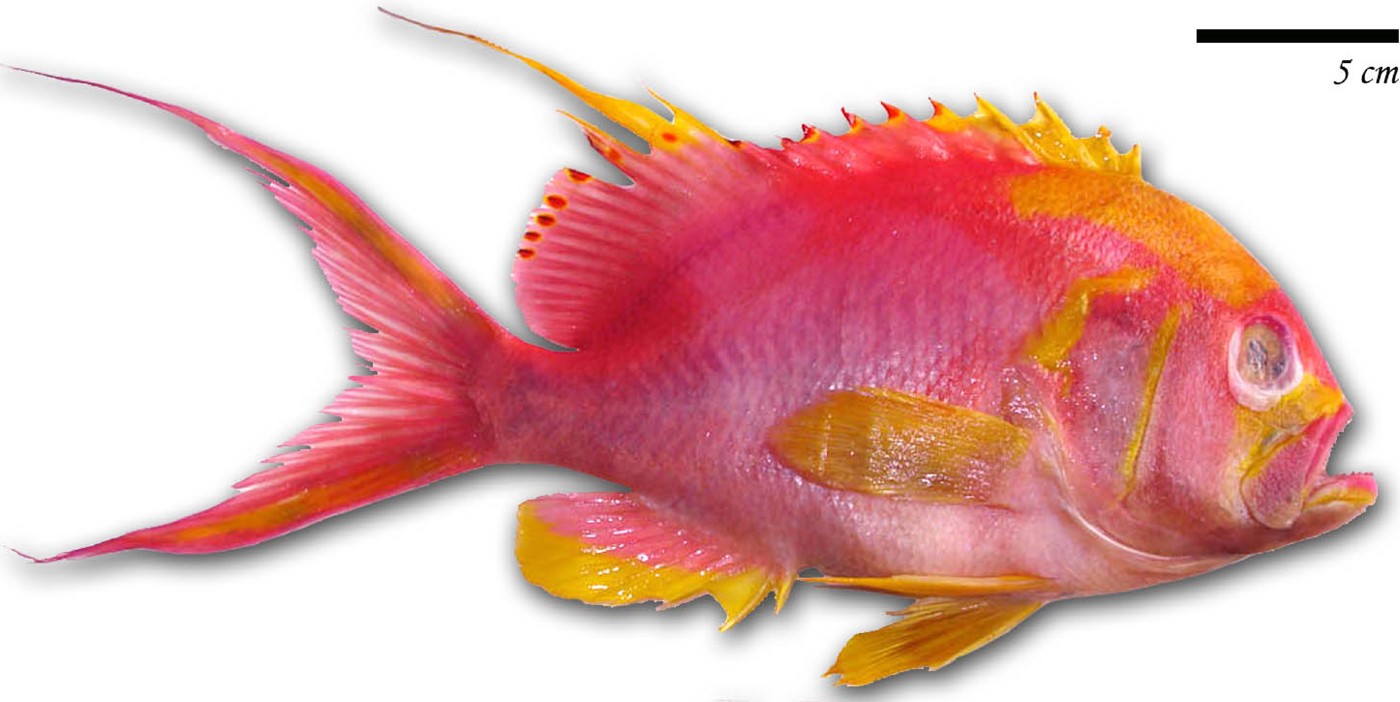
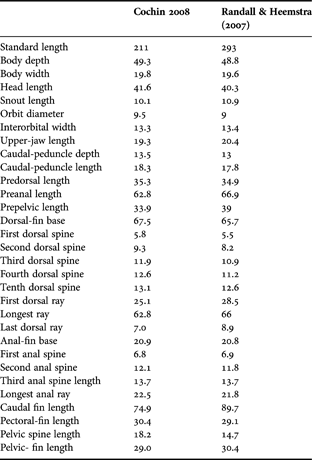
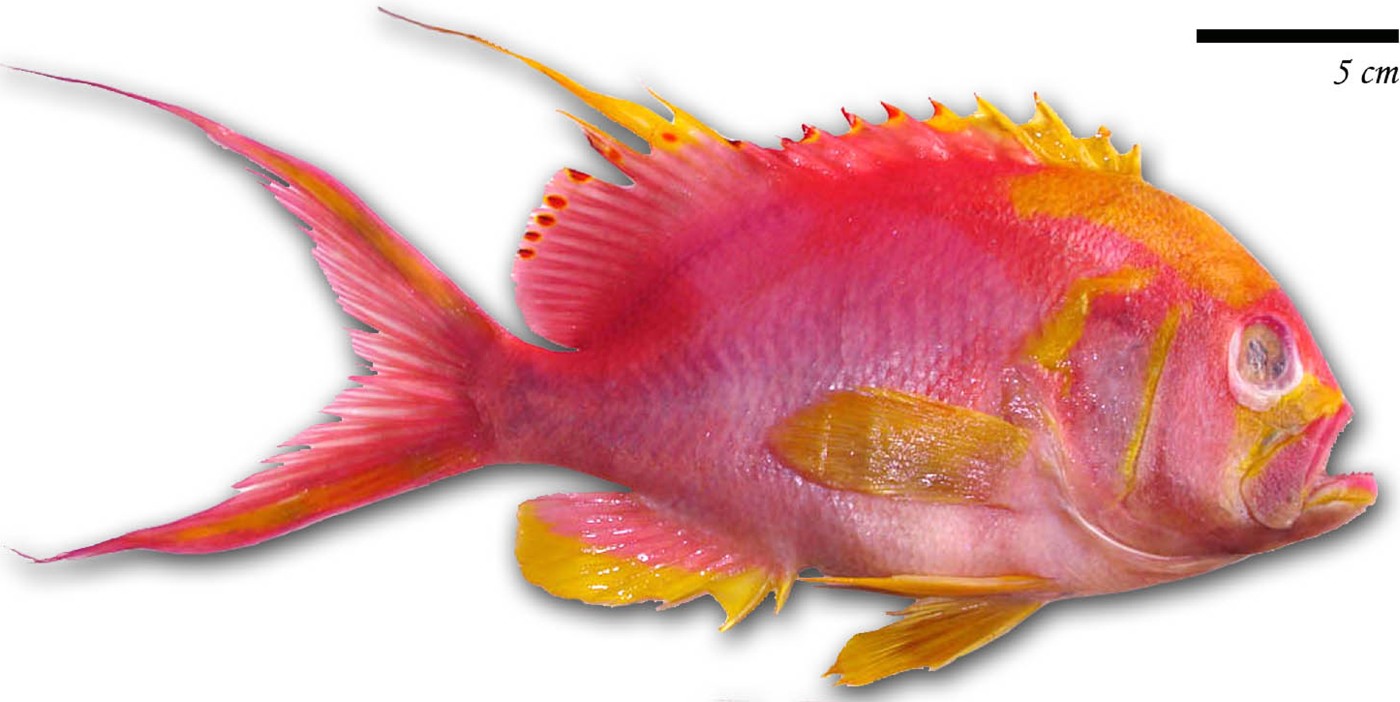
On 26 August 2008 a single specimen of M. filiferus, 211 mm SL was collected from a commercial trawler operated in the Arabian Sea, off the south-western coast of India (Figure 1). This is the first report of the species from Indian waters. The specimen was deposited in the National Marine Biodiversity Referral Museum at Central Marine Fisheries Research Institute, Cochin India. The morphometric and meristic characters of the specimen agree well with data from the holotype given by Randall & Heemstra (Reference Randall and Heemstra2007) (Table 1). This second report of M. filiferus is the first record from the west coast of India and indicates a marked extension of the distribution from its type locality.
Meganthias filiferus, 211 mm SL, Arabian Sea, off the south-western coast of India.
Morphometric comparison of Meganthias filiferus (%SL in mm) from India with the holotype (Randall & Heemstra, Reference Randall and Heemstra2007).

DIAGNOSIS
Dorsal rays X18; anal rays III.8; pectoral rays 17; pelvic rays I.5; lateral line scales 43–44. Scales above lateral line to 5th dorsal spine 4; gill rakers; 12 + 25. Upper jaw with canine teeth on anterior portion. Vomer and palatines with villiform teeth. Similarities between the Thai and Indian fish include the elongated 2nd and 3rd dorsal-fin rays and the acutely elongated caudal fin lobes.
The colour patterns are identical with similarities as follows: head and body pink with several yellow markings that include a broad, slightly greenish yellow area on top of head from upper edge of eye (interorbital area) to below first 4 dorsal-fin spines and extending out over the first four inter-spinous dorsal fin membranes. Rear part of spinous dorsal fin pink, the posterior 6 spines with a scarlet spot at tip of each spine; the first 4 dorsal-fin rays elongated, pinkish proximally and yellow distally, the second and third dorsal rays greatly elongated and merging to form a slender filament about equal to head length, with a small oval red spot on the lower edge of yellow part of these two rays; rest of soft dorsal fin pinkish with a row of 6 small oval red spots near the fin margin, perhaps 2 or 3 red spots on 5th ray (fin membrane slightly damaged here); caudal fin pink, with dull yellow sub-marginal band along each lobe; upper margin of opercle yellow; a dull yellow band along vertical edge of preopercle, suborbital area, cheek above and behind maxilla and extending onto lower lip; maxilla pink, the upper edge yellow, upper lip and front of lower lip pink; pectoral and pelvic fins dusky yellow; anal fin pink proximally, the outer third and interspinous membranes bright yellow. The oval red spots on the soft dorsal fin of the holotype are more numerous (12) and scattered irregularly over the distal part of the fin; and this difference may be ontogenetic or sexually dimorphic.
ACKNOWLEDGEMENTS
We thank Dr Philip C. Heemstra, SAIAB, South Africa and Dr John E. Randall, Bishop Museum, Honolulu, USA for providing valuable reprints. Help provided by Ms Manju Sebastine and Ms Beni in the laboratory is gratefully acknowledged.