Looking back over 30 years of Swedish health care, professor Saltman examines structural changes in the Swedish health care sector. This is a very welcome contribution to the literature, and it makes good sense – institutional change is often a slow process, and it may take considerable time before the effects can be fully appreciated.
Saltman’s paper provides a useful analytical overview of three decades of Swedish health care. He identifies several noteworthy structural patterns: the resilience of the county councils, the slow growth of diversity among service providers and the slow strengthening of patients’ choice.
It is interesting to consider this health-sector development in a broader perspective. Both diversity of providers and free choice for patients can be seen as deregulations of the Swedish market. The period from the early 1980s till today is in fact characterized by a deep-going trend of deregulation in Sweden. At the macro level, this is captured by the Economic Freedom Index (Gwartney et al., Reference Gwartney, Lawson and Hall2013). This index measures economic freedom in five dimensions and the overall score lies between 0 and 10. For example, second-placed Singapore has an overall index score of 8.60.
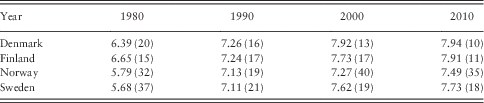
Back in 1980, Sweden was “a highly regulated economy with several state monopolies and low levels of economic freedom. Less than 20 years later, liberal reforms turned Sweden into one of the world’s most open economies with a remarkable increase in economic freedom” (Bergh and Erlingsson, Reference Bergh and Erlingsson2008). The Swedish score increased from 5.68 in 1980 to 7.73 in 2010 (Table 1). This moved Sweden up from 37th to 18th place worldwide (the average score for the 101 countries for which there is data back to 1980 increased by 1.52). Economic freedom increased also in Denmark, Finland and Norway (Norway peaked in 2005–2007), but Sweden increased the most.
Nordic countries in the Economic Freedom Index (overall rank in parenthesis)
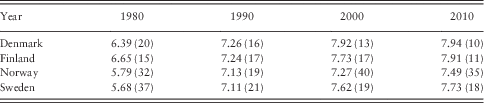
Source: Gwartney et al. (Reference Gwartney, Lawson and Hall2013).
Among the many changes in Sweden were several tax reforms. The marginal income tax peaked 1979–1982, with a top tax rate of 87% (Bergh, Reference Bergh2013). By 1990, this figure had been reduced to 50%. In 1980, there were state monopolies on postal services, telecommunications, electricity, railway services, etc., but these have now been abolished.
Thus, it appears that the trend towards more ‘market solutions’ in health care is a reflection of the overall trend in the Swedish economy, but also that the health care sector lags behind other parts of the economy. One may reasonably ask why?
The demise of the Swedish welfare state has frequently been predicted, but it has proved more resilient than expected and has demonstrated a capacity to adapt to new challenges and transform itself. Bergh and Erlingsson (Reference Bergh and Erlingsson2008) argue persuasively that an important reason why not only government monopolies but also, for example, the pay-as-you-go old-age pension system could be successfully reformed is the Swedish use of government commissions. The traditional commission provided a forum where the different political parties met with each other and met with researchers, with time for discussion and outside the immediate limelight. This provided an opportunity first and foremost to agree on the facts of the situation (we should not in general assume that different actors have the same belief about the world). As a consequence, wide political agreements could be reached. Many of the reforms survived changes of political majority in the Swedish parliament.
To the extent that this process was a reason for the ‘success’ of the reforms, it may also explain why the health care sector lags behind. It is hardly surprising if a sector governed by more than 20 political bodies does not reform itself in the same way as sectors governed by (one) parliament. In fact, as Saltman notes, there was a suggestion from a government commission to reduce the number of county councils from 21 to 6 or 8, but it did not survive the political process (in a few instances, a small number of county councils have chosen to amalgamate).
In his discussion of the Swedish health care sector, Saltman focusses on the formal rules. Institutions are often seen as the ‘rules of the game’ – the constraints that shape human interaction (North, Reference North1990). Rules can be formal, such as laws and regulations, but they can also be informal, like social norms. A particularly important contextual aspect of the Nordic health care systems is the level of trust between citizens that is extremely high by international standards. Citizens in the Nordic countries also trust their government to a much higher degree than in OECD countries generally (Lyttkens et al., Reference Lyttkens, Christiansen, Häkkinen, Kaarboe, Sutton and Welander2014). It seems to me likely that trust is an important element both in the work ethic of public employees and in the emphasis on equal access in Sweden and the other Nordic countries.
As in many countries, Sweden will most likely have to change the financing of health care, and peoples’ incomes will play a greater role for health care consumption in the future. Whether this will disrupt the public involvement in health care will depend, for example, on whether the different stakeholders in the county councils will be able to agree on the nature of the problem and adapt their institutional structure accordingly. The role of trust within the public health care system and between the health care sector and the rest of the society will be crucial for the long-run effects of such measures.