

INTRODUCTION
Tinned ceramicsFootnote 1 have been found in many places around the Aegean, including Crete, the Greek mainland and Rhodes. They are simply ceramic pots originally covered with a thin layer of tin. Tinned vessels have generally been considered a Mycenaean phenomenon (Driessen and MacDonald Reference Driessen and MacDonald1984, 66; Popham et al. Reference Popham, Betts, Cameron, Catling, Evely, Higgins and Smyth1984, 301 n. 23; Godart and Tzedakis Reference Godart and Tzedakis1992, 91), although recent evidence may indicate that such a conclusion was premature. Many scholars still connect them with the period of Late Helladic (LH) IIIA1 (Rutter Reference Rutter and Cline2010, 418; Davis, Bennet, and Shelmerdine Reference Davis, Bennet, Shelmerdine, Betancourt, Karageorghis, Laffineur and Niemeier1999, 447). This is probably because when the earliest in-depth analysis of the phenomenon was published (Immerwahr Reference Immerwahr1966), almost all known examples were contemporary with that period. However, further finds have demonstrated that their chronological range was much wider than previously suspected; the earliest context in which a tinned vessel has been recovered dated to Middle Minoan (MM) II–III (Alberti Reference Alberti2001, 185), and they have also appeared in Late Minoan (LM)/LH IIIB contexts.
Initially the consensus interpretation regarded tinned vessels as imitations of silver vessels. Work by Gillis on tinning undermined many arguments used to support this hypothesis, yet somehow it has remained the dominant explanation for their existence. Why is this problematic? As well as affecting the interpretation of the role of tinned ceramics in Late Bronze Age Aegean societies, it has also impacted upon analysis of the contemporary silver vessel assemblage. Metalwork, due to its convertibility, is under-represented in the archaeological record (Wiener Reference Wiener and Gale1991, 326; Aulsebrook Reference Aulsebrook2017). The majority of precious metal vessels found in well-dated contexts on the Greek mainland come from the Mycenae shaft graves (Aulsebrook Reference Aulsebrook2012; Karo Reference Karo1930; Mylonas Reference Mylonas1972–3). Given the relative scarcity of silver vessels, and metal vessels more generally, after LH I scholars have looked for alternative ways to study them; therefore, the presumed link between tinned and silver vessels has been used to justify applying observations concerning the former to the latter. This has been especially significant for the interpretation of silver vessel assemblages, which are exceedingly rare.
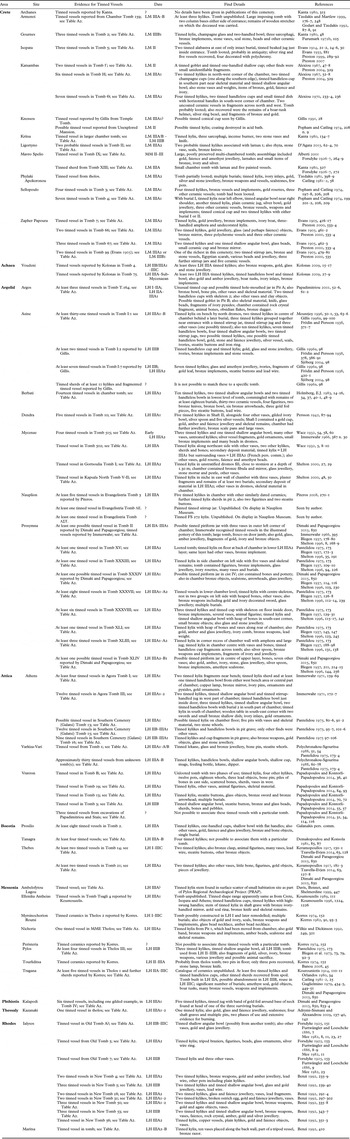
One of these silver vessel assemblages comes from the Kokla tholos tomb (Demakopoulou Reference Demakopoulou, Hägg and Nordquist1990; Reference Demakopoulou, Zerner, Zerner and Winder1993; Reference Demakopoulou, Driessen and Farnoux1997). During 2014 the metal vessels from Kokla were undergoing conservation at the Athens National Museum and I was granted access to examine them.Footnote 2 As the least well studied of the three post-LH I silver vessel assemblages that have been specifically linked by scholars to tinned ceramics,Footnote 3 insights gained from the analysis of the Kokla group should help clarify the relationship between tinned and silver vessels. This paper begins with an examination of the evidence concerning tinned ceramics. It then discusses the relationship between silver and tinned vessels, the silver vessel assemblages and the significance of the data from Kokla. A list of sites from which tinned vessels have been recovered and a catalogue of individually published tinned vessels are given in the Appendix, within which detailed reference citations are provided.
THE PHENOMENON OF TINNED CERAMICS
There was much speculation on the nature of this distinctive surface treatment before scientific analysis provided an answer. Evans described it as a ‘curious dark varnish’ that ‘may have been intended to produce the illusion of metal work for funereal show’ (Evans Reference Evans1905, 515). Furumark called it a ‘special kind of surface treatment … a coating of an unfixed pigment of greyish colour applied, as it seems, after the firing’ (Furumark Reference Furumark1972a, 12).Footnote 4 Immerwahr carried out the first systematic investigation, after more examples came to light at the Athenian Agora excavations, and conclusively demonstrated that these ceramics had been originally covered with tin (Immerwahr Reference Immerwahr1966).Footnote 5
Identifying tinned ceramic is not a straightforward task. In the cold atmosphere of tombs the foil suffers from an affliction known as ‘tin pest’, a process of oxidation that causes the tin to become powdery and flake away (Gillis Reference Gillis, Gillis, Risberg and Sjöberg1997, 134; Cardarelli Reference Cardarelli2008, 204; Noll and Heimann Reference Noll and Heimann2016, 194). When excavated, tinned pottery usually has a smattering of small irregular grey-black spots, which can be mistaken for some form of dirt. It can easily be overlooked, and in some cases traces have only been recognised during a later re-examination of sherds (Immerwahr Reference Immerwahr1966, 395; Alberti Reference Alberti2001);Footnote 6 therefore, it is likely that further unidentified tinned ceramics from older excavations are still awaiting discovery (Gillis Reference Gillis, Olausson and Vandkilde2000, 232). Tin readily dissolves in hydrochloric acid, which was often used to clean sherds (Farnsworth Reference Farnsworth1966, 396).Footnote 7 The colour of the traces can vary from brown (Dimaki and Parageorgiou Reference Dimaki, Papageorgiou and Mazarakis Ainian2015, 854) to a thin black-grey layer over a white substance (Immerwahr Reference Immerwahr1966, 382),Footnote 8 and even green to blue (Popham and Catling Reference Popham and Catling1974, 209). Taking these factors into consideration, it is possible that the phenomenon of tinning ceramics may have been significantly more common and widespread than current evidence suggests.Footnote 9
Research has taken place to determine how the tin coating was applied. Experiments have demonstrated that a similar effect can be produced by spreading a protein-based glue on the surface, and then dipping the entire vessel into molten tin (Holmberg, K. Reference Holmberg1983, 384; Mountjoy Reference Mountjoy1993, 66). The use of this method would explain why the underside of the base was sometimes coated, even on closed shapes (Mountjoy Reference Mountjoy, Hägg, Nordquist and Wells1996, 54–5).Footnote 10 However, close examination of the surface of some sherds from Asine showed wrinkles that were comparable to those produced from overlapping strips of tin foil (Gillis Reference Gillis1991–2, 27). The use of tin foil in elongated strips was also argued for by Pantelidou (Reference Pantelidou1971, 435; Reference Pantelidou1975, 173), due to her observation of grooves visible in the coating on a kylix from an Athenian tomb. Furthermore, the tin had flaked away from the ceramic surface in a way that only happens when tin has been made into foil (Gillis Reference Gillis1991–2, 28; Gillis and Bohm Reference Gillis, Bohm, Burragato, Grubessi and Lazzarini1994, 219–20). Similar findings were reported by another research group (Noll, Holm and Born Reference Noll, Holm and Born1980, 30; Noll and Heimann Reference Noll and Heimann2016, 193). The foil may have been extended onto the base in order to create a neater effect (Gillis Reference Gillis1994, 58).
During a series of experiments to test various methods of applying the tin coating, only the use of foil consistently produced a shiny, smooth and even surface (Gillis Reference Gillis1994, 57).Footnote 11 Analysis of the underside of the coating suggested a binder was used, most probably colophony (pine resin) (Gillis Reference Gillis1994, 61; Reference Gillis, Vendrell-Saz, Pradell, Molera and Garcia1995, 36).Footnote 12 The binder would have secured the foil in place and filled in defects in the ceramic surface to produce a more even finish (Gillis Reference Gillis1994, 58). Applying the foil in strips would have been time-consuming and particularly difficult where the surface morphology was complicated, for example near and on the handles (Mountjoy Reference Mountjoy1995, 31).Footnote 13 The binder would have mitigated this problem to some extent (Gillis Reference Gillis1994, 58). On the other hand, less tin would have been required than that needed for a molten tin bath. Although the majority of the evidence points towards the use of foil, it is possible that different workshops utilised either technique or a combination of both.Footnote 14
A series of analyses demonstrated that the tin used on some vessels from Asine had undergone a specific heat treatment, which caused it to oxidise to a golden colour (Gillis Reference Gillis1991–2, 28; Gillis and Bohm Reference Gillis, Bohm, Burragato, Grubessi and Lazzarini1994, 223; Gillis, Holmberg and Widelöv Reference Gillis, Holmberg, Widelöv and Vincenzini1995, 259; Gillis Reference Gillis, Young, Pollard, Budd and Ixer1999a; Reference Gillis, Betancourt, Karageorghis, Laffineur and Niemeier1999b).Footnote 15 The deposition of both golden and silvery tinned ceramics has been proven in Chamber Tomb I:1 at Asine through XPS analysis (Gillis Reference Gillis, Betancourt, Karageorghis, Laffineur and Niemeier1999b, 291–3; Reference Gillis, Olausson and Vandkilde2000, 233). The foil must have been treated prior to attachment, as otherwise the effectiveness of the binder would have been compromised (Gillis Reference Gillis1994, 59; Gillis and Bohm Reference Gillis, Bohm, Burragato, Grubessi and Lazzarini1994, 224).
Unlike tinning copper, which has practical applications such as preparing copper vessels for long-term food storage (Untracht Reference Untracht1968, 51), the tinning of ceramic has no functional purpose. Nevertheless, tinned vessels are known beyond the Late Bronze Age Aegean; similar vessels have been found on Cyprus, in the Iron Age cemetery at Salamis (Karageorghis Reference Karageorghis1974, 16–18, 55–7; Muhly Reference Muhly, Franklin, Olin and Wertime1978, 47),Footnote 16 in Late Classical and Hellenistic Macedonia (Kotitsa Reference Kotitsa, Drougou and Touratsoglou2012) and in prehistoric Italy, Austria, Hungary, France, Germany and Switzerland (Noll and Heimann Reference Noll and Heimann2016, 197). The usage of metals to cover ceramics is found in many other societies as well (Gillis Reference Gillis, Cleland and Stears2004, 56). This close relationship between metals and another material is not unprecedented in the Aegean vessel assemblage. A tin-lined ivory pyxis was recovered from tomb I at the Athens Agora (Immerwahr Reference Immerwahr1971, 166 [I-16]), and a partially gilded ivory bowl from chamber tomb 10 at Dendra (Persson Reference Persson1942, 91), while fragments of ivory and bronze from tomb XXVI at Prosymna were interpreted as the remains of a conical rhyton (Blegen Reference Blegen1937, 98, 354). Faience vessels were often gilded or plated with bronze (Foster Reference Foster1979, 131–2), and faience and metal were also combined simultaneously to decorate ostrich egg rhyta. Fittings and ornamentation of bronze and gold were sometimes added to stone vessels (Warren Reference Warren1969, 162–3).
Tinned ceramics also add to our understanding of the East Mediterranean metals trade. No references to tin have been found in Linear A or B,Footnote 17 and pure tin is rare on the Greek mainland throughout the Bronze Age (Gillis and Clayton Reference Gillis, Clayton and Tzachili2008, 134). With the exception of the tinning of ceramics, it is rare to find this metal used in the Aegean for any other purpose than as a constituent of bronze.Footnote 18 No tin vessels have been found in the Aegean, despite their appearance elsewhere in the East Mediterranean, for example on the Ulu Burun shipwreck (Bass et al. Reference Bass, Pulak, Collon and Weinstein1989, 12). The presence of tinned ceramics therefore reaffirms the presence of unalloyed tin in the Aegean, although it is not yet possible to determine its origin.Footnote 19
The Distribution and Chronology of Tinned Ceramics
Tin-coated ceramic vessels have been found at a range of sites across the Aegean (Fig. 1). These concentrate in three regions; the Greek mainland, Crete and Rhodes. No examples have been reported from the Cyclades; this may be because there are so few known Late Bronze Age (LBA) Cycladic tomb sites.Footnote 20 The following section provides an overview of their find locations. For further details see the Appendix.
Map of the Aegean, showing the sites from which tinned vessels are known or have been reported. (1) Archanes; (2) Armenoi; (3) Gournes; (4) Isopata; (5) Katsambas; (6) Knossos; (7) Kritsa; (8) Ligortyno; (9) Mavro Spelio; (10) Phylaki Apokoronou; (11) Sellopoulo; (12) Zapher Papoura; (13) Voudeni; (14) Argos; (15) Asine; (16) Berbati; (17) Dendra; (18) Mycenae; (19) Nauplion; (20) Prosymna; (21) Athens; (22) Varkiza-Vari; (23) Vravron; (24) Prosilio; (25) Tanagra; (26) Thebes; (27) Ambelofytou Lagou; (28) Ellenika Antheias; (29) Myrsinochorion Routsi; (30) Nichoria; (31) Peristeria; (32) Pylos; (33) Tourliditsa; (34) Tragana; (35) Kalapodi; (36) Kazanaki; (37) Ialysos; (38) Maritsa. Map by author.

Crete
There are 12 Cretan sites from which tinned vessels have been published or reported, including the earliest known example of a tinned vessel found thus far. No tinned ceramics have been reported in LM IIIC contexts.Footnote 21 The chronology of the Cretan finds is set out below with the exception of those from Archanes, for which there is no information beyond the fact of their existence (Kanta Reference Kanta1980, 315).Footnote 22
Neopalatial Period (MM III–LM IB)
Recognised after a restudy of material from the Mavro Spelio cemetery,Footnote 23 a tinned MM III–LM I conical cup was recovered from Tomb IX, which was in use from MM II–III (Alberti Reference Alberti2001, 185, 179 n. 24 fig. 6e). The archaeological record then seems to indicate a hiatus in their manufacture, as no tinned vessels have been reported from LM IA or IB contexts (Hatzaki Reference Hatzaki and Momigliano2007, 208). This lacuna may stem from a lack of analysis (Alberti Reference Alberti2001, 179 n. 24) rather than a temporary lapse in production; scholars have simply not expected tinned ceramics to appear in Cretan contexts pre-dating LM II.
Final/Postpalatial Period (LM II–IIIB)
Tinned ceramics have been recovered from two LM II contexts: Katsambas Tomb Γ (Alexiou Reference Alexiou1967, 47–8) and Isopata Tomb 5 (Evans Reference Evans1914, 24–5). The latter also contained ceramic vessels with polychrome decoration.Footnote 24 The existence of such decoration highlights an apparent interest in the selective transformation of ceramics upon entry to the mortuary sphere that reached beyond tinning. LM IIIA1 tinned ceramics were also recovered from the Knossian region, at Katsambas and Sellopoulo (Table 1). Another possible contemporary example may have been found in the Temple TombFootnote 25 at Knossos (Gillis Reference Gillis1991, 28).
Finds of tinned ceramics within LM IIIA1 assemblages.

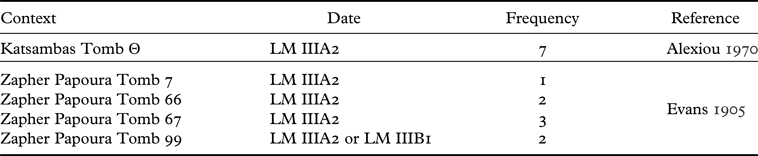
Tinned ceramics continued to be deposited in this region during LM IIIA2 (Table 2). They were also present at Mavro Spelio during LM IIIA: a sherd from Tomb XIII tested positive for tin (Kanta Reference Kanta1980, 327). As noted by Hatzaki (Reference Hatzaki and Momigliano2007, 230), tinned ceramics were apparently not deposited in the Knossian region after LM IIIA2 (with the possible exception of Zapher Papoura Tomb 99).Footnote 26 The assemblages at Zapher Papoura are smaller than those from Katsambas and Sellopoulo, although this may reflect the relative paucity of pottery from this site.
Finds of tinned ceramics from the Knossian region after LM IIIA1.

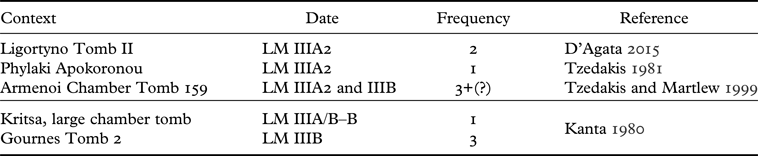
From LM IIIA2 onwards, tinned ceramics were found outside the Knossian region in West Crete at Phylaki Apokoronou and Armenoi, on the Mesara at Ligortyno and elsewhere in Central Crete at Gournes and Kritsa (Table 3). The number of vessels deposited in these contexts was also smaller, suggesting a possible decline in the tinned vessel assemblage size over time, although the extent of the presence of tinned ceramics at Armenoi has not yet been confirmed.
Finds of tinned ceramics on Crete beyond the Knossian region.

Greek Mainland
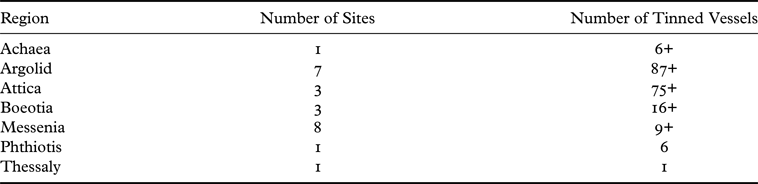
Tinned ceramics have been found at 24 sites on the Late Bronze Age Greek mainland. They are predominantly concentrated in the Argolid, Attica and Messenia (Table 4). The number of examples from Messenia is probably significantly underestimated because the majority have not been published; Korres reported tinned ceramics from Tourliditsa, Myrsinochorion Routsi,Footnote 27 and Peristeria, and that examples were held at the Museums of Pylos, Chora and Athens (Korres Reference Korres1974, 152; Mountjoy Reference Mountjoy, Hägg, Nordquist and Wells1996, 55 n. 46). Pantelidou (Reference Pantelidou1975, 173) also reported at least eight further tinned vessels in the National Museum stores, which were apparently from Attica.Footnote 28 Gillis suggested that other tombs at Mycenae and Dendra contained tinned ceramics (Gillis Reference Gillis, De Miro, Godart and Sacconi1996b, 1202 n. 18) and reported further sherds from an unknown tomb or tombs at Asine (Gillis Reference Gillis, Hägg, Nordquist and Wells1996a, 98). Four tinned kylikes from the cemetery at Tanagra, dated to LH IIIA–B, were previously on display at the Thebes Archaeological Museum (Demakopoulou and Konsola Reference Demakopoulou and Konsola1981, 85, 87); these are awaiting publication, and it is possible that further tinned vessels were recovered from this site. No LH IIIC tinned ceramics have been positively identified.
Number of sites in each region of the Greek mainland at which tinned vessels have been found and estimate of the total number of tinned vessels from each region.

Prepalatial Period LH I–II
The earliest known mainland tinned vessel is perhaps from a built chamber tomb, T.164, at Argos (Papadimitriou Reference Papadimitriou2001, 55–6 [P11] fig. 11a, pl. 8a). It was an unusual shape and is discussed in more detail below. Several tinned vessels were found associated with later burials in the same tomb (Papadimitriou Reference Papadimitriou2001). Three tinned goblets were found with other LH IIB vessels deposited during an early usage phase in Asine Tomb I:7 (Sjöberg Reference Sjöberg2004). There are no known examples outside of the Argolid from this period.
LH IIIA
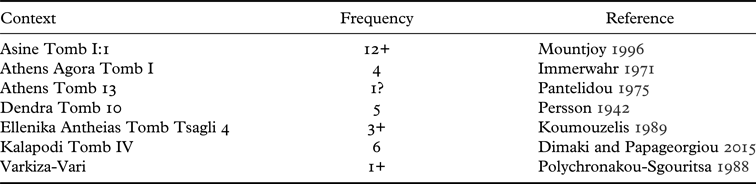
The number and range of sites with tinned ceramics expanded dramatically during this period. Two pit graves in the southern cemetery at Athens, dated LH IIB–IIIA1, contained sizeable assemblages of tinned vessels (Pantelidou Reference Pantelidou1975). LH IIIA1 tinned ceramics are known from Asine,Footnote 29 Athens, Dendra, Ellenika Antheias, Kalapodi and Varkiza-VariFootnote 30 (Table 5). A tinned jug from Kalapodi had a separate piece of gold sheet around the base of its neck (Dimaki and Papageorgiou Reference Dimaki, Papageorgiou and Mazarakis Ainian2015, 854 fig. 7). This may indicate that the artisans who tinned it were unaware of the technique to recolour tin to resemble gold, even though the process was relatively simple (Gillis, Holmberg and Widelöv Reference Gillis, Holmberg, Widelöv and Vincenzini1995, 259).Footnote 31
Known examples of LH IIIA1 tinned ceramics.

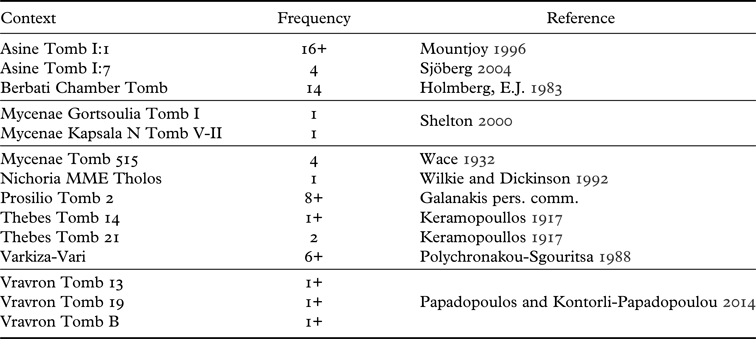
LH IIIA2 tinned ceramics have been found at Asine, Berbati,Footnote 32 Mycenae, Nichoria, Prosilio,Footnote 33 Thebes, Varkiza-Vari and Vravron (Table 6). Several contexts, which cannot be more precisely dated within LH IIIA, have also yielded tinned vessels. These are Athens Agora Tomb III (Immerwahr Reference Immerwahr1971), Mycenae Tomb 502 (Wace Reference Wace1932), Nauplion Evangelistria Tomb 3 (Piteros Reference Piteros2008; Reference Piteros, Schallin and Tournavitou2015),Footnote 34 Tragana Tholos 1 (Kourouniotis Reference Kourouniotis1914; Gulgielmino Reference Guglielmino1979), Kazanaki tholos (Adrymi-Sismani and Alexandrou Reference Adrymi-Sismani, Alexandrou and Mazarakis Ainian2009) and Voudeni Tombs 4 and 75 (Kolonas Reference Kolonas2009). A tinned kylix sherd from Ambelofyto Lagou was also suggested to date to LH IIIA (Davis, Bennet, and Shelmerdine Reference Davis, Bennet, Shelmerdine, Betancourt, Karageorghis, Laffineur and Niemeier1999, 447).Footnote 35
Known examples of LH IIIA2 tinned ceramics.

Many tinned vessels seem to have been deposited at Prosymna, although this was not noted in its publication (Blegen Reference Blegen1937). Immerwahr was the first to note nine tinned vesselsFootnote 36 from Prosymna on display at the Athens National Museum, one of which could be securely identified as kylix no. 712 from Tomb XXXVII (Immerwahr Reference Immerwahr1966, 395). Later, Pantelidou identified another 19 in the National Museum stores (Pantelidou Reference Pantelidou1975, 173), confirming that at least six tombs contained tinned ceramics. Dimaki and Parageorgiou (Reference Dimaki, Papageorgiou and Mazarakis Ainian2015, 850) listed another three from the same site.Footnote 37
LH IIIB
Four tinned vessels were recovered from Tholos III at Pylos (Blegen et al. Reference Blegen, Rawson, Taylour and Donovan1973; Pantelidou Reference Pantelidou1975),Footnote 38 two from Asine Tomb I:2 (Gillis Reference Gillis, Hägg, Nordquist and Wells1996a; Sjöberg Reference Sjöberg2004), and one from Vravron Tomb 3 (Papadopoulos and Kontorli-Papadopoulou Reference Papadopoulos and Kontorli-Papadopoulou2014). Tinned ceramics continued to be deposited in Asine Tomb I:1 (Mountjoy Reference Mountjoy, Hägg, Nordquist and Wells1996; Gillis Reference Gillis, Hägg, Nordquist and Wells1996a) and at Varkiza-Vari (Polychronakou-Sgouritsa Reference Polychronakou-Sgouritsa1988).
Rhodes
There are two sites on this island from which tinned ceramic vessels have been recovered, 20 in total. The majority come from Ialysos, from 10Footnote 39 tombs in assemblages dating from LH IIIA1–B (Benzi Reference Benzi1992).Footnote 40 A single tinned kylix was found at a second cemetery site, Maritsa,Footnote 41 in a tomb used during LH IIIA2–B (Benzi Reference Benzi1992, 410).
Tinned Vessel Shapes
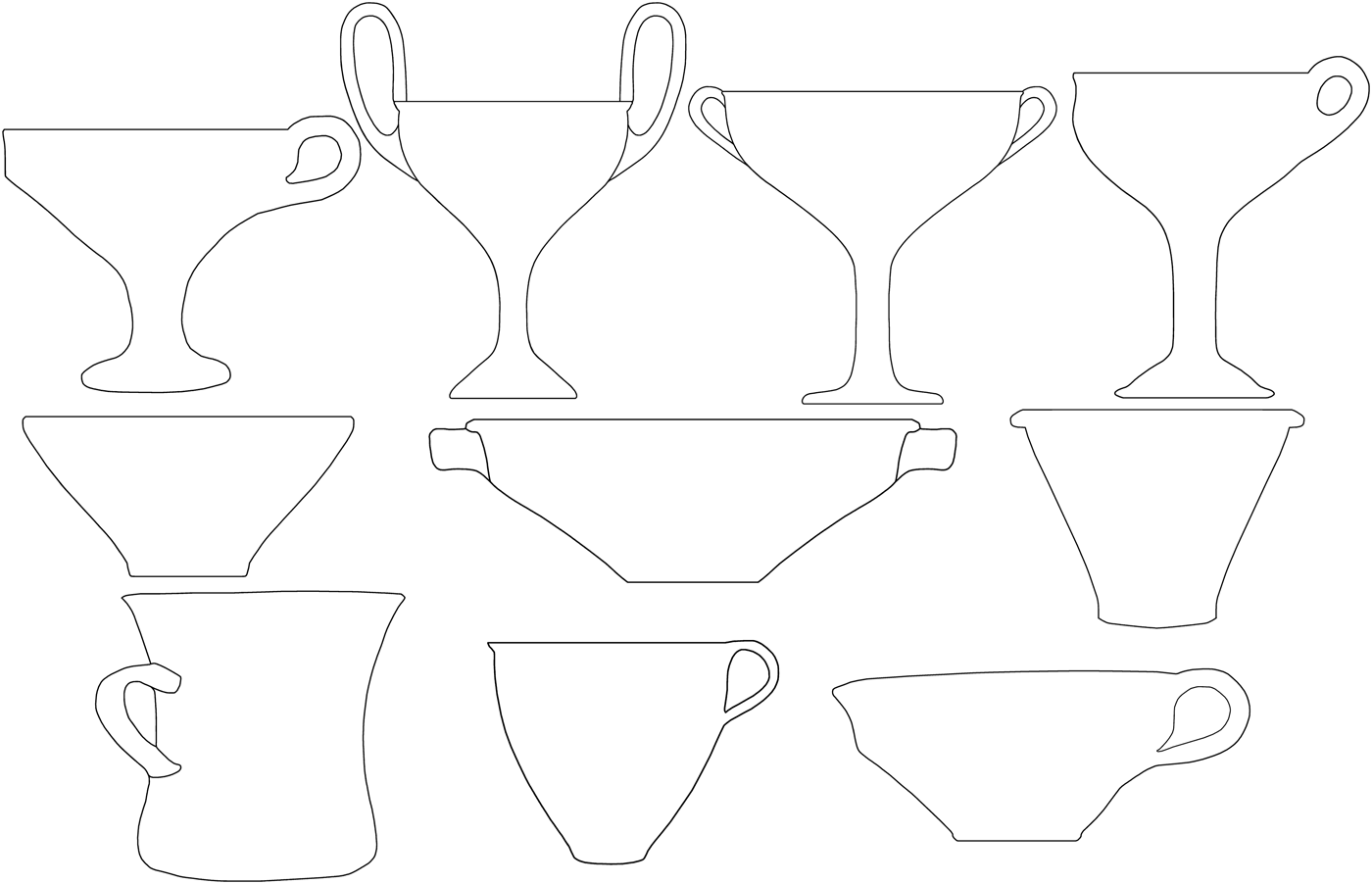
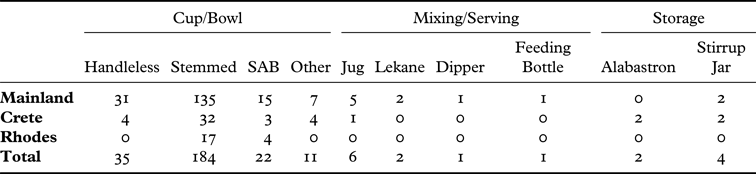
Some tinned vessels were recovered in too fragmented a state for their original form to be recognised. However, it has been possible to identify the shapes of 268 individually published vessels. A summary of their forms can be found in Table 7.Footnote 42 They can be broadly split into three categories; cups and bowls (Fig. 2),Footnote 43 mixing and serving vessels (Fig. 3), and storage vessels (Fig. 4). Currently there are no known examples of tinned cooking vessels or tinned rhyta. Certain distinctive shapes are also absent from the tinned vessel assemblage, such as deep bowls and kraters. Clearly a process of selection took place.
Sketches of the known tinned cup and bowl forms. Only the most frequent tinned kylix variants are illustrated. From left to right; top: FS 267 kylix, FS 272 kylix, FS 265 kylix, FS 264 kylix; middle: handleless bowl FS 204, shallow angular bowl FS 295, Minoan conical cup; bottom: mug, deep cup, shallow cup. Drawing by author.

Sketches of the known tinned mixing and serving forms. Clockwise from top right: feeding bottle, stirrup jug, lekane, beaked jug; centre: dipper. Drawing by author.
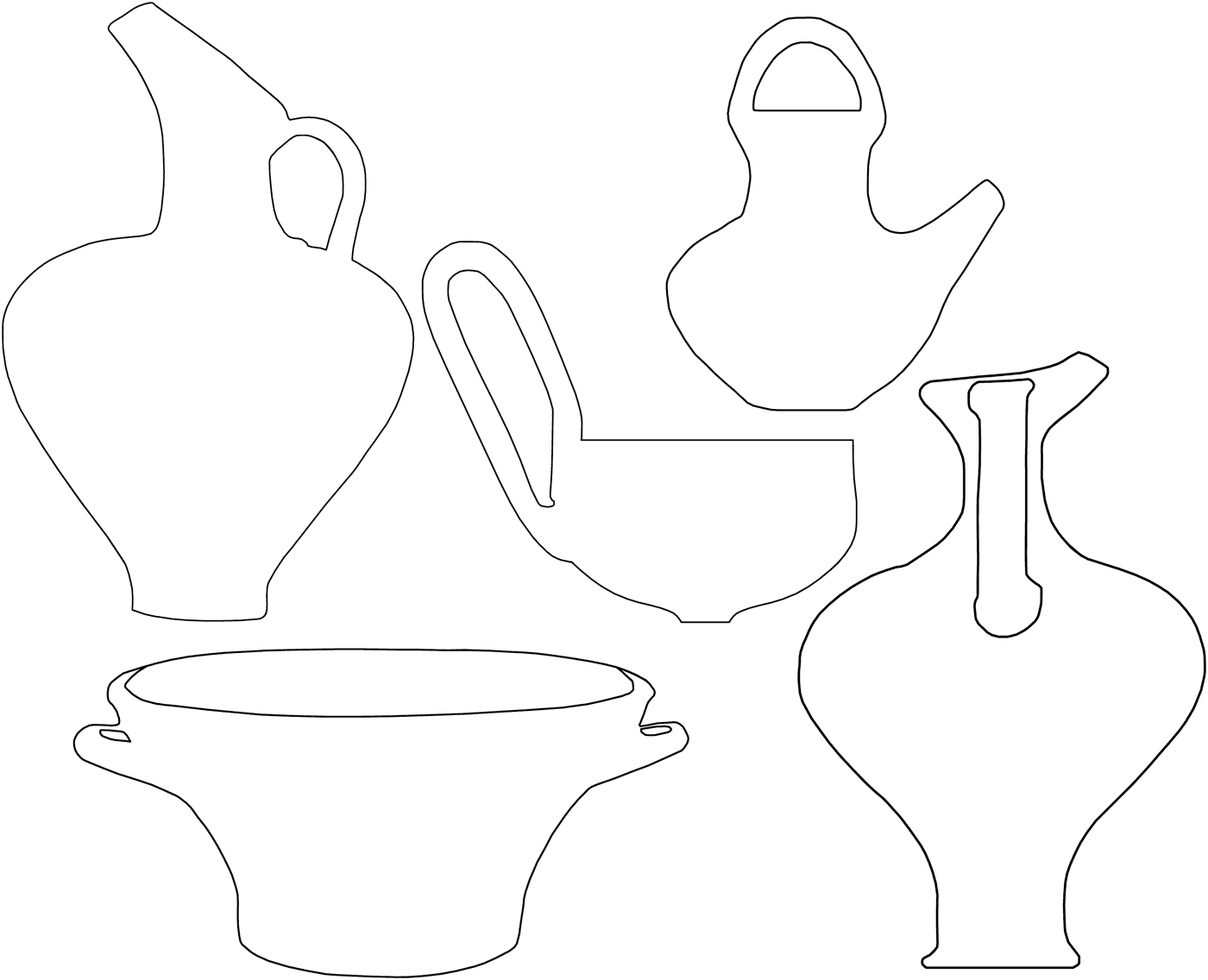
Sketches of the known tinned storage forms. Left: stirrup jar; right: alabastron. Drawing by author.

Categories of shape found in the tinned vessel assemblages of the Greek mainland, Crete and Rhodes. SAB = Shallow angular bowl.

The most diverse range of tinned shapes is found on the Greek mainland, which may be because its published dataset is so much larger than that of Crete and Rhodes. The form of 199 individually published vessels from the Greek mainland could be identified. The majority are stemmed goblets, followed by handleless and shallow angular bowls. Tinned versions of several shapes, including the dipper, feeding bottle, mug and lekane, are known only from Varkiza-Vari. It has been suggested that the motivation to tin so many unusual shapes was to hide their worn paint (Polychronakou-Sgouritsa Reference Polychronakou-Sgouritsa1988, 100). This does not explain why the users of the tomb chose to deposit those specific vessels, once tinned, rather than less worn examples. Other rare forms include the stirrup jar, known from Asine and Nauplion, and a shallow cup, from Prosymna. An unusual deep cup was recovered from T.164 at Argos. It may have been derived from the Cycladic cup and its shape and handle are reminiscent of metallic forms; it was accompanied by LH I–IIA sherds, but the cup itself should be dated to final Middle Helladic (MH) or early LH I (Papadimitriou Reference Papadimitriou2001, 55). It may have been an antique when deposited, perhaps indicating why it was singled out for tinning. All known tinned jugs belong to the stirrup-handled type.
The majority of the 48 Cretan vessels for which details of shape have been published are stemmed cups (goblets, kylikes and champagne cups). As with the mainland assemblage, the shallow angular and handleless bowls are the next most popular tinned shapes. Pace Preston (Reference Preston2004, 329), tinned drinking vessels have been found in a LM II context, Katsambas Tomb Γ (Alexiou Reference Alexiou1967). The alabastra, from Isopata Tomb 5, are the only known tinned examples of this form. Two tinned stirrup jars were found at Zapher Papoura, and a tinned shallow cup and unusual tinned two-handled dish at Katsambas.Footnote 44 Only one Cretan tinned jug is known, of a different form to mainland tinned jugs.
Only two tinned shapes are known from Rhodes: the kylix and shallow angular bowl. The former outnumbered the latter by 4:1. No handleless bowls have been found. However, these findings are based upon just 21 vessels, and therefore must be treated with caution.
Thus an apparent core of three tinned shapes can be recognised: the stemmed cup, the handleless bowl and the shallow angular bowl. As shown in Fig. 5, they collectively accounted for over 80 per cent of the tinned forms on Crete, over 90 per cent on the Greek mainland and 100 per cent on Rhodes. Establishing this core range took time; several of the earliest known assemblages, including Isopata Tomb 5 (Evans Reference Evans1914), Argos T.164 (Papadimitriou Reference Papadimitriou2001) and Katsambas Tomb Γ (Alexiou Reference Alexiou1967) contained different shapes. All three forms were only certainly present in a few contexts, which date to LH/LM IIIA at the earliest.
Pie charts comparing the percentage of stemmed cups, handleless bowls, shallow angular bowls and other shapes in the tinned vessel assemblages of Mainland Greece, Crete and Rhodes.

Mountjoy (Reference Mountjoy, Hägg, Nordquist and Wells1996, 55) suggested that Asine Tomb I:1 contained a set of tinned vessels, consisting of one closed pouring vessel and a variety of open shapes. However, three tinned jugs were found in this tomb,Footnote 45 and it cannot be confirmed that the entire ‘set’ was deposited simultaneously. Tinned jugs are relatively rare; only two other contexts contained both a jug and open shapes. Non-tinned jugs may have been used instead, as Mountjoy (Reference Mountjoy2003, 166) suggests, although this undermines the notion that tinning was intended to create a distinct assemblage for mortuary rituals. Jugs are larger than cups and bowls, and require more tin for complete coverage; however, some tombs contained so many smaller tinned vessels that it is difficult to argue the rarity of tinned jugs was due to cost. This issue is discussed further below. It seems that small individualised pots, rather than larger communal vessels, were prioritised for tinning.
It is also evident from Fig. 5 that the stemmed cup dominated the tinned vessel assemblage in all three regions. They are absent from only five contexts yet are the sole constituent of 15 tinned assemblages.Footnote 46 This indicates that, despite the core triad of tinned shapes, stemmed cups were the real focus of tinning. It is therefore interesting that they were not among the first known examples.
In many cases the variant of stemmed cup could be recognised; these are shown in Table 8.Footnote 47 On the Greek mainland 57 stemmed cups with rounded bowls were recovered from 27 different contexts, whereas 40 stemmed cups with angular bowls were recovered from 15 different contexts. On Rhodes the figures are eight rounded stemmed cups from seven different contexts, and seven angular stemmed cups from five different contexts. Among the rounded stemmed cups there is no clear predominant form in either region.
Comparison of the variants of stemmed cups on the Greek mainland and Rhodes. The first figure shows the total frequency, the figure in brackets the number of contexts in which each variant was found.

In every context on the Greek mainland and Rhodes where tinned shallow angular bowls are present tinned angular stemmed cups are also found, although the converse is not true.Footnote 48 Such a relationship does not exist between handleless cups and angular stemmed cups. A special relationship between angular kylikes and shallow angular bowls has been mooted by Thomas (Reference Thomas, Gauss, Lindblom, Angus, Smith and Wright2011), and this may provide additional evidence to support such a hypothesis. Whether this means that tinned vessels can be linked to the deliberate archaising move away from continuously curving to angular profiles discussed by Thomas (Reference Thomas, Gauss, Lindblom, Angus, Smith and Wright2011, 303) is less certain. Almost all examples of tinned angular stemmed cups were accompanied by rounded bowl versions as well.Footnote 49 Although the latter are commonly interpreted as drinking vessels, it has been argued that the angular type should be associated with food consumption, as should the shallow angular bowl (Tournavitou Reference Tournavitou1992, 200; Lis Reference Lis, Hitchcock, Laffineur and Crowley2008, 145; Thomas Reference Thomas, Gauss, Lindblom, Angus, Smith and Wright2011, 301). The widespread presence of the angular kylix therefore demonstrates that tinned vessels were used for eating as well as drinking rituals. Coupled with the rarity of tinned jugs, the use of tinned sets as evidence for drinking rituals specifically must be treated with caution.
Tinned Vessel Production
Immerwahr (Reference Immerwahr1966, 382) noted that the majority of tinned vessels recovered from Athens Tomb III were technically inferior or unfinished, with preliminary smoothing but no technical slip or final polishing. This could indicate that these vessels were earmarked for tinning before their manufacture was complete. However, examples with well-finished surfaces have been found at other sites, such as Asine (Mountjoy Reference Mountjoy, Hägg, Nordquist and Wells1996) and Argos (Papadimitriou Reference Papadimitriou2001), and also in Athens Tomb III, alongside unfinished examples.Footnote 50 Furthermore, some vessels were clearly already painted before tinning took place. Examples are known from Asine,Footnote 51 Varkiza-Vari,Footnote 52 Nauplion,Footnote 53 Armenoi,Footnote 54 Ialysos,Footnote 55 and possibly Argos.Footnote 56 Pantelidou stressed that, in some cases, their paint was well worn, implying that these vessels had had a significant use life before being tinned and deposited (Pantelidou Reference Pantelidou1975, 174). A similar pattern is visible at Varkiza-Vari. Unfortunately, investigation of these trends is hampered by the patchiness of the information provided on surface treatment, which is only available for a limited number of tinned vessels.
Their quality also varied widely, even at the same site. This was the case on Rhodes (Benzi Reference Benzi1992, 6). At Varkiza-Vari many tinned vessels were poorly manufactured (Polychronakou-Sgouritsa Reference Polychronakou-Sgouritsa1988, 100). On Crete, they tended to be made using a fine buff fabric (Hatzaki Reference Hatzaki and Momigliano2007, 216). The tinned vessels from Kalapodi were made from good-quality ceramic but details of their construction were poor, causing problems such as lopsidedness; Dimaki and Papageorgiou (Reference Dimaki, Papageorgiou and Mazarakis Ainian2015, 850) suggested this showed indifference from the potter. It is possible that some vessels selected for tinning directly after manufacture were seconds, especially if they were only to be used once. However, there are also many examples of tinned vessels that met the same quality standards as ordinary pottery. Overall, this variability in quality and process of manufacture demonstrates that there was no single chaîne opératoire for the production of tinned vessels. The patterning of this variability indicates that it was not the result of regional or chronological differences.
Immerwahr (Reference Immerwahr1966, 392) suggested that tinned ceramics were primarily manufactured in workshops situated at Knossos and Mycenae, due to their known distribution and apparent connection to C and D Type swords. This hypothesis has been undermined by discoveries of tinned vessels across a much broader area of the Aegean. Pantelidou (Reference Pantelidou1975, 174) argued against the supply of tinned vessels to Athens by a Mycenae-based workshop, as 19 of the 20 examples found in the southern cemetery had the same clay as ordinary unpainted Athenian pottery. Immerwahr (Reference Immerwahr1966, 393) also accepted that some vessels must have been tinned locally, such as those from Ialysos that were originally painted or had a fine surface treatment. A provenance analysis of A863 from Ialysos first gave east Attica as a production centre, which was then altered to Knossos–Thebes, although this should be treated with caution (Jones Reference Jones1986; Benzi Reference Benzi1992, 7). Tinned vessels may have been exported (D'Agata Reference D'Agata2015, 89) or perhaps used in gift exchange (Reeves Reference Reeves2003, 248); however, it is likely that the coating would have been damaged by lengthy periods of transit. Their strong association with mortuary contexts implies that, even if some tinned ceramics were exchanged prior to deposition, this was unlikely to have been the primary motivation for their production. It is perhaps more probable that vessels were traded before being tinned. Further research through provenance analyses would be welcome, in order to examine the networks behind the manufacture of tinned vessels.
Tinned Ceramics in the Mortuary Sphere
Tinned ceramics have been found within a variety of different mortuary assemblages. In most cases it is not possible to tell exactly which other objects accompanied the tinned vessels into the tomb. This is because grave goods, including tinned vessels, and previous burials were often displaced when a new burial took place.Footnote 57 They were therefore treated the same as other ceramics. Objects were sometimes removed from tombs (Wolpert Reference Wolpert, Barrett and Halstead2004, 135), so only part of the assemblage remains. Some tombs containing tinned ceramics were later reused, providing another opportunity for objects to be removed (Dickinson Reference Dickinson2006, 178), or were looted.Footnote 58 However, a general overview of the preserved assemblages can provide some information about the treatment of tinned ceramics during and after deposition in tombs.
Generally, tinned ceramics are found alongside untreated vessels. In some cases, both tinned and non-tinned versions of the same type have been found in the same tomb;Footnote 59 therefore, tinned ceramics do not wholly replace ordinary ceramics in mortuary assemblages. There are several tombs from which both metal and tinned ceramics were recoveredFootnote 60 and it is occasionally possible to see that both formed part of the same burial assemblage.Footnote 61 Therefore, it is difficult to argue that tinned ceramics were always conceptualised as direct replacements for metal vessels; this issue is discussed in more detail below. Tinned vessels have also been found alongside stoneFootnote 62 and ivory vases.Footnote 63 Thus tinned vessels formed part of a wider vessel assemblage. There is no evidence to suggest that they were singled out for deposition in shafts, niches or other features in tombs (contra Borgna Reference Borgna2004, 268). Where tinned vessels have been found within such features, they were accompanied by other ordinary ceramics.Footnote 64
The number of tinned vessels per tomb varies widely from a single specimen to an assemblage of at least 31. These large tinned groups were rarer and need not have been deposited together. For example, as the tinned vessels in Asine Tomb I:1 range from LH IIIA1–IIIB (Mountjoy Reference Mountjoy, Hägg, Nordquist and Wells1996, 64–6), it is more likely that this assemblage was built up through multiple acts of deposition. The size of the tinned assemblage may have depended upon the frequency of ceramic deposition practised within a cemetery, as seen at Zapher Papoura.
Several scholars have remarked on the fact that tinned vessels seem to have been associated with richer tombs (Immerwahr Reference Immerwahr1966, 388; Mee Reference Mee1982, 18; Gillis Reference Gillis, De Miro, Godart and Sacconi1996b, 1202–3). In contrast, less extravagant mortuary assemblages containing tinned vessels, such as at Berbati, have been used to argue that tin was relatively plentiful and easily accessible (Warren Reference Warren1985, 207).Footnote 65 As discussed above, the original contents of each tomb are difficult to ascertain. The definition of a ‘wealthy’ tomb is also not straightforward.Footnote 66 However, such a relationship does seem possible, given the proportion of tombs containing both tinned vessels and gold: 57.5 per cent.Footnote 67 This gives only a rough impression, as several tombs without gold did contain other probable high-value materials, such as silver or ivory, alongside tinned ceramics. Tin itself was costly (Gillis Reference Gillis, Olausson and Vandkilde2000, 231); that it can change colour may have added to its value (Gillis Reference Gillis, Olausson and Vandkilde2000, 234), as might its rarity in the Aegean as an unalloyed metal. It is important, therefore, to approach tinned vessels as a luxury item (Mountjoy Reference Mountjoy1995, 31); this viewpoint makes the discovery of tinned ceramics in well-furnished tombs unsurprising.
Tinned Vessels outside the Mortuary Sphere
Almost all tinned vessels have been found in mortuary contexts. One exception is the tinned kylix stem found at Ambelofyto LagouFootnote 68 in Messenia (Davis, Bennet, and Shelmerdine Reference Davis, Bennet, Shelmerdine, Betancourt, Karageorghis, Laffineur and Niemeier1999, 447). This small habitation site, suggested to be the remains of an unfortified agricultural centre (McDonald and Hope Simpson Reference McDonald and Hope Simpson1961, 237 no. 40), has been badly eroded by intensive cultivation (Hope Simpson Reference Hope Simpson1965, 65; McDonald and Rapp Reference McDonald and Rapp1972, 267). It seems an unlikely find location, given that many tinned vessels are associated with well-furnished tombs. This find could indicate that tinned ceramics had a role outside the mortuary sphere, although it may equally have been a stray from a workshop, perhaps indicating their production in the locality. Unfortunately, the damage wrought upon this site during recent decades has severely lessened the likelihood that further investigation will take place in the foreseeable future.
The other exception was a kylix from the LM II destruction levels at the Unexplored Mansion at Knossos (Popham and Catling Reference Popham and Catling1974, 208 n. 9). Unfortunately any traces were destroyed by acid and it is impossible to verify whether the coating was tin or another substance.Footnote 69 In situ remains from these levels suggested that it or a neighbouring area had been used for metallurgical activities (Popham et al. Reference Popham, Betts, Cameron, Catling, Evely, Higgins and Smyth1984, 262). The tinned vessel does not provide evidence of domestic usage, but may indicate that tinning was carried out by metallurgists, not potters.Footnote 70 However, the extent of the involvement of metalworkers in tinned ceramic manufacture cannot be resolved by one untested sherd. Further evidence is needed before such issues can be addressed.
THE RELATIONSHIP BETWEEN TINNED CERAMIC AND METAL VESSELS
Many scholars have suggested that tinned ceramics were intended to imitate metal vessels, especially those in silver, and were used as less expensive substitutes for the funerary sphere.Footnote 71 Skeuomorphing of silver vessels in ceramic has been proposed for a number of East Mediterranean cultures, particularly for glossy black-grey wares (Reeves Reference Reeves2003, 234; Philip and Rehren Reference Philip and Rehren1996, 144; Vickers Reference Vickers1985, 108). Tinning could therefore be understood as a more luxurious method of imitation (Mountjoy Reference Mountjoy1995, 31; Immerwahr Reference Immerwahr1966, 386).
Scholars have also connected tinned vessels to three specific silver vessel assemblages, from the South House at Knossos, Dendra chamber tomb 10 and Kokla tholos tomb, and used this link to discuss their significance and social role. Mountjoy (Reference Mountjoy2003, 166) used tinned vessels to help support her argument that the Kokla and South House silver vessel assemblages could be interpreted as ceremonial groups. Wright (Reference Wright, Halstead and Barrett2004, 99) used tinned ceramics to suggest increased standardisation in silver vessel sets, such as the Dendra group, during LH IIIA1. It is important to note that there are two other silver vessel assemblages contemporary with the usage of tinned ceramics, from the Dendra and Vapheio tholoi (Persson Reference Persson1931, 33–4, 38; Tsountas Reference Tsountas1889), which have not been linked in the literature to the practice of tinning.Footnote 72 The characteristics of these assemblages with reference to tinned vessels are also discussed below.
Imitation is complex, as are the motivations that lie behind imitative actions. Recent work on the nature of imitation and skeuomorphs has emphasised their diversity (McCullough Reference McCullough2014). Describing tinned ceramics as imitations of silver vessels is therefore not sufficient; it is necessary to ask in what ways this imitation was manifested before their relationship can be fully examined. To achieve this, it is necessary to compare and contrast the silver assemblages that tinned vessels are assumed to imitate. First, however, the background to this claimed imitation must be examined.
If imitation was their primary purpose, it is perhaps surprising that no tinned ceramics discovered thus far have any additional features referencing metal vessels. This practice is reasonably common in Aegean pottery and includes fake rivets, base and neck rings to imitate seams, and central grooves on handles to mimic wired edges (Mountjoy Reference Mountjoy1993, 38). To individuals familiar with the appearance of metal vessels, the lack of such features would have been immediately obvious. Furthermore, no tinned vessels found thus far have exhibited any attempts to imitate the decoration often found on metal vessels by, for example, manipulating the topography of their surface prior to tinning.
Tinning does not reproduce a perfect imitation of the appearance or colour of silver (Gillis Reference Gillis1991–2, 32). The manufacture of gold-coloured tinned ceramics also weakens their connection to silver specifically. It is worth remembering that gold-coloured tinned ceramics would also have resembled high-tin bronze (Fang and McDonnell Reference Fang and McDonnell2011, 54–6).
Of the three core shapes discussed above, only the stemmed cup and handleless bowl are found in the metal vessel corpus; there are no known examples of shallow angular bowls.Footnote 73 Gillis also highlighted that the range of tinned forms included closed shapes, such as stirrup jars, not known and unlikely to have ever been produced in metal (Gillis Reference Gillis, Gillis, Risberg and Sjöberg1997, 133; Reference Gillis, Young, Pollard, Budd and Ixer1999a, 142).Footnote 74 Furthermore, the numbers of known tinned versions of the most common silver shapes, the shallow and Vapheio cups (Aulsebrook Reference Aulsebrook2012, 162), are three and zero respectively. Admittedly, the number of metal Vapheio cups falls significantly after LH I and the ceramic version does not seem to last beyond LH IIB, but the same cannot be said of the shallow cup. Moreover, the distinctive features of the most common form of metal shallow cup, with a wide decorated rim and co-ordinated ring handle, were not imitated by tinned versions (Fig. 6).
Comparison of the ceramic shallow cup (left) and the most frequently found version of the silver shallow cup (right). Drawing by author.

The decay caused by ‘tin pest’ occurs so rapidly that it was already in train while the tomb was in use, leaving visitors in no doubt as to the true nature of these objects (Gillis, Holmberg and Widelöv Reference Gillis, Holmberg, Widelöv and Vincenzini1995, 259; Gillis Reference Gillis, Gillis, Risberg and Sjöberg1997, 135; Reference Gillis, Bassiakos, Aloupi and Facorellis2001, 453–4). This underlines the short-term importance of their visual appearance, which is emphasised by their inability to withstand prolonged handling (Holmberg, E.J. Reference Holmberg1983, 384; Gillis Reference Gillis1991–2, 28; Gillis and Bohm Reference Gillis, Bohm, Burragato, Grubessi and Lazzarini1994, 226). This delicacy could explain why settlements have yielded only two tinned sherds, as post-depositional conditions may have been too harsh for identifiable traces to remain.
The points raised above imply that the term ‘imitation’ needs to be applied in a more considered way. It is time now to consider evidence from the silver vessel assemblages themselves.
The Silver Vessels from the South House at Knossos
The South House, constructed in MM III/LM IA, stood at the south-west corner of the palace at Knossos (Mountjoy Reference Mountjoy2003, 1). It was not perhaps an elite residence per se, as it lacked substantial storage facilities, but may have been used for special purposes, such as receiving or accommodating important visitors (Lloyd Reference Lloyd, Glowacki and Vogeikoff-Brogan2011, 175). This building was destroyed in LM IA, possibly by an earthquake (Mountjoy Reference Mountjoy2003, 25). Three silver bowls and a silver jug were discovered in the tough clayey debris from this destruction event, in the north-west corner of the Pillar Crypt 0.75 m above its floor; it is presumed that they fell from an upper storey (Evans Reference Evans1928, 387; Mountjoy Reference Mountjoy2003, 10). As they were discovered nested together Evans (Reference Evans1928, 387) suggested they were originally stored in a wooden box, which kept them together as they fell.
All four vessels were raised from silver plate and, except for one bowl, were without ornamentation (Davis Reference Davis1977, 105–7). The decorated bowl had a row of six large repoussé running spirals with two parallel grooves under the rim; it had an offset foot and no handle (Davis Reference Davis1977, 106 no. 15 figs 79, 80; Evans Reference Evans1928, 387 fig. 221a [HM 403]). The largest bowl was also handleless with a simple rim, although its lower section was not preserved (Davis Reference Davis1977, 107 no. 16 fig. 82; Evans Reference Evans1928, 387 fig. 221d [HM 401]). The third bowl could also be described as a cup. It had a single loop handle above an everted rim with a flat bottom and offset foot (Davis Reference Davis1977, 107 no. 17 fig. 83; Evans Reference Evans1928, 387 fig. 221c [HM 402]). The accompanying jug had a flat base, continuously curving walls and everted rim, with a handle formed from a silver-plated copper rod, fastened by three rivets (Davis Reference Davis1977, 105–6 no. 14 fig. 78; Evans Reference Evans1928, 387 fig. 221b [HM 404]). Evans (Reference Evans1928, 387) noted that all four had exceedingly thin walls.
Mountjoy (Reference Mountjoy2003, 166) suggested that these silver vessels may have constituted a ceremonial group on the basis of similar but later tinned sets. None of the South House silver vessel shapes have appeared in tinned ceramic. As discussed above, tinned jugs are infrequent finds, and therefore tinned sets containing drinking and pouring vessels are rare. Furthermore, such sets are also common in ordinary pottery; there seems to be no strong reason to link the South House group to a specific practice that was also conducted using tinned ceramics. Rather, the association of drinking and pouring vessels appears to be a standard convention. It therefore seems somewhat counterintuitive to use tinned ceramic vessels to support the interpretation of the South House group as a ceremonial vessel set, when the joint deposition of drinking and pouring vessels that were not tinned was far more frequent.
The Silver Vessels from Chamber Tomb 10 at Dendra
Five tinned kylikes were recovered from Dendra chamber tomb 10, in Shaft II (Persson Reference Persson1942, 92–3 nos 41–5). Deposited within the same pit were four other ceramic vessels, a gilded ivory bowl, a silver spoon and five silver vessels (Persson Reference Persson1942, 87–94). It had not been sealed with slabs or the like, although four pots were placed directly above it (Persson Reference Persson1942, 87). The tomb's only skeletal remains were located in Shaft I, alongside pieces of gold, glass, faience and amber jewellery, gold rosettes, a sealstone and a gold cup (Persson Reference Persson1942, 74–87). The chamber contained two scale pans, gold and glass beads and 11 ceramic jars, jugs and alabastra (Persson Reference Persson1942, 63, 65–70, 73). This tomb was apparently used only once for a single interment in LH IIIA1 (Persson Reference Persson1942, 95). It contained an unusually high number of metal vessels, even within this relatively wealthy cemetery.Footnote 75
The appearance of silver and tinned ceramic vessels side-by-side in Shaft II is very intriguing and has been used to argue for a special relationship between the tinned and silver vessels; the former carefully chosen to reflect the latter. The similarities between the assemblages are clear, but their differences have been overlooked.
The silver vessel set contained a common standard form of shallow cup, with a gilded rim (Persson Reference Persson1942, 90–1 no. 39). The contents of Shaft II do include a ceramic version; however, it was not tinned. As mentioned above, only three examples of tinned shallow cups are known, none of which attempt to emulate the wide decorated rim found on so many silver versions including the Dendra chamber tomb example (Fig. 6). Therefore, as discussed above, although they shared similar profiles and handles, such tinned shallow cups lacked an important feature that was often deliberately emphasised on their metal counterparts through elaborate decoration and gilding. This highlights yet again the separation in visual appearance between tinned ceramic and metal vessels.
The assemblage includes no silver analogue for the tinned FS 272 kylix (Persson Reference Persson1942, 93 no. 45). There is also no more than a passing resemblance between the one-handled gilded silver goblet decorated with birds (Persson Reference Persson1942, 89–90 no. 37) and the tinned FS 271 kylix (Persson Reference Persson1942, 93 no. 44).
In fact, only three vessels from each group can be said to share a strong resemblance. The most striking of these concerns the silver stemmed krater (Persson Reference Persson1942, 87–8 no. 34) and the large tinned FS 263 kylix (Persson Reference Persson1942, 92 no. 41). Despite a minor discrepancy in size, it is very likely that their deposition sprang from a conscious decision to link the two groups. The silver stemmed krater is the only known example of its type in metal and is the largest silver vessel from a securely dated post-LH I context on the Greek mainland (Aulsebrook Reference Aulsebrook2012). The FS 263 kylix is the only certain tinned example of this variant. The presence of these two similar, yet unusual, vessels in the same context is unlikely to be a coincidence.
The other four vessels are two tinned FS 267 kylikes (Persson Reference Persson1942, 92 no. 42 and 93 no. 43) and two almost identical silver versions (Persson Reference Persson1942, 88 no. 35 and 89 no. 36). There are only minor discrepancies between them in terms of size and exact profile.
Analysis of the three silver vessels suggests a shared production source. All three have a plate riveted inside the bowl to seal off the stem, the same rim formation and the same handle type, and share the same details of their handle attachment (although the stemmed krater has an additional rivet, probably to counteract the greater weight of the vessel) (Davis Reference Davis1977, 273–5).
The correspondence between the sets has therefore been exaggerated.Footnote 76 Three tinned and three silver vessels appear to have been chosen for deposition due to their close similarity. However, the other tinned and silver vessels in the same shaft are much more akin to other vessels in the same material than to each other.
The Silver Vessels from the Tholos Tomb at Kokla
The tholos tomb at Kokla contained a set of seven silver vessels, four kylikes and three handleless bowls, as well as a gold shallow cup and ivory plaque. There was little pottery in the tomb, but the finds seem to indicate a date of LH IIB–IIIA1 (Demakopoulou Reference Demakopoulou, Driessen and Farnoux1997, 104). The tomb itself is architecturally unusual, combining the characteristics of a tholos and chamber tomb; the dromos and part of the entrance were cut into bedrock, whereas the chamber walls and stomion jambs were of dressed stone (Demakopoulou Reference Demakopoulou, Driessen and Farnoux1997, 104).
The silver vessels were all associated with the bench; four upon it and three on the floor beneath, the latter neatly stacked within each other (Demakopoulou Reference Demakopoulou, Hägg and Nordquist1990, 117–19 figs 6–12). There is good reason to believe that the four kylikes were made in the same workshop and possibly even by the same artisan.Footnote 77 The handleless bowl shape is too simple for any similar interpretations to be drawn. It is a relatively rare shape in the Aegean metal vessel repertoire.Footnote 78
One notable difference between tinned kylikes and the Kokla kylikes is the latter's decoration.Footnote 79 However, it was relatively simple, unobtrusive and not particularly apparent from even a short distance away. Both the kylix and handleless bowl were frequently tinned. The redundancy of forms in this group is also reminiscent of tinned vessel assemblages, and very unusual in post-LH I precious metal assemblages. The probable common workshop for the four kylikes suggests they were made for use together as a set. The placement of the silver vessels around the focal point of the bench also indicates a possible role for them within the mortuary ritual (Demakopoulou Reference Demakopoulou, Hägg and Nordquist1990, 121–2).
The Silver Vessels from the Dendra and Vapheio Tholoi
Scholars have not drawn either of these two silver vessel assemblages into the debate concerning the relationship between silver and tinned vessels. A brief glance at their shapes suggests why this may have been the case. In the Dendra tholos four silver vessels were uncovered in the undisturbed LH IIIA1 Pit I. A stemmed goblet (Persson Reference Persson1931, 33 no. 5), a shallow cup (Persson Reference Persson1931, 33 no. 6) and a Vapheio cup (Persson Reference Persson1931, 33–4 no. 7) were found together at the north end, while at the southern end lay a wishbone-handled hemispherical cup (Persson Reference Persson1931, 38 no. 1). This pit also contained a gold shallow cup, bronze objects, jewellery, sealstones and the skeletons of a man and woman; other finds within the tholos, also contained within pits, include a further burial, other human and animal skeletal material and a significant quantity of ash and charcoal mixed with the burnt remains of ivory, metal and stone objects (Persson Reference Persson1931). The form of the silver stemmed goblet bears little relation to those found in the contemporary ceramic corpus and the other three shapes are apparently either rarely or never tinned.
The untouched LH IIA cist grave in the otherwise looted Vapheio tholos contained two silver Vapheio cups (Davis Reference Davis1977, 258–60 nos. 105 and 106), an incomplete silver jug (Davis Reference Davis1977, 261–3 no. 108) and two further silver cup fragments: a segment from a rim and part of a handle (Davis Reference Davis1977, 261–2). Other finds include the two famous gold Vapheio cups decorated with scenes of bull-catching, a collection of bronze weapons and vessels, pottery and a significant number of seals (Tsountas Reference Tsountas1889). The two Vapheio cups and jug share the same decoration, a simple motif of parallel grooves grouped in triplets; this may indicate that they were intended to be used together as a vessel set. Also to be considered alongside these silver vessels is a complete shallow cup manufactured from silvered copper,Footnote 80 which would have had the appearance of solid silver (Davis Reference Davis1977, 260–1 no. 107) and a fragment from another silvered copper shallow cup (Davis Reference Davis1977, 262). Therefore, this tomb contained at least six silver or silvered copper vessels. Their forms, where discernible, are apparently either rarely or never found in the tinned ceramic corpus, just like those in the Dendra tholos.
Discussion
To understand whether tinned ceramics were imitating a specific practice linked to silver vessels, or were imitative of metal vessels in a more general sense, it is necessary to compare the features of the five silver vessel assemblages discussed above. It is important to bear in mind that these assemblages may not be complete. Nevertheless, the recovered contents of each show important similarities and distinctions.
There are few similarities between the assemblages from the South House, Dendra chamber tomb, Dendra tholos, Vapheio and Kokla. The different forms of the South House assemblage can be ascribed to its earlier date and Cretan find location; the Vapheio group is also earlier than the other mainland silver vessel assemblages. Only these two groups included a pouring vessel; it is possible, but perhaps unlikely, that any originally included in the other assemblages were later removed. There are stronger associations between the Dendra chamber tomb and Kokla assemblages, such as the inclusion of kylikes, certain manufacturing similarities in the kylikes and the accompanying gold shallow cup. These associations are stronger than the similarities between the two Dendra silver vessel groups, both of which contained shallow cups and stemmed goblets. This is despite the fact that the two Dendra groups come from the same site and were both deposited in LH IIIA1. However, each assemblage differs significantly in the number and form of the vessels deposited. It is difficult to argue that they were specially linked or formed a distinct phenomenon. This undermines any notion of a standardised silver vessel mortuary set that could have provided the inspiration for the composition of tinned ceramic assemblages. It also calls into question the use of the much more standardised tinned sets as a basis for interpreting silver vessel groups.
Except for their material, there is nothing to distinguish the silver vessel assemblages from other metal vessel sets, such as the four gold goblets from the Acropolis Treasure (Thomas Reference Thomas1938–9). Their links to tinned ceramics are also variable. There is little reason to posit a connection between tinned vessels and the South House group, Dendra tholos group or Vapheio group. Part of the Dendra chamber tomb silver vessel assemblage does show general similarities with tinned vessels, and specific tinned shapes that emphasised this link were selected for deposition alongside them. However, the rest show closer ties to the general silver vessel corpus. The strongest links are visible in the Kokla group, in terms of shapes, redundancy of forms and minimal decoration. These characteristics also distinguished it from the contemporary precious metal repertoire.
Kokla: Chicken or Egg?
Although the above discussion has demonstrated that the link between tinned and metal vessels is less strong than previously believed, it is still necessary to account for the very close ties between the Kokla group (and, to a lesser extent, the Dendra chamber tomb group) and the tinned ceramic phenomenon. The first known Aegean tinned vessels are earlier than the use of either the Kokla tholos or Dendra tomb 10, yet it took time to establish a standard repertoire of tinned shapes. The use of these tombs and the increased standardisation of tinned assemblages were apparently roughly contemporaneous. Given their similarities, and putting the more complex Dendra chamber tomb group to one side for a moment, it is worthwhile considering two different scenarios:
1. Standardisation in tinned vessel assemblages was inspired by the use of silver vessel groups with a similar composition to that found at Kokla.
2. Standardised tinned vessel assemblages inspired the manufacture of specialised silver vessel groups with a similar composition to that found at Kokla.
Scenario One
The first scenario is predicated on the assumption that silver vessel assemblages with the same composition as that found at Kokla appeared before the introduction of the standard triad of tinned shapes; the use and deposition of tinned vessels was therefore intended to imitate these supposed precious metal vessel groups. In this case, tinned vessels were already in existence but the creation and use of the Kokla group instigated a change in meaning, which led to the establishment of the three core tinned types and general stabilisation in the composition of tinned assemblages.
The standard triad of core tinned forms eventually spread quite widely across the Aegean. It seems unlikely that this could have been sparked by the single group at Kokla; nothing indicates that Kokla was particularly important during this period or that it held some form of ritual significance within Mycenaean culture. Similar groups may have been melted down (Aulsebrook Reference Aulsebrook2017), but the surviving evidence suggests there was little or no standardisation between silver vessel assemblages. This hypothesis also fails to account for the inclusion of the shallow angular bowl in the core triad of tinned shapes.
Scenario Two
The alternative scenario is that the Kokla group was a specific local response to the ritual significance of tinned ceramics. This possibility has not been discussed before. Scholars tend to regard emulation as a phenomenon that moves only in one direction: from the elite sphere to the non-elite sphere. However, there is no a priori reason to exclude the possibility that high-status individuals chose to imitate a widespread practice, while imposing their own special conditions upon it to create a new restricted version.
Although tinned vessels have not been reported from Kokla itself, they were deposited in nearby cemeteries, including Argos, Dendra, Mycenae and Nauplion. Thus it is probable that people using Kokla cemetery were aware of their existence. Tinned ceramics were costly and the majority were associated with well-furnished tombs. However, it is likely that silver versions were even more restricted in circulation and ownership.Footnote 81 Solid silver vessels would have required more metal and access to specialists able to skilfully work the material. The ability to deposit such objects within a funerary assemblage is therefore a strong statement of economic and social status. Such a message would be strengthened if any special meanings attached to tinned ceramics were incorporated. In this scenario, it is not necessary to assume the existence of similar silver vessel assemblages, or that Kokla played an important role in the trajectory of tinned ceramics. Rather, the Kokla group would represent a specific local innovation: the manufacture of a special and distinct group of silver vessels that deliberately resembled a tinned ceramic assemblage. This does not mean that these silver vessels were produced especially as a funerary service. A silver version of a tinned ceramic set may have been intended to bring the rituals associated with the latter into the sphere of the living. The later deposition of these special vessels in the Kokla tholos as a group could have been an acknowledgement of their original inspiration.
The Evidence from Dendra Chamber Tomb 10
The link between the Dendra chamber tomb group and tinned ceramics also makes it significant to this discussion. Again, given the choice of shapes deposited, it is difficult to argue that the Dendra tomb 10 silver group played an important role in establishing the three core tinned forms. However, the two silver kylikes and stemmed krater share many characteristics with the Kokla group and were apparently manufactured as a set. It is possible that they too were meant to convey a particular meaning or used in a particular way during the funeral process, which was enhanced by the inclusion of identical tinned versions in the same assemblage.
CONCLUSIONS
This thorough review of the phenomenon of tinned ceramics has reaffirmed many of the objections raised by Gillis against their interpretation as imitations of metal vessels. Ceramics can reference metal vessels in two different ways: by imitating appearance or shape. Tinned ceramics reproduced the surface appearance of metal vessels but went no further. In most other respects they exhibited closer ties with the ceramic corpus. Indeed, with the exception of their coating, no attempt was made to visually differentiate tinned ceramics from ordinary pottery. There was therefore no intention to create a wholly separate class of material culture.
If we then interpret tinned vessels as enhanced ceramics, rather than emulators of silver, their characteristics become more understandable. This idea was already present during Immerwahr's seminal treatment of the phenomenon; she described tinning as the dressing-up of simple clay containers for funeral display (Immerwahr Reference Immerwahr1966, 387), and queried whether it really owed much to the original metallic derivation of their shapes (Immerwahr Reference Immerwahr1966, 386). Yet she also drew a simplistic link between silver and tinned vessels which came to dominate their interpretation. This has led to scholars using tinned ceramics to make judgements about the silver vessel corpus, an interpretative framework which, given our better knowledge of the tinned vessel phenomenon, can no longer be justified.
Granting tinned vessels this autonomy from metal prototypes and concentrating on their links to the ceramic corpus helps to confirm that they had their own trajectory of distribution and change, and may have had a special role within Late Bronze Age Aegean culture that linked the two. The loss of shapes directly imitating metal forms in LH IIIA, such as the ring-handled and Vapheio cups, may have been compensated for by the expansion in tinning, because it represented an alternative way to link the ceramic and metal assemblages (Shelton Reference Shelton, Hitchcock, Laffineur and Crowley2008, 222). Looking at the Kokla and Dendra chamber tomb groups from this perspective also allows us to reassess their significance. Rather than trying to force the meagre evidence from silver vessel groups to demonstrate a level of standardisation that could have acted as the inspiration for the manufacture of tinned ceramics, it is possible to view the Dendra chamber tomb and Kokla groups specifically as an innovative strategy to co-opt the meanings behind tinning while simultaneously employing exclusionary tactics.
Some may regard tinned ceramics as yet another way to express affluence in the competitive mortuary sphere (Reeves Reference Reeves2003, 234). Such an interpretation may be applicable to the use of tinned ceramics in certain other cultures; in Macedonia tinned and even gilded examples of almost all the common shapes encountered in fourth-century bc mortuary contexts have been found (Kotitsa Reference Kotitsa, Drougou and Touratsoglou2012, 113). However, in the Middle and Late Bronze Age Aegean there was a clear process of selection for tinning, particularly with the establishment of the core triad of shapes, that implies the existence of other factors apart from status display. Moving beyond the paradigm of imitation can help to open up other possibilities. Gillis (Reference Gillis, Betancourt, Karageorghis, Laffineur and Niemeier1999b, 293) argued that the inclusion of both golden and silvery versions demonstrated that their presence was driven by symbolism, not socio-economic reasons. She suggested that the desire was to incorporate yellow and white shiny objects, due to colour symbolism, not imitate metal vessels (Gillis Reference Gillis, Nosch and Laffineur2012, 584). Tinning would therefore enable a vessel to be coloured gold or silver while using a less valuable resource (French and Tomlinson Reference French, Tomlinson, Betancourt, Karageorghis, Laffineur and Niemeier1999, 260). In addition, the decay of the tin, leaving bare ceramic, could have been associated with the decay of the flesh of the dead, which leaves bare bones (Dimaki and Papageorgiou Reference Dimaki, Papageorgiou and Mazarakis Ainian2015, 851). The focusing of tinning upon kylikes in particular would suggest that the tinned sets either were used by a perhaps select group of mourners during the funeral for drinking and/or eating rituals, or were intended to symbolise the partaking of the deceased in feasting activities. The emergence of the core triad of tinned shapes may demonstrate that the use of tinned vessels within mortuary contexts became more formalised over time. However, it is also important to consider that, although there are many similarities between tinned assemblages across all three regions of their use, their meaning was not necessarily uniform. Unusual assemblages, like that at Varkiza-Vari, caution against such an assumption.
The production of single-use objects for mortuary rituals may have been intentional. Assemblages such as that in Chamber Tomb I:1 at Asine prove that new tinned vessels were brought into the tomb on multiple occasions and those deposited previously, the shiny surface of which was already beginning to decay, were swept aside. The degeneration of the tin made the retrieval of tinned vessels pointless, unlike other precious items that were sometimes removed from tombs. The use of tinned vessels was therefore an obvious and potent act of conspicuous and irreversible consumption; it was a permanent offering by the living to the realm of the dead.
ACKNOWLEDGEMENTS
I would like to thank Dr Katie Demakopoulou and the staff at the Athens National Museum for allowing me to examine the metal vessels from Kokla and for their help during my visit. Thanks are also due to Dr Anja Ulbrich and Ilaria Perzia of the Ashmolean Museum for allowing me to view a tinned vessel from Isopata and for arranging my visit. I would like to thank Dr Elizabeth French and Dr Kim Shelton for helping me track down the gold-covered tinned jug from Kalapodi, and Maria Papageorgiou for sending me a link to her joint paper on tinned vessels from that site. I would also like to thank Dr Yannis Galanakis for allowing me to add the newly discovered tinned vessels from Prosilio to my catalogue. Both Dr Demakopoulou and Dr French provided useful comments and corrections to earlier drafts of this paper, for which I am very grateful. Two anonymous reviewers also provided many helpful suggestions as well as drawing my attention to the tinned vessel at Nichoria and the gilding and tinning of ceramics during the Late Classical and Hellenistic Period in Macedonia. All mistakes and omissions should be solely attributed to the author. This paper was partly based upon work completed for my doctoral thesis, funded by the AHRC and a Leslie Wilson Scholarship from Magdalene College (Cambridge), and partly on the findings from a series of postdoctoral research visits to Greek museums, funded by the Michael Ventris Memorial Award for 2014.
APPENDIX
Part One – Site Catalogue (Table A1)
A catalogue of all the Late Bronze Age Aegean sites from which tinned ceramics have been published or reported.
Part Two – Tinned Vessel Catalogue (Table A2)
A catalogue of individually published tinned ceramics. The following conventions are used:
• Vessels marked in bold have had their tin coating scientifically confirmed.
• Vessels marked in italics are only suspected to be tinned.
• Dates marked in italics refer to the vessel only, not its context.
• Vessels marked with an * were probably heat treated to turn them into a golden colour, according to analysis carried out by Gillis (Reference Gillis, Betancourt, Karageorghis, Laffineur and Niemeier1999b, 292).
• Vessels marked with a ‘P’ before their description were previously painted.
• ‘SAB’ stands for ‘shallow angular bowl’.
Site catalogue.

Tinned vessel catalogue.